
Institutionalized Racism: Communicated and Sustained
Ken Breeding
We are continuously and comprehensively bombarded by messages that create and sustain the status quo of the power system that supports the system of privilege in place. Most of these dynamics support white male supremacy over other groups. We absorb these messages very early, internalizing them at a time when we don’t have the experience or ability to critically analyze them.
What’s Wrong?
A Black professor from Long Beach State University told a story at a conference that illustrates this. He had dark ebony skin, and since he was about my age, his beard was white. He was in line in a suburban grocery store waiting to check out. A little boy and his father were in front of him. The boy turned to his dad and asked, “What’s wrong with that man’s face?” “He has a beard, son,” his father said as he quickly put the groceries up out of his cart. “No, Dad, what’s wrong with his face?”. He and the clerk were now frantically ringing the items up.
The professor said that the gentleman said nothing more, but quickly left as soon as possible. The clerk also said nothing, but looked very uncomfortable. We don’t know if the father was an ardent racist or just embarrassed by his son’s questions, but what messages did that young child learn about Blacks? The message was that there is definitely something wrong and scary about them.
The Doll Study
During my work with a school district, I coordinated an early intervention program that paired “mildly at-risk” children in the first few grades with a caring adult aide who spent time with that child in a playroom. It was funded by a state-wide grant based on solid research evidence that this kind of bonding with a caring adult increased many positive outcome measures. One day in weekly supervision, an aide at one of the schools shared she had met with a Black kindergarten student who, in the playroom, picked up two dolls, one white and one of color, giving the aide the colored doll and saying, “You play with this one, I want the pretty one.”
The famous “doll studies” by Clark & M Clark (1947) had already shown this dynamic. Young Black children were presented with two dolls—one with light skin and one with dark skin—and asked a series of questions such as which doll was “nice,” which one they would like to play with, and which doll looked like them. The results showed that many African American children attributed positive characteristics to the White dolls and negative characteristics to the Black dolls. When asked to identify the doll that looked like themselves, many expressed reluctance or distress. The Clarks interpreted these findings as evidence of internalized racism and harm caused by segregation. These studies have been replicated and expanded with consistent outcomes even today (Colabra, 2025; Williams & Steele, 2025; White, Roosa, & Zeiders, 2021).
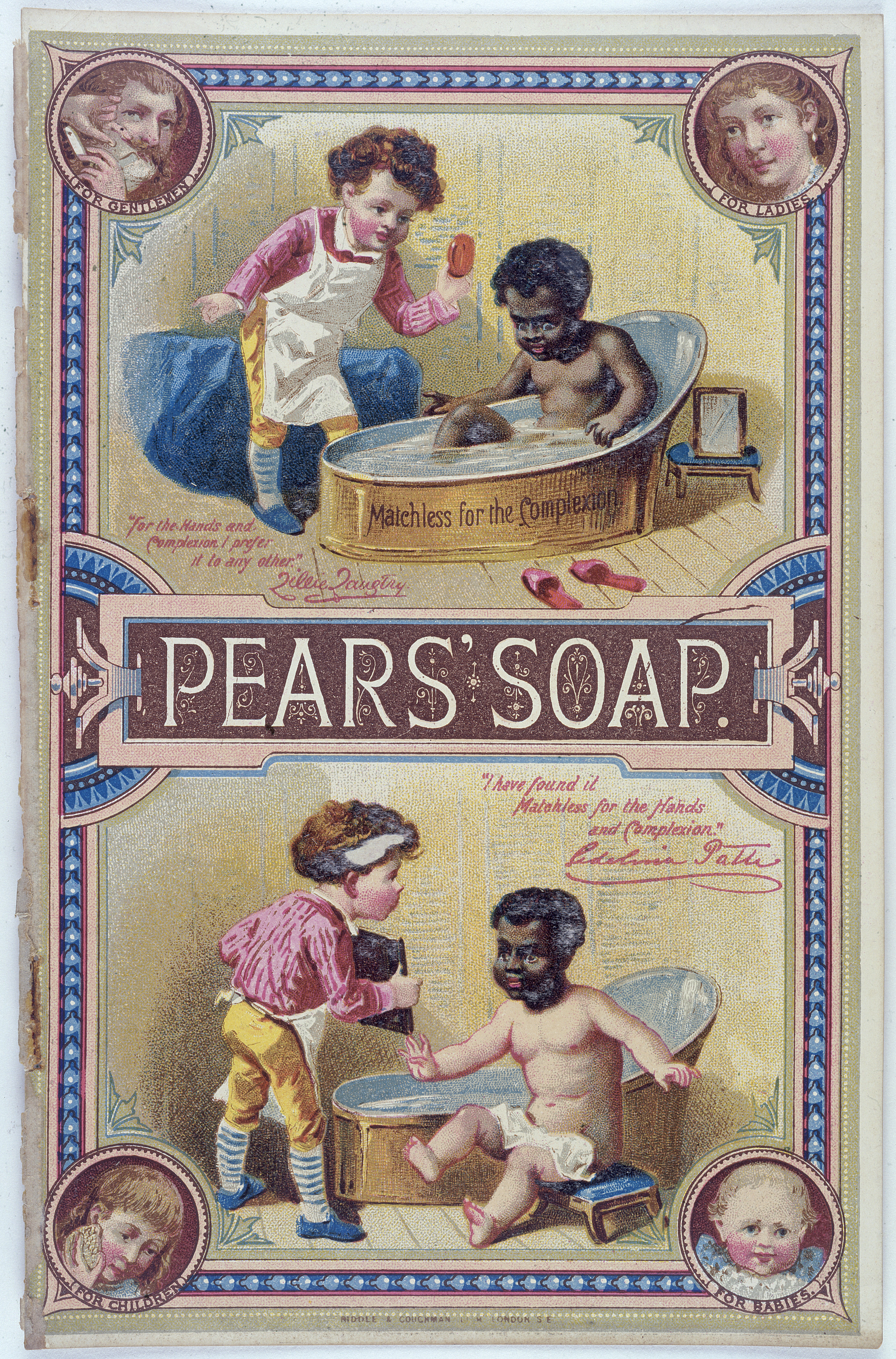
It’s easy to assume that these messages existed in the past, but certainly could not be a current reality. Below is an image from a 1896 soap advertisement and one from 2017. These subtle, unconscious messages are just one example of media content that sends powerful messages reinforcing the concept of white supremacy.
Racial Controversy Continues
In recent years, Dove, a personal care brand owned by Unilever, has continued to attract public attention for its advertising choices. A short social-media commercial released in 2017 drew widespread criticism when it appeared to show a Black woman transforming into a white woman after using Dove body wash. Many viewers interpreted this sequence as conveying an unintended racial hierarchy, prompting Dove to remove the ad and issue a public apology for “missing the mark” in its representation of women of color. The company stated that the intent had been to celebrate diversity and that feedback from the controversy would inform future work.
Exercise
Watch the following video to see the commercial unfold.
More recently, a 2025 Dove haircare commercial featuring a transgender woman garnered significant backlash on social media, including coordinated boycott calls from conservative groups. Critics framed the ad as controversial in its inclusion of a trans model, while supporters hailed it as an extension of Dove’s long-standing emphasis on diverse beauty. Dove’s continued efforts toward inclusive representation reflect lessons from past controversies, including increased sensitivity to audience perceptions and a broader commitment to portraying a wide range of identities in advertising.
Conclusion
Advertisements such as the soap ads discussed in this chapter illustrate how institutional racism can be communicated and sustained through everyday media messages that normalize hierarchy, superiority, and exclusion. Although these advertisements are created for adult consumers, they circulate widely in public spaces and digital media, becoming part of the visual environment in which children are raised. Young children are highly observant and absorb meaning from images long before they can critically analyze them. Repeated exposure to messages that associate cleanliness, beauty, or worth with particular skin tones or identities can shape children’s early beliefs about themselves and others. Over time, these subtle cues contribute to shared social narratives that privilege certain groups while marginalizing others, reinforcing inequities across generations. Understanding how media messaging functions in this way is essential for educators and caregivers, as it underscores the importance of intentionally countering harmful narratives and creating learning environments that promote equity, belonging, and respect for all children.
References
- 1896 Pears Soap advertisement (PeriodPaper). (n.d.). In PeriodPaper. https://www.periodpaper.com/products/1896-ad-pears-soap-bath-cleaning-hygiene-health-skin-original-advertising-080494-lhj4-118
- Clark, K. B., & Clark, M. P. (1947). Racial identification and preference in Negro children. Readings in Social Psychology, 169–178.
- Collabra: Psychology. (2025). Children’s use of race in their social judgments: A multi-site investigation. Collabra: Psychology, 11(1), 132489. https://doi.org/10.1525/collabra.132489
- Dove shirt-change advertisement (press still). (2017). In La Trobe University news: Dove: real beauty and the racist history. Retrieved [date], from https://www.latrobe.edu.au/news/articles/2017/opinion/dove-real-beauty-and-the-racist-history
- White, R. M. B., Roosa, M. W., & Zeiders, K. H. (2021). Measuring 5-year-old Mexican-heritage children’s ethnic preferences and identity. Journal of Child and Family Studies, 30(8), 1912–1926. https://doi.org/10.1007/s10826-021-01982-1
- Williams, A. D., & Steele, J. R. (2025). Mapping research on early ethnic–racial awareness: A systematic review. Infant and Child Development, 34(2), e1235. https://doi.org/10.1002/icd.1235