
Guidance Goals
Ken Breeding
Prevention and Facilitating Guidance Goals
First things first. The old saying that an ounce of prevention is worth a pound of cure is certainly true here. Managing behavior is only necessary when behavior interferes with the needs of the group or the class or the child’s own best interests. The best way to manage these kinds of behaviors is to create environments and experiences that don’t elicit these kinds of behaviors in the first place.
This proactive approach aligns with what is often called positive behavior support, which emphasizes teaching, environment design, and relationship-building rather than reacting to misbehavior (Sugai & Horner, 2002). When teachers intentionally structure environments that meet children’s developmental needs, many behavior problems simply never arise.
Agreements or Rules
We all live within sets of rules or agreements. We might even consider that we can have personal rules that we use just for ourselves to guide and organize our behavior. Most of the time, however, we think of rules as necessary within a community or a group. Think about how unsafe and confusing it would be if there were no rules for driving a car. Rules about which side of the road to drive on, who goes first at intersections, etc., are necessary for our safety and sanity.
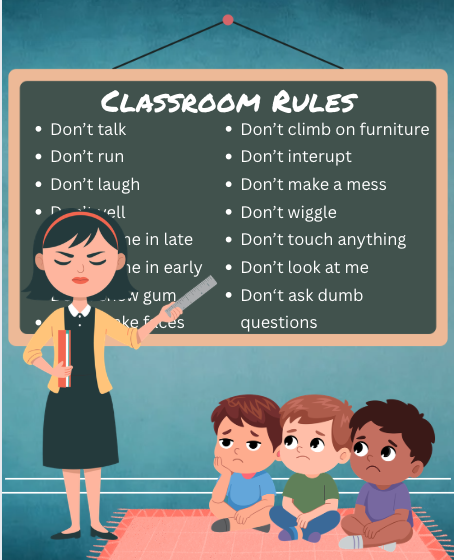 We create these rules to serve our purposes as a group. There are often many similarities between rules for different groups that have to live or work together, but they can also be different for different groups. Children can navigate quite well between differences in rules at home, in school, and with their friends if the rules for each are consistent. In England and other British countries, the rule is to drive on the left side of the road. For those of us who travel there often, we get used to them and manage well as long as we know what those rules are.
The traditional way that rules were established in classrooms is illustrated on the right. What do you think those students are experiencing? Some may be somewhat intimidated, but I can guarantee that some of them are going to be thinking, “I bet I can break all of these by Christmas time.”
Needless to say, the imposition of these kinds of rules doesn’t work at all. Research supports this observation: when rules are externally imposed without student involvement, children are more likely to comply only superficially and are less likely to internalize expectations (Bear, 2010).
Involve Everyone in Creating Classroom Agreements
Everybody in a learning community is a member and has, or should have, a voice in deciding what is going to happen in that group. The use of the word “agreements” suggests this more strongly than using the word “rules.” When children and students are involved in establishing these agreements, it makes life so much better for everybody. One, they are invited to look at themselves as respected members of a community, which is great on its own. But when they’ve actually been in a group that’s created those rules, there’s buy-in. There’s no incentive to skip around this rule because it’s their rule, not somebody else’s.
When I was doing all the national training work, there was one fifth-grade teacher who loved all the stuff that we did: active listening, mutual respect, and conflict resolution. And yet this whole idea of having the students decide what the rules were was just terrifying to him. He imagined all kinds of things, you know, “No homework.” “We get to eat all day”, and on and on. But finally, one year, he was brave enough to actually try it. The next time I came to his school to visit, he was just ecstatic. He said, ” You know, we had this whole discussion, and they created rules. They came up with everything that I give them every year, plus this other one that was something I hadn’t thought of, but that was really great.” It’s very important to involve everybody in making agreements.
This experience is strongly supported by research on democratic classrooms and student voice, which shows that when children participate in creating norms, they develop a greater sense of belonging, responsibility, and commitment to those norms (Nelsen, Lott, & Glenn, 2013). This “buy-in” is not just emotional; it directly impacts behavior. Children are far more likely to follow agreements they helped create because those agreements reflect their own values and understanding.
Additionally, involving children in rule-making supports the development of autonomy, which is a key component of intrinsic motivation (Deci & Ryan, 2000). Rather than behaving appropriately to avoid punishment, children begin to act in ways that align with shared community expectations.
Positive, Clear, and as Few as Possible
Rules should be positive in the sense that they clarify what people should do rather than what they shouldn’t do. Although we tend to think in terms of what not to do, as illustrated above, things should always be stated in terms of the desired behavior. Rather than “Don’t do this, don’t do that.” They should specify what people should do, what we want people to do.
This aligns with research on how young children process language and expectations. Children respond more effectively to clear, positively stated directions because they tell the child exactly what action to take, rather than requiring them to interpret what to avoid (Kostelnik, Soderman, Whiren, & Rupiper, 2015).
To be effective, rules need to be clearly understood by everyone. We often assume that everyone has the same understanding, but that is often not the case. Think about how many laws are created nationally and locally that have to be “interpreted” by a court to define exactly what they mean. With young children, who have a smaller amount of experience to help them refine meanings, this can be even more pronounced. Clear demonstration and practice can help everyone have the same understanding of expectations, such as “walking when we’re in the hallway.” Modeling, role-playing, and revisiting expectations help ensure that rules are not just stated but understood and internalized (Epstein, 2009).
It is best to have everyday guidelines for behavior as simple and few as possible. My experience in creating group agreements in literally hundreds of classrooms and groups is that there is a core of agreements that always come up. They are manifestations of remarkably universal democratic values about how groups should treat each other and get along together.
Too many rules overwhelm children and reduce the likelihood of consistent implementation. Broad, principle-based expectations, like those described by Miller (2016), are more effective because they are flexible and transferable across situations.
Miller, in her book Positive Child Guidance (2016), suggests that these can be summed up by three short-term objectives:
- Behavior must not present a clear risk of harm to oneself or others.
- Behavior must not infringe on the rights of others.
- Behavior must not unreasonably damage the environment, animals, objects, or materials in the environment.
She suggests that these can be operationalized by three positive, concise agreements:
- Be healthy/safe
- Be respectful
- Be responsible
Miller’s framework is particularly powerful because it reflects widely recognized developmental goals in early childhood education: Safety (physical and emotional), Respect (for self and others), and Responsibility (for actions and environment). These align closely with widely used frameworks such as social-emotional learning competencies (CASEL, 2020).
Routines and Consistency
Establishing routines is important and useful for many reasons. When things happen regularly, they don’t have to be managed. They become a habit, and habits don’t need enforcing. We brush our teeth. It’s a habit. Until that routine is established, though, it’s not a habit. And so establishing those habits makes everything run smoother
Routines also give children predictability and a sense of safety. Routines reduce the cognitive load on children because they no longer have to figure out what to do in each situation; they simply follow a known pattern. This frees up mental energy for learning and social interaction (Bodrova & Leong, 2007).
Routines also give children predictability and a sense of safety. Research in child development consistently shows that predictable environments support emotional security and reduce anxiety, which in turn decreases challenging behaviors (Copple & Bredekamp, 2009).
Routines and limits are only effective if they really are solid. And that means being consistent with following through with whatever the routine or the limit is. Of course, there’s always the need to be flexible in different circumstances, not rigid, but being consistent with things like, “This happens every morning at this time,” is so helpful in very many ways for children and for us.
Effective teachers maintain consistent expectations while remaining responsive to individual needs and circumstances. This balance is a hallmark of developmentally appropriate practice (NAEYC, 2020). When routines are consistently practiced, they become internalized habits. Over time, children begin to regulate their own behavior without adult prompting—this is the ultimate goal of guidance.
Encouragement, Not Praise
There is a huge difference between encouragement and praise, although that difference can be confusing. Praise, as we learned in the last chapter, is a leftover remnant of the old paradigm of vertical power as a means of control.
Just as chocolate can taste wonderful and can be welcomed by us, praise can give us a similar sugar rush. Having too much of either can make us ill. But the important difference, which can be very subtle, is how it is given and received, and the effects that it can have on the people involved. Although for those of us who love chocolate, we might readily accept some if offered by another, very few of us would “sit up”, “roll over” or “bark” on command of another, even if offered a small chocolate to do so.
The realities and research about this were covered in Chapter 14. Using praise can be a hard habit to break, however. What we’re going to discuss here is how to consciously use encouragement instead of praise.
Life takes courage. It can be crucial for us to receive the encouragement we need from others to deal with life. We all need it. Alfred Adler, one of the early pioneers of understanding human motivation and behavior, believed that encouragement is the most powerful tool we can offer another person. He suggested that all misbehavior can be understood as a form of discouragement, and that helping individuals feel capable, connected, and valued is essential for healthy development (Adler, 1930/1998; Dreikurs, 1964).
Encouragement, in this sense, is not about judging a child’s performance as “good” or “bad.” Instead, it is about recognizing effort, progress, contribution, and the child’s own developing sense of competence. It communicates, “You are capable. You are growing. You belong.”
Dweck and the Power of Mindset
Carol Dweck’s extensive research on mindset helps us understand why this distinction is so important. Dweck (2006) found that when children are praised for traits like intelligence (“You’re so smart”), they are more likely to develop a fixed mindset, the belief that their abilities are static and must be proven. Children with a fixed mindset often avoid challenges, give up more easily, fear making mistakes, and seek approval rather than growth.
In contrast, when children receive feedback that emphasizes effort, strategies, and persistence, they are more likely to develop a growth mindset, the belief that abilities can improve with effort and learning. These children are more likely to embrace challenges, persist through difficulty, learn from mistakes, and develop resilience.
Encouragement naturally supports a growth mindset because it focuses on the process rather than the person. For example, instead of: “You’re a great artist,” encouragement would say, “You tried different colors and kept working until it looked the way you wanted.” This subtle shift helps children see themselves not as “good” or “bad,” “smart” or “not smart,” but as learners who can grow.
Examples
Following are some specific suggestions with examples
- Catch Yourself Saying “Good Job.” When you notice yourself about to say “Good job,” pause and rephrase. The goal is not perfection—it’s awareness.
-
- Instead of: “Good job!”
- Try: “You worked really hard on that.”
- Describe What You See. Focus on observable actions, not judgments. This helps children see their own effort and decisions.
-
- “You used three different colors in your drawing.”
- “You put all the blocks back on the shelf.”
- Name Effort and Persistence. Look for moments when children keep going, even briefly. This builds resilience and supports a growth mindset.
-
- “You kept trying even when that was tricky.”
- “You didn’t give up when it fell down.”
- Highlight Strategies. Help children recognize how they succeeded. This teaches children that success comes from strategies, not just ability.
-
- “You slowed down and figured it out step by step.”
- “You asked for help when you needed it.”
- Connect Behavior to Impact. Show children how their actions affect others. This builds empathy and a sense of belonging.
-
- “When you shared your markers, your friend could finish their picture.”
- “You helped clean up. That made it easier for everyone.”
- Ask Instead of Tell. Turn feedback into reflection. This shifts ownership from teacher to child.
-
- “How did you figure that out?”
- “What part was the hardest?”
- “What are you proud of?”
- Encourage the Process, Not the Product. Especially important for art and open-ended work. This keeps the focus on learning, not approval.
-
- Instead of: “That’s beautiful!”
- Try: “You spent a lot of time adding details.”
- Support Mistakes as Learning. When something goes wrong, respond with encouragement.
-
- “That didn’t work the way you expected. What could you try next?”
- “Mistakes help us learn. What did you notice?”
- Use Encouragement During Challenging Behavior. Encouragement isn’t just for success. This reinforces growth even in difficult moments.
-
- “You’re having a hard time, but you’re starting to calm your body.”
- “You stopped yourself—that took control.”
- Use a Positive I-Message. Instead of judging, share positive feelings their behavior or effort elicited in you. This allows them to appreciate the effect of their behavior on you.
-
- Instead of “Great job cleaning up the toys before we went out.”
- Try: “It felt so good coming into a tidy classroom. Now we can start our art activity right away!”
You don’t need to eliminate praise overnight. The goal is to gradually shift the balance toward encouragement. Small changes in language can lead to big changes in how children:
- See themselves
- Approach challenges
- Develop confidence
Class Meetings
Class meetings, as a regular routine either daily or weekly, can accomplish several important things. It can be a place to do direct instruction and provide practice for social and emotional skill building. It can also be a way of governance. After class agreements have been cooperatively generated, if there is a need to revisit them when they have been broken or are showing signs of not being implemented at the level they could be, class meetings provide a natural and respectful structure for doing so. Specific problems or issues that come up can be solved with full community involvement.
At their best, class meetings are one of the most powerful structures we can create for building mutual respect in a classroom. Rather than the teacher being the sole authority and problem-solver, the group becomes a community that shares responsibility. This shift from “teacher control” to “shared responsibility” is central to many democratic and relationship-based approaches to classroom management (Nelsen, Lott, & Glenn, 2013).
Research consistently supports the effectiveness of structured group meetings in developing children’s social and emotional competence. When children are given regular opportunities to express their ideas, listen to others, and collaboratively solve problems, they develop stronger communication skills, empathy, and self-regulation (Elias et al., 1997; Durlak et al., 2011). These are not just “nice extras”; they are foundational life skills.
What Class Meetings Can Do
Class meetings serve multiple overlapping purposes:
- Skill Building: Teaching and practicing skills such as listening, turn-taking, expressing feelings, and problem-solving
- Community Building: Strengthening relationships and a sense of belonging
- Shared Governance: Revisiting agreements and making group decisions
- Problem Solving: Addressing real classroom issues in constructive ways
When these functions are consistently present, class meetings become a cornerstone of guidance rather than just an occasional activity.
Across Age Levels
In Early Childhood classrooms, having circle time or group time is already structured into each day. Integrating the concepts about class meetings discussed here may simply involve including a conscious “problem-solving” component when needed.
For older age classrooms, this may mean adding a specific time and structure for a weekly gathering. When there aren’t governance or problems to address, this time can be used for direct social-emotional literacy instruction, as well as a time to reflect or look ahead at the week, make plans, celebrate achievements together, and general community building.
Key Takeaways
Things to keep in mind for problem-solving at different age levels:
Early Childhood (Preschool–Kindergarten)
- Short (5–10 minutes)
- Highly structured and teacher-supported
- Use of visuals, puppets, or stories
- Focus on simple skills: taking turns, naming feelings, listening
At this level, the teacher plays a strong guiding role, modeling language and helping children participate successfully.
Early Elementary (Grades 1–3)
- Slightly longer (10–15 minutes)
- More child participation
- Introduction of simple problem-solving steps
- Children begin suggesting solutions
Here, children begin to take more ownership, though teacher facilitation is still important.
Upper Elementary (Grades 4–5 and beyond)
- Longer and more student-led
- Students can facilitate parts of the meeting
- Deeper discussions of fairness, responsibility, and community
At this stage, class meetings can become a true form of shared governance.
Key Elements of Effective Class Meetings
Across all ages, effective class meetings tend to include:
- A predictable structure (opening, discussion, closing)
- Clear expectations for participation
- A focus on solutions rather than blame
- Teacher modeling of respectful communication
Other Components of the Environment
There are other components of the overall classroom environment, other than class meetings, that play a critical role in shaping children’s behavior. In many cases, “behavior problems” are actually reflections of unmet needs, unclear expectations, or environmental mismatches.
A well-designed environment supports children in being successful. Research in early childhood education consistently shows that thoughtful environmental design reduces challenging behavior and increases engagement and cooperation (Fox et al., 2003; Copple & Bredekamp, 2009).
Below are several key components that support guidance in everyday practice.
Peace Places (Calm-Down Areas)
A “Peace Place” or an area for children to calm down or regroup is a designated space where children can go to regulate their emotions. Research on self-regulation emphasizes that children benefit from having both co-regulation with adults and opportunities for independent regulation (Shonkoff & Phillips, 2000).
This is not a punishment space, but a supportive environment for self-regulation. When introduced and taught effectively, Peace Places:
- Help children learn to recognize their emotions
- Provide tools for calming (breathing, sensory items, visuals)
- Promote independence in managing strong feelings
This area can contain a space where two children can meet to work out problems between them. This can be an efficient way to handle issues, as well as allowing children to practice the social-emotional competencies they have been learning in class.
Preparation for Transitions
Many challenging behaviors occur during transitions, when children are asked to stop one activity and begin another. These moments can be difficult because they involve shifts in attention, expectations, and sometimes emotional attachment to what the child was doing. Simple strategies can make a significant difference:
- Giving advance warnings (“In five minutes, we will clean up”)
- Using songs or signals
- Providing clear, consistent routines
Predictable transitions reduce stress and confusion, helping children move smoothly from one activity to the next (Kostelnik et al., 2015).
Visual Supports
Young children are highly responsive to visual information. After generating group agreements, continuously displaying a chart that clearly shows what was agreed upon not only reinforces these agreements each day, but it’s also a useful thing to refer to when an individual or the group is not living up to their agreement. The agreements can be shown with words, and/or pictures, or symbols for children at younger ages.
Visual supports of all kinds can make expectations clear and accessible, especially for children who are still developing language skills. Examples include:
- Picture schedules
- Visual cues for routines (handwashing steps, cleanup charts)
- Emotion charts
These reduce the need for constant verbal reminders and help children become more independent. They also support diverse learners, including children with language delays or additional needs (Hemmeter, Ostrosky, & Fox, 2006).
The Bigger Picture
All of these elements, class meetings, Peace Places, routines, transitions, and visual supports, work together to create an environment that supports positive behavior. When the environment is thoughtfully designed:
- Expectations are clear
- Children feel safe and supported
- Opportunities for success are built in
In this kind of classroom, guidance becomes less about reacting to problems and more about creating the conditions where problems are less likely to occur in the first place. Additional suggested activities for social emotional development can be found in the Appendix.
References
- Adler, A. (1998). The education of children (2nd ed.). Gateway Press. (Original work published 1930)
- Bear, G. G. (2010). School discipline and self-discipline: A practical guide to promoting prosocial student behavior. Guilford Press.
- Bodrova, E., & Leong, D. J. (2007). Tools of the mind: The Vygotskian approach to early childhood education (2nd ed.). Pearson.
- Collaborative for Academic, Social, and Emotional Learning (CASEL). (2020). Core SEL competencies. https://casel.org
- Copple, C., & Bredekamp, S. (2009). Developmentally appropriate practice in early childhood programs (3rd ed.). NAEYC.
- Deci, E. L., & Ryan, R. M. (2000). The “what” and “why” of goal pursuits: Human needs and the self-determination of behavior. Psychological Inquiry, 11(4), 227–268.
- Deci, E. L., Koestner, R., & Ryan, R. M. (1999). A meta-analytic review of experiments examining the effects of extrinsic rewards on intrinsic motivation. Psychological Bulletin, 125(6), 627–668.
- Dreikurs, R. (1964). Children: The challenge. Hawthorn Books.
- Durlak, J. A., Weissberg, R. P., Dymnicki, A. B., Taylor, R. D., & Schellinger, K. B. (2011). The impact of enhancing students’ social and emotional learning: A meta‐analysis. Child Development, 82(1), 405–432.
- Dweck, C. S. (2006). Mindset: The new psychology of success. Random House.
- Elias, M. J., Zins, J. E., Weissberg, R. P., et al. (1997). Promoting social and emotional learning: Guidelines for educators. ASCD.
- Epstein, A. S. (2009). The intentional teacher: Choosing the best strategies for young children’s learning. NAEYC.
- Fox, L., Dunlap, G., Hemmeter, M. L., Joseph, G. E., & Strain, P. S. (2003). The teaching pyramid: A model for supporting social competence and preventing challenging behavior. Young Children, 58(4), 48–52.
- Hemmeter, M. L., Ostrosky, M., & Fox, L. (2006). Social and emotional foundations for early learning: A conceptual model for intervention. Vanderbilt University.
- Kostelnik, M. J., Soderman, A. K., Whiren, A. P., & Rupiper, M. L. (2015). Guiding children’s social development and learning (8th ed.). Cengage.
- Miller, D. F. (2016). Positive child guidance (8th ed.). Cengage Learning.
- NAEYC. (2020). Developmentally appropriate practice (DAP) position statement. National Association for the Education of Young Children.
- Nelsen, J., Lott, L., & Glenn, H. S. (2013). Positive discipline in the classroom (3rd ed.). Three Rivers Press.
- Shonkoff, J. P., & Phillips, D. A. (2000). From neurons to neighborhoods: The science of early childhood development. National Academy Press.
- Sugai, G., & Horner, R. (2002). The evolution of discipline practices: School-wide positive behavior supports. Child & Family Behavior Therapy, 24(1-2), 23–50.
Media Attributions
- Class Rules © Tanessa Sanchez is licensed under a CC0 (Creative Commons Zero) license