
Communication Defined
Ken Breeding
What is Communication?
Everything in the universe is intricately connected, and those connections are formed through communication.
Communication is a constant process that happens everywhere. A stoplight turning red is communication. A dog barking is communication. Communication is even involved in places we couldn’t have imagined in the distant past.
We know trees have fascinating ways of communicating with each other, primarily through underground networks (that have been referred to as the “Wood Wide Web”) and airborne chemical signals. These communication systems help trees warn each other about environmental threats and share resources. Trees form symbiotic relationships with fungi in the soil. Fungal networks connect tree roots, allowing trees to share water, nutrients, and even warning signals. Older, larger “mother trees” (coined by scientist Suzanne Simard) distribute nutrients to younger or weaker trees. If a tree is under attack (e.g., insect infestation), it sends distress signals through the underground network as well as airborne chemical signals to warn nearby trees to prepare their defenses. (Simard, 2021)
Guiding children is all about communication. Our relationship with children is the most powerful and important tool for everything we do in education and childcare. It is even more important in guidance, management of behavior, and raising children.
The Process of Communication
Although communication is a complex and integrated process, for our purposes, it can be defined as simply,
The process of sending and receiving messages through verbal, nonverbal, or written means involving any of the senses through a variety of mediums.
Most of the time, communication is a back-and-forth process between people. It’s much like playing a game of catch. Someone “Sends” a message, and the other person “catches it”. We will be focusing on how to be a good “catcher”, how to understand what children are communicating to us through their words and behaviors. We will also focus on becoming better “senders” and how to convey information in the strongest, clearest, most effective way possible.
In a physical game, being a good thrower may be as important or even more important than being able to catch a ball. In interpersonal communication, however, the most important skill is being able to listen and understand. We are not going to get children to listen to anything we have to convey if they do not feel heard and seen by us.
The Complexity of Communication
We all see and experience the world differently. Think about all of the many different physical things that go into not only actually sending and receiving a message but also all of the processing and interpreting that occur.
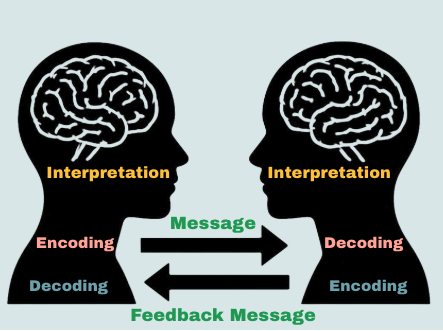 As I am writing this section, I have to form ideas about what is important to write. I then have to encode my interpretations of the process into language that attempts to convey my ideas. This means sending my thoughts to a part of my brain that deals with language to put those concepts into words. My brain then sends electrical, chemical signals to the area of my brain responsible for motor movement. My fingers then hit different keys for each of the letters of the words I have chosen. A picture of this result is then saved on my computer, where it will eventually be uploaded to be part of this book. From there, it has to be downloaded on a device of yours, opened, and then the words on this page have to be read by you. What your eyes see on the screen gets sent to a section of your brain that processes visual stimuli. From there, what has been visually processed is associated with words. If English is not your primary language, those words then often have to be connected with words from your native language that you have learned should mean the same thing as the concept symbolized by these words. Then, you have to combine the meaning of the words in these sentences into ideas or concepts.
As you can see, this is an amazingly complex process. George Berhard Shaw, the famous British author, once said, “The only problem with communication is the illusion that it has occurred.” Very often, what we think has been communicated very clearly has not been at all.
There is no way to directly experience the chemical and electrical activity inside the brain of the person sending the message. Aside from the sheer amount of all the physical things that can get in the way of a successful message being sent, we each see the world through our own personal filters. The messages from another are always filtered through our personal lenses and understandings.
References
- Hall, J. A. (2006). Women’s and men’s nonverbal communication: Similarities, differences, and stereotypes. Review of Communication Research, 6(1), 1-30.
- Rogers, C. R., & Farson, R. E. (1957). Active listening. University of Chicago, Industrial Relations Center.
- Simard, S. W. (2021). Finding the mother tree: Discovering the wisdom of the forest. Alfred A. Knopf.
Media Attributions
- Communication © Tanessa Sanchez is licensed under a CC0 (Creative Commons Zero) license