
Create Equity
Ken Breeding
There are two major ways we can counter these dynamics and support equity for all children and families in our care. One is to help children grow out of this obsession to feel “better than” others and help them desire to be constructive members of a group that considers and values everyone. The second is to consciously disrupt the mechanisms of systemic racism.
Create Equity and Equality Rather Than Hierarchies
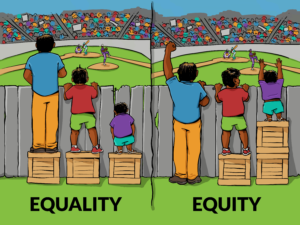 Hierarchies usually provide tangible benefits for those at the top. Much of the personal wealth and power of countries and individuals has relied on the subjugation and oppression of other groups. Hierarchies also provide emotional and psychological benefits in systems where people are identified as either superior or inferior. This is a major reason that we cannot get past maintaining systems of racism. After the Civil War and the emancipation of Blacks, Jim Crow reimplemented the system. When the Civil Rights Movement seemed to eliminate those inequities, it came back again through the “War on Drugs” and mass incarceration, and is supported by much of the political dynamics today. We need to grow beyond the need for these false, external sources of self-esteem. We desperately need to feel “just as good as anyone else” and “no better than anyone else”.
From a scientific perspective, our interconnectedness and equal worth can be seen in both the physical and social sciences. Albert Einstein (1931/1954) reflected that the human sense of being a separate individual is an “optical delusion of consciousness,” emphasizing that we are in fact equal parts of a greater whole. Modern neuroscience supports this vision through the emerging field of interpersonal neurobiology, which demonstrates that human brains are wired for connection and that relationships literally shape neural pathways (Siegel, 2012). The finding that emotional states, stress responses, and even resilience are co-created within relationships underscores that no person thrives in isolation. Together, these insights affirm that each individual is both distinct and inseparable from the larger web of humanity, making it unscientific as well as unhelpful to assign greater value to some over others.
Across the world’s major religious traditions, a common theme emerges: all individuals possess inherent worth, and one’s value cannot be reduced to the shifting judgments of others. Christianity teaches that all are created in the image of God and made equal in Christ (Galatians 3:28, New International Version, 2011). Judaism emphasizes that humanity’s shared origin prevents anyone from claiming superiority (Mishnah Sanhedrin 4:5, Eider, 1988). Similarly, the Qur’an affirms that distinctions among people are not markers of worth, as the only measure of nobility is righteousness (Qur’an 49:13, Abdel Haleem, 2004). In Hindu thought, the Bhagavad Gita teaches that the wise see all beings with equal vision, regardless of social status (Prabhavananda & Isherwood, 1944). Buddhism underscores that purity and growth come from one’s own efforts, not others’ opinions (Buddharakkhita, 1985). Sikhism rejects caste and social hierarchies, affirming that all people are equal before God (Singh, 1960). Even Confucianism, though rooted in social order, reminds us that true worth lies in inner virtue rather than external recognition (Analects 15:18; Lau, 1979).
Together, these teachings provide powerful justification for practices in education that emphasize equity and cooperation over ranking and comparison. They remind us that fostering respect for each child’s inherent dignity is both a spiritual and a practical foundation for justice.
Personal Reflection
Too often, our sense of self and contentment is dependent on an assessment of our worth that we let others control, external judgments that we are valuable because we’re “better” in some way than someone else. If we are low on the totem pole, we want someone else to be lower.
How free are you of the effects of this kind of external judgment? I don’t think as humans that we ever get to the perfect goal of total acceptance of ourselves with no emotional reaction to the judgment of others. But the closer we get to it, the better we feel about ourselves and others. The closer we get to it, the better we are at teaching and guiding children. This allows us to truly “act” rather than “react”.
Exercise
Read the “Better Than” poem and answer the questions that follow.
Better Than
I built my joy on higher ground,
On the steps of people I pushed below—
Each rung a proof that I was more,
Each shadow cast to make me glow.
But every rise upon that wall
Made thinner air for me to breathe;
And those I pressed to make me tall
Became the roots beneath my feet.
One day I looked, and saw their eyes—
Not lower, smaller, less, or few,
But mirrors showing all my ties,
The truth that I was part of you.
Now I unstack my borrowed pride,
And feel the ground beneath us one;
No higher hills, no deep divides—
Just equal hearts beneath one sun.
When in your life have you found your sense of worth or confidence tied to feeling “better than” someone else — more capable, more right, more deserving, or more valued?
- How did that feeling shape the way you acted toward others?
- What fears or insecurities might have been underneath it?
Think of a time when you noticed yourself reacting defensively or judgmentally.
- What might it look like to act instead to respond from empathy or shared humanity instead of comparison?
- How could this shift change your relationships, your teaching, or the way you guide children?
References
- American Civil Liberties Union. (n.d.). End the war on drugs. https://www.aclu.org/end-the-war-on-drugs
- Blakemore, E. (2020, February 5). Jim Crow laws created ‘slavery by another name’. National Geographic. https://www.nationalgeographic.com/history/article/jim-crow-laws-created-slavery-another-name/
- Buddharakkhita, A. (Trans.). (1985). The Dhammapada. Buddhist Publication Society.
- Einstein, A. (1954). Ideas and opinions (C. Seelig, Ed.; S. Bargmann, Trans.). Crown Publishers. (Original work published 1931)
- Mishnah Sanhedrin 4:5. (1988). In S. Eider (Trans.), The Mishnah. Feldheim.
- Prabhavananda, S., & Isherwood, C. (Trans.). (1944). The Bhagavad Gita: The song of God. Vedanta Press.
- Siegel, D. J. (2012). The developing mind: How relationships and the brain interact to shape who we are (2nd ed.). Guilford Press.
- Singh, G. (Trans.). (1960). Sri Guru Granth Sahib. Shiromani Gurdwara Parbandhak Committee.
- The Holy Bible, New International Version. (2011). Zondervan. (Original work published 1978)
- The Qur’an. (2004). (M. A. S. Abdel Haleem, Trans.). Oxford University Press.
Media Attributions
- Equality_vs_Equity_illustration_-_Interaction_Institute_for_Social_Change_-_Angus_Maguire © Angus Maguire adapted by Wikimedia Commons is licensed under a CC BY (Attribution) license