
The Neoclassical
Chapter Overview and Introduction
The late 18th century Neoclassical style corresponds to major historical movements, such as the Enlightenment, and political revolutions in both France and the United States. Dramatic changes were happening in the world. Along with the massive political and societal changes shaped by the Enlightenment, the Industrial Revolution began to change people’s everyday lives. During this Age of Enlightenment, the Neoclassical style became dominant in England, France, and the United States.
Focus Artworks
- Joseph Wright of Derby, A Philosopher Giving a Lecture at the Orrery (in which a lamp is put in place of the sun), c. 1766, oil on canvas
- Angelica Kauffmann, Cornelia, Mother of the Gracchi, Pointing to her Children as Her Treasures, c. 1785, oil on canvas
- Jacques-Louis David, Oath of the Horatii, 1784, oil on canvas
- Jacques-Louis David, The Death of Marat, 1793, oil on canvas
- Gilbert Stuart, Lansdowne Portrait of George Washington, 1796, oil on canvas
- Thomas Jefferson, Monticello, Charlottesville, Virginia, 1770–1806
Term List
- French Revolution
- Enlightenment
- Orrery
- Industrial Revolution
- Scientific Revolution
- Neoclassical
- Exemplum virtutis
- Pompeii and Herculaneum
- Poussinist
- Classical
- Ancien régime
- American Revolution
- Declaration of Independence
- Constitution
- Grand Manner Portraiture
The Early Modern era: the 18th century
The events of the 18th century—the beginnings of the Industrial Revolution, expanding global trading networks, the acceleration of the transatlantic slave trade, the first European colonies demanding independence (the 13 British colonies in North America in 1776, and then Haiti in 1804) posed threats to established traditions and institutions. Tellingly, the century opens with the invention of the first practical steam engine (1712) and closes with the French Revolution (the Revolution began as an effort to limit the absolute authority of the monarchy). The French Revolution ended badly—with thousands of members of the aristocracy, along with the king and queen, meeting their death at the guillotine.
This century is often referred to as the period of the Enlightenment. Influenced by the scientific revolutions of the previous century (Galileo Galilei, for example, held that mathematics is the key to understanding the reality behind the appearance of natural phenomena), there was a sense that shedding the light of science and reason could overcome the corruption of the aristocracies and monarchies of Europe and its colonies. Although there were earlier examples, Denis Diderot’s Encyclopedia (France, 1751–72) was a signal expression of the Enlightenment and was quickly followed by the Encyclopædia Britannica (Britain, 1768)—efforts that sought to make all human knowledge accessible. In accordance with the Enlightenment predisposition toward classification and cataloguing, this period also saw expanded efforts by Europeans to document the botany, topography, people, and traditions of Latin America’s interior. The knowledge acquired during these expeditions came mainly from first-hand experience, in keeping with the Enlightenment ideal of empiricism, which valued the concrete and measurable.
The Age of Enlightenment, an introduction
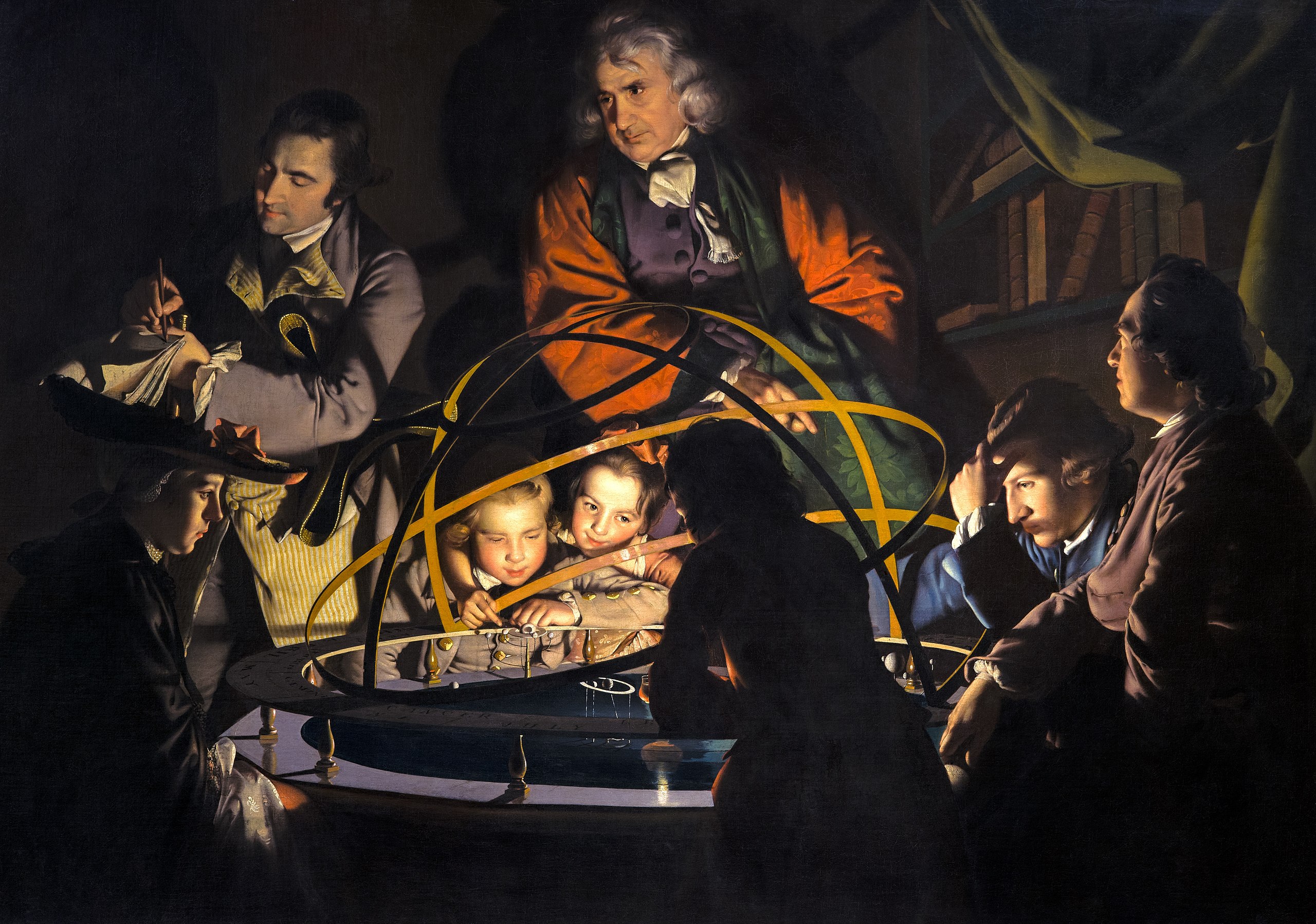
In A Philosopher Giving a Lecture at the Orrery by Joseph Wright of Derby we see an orrery— a mechanical model of the solar system. In the center is a gas light which represents the sun (though the child who stands in the foreground with his back to us block this from our view); the arcs represent the orbits of the planets. Wright concentrates on the faces of the figures to create a compelling narrative.
With paintings like these, Wright invented a new subject: scenes of experiments and new machinery. This was the beginning of the Industrial Revolution (think cities, railroads, steam power, gas and then electric light, factories, and machines). Wright’s fascination with light, strange shadows, and darkness, reveals the influence of Baroque art.
Enlightenment
Toward the middle of the eighteenth century a shift in thinking occurred. This shift is known as the Enlightenment. You have probably already heard of some important Enlightenment figures, like Rousseau, Diderot and Voltaire. It is helpful I think to think about the word “enlighten” here—the idea of shedding light on something, illuminating it, making it clear.
The thinkers of the Enlightenment, influenced by the scientific revolutions of the previous century, believed in shedding the light of science and reason on the world in order to question traditional ideas and ways of doing things. The scientific revolution (based on empirical observation, and not on metaphysics or spirituality) gave the impression that the universe behaved according to universal and unchanging laws (think of Newton here). This provided a model for looking rationally on human institutions as well as nature.
Reason and equality
Rousseau, for example, began to question the idea of the divine right of Kings. In The Social Contract, he wrote that the King does not, in fact, receive his power from God, but rather from the general will of the people. This, of course, implies that “the people” can also take away that power.
The Enlightenment thinkers also discussed other ideas that are the founding principles of any democracy—the idea of the importance of the individual who can reason for himself, the idea of equality under the law, and the idea of natural rights. The Enlightenment was a period of profound optimism, a sense that with science and reason—and the consequent shedding of old superstitions—human beings and human society would improve.
You can probably tell already that the Enlightenment was anti-clerical; it was, for the most part, opposed to traditional Catholicism. Instead, the Enlightenment thinkers developed a way of understanding the universe called Deism—the idea, more or less, is that there is a God, but that this God is not the figure of the Old and New Testaments, actively involved in human affairs. He is more like a watchmaker who, once he makes the watch and winds it, has nothing more to do with it.
The Enlightenment, the monarchy, and the French Revolution
The Enlightenment encouraged criticism of the corruption of the monarchy (at this point King Louis XVI), and the aristocracy. Enlightenment thinkers condemned Rococo art for being immoral and indecent, and called for a new kind of art that would be moral instead of immoral, and teach people right and wrong.
Denis Diderot, Enlightenment philosopher, writer and art critic, wrote that the aim of art was “to make virtue attractive, vice odious, ridicule forceful; that is the aim of every honest man who takes up the pen, the brush or the chisel.” [1]
These new ways of thinking, combined with a financial crisis (the country was bankrupt) and poor harvests left many ordinary French people both angry and hungry. In 1789, the French Revolution began. In its initial stage, the revolutionaries asked only for a constitution that would limit the power of the king.
Ultimately the idea of a constitution failed, and the revolution entered a more radical stage. In 1792, King Louis XVI and his wife, Marie Antoinette, were deposed and ultimately beheaded along with thousands of other aristocrats believed to be loyal to the monarchy.
Joseph Wright of Derby, A Philosopher Giving a Lecture at the Orrery
Two young boys, gazing over the edge of the contraption in playful wonder. A teenaged girl, her arms resting on the machine, in quiet contemplation. A young man shielding his eyes from the brilliance of the light emanating from the center, and a young woman staring unblinkingly. A standing man taking copious notes on the proceedings. Another man leaning back in his seat, listening intently to the gray-haired lecturer, captivating his audience like a magician.
A key idea of the Age of Enlightenment—that empirical observation grounded in science and reason could best advance society—is expressed by the faces of the individuals in Joseph Wright of Derby’s A Philosopher Lecturing on the Orrery.
The Age of Enlightenment
Wright’s painting encapsulates in one moment the Enlightenment, a philosophical shift in the eighteenth century away from traditional religious models of the universe and toward an empirical, scientific approach. It is important to note the term given this new way of thinking. “Enlightenment” indicates an active process, undertaken by an individual by group.
The age of Enlightenment is most closely associated with scientists and inventors, but writers and artists also played major roles. They helped spread enlightenment concepts via the written word and printed image, and inspired others to think rationally about the world in which they lived. The provincial English painter Joseph Wright of Derby became the unofficial artist of the Enlightenment, depicting scientists and philosophers in ways previously reserved for Biblical heroes and Greek gods.
Joseph Wright of Derby
Joseph Wright of Derby was born in the town of Derby in central England, and save for short stints in Liverpool and London, lived in that city his entire life. He was known even during his lifetime as Joseph Wright of Derby, to distinguish him from another artist of the same name. Even though Wright of Derby was the more talented of the two, he was stuck with the geographical identifier on his name.
Other than Thomas Gainsborough, who spent much of his career in the high-society resort town of Bath, Wright was the most prominent English painter of the eighteenth century to spend the majority of his career outside of London. Operating without the constraints of the mainstream London art world, Wright was free to explore a general interest in science with his friends, a group that included Erasmus Darwin (grandfather of Charles) and other members of the Lunar Society of Birmingham, an informal learned society which met to discuss scientific topics of the day.
Wright was known for his deft depiction of the contrasts between light and dark, also known as chiaroscuro, and his unflinching portrayal of the true personalities of his subjects. This trait caused his downfall when he attempted to work as a portraitist—few wanted a portrait, warts and all.
The intensity of scientific discovery
In the 1760s Wright began to explore the traditional boundaries of various genres of painting. According to the French academies of art, the highest genre of painting was history painting, which depicted Biblical or classical subjects to demonstrate a moral lesson. This high regard for history panting was adopted by the British—Benjamin West’s The Death of General Wolfe is a prominent example.
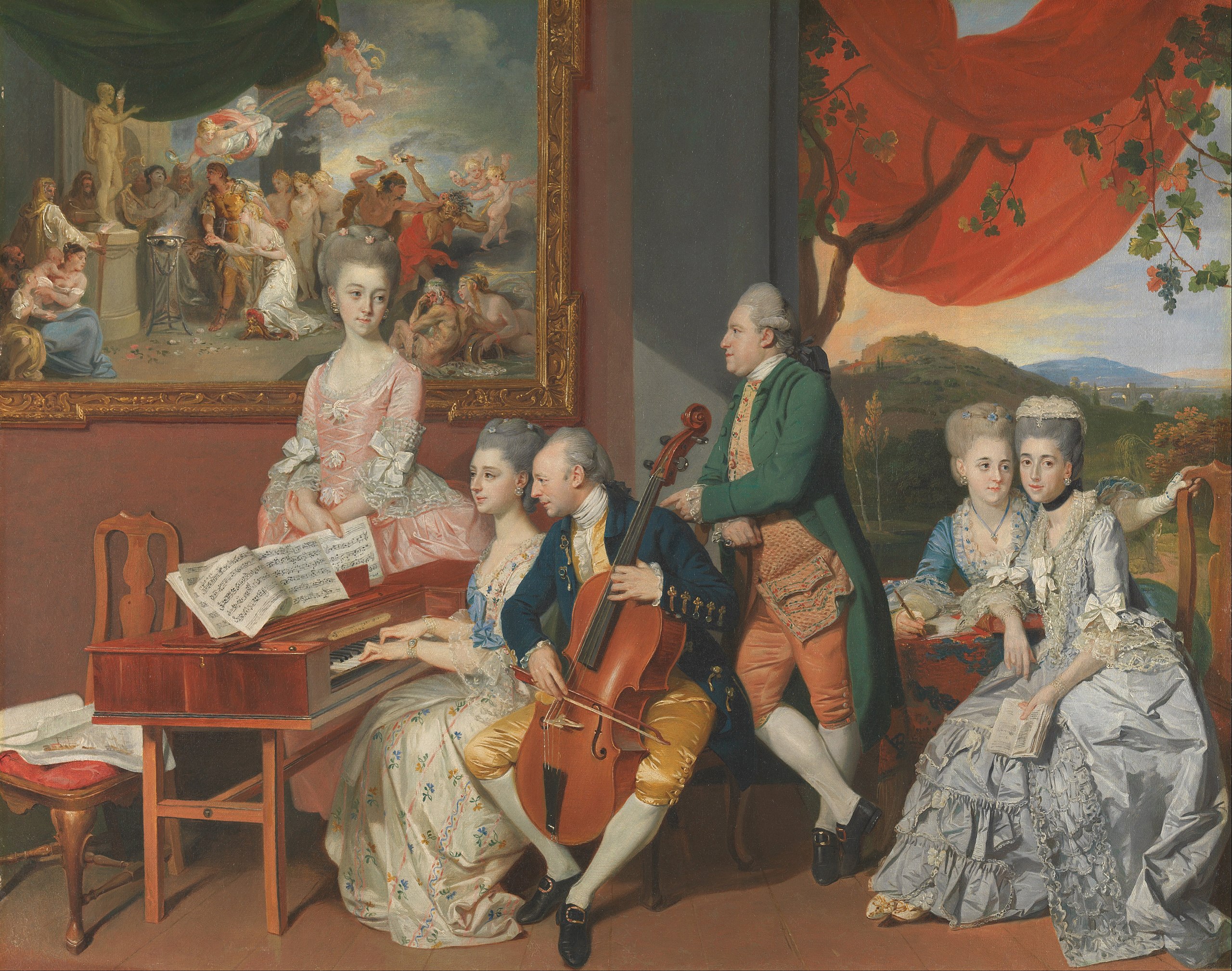
Wright took this noble, aggrandizing method of portraying events and applied it to a composition showing a contemporary subject in A Philosopher Lecturing at the Orrery. Rather than a moral of leadership or heroism, this painting’s “moral” is the pursuit of scientific knowledge. With its collection of non-idealized men, women, boys, and girls informally arranged in a small physical space around a central organizing point, Wright’s painting mimics the compositional structure of a conversation piece (an informal group portrait) like Zoffany’s Gore Family (above), but with the dramatic lighting and scale expected from a major religious scene.
In effect, A Philosopher Lecturing at the Orrery does depict a moment of religious epiphany. Much like the central figure in Caravaggio’s Calling of Saint Matthew (below), the figures listening to the philosopher’s lecture in Wright’s painting are experiencing conversion…to science.
Heroizing the search for knowledge
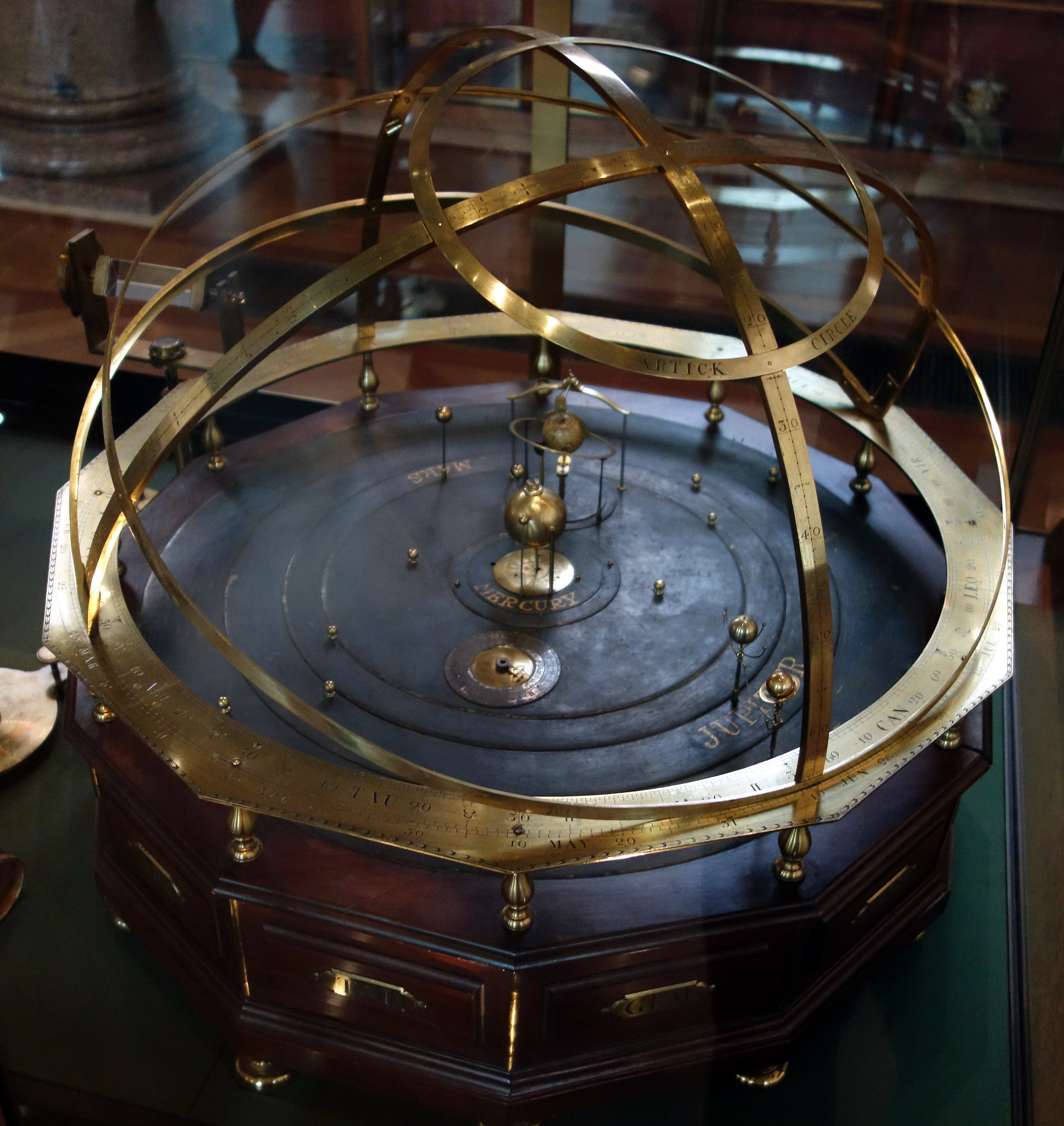
An orrery is a mechanical model of the solar system, a miniature, clockwork planetarium. Each planet, with its moons, is a sphere attached to a swing arm which allows it to rotate around the sun when cranked by hand. When in motion, the orrery depicts the orbits of each planet, as well as their relative relationship to each other. The orrery depicted by Wright has large metal rings which can simulate eclipses, and give the model a striking and exciting three-dimensionality.
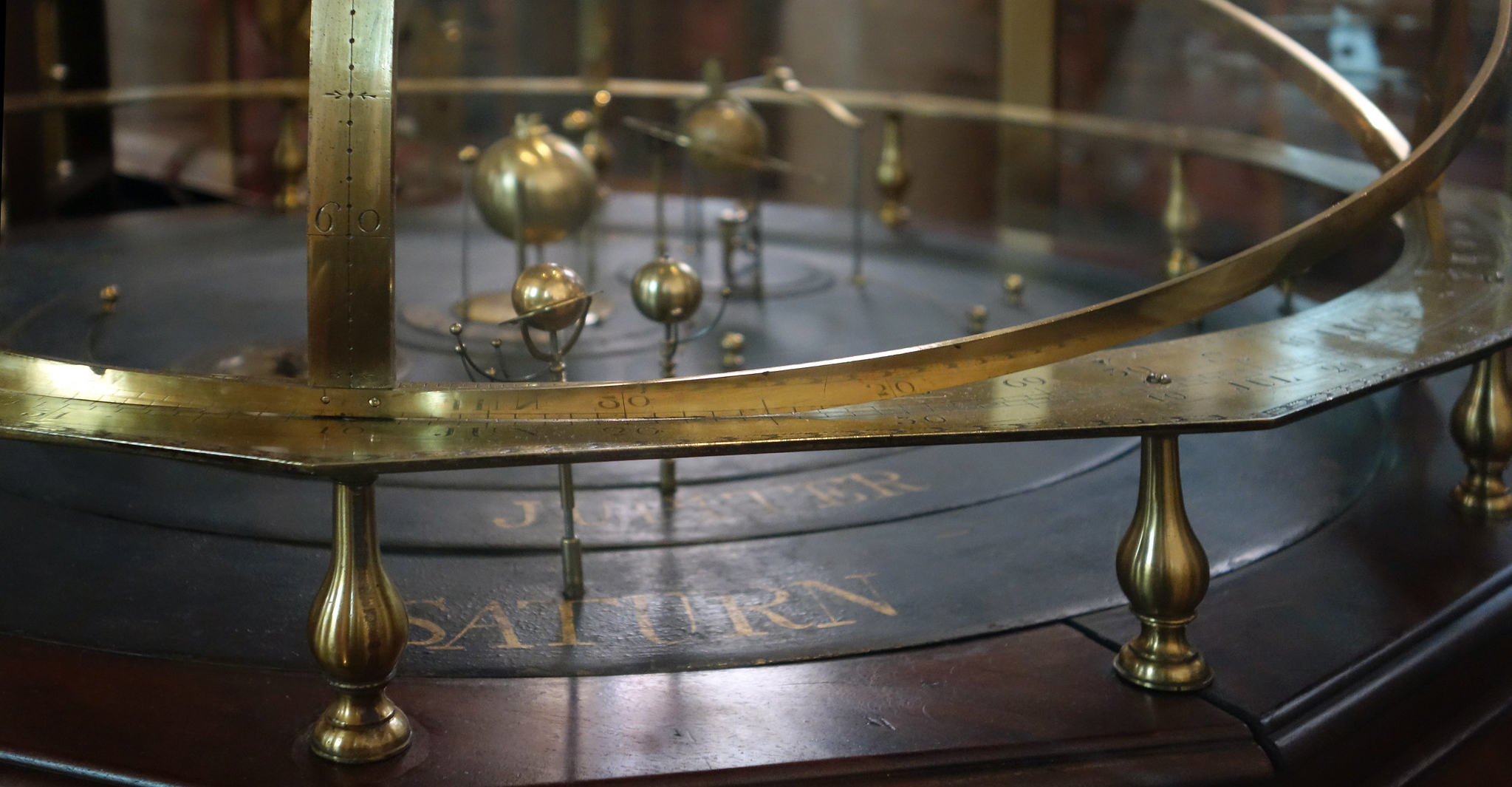
Although each of the figures in the painting is clearly modeled on a specific person, Wright’s work was not meant to be a conversation piece in the eighteenth-century sense of the word, and so we can only guess at the identities of each person. Most likely the man standing and taking notes is Wright’s friend Peter Perez Burdett, and the man seated at the far right may be Washington Shirley, 5th Earl Ferrers, the initial owner of the work.
Several identities have been proposed for the philosopher delivering the lecture. The most tempting theory is that his face is modeled on that of Sir Isaac Newton, the great English scientist whose work helped herald in the Enlightenment. Another possibility is that it is a member of the Lunar Society of Birmingham.
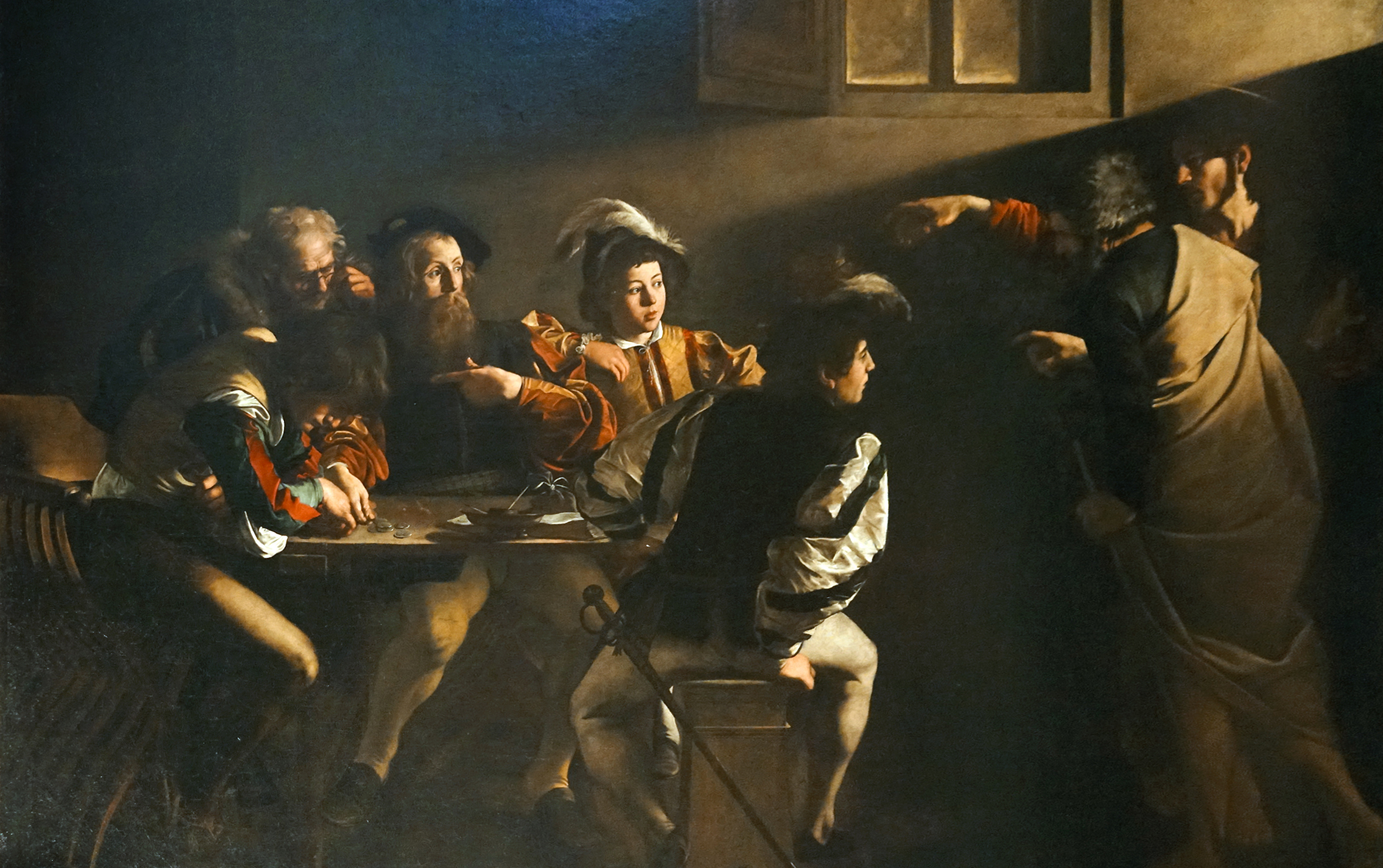
The events depicted, although exciting, do not give A Philosopher Lecturing at the Orrery its high dramatic impact. That responsibility falls on the paintings strong internal light source, the lamp that takes the role of the sun. Wright mimics Baroque artists like Caravaggio, who inserted strong light sources in otherwise dark compositions to create dramatic effect. Most of these earlier works were Christian subjects, and the light sources were often simple candles. Wright flips the script with his scientific subject matter. The gas lamp which acts as the sun pulls double duty in the painting. It illuminates the scene, allowing the viewer to clearly see the figures within, and it symbolizes the active enlightenment in which those figures are participating.
Practicing Visual Analysis
Briefly looking at Joseph Wright of Derby’s A Philosopher Lecturing at the Orrery, it is easy to understand how one might confuse the work as a 17th century Baroque-era painting. The tenebroso lighting with contrasting bright highlights and dark shadows creates a dramatic composition. However, Wright introduces a new subject matter to the 18th century: science. Using crisp brushwork, Wright created a balanced yet asymmetrical composition. Contour lines clearly indicate the variety of forms: figurative forms of the people, rectilinear forms of the books, and curvilinear forms in the solar system model. Wright used a subtle hierarchy of scale within the painting. Although he is set toward the background, the philosopher dressed in the vibrant red cloak is larger in size compared to those around him. To create a sense of depth in the pictorial space, Wright utilized overlapping figures. The child in the foreground has their back toward the viewer, which suggests we are standing on the outside of this circular arrangement. The solar system model sits in the middle of the composition while the philosopher, children, and note-taker are in the background. The atmospheric perspective of soft shadows cast against the back wall and the softer contour lines of the books suggest those forms are further back in space and thus, less defined.
Angelica Kauffmann, Cornelia Pointing to her Children as Her Treasures
Taught by her father, Swiss-born Angelica Kauffmann’s portraits and history paintings established her as an important Neoclassical artist in England. Kauffman painted Roman stories with moralizing messages. Here, Cornelia provides a model of virtue.
A moment of moralizing
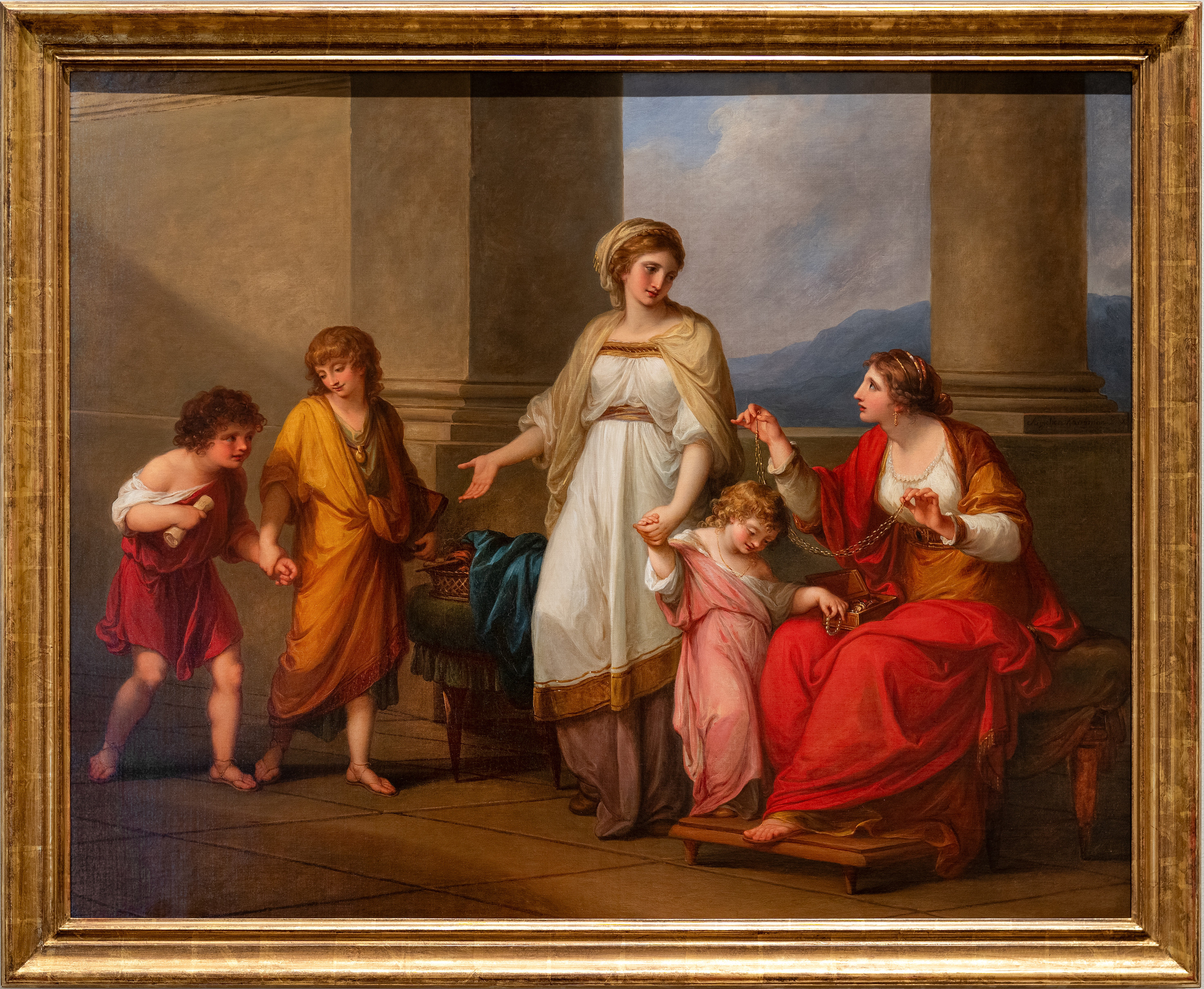
To the artists of eighteenth-century Europe, it was not enough to simply paint a beautiful painting. Yes one could marvel at your use of colors, proportions, and how masterfully you draped the fabric on your figures, but this was just not enough. The story that is represented must also improve the viewer and impart a moralizing message. This was a common theme even before the emergence of the Neoclassical trend (for example, Chardin’s canvases of simple French country life or Hogarth’s painted commentaries on the wealthy classes of England). When interest in the ancient cultures of the Mediterranean—more specifically Rome—arose in the mid eighteenth century the moralizing theme segued to also include stories from classical antiquity.
The Swiss-born painter Angelica Kauffmann is just one artist to contribute to this genre. Painted in 1785, Cornelia, Mother of the Gracchi, Pointing to Her Children as Her Treasures, is her subject. Roman architectural influences frame two women portrayed wearing what one can imagine is typical of ancient Roman dress, along with three children, also wearing masterfully draped togas with thin leather sandals. They look like they might have stepped directly off a temple’s pediment.
An example of virtue
If you compare Kauffmann’s simple presentation to the previous Rococo genre, with the lush landscapes, frothy pastel pink frocks, and chubby frolicking cherubs, it is clear that art is going in a different direction. This painting is an exemplum virtutis, or a model of virtue. The story that Kauffmann painted is that of Cornelia, an ancient Roman woman who was the mother of the future political leaders Tiberius and Gaius Gracchus. The brothers Gracchi were politicians in second-century B.C.E. Rome. They sought social reform and were seen as friends to the average Roman citizen. So where did these benefactors of the people learn their exemplary ethics? That would be their mother, Cornelia.
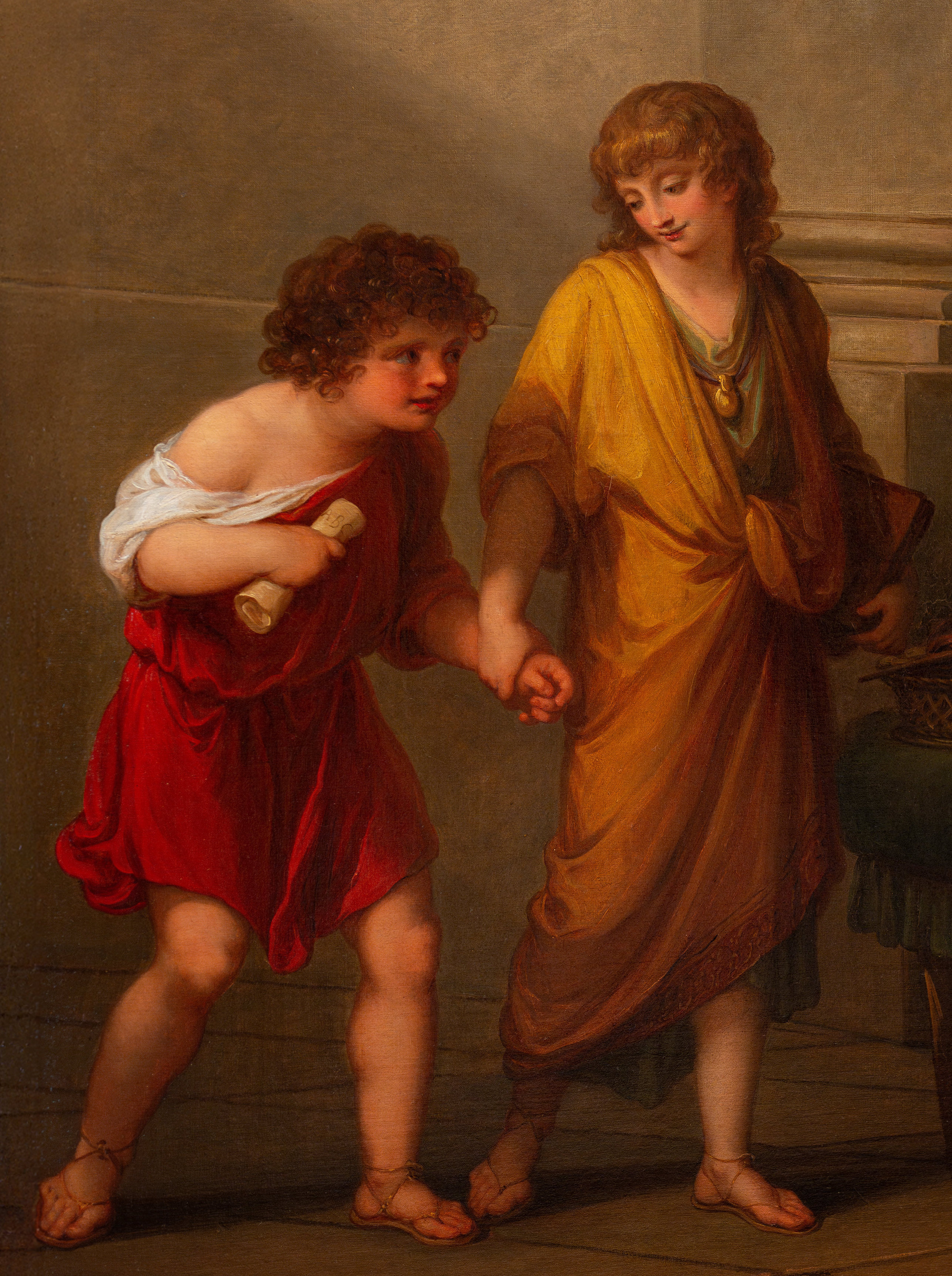
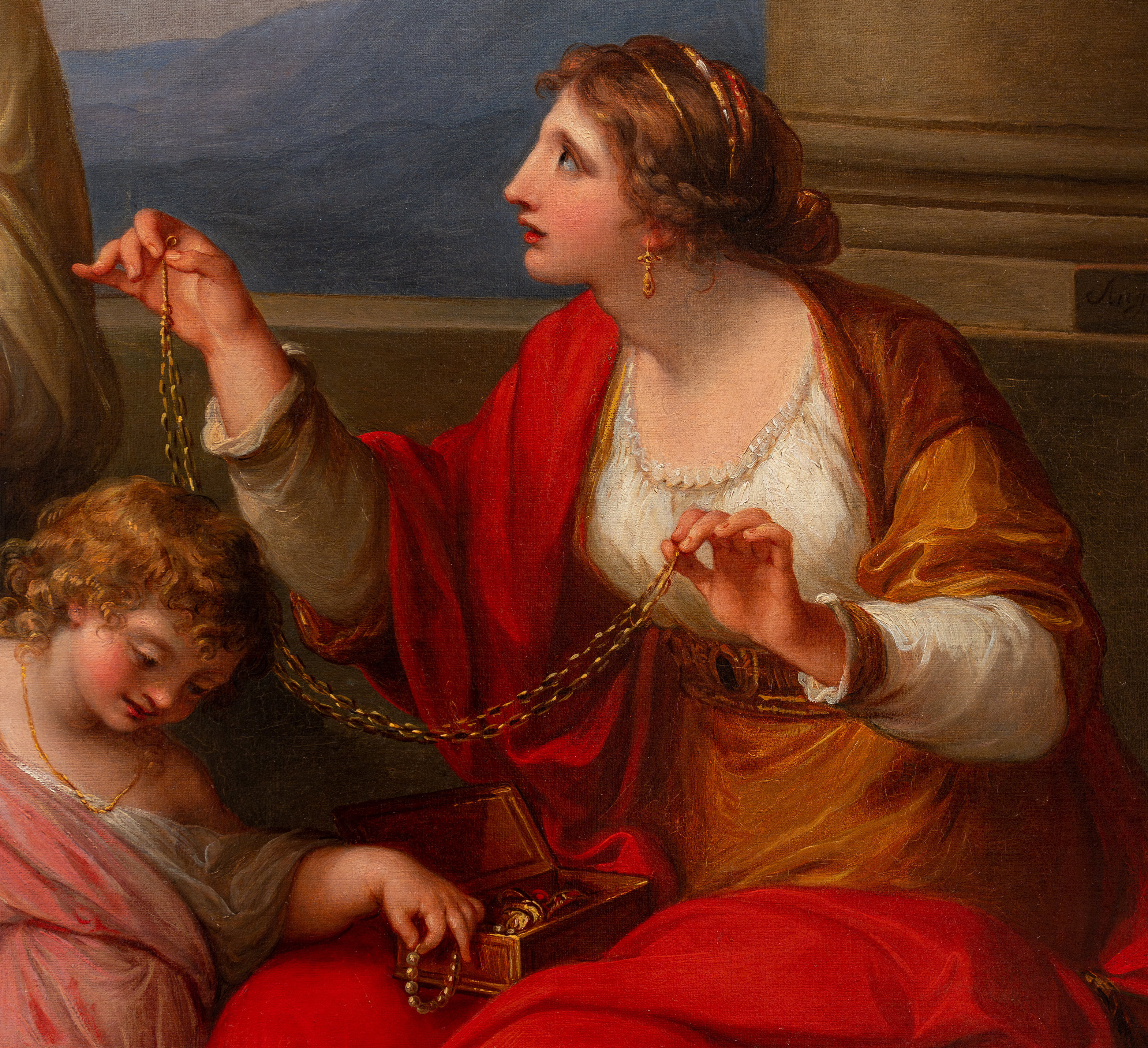
The scene that we see in Kauffmann’s painting illustrates one such example of Cornelia’s teachings. A visitor has come to her home to show off a wonderful array of jewelry and precious gems, what one might call treasures. To her visitor’s chagrin, when she asks Cornelia to reveal her treasures she humbly brings her children forward, instead of running to get her own jewelry box. The message is clear; the most precious treasures of any woman are not material possessions, but the children who are our future. You can almost feel the embarrassment when you look at the face of the visitor, who Kauffmann has smartly painted with a furrowed brow and slightly gaped mouth.
The lure of ancient Rome
Born in 1740, Angelica Kauffmann received a first-rate artistic education from her father, who was a Swiss muralist. She traveled through her native Switzerland, Austria, and eventually Italy where she was able to see the work of the ancient artists with her own eyes. She was following in the tradition of the Grand Tour, the educational excursion that many wealthy Europeans took to marvel and study the art, architecture, and history of ancient Rome.
The interest in ancient Mediterranean cultures was fueled not just by the cultural productions of Rome, but also by the newly discovered remains of the ancient Roman cities of Herculaneum and Pompeii, which were excavated beginning in 1738 and 1748, respectively. Covered by the volcanic ash of Mount Vesuvius in August 79 C.E., an almost perfect scene of typical ancient life was preserved. These findings did not just spark a renewed interest in classical antiquity in eighteenth-century art and architecture, but also inspired new fashions, interior design, and even gardens and tableware. This was a find that one must see in person, and Angelica Kauffman was lucky enough to take the Grand Tour like so many of her fellow artists.
Enlightenment ideals
While the geometric symmetry and simplicity of the arts in antiquity might have greatly inspired the work of Kauffman and other Neoclassical artists, these ancient societies also aligned with Enlightenment ideals, which were often seen as the zenith of human civilization. Greece and Rome—it was felt—were the cultures that gave us the enlightened political systems of democracy and republicanism, as opposed to the modern monarchies, which would be increasingly criticized as corrupt and arbitrary in the mid and late eighteenth century. The ancients could instruct modern audiences in patriotism, civic virtue, and ethics, and Kauffmann’s moralizing message is a wonderful example of this trend.
This revival of classical antiquity was a cultural phenomenon that affected not just artistic practices, but also shaped the modern mind. Angelica Kauffman would eventually settle in England where she enjoyed great success as a portrait artist and history painter. In an age that can be described as patriarchal at its best and chauvinistic at its worst, Kauffmann played a major role in the British art scene. She was a regular exhibitor at the prestigious Royal Academy and had many aristocratic and even royal patrons. Cornelia Pointing to Her Children as Her Treasures is truly one of Kauffmann’s most famous treasures, and permanently positioned her as a pioneer of the Neoclassical movement.
Neoclassicism, an introduction
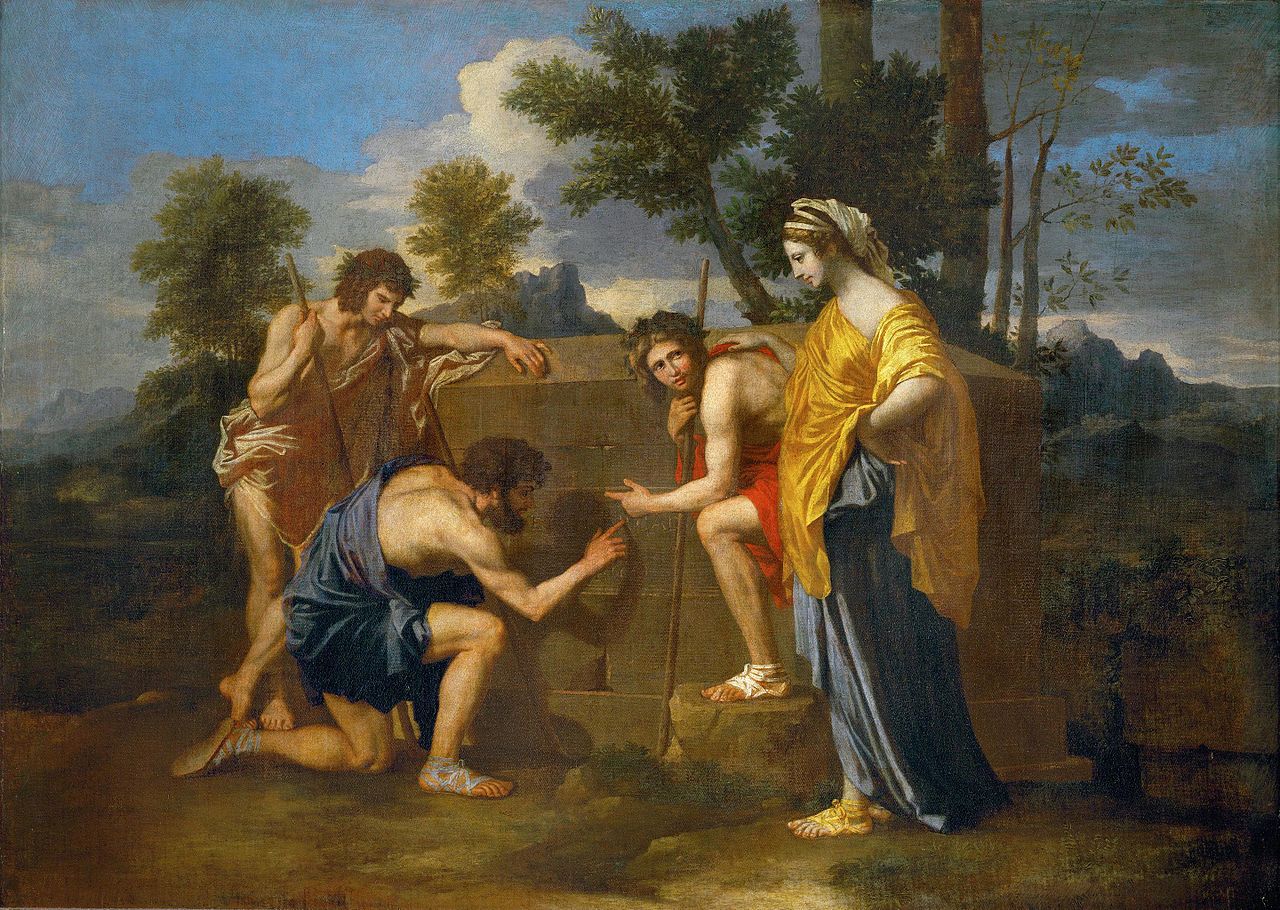
In opposition to the frivolous sensuality of Rococo painters like Jean-Honoré Fragonard and François Boucher, the Neoclassicists looked back to the French painter Nicolas Poussin for their inspiration (Poussin’s work exemplifies the interest in classicism in French art of the seventeenth century). The decision to promote “Poussiniste” painting became an ethical consideration—they believed that strong drawing was rational, therefore morally better. They believed that art should be cerebral, not sensual.
The Neoclassicists, such as Jacques-Louis David (pronounced Da-VEED), preferred the well-delineated form—clear drawing and modeling (shading). Drawing was considered more important than painting. The Neoclassical surface had to look perfectly smooth—no evidence of brush strokes should be discernible to the naked eye.
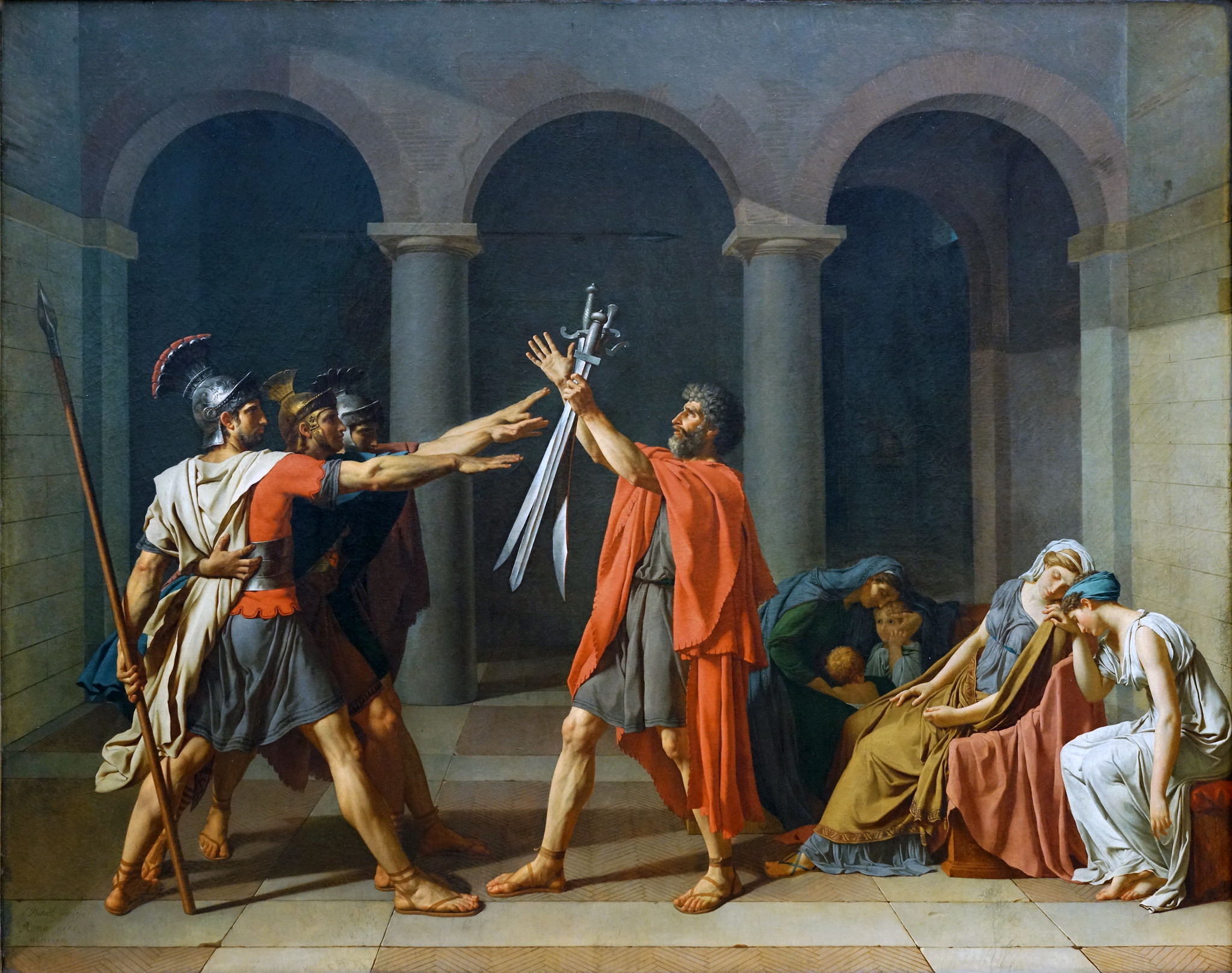
France was on the brink of its first revolution in 1789, and the Neoclassicists wanted to express a rationality and seriousness that was fitting for their times. Artists like David supported the rebels through art that asked for clear-headed thinking, self-sacrifice to the State (as in Oath of the Horatii ) and an austerity reminiscent of Republican Rome.
Neoclassicism was a child of the Age of Reason (the Enlightenment), when philosophers believed that we would be able to control our destinies by learning from and following the laws of nature (the United States was founded on Enlightenment philosophy). Scientific inquiry attracted more attention. Therefore, Neoclassicism continued the connection to the classical tradition because it signified moderation and rational thinking but in a new and more politically-charged spirit (“neo” means “new,” or in the case of art, an existing style reiterated with a new twist.)
Neoclassicism is characterized by clarity of form, sober colors, shallow space, strong horizontal and verticals that render that subject matter timeless (instead of temporal as in the dynamic Baroque works), and classical subject matter (or classicizing contemporary subject matter).
Jacques-Louis David, Oath of the Horatii
In 1785 visitors to the Paris Salon (the official art exhibition organized by the Academy of Fine Arts) were transfixed by one painting, Jacques-Louis David’s Oath of the Horatii. It depicts three men, brothers, saluting toward three swords held up by their father as the women behind him grieve—no one had ever seen a painting like it. Similar subjects had always been seen in the Salons before but the physicality and intense emotion of the painting was new and undeniable. The revolutionary painting changed French art but was David also calling for another kind of revolution—a real one?
An example of Neoclassicism
In beginning art history courses, the painting is typically presented as a prime example of Neoclassical history painting. It tells a story derived from the Classical world that provides an example of virtuous behavior (exemplum vertutis). The dramatic, rhetorical gestures of the male figures easily convey the idea of oath-taking and the clear, even light makes every aspect of the story legible. Instead of creating an illusionistic extension of space into a deep background, David radically cuts off the space with the arches and pushes the action to the foreground in the manner of Roman relief sculpture.
Enlightenment and Revolution
Ideas of the Enlightenment quickly gave rise to a questioning of the political status quo. The American Revolution (1763–83), the French Revolution (1789–99), and the Haitian Revolution (1791–1804) sought to vest political power in the populace rather than the monarchy and in the case of Haiti, to end slavery. The nobility had ruled for so long that when historical models were sought, political thinkers, artists, and writers had to go all the way back to ancient Republican Rome and ancient Athens (Greece) for examples.
This interest in ancient Greece and Rome became known as Neoclassicism (new classicism) which heroicized the classical world for its moral courage and stoic resoluteness—values that accorded with the revolutionary moment. Classical architecture enjoyed yet another revival, and the canvases of the French painter Jacques Louis David have come to exemplify this pivotal moment. However, within only a few years, the ideals of the Enlightenment were used to justify political violence known as the Reign of Terror (where thousands of aristocrats were assassinated) resulting in a power vacuum soon filled by a young, ambitious general named Napoleon.
Jacques-Louis David, The Death of Marat
David and the Jacobins
By 1793, the violence of the Revolution dramatically increased until the beheadings at the Place de la Concorde in Paris became a constant, leading a certain Dr. Joseph Guillotine to invent a machine that would improve the efficiency of the ax and block and therefore make executions more humane. David was in thick of it. Early in the Revolution he had joined the Jacobins, a political club that would in time become the most rabid of the various rebel factions. Led by the ill-fated Georges Danton and the infamous Maximilien Robespierre, the Jacobins (including David) would eventually vote to execute Louis XVI and his Queen Marie Antoinette who were caught attempting to escape across the border to the Austrian Empire.
Marat and Christ
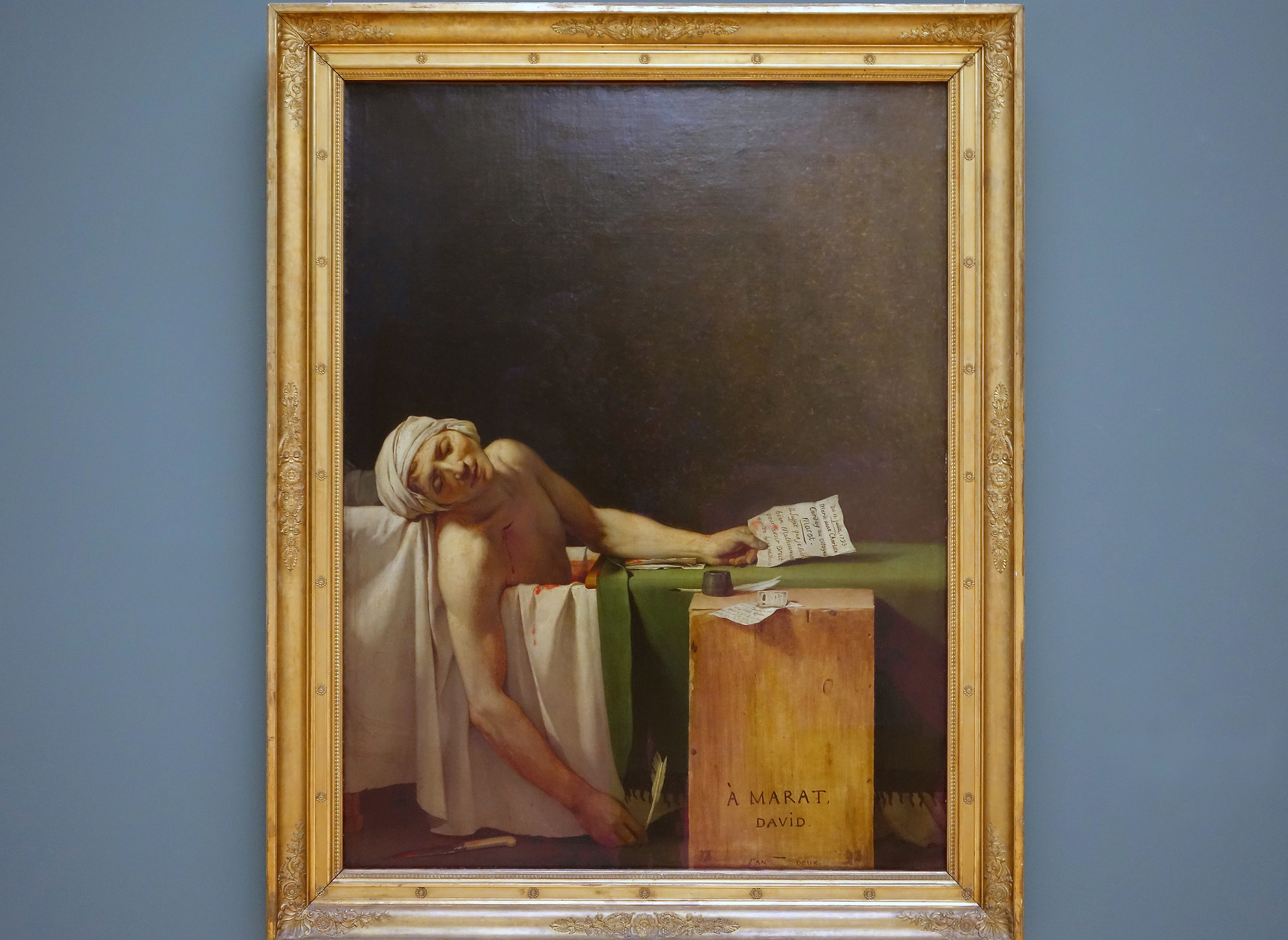
At the height of the Reign of Terror in 1793, David painted a memorial to his great friend, the murdered publisher, Jean Marat. As in his Death of Socrates, David substitutes the iconography (symbolic forms) of Christian art for more contemporary issues. In Death of Marat, 1793, an idealized image of David’s slain friend, Marat, is shown holding his murderess’s (Charlotte Corday) letter of introduction.
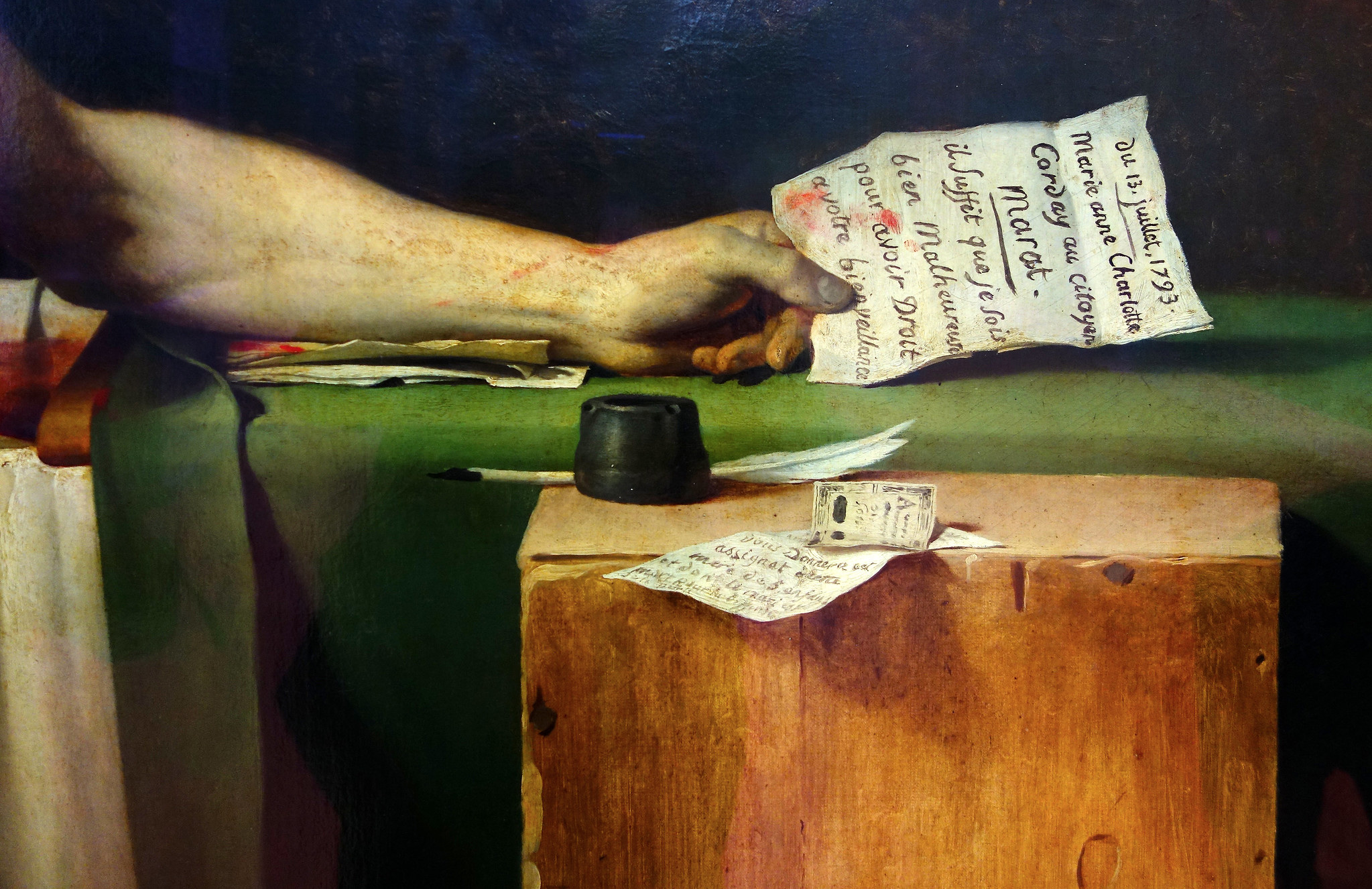
The bloodied knife lays on the floor having opened a fatal gash that functions, as does the painting’s very composition, as a reference to the entombment of Christ and a sort of secularized stigmata (reference to the wounds Christ is said to have received in his hands, feet and side while on the cross). Is David attempting now to find revolutionary martyrs to replace the saints of Catholicism (which had been outlawed)?
David and Napoleon
By 1794 the Reign of Terror had run its course. The Jacobins had begun to execute not only captured aristocrats but fellow revolutionaries as well. Eventually, Robespierre himself would die and the remaining Jacobins were likewise executed or imprisoned. David escaped death by renouncing his activities and was locked in a cell in the former palace, the Louvre, until his eventual release by France’s brilliant new ruler, Napoleon Bonaparte. This diminutive Corsican had been the youngest general in the French army and during the Revolution had become a national hero by waging a seemingly endless string of victorious military campaigns against the Austrians in Belgium and Italy. Eventually, Napoleon would control most of Europe, crown himself emperor, and would release David in recognition that the artist’s talent could serve the ruler’s purposes.
1754–1800 in North America, an introduction
Great Britain wins and loses
In 1759 when the North American component of the French and Indian War (also known as the Seven Years’ War) concluded, Britain’s control of the continent was all but assured and the balance of power in North America officially rested with Great Britain. As a result, France relinquished its territorial holdings in Canada and all its possessions east of the Mississippi River to their great rival.
The year 1760 not only saw the de facto conclusion of the French and Indian War, it also saw the ascension of George III to the British throne. The Seven Years’ War—a conflict Britain waged in Europe, Asia, and North America—had emptied Britain’s coffers to such an extent that the country had borrowed—from private investors and banks—more than £150 million pounds to finance the war. To put this into current terms, this sum amounts to tens of trillions—yes, trillions!—of dollars today.
If you are King George III and you need to raise money — tax the colonies
As a result, Britain had two herculean obstacles at the end of the Seven Years’ War. In addition to being practically bankrupt, the rolls of the British army and had swelled to a size far greater than was necessary in peacetime. That payroll, combined with the already existing debt, required an immediate influx of money.
There are only so many ways in which governments can raise money. The most common way to do so is in the levying of taxes, and in the decade following the conclusion of this conflict, Britain specifically taxed their colonial subjects to such an extent that it was one of the primary causes for the rally for independence from the mother country.
The Sugar Act of 1764 was a continuation of the recently expired Molasses Act of 1733, and although the tax per gallon of molasses—crucial to the creation of rum—was decreased by half, the enforcement of the tax collection was greatly increased. The Stamp Act of 1765 taxed almost any product with paper, including legal documents and contracts, newspapers, and even playing cards. The failure of the Stamp Act brought about the Townshend Acts (1767–78) in which the crown attempted to tax everything from paper and tea to paint and lead.
Intolerable Acts
The spark that may have ignited the powder keg for independence, however, was the 1773 Tea Act. Finally, “no taxation without representation!” — made famous by James Otis in 1765—became a rallying cry for those who wanted to formally break with Great Britain. The Tea Act was passed on 10 May.
The Boston Tea Party—more a political act of resistance and defiance than anything else—took place late in the evening of 16 December 1773, a little more than seven months later.
Soon after, the British Parliament passed the first of the so-called Intolerable Acts, which were intended to punish the colonists and assert British control. The Boston Port Act, for example, provided the British navy the authority to prohibit all ships from either entering or leaving Boston harbor. Another, the Quartering Act of 1774, gave the royally appointed governor the authority to house British soldiers in private citizens homes.
The colonialists viewed these Intolerable Acts as nothing short of punitive acts of war. The Battles of Concord and Lexington, fought between the colonies and Britain, commenced the American Revolutionary War less than a year later.
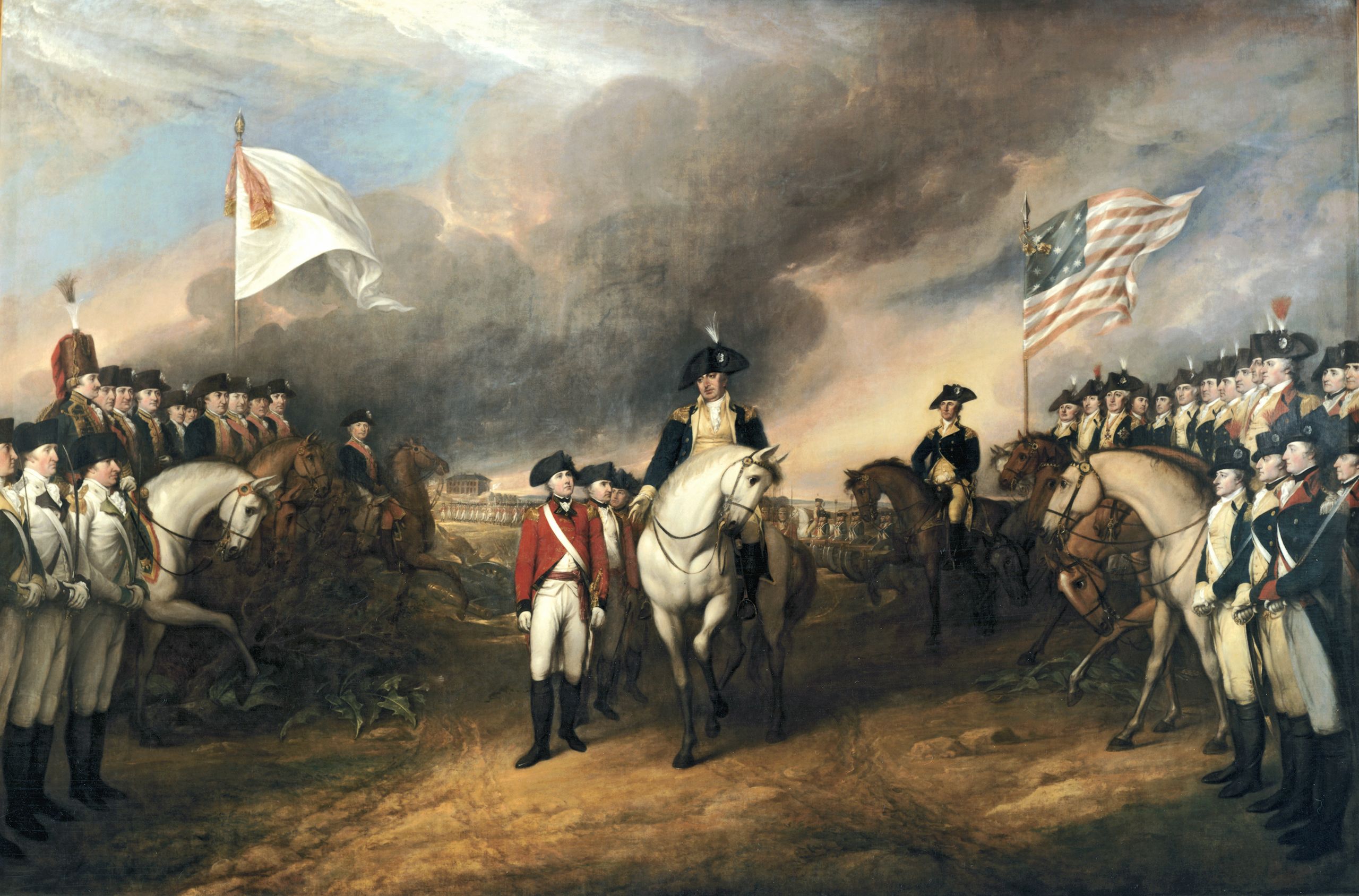
The next fifteen years—that is, from 1775 until 1790—were tumultuous times in North America. If the war began on 19 April, 1775 at Concord and Lexington, it was the surrender of Lord Cornwallis after the Battle of Yorktown (17 October, 1781) that brought the fighting to an end. British and American delegates signed the Treaty of Paris on 2 September 1783, and this formalized the American colonies’ break with Great Britain. Those fifteen years also witnessed the writing of two of the most famous legal documents in the history of the United States.
The Declaration of Independence
Indeed, the Declaration of Independence (“We hold these truths to be self-evident, that all men are created equal, that they are endowed, by their Creator, with certain unalienable Rights, that among these are Life, Liberty, and the pursuit of Happiness”) and the Constitution of the United States (“We the People of the United States, in Order to form a more perfect Union, establish Justice, insure domestic Tranquility, provide for the common defence, promote the general Welfare, and secure the Blessings of Liberty to ourselves and our Posterity…”) contain some of the most eloquent passages in regards to human governance that have been written.
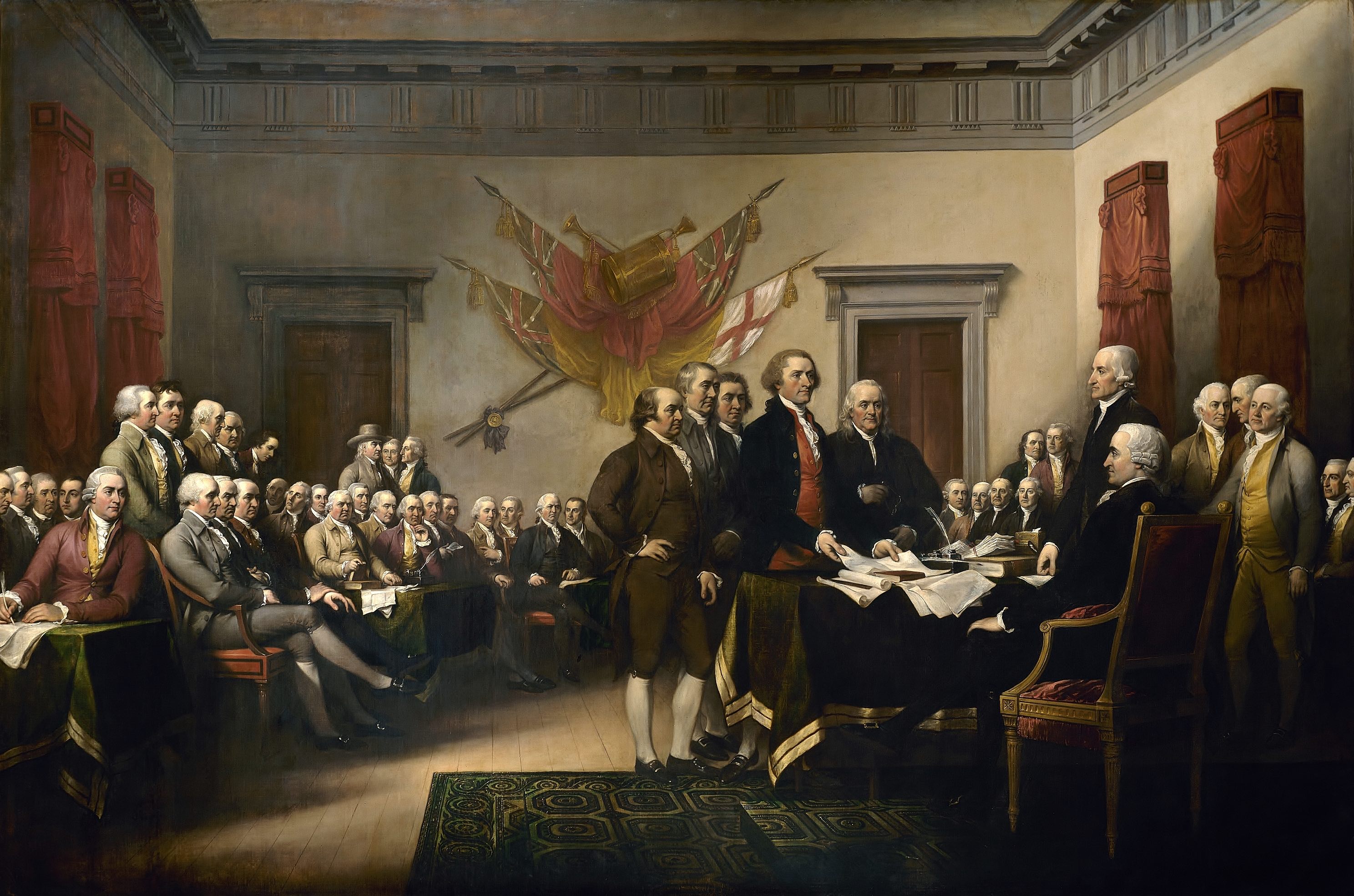
But these two documents—the Declaration of Independence and the Constitution—had differing purposes. The first was to unite the colonial cause in opposition to tyranny, and the second was to create a working system of governance. Not surprisingly, the first of these—getting people to unite against despotism—is comparatively easier than the second.
The debates over the United States Constitution occupied large parts of the new nation from the moment it was presented in September 1787 until it was finally ratified by Rhode Island—the last of the 13 colonies—on 29 May, 1790. In the more than two and half years between those dates, something profound (yet not surprising) happened: two distinct groups—the Federalists and the Antifederalists—were formed because of vastly different views as to what the Constitution should be.
The two-party system
This was the beginning of the two-party system in American politics. The Federalists—led by the writers of the Federalist Papers, Alexander Hamilton, John Jay, and James Madison—advocated for a strong centralized federal government, while the Antifederalists—Thomas Jefferson, Patrick Henry, and Samuel Adams among others—believed that the United States was best served by having stronger states’ rights and a less prominent federal government.
The fact that Hamilton, Jay, and Madison needed to write the 85 essays that comprise what is collected as the Federalist Papers suggests the discord and disagreement that existed in the newly formed country in regards to what the United States was to become. This discord, however, was to continue through the end of the century with the creation of the two-party system that is part of American politics to this day.
Even though the American electoral landscape was somewhat united under the (comparatively) apolitical George Washington through the end of his second term as president in 1797, the voting for his successor in the election of 1796 was hotly contested and acrimonious, even within the political parties themselves. John Adams, Washington’s vice president, defeated Thomas Jefferson by a relatively narrow electoral count of 71 to 68. This election was indicative of the political divide that would continue to this day.
Gilbert Stuart’s Lansdowne Portrait of George Washington
A well-known image
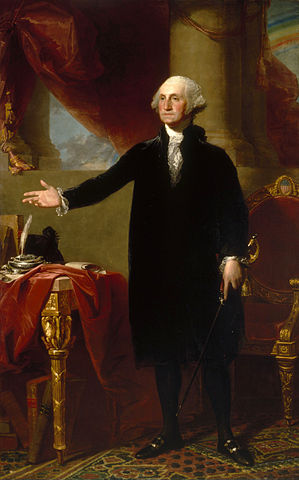
While the name Gilbert Stuart may be one unknown to most Americans, practically every American is aware of at least one of his paintings. Art historians formally call it the Athenaeum Portrait. Most everyone is familiar with it as the engraved image of George Washington that graces the front of the one-dollar bill. This is one of the dozens of portraits that Stuart painted of our first president. Another, a full-length likeness, is called the Lansdowne Portrait. Although not as famous as its bust-length counterpart, the Lansdowne Portrait retains a place of special significance within the history of American art.
Expat education
On the brink of the American Revolutionary War, Stuart decided it was time to pursue serious artistic instruction, and so, in 1775, he sailed for London and the studio of Benjamin West, whose generosity to his colonial brethren was seemingly endless.
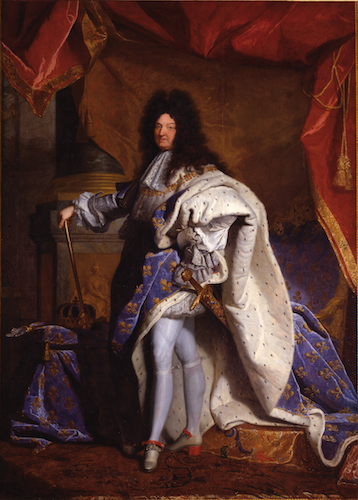
Stuart remained in London for almost twelve years and then relocated to Ireland. He clearly had aspirations of making American versions of European Grand Manner portraits such as the likeness Hyacinthe Rigaud painted of Louis XIV in 1701. After acquiring debts sufficient to necessitate a hasty departure from the Emerald Isle, the artist told a friend about his short-term plans for Ireland and about his anticipated return to the United States:
“When I can net a sum sufficient to take me to America, I shall be off to my native soil. There I expect to make a fortune by [portraits of] Washington alone. I calculate upon making a plurality of his portraits, whole lengths, what will enable me to realize; and if I should be fortunate, I will repay my English and Irish creditors. To Ireland and English I shall be adieu.”
This was a task easier said than done. Stuart did not personally know the recently elected president, and the artist had been away from his homeland for 18 years.
Letter of introduction
Rather than return to Rhode Island, the state of his birth, he instead sailed for New York City, the home of John Jay, the first Chief Justice of the Supreme Court and a close political confidant to George Washington. Stuart first met Jay in 1782 when the politician was in London negotiating the Treaty of Paris, the accord that officially ended the American Revolutionary War. Stuart arrived in New York City in early May of 1793, and a visit to Jay, one of the few people the painter could have known in Manhattan, must have been amongst Stuart’s first social calls. He painted Jay several times during the months that followed and the politician provided a letter of introduction for the relatively unknown artist to meet the president. Stuart departed New York City for Philadelphia in November 1794.
Philadelphia
If painting images of George Washington was the primary reason Stuart returned to the United States, then Philadelphia was certainly the place to be. Stuart wasted little time in calling on Washington, and painted three different kinds of portraits of the president (with dozens of subsequent copies) in the years that followed. In the decades immediately preceding the invention of photography, the myriad of portraits of Washington that Stuart painted created an image Americans accepted as the portrait of their first president. The “Vaughan Type” shows Washington facing slightly to his left, the “Athenaeum Type” shows the first president facing to his right, and the “Lansdowne Type” is a full-length portrait.
Stuart painted six full-length portraits of Washington. The “Lansdowne Type” acquired its name from the owner of the first full-length portrait Stuart painted, William Petty, the first Marquis of Lansdowne. The portrait was a gift from William Bingham, a wealthy Philadelphian merchant and was intended to thank Lord Lansdowne for his financial support of the colonial cause during the American Revolutionary War.
Civilian commander
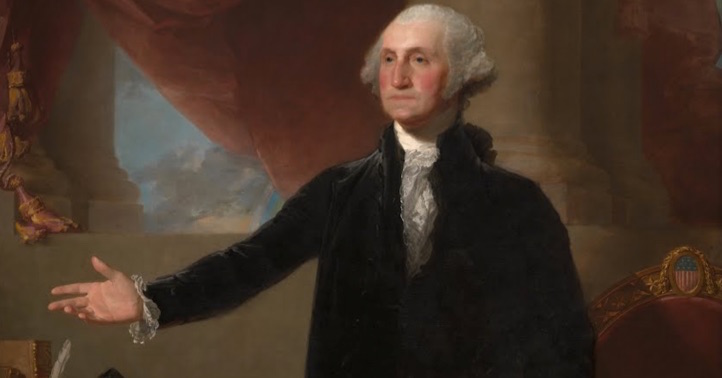
Given his European training, Stuart was well suited to execute a Grand Manner portrait of America’s first president. However, whereas previous artists such as John Trumbull and Charles Willson Peale emphasized Washington’s position as an officer in the Revolutionary Army, Stuart stressed Washington’s position as a civilian commander in chief. In the Lansdowne Portrait, Washington does not hold a scepter, wear a crown, or sit on a throne. Instead, Stuart filled the eight-foot tall composition with elements symbolic to the new republic. He wears an American made black velvet suit, one similar in fabric, cut, and color to one he frequently wore on public occasions. Washington raises his right arm in a classically inspired oratorical pose, while his left hand grasps a ceremonial sword. The President stands before a portico-like space, complete with two pairs of columns and a red curtain that has been pulled aside to reveal a background of open sky.
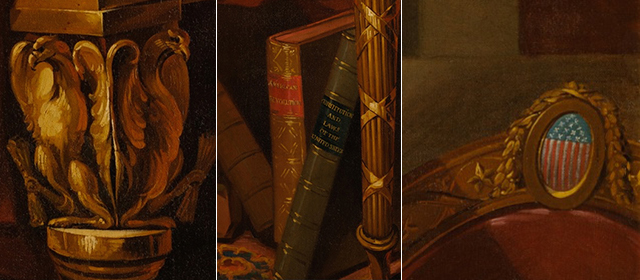
In addition to the architectural setting and the sitter’s pose, other elements within the composition transform the Lansdowne Portrait from a simple likeness of Washington into an official state portrait. The Neo-Classical chair on the right side of the painting contains elements from the Great Seal of the United States. A small oval medallion on the top of the chair is divided in half. The top half contains thirteen white stars in a blue field, and thirteen alternating red and white stripes appear underneath. Two erect eagles are visible on top of the leg of the table, each of which grasps a bundle of arrows, symbols of readiness for war. Underneath the table are several books, titled, General Orders, American Revolution, and Constitution & Laws of the United States that indicate Washington’s past military and political accomplishments. More books, Federalist and Journal of Congress, stand upright on top of the table. A silver inkwell, quill, and several sheets of blank paper can be seen immediately underneath Washington’s outstretched right hand.
Representing the office of the presidency
Without question, Gilbert Stuart’s Lansdowne Portrait of George Washington is far more than a portrait of the first president of the United States of America. It is instead a painting that represents not only Washington’s likeness, but also the aesthetic and political trappings of the office of the presidency and of the New Republic. Utilizing all of the traditions of European Grand Manner portraiture, it became the standard full-length political likeness of Washington throughout the Federalist period.
Neoclassical Architecture in the United States: Thomas Jefferson, Monticello

A gentleman architect
In an undated note, Thomas Jefferson left clear instructions about what he wanted engraved upon his burial marker:
“Here was buried
Thomas Jefferson
Author of the Declaration of American Independence
of the Statute of Virginia for religious freedom
Father of the University of Virginia”
Jefferson explained, “because by these, as testimonials that I have lived, I wish most to be remembered.” To be certain, there are important achievements Jefferson neglected. He was also the Governor of Virginia, American minister to France, the first Secretary of State, the third president of the United States, and one of the most accomplished gentleman architects in American history. To quote William Pierson, an architectural historian, “In spite of the fact that his training and resources were those of an amateur, he was able to perform with all the insight and boldness of a high professional.”
Indeed, even had he never entered political life, Jefferson would be remembered today as one of the earliest proponents of neoclassical architecture in the United States. Jefferson believed art was a powerful tool; it could elicit social change, could inspire the public to seek education, and could bring about a general sense of enlightenment for the American public. If Cicero believed that the goals of a skilled orator were to Teach, to Delight, and To Move, Jefferson believed that the scale and public nature of architecture could fulfill these same aspirations.
Return to the classical
Jefferson arrived at the College of William and Mary in 1760 and took an immediate interest in the architecture of the college’s campus and of Williamsburg more broadly. A lifelong book lover, Jefferson began his architectural collection while a student. His first two purchases were James Leoni’s The Architecture of A. Palladio (1715–20) and James Gibbs’ Rules for Drawing the Several Parts of Architecture (1732).
Although never formally trained as an architect, Jefferson, both while a student and then later in life, expressed dissatisfaction with the architecture that surrounded him in Williamsburg, believing that the Wren-Baroque aesthetic common in colonial Virginia was too British for a North American audience. In an oft-quoted passage from Notes on Virginia (1782), Jefferson critically wrote of the architecture of Williamsburg:
“The College and Hospital are rude, mis-shapen piles, which, but that they have roofs, would be taken for brick-kilns. There are no other public buildings but churches and court-houses, in which no attempts are made at elegance.”
Thus, when Jefferson began to design his own home, he turned not to the architecture then in vogue around the Williamsburg area, but instead to the classically inspired architecture of Antonio Palladio and James Gibbs. Rather than place his plantation house along the bank of a river—as was the norm for Virginia’s landed gentry during the eighteenth century—Jefferson decided instead to place his home, which he named Monticello (Italian for “little mountain”) atop a solitary hill just outside Charlottesville, Virginia.
French Neo-Classicism for an American audience
Construction began in 1768 when the hilltop was first cleared and leveled, and Jefferson moved into the completed South Pavilion two years later. The early phase of Monticello’s construction was largely completed by 1771. Jefferson left both Monticello and the United States in 1784 when he accepted an appointment as America Minister to France. Over the next five years, that is, until September 1789 when Jefferson returned to the United States to serve as Secretary of State under newly elected President Washington, Jefferson had the opportunity to visit Classical and Neoclassical architecture in France.

This time abroad had an enormous effect on Jefferson’s architectural designs. The Virginia State Capitol (1785–89) is a modified version of the Maison Carrée (16 B.C.E.), a Roman temple Jefferson saw during a visit to Nîmes, France. And although Jefferson never went so far as Rome, the influence that the Pantheon (125 C.E.) had over his Rotunda (begun 1817) at the University of Virginia is so evident it hardly need be mentioned.
Politics largely consumed Jefferson from his return to the United States until the last day of 1793 when he formally resigned from Washington’s cabinet. From this year until 1809, Jefferson diligently redesigned and rebuilt his home, creating in time one of the most recognized private homes in the history of the United States. In it, Jefferson fully integrated the ideals of French neoclassical architecture for an American audience.
In this later construction period, Jefferson fundamentally changed the proportions of Monticello. If the early construction gave the impression of a Palladian two-story pavilion, Jefferson’s later remodeling, based in part on the Hôtel de Salm (1782–87) in Paris, gives the impression of a symmetrical single-story brick home under an austere Doric entablature. The west garden façade—the view that is once again featured on the American nickel—shows Monticello’s most recognized architectural features. The two-column deep extended portico contains Doric columns that support a triangular pediment that is decorated by a semicircular window. Although the short octagonal drum and shallow dome provide Monticello a sense of verticality, the wooden balustrade that circles the roofline provides a powerful sense of horizontality. From the bottom of the building to its top, Monticello is a striking example of French Neoclassical architecture in the United States.
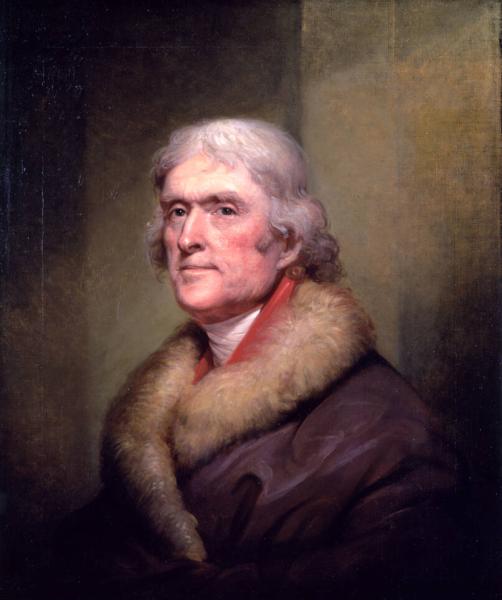
Jefferson changed political parties and was a Democratic-Republican by the time he was elected president. He believed the young United States needed to forge a strong diplomatic relationship with France, a country Jefferson and his political brethren believed were our revolutionary brothers in arms. With this in mind, it is unsurprising that Jefferson designed his own home after the neoclassicism then popular in France, a mode of architecture that was distinct from the style then fashionable in Great Britain. This neoclassicism—with roots in the architecture of ancient Rome—was something Jefferson was able to visit while abroad.
Failing to live up to his own democratic ideals
By helping to introduce classical architecture to the United States, Jefferson intended to reinforce the ideals behind the classical past: democracy, education, rationality, civic responsibility. Because he detested the English, Jefferson continually rejected British architectural precedents for those from France. In doing so, Jefferson reinforced the symbolic nature of architecture. Jefferson did not just design a building; he designed a building that eloquently spoke to the democratic ideals of the United States. This is clearly seen in the Virginia State Capitol, in the Rotunda at the University of Virginia, and especially in his own home, Monticello.
In many regards, Thomas Jefferson remains an exceedingly complicated historical figure. On the one hand, we can justifiably laud his significant civic and architectural achievements, for his accomplishments in the political realm are unmatched in American history and the buildings he designed—Monticello, the Virginia State Capitol, and the Rotunda at the University of Virginia—places him at the forefront of the gentlemen architects of the early Federal period. Yet on the other hand, we need to wrestle with the truth that Jefferson was—as were the majority of the Founding Fathers from the southern colonies, men such as George Washington, James Madison, and James Monroe—a slaveholder who owned more than 600 men, women, and children during the course of his life.
So when we look at Monticello—a building in part constructed by the enslaved people Jefferson owned—we are right to feel a kind of conflict. Although he helped to introduce classical architecture to the United States and used architectural language to reinforce the ideals behind the classical past—elements such as democracy, education, rationality, civic responsibility—those very virtues were actively denied to many. Because Jefferson so detested the English, he continually rejected British architectural precedents for those from France. In doing so, Jefferson reinforced the symbolic nature of architecture. Jefferson did not just design a building; he designed a building that eloquently spoke to the democratic ideals the United States should aspire to, even if in practice these democratic ideals were intentionally withheld from the enslaved people Jefferson owned.
Conclusion
The 18th century was a century of revolution: Industrial, Scientific, French, American, and more. Enlightenment ideals of reason, logic, and science helped to shift political power structures from monarchies into the hands of everyday people. Unfortunately, the right to govern oneself did not extend to all people, including the enslaved and women. Toward the end of the 18th century, the Neoclassical style replaced the preceding Rococo. The Neoclassical, with its origins in the Greco-Roman world, represented an ordered and balanced aesthetic based in clear drawing and design (disegno). In France at the turn of the 19th century, a new leader would install himself as emperor: Napoleon. At the beginning of the 19th century, Napoleon continued the Neoclassical style in service of his own political propaganda. During Napoleon’s rule, a new generation of artists and thinkers questioned the clear precision of the Neoclassical in favor of the personal and emotional.
Citation and Licensing
The following sections were written by Chelsea Wright and licensed CC BY-NC-SA 4.0:
- Chapter Overview and Introduction
- Focus artwork and term list compiled by Chelsea Wright
- Practicing Visual Analysis
- Conclusion
The following articles from Smarthistory licensed CC BY-NC-SA 4.0 were remixed and adapted for the chapter:
- Dr. Beth Harris and Dr. Steven Zucker, “The Early Modern era: the 18th century (4 of 4),” in Smarthistory, January 15, 2025.
- Dr. Steven Zucker and Dr. Beth Harris, “The Age of Enlightenment, an introduction,” in Smarthistory, January 7, 2016.
- Dr. Abram Fox, “Joseph Wright of Derby, A Philosopher Giving a Lecture at the Orrery,” in Smarthistory, January 8, 2016.
- Smarthistory, “Angelica Kauffmann,” in Smarthistory.
- Dana Martin, Dr. Beth Harris and Dr. Steven Zucker, “Angelica Kauffmann, Cornelia Pointing to her Children as Her Treasures,” in Smarthistory, July 10, 2025.
- Dr. Beth Gersh-Nesic, “Neoclassicism, an introduction,” in Smarthistory, January 7, 2016.
- Dr. Claire Black McCoy, “Jacques-Louis David, Oath of the Horatii,” in Smarthistory, January 7, 2016.
- Dr. Beth Harris and Dr. Steven Zucker, “Jacques-Louis David, The Death of Marat,” in Smarthistory, January 7, 2016.
- Dr. Bryan Zygmont, “1754–1800 in North America, an introduction,” in Smarthistory, June 25, 2024.
- Dr. Bryan Zygmont, “Gilbert Stuart’s Lansdowne Portrait,” in Smarthistory, August 9, 2015.
- Dr. Bryan Zygmont, “Thomas Jefferson, Monticello,” in Smarthistory, August 9, 2015.
- Denis Diderot, Essai sur la peinture, 1765. ↵



,_by_John_Trumbull.jpg)
_-_Google_Art_Project.jpg)

.JPG)
