
From the Baroque to the Rococo
Chapter Overview and Introduction
The Baroque style was also prominent in Spain and France. Both Spain and France were affiliated with the Catholic Church and the Counter-Reformation; however, the royal monarchy of those countries also used the dramatic Baroque style in non-religious artworks. In Spain, we see royal portraiture with Velázquez’s Las Meninas. In France, we see royal portraiture of Louis XIV and his massive architecture program at the Palace of Versailles. The Palace of Versailles with its Hall of Mirrors exemplifies secular Baroque architecture. From the end of Louis XIV’s rule in the 17th century until the French Revolution in 1789, a new style became dominant in France: the Rococo. The Rococo served the French aristocracy with its scenes of domesticated landscapes, fête galante, luxury, leisure, and pleasure.
Focus Artworks
- Diego Rodríguez de Silva y Velázquez, Las Meninas, 1656, oil on canvas
- Hyacinthe Rigaud, Louis XIV, 1701, oil on canvas
- Louis le Vau, André le Nôtre, and Charles le Brun, Palace of Versailles, France, 1664–1710
- Nicolas Poussin, Landscape with Saint John on Patmos, 1640, oil on canvas
- Antoine Watteau, Pilgrimage to Cythera, 1717, oil on canvas
- Jean-Honoré Fragonard, The Swing, 1767, oil on canvas
- Élisabeth Louise Vigée Le Brun, Self-Portrait, 1790, oil on canvas
- Thomas Gainsborough, Mr. and Mrs. Andrews, c. 1750, oil on canvas
Term List
- Absolute Monarch
- French Academy
- Baroque Classicism
- Poussinists
- Prix de Rome
- Salon (as related to architecture)
- Salon (as related to art exhibition)
- Rococo
- Aristocracy
- Fête galante
- Rubenists
Spanish Baroque: Diego Velázquez, Las Meninas
The Spanish Baroque style was influenced by Caravaggio’s realism and dark backgrounds, an interest in movement and light, and Spanish religiosity. Painter to Philip IV of Spain, Diego Velázquez’s works incorporate the influence of Rubens and Titian in an elegant and expressive style of loose brushwork.
In Velázquez’s Las Meninas, this puzzling painting about painting is half genre scene, half family portrait. But what’s on the large canvas?
At first glance nothing seems particularly extraordinary. People attired in 17th-century clothing assemble in a room decorated with paintings. The room is recognizable as one inside the Alcázar palace in the Spanish city of Seville that had become Velázquez’s painting studio. Most of the figures gaze out of the painting towards where we stand as the viewer in front of the canvas. The scene of a princess, court attendants, painter Diego Velázquez himself, and a mirrored reflection of the king and queen on the back wall refuses to adhere to any established genre. Instead, Velázquez pictures the complex interconnected web of power in 17th-century Spain and examines how that power is created.
The king and queen at the top of the social hierarchy are mere reflections painted by an artist whose brush conjures them into existence, yet their presence dominates the room. Every figure turns to regard them. Teasing the viewer, a painted version of Velázquez faces a canvas that the viewer can never see. Outside the painting, the viewer stands where the painting implies the monarchs would be. The seemingly straightforward gathering of members of the royal household in a room inside the Alcázar palace quickly complicates itself.
French Baroque: Hyacinthe Rigaud, Louis XIV
Art and state
The early seventeenth century was marked by unrest and near constant warfare; however, by the mid seventeenth century, France had emerged as Europe’s largest and most powerful country. France, under Louis XIV, was an absolute monarchy where full power resided with the king. As an absolute monarch, Louis was not subject to any constitutional limitations, leading him to declare “l’etat, c’est moi” (“I am the state”). Louis ruled by divine right, receiving his authority directly from God. The concept of divine right allowed Louis to quash emerging rebellions while establishing legitimacy. Louis became known as le Roi Soleil, the Sun King, furthering his claim of divine lineage by recalling the ancient Greek god Apollo and declaring himself, in his usual modest manner, to be the center of the universe.
Recognizing the importance of propaganda, Louis and his advisors embarked on many large-scale projects, most memorably the expansion of Versailles from a rather unassuming (by royal standards, at least) hunting lodge to an enormous, gilded (and mirrored) palace. Versailles reinforced the image of the Sun King and infused the Baroque style with classical elements, visually linking Louis’ rule to the might of Imperial Rome. As the leading patron of the era, Louis XIV employed a workshop of artists and architects; Hyacinthe Rigaud became the principal painter to the king.
“L’etat, c’est moi”
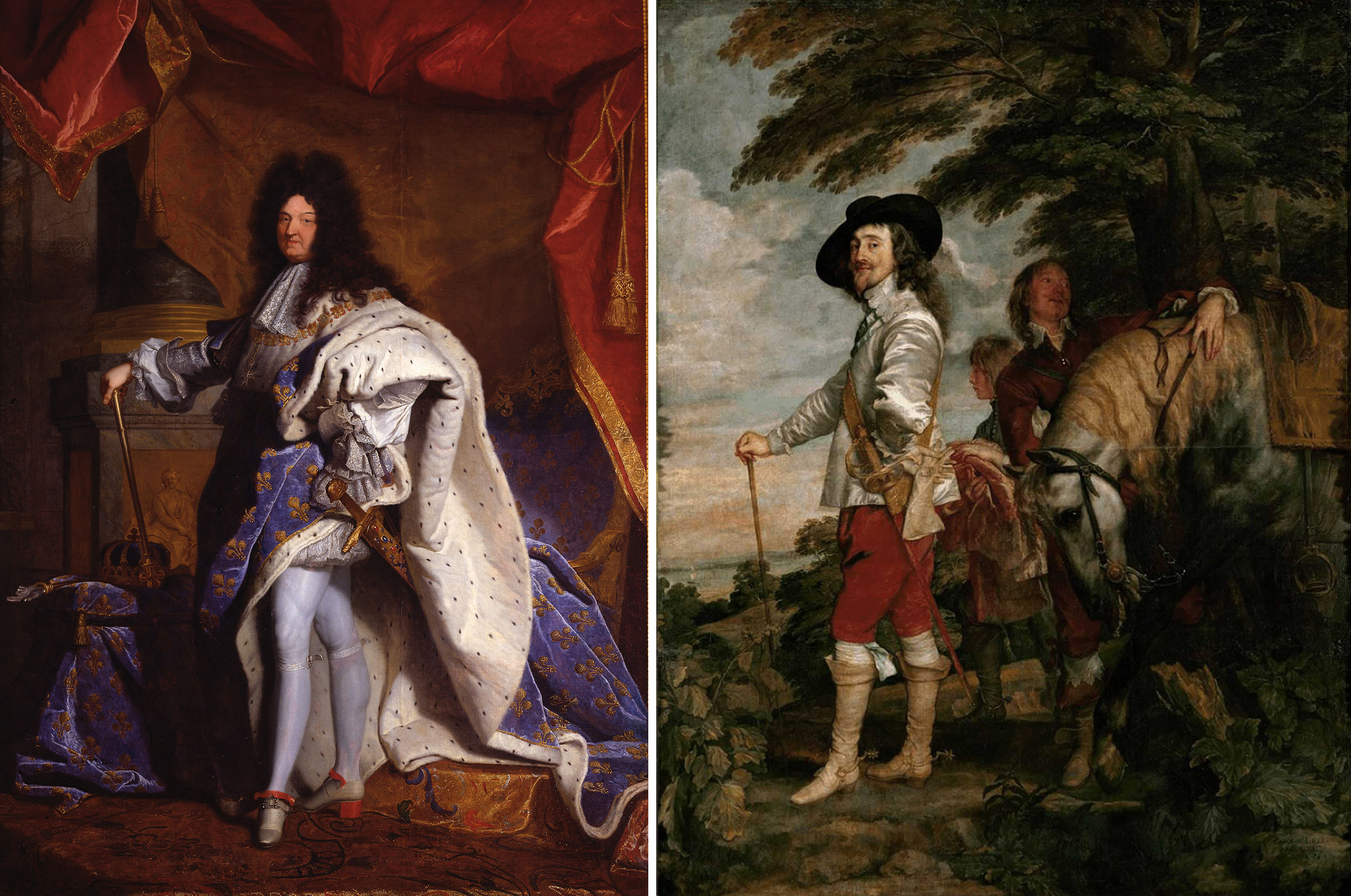
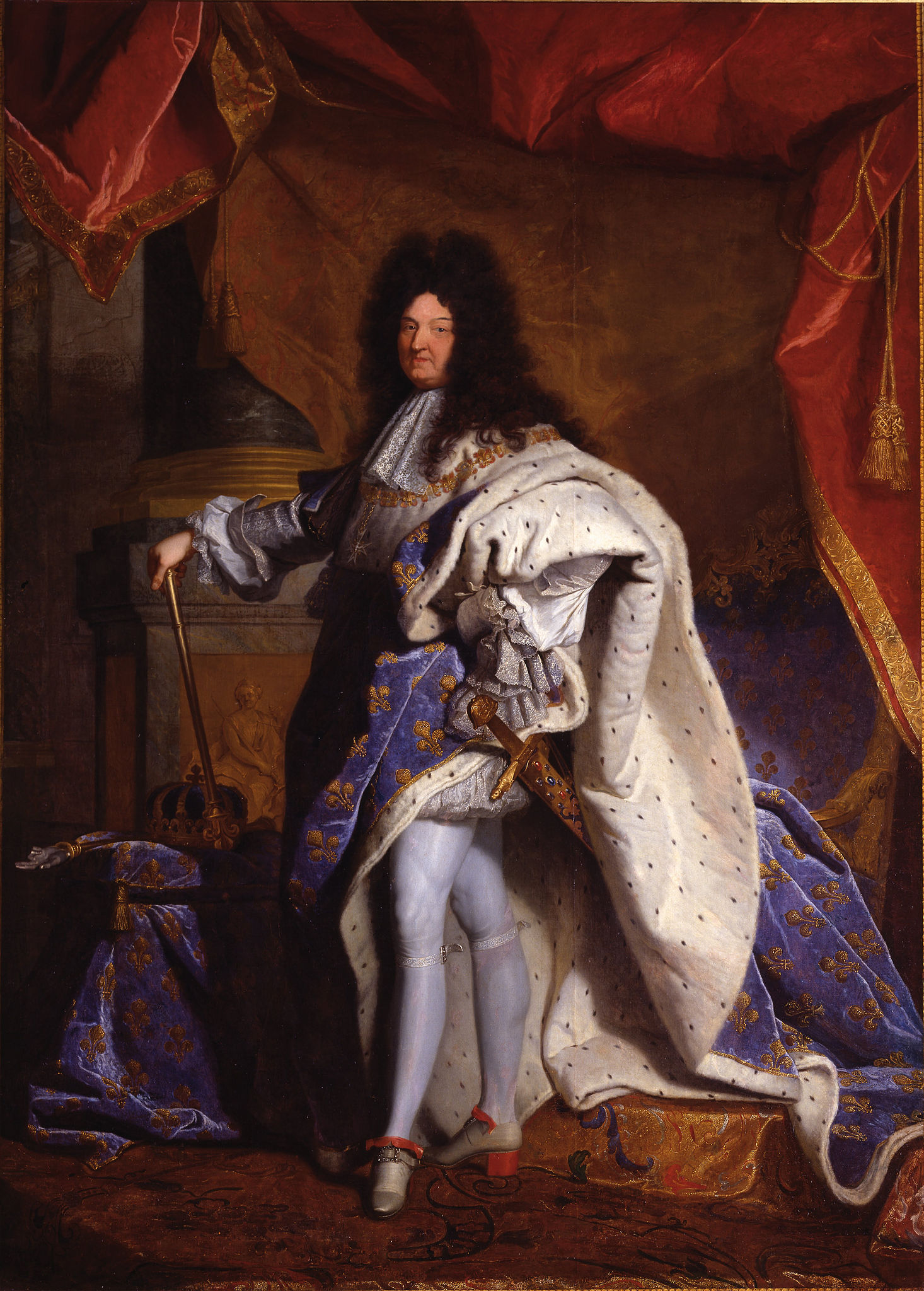
Rigaud’s monumental portrait displays a life-size, full-body depiction of Louis XIV. The composition recalls Anthony Van Dyck’s 1635 Charles I at the Hunt. Louis, as the focal point, stands in the center of the canvas, his body angled slightly while his face is turned to meet the viewer with the confidence and directness expected from a king.
Billowing embroidered silk curtains form an honorific canopy over the King’s head while the lavish carpeting creates an opulent environment worthy of the king’s presence. To the left, a marble column sits atop a gilded base, symbolizing the strength of the monarch while again recalling the classical era.
Louis’ pose, like Charles’ before him, allows him to literally look down on the viewer, despite both monarchs being quite short. As royal portrait painters, both Rigaud and Van Dyck were able to assert the dominance of the monarch by carefully creating the illusion of height; to please their patron, royal painters often opted for idealized elements at the expense of realism. Despite the similarities in their portraits, Louis met a happier (or at least far less grisly) end than Charles I who was beheaded in 1649.
Accessories make the man
Like Versailles, nothing in Louis XIV is understated; every detail was intended to remind the viewer of the supremacy of the monarch and his divine authority. Louis, dressed to the nines, is bedecked in his coronation robe. Even the materials of the robe reinforce the image of the monarch; the black-and-white ermine fur and the blue-and-gold fleur-de-lis, a stylized lily, are symbolic of the French monarchy.
Rigaud paints Louis with a royal sword fastened to his hip, the precious materials contributing to the extravagant atmosphere while also symbolizing his military might. In his right hand, Louis holds the royal scepter while the crown rests on the table below, just in case there were any lingering doubts that this Louis was a pretty important fellow.
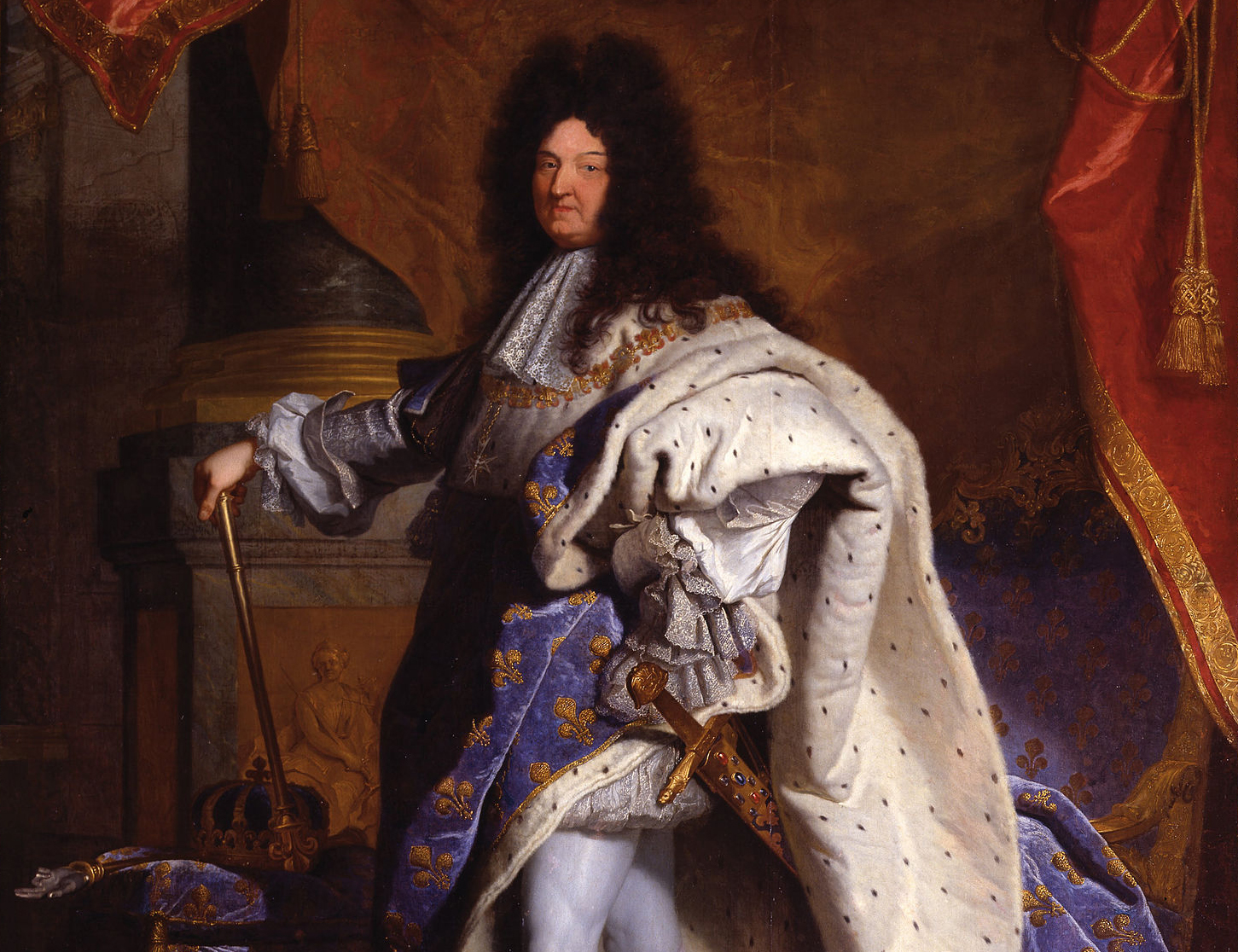
Louis’ hair is also worth noting (and not just because it’s amazing). To modern eyes, the king’s hair seems more appropriate for a member of KISS than for a sixty-three year old absolute monarch; however, Louis’ hair cascades down his royal robes—representing a still youthful and robust king. In official royal portraits, there was constant negotiation between historical accuracy and the ideal form. How exactly to render Louis’ hair sparked an intense debate on more than one occasion: should the hairstyle be accurate, the king presented as he actually looks, or should concessions be made so that the regal qualities of the king might be more readily apparent? Like with Louis’ (lack of) height, royal painters had to strike a balance between an identifiable and recognizable portrait and one that idealized the sitter to meet the patron’s desired result.
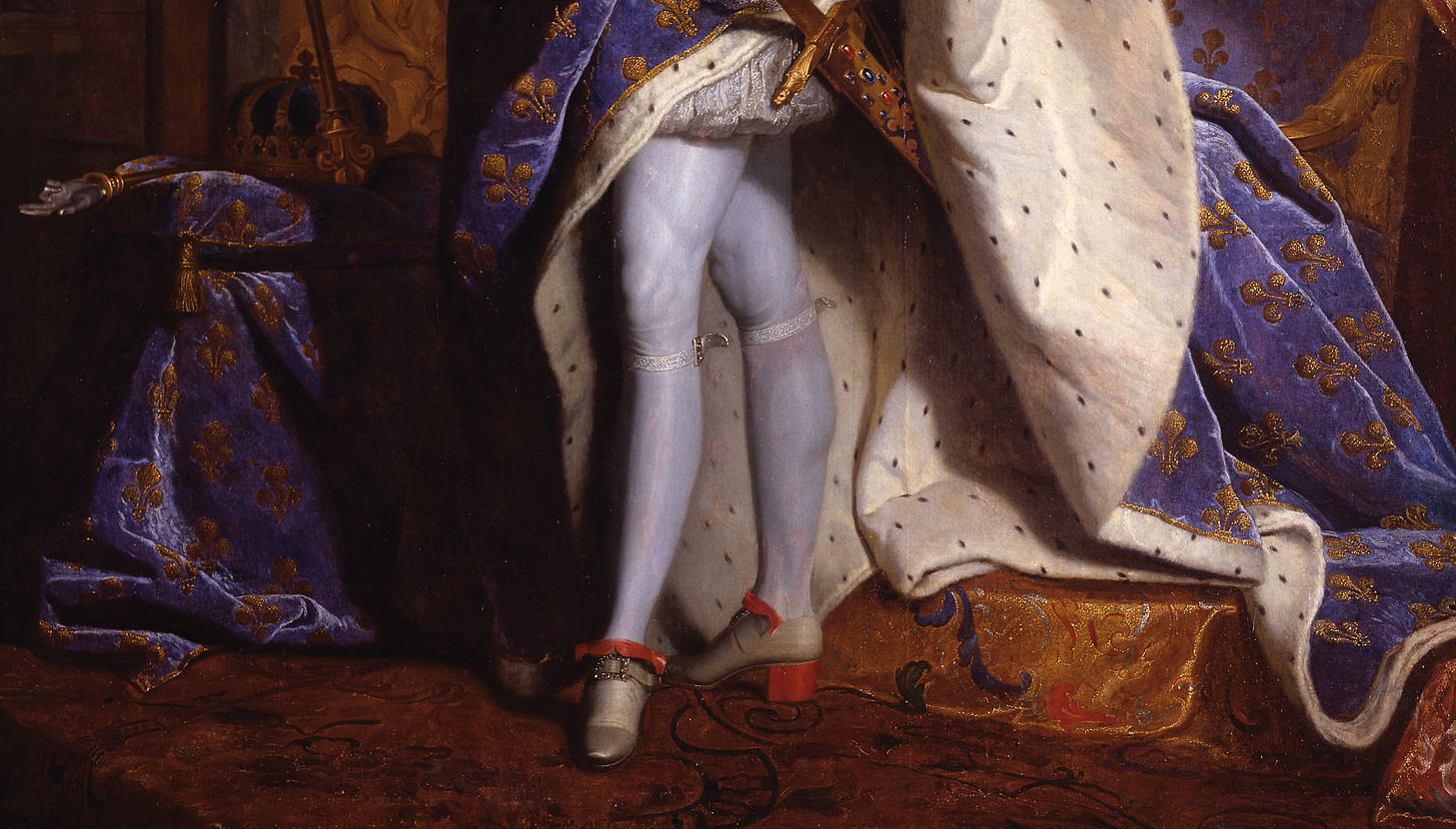
Similarly, Louis’ legs, which Rigaud has cleverly and prominently displayed, are rather well defined for an aging king. Louis’ advancing age (he would die fourteen years after this portrait) is betrayed by his lined face, slight jowls, and double chin; the king was reportedly in ill health and had to have several teeth extracted due to infection. It is no coincidence that Louis is posed with his majestic robe draped over his shoulder to reveal his lower limbs: Louis had been a ballet dancer in his youth and prided himself on his dancer’s legs. The legs, while in contrast to his aged face, suggest a vital and vigorous man, still in the prime of his power. Rigaud tempers the monarch’s timeworn face by reminding the viewer of Louis’ athletic past; the heeled shoes are not only flattering but add several precious inches onto Louis’ height. Here, Louis is identifiable—clearly the portrait is of the king in the later years of his life—yet also idealized, his well-toned legs and lustrous hair preternaturally preserved.
Success
Rigaud’s portrait, originally commissioned as a gift for Louis’ grandson, Philip V of Spain, was so well received that Louis ultimately chose to keep it and sent a copy in its place. Rigaud so successfully captured the power of Louis XIV that the image was placed over the throne and in the king’s absence, the painting served as his proxy and courtiers were forbidden to turn their backs on the painting.
French Baroque: Louis le Vau, André le Nôtre, and Charles le Brun, Château de Versailles
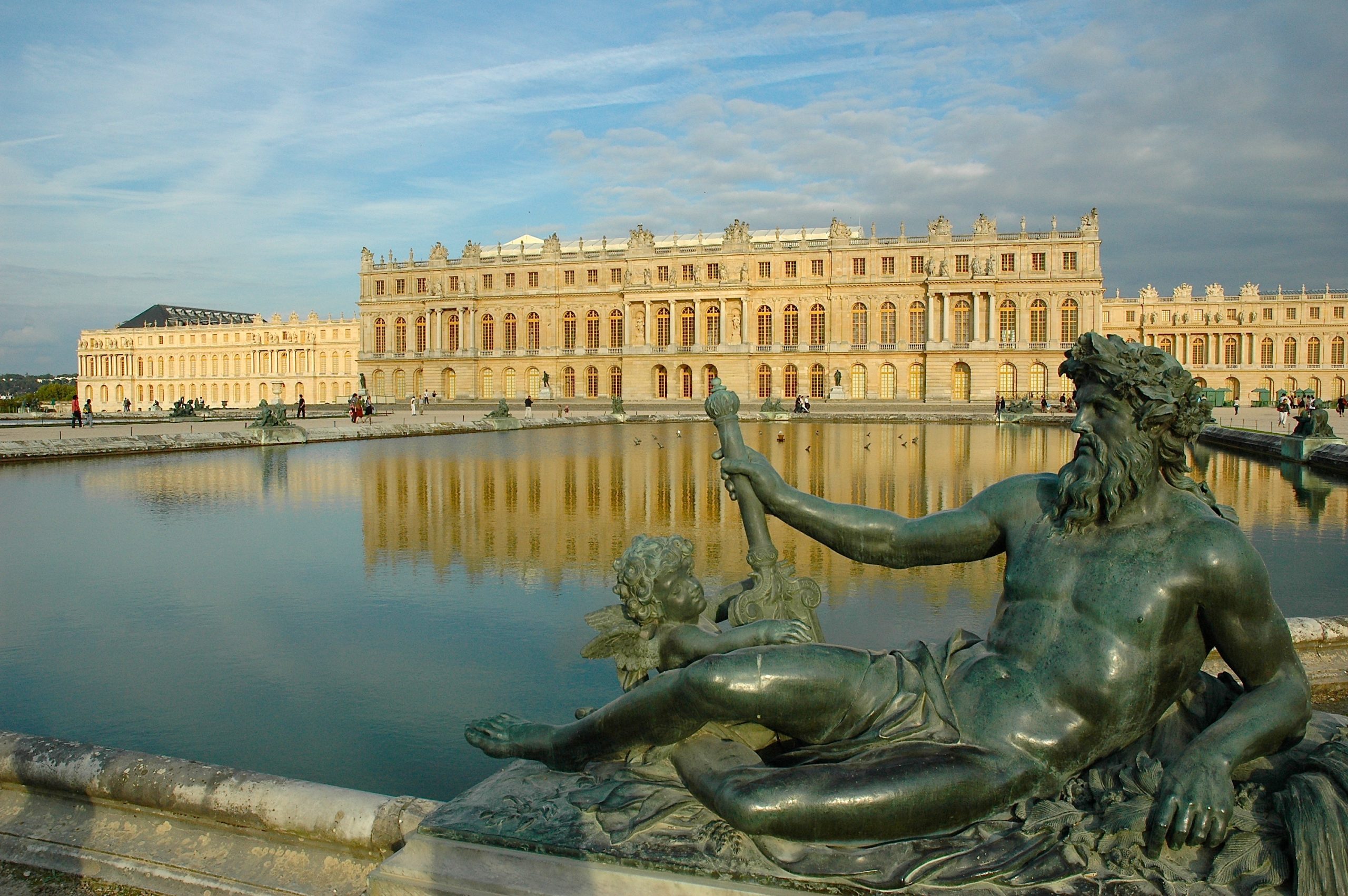
When the King of France, Louis XIV, first decided to build a new palace and move his court out of Paris, there was nothing on his chosen site at Versailles but a smallish hunting lodge. Today, the palace stands as a prime example of the over-the-top excesses of the French nobility that led to the French Revolution.
Huge, but oh so stylish
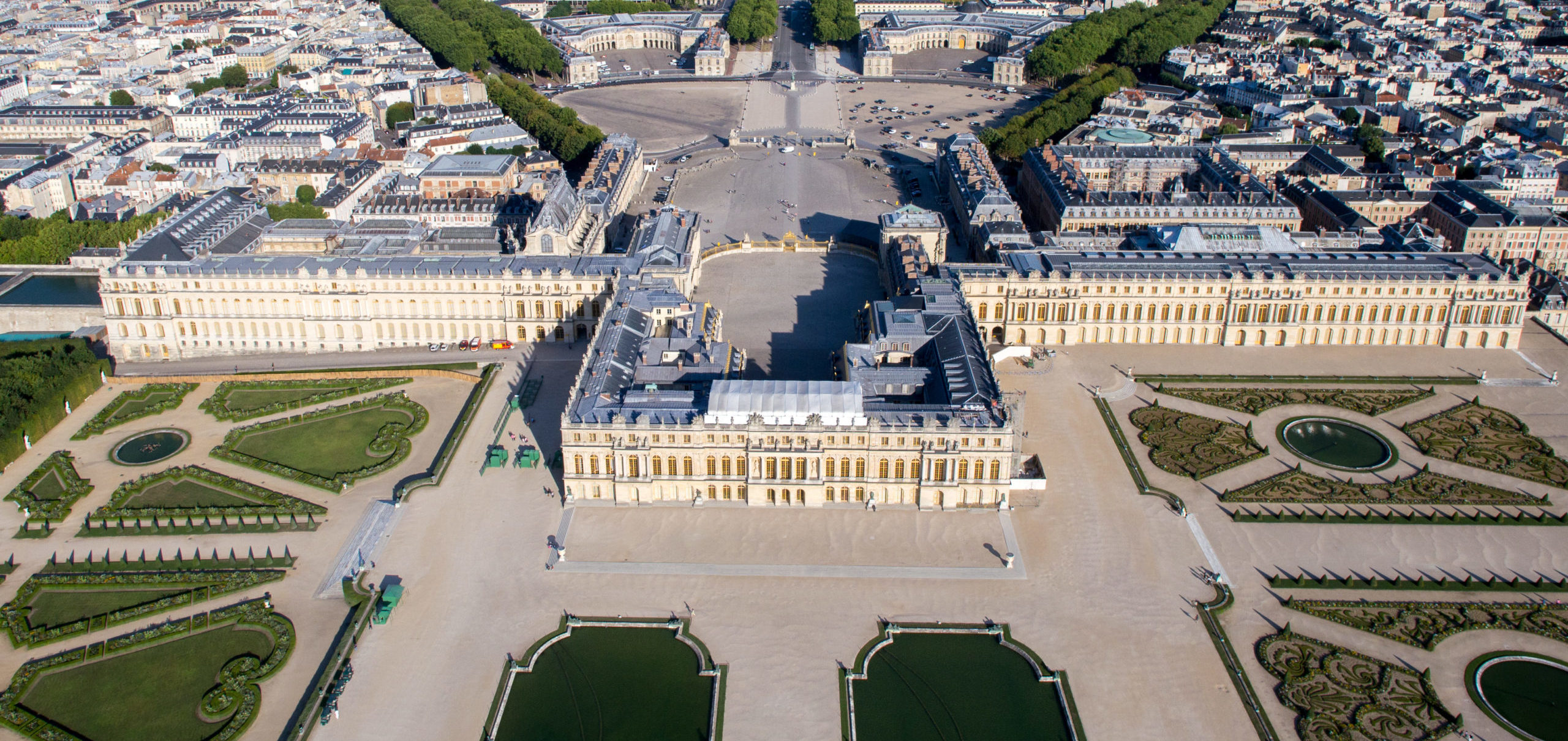
Thanks to the team of Louis le Vau (architect to the aristocracy), André le Nôtre (landscape designer extraordinaire), and Charles le Brun (über-fashionable interior decorator and painter), Louis XIV’s enormous and stylish palace was completed 21 years after it was begun in 1661 allowing Louis (and his closest friends, family, courtiers, servants and soldiers—all 20,000 of them) to officially set up court there (by that point, the next superstar architect, Jules Hardouin Mansart, had taken up the design reins). Enormous is no joke. The place has 700 rooms, 2,153 windows, and takes up 67,000 square meters of floor space (for those of you keeping track at home, that’s over 12 American football fields or a bit more than 9 soccer pitches).
Over and above anything else, Versailles was meant to emphasize Louis’s importance. After all, this is the guy that called himself The Sun King; as in, everything revolves around me. “L’état, c’est moi” (I am the state), he said, famously and oh-so-modestly. By building Versailles, Louis shifted the seat of French government away from the feuding, gossiping, trouble-making noble families in Paris. He had the whole palace and its massive gardens built along an east/west axis so the sun would rise and set in alignment with his home. And he filled both the palace and its gardens with sculpture, painting, and fountains that all focused on…you guessed it…himself.
Buttons and bedchambers
When you walk through the palace at Versailles, you’re bombarded with room after room of marble and gold and paintings: ceilings painted to place Louis in the company of the Greek gods, busts of him in a huge formal curly wig staring at you wherever you go, and gold gold gold, so you never lose sight of how wealthy the King of France was. To give you just a hint, we’re talking about a man who spent the equivalent of $5,000,000 on buttons over the 54 years of his reign. That’s an average of almost $100,000 a year. On buttons.
Of the 700 rooms inside the palace, there are a few notable ones that served very particular functions. The king’s official state bedroom is one, where the incredibly detailed lever (rising) and coucher (going to sleep) rituals would be performed each day. Both involved a whole host of courtiers waiting on the king while he got up or went to bed, following strict rules of position and rank to determine who got to perform which parts of the ceremony.
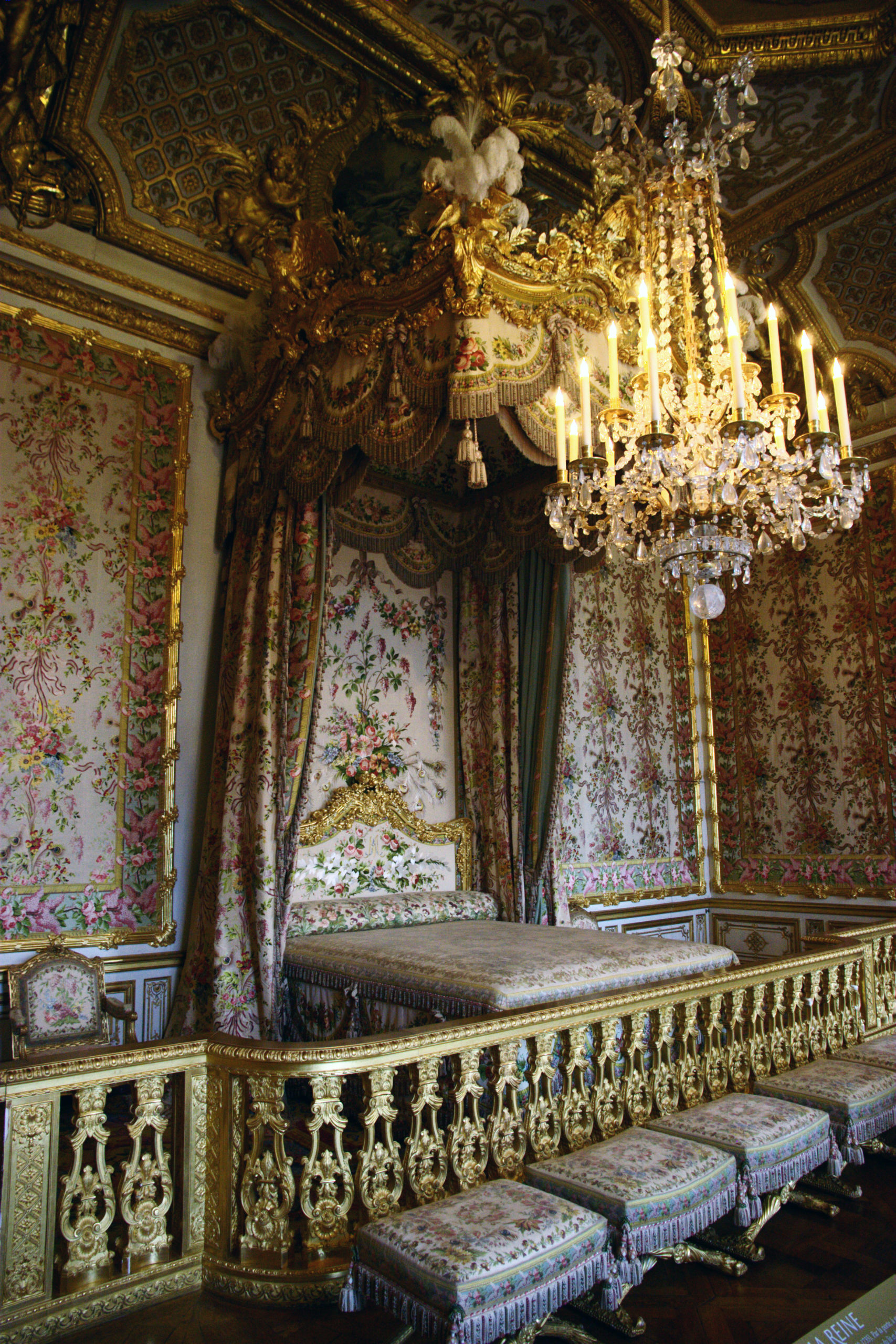
The queens of France who lived at Versailles were the focus of a similar ritual (the Toilette) in the queen’s main bedchamber, a room where they also gave birth in public. The symmetrical Salon of War and Salon of Peace are decorated with paintings highlighting, unsurprisingly, France’s military might and the benefits of living calmly under a tranquil ruling government. And the Cabinet des Chiens (literally, the Study for Dogs) was a room that Louis XV’s valets shared with his dogs, who also got to sleep in a room full of gilding and painted decoration.
Hall of Mirrors
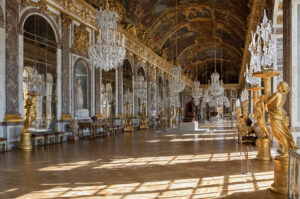
The most famous room is the Hall of Mirrors, which runs along the entire length of the central building. One wall contains a row of giant windows looking out over the gardens (almost 2,000 acres of manicured lawns, fountains and paths arranged in the formal garden style that André le Nôtre was known for), and the other wall is covered with 357 mirrors that catch the setting sun’s rays inside the palace and remind us yet again (as if we could forget) of Louis XIV’s power.
Though the room is over the top in its grandeur, it was mainly used as a passageway. After the king got up for the day, he proceeded through this mirrored hall to his private chapel, and as many courtiers as could fit would squeeze in, waiting for their chance to beg a favor of the king as he passed by them. Since Louis XIV’s day, the room has also been used for parties (the masked ball for the wedding of Louis XVI and Marie Antoinette) and military agreements (the Treaty of Versailles that officially ended World War I was signed here in 1919).
Classical restraint
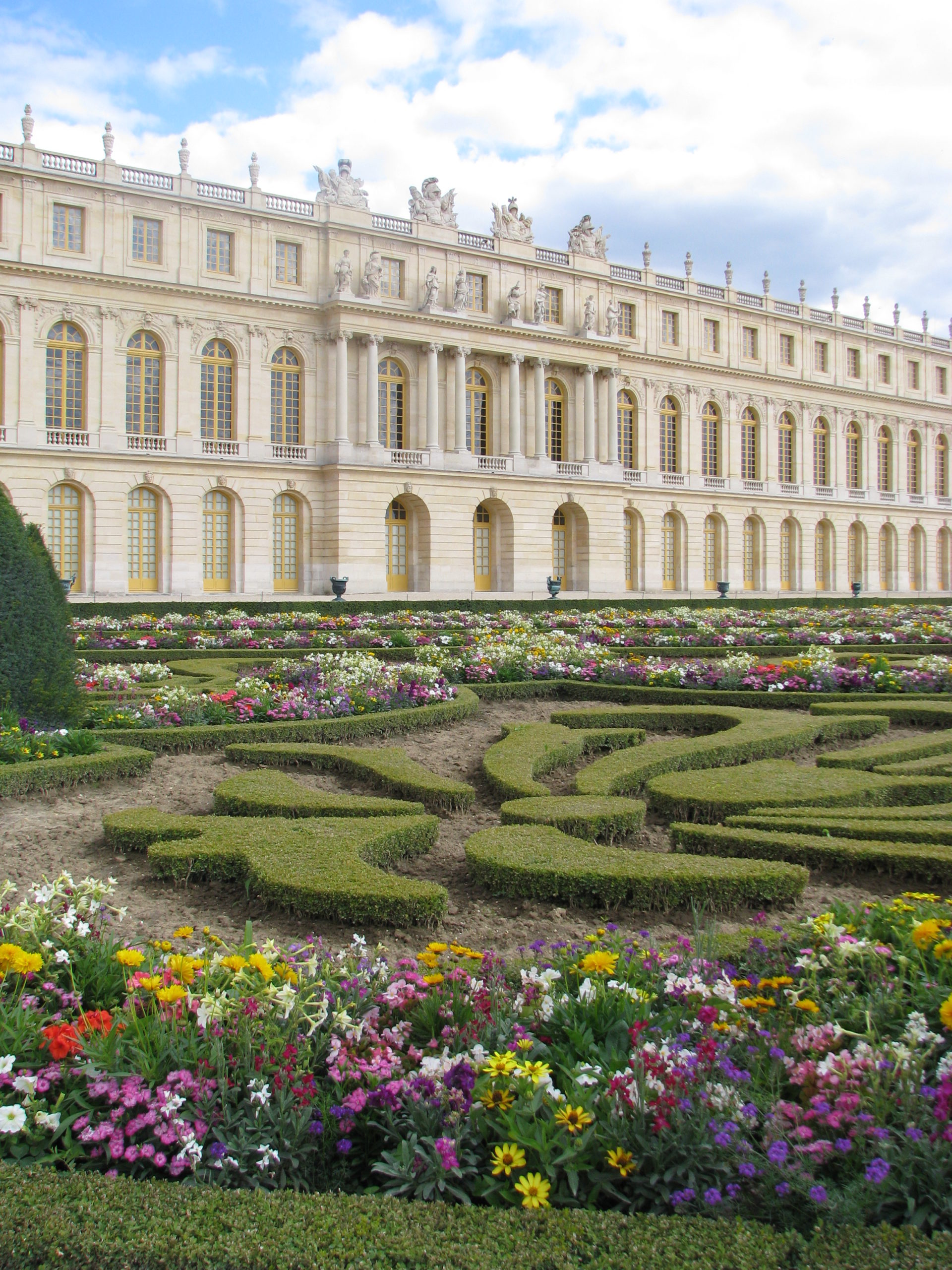
The palace’s outside isn’t as ornate as its inside. Sure it’s still huge, and sure it’s still got plenty of gold and statues and embellishments, but the basic structure is classical; it’s symmetrical, repetitive, and based on simple elements that are directly borrowed from ancient Greek temples. The façade that faces the gardens looks remarkably similar to the White House in Washington, DC, albeit much bigger and not so white.
Before you go thinking that this is a sign of Louis XIV’s hidden modesty, keep in mind that classical architecture was intended to remind people of the greatness of the antique Greek and Roman past (Greek and Roman civilization were often lumped together and called classical). When Versailles was being built, this ancient past was seen as the root of the intellectual and aesthetic superiority they believed had descended to the French nation. Classical architecture was the name of the game at Versailles, and although it wasn’t as complicated as some of Louis XIV’s other choices, he was making a direct link from himself all the way back to the great thinkers and builders of the ancient, classical, past.
Sun King or Sun God
Louis, ever modest, especially liked linking himself directly to the Greek god Apollo (Sun King = Sun God… subtle wasn’t Louis’s middle name). The Apollo Fountain and Apollo Salon remain two of the major highlights of a visit to Versailles. Not content with the restraint of pure classical design, he had his team create a palace that used classical structures to contain the elaborate grandeur of the Baroque style that was all the rage in the mid-seventeenth century. He wanted to make the biggest possible statement and what he ended up with was Versailles: a palace designed to glorify the French monarch by incorporating both ornate Baroque decoration that amply demonstrates his wealth and glory and the stricter rules of classicism that express his intellectual and cultural stature.
French Baroque Classicism: Nicolas Poussin, Landscape with Saint John on Patmos
The French Baroque was a variation that infused the Baroque style with classical elements and emotional restraint to contain the elaborate grandeur that characterized it. The French artist, Nicolas Poussin was known for his allegorical, mythological, and historical scenes that were rationally ordered but often poetic in tone.
The formation of a French school: the Royal Academy of Painting and Sculpture
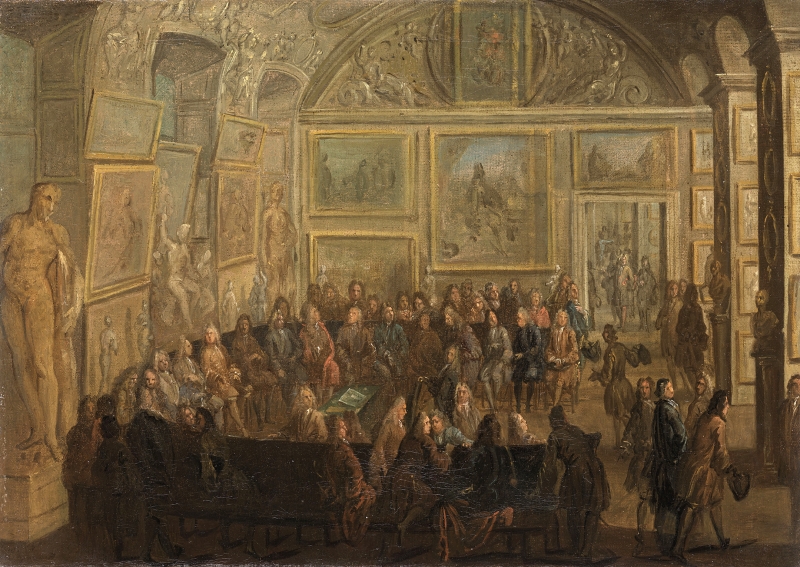
In a room filled to the brim with painting and sculpture, well-dressed men in powdered wigs assemble around a desk while stragglers chat with their neighbors. Jean-Baptiste Martin’s small painting depicts a meeting of the distinguished French art academy without an artist’s tool in sight—only the ornate room situates the scene in the Louvre palace. The choice to not show the artists at work, but rather as fashionable gentlemen engaged in sociable intellectual exchange speaks directly to the early history of the French Royal Academy.
The Académie Royale de Peinture et de Sculpture (Royal Academy of Painting and Sculpture) was established in 1648. It oversaw—and held a monopoly over—the arts in France until 1793. The institution provided indispensable training for artists through both hands-on instruction and lectures, access to prestigious commissions, and the opportunity to exhibit their work. Significantly, it also controlled the arts by privileging certain subjects and by establishing a hierarchy among its members. This hierarchical structure ultimately led to the Académie’s dissolution during the French Revolution. However, the Académie in Paris became the model for many art academies across Europe and in the colonial Americas.
Foundation
This preeminent training organization for painters and sculptors was founded in response to two related concerns: a nationalistic desire to establish a decidedly French artistic tradition, and the need for a large number of well-trained artists to fulfill important commissions for the royal circle. Previous monarchs had imported artists (primarily from Flanders and Italy), to execute major projects. In contrast, King Louis XIV sought to cultivate and support French artists as part of his grander project of self-fashioning, with art playing a vital role in the construction of the royal image.
The Académie quickly rose to prominence, in conjunction with the Ministry of Arts (responsible for construction, decoration, and upkeep of the king’s buildings) and the First Painter to the King—the most prestigious title an artist could achieve. Two men were integral to the institution’s early history: Jean-Baptiste Colbert, an increasingly influential statesman who acted as the institution’s protector, and the artist Charles Le Brun, who would go on to be both First Painter and the Académie’s Director. Both men sought to elevate the status of artists by emphasizing their intellectual and creative capacities, and both sought to differentiate members of the Académie—academicians— from guild members (guilds were a medieval system that strictly regulated artisans). The Académie, whose members were financially supported by the King, moved into its permanent location at the Louvre Palace in 1692, further reinforcing the institution’s status. Given such institutional preoccupations, Martin’s decision to show artists as gentlemen socializing rather than as artisans laboring takes on new significance.
Hierarchies
From its inception, the Académie was structured around hierarchy. There were distinct levels of membership that an artist could advance through over time. In art, too, there was a hierarchy: painting was prioritized over sculpture, and certain subjects were considered more noble than others. To become a member, artists submitted work for evaluation by academicians, who accepted them at a certain level, based on the kind of subjects they aspired to paint. If they passed this first phase, applicants would execute a “reception piece” depicting a subject chosen by the academicians.
The Académie divided paintings into five categories, or genres, ranked in terms of difficulty and prestige:
- History Painting—encompassing highbrow subjects taken from the classical tradition, the bible, or allegories, this type of painting was considered the highest genre because it required proficiency in depicting the human body, as well as imagination and intellect to depict what could not be seen. These were often large-scale multi-figure paintings.
- Portraiture—focusing on capturing likeness, this genre was prestigious, and certainly lucrative, but less so than history painting. Portraitists were derided for “merely” copying nature rather than inventing (an oversimplification as few portraits were executed entirely from life).
- Genre Painting—depicting scenes of everyday life, this genre included the human figure but ostensibly did not represent grand ideas, although many genre paintings had moralizing undertones. Genre paintings were smaller in size than history paintings, further detracting from their prestige.
- Landscapes—consisting of all representations of rural or urban topography, real or imagined, this genre became especially popular during the eighteenth and nineteenth centuries.
- Still Life Painting—often indulging in the juxtaposition of colors and textures, these paintings represented inanimate (often luxury) objects and drew heavily on the seventeenth-century Dutch tradition of such subjects. While at times other moralizing symbols such as memento mori (reminders of human mortality) were included, these were not an intrinsic part of the genre, which was considered to require no invention on the part of the artist (since, they were painting what they could see).
Training
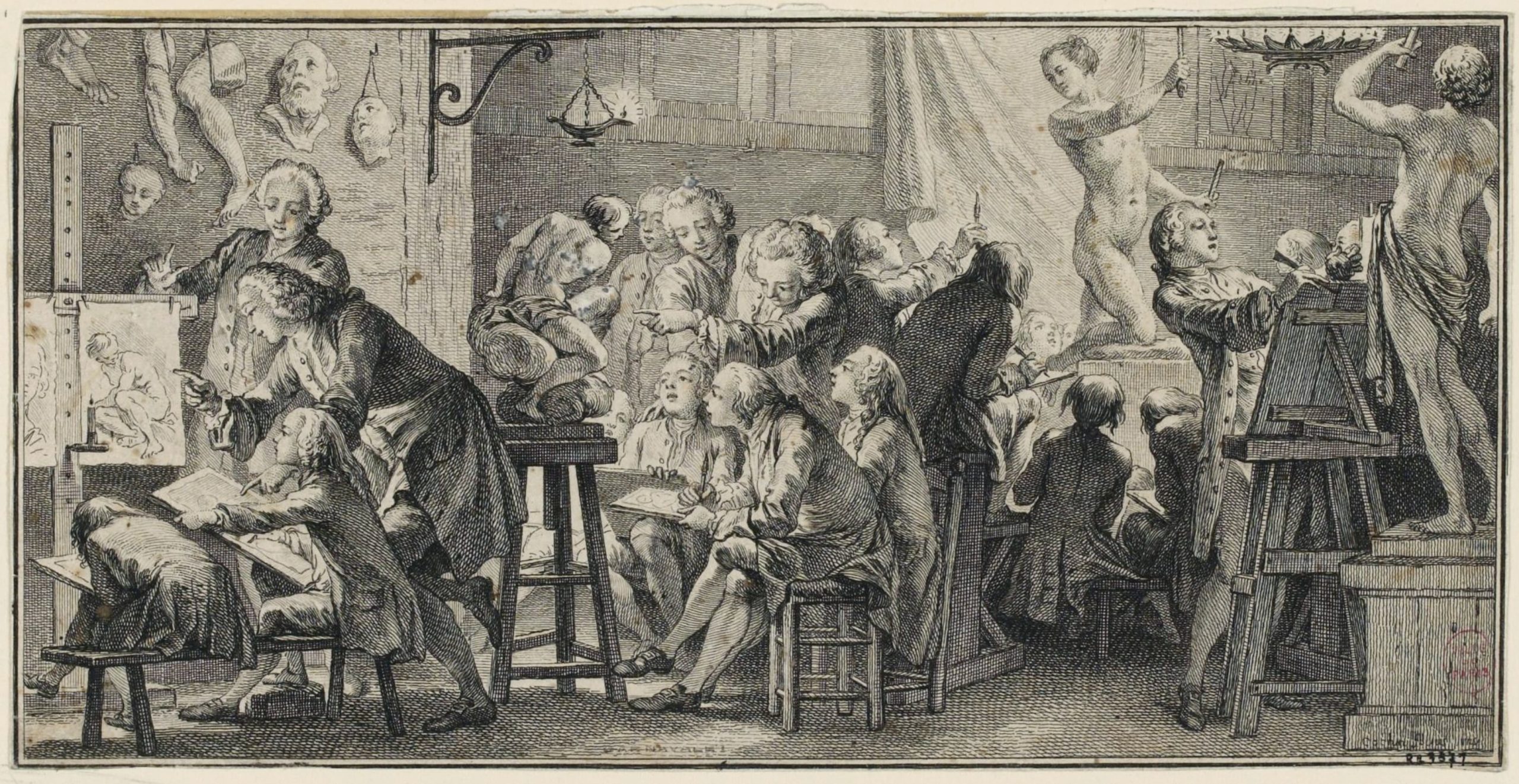
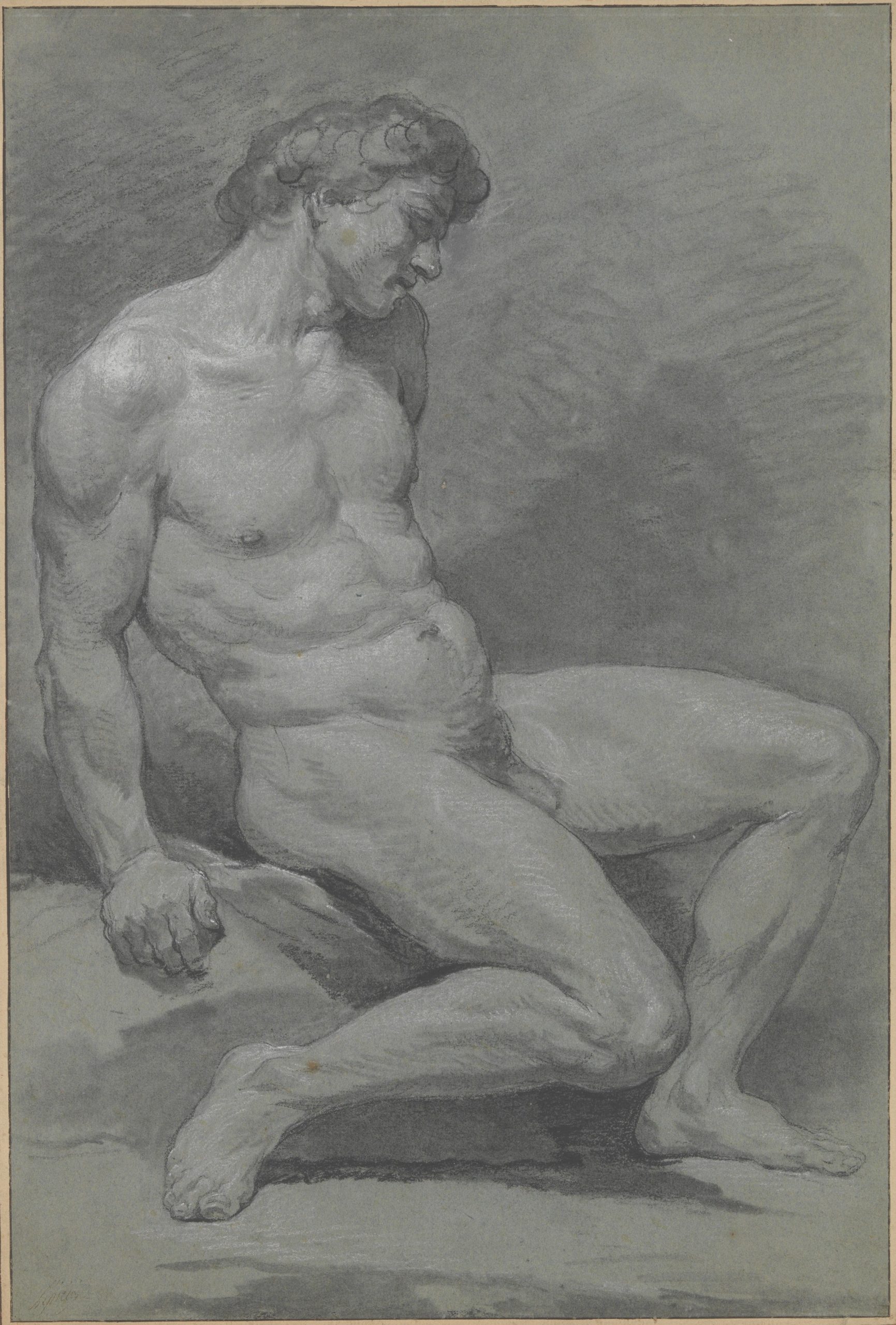
Academic instruction was centered on drawing (following the precedent of Italian drawing schools established in the sixteenth century). The Académie maintained a rigid curriculum to instruct artists, as recorded in contemporary accounts and depictions. An etching illustrating a 1763 description of the “school of art” shows how students first learned to draw by copying drawings and engravings (seen on the left) before moving on to drawing plaster casts to learn how to translate the three-dimensional form into two dimensions (seen at center). Students would then copy large-scale sculpture (as seen at the right-most edge) before being allowed to draw the live nude model (as seen in the middle-right portion, slightly set back from the foreground). Drawing the male nude form was the bedrock of the Académie’s curriculum, an essential building block for painters, particularly those destined to produce history paintings. Students produced many single-figure nude studies, known as académies,such as this example from Nicolas Bernard Lépicié. Props could be added subsequently to transform the posed bodies into identifiable figures.
In a lively drawing, Charles Natoire depicts himself in a red cape in the left foreground, providing feedback on students’ drawings. The majority of students work independently, focused on the two nude models in an intertwined pose selected by the supervising professor. The opportunity to study two interacting male bodies was a rarer and more challenging exercise.
Outside of the Académie’s official spaces, academicians would provide advanced students opportunities to draw nude female models. In addition to supervising drawing education, each professor selected students to be part of his studio. This is where artists actually learned to paint or sculpt by emulating their teacher, often contributing to his large-scale commissions. Studio practices varied, and not all studio members were necessarily enrolled Académie students.
Both academicians and students attended lectures addressing theoretical and practical aspects of artistic practice, such as the importance of expressions or how to apply paint to ensure longevity. These were offered by professors and so-called amateurs. These honorary Académie members were not professional artists but art lovers and “friends of artists”—often from the nobility—who advised artists on questions of composition, aesthetics, and iconography and often championed certain artists, sometimes as patrons or collectors.
The draw of Rome
The classical tradition was central to the Académie’s curriculum. In 1666, the Académie opened a satellite in Rome to facilitate students’ study of antiquity. In 1674, the Académie established the Prix de Rome (Rome Prize), a prestigious award that allowed its most promising artists to study in Rome for three to five years. While the focus of the French Academy in Rome was facilitating the study of classical antiquity, students also drew after important Renaissance and Baroque artworks, as seen in Hubert Robert’s red chalk drawing depicting an artist copying Domenichino’s fresco in a Roman church.
While in Rome, these Académie students—called pensionnaires—studied canonical artworks and regularly sent their drawings and copies after important works back to Paris to demonstrate their progress. Although not part of the formal curriculum, most artists explored the Roman environs, taking inspiration from the rich landscape, diverse topography, and colorful scenes of peasant life. Important connections were forged in Rome with other artists, patrons, and supporters.
Salons and the rise of public opinion
Beginning in 1667, the Académie established exhibitions to provide members with the crucial opportunity to display their work to a wider audience, thereby cultivating potential patrons and critical attention. Held annually and, later, biannually, these exhibitions came to be known as Salons, after the Louvre’s salon carré where they took place after 1725. The Salon became a significant space of artistic exchange and an important opportunity to view art prior to the formation of the public art museum.
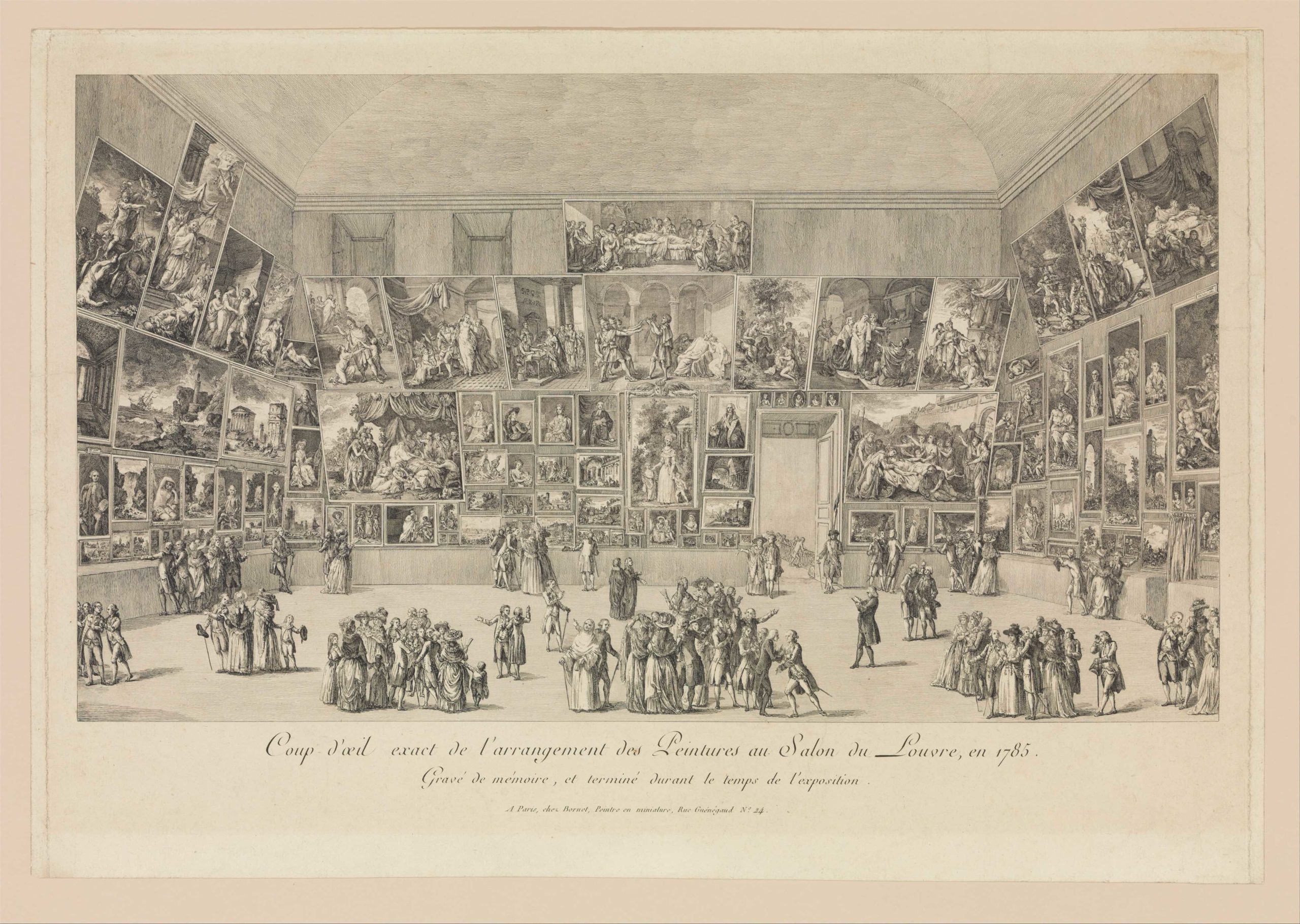
Artworks in the Salon were selected by a jury of academicians. Paintings were displayed according to size and genre, with larger works (history painting and portraiture) occupying the more prestigious higher levels, as can be seen in an engraving of the Salon of 1785 where Jacques-Louis David’s Oath of the Horatii features prominently in the center. With the 1737 introduction of a broader public to the Salon came the advent of public opinion and the emergence of art criticism. The Académie published a booklet that listed the displayed works, organized by the artist’s rank, called the livret. Art collectors and learned Salon-goers penned opinions analyzing the artistic and intellectual merit of the exhibited artworks; some of these, like those written by philosopher Denis Diderot, were meant for a small community of like-minded individuals both in France and beyond, but increasingly art criticism was printed in newspapers for access by a broader public.
Genders and genres
The Académie was a male space, for the most part; some painters accepted female students in their studios, particularly in the last quarter of the eighteenth century. Women artists were barred by propriety from studying the male nude figure, a core aspect of Academic training. This rendered them unable to become officially recognized history painters, and they were therefore restricted to genres considered to be less intellectually rigorous. During its 150-year long history, the Académie only welcomed four women as full members: Marie-Thérèse Reboul was admitted in 1757; Anne Vallayer-Coster was admitted in 1770; Adélaïde Labille-Guiard and Elisabeth Vigée-LeBrun were both admitted in 1783.
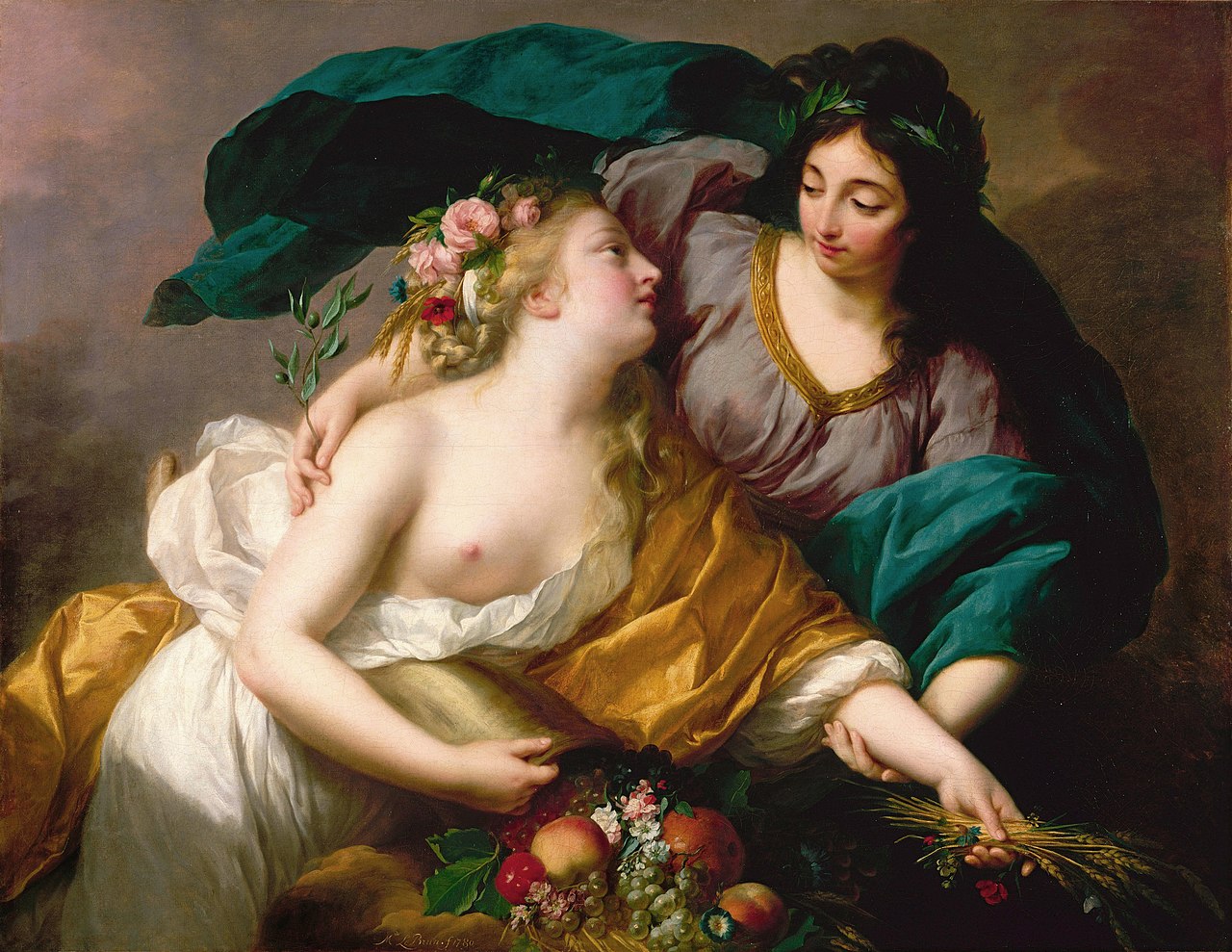
Despite their acceptance to the Académie, these women had limited options. Painting primarily still-lifes (like Reboul), Vallayer-Coster elevated that genre with large-scale ornate compositions. Labille-Guiard led a large studio of female students and was well-known as a prominent portraitist. So too did Vigée-LeBrun, who pushed the boundaries of genre and her gender by occasionally painting allegories, including her reception piece for the Académie. Familial connections (in the case of Reboul, Labille-Guiard, and Vigée-LeBrun) or royal protectors (in the case of Vallayer-Coster, Labille-Guiard, and Vigée-LeBrun) played vital roles in their success. Without such champions, female artists were unable to penetrate the patriarchal institution of the Académie. Still, their work and personal lives were subjected to undue public scrutiny and their achievements were often maligned.
Abolition and afterlives
In the 1780s, the Académie came under attack by members and outsiders for politicizing the distribution of prizes and honors. Its rigid hierarchies, inequitable structures, and rampant nepotism were incompatible with the Revolution’s core values of Liberty and Equality. Major artists who had benefited from the institution lobbied for its dissolution. With the overthrow of the monarchy and Louis XVI’s execution, institutions with indelible royal connections were scrutinized and deemed irrelevant. The Académie was abolished on August 8,1793 by order of the National Convention.
After several years of hardship for artists brought about by the erosion of royal, noble, and ecclesiastical patronage during the Revolution, the Directory government revived many of the structures of the Académie in establishing a National Institute of Sciences and Arts (Institut nationale des sciences et des arts, subsequently Institut de France) in 1795. The new organization’s membership included many former academicians, who reinstated certain aspects of the now-defunct Académie, such as the Rome Prize in 1797. The hierarchy of genres, inculcated in the Académie’s members and audiences, remained central to understanding the arts throughout the nineteenth century.
Rococo art, an introduction
The beginnings of Rococo
In the early years of the 1700s, at the end of the reign of Louis XIV, there was a shift away from the classicism and “Grand Manner” (based on the art of Nicolas Poussin) that had governed the art of the preceding 50 years in France, toward a new style that we call Rococo. The Palace of Versailles (a royal chateau that was the center of political power) was abandoned by the aristocracy, who once again took up residence in Paris. A shift away from the monarchy, toward the aristocracy characterizes the art of this period.
What kind of lifestyle did the aristocracy lead? Remember that the aristocracy had enormous political power as well as enormous wealth. Many chose leisure as a pursuit and became involved themselves in romantic intrigues. Indeed, they created a culture of luxury and excess that formed a stark contrast to the lives of most people in France. The aristocracy—only a small percentage of the population of France—owned over 90% of its wealth. A small, but growing middle class will not sit still with this for long (remember the French Revolution of 1789).
Antoine Watteau, Pilgrimage to Cythera
Influenced by Rubens and Venetian art, Antoine Watteau created the fête galante, a new Rococo genre that reflected the artifice of aristocratic leisure.
Jean-Honoré Fragonard, The Swing
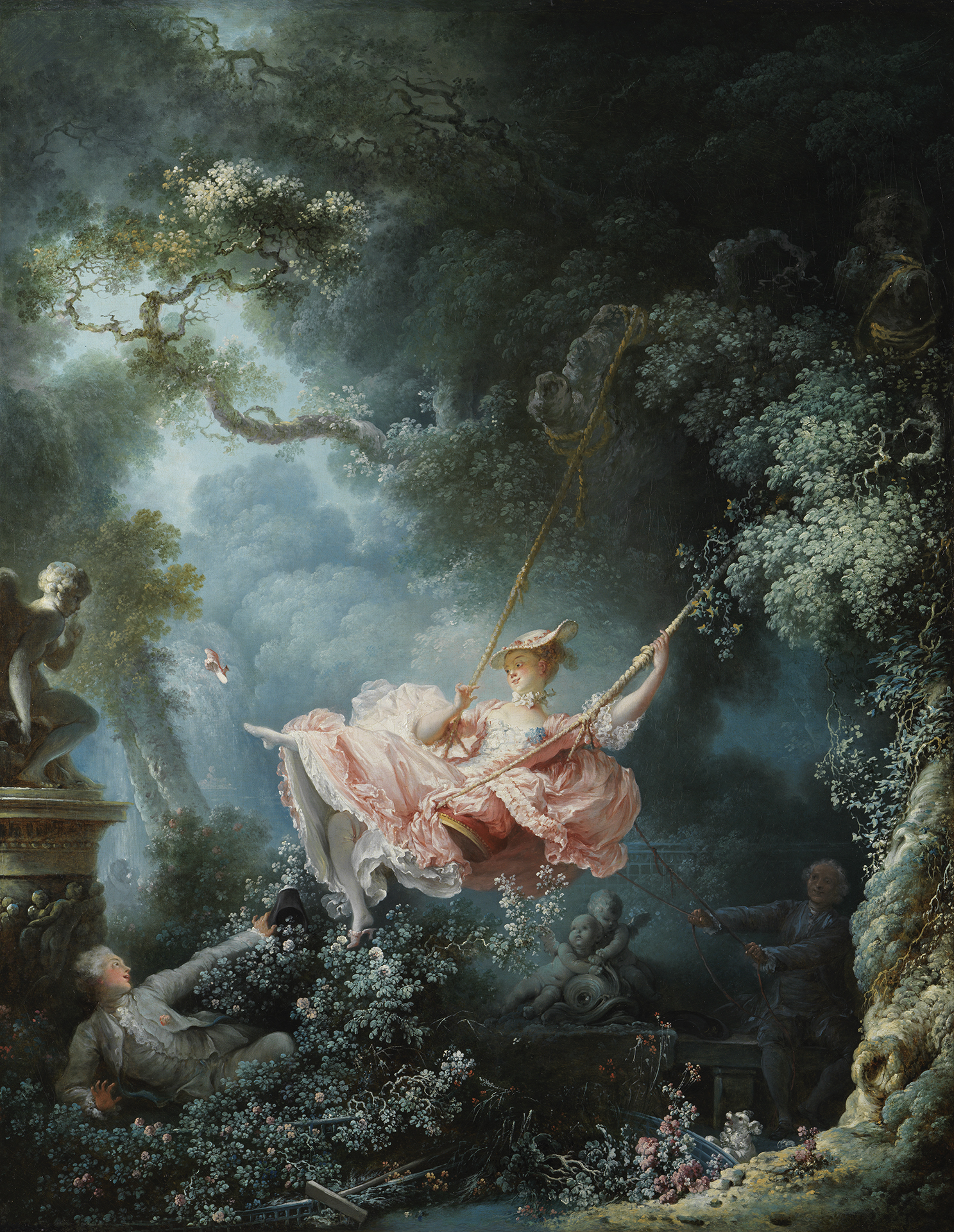
As with most Rococo paintings, the subject of Jean-Honoré Fragonard’s The Swing is not very complicated. Two lovers have conspired to get an older fellow to push the young lady in the swing while her lover hides in the bushes. Their idea is that—as she goes up in the swing, she can part her legs, and her lover can get a tantalizing view up her skirt.
The figures are surrounded by a lush, overgrown garden. A sculptured figure to the left puts his fingers to his mouth, as though saying “hush,” while another sculpture in the background shows two cupid figures cuddled together. The colors are pastel pale pinks and greens, and although we have a sense of movement and a prominent diagonal line—the painting lacks the seriousness of a Baroque painting.
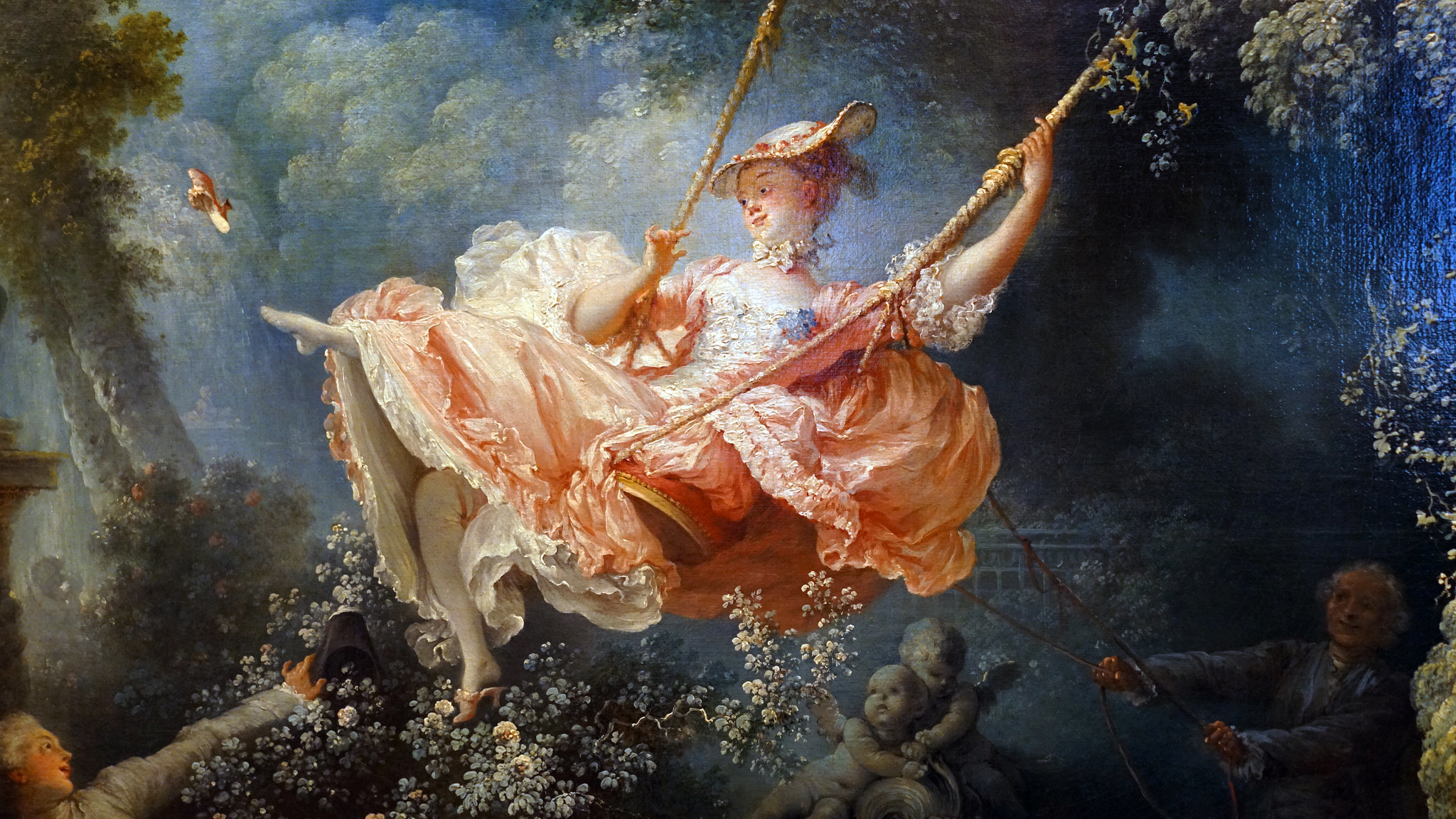
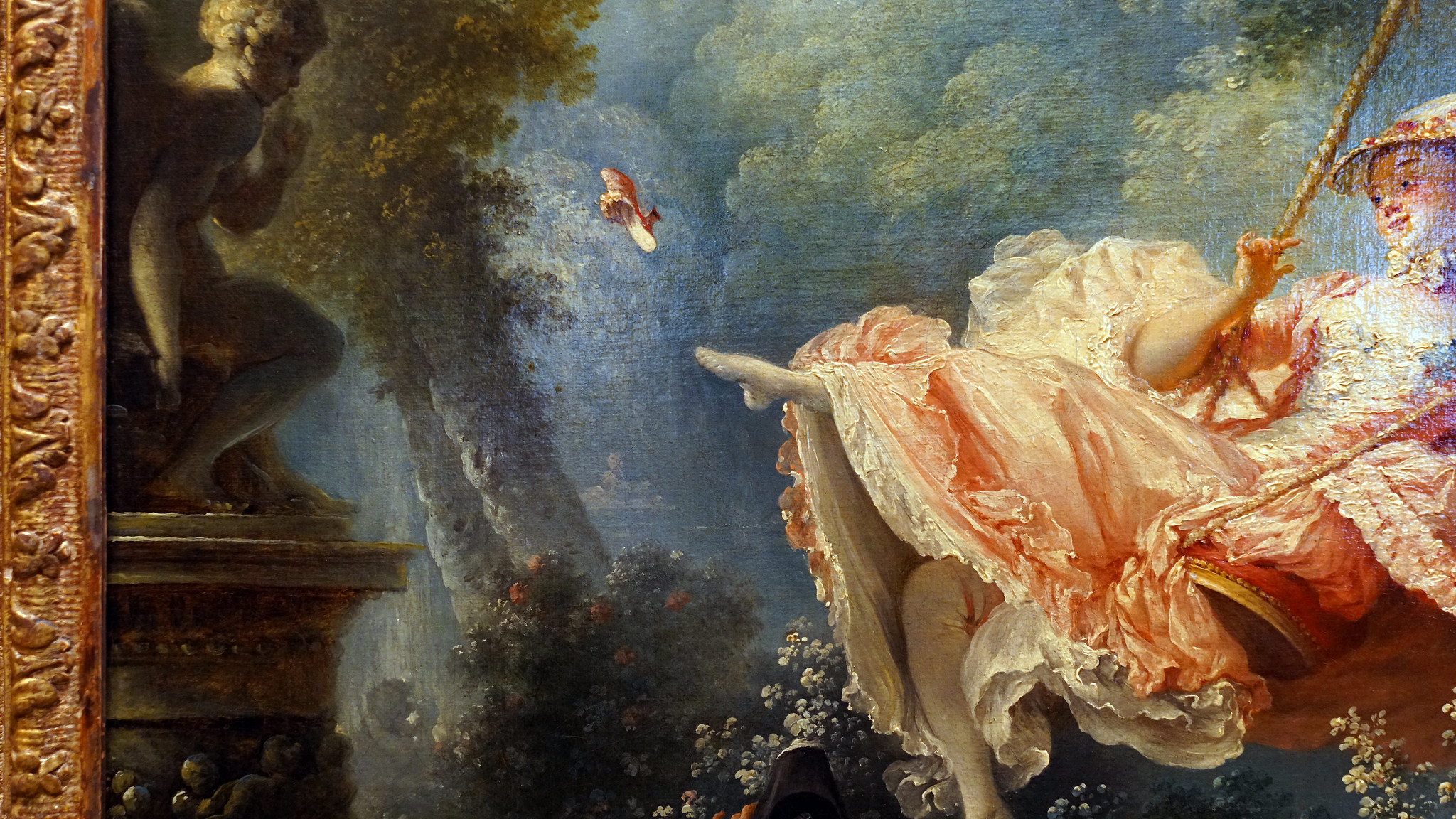
Inside a lush garden, a young woman in a billowing pink gown glides through the air. Her suspension high above the ground is enabled by a swing consisting of a crimson velvet cushioned seat and a pair of ropes tied around the knobby branches of an enormous tree. On the far right, an older man seated on a stone bench helps operate the device. Using a series of connected ropes, he pulls the swing back to create the momentum necessary to propel the woman forward. As he releases the ropes, she leans back and extends her legs, expelling a tiny pink slipper from her pointed foot. The dainty shoe flies through the air toward a marble statue on the far left. At the base of the large pedestal supporting this sculpture lies a young man. Partially hidden by an overgrown rose bush, he peers wide-eyed up the open skirt of the swinging woman.
This oil painting known as The Swing was created by the French artist Jean-Honoré Fragonard sometime during 1767 and 1768. A gentleman of the court reportedly requested the painter represent his mistress being pushed on a swing as he secretly admired her from below. While the figures in the work are not identifiable as portraits of specific individuals, their rich attire and leisurely activity underline their aristocratic status.
Such playful and erotic scenes were popular among the elite clientele Fragonard served. Unlike large-scale history paintings, or the widely collected genres of portraiture and landscape, these works were relatively small (81 x 64.2 cm in the case of The Swing) and intended for display in intimate rooms known as cabinets. Admiring the painting in the privacy of such a space, the patron and his inner circle would have appreciated its depiction of societal norms subverted for the pursuit of personal pleasure. The work’s strong appeal led to the production of a printed version by Nicolas Delaunay in 1782, which circulated among a broader, though still elite, audience of collectors.
Play and pleasure
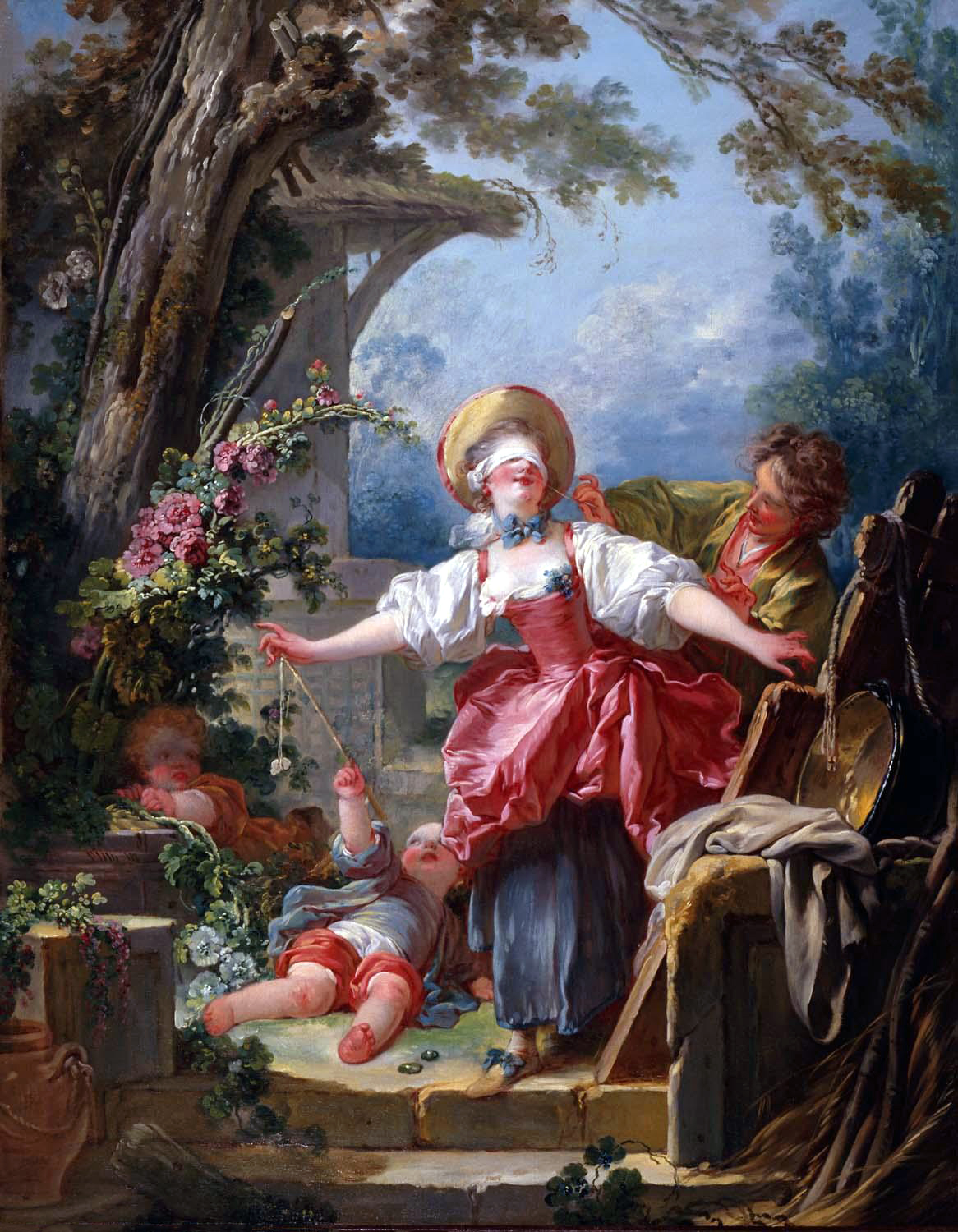
Swinging was one of several outdoor leisure activities common among elites in eighteenth-century France. Artists captured these popular games and pastimes in numerous works of art created for private patrons, such as two of Fragonard’s earlier paintings: Blind Man’s Bluff and The See-Saw. The See-Saw‘s portrayal of a young woman gleefully raising her arms and legs as she is suspended in mid-air is a clear precedent for the pose of the main figure in The Swing. Both women recline back as they lift their arms nearly above their heads and kick one leg up, revealing the area beneath their skirts. Eighteenth-century audiences would have considered this uninhibited behavior quite indecent under ordinary circumstances. However, within the context of leisure activities, the period’s established rules of social etiquette were often bent.
Intimate garden-parks like the one depicted in The Swing were common sites for aristocratic leisure. These outdoor spaces were viewed as less formal than domestic interiors. Situated on the grounds of private country estates and pleasure pavilions, garden-parks provided a retreat from the strict regulations of elite society. Here, French nobles could fashion themselves as carefree shepherds or milkmaids, a role-playing game alluded to by the swinging woman’s straw hat. In addition, the hidden alcoves and secret corners within these asymmetrical gardens enabled men and women to mingle more freely and couples to sneak away unchaperoned. By juxtaposing various natural and man-made elements, Fragonard emphasizes the freedoms and restrictions French elites simultaneously experienced when playing in these spaces. While the fountains and trelliswork on the right suggest efforts to manipulate nature, the overgrown plants and abandoned rake in the foreground underline that the will of nature—like that of love—can never be fully constrained.
Eroticism
The left side of The Swing includes multiple references to untamed desire. Clearest among these is the swinging woman’s raised left leg, which lifts the hem of her skirt to reveal her curved right calf clad with a white stocking and pink garter. This flirtatious act signals her rejection of the traditional constraints of female modesty.
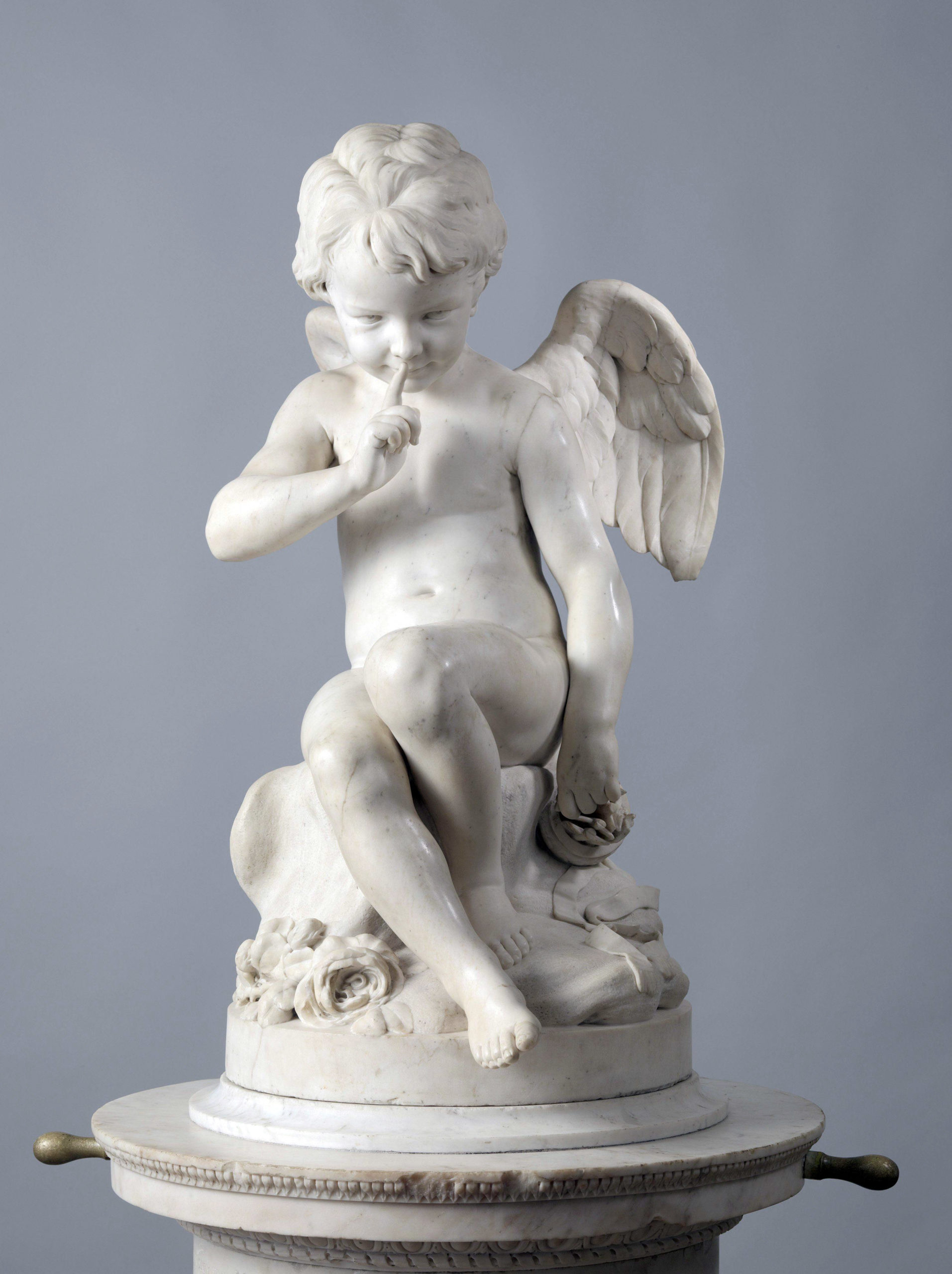
The heeled slipper that flies off her pointed foot leads our eyes to a marble statue of Cupid (the mythological god of erotic love) on the far left. Fragonard based this object on a well-known sculpture created by Etienne-Maurice Falconet in 1755 for King Louis XV’s former mistress, Madame de Pompadour. Both the painted and sculpted Cupid bring the index finger of one hand to their lips as they reach with the opposite hand to remove an arrow from their quivers. By showing the god facing the swinging woman as he makes this silencing gesture, Fragonard positions the two as confidants sharing a secret.
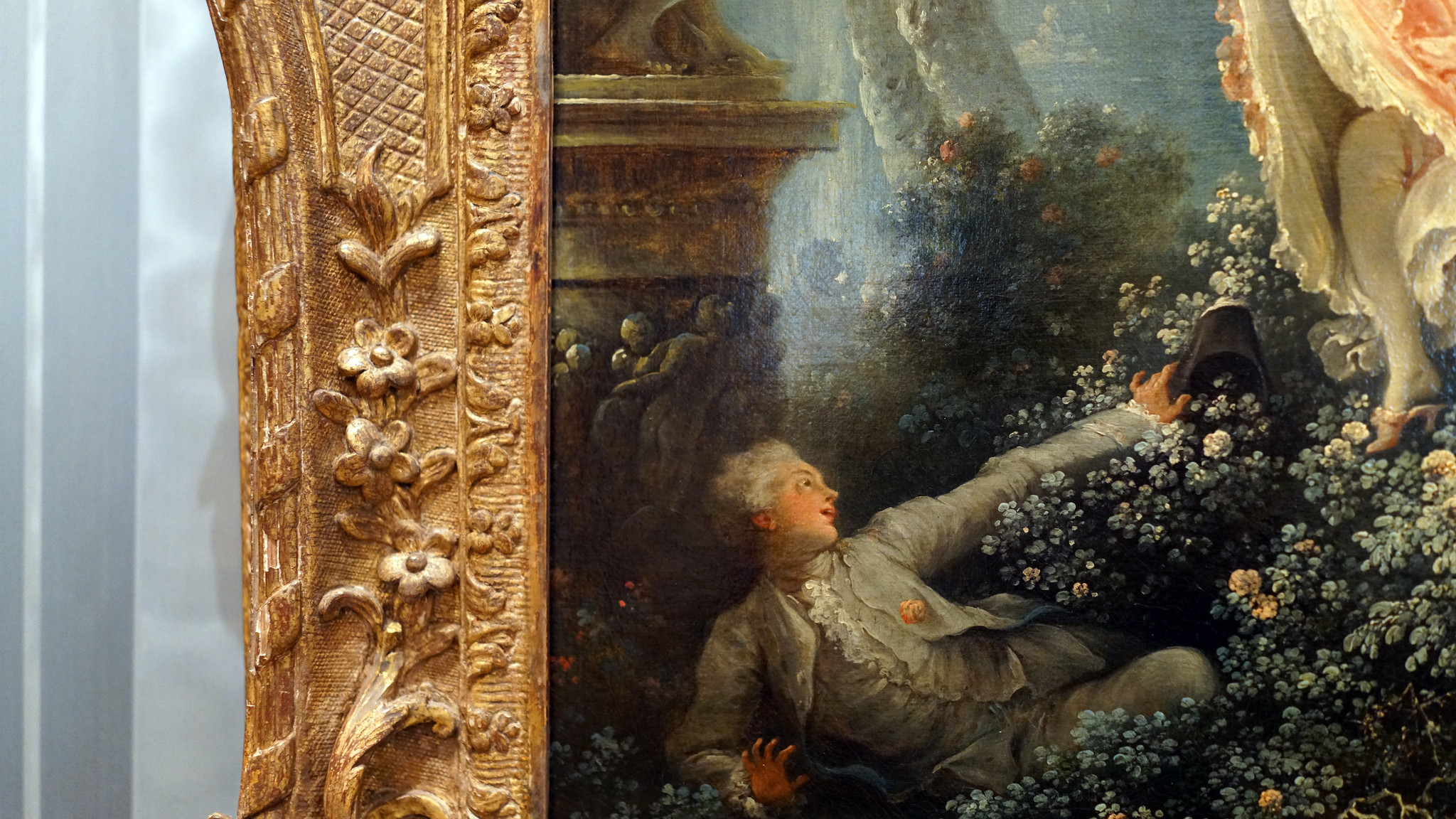
The subject of their deception is quickly discovered hiding in the rose bushes below. Here, a young man leans against the statue’s pedestal carved with images of dancing maenads. A seeming victim of the infatuation caused by Cupid’s arrow, his wide-eyed gaze and extended left arm turn our attention to the exposed legs of the woman. The layers of her skirt open like the petals of the blooming pink roses on the bush below, a visual connection that suggests her fertility rivals that of the garden itself.
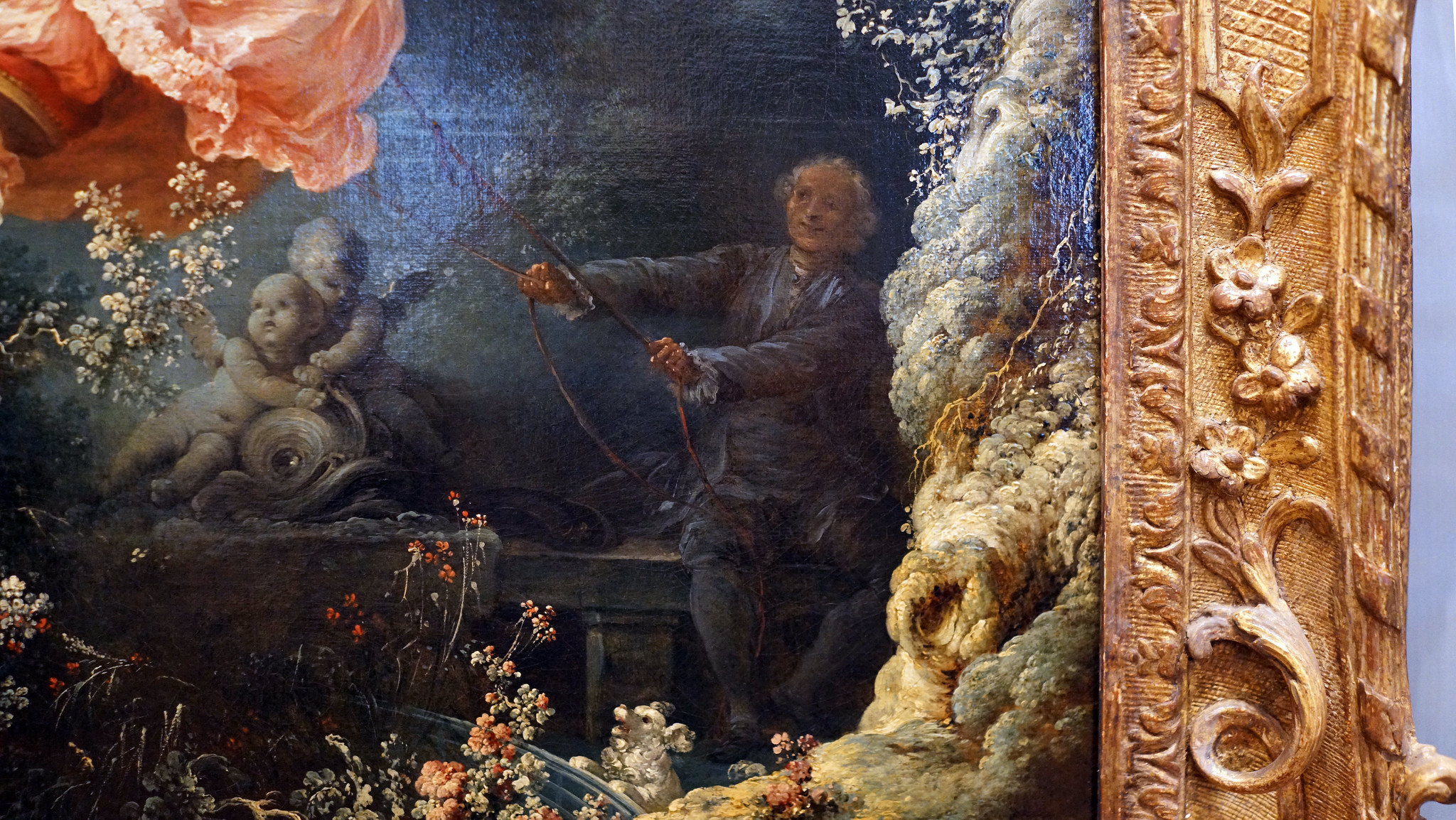
These references to unbridled passion are balanced by symbols of constraint on the right side of the composition. Beside the garden’s trellis and fountain, the older man operating the swing is presumably the husband of the young woman. His smiling expression as he gazes at his wife suggests that he is blissfully unaware of her hidden lover. A series of looks and gestures connects the three figures, creating an inverted V-shape that visually reinforces their individual roles in this love triangle. The ropes the husband uses to pull his wife toward him resemble a set of reigns and are evocative of both the bonds of marriage and the restrictions placed on female sexuality during the period. The act of taming is further recalled by an adjacent sculpture of two putti riding a dolphin. While the winged bodies of these figures echo that of Cupid on the far left, the putto gazing at the swinging woman adopts a concerned rather than conspiratorial expression. Likewise, the yapping white dog (a common symbol of fidelity) at the husband’s feet seems to sound the alarm on the woman’s bawdy behavior. Contrasting with Cupid as secret-keeper, the barking dog threatens to expose the infidelity of its mistress.
The Rococo’s visual games
While works like The Swing would be critiqued as symbols of the moral decay of aristocratic culture, they were immensely popular during the eighteenth century. The appeal of these objects often categorized as Rococo art rested not only in their styles or subjects, which were exceptionally diverse, but also in their ability to engross viewers in visual games that comment on the nature of both art and humanity. The Swing draws us in through a mixture of visual humor, double entendre, and loaded symbols that reward close looking. Like the woman swinging back-and-forth, our attention is swiftly drawn between the many rich details sprinkled across the painted canvas. As our eyes move from one element to the next, we discover charged symbols like the abandoned rake or yapping dog and recognize familiar characters such as Cupid or the dancing maenads. We also uncover intriguing connections between the swinging woman and Venus (a companion of Cupid), Madame de Pompadour (patron of Falconet’s sculpture), or a blooming flower (like the pink rose adorning her lover’s jacket). These discoveries provide us with mental exhilaration meant to rival the physical thrill of riders on a swing. Like swingers flying through the air while tethered to a stable object, we are simultaneously free and supported as we explore the artist’s carefully constructed canvas.
It was precisely this kind of painting that the philosophers of the Enlightenment were soon to condemn. They demanded a new style of art, one that showed an example of moral behavior, of human beings at their most noble.
Élisabeth Louise Vigée Le Brun, Self-Portrait and Archduchess Marie Antoinette
There is an oft-quoted saying misattributed to Marie Antoinette, Queen of France, during a famine suffered by her subjects: If they have no bread, “then let them eat cake.”
In fact, this statement (which showed flagrant disregard for the suffering of the people) was never uttered by the Queen that we know from so many sumptuous portraits. These portraits are largely the work of Élisabeth Louise Vigée Le Brun, a celebrated French artist known especially for her lavish portraits of Marie Antoinette and other European monarchs and nobles as well as for her many self-portraits.
Patron Queen
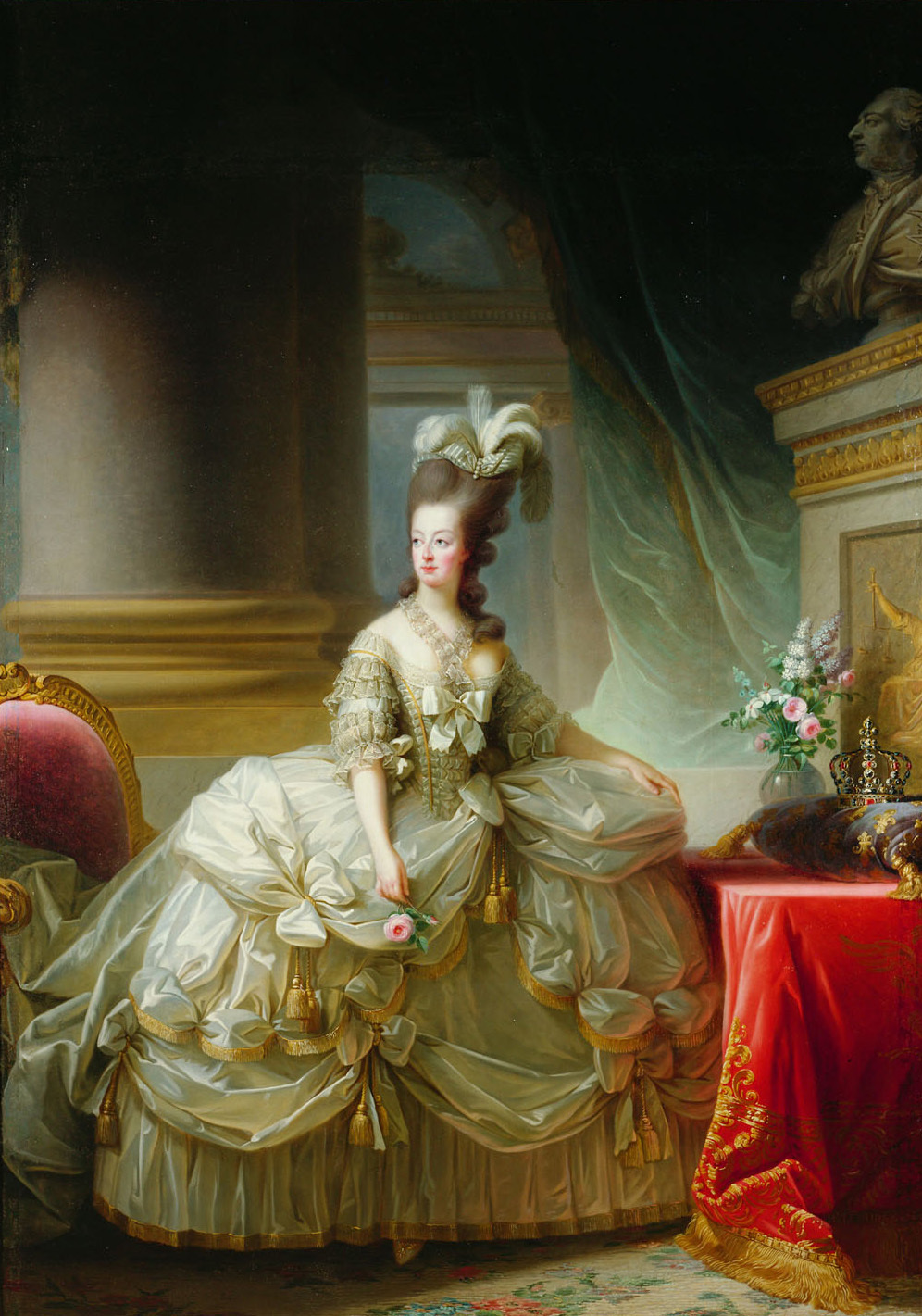
Vigée Le Brun first met Queen Marie Antoinette at the royal palace at Versailles in 1778. The Queen had heard of the young painter’s successes and had her own likeness painted en robe a paniers (in a hoopskirt). The painting is a majestic full-length display of power. Marie Antoinette stands facing the viewer, with the exception of her head, which is turned slightly to the viewer’s left so that she looks past us. The Queen is dressed in an elaborate golden white dress. Her hair is piled high and she wears a feathery headdress. All around her are the accoutrements of her station: huge columns, a marble bust of her husband, Louis XVI, displayed high atop a pedestal and behind a table on which sits a crown. The painting was originally meant for the queen’s brother, Emperor Joseph II of Austria, but Marie Antoinette was so pleased with it that she ordered copies made for Catherine the Great of Russia and her own apartments at Versailles.
Élisabeth Louise Vigée Le Brun, painter
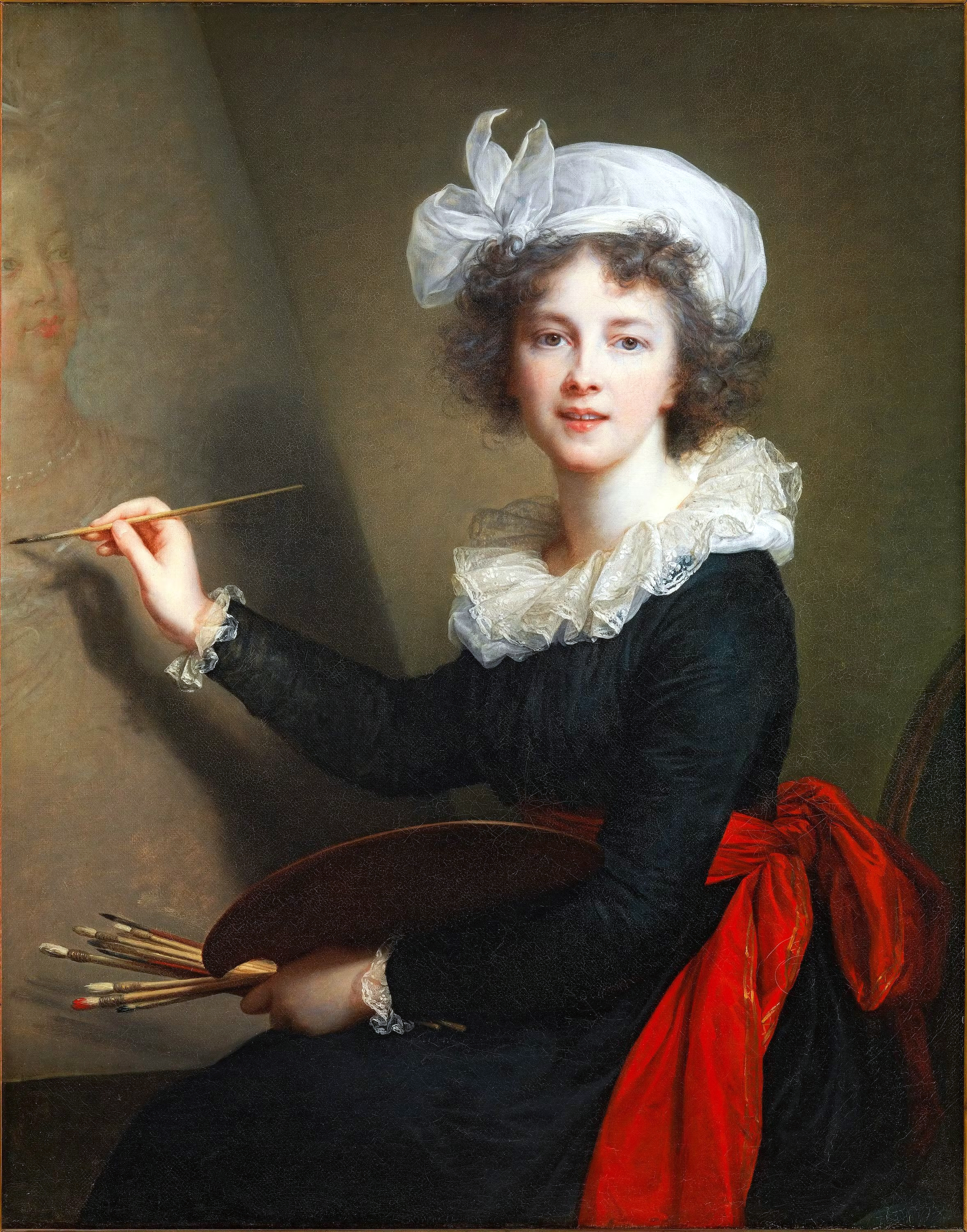
The artist who created this opulent showpiece became famous and wealthy as Queen Marie Antoinette’s official court painter. She was born to Louis Vigée and Jeanne Maissin in a bustling section of Paris. In her autobiography Souvenirs written towards the end of her life, Vigée Le Brun wrote that her father, a minor portraitist, doted on her, wishing his daughter fame and good fortune, and that he cherished her early efforts at drawing. Vigée Le Brun wrote that her mother thought her awkward and ugly. Nevertheless, she grew up to be intelligent, beautiful, rich, and talented, characteristics on display in her Self-Portrait of 1790.
Created soon after her swift departure from France at the onset of the French Revolution, Vigée Le Brun’s Self-Portrait in the Gallerie degli Uffizi in Florence is one of her best-known pictures. It is a late example of the Rococo style. Rococo epitomized a fashionable ideal, wherein perpetual youth was libertine and pleasure-loving, its sexual gratification taken without guilt or consequence. Despite this, the artist, like her royal patron, was extremely conservative in her politics.
This self-portrait was painted in Rome; one of the first cities in which Vigée Le Brun stayed during her decade-long exile from France. The artist sits in a relaxed pose at her easel and is positioned slightly off center. She wears a white turban and a dark dress—in the free-flowing style that Marie Antoinette had made popular at the French court—with a soft, white, ruffled collar of the same material as her headdress. Her belt is a wide red ribbon. Vigée Le Brun holds a brush to a partially finished work; the subject is probably Marie Antoinette—perhaps intended as a tribute to her favorite sitter. Slightly used brushes are at the ready along with a palette, she has everything cradled in her arm close to the viewer.
The painting expresses an alert intelligence, vibrancy, and freedom from care, despite the fact that Vigée Le Brun had been forced to flee France in disguise and under cover of darkness during the early stages of the Revolution. As she painted this portrait, her Queen was being driven from power by revolutionaries who hated the profligate lifestyle of the nobility and would later execute both Marie Antoinette and her husband, King Louis XVI. Given these circumstances, Vigée Le Brun—a working painter, wife, and mother—displays an extraordinarily sanguine persona.
The Rococo in England: Thomas Gainsborough, Mr. and Mrs. Andrews
Money. Possessions. Power.
The same materialistic ideals which drive many men and women today have performed the same function throughout history. Those in positions of power often chose to commemorate their status through images. Some purchase works of art by famous artists to demonstrate their wealth, while others commission portraits of themselves as reminders of their prestige.
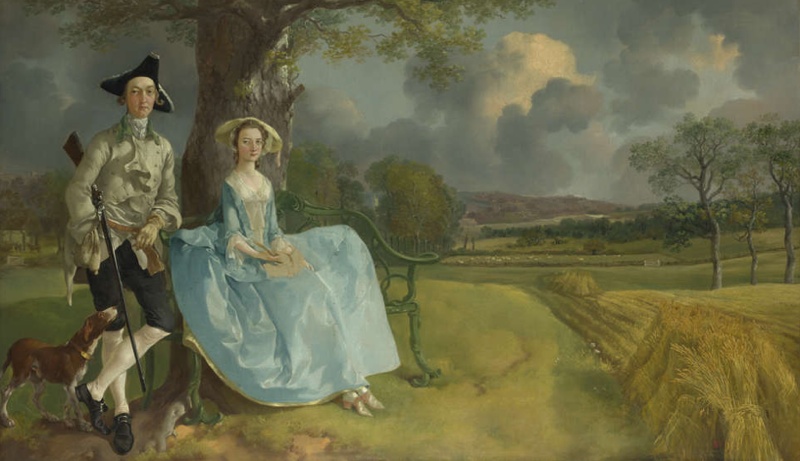
A young couple in the middle of the eighteenth century, Robert Andrews and Frances Andrews, opted for the second option to celebrate their marriage and subsequent combination of their families’ fortune. To depict their increased status, the Andrews’ commissioned a relatively unknown painter named Thomas Gainsborough to paint their portraits. Little could they anticipate that within a few decades it would be the artist, and not the subjects, that would make their portrait famous.
A conversation on canvas
Gainsborough’s portrait of the newly-married Robert and Frances Andrews is typical of the genre of “conversation pieces;” informal group portraits which gained popularity in the middle of the eighteenth century in England. Unlike the formal, straightforward portraits which characterized earlier periods and locations, the “conversation piece” usually presented a small group of individuals in an outdoor space, engaged in discussion and unaware of the viewer’s presence. Mr. and Mrs. Andrews diverts from that tradition, as its sitters are clearly reacting to Gainsborough’s presence, but their relaxed poses and location in the English countryside connects them to the “conversation piece” tradition.
At the time Gainsborough executed this painting, he was a 23-year-old emerging artist working in city of Ipswich in the rural English county of Suffolk. As a teenager he served an apprenticeship in London and also received instruction from Hubert-François Gravelot, a popular Rococo engraver working in England’s capital city. In 1749 Gainsborough moved with his wife to Ipswich, 70 miles from London and just 20 miles from his birthplace of Sudbury, in Suffolk County. Robert Andrews and his future wife, then known as Frances Carter, also grew up in Sudbury, in much wealthier families. In his portrait of the pair, Gainsborough captures the barely-veiled disdain in Frances Andrews’ eyes and her wry smile. She and her husband are well aware that the portraitist, whom they would have known since childhood, is well below them on the social ladder.
Love of landscape
Following the “conversation piece” tradition, Gainsborough includes a landscape in his painting. However, he provides a much greater view of rural England than might be expected from such a work. Mr. and Mrs. Andrews pose on the left half of the canvas, rather than directly in the middle as was typical in a straightforward portrait. On the right side, Gainsborough gives equal attention to the grounds of The Auberies, the Andrews’ estate in Sudbury.
The couple is located on the edge of a field of wheat, and fenced in cattle populate the middle ground to the left while sheep graze to the right of the pair. Through the implementation of modern agricultural techniques and technology, Mr. Andrews has brought the land under his control. His pose is meant to suggest that his work is done and he can now relax and hunt with his dog, although he doesn’t look very comfortable holding his rifle.
The attention Gainsborough lavishes on the rolling English countryside reflects his lifelong love for nature. Although he became famous as a portrait painter, Gainsborough insisted throughout his life that landscape painting was his true calling, and he considered himself a landscape painter rather than a portraitist. He spent most of his career outside of London, the center of the English art world. After leaving Ipswich a decade after painting Mr. and Mrs. Andrews, Gainsborough set up shop in the resort city of Bath, where his delicate and sensual portraits defined the Rococo fashion in England in the second half of the eighteenth century.
Rococo in England
The Rococo was a French style, imported by foreign artists like Hubert-François Gravelot and by English collectors. In the early 1700s England did not have a strong painting tradition, and its most famous artists were international painters who traveled to London to take advantage of that fact. Gainsborough looked to the frivolous, playful paintings being commissioned by French aristocrats, and applied their delicate style to slightly more reserved and contained subjects.
Mrs. Andrews’ dress possesses the pastel colors and delicate lace of more erotic French works like Jean-Honoré Fragonard’s The Swing. Her dress and Mr. Andrews’ shirt glimmer in sunlight, despite the overcast sky. Mrs. Andrews sits on a bench that is entirely too elaborate to sit exposed in the middle of a wheat field. Both figures are pale and lithe, reflecting the upper-class privilege of not having to work for a living. Their expansive estate functions as an ostentatious demonstration of their wealth: it continues as far as the eye can see.
A mysterious absence
Although the Andrews purchased their conversation portrait from Gainsborough, something is missing from the work. Bare canvas surrounds Mrs. Andrews’ hands, folded in her lap. No one knows exactly what Gainsborough intended to paint in that space, if he intended to paint anything at all. Some scholars have suggested that Mrs. Andrews was meant to hold a dead game bird, the result of a successful hunting trip by her husband. Such an inclusion would emphasize the couple’s control over their land, but a bloody animal would ruin Mrs. Andrews’ elaborate dress, and therefore seems unlikely.
Another possibility for Mrs. Andrews’ lap is that the blank space was intended for a baby. Regardless of what was meant to go in that spot, Gainsborough never added it in. Modern scholars consider the painting to be “unfinished,” but we’ll never know what the original finished work was to look like, or if its current state was as “finished” as Gainsborough and the Andrews wanted.
Conclusion
As the late 17th century Baroque style at Versailles transformed into the 18th century Rococo style, major societal changes were taking place. The monarchy and the aristocracy grew in their power and authority over previous power structures like the Catholic Church. The luxurious tastes of the aristocracy dominated the Rococo style as patrons commissioned artworks of pleasure, leisure, and sensuality for their private homes. While the Rococo style was in vogue around 1700-1780, the Enlightenment was simultaneously occurring. Driven by the ideals of science, reason, and morality, philosophers of the Enlightenment would point to the frivolous luxuries of the Rococo style and its patrons. Soon, even larger societal shifts would take place in the form of revolution and the rising new style of the Neoclassical.
Citation and Licensing
The following sections were written by Chelsea Wright and licensed CC BY-NC-SA 4.0:
- Chapter Overview and Introduction
- Focus artwork and term list compiled by Chelsea Wright
- Conclusion
The following articles from Smarthistory licensed CC BY-NC-SA 4.0 were remixed and adapted for the chapter:
- Smarthistory, “Spanish Baroque,” in Smarthistory.
- Smarthistory, “Diego Velazquez,” in Smarthistory.
- Dr. Letha Ch’ien, “Diego Velázquez, Las Meninas,” in Smarthistory, March 25, 2026.
- Tessa Fleming, “Hyacinthe Rigaud, Louis XIV,” in Smarthistory, August 8, 2015.
- Rachel Ropeik, “Louis le Vau, André le Nôtre, and Charles le Brun, Château de Versailles,” in Smarthistory, August 8, 2015.
- Smarthistory, “French Baroque,” in Smarthistory.
- Smarthistory, “Nicolas Poussin,” in Smarthistory.
- Dr. Steven Zucker and Dr. Beth Harris, “Nicolas Poussin, Landscape with Saint John on Patmos,” in Smarthistory, December 4, 2015.
- Daniella Berman, “The formation of a French school: the Royal Academy of Painting and Sculpture,” in Smarthistory, September 2, 2020.
- Dr. Steven Zucker and Dr. Beth Harris, “Rococo art, an introduction,” in Smarthistory, January 7, 2016.
- Smarthistory, “Antoine Watteau,” in Smarthistory.
- Dr. Steven Zucker and Dr. Beth Harris, “Antoine Watteau, Pilgrimage to Cythera,” in Smarthistory, December 13, 2015.
- Dr. Ashley Bruckbauer, “Jean-Honoré Fragonard, The Swing,” in Smarthistory, February 26, 2021.
- Dr. April Renée Lynch, “Élisabeth Louise Vigée Le Brun, Self-Portrait,” in Smarthistory, January 7, 2016.
- Dr. Abram Fox, “Thomas Gainsborough, Mr. and Mrs. Andrews,” in Smarthistory, January 8, 2016.



,_K%C3%B6nigin_von_Frankreich_-_GG_2772_-_Kunsthistorisches_Museum.jpg)

