
Art After World War II
Chapter Overview and Introduction
After World War II, several major art styles developed in the United States with New York City flourishing as a new epicenter for art. The first was Abstract-Expressionism. Artists developed two forms of Abstract Expressionism with large-scale canvas designed to envelop the viewer: action painting and color field painting. In response to Abstract-Expressionism, other new styles emerged in the 1960s. This included Pop Art, with its fascination with the rising consumer culture of 1960s America. The other was Minimalism.
Focus Artworks
- Jackson Pollock, Autumn Rhythm (Number 30), 1950, enamel on canvas
- Willem de Kooning, Woman, I, 1950–52, oil on canvas
- Mark Rothko, No. 210/No. 211 (Orange), 1960, oil on canvas
- Helen Frankenthaler, Mountains and Sea, 1952, oil and charcoal on unsized, unprimed canvas
- Roy Lichtenstein, Look Mickey, 1961, oil on canvas
- Andy Warhol, Marilyn Diptych, 1962, acrylic on canvas
Term List
- Abstract-Expressionism
- Action painting
- Color field painting
- Stain
- Biomorphic
- Pop art
- Silkscreen
- Ben-Day dots
- Minimalism
1945–80 in the United States, an introduction
Seven miles of traffic backed up the Santa Ana Freeway on a hot July day in 1955. Families in their vehicles baked in the sun while waiting to arrive at the opening of filmmaker Walt Disney’s new California amusement park. The much-anticipated opening of Disneyland brought a crowd connected by popular culture and eager for respectable middle-class entertainment.
The freeway that connected them to the park had only recently been built. Freeways and interstate highways throughout the nation connected people to burgeoning suburbs and the promise of the American dream, a peaceful family life, and home ownership.
Inside those homes, families watched television programs that packaged the American middle class lifestyle in cheery and gender-stratified roles. This seemingly simple conformist society quickly gave way to conflicts in the 1960s and 70s that unmasked discontents that lurked behind post-war prosperity.
In the summer of 1955, the opening of Disneyland signaled the fictions of the screen come to life. The entire park landscape questioned the division between fantasy and reality, and blurred the lines between history and fairytale.
Disney’s Main Street USA represented nostalgia for an imagined naïve America before the war, while Tomorrowland optimistically cast technology as the road to national contentment. Lost in this land, Americans suspended their disbelief, entertained their children and themselves, and, as the century progressed, escaped their increasingly complex social and political present.
A new war
Emerging from the conflict of World War II as a dominant power, the U.S. embroiled itself in a new conflict — the Cold War. With the Marshall Plan, the U.S. helped aid recovery in Western Europe and Asia, but the underlying goal, to stop Communist expansion, led to an arms race with the Soviet Union and culminated, in 1962, in an event that brought the world to the brink of nuclear war — the Cuban Missile Crisis.
In attempts to stop Russia and China’s communist models from being replicated, the U.S. engaged in wars in both Korea and Vietnam. Fear of communists at home reemerged as well. Unions were investigated for pro-communist leaders beginning in 1947 and, in 1950, Senator Joe McCarthy investigated suspected spies inside the U.S. government using methods widely seen as an abuse of power.
Throughout the 1960s, the space race promoted technology as political prowess. The Soviets launched the first man-made satellite of earth, Sputnik, while the U.S. landed the first man on the moon in 1969. But, with the aftermath of the atomic bomb that had ended the world war, Americans in the mid-twentieth century also questioned technology’s impact upon society and the environment.
Cultural changes
Entering the 1950s, elements of the New Deal remained strong with many in support of unions and business regulation. As a result, the post-war middle class grew — as did the population in an unsurpassed “baby boom” that lasted until the 1960s.
President Dwight D. Eisenhower funded an expansive interstate highway system just as affordable cookie-cutter houses popped up in growing suburban neighborhoods. American dreams of home-owning and the accoutrements of middle class life became more accessible to white Americans who increasing fled from cities. In addition, with the Fair Labor Standards Act and the establishment of a regulated 40-hour work week in most industries and paid leisure time, came the motels, and tourist attractions that began to dot the new highway system. Consumer culture depicting this new American lifestyle rapidly spread through television programs and advertisements.
With young people newly able to enjoy increasing leisure time, a teenage culture thrived. It rebelled against postwar conformity while simultaneously becoming mainstream and commercially potent. Rock and roll music grew in popularity during this era, with the controversial moves of Elvis Presley ringing in the phenomenon.
Popular music began to express the feelings, as well as the politics, of the younger generation through performers like Bob Dylan and the Beatles. Hollywood portrayed appealing rebels and “greasers” while the Beat Generation sought isolation from the reach of popular culture and consumerism.
This generation grew to launch protests against unjust politics, racial and gender discrimination, and the Vietnam War. The countercultural movements of the 1960s and 70s also sought to change attitudes about sexuality, homosexuality, reproductive rights, and divorce.
Women who had worked in jobs on the home front while men were fighting World War II, had been pushed back into the domestic realm. In 1963, Betty Friedan expressed the discontent of housewives in the book The Feminine Mystique and helped found the National Organization for Women. She was among the promotors of the Equal Rights Amendment which ultimately failed to pass — leaving the legal protection of equal opportunities for women in the hands of other, narrower federal laws, and piecemeal state regulations.
With the legalization of contraception and abortion, and the introduction of the Pill, women found they could more easily delay marriage and children to pursue careers. But as the work of the artist Mierle Ukeles makes clear, women continue to struggle in the modern workplace.
The Great Society
When John F. Kennedy was elected president in 1960, he was the youngest to ever serve in that office, and he was the first Catholic to do so. His promise was to build a Great Society that was both democratic and equal.
Before his assassination in 1963, JFK began pushing federal programs aimed at alleviating poverty and dismantling segregation, as well as introducing Medicare, federal financial aid for education, funding for arts, and environmental protections. Though these plans were ultimately implemented under Lyndon B. Johnson, JFK’s celebrity only grew after his death.
Among the legislation that President Johnson pushed forward were the Civil Rights Act of 1964 and the Voting Rights Act of 1965, marking major victories for the civil rights movement. The 1950s saw several landmark U.S. Supreme Court decisions that were important moves toward racial equality, but none fully established desegregation. Brown v. Board of Education (1954), for example, ended “separate but equal” but left implementation to the states where there were often long traditions of racial discrimination.
Many civil rights leaders, such as Dr. Martin Luther King, Jr., promoted peaceful direct action, such as boycotts and sit-ins, to demonstrate African American resistance to segregation, while other civil rights leaders wished for a more radical course of action. Nonviolent tactics, sought to bring awareness through media coverage and political attention, to the plight of their cause, but even peaceful actions were met with violence and arrests by police.
While African Americans had long fought for equal rights through such actions, the protests of the civil rights movement grew to include women, Native Americans, LGBT, and other marginalized Americans. The momentum of these movements also helped to galvanize protests to the Vietnam War as people questioned the purpose and the expansion of American involvement in Southeast Asia.
When Richard Nixon took office, he expanded the war beyond Vietnam to the neighboring country of Cambodia, further escalating protests against the war. Demonstrations at Kent State and Jackson State resulted in live fire from the National Guard and police, fueling nationwide protests not just against the war but against the government’s abandonment of the principles of law and order.
A new reality
In 1973, cars backed up along roadways not in anticipation of the fantasies of Disneyland but in long lines at gas stations as the oil crisis limited availability of the commodity that fueled twentieth-century America.
As the 1970s came to an end, the culture war between conservatives, liberals, and the New Left simmered. The liberal decades after the Second World War ended with a swing to conservatism signaled by the election of Ronald Reagan in 1980.
What had begun as a tranquil era of idealism ended with an awareness that inequality and other injustices had undermined the American dream. Throughout the 1970s, many had become uncertain or discontent with their role in society, unsure of future economic prosperity, and confused about the ethical course of the American political system.
But progress had been made. In a blind competition of 1,400 entries, a young Asian American woman won the bid to design the national Vietnam War Memorial. Maya Lin’s design was something entirely new in war memorialization. It honored not generals or leaders or individual faces. Instead, it listed the name of every known individual who had lost their life in the controversial war.
With its abstract design and apolitical approach, the memorial symbolized the need for the nation to move beyond the conflicts of the 1970s, even if the root of those conflicts remained largely unresolved.
Abstract Expressionism, an introduction
The group of artists known as Abstract Expressionists emerged in the United States in the years following World War II. As the term suggests, their work was characterized by non-objective imagery that appeared emotionally charged with personal meaning. The artists, however, rejected these implications of the name.
What’s in a name?
They insisted their subjects were not “abstract” but rather primal images, deeply rooted in society’s collective unconscious. Their paintings did not express mere emotion. They communicated universal truths about the human condition. For these reasons, another term—the New York School—offers a more accurate descriptor of the group, for although some eventually relocated, their distinctive aesthetic first found form in New York City.
The rise of the New York School reflects the broader cultural context of the mid-20th century, especially the shift away from Europe as the center of intellectual and artistic innovation in the West. Much of Abstract Expressionism’s significance stems from its status as the first American visual art movement to gain international acclaim.
Art for a world in shambles
Barnett Newman, an artist associated with the movement, wrote:
“We felt the moral crisis of a world in shambles, a world destroyed by a great depression and a fierce World War, and it was impossible at that time to paint the kind of paintings that we were doing—flowers, reclining nudes, and people playing the cello.” [1]
Although distinguished by individual styles, the Abstract Expressionists shared common artistic and intellectual interests. While not expressly political, most of the artists held strong convictions based on Marxist ideas of social and economic equality. Many had benefited directly from employment in the Works Progress Administration’s Federal Art Project. There, they found influences in Regionalist styles of American artists such as Thomas Hart Benton, as well as the Social Realism of Mexican muralists including Diego Rivera and José Clemente Orozco.
The growth of Fascism in Europe had brought a wave of immigrant artists to the United States in the 1930s, which gave Americans greater access to ideas and practices of European Modernism. They sought training at the school founded by German painter Hans Hoffmann, and from Josef Albers, who left the Bauhaus in 1933 to teach at the experimental Black Mountain College in North Carolina, and later at Yale University. This European presence made clear the formal innovations of Cubism as well as the psychological undertones and automatic painting techniques of Surrealism.
Whereas Surrealism had found inspiration in the theories of Sigmund Freud, the Abstract Expressionists looked more to the Swiss psychologist Carl Jung and his explanations of primitive archetypes that were a part of our collective human experience. They also gravitated toward Existentialist philosophy, made popular by European intellectuals such as Martin Heidegger and Jean-Paul Sartre.
Given the atrocities of World War II, Existentialism appealed to the Abstract Expressionists. Sartre’s position that an individual’s actions might give life meaning suggested the importance of the artist’s creative process. Through the artist’s physical struggle with his materials, a painting itself might ultimately come to serve as a lasting mark of one’s existence. Each of the artists involved with Abstract Expressionism eventually developed an individual style that can be easily recognized as evidence of his artistic practice and contribution.
What does it look like?
Although Abstract Expressionism informed the sculpture of David Smith and Aaron Siskind’s photography, the movement is most closely linked to painting. Most Abstract Expressionist paintings are large-scale, include non-objective imagery, lack a clear focal point, and show visible signs of the artist’s working process, but these characteristics are not consistent in every example.
In the case of Willem de Kooning’s Woman I, the visible brush strokes and thickly applied pigment are typical of the “Action Painting” style of Abstract Expressionism also associated with Jackson Pollock, Joan Mitchell, and Franz Kline. Looking at Woman I, we can easily imagine de Kooning at work, using strong slashing gestures, adding gobs of paint to create heavily built-up surfaces that could be physically worked and reworked with his brush and palette knife. De Kooning’s central image is clearly recognizable, reflecting the tradition of the female nude throughout art history. Born in the Netherlands, de Kooning was trained in the European academic tradition, unlike his American colleagues. Although he produced many non-objective works throughout his career, his early background might be one factor in his frequent return to the figure.
In contrast to the dynamic appearance of de Kooning’s art, Helen Frankenthaler, Mark Rothko, Hedda Sterne, and Barnett Newman exemplify what is sometimes called the “Color Imagist” or “Color Field” style of Abstract Expressionism. These artists produced large-scale, non-objective imagery as well, but their work lacks the energetic intensity and gestural quality of Action Painting. Rothko’s mature paintings exemplify this tendency. His subtly rendered rectangles appear to float against their background. For artists like Rothko, these images were meant to encourage meditation and personal reflection.
Abstract Expressionist Adolph Gottlieb, writing with Rothko and Newman in 1943, explained,
“We favor the simple expression of the complex thought.” [2]
Barnett Newman’s Vir, Heroicus, Sublimis illustrates this lofty goal. In this painting, Newman relied on “zips,” vertical lines that punctuate the painted field of the background to serve a dual function. While they visually highlight the expanse of contrasting color around them, they metaphorically reflect our own presence as individuals within our potentially overwhelming surroundings. Newman’s painting evokes the 18th-century notion of the Sublime, a philosophical concept related to the spiritual understanding of humanity’s place among the greater forces of the universe.
Abstract Expressionism’s legacy
Throughout the 1950s, Abstract Expressionism became the dominant influence on artists both in the United States and abroad. The U.S. government embraced its distinctive style as a reflection of American democracy, individualism, and cultural achievement and actively promoted international exhibitions of Abstract Expressionism as a form of political propaganda during the years of the Cold War. However, many artists found it difficult to replicate the emotional authenticity implicit in the stylistic innovations of de Kooning and Pollock. Their work appeared studied and lacked the same vitality of the first-generation pioneers. Others saw the metaphysical undertones of Abstract Expressionism at odds with a society increasingly concerned with a consumer mentality, fueled by economic success and proliferation of the mass media. Such reactions would inevitably lead to the emergence of Pop, Minimalism, and the rise of a range of new artistic developments in the mid-20th century.
Jackson Pollock, Autumn Rhythm
Best known for his drip paintings, Jackson Pollock explored the relationship between artist and material, creating influential works that redefined painting. The video below looks closely at Jackson Pollock’s great drip painting, Autumn Rhythm.
Practicing Visual Analysis
Jackson Pollock’s Autum Rhythm is large scale at seventeen feet wide. Noticeably absent from this Abstract-Expressionist work is discernable subject matter, which makes this piece abstract. Also missing are the following visual analysis concepts: linear perspective, atmospheric perspective, chiaroscuro, contour lines, forms, and veracity. What’s left? A lot! Pollock’s composition balances conscious artistic decisions with an interest in the unconscious mind and the concept of spontaneity (think back to Dada and Surrealism). Pollock allowed for the paint to operate according to its own qualities – drips, splatters, running, seeping – these come together to suggest the random and the spontaneous. Yet, the piece shows evidence of conscious decisions. Looking at the overall composition, we can see that Pollock chose to leave a border around the edges of the piece. The tan background of underlying color helps to unify the composition. It also concentrates the line work of paint toward the center of the canvas. He then chose to layer a minimal color palette of paint: black, white, splotches of blue, and tones of brown. The colors layer and overlap with one another creating a shallow pictorial space. Pollock applied the paint with various techniques, which allowed for a variety of textures across the canvas – areas where the paint is thin and seeped into the canvas, areas where the paint gathered in thick globs, etc. The black and white are also consciously gathered in certain areas of the canvas making concentrated focal points in a rhythmic pattern. In particular, the black lines allow the viewer’s eye to be guided in a rhythmic movement across the canvas.
Willem de Kooning, Woman, I
A Dutch-born American artist, Willem De Kooning was an Abstract Expressionist whose style of constant revision moved between figuration and abstraction.
Mark Rothko, No. 210/No. 211 (Orange)
Mark Rothko was a key figure in Abstract Expressionism, developing a form of Color Field painting that expressed the emotional impact of color.
Helen Frankenthaler, Mountains and Sea
Helen Frankenthaler’s mature Abstract Expressionist work featured thinned oil paint poured onto raw canvas.
Pop art, an introduction
Popular culture, “popular” art
At first glance, Pop art might seem to glorify popular culture by elevating soup cans, comic strips and hamburgers to the status of fine art on the walls of museums. But, then again, a second look may suggest a critique of the mass marketing practices and consumer culture that emerged in the United States after World War II. Andy Warhol’s Gold Marilyn Monroe clearly reflects this inherent irony of Pop. The central image on a gold background evokes a religious tradition of painted icons, transforming the Hollywood starlet into a Byzantine Madonna that reflects our obsession with celebrity. Notably, Warhol’s spiritual reference was especially poignant given Monroe’s suicide a few months earlier. Like religious fanatics, the actress’s fans worshipped their idol; yet, Warhol’s sloppy silkscreening calls attention to the artifice of Marilyn’s glamorous façade and places her alongside other mass-marketed commodities like a can of soup or a box of Brillo pads.
Genesis of Pop
In this light, it’s not surprising that the term “Pop art” first emerged in Great Britain, which suffered great economic hardship after the war. In the late 1940s, artists of the “Independent Group,” first began to appropriate idealized images of the American lifestyle they found in popular magazines as part of their critique of British society. Critic Lawrence Alloway and artist Richard Hamilton are usually credited with coining the term, possibly in the context of Hamilton’s famous collage Just what is it that makes today’s home so different, so appealing? Made to announce the Independent Group’s 1956 exhibition “This Is Tomorrow,” in London, the image prominently features a muscular semi-nude man, holding a phallically positioned Tootsie Pop.
Pop art’s origins, however, can be traced back even further. In 1917, Marcel Duchamp asserted that any object—including his notorious example of a urinal—could be art, as long as the artist intended it as such. Artists of the 1950s built on this notion to challenge boundaries distinguishing art from real life, in disciplines of music and dance, as well as visual art. Robert Rauschenberg’s desire to “work in the gap between art and life,” for example, led him to incorporate such objects as bed pillows, tires, and even a stuffed goat in his “combine paintings” that merged features of painting and sculpture. Likewise, Claes Oldenberg created The Store, an installation in a vacant storefront where he sold crudely fashioned sculptures of brand-name consumer goods. These “Proto-pop” artists were, in part, reacting against the rigid critical structure and lofty philosophies surrounding Abstract Expressionism, the dominant art movement of the time; but their work also reflected the numerous social changes taking place around them.
Post-war consumer culture grabs hold (and never lets go)

The years following World War II saw enormous growth in the American economy, which, combined with innovations in technology and the media, spawned a consumer culture with more leisure time and expendable income than ever before. The manufacturing industry that had expanded during the war now began to mass-produce everything from hairspray and washing machines to shiny new convertibles, which advertisers claimed all would bring ultimate joy to their owners. Significantly, the development of television, as well as changes in print advertising, placed new emphasis on graphic images and recognizable brand logos—something that we now take for granted in our visually saturated world.
It was in this artistic and cultural context that Pop artists developed their distinctive style of the early 1960s. Characterized by clearly rendered images of popular subject matter, it seemed to assault the standards of modern painting, which had embraced abstraction as a reflection of universal truths and individual expression.
Irony and iron-ons
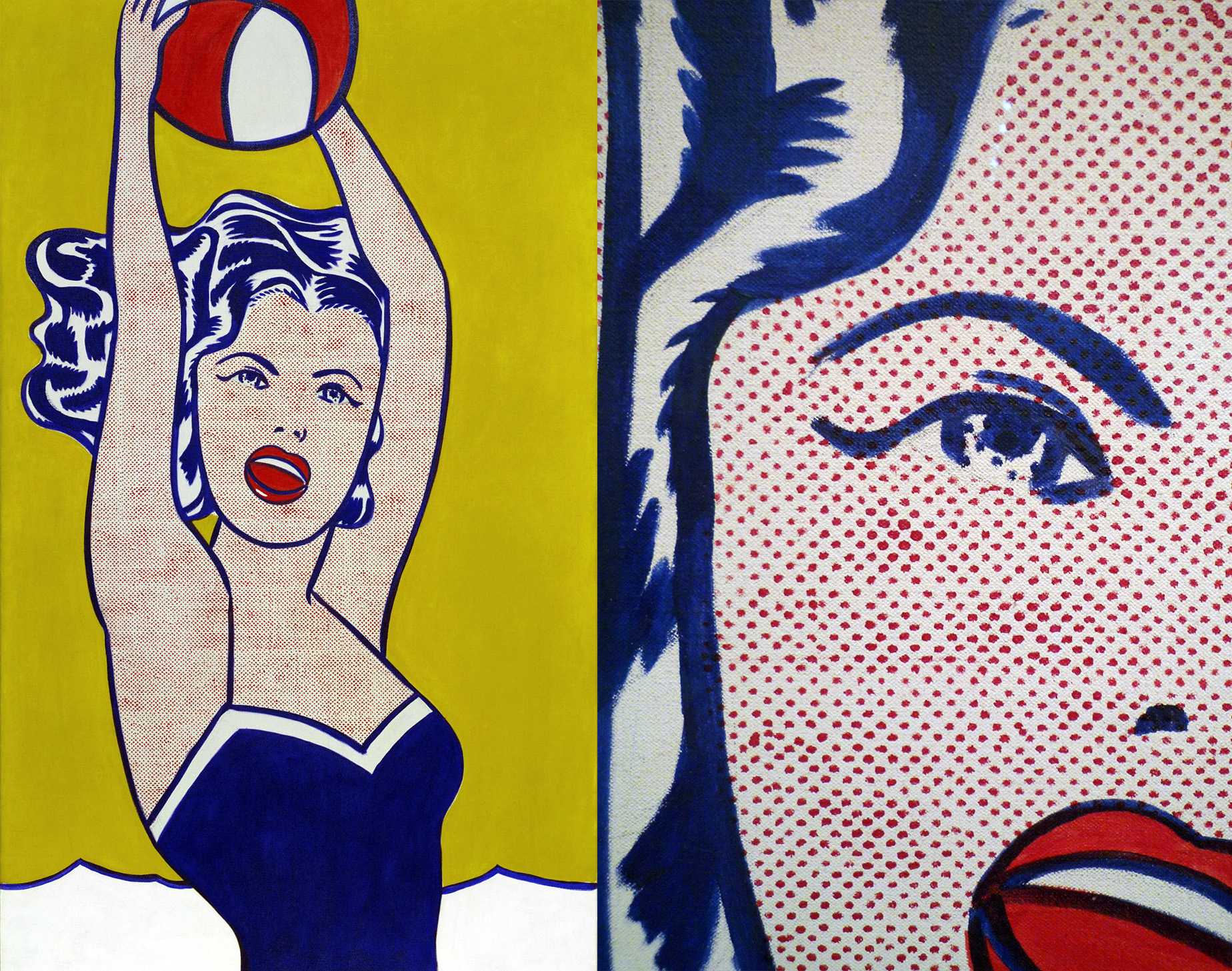
In contrast to the dripping paint and slashing brushstrokes of Abstract Expressionism—and even of Proto-Pop art—Pop artists applied their paint to imitate the look of industrial printing techniques. This ironic approach is exemplified by Lichtenstein’s methodically painted Ben-Day dots, a mechanical process used to print pulp comics.
As the decade progressed, artists shifted away from painting towards the use of industrial techniques. Warhol began making silkscreens, before removing himself further from the process by having others do the actual printing in his studio, aptly named “The Factory.” Similarly, Oldenburg abandoned his early installations and performances, to produce the large-scale sculptures of cake slices, lipsticks, and clothespins that he is best known for today.
Roy Lichtenstein, Look Mickey
A major figure in the American Pop Art movement, Roy Lichtenstein is known for his appropriated comic-book style featuring hand-painted Ben-Day dots. Lichtenstein asks: can a painting of Mickey and Donald Duck be fine art?
Why is this art? Andy Warhol, Campbell’s Soup Cans
Through Pop Art, Andy Warhol examined consumer culture, mass media, and what it meant to be famous, using media that removed the artist’s hand.
Andy Warhol, Marilyn Diptych
Andy Warhol’s Marilyn Diptych is made of two silver canvases on which the artist silkscreened a photograph of Marilyn Monroe fifty times. At first glance, the work—which explicitly references a form of Christian painting (see below) in its title—invites us to worship the legendary icon, whose image Warhol plucked from popular culture and immortalized as art.

But as in all of Warhol’s early paintings, this image is also a carefully crafted critique of both modern art and contemporary life.
Not only pop culture
With sustained looking, Warhol’s works reveal that he was influenced not only by pop culture, but also by art history—and especially by the art that was then popular in New York. For example, in this painting, we can identify the hallmarks of Abstract Expressionist painters like Jackson Pollock and Willem de Kooning.
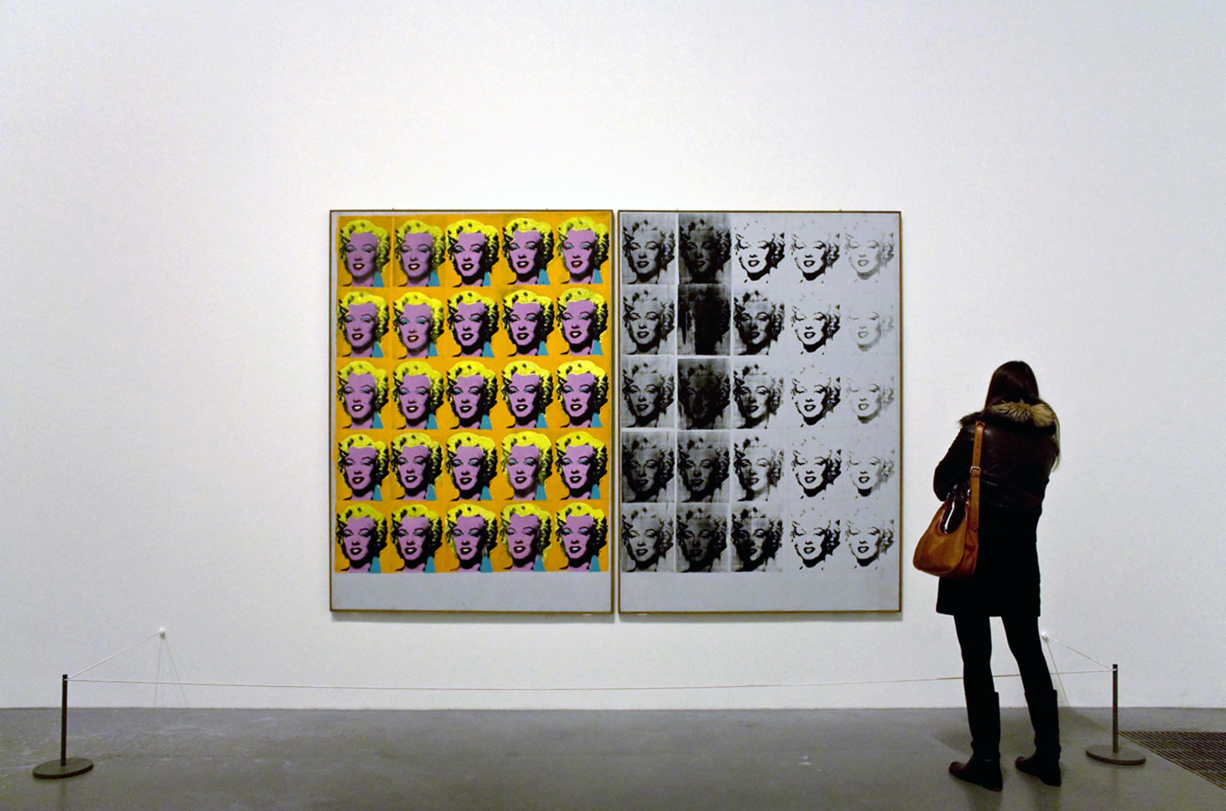
As in the work of these older artists, the monumental scale of Marilyn Diptych (more than six feet by nine feet) demands our attention and announces the importance of the subject matter. Furthermore, the seemingly careless handling of the paint and its “allover composition”—the even distribution of form and color across the entire canvas, such that the viewer’s eyes wander without focusing on one spot—are each hallmarks of Abstract Expressionism, as exemplified by Jackson Pollock’s drip paintings. Yet Warhol references these painters only to undermine the supposed expressiveness of their gestures: like Jasper Johns and Robert Rauschenberg, whose work he admired, he uses photographic imagery, the silkscreen process and repetition to make art that is not about his interior life, but rather about the culture in which he lived.
Emotional flatness
Warhol takes as the subject of his painting an impersonal image. Though he was an award-winning illustrator, instead of making his own drawing of Monroe, he appropriates an image that already exists. Furthermore, the image is not some other artist’s drawing, but a photograph made for mass reproduction. Even if we don’t recognize the source (a publicity photo for Monroe’s 1953 film Niagara), we know the image is a photo, not only because of its verisimilitude, but also because of the heightened contrast between the lit and shadowed areas of her face, which we associate with a photographer’s flash.
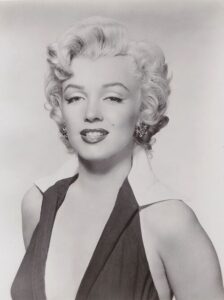
True to form, the actress looks at us seductively from under heavy-lidded eyes and with parted lips; but her expression is also a bit inscrutable, and the repetition remakes her face into an eerie, inanimate mask. Warhol’s use of the silkscreen technique further “flattens” the star’s face. By screening broad planes of unmodulated color, the artist removes the gradual shading that creates a sense of three-dimensional volume, and suspends the actress in an abstract void. Through these choices, Warhol transforms the literal flatness of the paper-thin publicity photo into an emotional “flatness,” and the actress into a kind of automaton. In this way, the painting suggests that “Marilyn Monroe,” a manufactured star with a made-up name, is merely a one-dimensional (sex) symbol—perhaps not the most appropriate object of our almost religious devotion.
Repetitions
While Warhol’s silkscreened repetitions flatten Monroe’s identity, they also complicate his own identity as the artist of this work. The silkscreen process allowed Warhol (or his assistants) to reproduce the same image over and over again, using multiple colors. Once the screens are manufactured and the colors are chosen, the artist simply spreads inks evenly over the screens using a wide squeegee. Though there are differences from one face to the next, these appear to be the accidental byproducts of a quasi-mechanical process, rather than the product of the artist’s judgment. Warhol’s rote painting technique is echoed by the rigid composition of the work, a five-by-five grid of faces, repeated across the two halves of its surface.
Here, as in many Neo-Dada, minimalist and conceptual works, the grid is like a program that the artist uses to “automate” the process of composing the work, instead of relying on subjective thoughts or feelings to make decisions. In other words, Warhol’s “cool,” detached composition is the opposite of the intimate, soulful encounter with the canvas associated with Abstract Expressionism. But whereas most works that use grids are abstract, here, the the grid repeats a photo of a movie star, causing the painting to resemble a photographer’s contact sheet, or a series of film strips placed side-by-side. These references to mechanical forms of reproduction further prove that for Warhol, painting is no longer an elevated medium distinct from popular culture.
Ghostly symmetry
Aside from radically changing our notion of painting, Warhol’s choices create a symmetry between the artist and his subject, who each seem to be less than fully human: the artist becomes a machine, just as the actress becomes a mask or a shell. Another word we could use to describe the presence of both the artist and the actress might be ghostly, and in fact, Warhol started making his series of “Marilyn” paintings only after the star had died of an apparent suicide, and eventually collected them with other disturbing paintings under the title “Death in America.” Her death haunts this painting: on the left, her purple, garishly made-up face resembles an embalmed corpse, while the lighter tones of some of the faces on the right make it seem like she is disappearing before our eyes.
Warhol once noted that through repeated exposure to an image, we become de-sensitized to it. In that case, by repeating Monroe’s mask-like face, he not only drains away her life, but also ours as well, by deadening our emotional response to her death. Then again, by making her face so strange and unfamiliar, he might also be trying to re-sensitize us to her image, so that we remember she isn’t just a symbol, but a person whom we might pity. From the perspective of psychoanalytic theory, he may even be forcing us to relive, and therefore work through, the traumatic shock of her death. The painting is more than a mere celebration of Monroe’s iconic status. It is an invitation to consider the consequences of the increasing role of mass media images in our everyday lives.
Minimalism, an introduction
A reductive abstract art
Although many works of art can be described as “minimal,” the name Minimalism refers specifically to a kind of reductive abstract art that emerged during the early 1960s. At the time, some critics preferred names like “ABC,” “Boring,” or “Literal” Art, and even “No-Art Nihilism,” which they believed best summed up the literal presentation and lack of expressive content characterizing this new aesthetic. [3] While scholars have recently argued for a broader definition of Minimalism that would include artists in a number of disciplines, the term remains closely linked to sculpture of the period.
Donald Judd’s Untitled (1969) is characteristic in its use of spare geometric forms, repeated to create a unified whole that calls attention to its physical size in relationship to the viewer. Like most Minimalists, Judd used industrial materials and processes to manufacture his work, but his preference for color and shiny surfaces distinguished him among the artists who pioneered the style.
Lack of apparent meaning
What most people find disturbing about Minimalism is its lack of any apparent meaning. Like Pop Art, which emerged simultaneously, Minimalism presented ordinary subject matter in a literal way that lacked expressive features or metaphorical content; likewise, the use of commercial processes smacked of mass production and seemed to reject traditional expectations of skill and originality in art. In these ways, both movements were, in part, a response to the dominance of Abstract Expressionism, which had held that painting conveys profound subjective meaning. However, whereas Pop artists depicted recognizable images from kitsch sources, the Minimalists exhibited their plywood boxes, fluorescent lights, and concrete blocks directly on gallery floors, which seemed even more difficult to distinguish as “Art.” (One well-known story tells of an art dealer who visited Carl Andre’s studio during the winter and unknowingly burned a sculpture for firewood while the artist was away.) [4] Moreover, when asked to explain his black-striped paintings of 1959, Frank Stella responded, “What you see is what you see.” [5] Stella’s comment implied that not only was there no meaning, but that none was necessary to demonstrate the object’s artistic value.
Writings
Given these facts, it may seem odd to learn that hundreds of essays and books have been written about Minimalism, many by the artists themselves. It is significant that, although Minimalist art shares similar features, the artists associated with the movement developed their aesthetic ideas from a variety of philosophical and artistic influences. Through their writings, Minimalist artists put forth distinctive positions about the work they produced. In addition to his role as a sculptor, Judd was a prominent art critic, and his reviews provide eloquent explanations of his intent—shared by Stella and Dan Flavin—to eliminate the illusionism and “subjective” decision-making of traditional painting. [6] Robert Morris, whose sculpture was influenced by avant-garde dance and performance, published a series of texts, arguing for sculpture to be understood in physical and psychological terms; and, Sol LeWitt introduced the term Conceptual Art to explain the use of seriality and systemic structure in his cubic grid-like forms. [7]
Legacy
In this way, the artists, along with critics and art historians over the past 50 years, have developed a critical discourse that surrounds the art objects, but which is essential to understanding Minimalism itself. Likewise, such artists as Richard Serra, Bernd and Hilla Becher, Maya Lin, and Rachel Whiteread, who use Minimalist practice of the early 1960s as a point of departure for their own creative exploration, continue to contribute to the movement’s legacy and our understanding of its significance today.
Conclusion
Abstract-Expressionism, Pop Art, and Minimalism represent three stylistic movements that serve as the foundation for later 20th century and contemporary art. Abstract-Expressionism focused on large-scale canvases that explored the moral crisis of art after the Second World War. In a rejection of the grandiose statements of Abstract-Expressionism, Pop Art emerged as a direct descendant of Dada. Working with the concepts of commercial culture and mass media, Pop artists rejected the presence of an artist’s gesture and the often-obscure abstraction of the previous generation. Instead, Pop artists favored clearer subject matter and material rooted in the popular culture of the 20th century. Also developing from the origins of Dada, Minimalism represented a different response to Abstract-Expressionism. Minimalists often removed gesture to focus on the mass-produced quality of modern materials and sought to collapse the boundaries of how we define art. Each of these three styles inspired numerous movements of the later 20th century and continue to inspire artists living and working today.
Citation and Licensing
The following sections were written by Chelsea Wright and licensed CC BY-NC-SA 4.0:
- Chapter Overview and Introduction
- Focus artwork and term list compiled by Chelsea Wright
- Practicing Visual Analysis
- Conclusion
The following articles from Smarthistory licensed CC BY-NC-SA 4.0 were remixed and adapted for the chapter:
- Dr. Kelly Enright, “1945–80 in the United States, an introduction,” in Smarthistory, June 25, 2024.
- Dr. Virginia B. Spivey, “Abstract Expressionism, an introduction,” in Smarthistory, August 9, 2015.
- Smarthistory, “Jackson Pollock,” in Smarthistory.
- Dr. Beth Harris and Dr. Steven Zucker, “Jackson Pollock, Autumn Rhythm,” in Smarthistory, December 3, 2020.
- Smarthistory, “Willem de Kooning,” in Smarthistory.
- Dr. Beth Harris and Dr. Steven Zucker, “Willem de Kooning, Woman, I,” in Smarthistory, October 8, 2016.
- Smarthistory, “Mark Rothko,” in Smarthistory.
- Dr. Margaret C. Conrads and Dr. Steven Zucker, “Mark Rothko, No. 210/No. 211 (Orange),” in Smarthistory.
- Smarthistory, “Helen Frankenthaler,” in Smarthistory.
- Dr. Beth Harris and Dr. Steven Zucker, “Helen Frankenthaler, Mountains and Sea,” in Smarthistory, June 19, 2018.
- Dr. Virginia B. Spivey, “Pop art, an introduction,” in Smarthistory, July 15, 2024.
- Smarthistory, “Roy Lichtenstein,” in Smarthistory.
- Dr. Beth Harris and Dr. Steven Zucker, “Roy Lichtenstein, Look Mickey,” in Smarthistory, August 25, 2025.
- Smarthistory, “Andy Warhol,” in Smarthistory.
- Sal Khan and Dr. Steven Zucker, “Why is this art? Andy Warhol, Campbell’s Soup Cans,” in Smarthistory, December 8, 2015.
- Tina Rivers Ryan, “Andy Warhol, Marilyn Diptych,” in Smarthistory, August 9, 2015.
- Dr. Virginia B. Spivey, “Minimalism, an introduction,” in Smarthistory, August 9, 2015.
- Barnett Newman, “Response to the Reverend Thomas F. Mathews,” Revelation, Place and Symbol: Journal of the First Congress on Religion, Architecture, and the Visual Art (New York, 1969), pp. 129–34. ↵
- Letter from Mark Rothko and Adolph Gottlieb to Edward Alden Jewell Art Editor, New York Times, June 7, 1943. ↵
- These critiques followed the Jewish Museum’s 1966 exhibition titled Primary Structures, which was the first major exhibition to showcase a survey of minimalist artworks in the United States. See Michael Fried, “Art and Objecthood,” Artforum, volume 5, number 10 (1967), pp. 12–23. ↵
- Hollis Frampton, “Letter to Enno Develing,” On the Camera Arts and Consecutive Matters: The Writings of Hollis Frampton, edited by Bruce Jenkins (Cambridge, MA: The MIT Press, 2015), pp. 281–82. ↵
- Frank Stella, “New Nihilism or New Art?” by Bruce Glaser, WBAI-FM, New York, February, 1964. ↵
- For example, see Donald Judd, “Specific Objects,” Arts Yearbook, volume 8 (1965), pp. 74–82. ↵
- Robert Morris, “Notes on Sculpture,” Artforum, volume 4, number 6 (1966), pp. 42–44 and Sol Lewitt, “Paragraphs on Conceptual Art,” Artforum, volume 5, number 10 (1967), pp. 79–83. ↵



.jpg)