
High Renaissance, Italy
Chapter Overview and Introduction
The High Renaissance produced some of the most famous names in art history: Leonardo, Michelangelo, and Raphael. Such artists of the High Renaissance in Italy represent the epitome of Renaissance philosophy and artistic aesthetic. The term “High Renaissance” is associated with the period of c. 1490-1520 and only in Italy. During this period, Rome strengthened as an artistic center with the Pope and the Vatican becoming one of the most prominent patrons of art and architecture in all Europe.
Focus Artworks
- Leonardo da Vinci, Last Supper, c. 1495-1498, oil and tempera on plaster
- New Saint Peter’s, Vatican, Rome
- Michelangelo Buonarroti, David, 1501-1504, marble
- Michelangelo Buonarroti, Ceiling of the Sistine Chapel, Vatican City, Rome, 1508-1512, fresco
- Raphael Sanzio, Philosophy (School of Athens), Stanza della Segnatura, Vatican City, Rome, Italy, 1509-1511, fresco
- Titian Vecellio, Venus of Urbino, 1536-1538, oil on canvas
Term List
- High Renaissance
- Humanism
- Neo-Platonism
- Linear perspective
- Sfumato
- Martyria
- Basilica
- Saint Peter
- Central Plan
- Contrapposto
- Chiaroscuro
- Disegno
- Colorito
Toward the High Renaissance, an introduction
When you think of the Renaissance, the names that come to mind are probably the artists of this period (the High Renaissance): Leonardo and Michelangelo, for instance. And perhaps when you think of the greatest work of art in the western world, Michelangelo’s Sistine Ceiling might come to mind. This is a period of big, ambitious projects.
How is the High Renaissance different from the Early Renaissance?
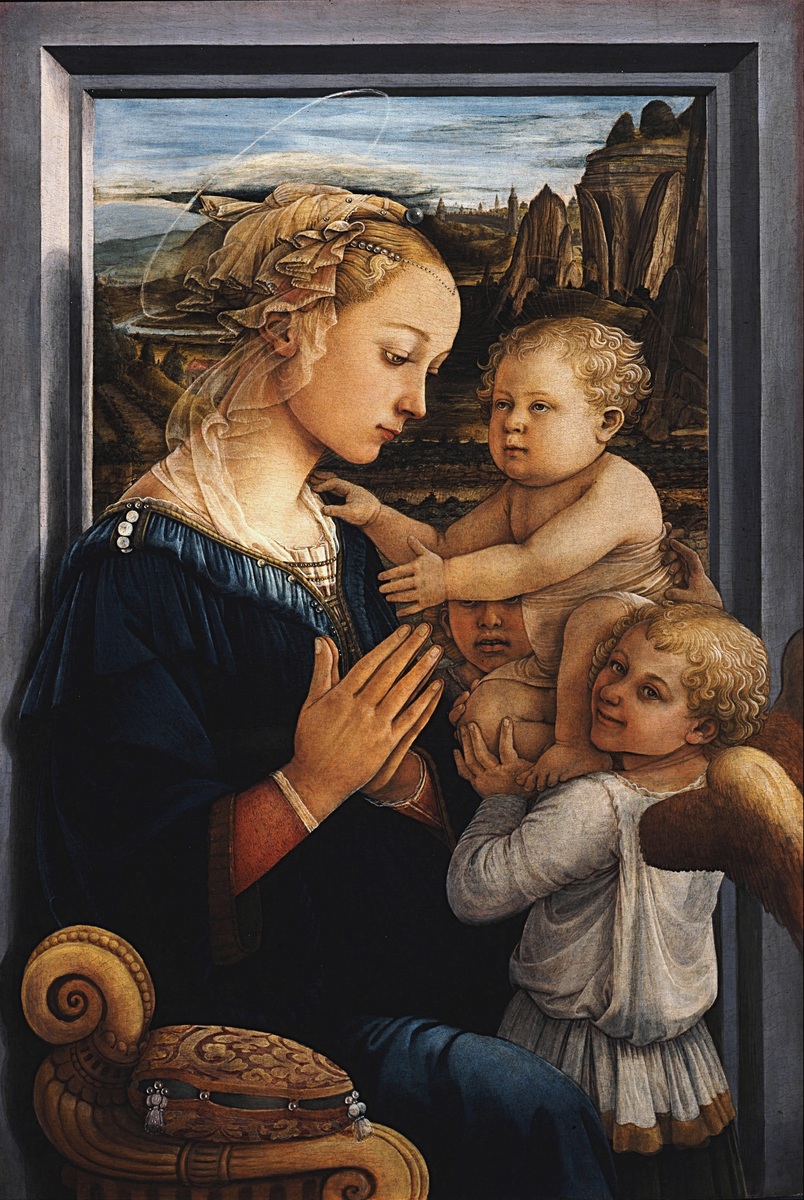
As the Humanism of the Early Renaissance develops, a problem arises. Have a look at Fra Filippo Lippi’s Madonna and Child with Angels. We see a Madonna and Christ Child that have become so real—the figures appear so human—that in some ways we can hardly tell that these are divine figures (except perhaps for the faint outline of a halo, and Mary’s sorrowful expression and hands clasped in prayer). On the other hand, in the Middle Ages, the need to create transcendent spiritual figures, meant a move toward abstraction—toward flatness and elongation.
In the Early Renaissance then, a tension arises. To create spiritual figures, your image can’t look very real, and if you want your image to appear real, then you sacrifice some spirituality. In the late 15th century though, Leonardo da Vinci creates figures who are physical and real (just as real as Lippi’s or Masaccio’s figures), and yet they have an undeniable and intense spirituality. We could say that Leonardo unites the real and spiritual, or soul and substance.
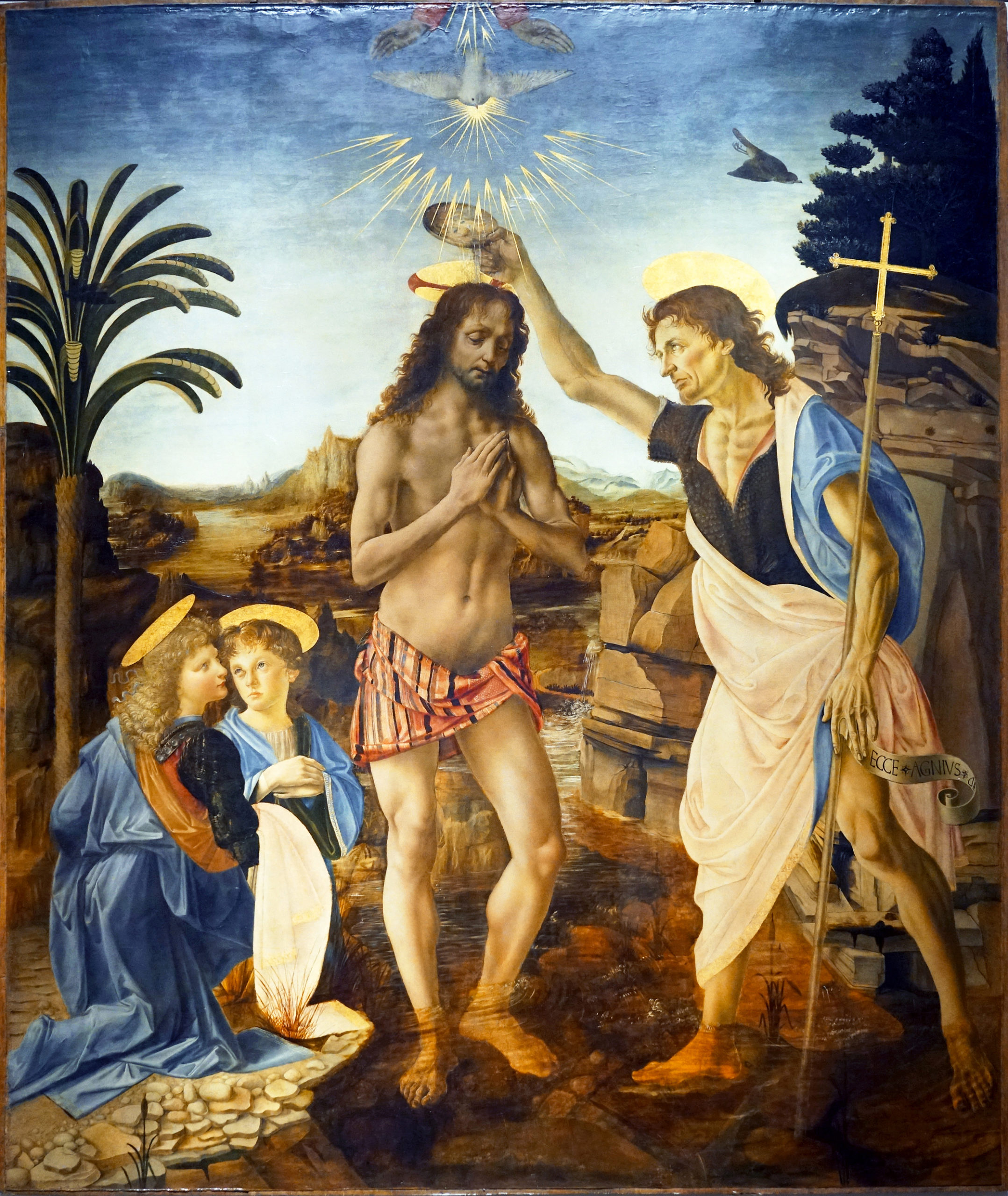
The best way to see this is in this painting by Verrocchio—an important Early Renaissance artist who Leonardo was apprenticed to when he was young. Verrocchio asked Leonardo to paint one of the angels in his painting of the Baptism of Christ.
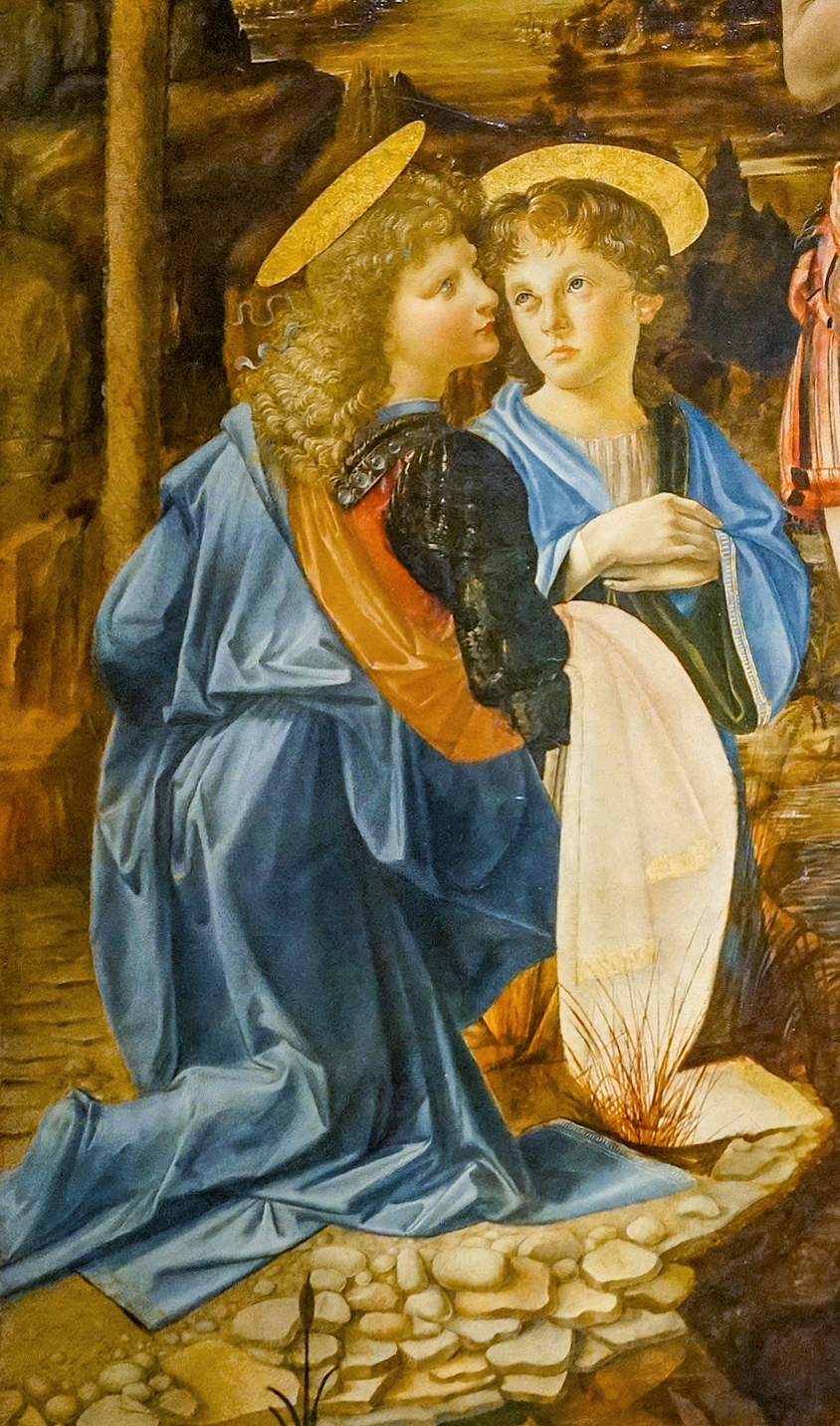
Can you tell which angel is Leonardo’s? One angel should look more like a boy—that’s the Early Renaissance angel (the one painted by Verrocchio) and the other angel should look truly divine, sent by God from heaven (that’s Leonardo’s angel).
The angel on the left is Leonardo’s.
Leonardo’s angel is ideally beautiful and moves in a graceful and complex way, twisting her upper body to the left but raising her head up and to the right. Figures that move elegantly and that are ideally beautiful are typical of the High Renaissance.
Leonardo da Vinci, Last Supper
“Leonardo imagined, and has succeeded in expressing, the desire that has entered the minds of the apostles to know who is betraying their Master. So in the face of each one may be seen love, fear, indignation, or grief at not being able to understand the meaning of Christ; and this excites no less astonishment than the obstinate hatred and treachery to be seen in Judas.” Giorgio Vasari, Lives of the Artists, 1568; translated by George Bull
Subject
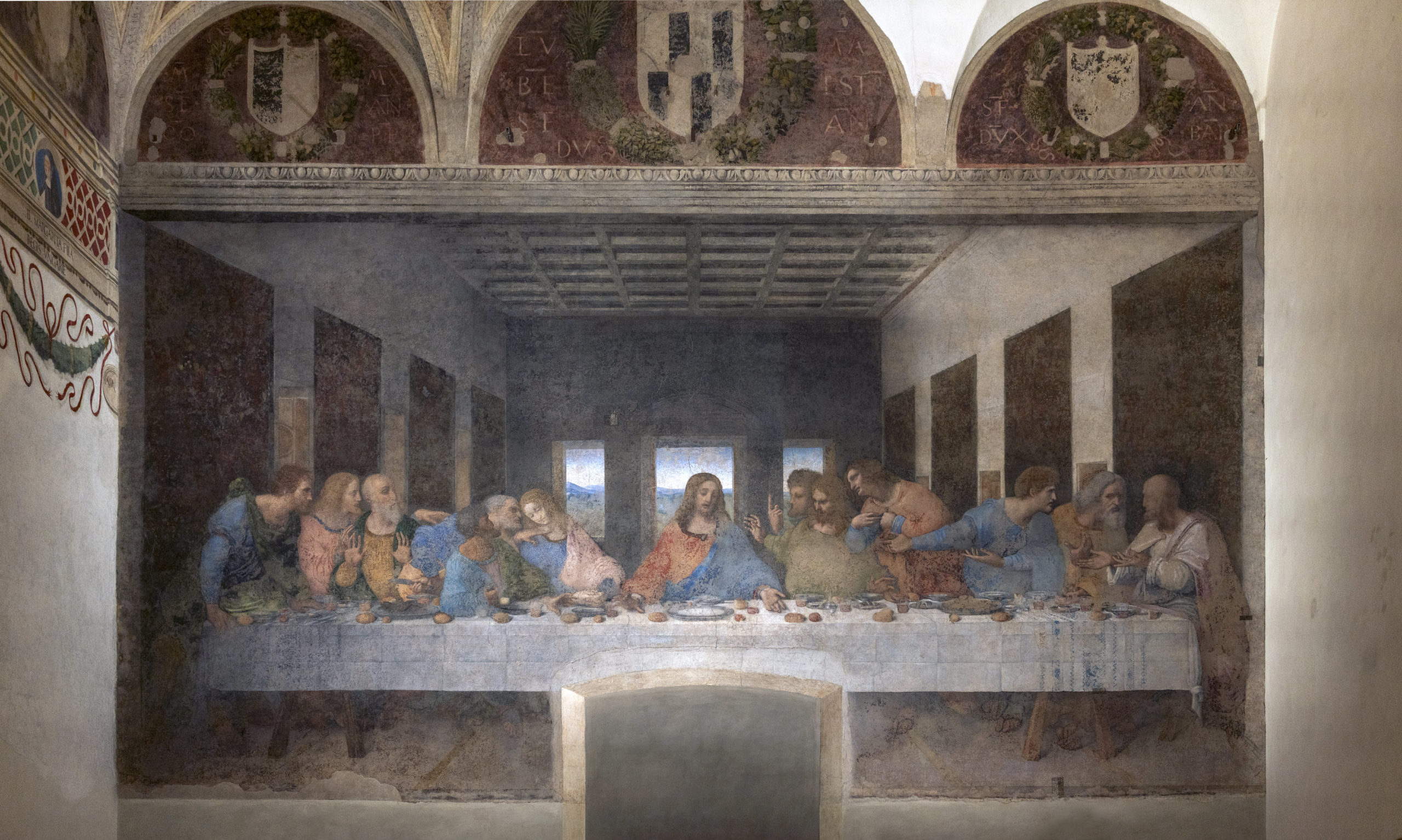
The subject of the Last Supper is Christ’s final meal with his apostles before Judas identifies Christ to the authorities who arrest him. The Last Supper (a Passover Seder) is remembered for two events:
Christ says to his apostles, “One of you will betray me,” and the apostles react, each according to his own personality. Referring to the Gospels, Leonardo depicts Philip asking, “Lord, is it I?” Christ replies, “He that dippeth his hand with me in the dish, the same shall betray me” (Matthew 26). We see Christ and Judas simultaneously reaching toward a plate that lies between them, even as Judas defensively backs away.
Leonardo also simultaneously depicts Christ blessing the bread and saying to the apostles, “Take, eat; this is my body” and blessing the wine and saying “Drink from it all of you; for this is my blood of the covenant, which is poured out for the forgiveness of sins” (Matthew 26). These words are the founding moment of the sacrament of the Eucharist (the miraculous transformation of the bread and wine into the body and blood of Christ).
Apostles identified
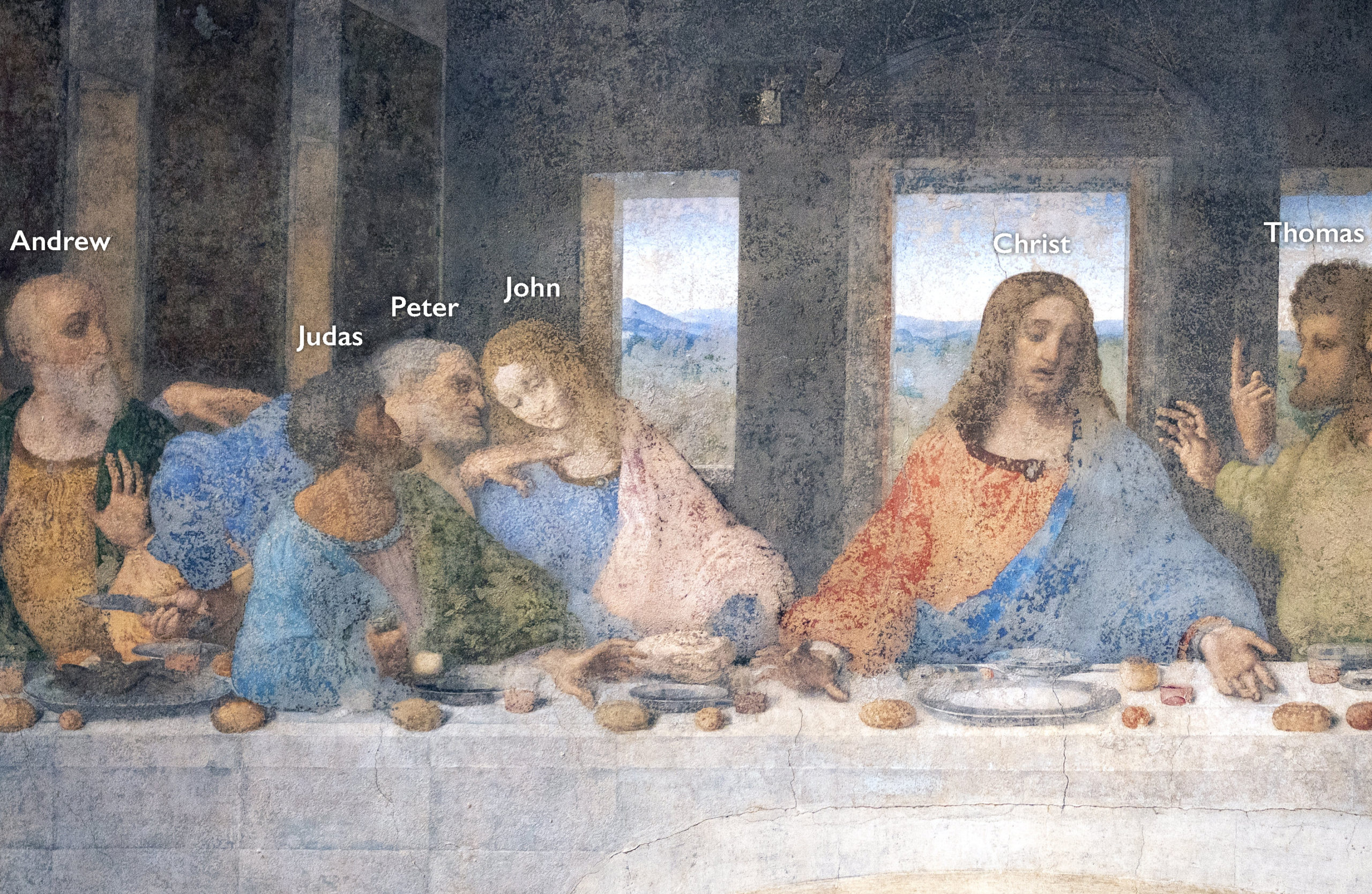
Leonardo’s Last Supper is dense with symbolic references. Attributes identify each apostle. For example, Judas Iscariot is recognized both as he reaches toward a plate beside Christ (Matthew 26) and because he clutches a purse containing his reward for identifying Christ to the authorities the following day. Peter, who sits beside Judas, holds a knife in his right hand, foreshadowing that Peter will sever the ear of a soldier as he attempts to protect Christ from arrest.
Suggestions of the heavenly
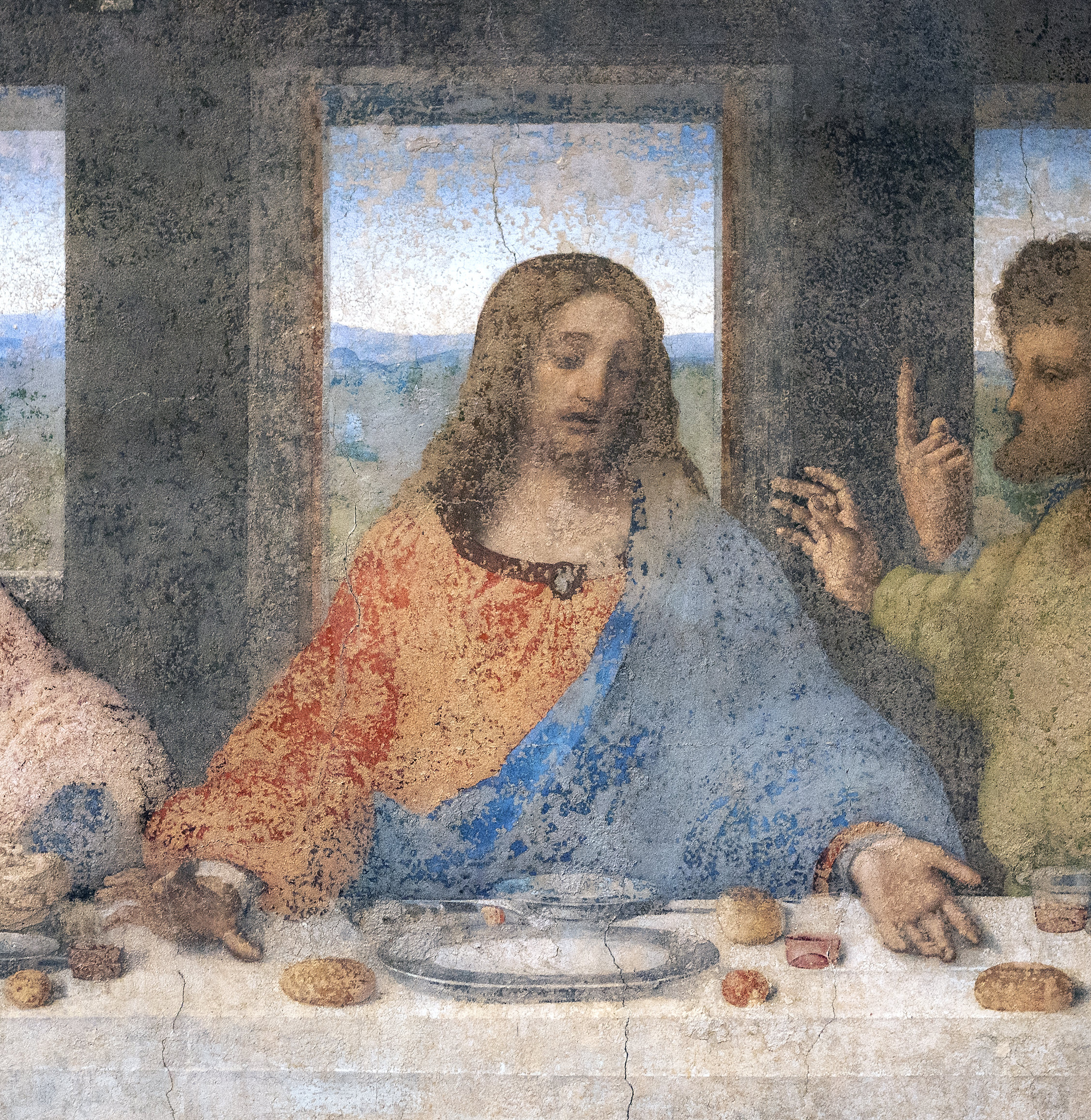
The balanced composition is anchored by an equilateral triangle formed by Christ’s body. He sits below an arching pediment that, if completed, traces a circle. These ideal geometric forms refer to the renaissance interest in Neo-Platonism (an element of the humanist revival that reconciles aspects of Greek philosophy with Christian theology). In his allegory, “The Cave,” the Ancient Greek philosopher Plato emphasized the imperfection of the earthly realm. Geometry, used by the Greeks to express heavenly perfection, has been used by Leonardo to celebrate Christ as the embodiment of heaven on earth.
Leonardo rendered a verdant landscape beyond the windows. Often interpreted as paradise, it has been suggested that this heavenly sanctuary can only be reached through Christ.
The twelve apostles are arranged as four groups of three and there are also three windows. The number three is often a reference to the Holy Trinity in Catholic art. In contrast, the number four is important in the classical tradition (e.g. Plato’s four virtues).
The Last Supper in the early Renaissance
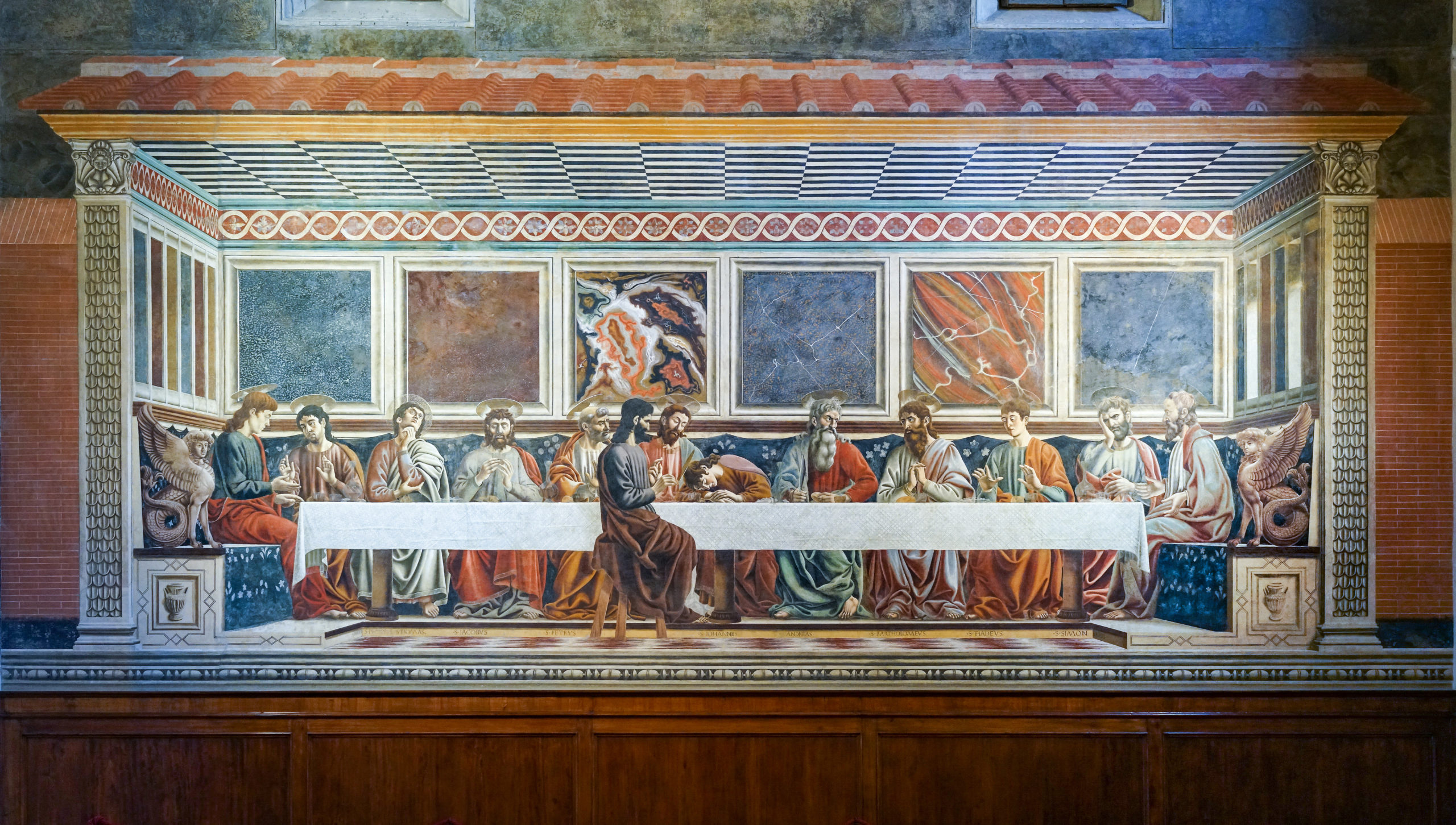
Andrea del Castagno’s Last Supper is typical of the early Renaissance. The use of linear perspective in combination with ornate forms such as the sphinxes on the ends of the bench and the marble paneling tend to detract from the spirituality of the event. In contrast, Leonardo simplified the architecture, eliminating unnecessary and distracting details so that the architecture can instead amplify the spirituality. The window and arching pediment even suggest a halo. By crowding all of the figures together, Leonardo uses the table as a barrier to separate the spiritual realm from the viewer’s earthly world. Paradoxically, Leonardo’s emphasis on spirituality results in a painting that is more naturalistic than Castagno’s.
Leonardo da Vinci, Mona Lisa
An inventor and key creator of High Renaissance style, Leonardo da Vinci’s skill in evoking character came from a masterful handling of space and chiaroscuro.
Portraits were once rare
We live in a culture that is so saturated with images, it may be difficult to imagine a time when only the wealthiest people had their likeness captured. The wealthy merchants of renaissance Florence could commission a portrait, but even they would likely only have a single portrait painted during their lifetime. A portrait was about more than likeness, it spoke to status and position. In addition, portraits generally took a long time to paint, and the subject would commonly have to sit for hours or days, while the artist captured their likeness.
The Mona Lisa was originally this type of portrait, but over time its meaning has shifted and it has become an icon of the Renaissance—perhaps the most recognized painting in the world. The Mona Lisa is a likely a portrait of the wife of a Florentine merchant. For some reason however, the portrait was never delivered to its patron, and Leonardo kept it with him when he went to work for Francis I, the King of France.
The most recognized painting in the world
Introducing High Renaissance Architecture
As with the geometry used by da Vinci in pieces like the Last Supper, Renaissance architects also returned to Ancient Greek ideas about geometry “to express heavenly perfection.” Architects like Bramante in the Tempietto and the Renaissance rebuilding of St. Peter’s Basilica in Rome are reflections of both Ancient Greek concepts of geometry and the philosophy of Neo-Platonism.
Donato Bramante, Tempietto, Rome
An architect, painter, and engineer, Donato Bramante’s High Renaissance designs had an enduring influence on architecture in the 16th century.
Saint Peter’s Basilica
The greatest minds of the High Renaissance worked on this vast church. Construction took more than a century.
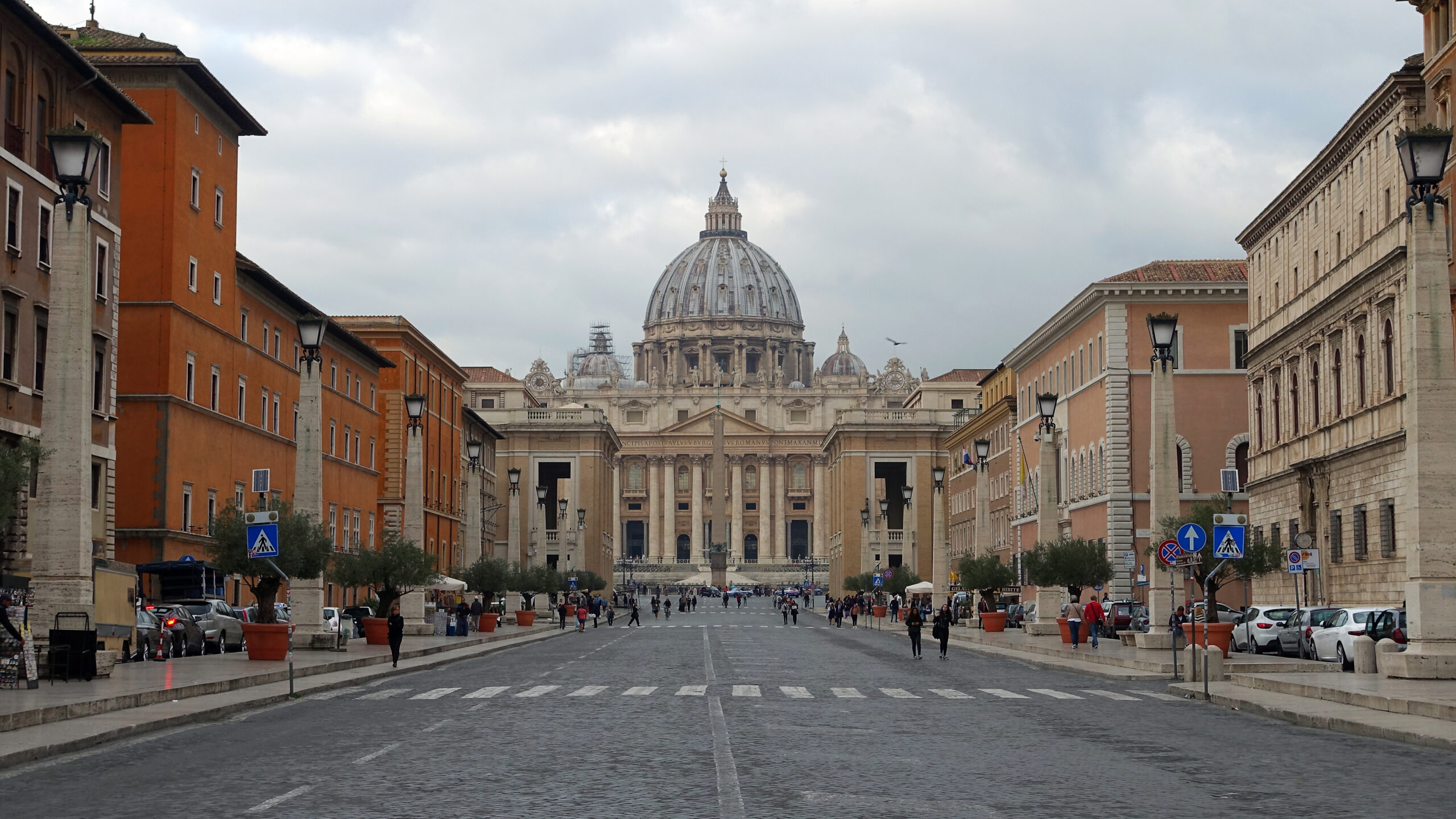
Architects and designers included: Donato Bramante (whose design won Julius II’s competition); Antonio da Sangallo, a student of Bramante (the Pauline Chapel); Fra Giocondo (strengthening of the foundation); Raphael and Fra Giocondo (whose redesigned building plan was not executed); Michelangelo (design of the dome, crossing, and exterior excluding the nave and facade); Giacomo della Porta (design of the cupola); Carlo Maderno (extension of Michelangelo’s plan, adding a nave and grand facade); Gian Lorenzo Bernini (addition of the piazza, the Cathedra Petri, and the Baldacchino)
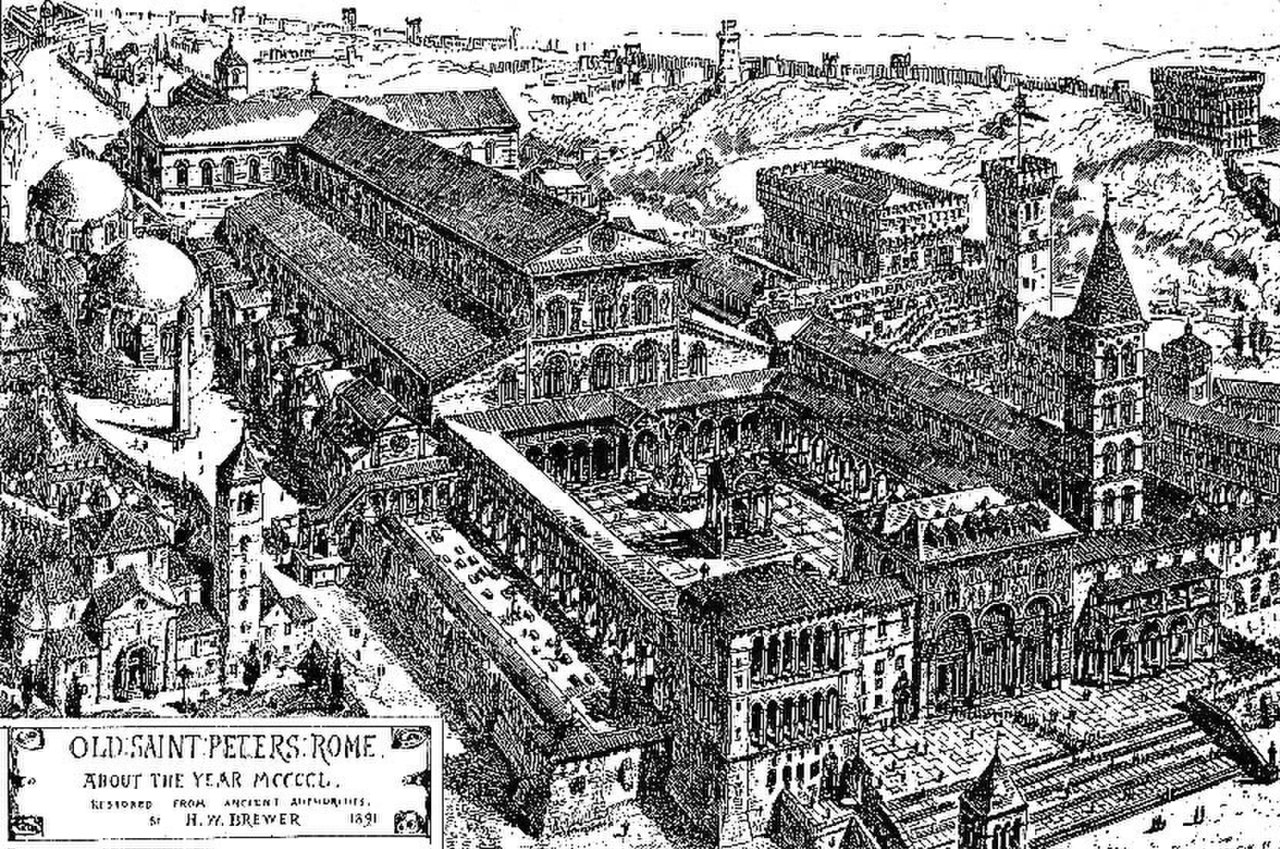
Pope Julius II commissioned Bramante to build a new basilica—this involved demolishing the Old St Peter’s Basilica that had been erected by Constantine in the 4th century. This ancient church was in disrepair. But tearing it down was a bold maneuver that gives us a sense of the enormous ambition of Pope Julius II, both for the papacy as well as for himself.
Burial site of Saint Peter
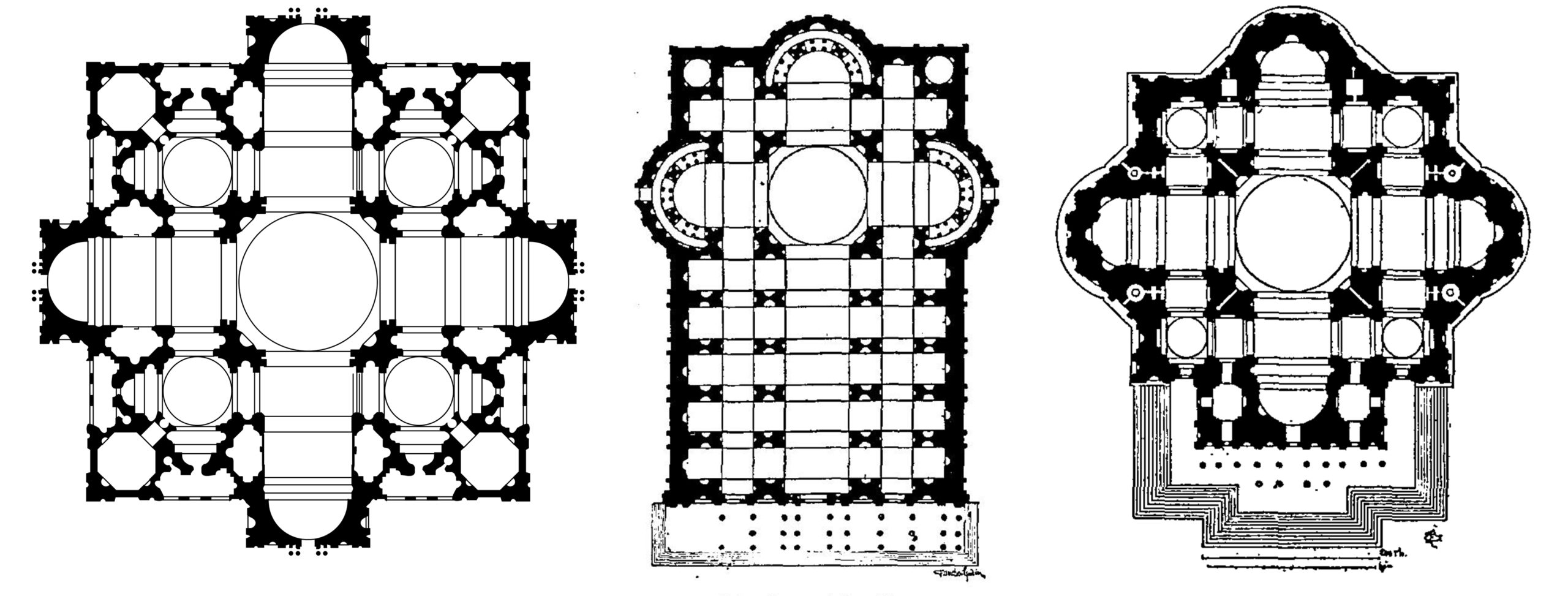
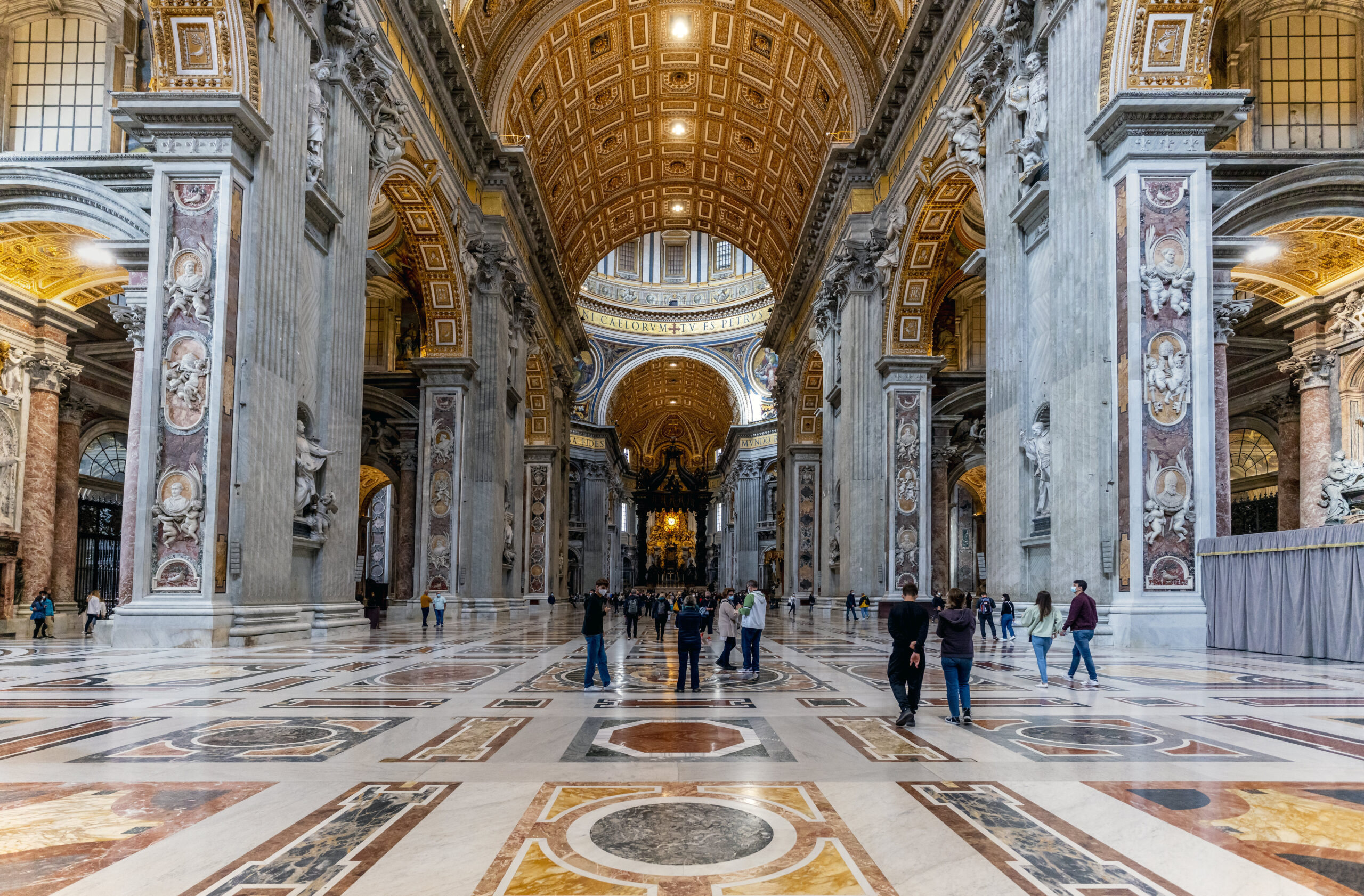
The site is a very holy one—it is (according to the Catholic Church) the site of the burial of Saint Peter. Bramante did the first plan for the new church. He proposed an enormous centrally planned church in the shape of a Greek cross enclosed within a square with an enormous dome over the center, and smaller domes and half-domes radiating out. When Bramante died, Raphael took over as chief architect for Saint Peter’s, and when Raphael died, Michelangelo took over. Both Michelangelo and Raphael made substantial changes to Bramante’s original plan. Nevertheless, the experience of being inside Saint Peter’s is awe-inspiring.
Basilica and central plan
The two basic types of churches are the basilica and the central plan. The basilica, with its long axis that focuses attention on the altar, has been the most popular type of church plan because of its practicality.
The other popular type of church plan is a central plan that is usually based either on the shape of a circle or on a Greek cross. These are called central plans because the measurements are all equidistant from a center. This type of church, influenced by Classical architecture (think of the Pantheon), was very popular among High Renaissance architects. Besides the influence of ancient Roman architecture, the circle had spiritual associations. The circle, which has no beginning and no end, symbolized the perfection and eternal nature of God. For some thinkers in antiquity and the Renaissance, the universe itself was constructed in the form of concentric circles with the sun, moon, and stars moving in circular orbits around the earth.
Bramante’s original design was for a central plan, however—as built—the church combines elements of a central plan with the longer nave of a basilica.
Who was Michelangelo?
Michelangelo Buonarotti—the Italian Renaissance painter, sculptor, architect, and poet—was called “Il Divino” (The Divine One) by his contemporaries because they perceived his artworks to be otherworldly. His art was in high demand, and thought to have terribilità, poorly translated as “terribleness” and better described as powerfulness. He was mythologized by followers, emulated by artists, celebrated by humanists, and patronized by a total of nine popes. As commemorations, over one hundred portraits of him were created during the sixteenth century alone, far more than any other artist at the time. Despite three biographies written about the artist during his own lifetime, we know the most about the sometimes-generous and often-humorous perfectionist through his letters. Not only do we have more primary sources on Michelangelo than any other historical artist, he is one of the most written-about artists of all time. In today’s terms, Michelangelo was a workaholic homebody whose cats missed him when he was away. He did not like to debate art, waste time, or show his work before he was ready. Despite a few mid-career collaborations, Michelangelo was careful and guarded, never running a typical workshop, locking his studio, and burning drawings. He also complained a lot, and, at times, could be overconfident, curt, and blunt, once resulting in a punch in the nose.
Michelangelo, David
Where’s Goliath? David scans for his enemy. This colossal sculpture is itself a giant of 16th-century Renaissance art.
Practicing Visual Analysis
Michelangelo’s David stands around seventeen feet tall. It is massive in terms of scale! Scale is often tied to function. In this case, Michelangelo’s David was originally meant for the roofline of Florence’s Santa Maria del Fiore cathedral. At seventeen feet tall, the scale was important for its visibility to viewers below. Then, it was relocated and its original religious iconography repurposed for political ideology. Carved from pure white Carrara marble, the sculpture is uniform it is color. The figurative form of David is idealized with its muscularity and symmetrical face. The composition of the sculpture emphasizes its verticality while Michelangelo captures the subtlety of the human body in the contrapposto stance. Made from a subtractive carving technique, Michelangelo rendered a range of textures in marble: smoothness of human skin, softness of curling hair, and rigidity of veins pulsing underneath skin. When looking at the face of David, we follow his gaze. The implied line created by his line of sight directs our attention to the distance. We know who stands in David’s sight line: Goliath.
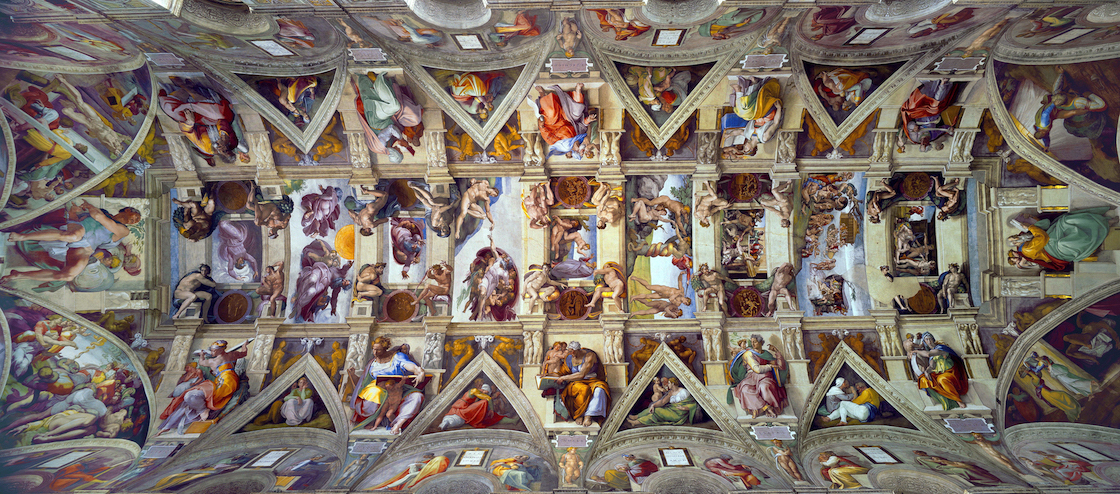
Michelangelo, Ceiling of the Sistine Chapel
God created the world in seven days, but it took Michelangelo four years to depict it on this remarkable ceiling.
Visiting the Chapel
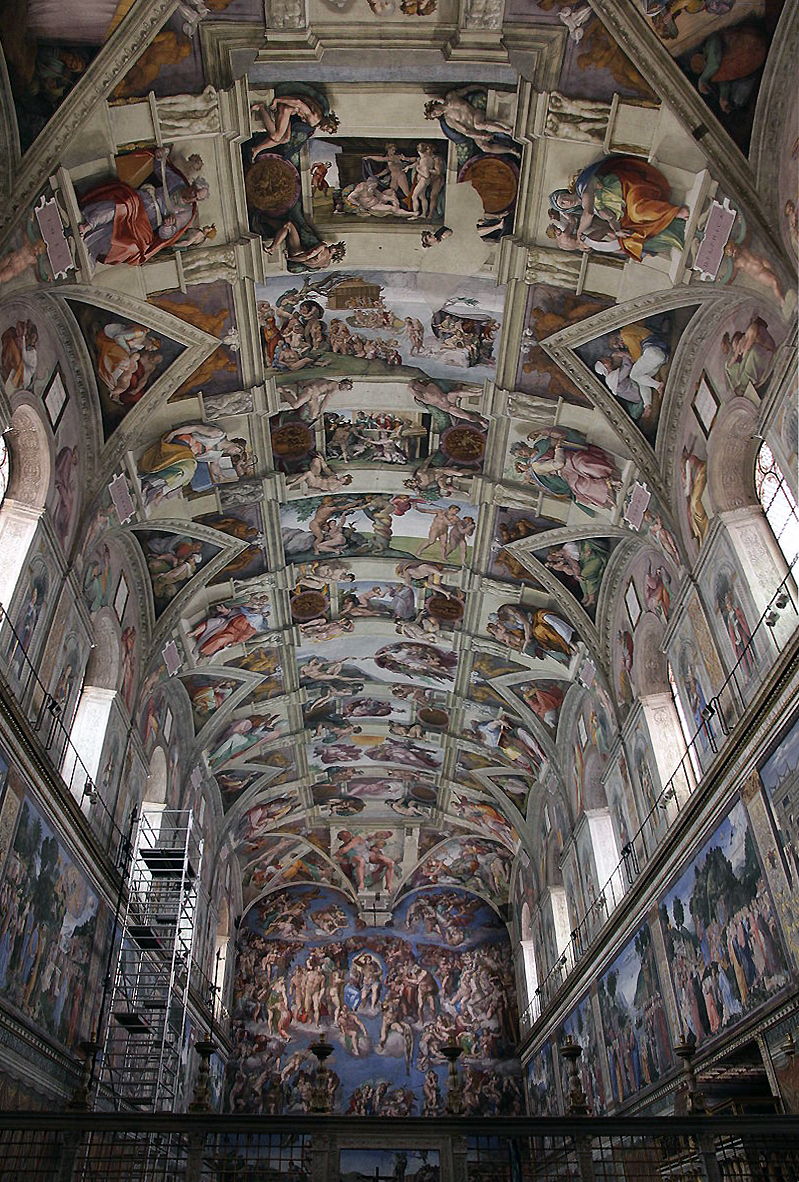
To any visitor of Michelangelo’s Sistine Chapel, two features become immediately and undeniably apparent: 1) the ceiling is really high up, and 2) there are a lot of paintings up there. Because of this, the centuries have handed down to us an image of Michelangelo lying on his back, wiping sweat and plaster from his eyes as he toiled away year after year, suspended hundreds of feet in the air, begrudgingly completing a commission that he never wanted to accept in the first place.
Fortunately for Michelangelo, this is probably not true. But that does nothing to lessen the fact that the frescoes, which take up the entirety of the vault, are among the most important paintings in the world.
For Pope Julius II
Michelangelo began to work on the frescoes for Pope Julius II in 1508, replacing a blue ceiling dotted with stars. Originally, the pope asked Michelangelo to paint the ceiling with a geometric ornament, and place the twelve apostles in spandrels around the decoration. Michelangelo proposed instead to paint the Old Testament scenes now found on the vault, divided by the fictive architecture that he uses to organize the composition.
The subject of the frescoes
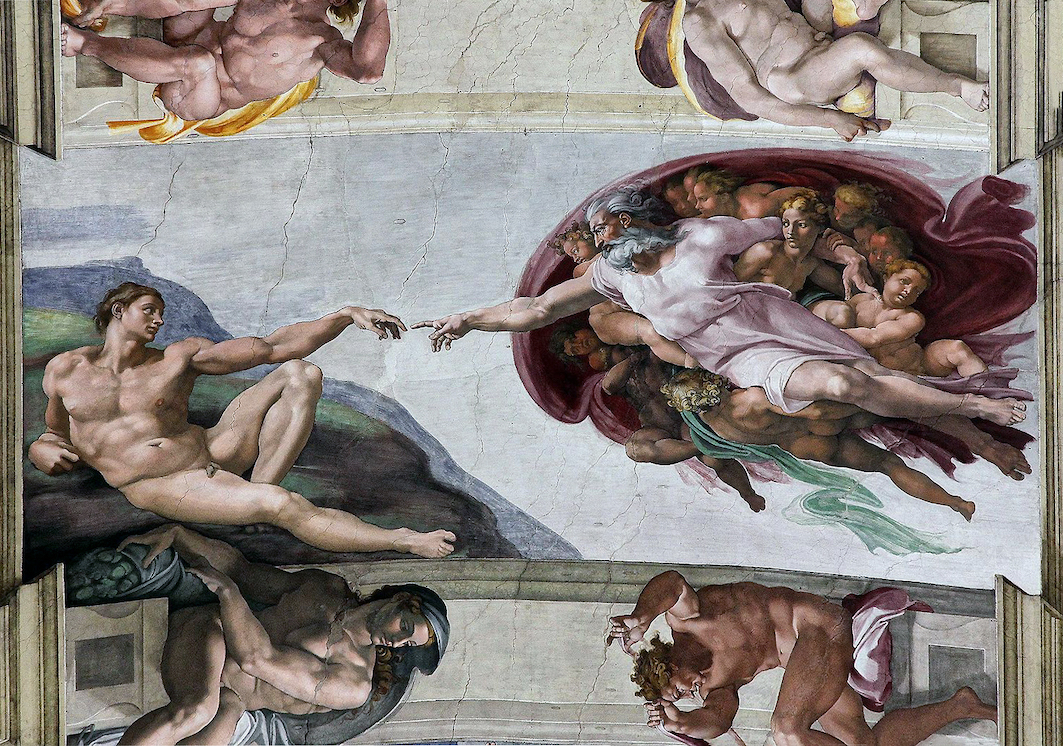
The narrative begins at the altar and is divided into three sections. In the first three paintings, Michelangelo tells the story of The Creation of the Heavens and Earth; this is followed by The Creation of Adam and Eve and the Expulsion from the Garden of Eden; finally is the story of Noah and the Great Flood.
Ignudi, or nude youths, sit in fictive architecture around these frescoes, and they are accompanied by prophets and sibyls (ancient seers who, according to tradition, foretold the coming of Christ) in the spandrels. In the four corners of the room, in the pendentives, one finds scenes depicting the Salvation of Israel.
The Deluge
Although the most famous of these frescoes is without a doubt, The Creation of Adam, reproductions of which have become ubiquitous in modern culture for its dramatic positioning of the two monumental figures reaching towards each other, not all of the frescoes are painted in this style. In fact, the first frescoes Michelangelo painted contain multiple figures, much smaller in size, engaged in complex narratives. This can best be exemplified by his painting of The Deluge.
In this fresco, Michelangelo has used the physical space of the water and the sky to separate four distinct parts of the narrative. On the right side of the painting, a cluster of people seeks sanctuary from the rain under a makeshift shelter. On the left, even more people climb up the side of a mountain to escape the rising water. Centrally, a small boat is about to capsize because of the unending downpour. And in the background, a team of men work on building the arc—the only hope of salvation.
Up close, this painting confronts the viewer with the desperation of those about to perish in the flood and makes one question God’s justice in wiping out the entire population of the earth, save Noah and his family, because of the sins of the wicked. Unfortunately, from the floor of the chapel, the use of small, tightly grouped figures undermines the emotional content and makes the story harder to follow.
A shift in style
In 1510, Michelangelo took a yearlong break from painting the Sistine Chapel. The frescoes painted after this break are characteristically different from the ones he painted before it, and are emblematic of what we think of when we envision the Sistine Chapel paintings. These are the paintings, like The Creation of Adam, where the narratives have been pared down to only the essential figures depicted on a monumental scale. Because of these changes, Michelangelo is able to convey a strong sense of emotionality that can be perceived from the floor of the chapel. Indeed, the imposing figure of God in the three frescoes illustrating the separation of darkness from light and the creation of the heavens and the earth radiates power throughout his body, and his dramatic gesticulations help to tell the story of Genesis without the addition of extraneous detail.

The Sibyls
This new monumentality can also be felt in the figures of the sibyls and prophets in the spandrels surrounding the vault, which some believe are all based on the Belvedere Torso, an ancient sculpture that was then, and remains, in the Vatican’s collection. One of the most celebrated of these figures is the Delphic Sibyl.
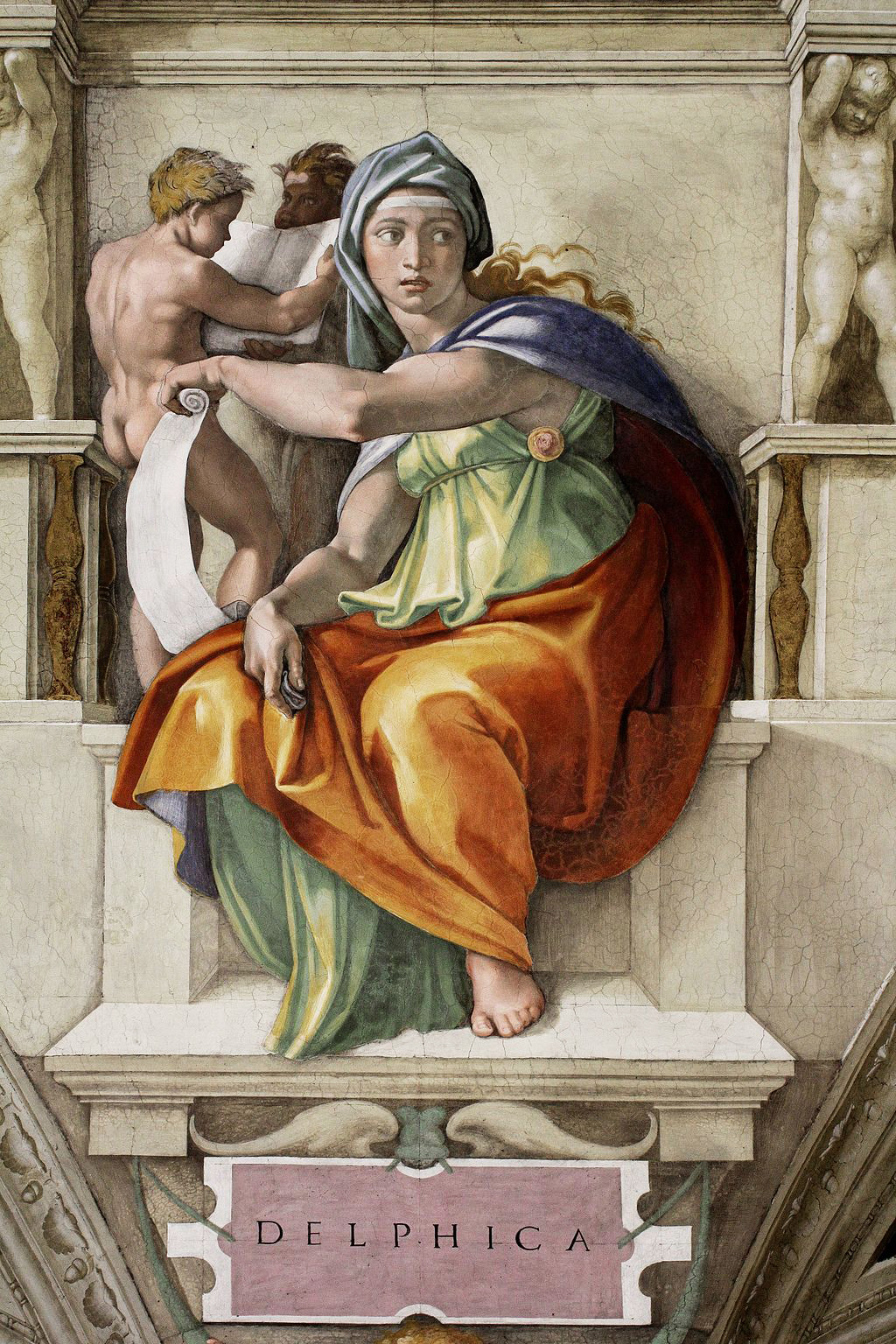
The overall circular composition of the body, which echoes the contours of her fictive architectural setting, adds to the sense of the sculptural weight of the figure.
Her arms are powerful, the heft of her body imposing, and both her left elbow and knee come into the viewer’s space. At the same time, Michelangelo imbued the Delphic Sibyl with grace and harmony of proportion, and her watchful expression, as well as the position of the left arm and right hand, is reminiscent of the artist’s David.
The Libyan Sibyl is also exemplary. Although she is in a contorted position that would be nearly impossible for an actual person to hold, Michelangelo nonetheless executes her with a sprezzatura (a deceptive ease) that will become typical of the Mannerists who closely modelled their work on his.
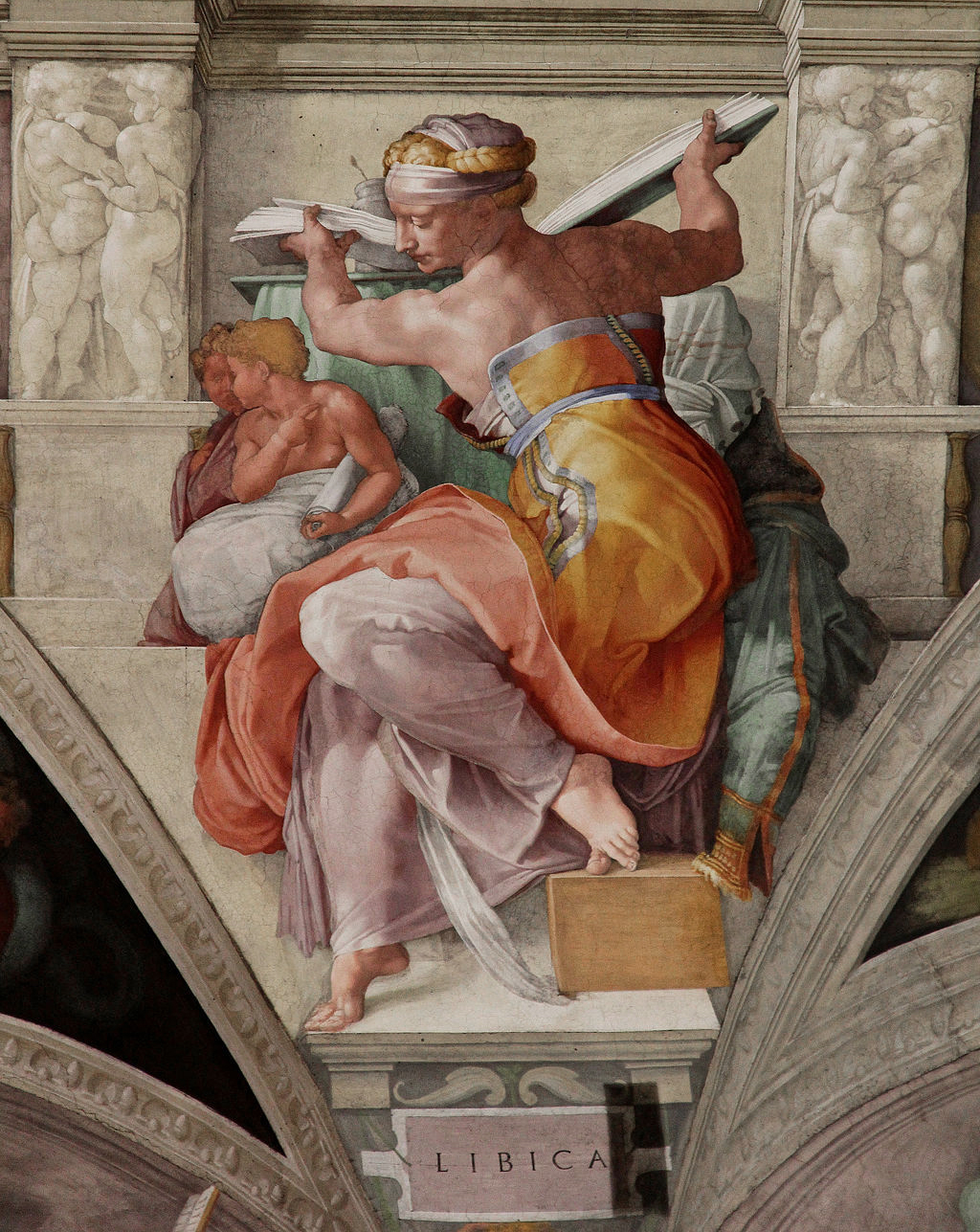
It is no wonder that Raphael, struck by the genius of the Sistine Chapel, rushed back to his School of Athens in the Vatican Stanze and inserted Michelangelo’s weighty, monumental likeness sitting at the bottom of the steps of the school.

Legacy
Michelangelo completed the Sistine Chapel in 1512. Its importance in the history of art cannot be overstated. It turned into a veritable academy for young painters, a position that was cemented when Michelangelo returned to the chapel twenty years later to execute the Last Judgment fresco on the altar wall.
The chapel recently underwent a controversial cleaning, which has once again brought to light Michelangelo’s jewel-like palette, his mastery of chiaroscuro, and additional iconological details which continue to captivate modern viewers even five hundred years after the frescoes’ original completion. Not bad for an artist who insisted he was not a painter.
Raphael, School of Athens
Raphael was a key figure in the Italian High Renaissance, known for his mastery of classical style in both religious and secular works. In Raphael’s School of Athens, two great philosophers of antiquity, Plato and Aristotle, face off in this meeting of minds
Disegno versus Colorito
During the Italian Renaissance, two competing concepts of how to organize a painting emerged: disegno and colorito. Disegno was “a term that literally translates to ‘drawing’ but rather emphasized highly the esteemed skill of crafting harmonious and proportional compositions and figures.” Artists working in Florence and Rome, such as da Vinci, Michelangelo, and Raphael, all tended to prioritize disegno. Colorito, by contrast, emphasizes the power of color.
The emphasis on disegno increased during the fifteenth century—emerging, for instance, in the writings of Antonio di Pietro Averlino (better known as Filarete)—but arguably grew to new prominence in the sixteenth century. For example, following in the mode of Giorgio Vasari, who declared disegno the father of the three arts (painting, sculpture, and architecture), Vincenzo Danti published in 1567 his Trattato delle perfetti proporzioni (Treatise on Ideal Proportions), in which he declared the beauty of art as stemming from the artist’s capabilities in disegno to capture these ratios; Federico Zuccaro echoed a similar sentiment in L’Idea di pittori, scultori ed architetti (1607), in which he proclaimed “painting is . . . the daughter of Nature and Disegno.” Disegno was particularly celebrated in cities like Rome, where the study of antique artifacts prompted artists to excel in conjuring the details of the body.
In contrast, artists from Venice became associated with the idea of color. Working with the rich, luminous quality of oil paint emerging from Northern Europe, the idea of colorito prioritizes the use of color to balance a composition. One such artist, Titian, created his now-iconic Venus of Urbino using the concept of colorito and worked in the fresh “new” medium of oil paint.
Titian, Venus of Urbino
A Venetian painter who was internationally famous in his own time, Titian is celebrated for his use of color, which influenced many later artists.
Conclusion
From Florence and Rome to Venice, the High Renaissance produced works of art shaped by the larger cultural revival of interest in humanism. Artists like da Vinci, Michelangelo, and Raphael brought together elements of the Classical world with Christian theology to create artworks that celebrated the human body, naturalism, and concepts of idealized beauty. The compositional principles of disegno and colorito, which often competed with one another, will become a major discussion for artists until the 21st century
Citation and Licensing
The following sections were written by Chelsea Wright and licensed CC BY-NC-SA 4.0:
- Chapter Overview and Introduction
- Focus artwork and term list compiled by Chelsea Wright
- Introduction to High Renaissance Architecture
- Practicing Visual Analysis
- Conclusion
The following articles from Smarthistory licensed CC BY-NC-SA 4.0 were remixed and adapted for the chapter:
- “Disegno versus Colorito” contains elements written by Chelsea Wright CC BY-NC-SA 4.0 and remix of the Smarthistory article: Dr. Alexis Culotta, “Preparatory drawing during the Italian renaissance, an introduction,” in Smarthistory, June 15, 2021.
- Dr. Beth Harris and Dr. Steven Zucker, “Toward the High Renaissance, an introduction,” in Smarthistory, August 9, 2015.
- Smarthistory, “Leonardo da Vinci,” in Smarthistory.
- Dr. Steven Zucker and Dr. Beth Harris, “Leonardo, Last Supper,” in Smarthistory, August 9, 2015.
- Dr. Steven Zucker and Dr. Beth Harris, “Leonardo, Mona Lisa,” in Smarthistory, August 9, 2015.
- Smarthistory, “Donato Bramante,” in Smarthistory.
- Dr. Steven Zucker and Dr. Beth Harris, “Donato Bramante, Tempietto, Rome,” in Smarthistory, December 5, 2015.
- Dr. Beth Harris and Dr. Steven Zucker, “Saint Peter’s Basilica,” in Smarthistory, August 9, 2015.
- Dr. Tamara Smithers, “Who was Michelangelo?,” in Smarthistory, August 10, 2020.
- Dr. Steven Zucker and Dr. Beth Harris, “Michelangelo, David,” in Smarthistory, December 6, 2020.
- Christine Zappella, “Michelangelo, Ceiling of the Sistine Chapel,” in Smarthistory, August 9, 2015.
- Smarthistory, “Raphael,” in Smarthistory.
- Dr. Steven Zucker and Dr. Beth Harris, “Raphael, School of Athens,” in Smarthistory, December 15, 2015.
- Smarthistory, “Titian,” in Smarthistory.
- Dr. James R. Jewitt, “Titian, Venus of Urbino,” in Smarthistory, August 20, 2020.


.jpg)
,_fresco_in_the_Stanza_della_Segnatura,_Vatican.jpg)