
Art Between the Wars
Chapter Overview and Introduction
The two largest influences on art in the early 20th century were Cubism and World War I. Cubism introduced a new visual arts language with fractured space, fragmented forms, inconsistent lighting, and the destruction of the picture plane. World War I, which lasted between 1914-1918, caused devastation on an unprecedent scale. Millions of military members were killed in action, millions of civilians were killed, and millions more were wounded both physically and psychologically. It is no wonder that World War I (WWI) is often considered the collapse of traditional Western culture. In between World War I and World War II (1939-1945), new styles like Dada and Surrealism emerged in response to the massive changes occurring. Also taking shape in the period between the two world wars were the aesthetics of Modern architecture. With influences from De Stijl, the Bauhaus school in Germany began developing the principles of Modernist architecture.
Focus Artworks
- Marcel Duchamp, Fountain (reproduction), 1917/1964, glazed ceramic with black paint
- Salvador Dalí, The Persistence of Memory, 1931, oil on canvas
- Meret Oppenheim, Object, 1936, Fur-covered cup, saucer, and spoon, cup
- Ludwig Mies van der Rohe with Philip Johnson, Seagram Building, 1956–58, 375 Park Avenue, New York
- Frank Lloyd Wright, Fallingwater (Edgar J. Kaufmann House), 1935–38, Bear Run, Pennsylvania
Term List
- Dada
- Ready-made
- Assisted ready-made
- Photomontage
- Surrealism
- Automatic drawing
- Paranoia criticism
- Modern architecture
- Bauhaus
- International style
- Organic architecture
- Functionalism
- Mullions
- Trellis
- Cantilever
Dada, an introduction
Art as provocation
When you look at Marcel Duchamp’s Fountain, a factory-produced urinal he submitted as a sculpture to the 1917 exhibition of the Society of Independent Artists in New York, you might wonder just why this work of art has such a prominent place in art history books.
You would not be alone in asking this question. In fact, from the moment Duchamp purchased the urinal, flipped it on its side, signed it with a pseudonym (the false name of R. Mutt), and attempted to display it as art, the piece has generated controversy. This was the artist’s intention all along—to puzzle, amuse, and provoke his viewers.
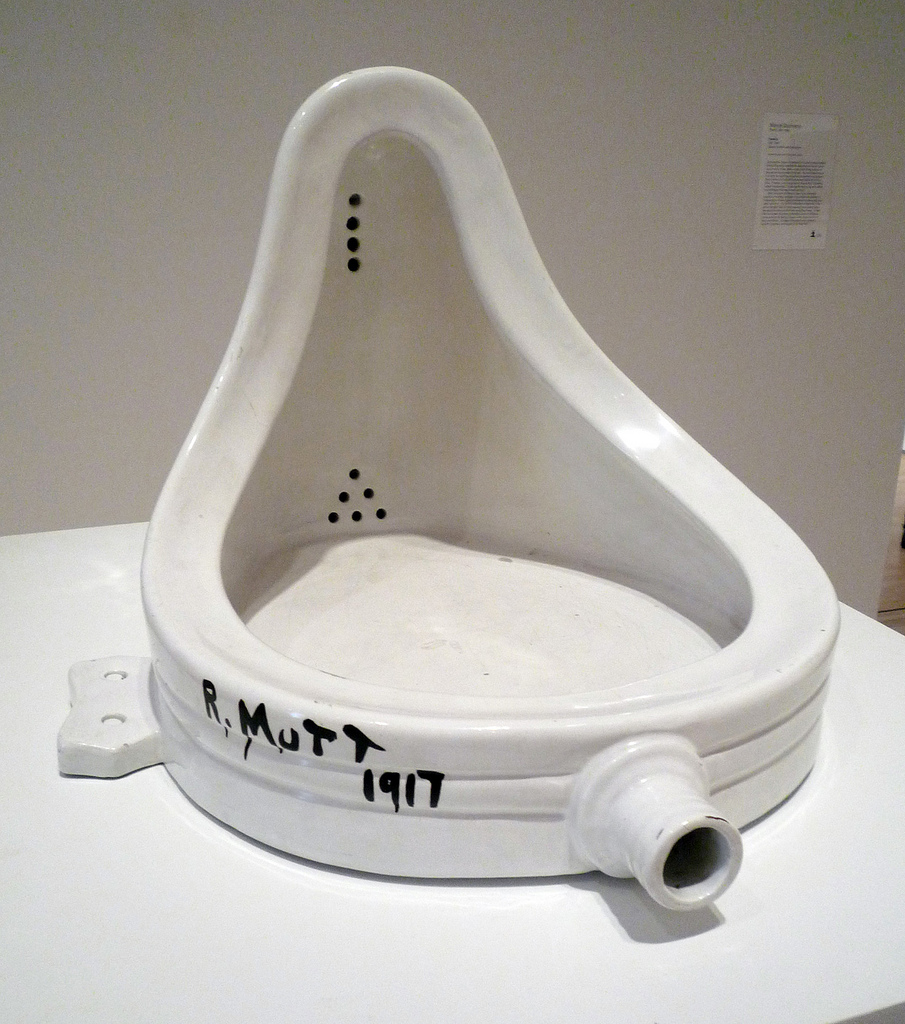
Fountain was submitted to the Society of Independent Artists, one of the first venues for experimental art in the United States. It is a new form of art Duchamp called the “readymade”— a mass-produced or found object that the artist transformed into art by the operation of selection and naming. The readymades challenged the very idea of artistic production, and what constitutes art in a gallery or museum. Duchamp provoked his viewers—testing the exhibition organizers’ liberal claim to accept all works with “no judge, no prize” without the conservative bias that made it difficult to exhibit modern art in most museums and galleries. Duchamp’s Fountain did more than test the validity of this claim: it prompted questions about what we mean by art altogether—and who gets to decide what art is.
Although the exhibition was non-juried, meaning that it would theoretically accept any submitted work, Fountain was rejected, and Duchamp published a defense of it:
“Whether Mr. Mutt with his own hands made the fountain or not has no importance. He CHOSE it. He took an ordinary article of life, and placed it so that its useful significance disappeared under the new title and point of view — created a new thought for that object.” Marcel Duchamp (anonymously), “The Richard Mutt Case,” in The Blind Man, no. 2 (May 1917), n.p.
Duchamp here notes several points of intervention by the artist that make even a “pure” readymade like Fountain different from an ordinary object:
(1) The readymade is chosen by the artist. Different objects have different associations and significance; an airplane propeller signifies something different than a high-heeled shoe. Readymades do not display an artist’s technical skill, but a work of art based on choosing an object, rather than representing one, does not necessarily sacrifice a capacity for meaningful communication.
(2) The readymade is divorced from its ordinary context and use value, and re-presented in an art world context. This encourages us to encounter the object in a different way. A urinal encountered in a men’s restroom is a simple matter of utilitarian fact; one encountered in a gallery becomes a focus for observation, cogitation, discussion, appreciation, and/or denunciation.
(3) The readymade is sometimes given an unexpected title. This also encourages us to think about the object anew: Why is Duchamp’s urinal entitled “fountain”? What do urinals have in common with fountains? How are they different? Why is a fountain suitable for public display (and a common site for sculptural decoration), while a urinal is not?
A world of questions
Duchamp’s provocation characterized not only his art, but also the short-lived, enigmatic, and incredibly diverse transnational group of artists who constituted a movement known as Dada. These artists were so diverse that they could hardly be called a coherent group, and they themselves rejected the whole idea of an art movement. Instead, they proclaimed themselves an anti-movement in various journals, manifestos, poems, performances, and what would come to be known as artistic “gestures” such as Duchamp’s submission of Fountain.
Dada artists worked in a wide range of media, frequently using irreverent humor and wordplay to examine relationships between art and language and voice opposition to outdated and destructive social customs. Although it was a fleeting phenomenon, lasting only from about 1914-1918 (and coinciding with WWI), Dada succeeded in irrevocably changing the way we view art, opening it up to a variety of experimental media, themes, and practices that still inform art today. Duchamp’s idea of the readymade has been one of the most important legacies of Dada.
Dada readymades
In a 1936 essay titled “The Work of Art in the Age of Mechanical Reproduction,” the German philosopher and cultural theorist, Walter Benjamin, proclaimed that the industrial age had changed everything about the way we view art. He believed that new technologies for mass production and media (such as photography) would invalidate the remnants of classical artistic traditions that were still being promoted by institutions such as art academies and museums.
Duchamp’s idea of the readymade, which he began exploring with works such as Bicycle Wheel and Bottle Rack as early as 1913, confronted these issues head on—subjecting the idea of art to intense scrutiny.
Although Duchamp coined the term “readymade” and was the first to show mass produced objects as art, he drew inspiration from Braque, Picasso, and the other Cubists then working in Paris, who had already begun incorporating everyday items from mass culture (such as newspaper and wallpaper) into their abstracted collages.
International collaboration
Sharing and adapting characterized the key approaches of Dada artists, and Duchamp’s use of articles from everyday life caught on among the various Dada collectives, though each used the readymade in ways that reflected their own group’s specific artistic concerns.
Art historian Leah Dickerman has demonstrated that Dada can best be understood by looking at its distinct manifestations in six urban centers. The Dada movement officially began in Zurich, a city in politically neutral Switzerland where many artists and intellectuals fled during World War I. From there, the movement radiated outward to the other groups in Berlin, Hannover, Cologne, New York, and Paris—each of which had members in communication with the other groups.
Zurich Dada
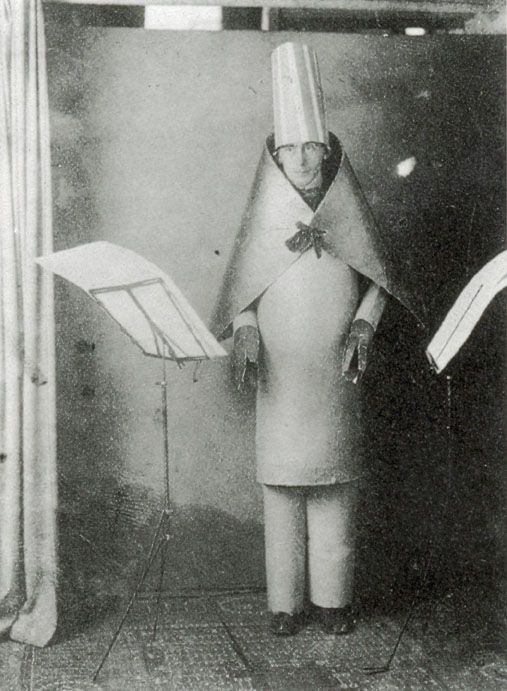
Beginning in 1916, Zurich Dada centered around the Cabaret Voltaire, which provided a creative haven for exiled artists and others to explore new media and performance while critiquing what they saw as the predominant “rational” culture that led to the irrational horrors of the war. Members of this group included Hugo Ball (German), Emmy Hennings (German), Hans (also known as Jean) Arp (from Alsace, a contested territory between France and Germany), Sophie Taeuber (later to become Sophie Taeuber Arp, Swiss), and Tristan Tzara (Romanian). It was their raucous, irreverent, and absurd performances ranging from sound poetry to dances in costumes modeled after Native American and other non-European ritual garments, that gained the attention of the avant-garde art world. In addition to their collaborative art practices, exhibitions, and performances, the artists in Zurich published a journal and other graphic materials to spread their ideas.
Taeuber and Arp
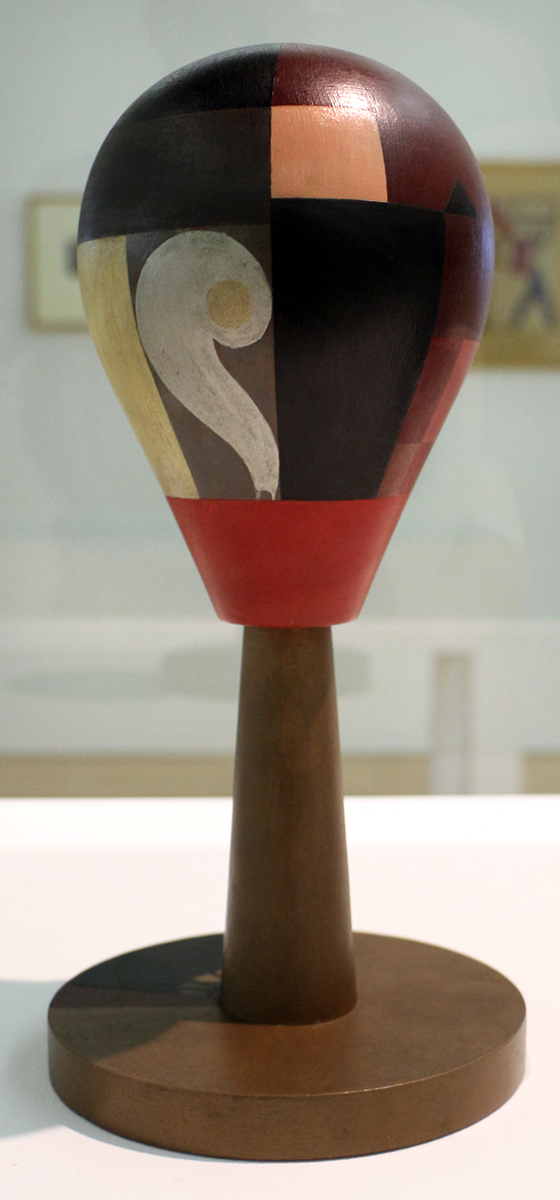
Sophie Taeuber produced an incredible collection of marionettes and worked in media such as textiles and wood, which had traditionally been relegated to the category of “craft” (ostensibly a “low” art associated with “women’s work”) by European academic art institutions. Hans/Jean Arp moved away from his previous interest in German Expressionism to develop what he called “chance collages,” in which it is said that he tossed torn or cut paper squares onto a larger sheet of paper on the floor and then glued them in whatever formation they landed. Taeuber and Arp also produced abstract wooden sculptures, many of which resembled organic forms or, alternatively, mechanical forms such as mannequin heads.
In works such as these, Zurich Dada demonstrated a skeptical attitude toward rationality and intention, found strategies to explore abstraction, and displaced the artist’s hand (that is, the direct connection to the work of art that was the basis of the “aura” that Benjamin associated with traditional artworks in museums and galleries). Instead of the specialized materials of fine art such as oil paint and marble, these artists favored mass media imagery and everyday commercial materials such as paper. They sought to integrate art and life more closely in order to critique the effects that modern industrialization—factory labor, mass production, and rapid urbanization—had wrought on society. These industrial advances raised the standard of living for many, but had a devastating impact on the battlefield where millions died due to poison gas and other types of newly efficient weapons.
Berlin Dada
Dada arrived in Germany in 1917 when Richard Huelsenbeck, a German poet who had spent time at the Café Voltaire, brought the ideas he encountered in Zurich to Berlin. Here, Dada became even more overtly political. Using the readymade, new photographic technologies, and elements from everyday life, including mass media imagery, Huelsenbeck and his collaborators critiqued modern bourgeois society and the politics that had led to the First World War.
Berlin Dadaists embraced the tension and images of violence that characterized Germany during and after the war, using absurdity to draw attention to the physical, psychological, and social trauma it produced. Employing strategies ranging from a Cubo-Futurist rendering of form to mixed-media assemblage, they satirized the immorality and corruption of the social elite, including cultural institutions such as museums. Many of these works were featured alongside manifestoes and other textual works in Dada journals.
During the Weimar Republic, artists such as Hannah Höch produced collages using imagery from magazines and other mass media to provoke the viewer to critically evaluate and challenge cultural norms.
One of the most transformative Berlin Dada practices—one that continues to inform contemporary art today—was the invention of mixed media installations. This began in earnest with the First International Dada Fair in 1920, which featured an assortment of paintings, posters, photographs, readymades, and two- and three-dimensional mixed media art.
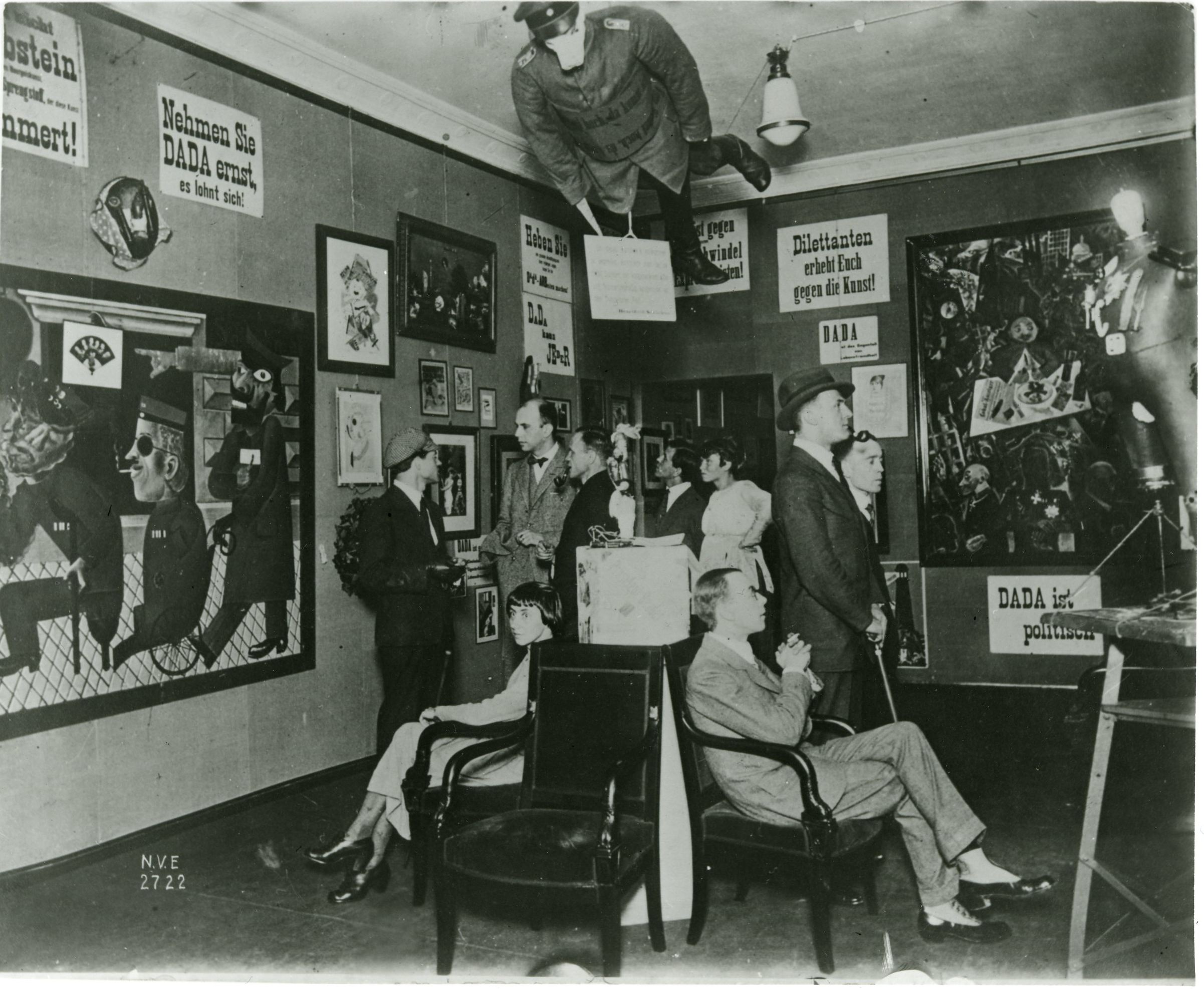
In Berlin, artists such as John Heartfield and George Grosz, political agitators who had anglicized their names in protest of overzealous German nationalism, continued their Dada cultural interrogations into the 1930s to combat the rise of the National Socialist (Nazi) Party. Because Heartfield, Grosz, and other artists involved in Berlin Dada embraced Communism as the solution to fight fascism, they combined Dada strategies with the radical agitprop (agitational propaganda) that had been used to mobilize public opinion against traditional bourgeois society during the Russian Revolution and the establishment of the Soviet Union. Heartfield is best known for his use of photomontage. In the hands of Heartfield and other Dadaists, mainstream advertising, high society publicity, and fascist propaganda was turned on its head, providing readers with humorous, yet sobering exposés.
Hannover Dada
Although a spirit of collaboration characterized Dada in all its manifestations, Hannover Dada is best known for the collages and three-dimensional assemblages of one artist: Kurt Schwitters. Labeling his art “Merz” (a term he extracted from the word Kommerz, German for “commerce”), his art reflected a desire to explore the connections between human experience, memory, and objects in the world—particularly discarded scraps of newspaper, movie tickets, or other scrapped consumer goods. Schwitters gave these cast-off everyday objects new life in his collages that retained a dialogue with painting, formal abstraction, and sculpture.
This approach is particularly visible in his Merzbau, a project that he worked on for years in his Hannover home before having to abandon it for subsequent efforts in Norway and England when he was forced by the Nazis to flee Germany. Within this cottage-sized three-dimensional assemblage he incorporated abstract structures reminiscent of German Expressionist film and stage design along with objects that served as souvenirs of key moments and relationships, expressing also his interest in material, physical, and spiritual interactions.
Cologne Dada
Dada in Cologne (a city in western Germany) is most closely associated with the diverse artworks of Max Ernst, an artist who produced a prolific body of work that included frotage (rubbings), painting, collage, and mixed media assemblage. These works, many of which explored the absurd and suggested fantastic creatures, dwellings, and landscapes, are often associated with Surrealism, a movement with which he was also affiliated. Because Ernst worked in Germany and France, fled to the United States during World War II, and later returned to Europe, his work impacted art on both sides of the Atlantic and can be found in collections around the world.
New York and Paris Dada
New York Dada, where we began this discussion, lost its momentum when its two primary leaders, Marcel Duchamp and Francis Picabia, returned to Europe after World War I. In Paris, the two leaders joined like-minded artists and former exiles to continue their raucous, yet playful, interrogation of art and culture. More attuned to the approaches of the Zurich and New York groups, Paris Dada centered around spectacle and was less overtly political than Dada in Germany. The group’s performances, photographs, mixed media collage, and installations nevertheless emphasized the absurd and challenged social norms. These interests, combined with the emerging appeal of investigating imagery that reflects psychological states, led many of the Paris Dada group (including Man Ray, best known for his experimental photographs) to join the Surrealists who, led by writer Andre Breton, made Paris the center of their activities.
Dada and Its Legacies
Many of the artists who identified with Dada went on to become Surrealists. Because of this, and the relatively brief duration of the Dada phenomenon, it took some time for subsequent artists and historians to appreciate its value. In retrospect, however, we can see the reverberations of Dada throughout the twentieth century, and it has been one of the main contributors to contemporary art practices since its revival as Neo-Dada in the 1960s.
Surrealism, an introduction
Reshaping the world
When you think of maps, what comes to mind? An informative document used by travelers? Demarcations of national borders and geographic features? At the very least, we might think of some factual representation of the world, not one that is fictitious or subjective.
Imagine a map of the world. Now take a moment to examine the following map, created by members of the Surrealist movement and published in the Belgian journal Variétés in June 1929.
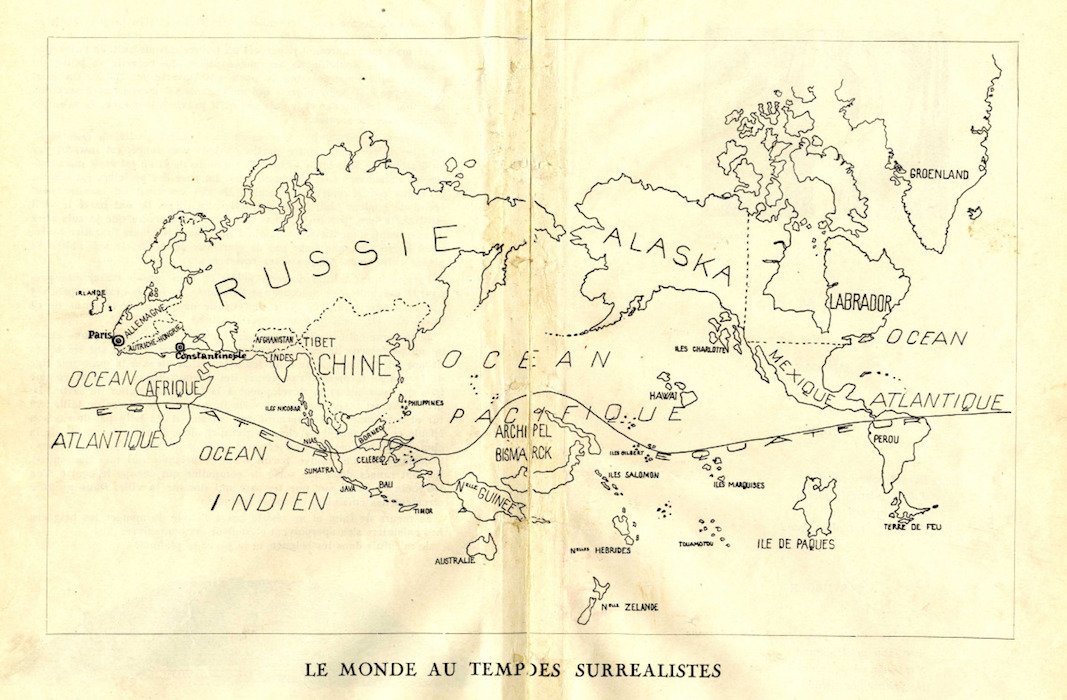
This anonymous map might seem unsettling; it emphasizes certain areas while removing others, and changes dramatically the size of landmasses. How is this map different from the world we know? And, although it might seem like an odd place to begin, what can it tell us about the ideas and approaches of the Surrealists?
Psychic freedom
Historians typically introduce Surrealism as an offshoot of Dada. In the early 1920s, writers such as André Breton and Louis Aragon became involved with Parisian Dada. Although they shared the group’s interest in anarchy and revolution, they felt Dada lacked clear direction for political action. So in late 1922, this growing group of radicals left Dada, and began looking to the mind as a source of social liberation. Influenced by French psychology and the work of Sigmund Freud, they experimented with practices that allowed them to explore subconscious thought and identity and bypass restrictions placed on people by social convention. For example, societal norms mandate that suddenly screaming expletives at a group of strangers—unprovoked, is completely unacceptable.
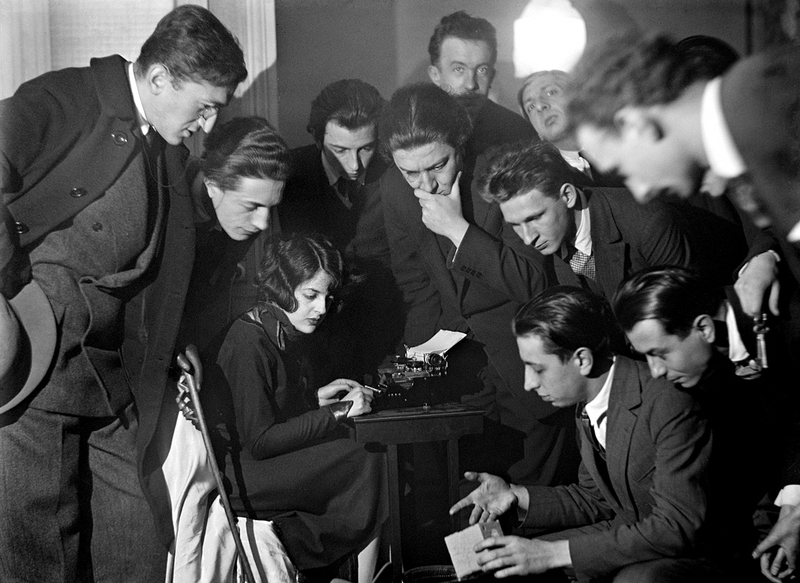
Surrealist practices included “waking dream” seances and automatism. During waking dream seances, group members placed themselves into a trance state and recited visions and poetic passages with an immediacy that denied any fakery. (The Surrealists insisted theirs was a scientific pursuit, and not like similar techniques used by Spiritualists claiming to communicate with the dead.) The waking dream sessions allowed members to say and do things unburdened by societal expectations; however, this practice ended abruptly when one of the “dreamers” attempted to stab another group member with a kitchen knife. Automatic writing allowed highly trained poets to circumvent their own training, and create raw, fresh poetry. They used this technique to compose poems without forethought, and it resulted in beautiful and startling passages the writers would not have consciously conceived.
Envisioning Surrealism: automatic drawing and the exquisite corpse
In the autumn of 1924, Surrealism was announced to the public through the publication of André Breton’s first “Manifesto of Surrealism,” the founding of a journal (La Révolution surréaliste), and the formation of a Bureau of Surrealist Research. The literary focus of the movement soon expanded when Max Ernst and other visual artists joined and began applying Surrealist ideas to their work. These artists drew on many stylistic sources including scientific journals, found objects, mass media, and non-western visual traditions. (Early Surrealist exhibitions tended to pair an artist’s work with non-Western art objects). They also found inspiration in automatism and other activities designed to circumvent conscious intention.
Surrealist artist André Masson began creating automatic drawings, essentially applying the same unfettered, unplanned process used by Surrealist writers, but to create visual images. In Automatic Drawing, the hands, torsos, and genitalia seen within the mass of swirling lines suggest that, as the artist dives deeper into his own subconscious, recognizable forms appear on the page.
Another technique, the exquisite corpse, developed from a writing game the Surrealists created. First, a piece of paper is folded as many times as there are players. Each player takes one side of the folded sheet and, starting from the top, draws the head of a body, continuing the lines at the bottom of their fold to the other side of the fold, then handing that blank folded side to the next person to continue drawing the figure. Once everyone has drawn her or his “part” of the body, the last person unfolds the sheet to reveal a strange composite creature, made of unrelated forms that are now merged. A Surrealist Frankenstein’s monster, of sorts.
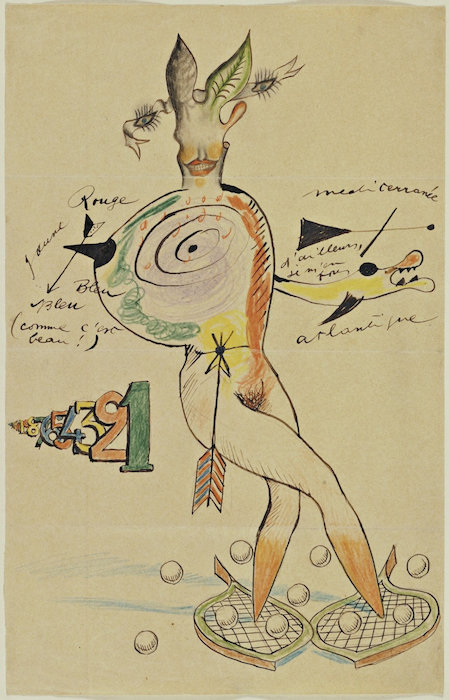
Whereas automatic drawing often results in vague images emerging from a chaotic background of lines and shapes, exquisite corpse drawings show precisely rendered objects juxtaposed with others, often in strange combinations. These two distinct “styles,” represent two contrasting approaches characteristic of Surrealists art, and exemplified in the early work of Yves Tanguy and René Magritte.
Tanguy began his painting Apparitions using an automatic technique to apply unplanned areas of color. He then methodically clarified forms by defining biomorphic shapes populating a barren landscape. However, Magritte, employed carefully chosen, naturalistically-presented objects in his haunting painting, The Central Story. The juxtaposition of seemingly unrelated objects suggests a cryptic meaning and otherworldliness, similar to the hybrid creatures common to exquisite corpse drawings. These two visual styles extend to other Surrealist media, including photography, sculpture, and film.
The Surrealist experience
Today, we tend to think of Surrealism primarily as a visual arts movement, but the group’s activity stemmed from much larger aspirations. By teaching how to circumvent restrictions that society imposed, the Surrealists saw themselves as agents of social change. The desire for revolution was such a central tenet that through much of the late 1920s, the Surrealists attempted to ally their cause with the French Communist party, seeking to be the artistic and cultural arm. Unsurprisingly, the incompatibility of the two groups prevented any alliance, but the Surrealists’ effort speaks to their political goals.
In its purest form, Surrealism was a way of life. Members advocated becoming flâneurs–urban explorers who traversed cities without plan or intent, and they sought moments of objective chance—seemingly random encounters actually fraught with import and meaning. They disrupted cultural norms with shocking actions, such as verbally assaulting priests in the street. They sought in their lives what Breton dubbed surreality, where one’s internal reality merged with the external reality we all share. Such experiences, which could be represented by a painting, photograph, or sculpture, are the true core of Surrealism.
The “Nonnational boundaries of Surrealism”*
Returning to The Surrealist Map of the World, let’s reconsider what it tells us about the movement. Shifts in scale are evident, as Russia dominates (likely a nod to the importance of the Russian Revolution). Africa and China are far too small, but Greenland is huge. The Americas are comprised of Alaska (perhaps another sly reference to Russia’s former control of this territory), Labrador, and Mexico, with a very small South America attached beneath. The United States and the rest of Canada are removed entirely. Much of Europe is also gone. France is reduced to the city of Paris, and Ireland appears without the rest of Great Britain. The only other city clearly indicated is Constantinople, pointedly not called by its modern name Istanbul. An anti-colonial diatribe, the Surrealists’s map removes colonial powers to create a world dominated by cultures untouched by western influence and participants in the Communist experiment. It is part utopian vision, part promotion of their own agenda, and part homage to their influences.
It also reminds us that Surrealism was an international movement. Although it was founded in Paris, pockets of Surrealist activity emerged in Belgium, England, Czechoslovakia, Mexico, the United States, other parts of Latin America, and Japan. Although Surrealism’s heyday was 1924 to the end of the 1940s, the group stayed active under Breton’s efforts until his death in 1966. An important influence on later artists within Abstract Expressionism, Art Brut, and the Situationists, Surrealism continues to be relevant to art history today.
Surrealist Techniques: Subversive Realism
The omnipotence of the dream
A central approach of Surrealist visual art was derived from André Breton’s assertion of “the omnipotence of the dream” in the first Surrealist Manifesto. Following the ideas of Sigmund Freud, the Surrealists saw dreams as visual representations of unconscious thoughts and desires. In their first magazine, La Révolution Surréaliste, they published accounts of their own dreams and reproductions of art that seemed to record dream images, notably the paintings of Giorgio de Chirico.
In addition to the dream-like atmosphere of de Chirico’s work, the Surrealists were attracted to what are often called its literary qualities. The strange juxtaposition of female nude, bananas, and train in The Uncertainty of the Poet seems like a literal illustration of the discordant imagery of a modern poem. In addition, the erotic symbolism of the image conforms to Freud’s belief in the central importance of sexuality in the unconscious.
Rejecting the formal concerns of modern art
In claiming de Chirico’s pre-war work as exemplary, the Surrealists implicitly rejected modern art’s emphasis on formal innovation. De Chirico’s use of linear perspective, his inexpressive representation of objects, and his lack of interest in the material qualities of paint all seemed to revive the outdated naturalistic conventions of pre-modern painting, as did his use of complex, symbolic subject matter.
For the Surrealists de Chirico’s style was irrelevant; what mattered to them was his ability to represent unconscious dream images. They were interested in the subject of his painting, not how it was painted. In their willingness to elevate subject matter over painting style and technique the Surrealists explicitly placed themselves outside of what they considered were the limiting concerns of established modern art. In return, many critics (and later art historians) attacked the Surrealists for failing to understand and appreciate the formal achievements of modern art.
Because the movement was initiated and led by writers, Surrealist art was often considered to be literary and illustrative rather than a properly modern visual art. This overlooked the fact that many prominent Surrealist artists, including André Masson, Joan Miró, and Max Ernst, frequently employed modern styles and developed innovative artistic techniques.
For the Surrealists, an artist’s style and technique were the means to concretize inspired thinking, the creative activity of the unconscious. Whether those means were traditional naturalism or the more abstract innovations of modern art was not important as long as they were effective. The use of meticulous naturalistic techniques — traditionally employed to represent the accepted “reality” of the external world — demonstrated the equal reality of the unconscious world revealed by Surrealism.
A window into another world
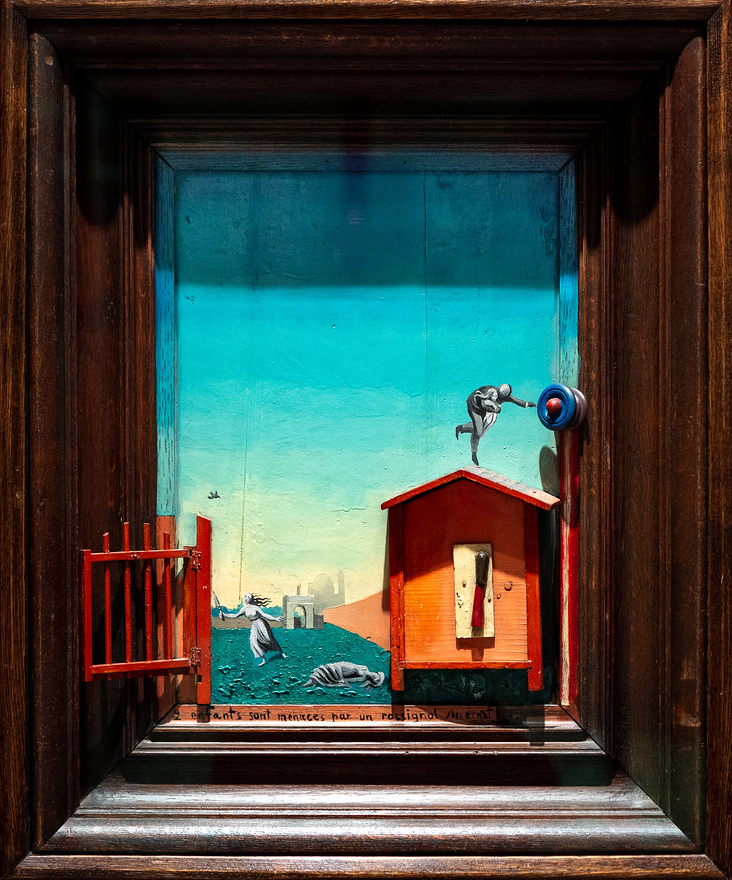
The complexity of the Surrealists’ challenge to modernist values can be appreciated by considering Max Ernst’s Two Children Threatened by a Nightingale. This painting was one of the first works by a Surrealist artist reproduced in the group’s journal, La Révolution Surréaliste. It combines echoes of de Chirico’s classical architecture and deep perspectival space with an incomprehensible nightmarish scene of violence in the foreground. Small wooden elements are attached to the painting to form a building, gate, and doorknob. The title is handwritten on the edge of the frame, which connects the painted world to the world of the viewer.
Ernst’s combination of painting, writing, collage, and relief sculpture disrupts the established categories of the individual arts as much as the image defies rational explanation. The painting is no longer simply a flat plane covered by colors, it has returned to its pre-modernist role as a window into another world, and that world is one into which we as viewers are invited. The gate on the left has swung open towards us, and the man running on the roof of the building at the right reaches for the “doorknob” on the frame that separates our world from his.
For the Surrealists who desired the complete breakdown of distinctions between art and life, dream and reality, Ernst’s disruption of pictorial boundaries meant far more than a challenge to the conventional distinctions between the different arts. It was the means to enter an entirely new world and heralded the concrete realization of Surrealism’s ultimate goal, the resolution of dream and reality into a new surreality.
The interior model
The Surrealists believed that the world of the imagination was the only proper subject for the arts, which must challenge what Breton called “the poverty of reality.” He claimed that the work of art must “refer to a purely interior model.” While this statement applies to all Surrealist artworks, regardless of productive technique, style, or subject, many Surrealist artists followed de Chirico’s example and created dreamlike imagery that appears to literally reveal the “interior model.”
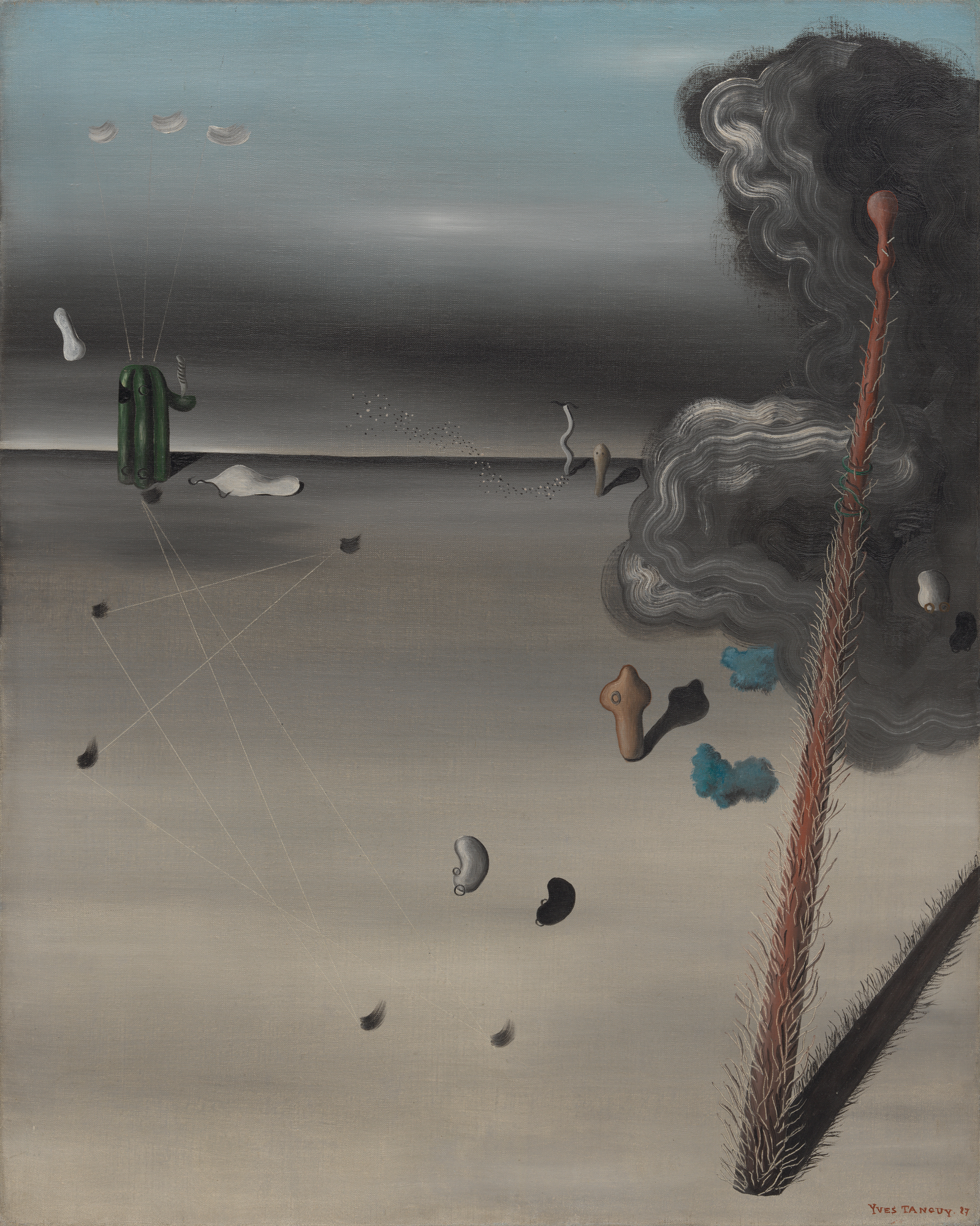
Yves Tanguy’s meticulously painted depictions of imaginary landscapes stretching off to an infinitely distant horizon combine the naturalistic rendering of real space and light effects with suggestive abstract forms. Their naturalism invites the viewer’s imaginative entry into the world they make visible and presents the possibility that the world of the unconscious can be made real.
Realism as subversive
The realistic representation of the world of the unconscious reached its apogee in the paintings of Salvador Dalí, who adopted an extremely detailed realistic technique reminiscent of nineteenth-century academic painting. This was an explicit attempt to turn academic naturalism into a subversive technique.
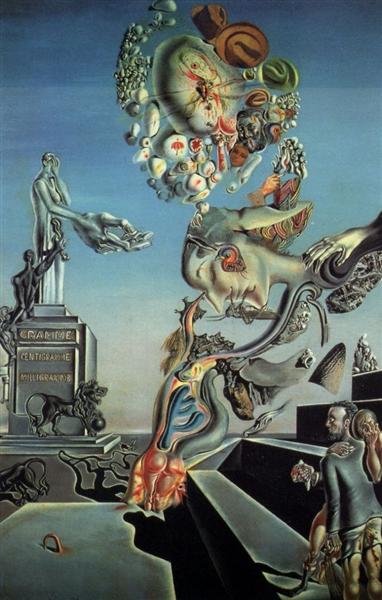
The vivid realism of Dalí’s bizarre scenes seems to confirm that the world they represent is just as real as scenes encountered in ordinary waking life. In paintings such as The Lugubrious Game, Dalí minutely depicted his psychological obsessions, which were largely derived from Freud’s theories of infantile eroticism.
The artist’s profile floats horizontally in the center of the painting and generates a bizarre collection of objects, human figures, animals, and insects. Explicit and symbolic depictions of male and female genitalia abound, as do direct references to Freud’s theories of castration anxiety and anality. In this painting and many others Dalí portrays a universe in which the most apparently innocent objects, from a seashell to a man’s hat, acquire erotic significance.
Systematic confusion
Dalí invented a technical strategy for Surrealist art that he called “paranoia criticism.” In Dalí’s view unconscious erotic desires inevitably shape our vision of reality, and the Surrealist artist’s role is to demonstrate this in order to “systematize confusion,” overthrow rationality, and discredit what we think of as reality. Just as paranoiacs are convinced that seemingly unrelated objects and events are in fact intimately connected to their own obsessions, Dalí’s paranoiac paintings were intended to demonstrate how his imagination radically transforms objects to make them conform to his desires.
His first published paranoiac painting, The Invisible Man, depicts a strange landscape with multiple figures and objects. Individual elements also create the figure of a large seated man. The back of a nude woman in the upper center of the image is one of his upper arms. His face appears in a collection of architectural elements, and his hair is also clouds. The longer you look at the painting, the more figures and parts of figures you will see. Paintings such as this were intended to make viewers aware that the “reality” they see is only one view. It is possible to make reality answer our desires simply by changing the way we look at things.
Philosophical conundrums
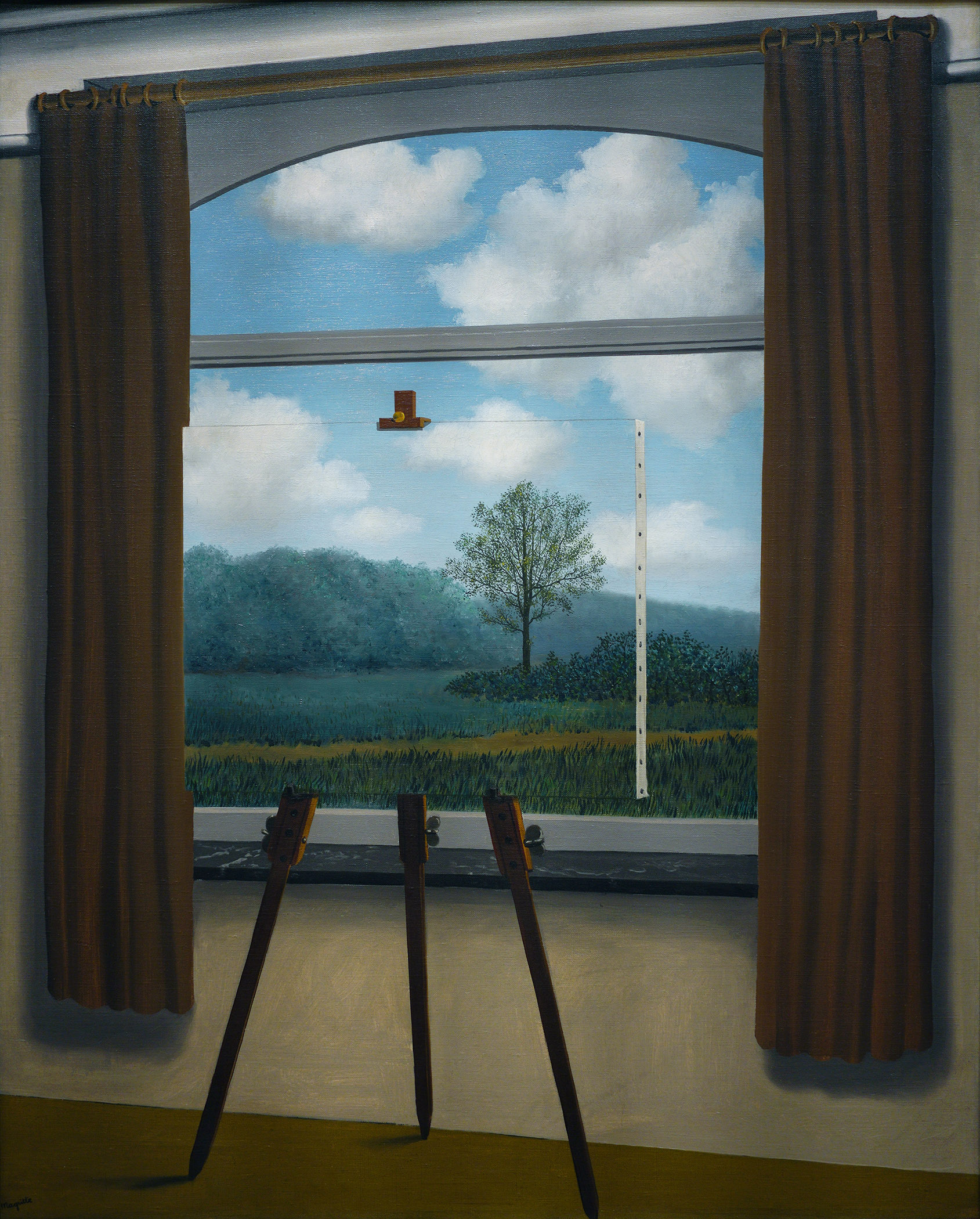
In contrast to Dalí’s often obscene and intentionally shocking imagery, René Magritte used realistic painting techniques to present philosophical conundrums about the nature of representation and its relation to reality and language. In The Human Condition, Magritte depicts the way a painting’s representation “replaces” reality, leading us to consider the many assumptions we make about realistic images and their relationship to what they represent.
The Treachery of Images presents the disjunctions between the written phrase “Ceci n’est pas une pipe” (This is not a pipe) and the depiction of a pipe above it. Representation is not reality, although it may look like it; nor is language to be trusted as a source of truth about what is real. The painting of a pipe is not a pipe; but the word “pipe” is not a pipe either. By undermining comfortable assumptions about the human ability to understand reality through language and representation, Magritte’s works demonstrate that we make the world we think we know. Everything is, in the end, a question of representation (in words or images) in which we choose to believe, or not.
Salvador Dalí, The Persistence of Memory
A Spanish Catalan artist, Salvador Dalí is best known for his surrealist artworks and designs in many media as well as his own eccentric public persona. In The Persistence of Memory, Dalí wages war on the rational in this naturalistic landscape populated by strange objects.
Meret Oppenheim, Object (Fur-covered cup, saucer, and spoon)
An important figure in Surrealism, Meret Oppenheim worked across media in works that explored female sexuality, identity, and exploitation. This furry tea service was a touchstone for Surrealism, but the artist was a victim of her own success.
Practicing Visual Analysis
Meret Oppenheim’s Object is certainly not a traditional sculpture made of bronze or marble. It is a curvilinear porcelain cup, saucer, and spoon covered in Chinese gazelle fur. In the case of sculpture, it is not pictorial space or the illusion of three-dimensional space that is discussed. Oppenheim’s Object exists in real space. The small, regular scale of the cup, saucer, and spoon relate to the viewer on an everyday level. This is not your everyday cup and saucer, however. The texture here is real rather than implied. If one could feel the work, we would feel the soft yet bristly texture of gazelle fur. The texture of fur contrasts with the texture of the porcelain underneath. Although we cannot see the porcelain, our brain recognizes the shapes of the objects and their attributes. The porcelain should be smooth and cold; yet we encounter a rough drinking vessel that implies warmth through fur. The juxtaposition of fur with porcelain provokes in the viewer an immediate response.
Introduction to Modern Architecture
The larger category of Modern Art includes architecture in addition to sculpture and painting. The De Stijl movement of Mondrian’s Composition with Red, Blue, and Yellow envisioned a universal design aesthetic for interior design and architecture using strong rectilinear lines and the primary colors of red, blue, and yellow. The De Stijl influence became prominent at the influential Bauhaus school in Germany under the direction of Walter Gropius. Out of the Bauhaus emerged the International Style, which made its way to the United States during the rise of the Nazi party in 1930s Germany. Although Modern architectures were built on either side of the Atlantic, many European modernists like Ludwig Mies van der Rohe found patrons for their designs in the United States. The flow of influence was also not one way. American artists were inspired by and influenced European architects. Frank Lloyd Wright exemplifies American Modernist architecture through his work Fallingwater.
The Bauhaus, an introduction
The Bauhaus was an art and design school in Germany whose importance is astonishing given its very brief and tenuous existence. The desk lamp and chair illustrated here are so familiar and so simple that they don’t seem to have required a designer, but they were as radical in their time as they are commonplace now, and their apparent simplicity was the result of a thoughtful and meticulous design education and design process that remains a model today.
During its fourteen years of existence the Bauhaus was forced to change location three times and was ultimately closed as a result of political pressure from the Nazi party. Founded by Walter Gropius in 1919, the school originally had three aims: to abolish the “arrogant” distinction between artist and craftsperson by recognizing the knowledge and skills common to both; to mobilize all arts and crafts towards the creation of total design environments; and, to foster links between the school and local manufacturers.

Art education and the “Vorkurs” (preliminary course)
The Bauhaus program of study is diagrammed above as a circle. Students began in the outer ring with the half-year Vorkurs or preliminary course (later expanded to a full year) before moving into one of several workshops to concentrate on a specific medium such as ceramics, woodworking, weaving, metalworking, and so on. Once they had achieved a degree of proficiency in their chosen medium all students converged again in Bau (building), to construct total environments, designing everything from the architecture to the furniture, carpets, dishes, and flatware.
The Vorkurs, which taught skills common to all areas of art and design, was one enduring innovation of the Bauhaus. Today’s art students will recognize in the Vorkurs the progenitor of their first-year 2-D Design and 3-D Design “foundations” courses. The original head of the Vorkurs was a charismatic Swiss art teacher named Johannes Itten, a follower of Mazdaznan (related to the ancient Persian religion Zoroastrianism) who wore monk-like clothing and encouraged students to meditate, do breathing exercises, and eat a vegetarian diet as aids to creativity.
Projects assigned in the Vorkurs were free-form and generally without practical application. They were intended to develop students’ perception, creativity, and understanding of materials. For one typical project Itten collected disparate materials such as wool, rope, and wood shavings.
“The students had to feel these sequences of textures with their fingertips, their eyes closed. After a short while their sense of touch improved dramatically. I then asked them to make texture montages of contrasting materials. Fantastic structures were produced and their effects were completely novel at the time.” Johannes Itten, Design and Form: The Basic Course at the Bauhaus and Later (London: Thames & Hudson, 1975), p. 34
Experimental constructions
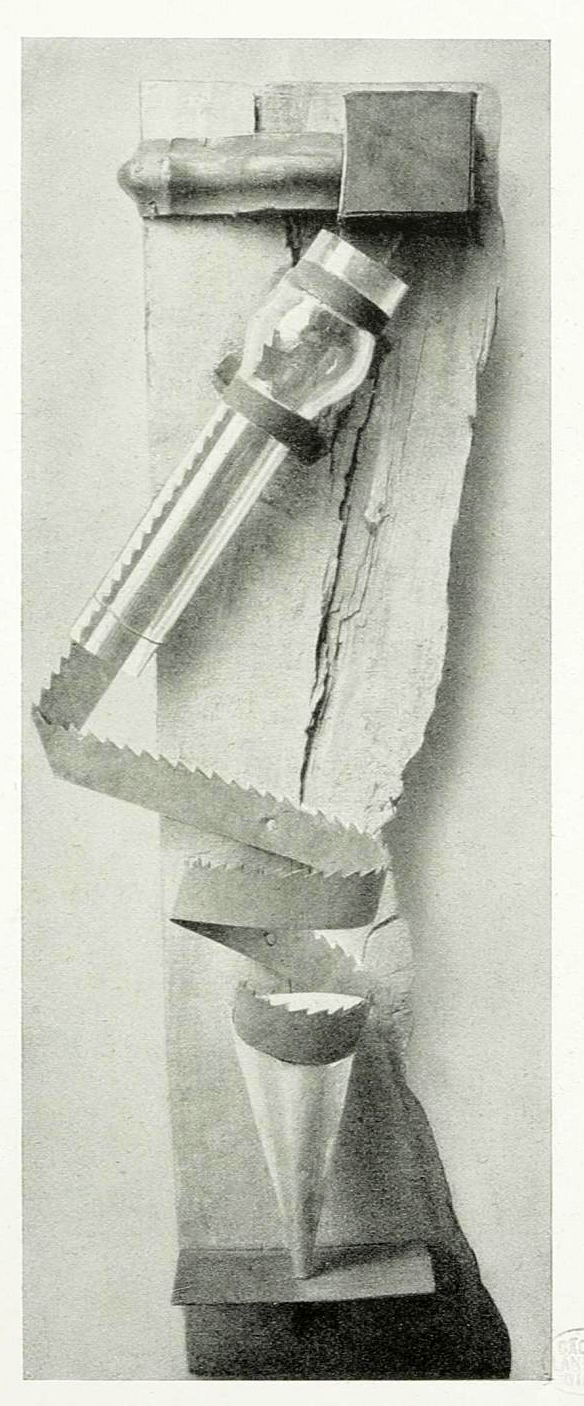
Very few of these Vorkurs projects have survived as they were only intended to be exercises. The work above is described in the 1923 Bauhaus exhibition catalog as a “combined contrast effect: material contrast (glass, wood, iron), contrast of expressive forms (jagged-smooth); rhythmic contrast.” In addition to demonstrating these formal contrasts, its purpose was to understand the nature and potential of different materials.
For example, the wood is left rough and unfinished in order to demonstrate its grain, texture, and color variations. Similarly, the saw blade shows the dull sheen of its surface and has been curled into a spiral to demonstrate the flexibility of metal. The rust on the saw blade’s surface and the knots and splits in the wood are not sanded or polished; instead, they are featured as qualities of those materials that need to be understood by the design students who will be working with them.
From craft to industry
The early Bauhaus concentrated primarily on hand-made crafts, but it soon became evident that, in order to survive, the school needed to reorient its goals toward industrial production. Bauhaus headmaster Walter Gropius asserted in the keynote address for the school exhibition of 1923, “The Bauhaus believes the machine to be our modern medium of design and seeks to come to terms with it.” [1]
Itten, whose spiritual and expressionist orientation did not fit with these aims, was replaced by Laszlo Moholy-Nagy, and later Josef Albers, as head of the Vorkurs. The traditional medieval titles from craft workshops initially used in the Bauhaus, where instructors were called “Masters” and students were called “Apprentices” or “Journeymen,” were replaced by the more modern titles of professor and student.
The reorientation toward the modern machine age is most obvious in products designed by the Bauhaus for mass production, but it is also visible in the graphic branding of the Bauhaus itself. In 1919, the founding manifesto of the Bauhaus was published with a cover by Lyonel Feininger that featured a cathedral crowned by three radiant stars. Both the medieval subject and the woodcut technique are deliberately old-fashioned, reflecting the guild structure of the school itself and its emphasis on hand making and personal expression.
By contrast, the poster designed for the 1923 exhibition is a lithograph, a more modern printmaking technology. It uses only rational geometric shapes and the primary colors red and blue, along with black and the white of the paper. Dotted lines and arcs made by a compass reinforce the overall sense of precise, mechanical execution, very different from the uneven, expressive marks of Feininger’s print. Even the letter forms reinforce the impression of clean, rationalized modernity: sans-serif, upright, and with a consistent (monoline) weight. Such “modern” typefaces are very familiar today, but were quite different from the medieval blackletter or gothic typeface that was common in Germany until the 1940s.
The Bauhaus building, Dessau
Image: Bauhaus Building, Dessau, exterior, 1925-26 (photo: Martavictor, CC BY-SA 4.0)
Due to the hostile political environment in Weimar, after 1924 the Bauhaus was forced to move to Dessau, Germany. The more sympathetic local government there provided the Bauhaus with land and a budget to build its own campus, giving the school another opportunity to fulfill its vision of a holistically-designed modern environment.
The Dessau building was constructed using aggressively modern materials appropriate to the machine age: steel, reinforced concrete, and glass, none of which are disguised with a false facade or ornamented with non-structural embellishments. The three main buildings — shop block, vocational school, and living quarters — are simple rectangular cubes of different dimensions, joined into an asymmetrical pinwheel plan by two connectors: a two-story bridge used for administrative offices, and a one-story building with an auditorium and cafeteria.
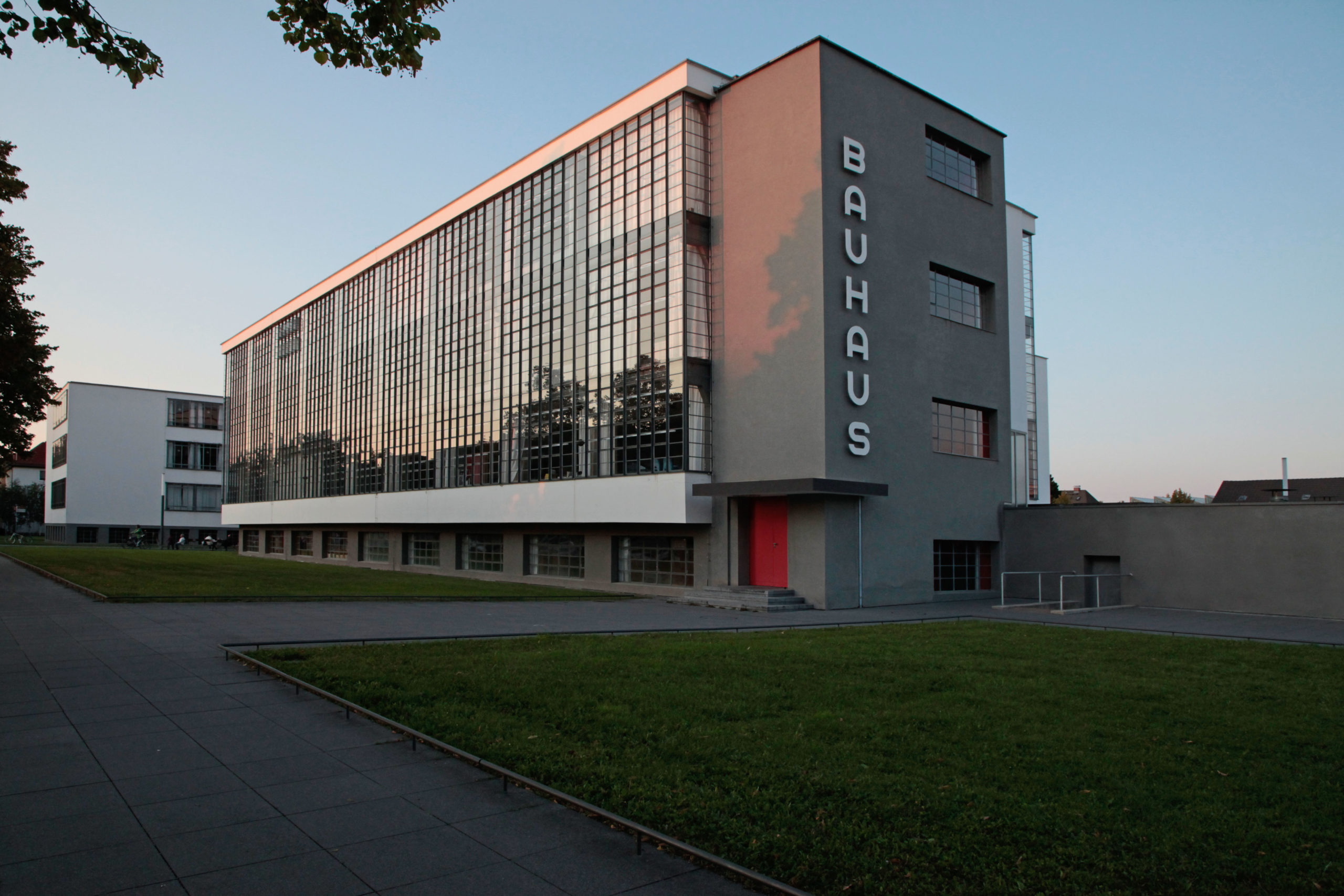
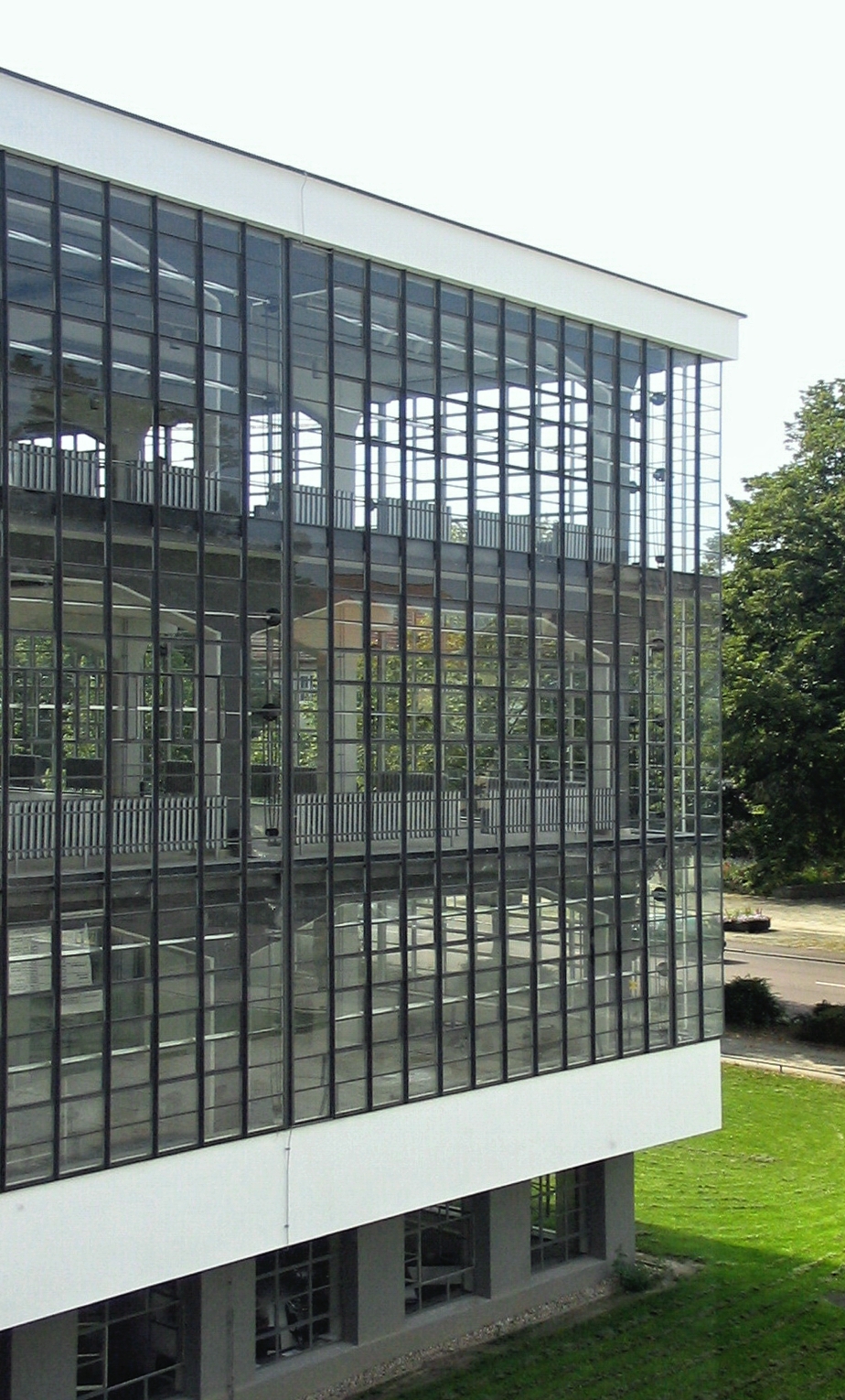
The most precociously modern of the three main buildings was the shop block, which is sheathed entirely in glass to let in plenty of natural light. The steel frame structure, proudly visible through the transparent walls, has been recessed, allowing the two glass curtain walls to meet at a corner without a masonry joint.
The interior spaces are as starkly geometric and functionalist as the exterior, with the furniture and hardware all designed in the school’s workshops. In the auditorium, Marcel Breuer designed the tube-steel seating and Max Krajewski designed the lighting. The 28 apartments for students and junior instructors, each measuring 20 square meters (approximately 215 square feet), are models of spartan efficiency and have shared bathrooms. But there are also surprising amenities, including a small balcony for every room, a roof terrace, and a food lift to connect the ground-floor canteen to the shared kitchens on every floor.
All the Bauhaus workshops were involved in the project. Despite the diversity of designers involved, a surprising degree of unity was achieved because every aspect of the project was based on the basic Bauhaus principles of functionalism and geometric rationalism. Purely “decorative” elements were eliminated for the sake of cost-effectiveness in manufacture, efficiency in usage, and harmony in aesthetics. The Bauhaus rejection of decoration did not imply a neglect of aesthetics. For Bauhaus designers, beauty was not something to be added to a functional item in the form of extra frills; instead, it was achieved through careful choices of materials, proportions, textures, and colors for the functional features of the objects.
Legacy of the Bauhaus
In 1925, the Bauhaus was forced to flee from its original location in Weimar, Germany. The right-wing nationalists who came to power in the region saw the school as a hotbed of foreigners sympathetic to Communism. The school lasted only seven years in its next location, Dessau, before being forced to move to Berlin. When the Nazi party came to national power under Chancellor Adolf Hitler in 1933 the Bauhaus closed for good.
Despite its relatively brief existence, the Bauhaus had an enormous influence on our contemporary visual environment. Fleeing the unfavorable political environment as well as a disastrous economic situation, Bauhaus students and instructors spread across Europe and the United States, bringing their modern design principles with them. Two of the former directors of the Bauhaus, Walter Gropius and Mies van der Rohe, went to teach in the United States (in Boston and Chicago respectively), where their designs and teaching helped to form the International Style of corporate architecture that now dominates the urban environment.
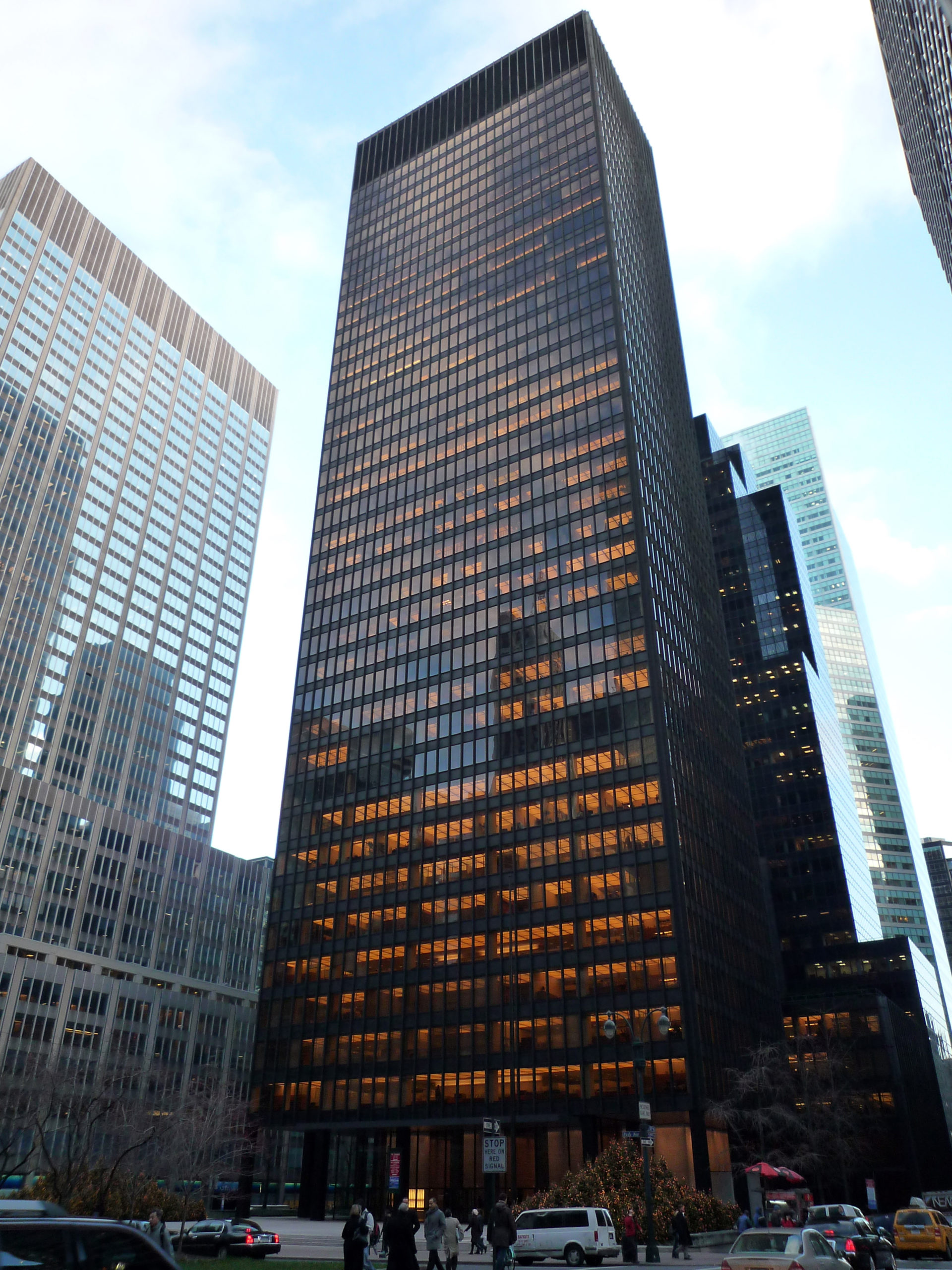
The promise of the Bauhaus shop block, a building apparently made entirely of glass and steel without the comforting presence of a masonry bulwark, is fulfilled in Mies van der Rohe’s Seagram Building in New York City. Its clear glass ground-floor lobby shows the steel frame and reinforced concrete core that hold the building up, so that its 38-story height appears to stand on stilts. Like the Dessau shop block, there are no decorative flourishes. Mies’s famous motto, “less is more,” embodies the Bauhaus creed that design should be about careful attention to function, materials, engineering, and proportion, not useless decoration. Whether this creed results in livable environments is perhaps a matter of taste, but Bauhaus ideals and designs continue to have an enormous influence today.
Ludwig Mies van der Rohe, Seagram Building, New York City
The International Style was characterized by the use of industrial materials, rejection of ornament, repetitive modular forms, and the use of flat surfaces and glass. A German-born architect, Mies van der Rohe taught at the Bauhaus before emigrating to the US. His “less is more” use of glass and steel shaped American modernism. Although dating to the mid-20th century, the Seagram Building on Park Avenue in New York City is a superb example of the International Style.
Frank Lloyd Wright, Fallingwater
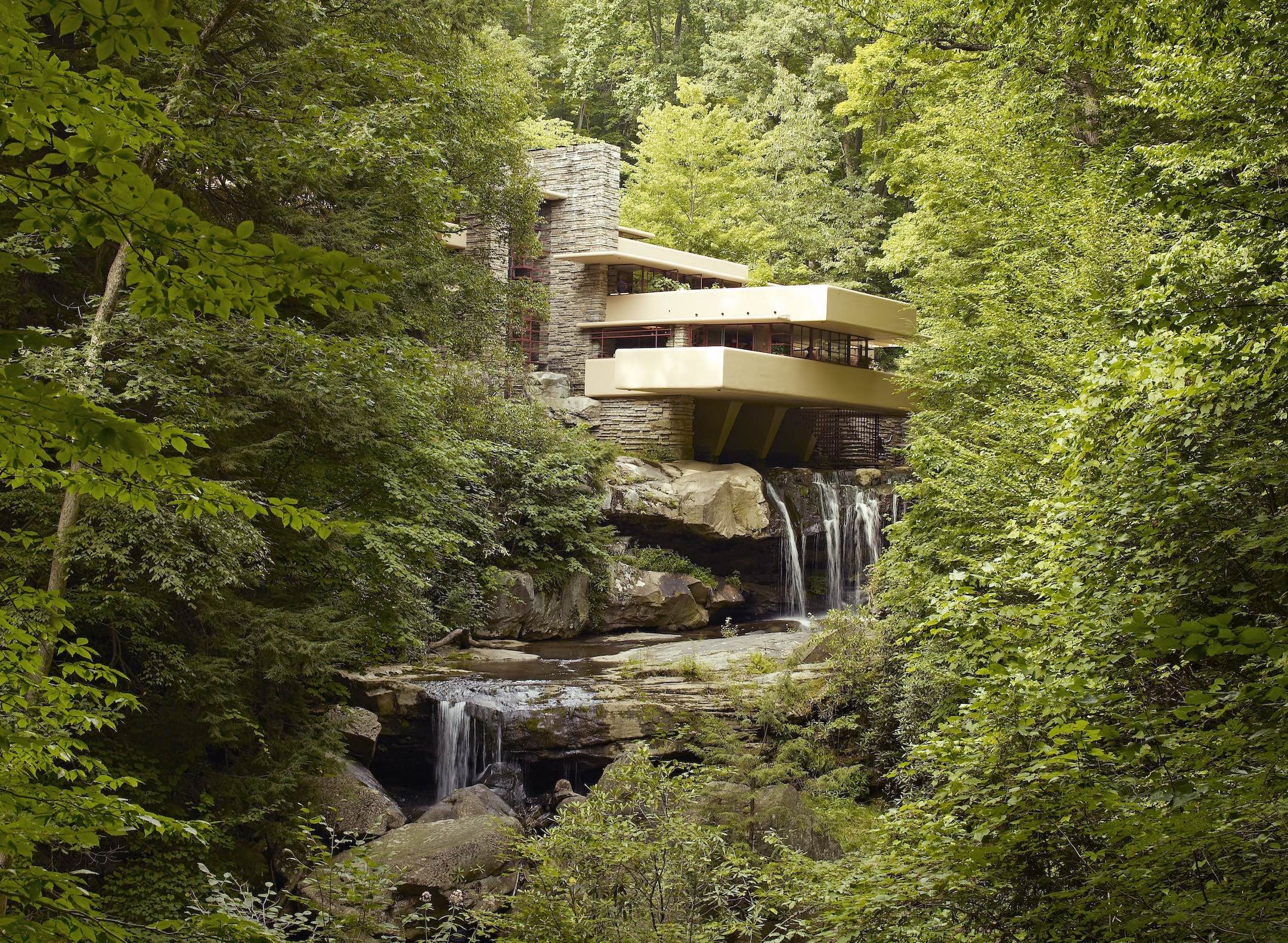
Perched above a mountain cataract on a rocky hillside deep in the rugged forest of Southwestern Pennsylvania, some 90 minutes from Pittsburgh, is the most famous house in the United States. The commission for Fallingwater was a personal milestone for the American architect Frank Lloyd Wright, since it clearly marked a turning point in his career. After this late-career triumph, the sixty-seven year old would go on to create a series of highly original designs that would validate his claim as “The world’s greatest architect.” [2]
“The greatest architect of the nineteenth-century” —Philip Johnson
The mid-1930s were among the darkest years for architecture and architects in American history; the country’s financial system had collapsed with the failure of hundreds of banks. Almost no private homes were built. Many of the architectural projects started during the boom of the late 1920s were halted for lack of funds. Now in his sixties, Wright and his new wife Olgivanna were struggling to keep Taliesin, his Wisconsin home and studio, out of foreclosure. Worse still, his peers were beginning to regard Wright as an irrelevant anachronism whose time had passed.
In 1932 Henry-Russell Hitchcock and Philip Johnson opened the “Modern Architecture: International Exhibition” at the newly founded Museum of Modern Art in New York and simultaneously published the book International Style. This was, perhaps, the most influential architectural exhibit ever mounted in the United States and the book became a manifesto for modern architecture and would profoundly affect almost every major architectural project worldwide for the next 30 years. It focused on the work of four great “European functionalists” Walter Gropius, Ludwig Mies van der Rohe, Le Corbusier, and J.J.P. Oud. Wright was largely snubbed.
Hitchcock had praise for his early work, for its “many innovations,” but he condemned Wright for a “[l]ack of continuity in his development and his unwillingness to absorb the innovations of his contemporaries and his juniors in Europe.” Hitchcock insulted Wright further by characterizing him as “a rebel by temperament… [who] refused even the discipline of his own theories.” The catalogue calls Wright a “half-modern” throwback, one of the “last representatives of Romanticism.” [3] Wright responded by denigrating European Modernism as an “evil crusade,” a manifestation of “totalitarianism.” [4]
A fellowship and a commission
The Wrights devised an architectural apprenticeship program that came to be known as the “fellowship.” Among the first candidates was Edgar Kaufmann Jr., who became enamored with Wright after reading his biography. Kaufmann was the son of Pittsburgh department store tycoon Edgar Kaufmann Sr., whose thirteen-story downtown Pittsburgh emporium was reported to be the largest in the world. Kaufmann Senior was no stranger to architectural pursuits—he was involved in numerous public projects and built several stores and homes. Kaufmann let Wright know that he had several civic architectural projects in mind for him. He and his wife Liliane were invited to Taliesin and were duly impressed.
There are varying accounts regarding the circumstances that brought Kaufmann to offer Wright a chance to design a “weekend home” in the country; but we know that Wright made his first trip to the site on Bear Run, Pennsylvania, in December, 1934. Wright’s apprentice Donald Hoppen has spoken of Wright’s “uncanny sense of…genius loci” (Latin for “spirit of the place”) and from the very beginning, the architect rejected a site that presented a conventional view of the waterfall; instead, he audaciously offered to make the house part of it, stating that the “visit to the waterfall in the woods stays with me and a domicile takes shape in my mind to the music of the stream.” [5] The South-southeast orientation gives the illusion that the stream flows, not alongside the house, but through it.

Fastest draw in the Midwest
Perhaps the most famous tale to come out of the lore of Fallingwater is the improbable story that Wright, after receiving the commission, procrastinated for nine months until he was forced to draw up the complete plans while his patron was driving the 140 miles from Milwaukee to Taliesin. However, the essential story is validated by several witnesses. Apprentice Edgar Taffel recalled that after talking with Kaufmann on the phone, Wright:
“briskly emerged from his office…sat down at the table set with the plot plan and started to draw…The design just poured out of him. ‘Liliane and E.J. will have tea on the balcony…they’ll cross the bridge to walk in the woods…’ Pencils being used up as fast as we could sharpen them….Erasures, overdrawing, modifying. Flipping sheets back and forth. Then, the bold title across the bottom ‘Fallingwater.’ A house has to have a name.” [6]
There seems to be agreement that the whole process took about two hours.
Organic architecture
Edgar Kaufmann Jr. pointed out that Wright’s famous concept of “Organic Architecture” stems from his Transcendentalist background which includes the belief that human life is part of nature. Wright even incorporated a rock outcropping that projected above the living room floor into his massive central hearth, further uniting the house with the earth. “Can you say,” Wright challenged his apprentices, “when your building is complete, that the landscape is more beautiful than it was before?” [7]
In his book, Fallingwater Rising: Frank Lloyd Wright, E. J. Kaufmann, and America’s Most Extraordinary House, Franklin Toker wrote that,
“this delicate synthesis of nature and the built environment probably counts as the main reason why Fallingwater is such a well-loved work. The contouring of the house into cantilevered ledges responds so sympathetically to the rock strata of the stream banks that it does make Bear Run a more wondrous landscape than it had been before.” [8]
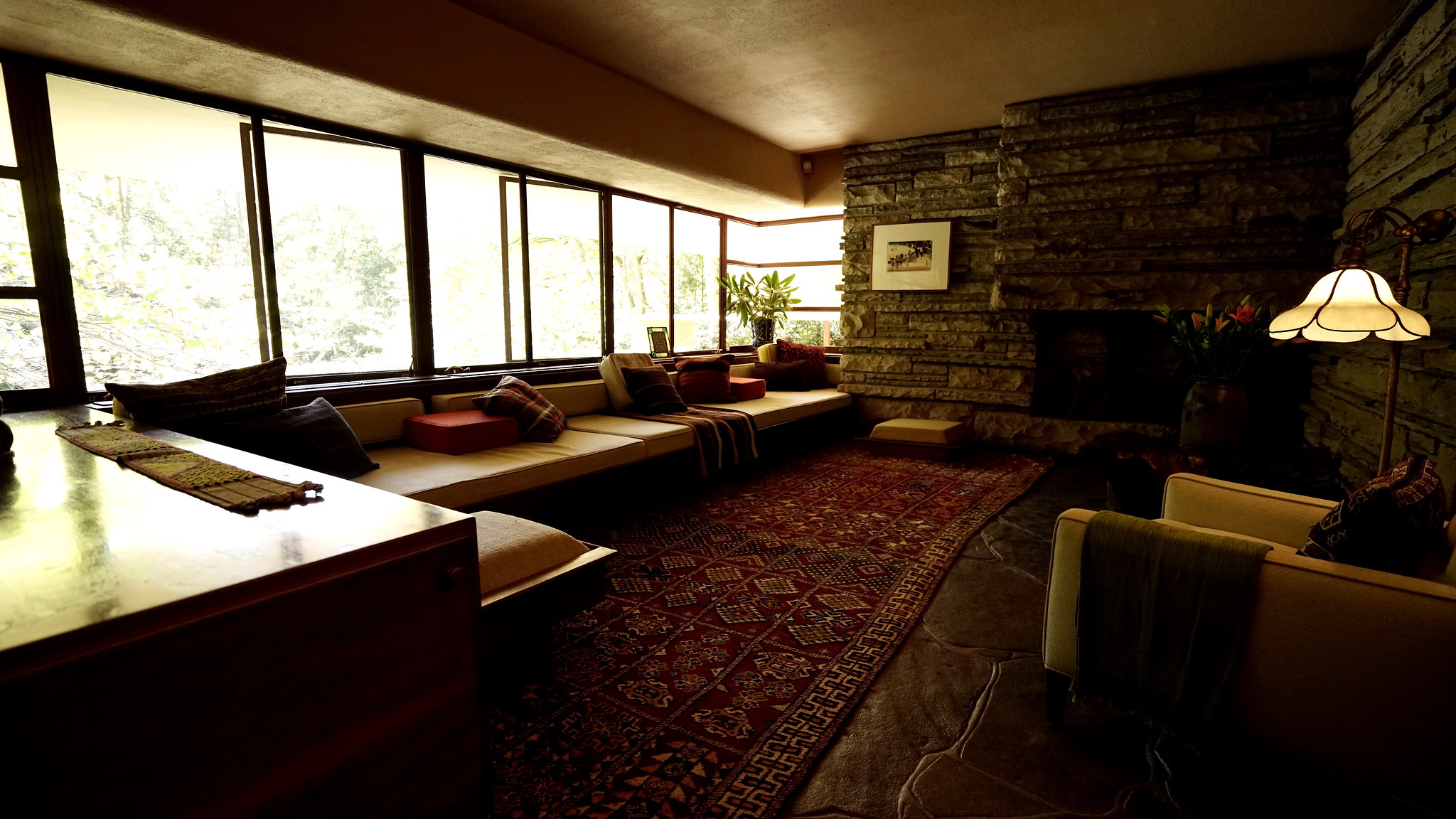
Wright further emphasizes the connection with nature by liberal use of glass; the house has no walls facing the falls, only a central stone core for the fireplaces and stone columns. This provides elongated vistas leading the eye out to the horizon and the woods. Art historian Vincent Scully has pointed out that this reflects “an image of Modern man caught up in constant change and flow, holding on…to whatever seems solid but no longer regarding himself as the center of the world.” [9] The architect’s creative use of “corner turning windows” without mullions causes corners to vanish. Wright even bows to nature by bending a trellis beam to accommodate a pre-existing tree.

Influences
Although he denied it, Wright was influenced by every conceivable architectural style, but Fallingwater owes little to his previous designs (the only exceptions being perhaps the use of irregular stones that are also found on Taliesin and his interest in strong horizontal lines). At Fallingwater, he appears to be more concerned with responding to the European Modernist design that he had in part inspired—but that had since eclipsed him. In effect, he set out to beat the Europeans at their own game, using elements of their idiom. We see, for example, inspiration drawn from the balconies of Gropius’ design for the Chicago Tribune Tower competition, though instead of the stark white of the International Style, he paints his balconies a warmer, earthen tone in deference to nature and perhaps the Adobe dwellings of the American Southwest.
Fallingwater falling down?
The Kaufmanns loved Wright’s radical proposal to literally suspend the house over the waterfall. But Edgar Kaufmann Sr., ever the pragmatic business man (who had also studied engineering for a year at Yale) prudently sent a copy of Wright’s blueprints to his engineer; who found the ground unstable and did not recommend that he proceed with the house. Wright was not happy with his client’s lack of faith, but permitted an increase in the number and diameter of the structure’s steel reinforcements—Kaufmann agreed to proceed. It’s worth noting that the engineer’s warnings later proved valid, an issue that “haunted” Wright for the rest of his life.
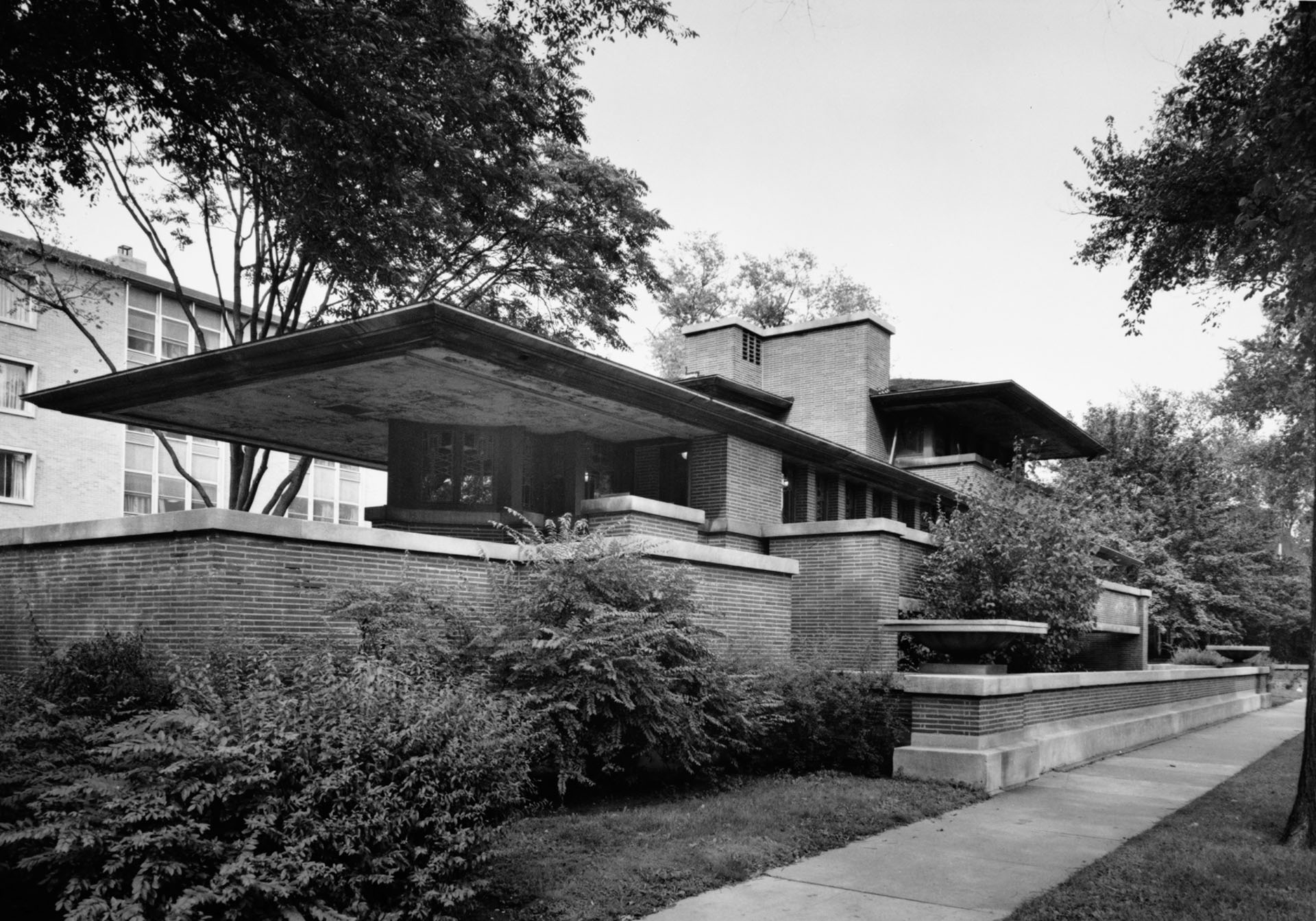
Wright is famous for pushing the architectural envelope for dramatic effect. We see this is in the vast cantilevered wooden roof of Robie House in Chicago. In Fallingwater he chose ferro-concrete for his cantilevers—this use of reinforced concrete for the long suspended balconies was revolutionary. He boldly extended the balcony of the second floor master bedroom soaring six feet beyond the living room below.
However, due to the lack of proper support, cracks began appearing in the balcony floors soon after they were poured. Over the years since, cracks have been repeatedly repaired as the cantilevers continued to sag. By 2001, some of the 15 foot cantilevers had fallen more than 7 inches. To avoid a complete collapse, an system was devised using tensioned cables to correct the problem and stabilize Wright’s masterwork.
Almost from the day of its completion, Fallingwater was celebrated around the world. The house and its architect were featured in major publications including the cover of Time Magazine. Over the years its fame has only increased. According to Franklin Toker, Fallingwater’s most important contribution to Modern Architecture is surely the “acceptance of Modern architecture itself.”
Conclusion
In between World War I and World War II, Dada and Surrealism grappled with a changing world. Dada used its anger and its humor to challenge established conventions of art and society. Artists like Marcel Duchamp broke the boundaries between fine arts and visual culture to question and then redefine what we call “Art.” Dada artists and then Surrealists turned to the new frontier of the unconscious mind for the possibility of expression and interpretation. In the larger period between 1900 and 1945, modern architects redefined the construction of both urban, public spaces and private, domestic architecture. In the period between the World Wars, there was also a widening of artistic geographic centers. The United States and Mexico began to play a more dynamic role in international avant-garde art and architecture.
Citation and Licensing
The following sections were written by Chelsea Wright and licensed CC BY-NC-SA 4.0:
- Chapter Overview and Introduction
- Focus artwork and term list compiled by Chelsea Wright
- Introduction to Modern Architecture
- Practicing Visual Analysis
- Conclusion
The following articles from Smarthistory licensed CC BY-NC-SA 4.0 were remixed and adapted for the chapter:
- Dr. Stephanie Chadwick, “Dada, an introduction,” in Smarthistory, September 4, 2017.
- Dr. Charles Cramer and Dr. Kim Grant, “Dada readymades,” in Smarthistory, March 24, 2020.
- Josh R. Rose, “Surrealism, an introduction,” in Smarthistory, September 8, 2016.
- Dr. Charles Cramer and Dr. Kim Grant, “Surrealist Techniques: Subversive Realism,” in Smarthistory, March 29, 2020.
- Smarthistory, “Salvador Dali,” in Smarthistory.
- Sal Khan and Dr. Steven Zucker, “Salvador Dalí, The Persistence of Memory,” in Smarthistory, December 9, 2015.
- Smarthistory, “Meret Oppenheim,” in Smarthistory.
- Josh R. Rose, Dr. Steven Zucker and Dr. Beth Harris, “Meret Oppenheim, Object (Fur-covered cup, saucer, and spoon),” in Smarthistory, April 9, 2022.
- Dr. Charles Cramer and Dr. Kim Grant, “The Bauhaus, an introduction,” in Smarthistory, September 28, 2019.
- Dr. Charles Cramer and Dr. Kim Grant, “The Bauhaus and Bau,” in Smarthistory, April 17, 2020.
- Smarthistory, “International Style,” in Smarthistory.
- Smarthistory, “Ludwig Mies van der Rohe,” in Smarthistory.
- Dr. Matthew A. Postal and Dr. Steven Zucker, “Ludwig Mies van der Rohe, Seagram Building, New York City,” in Smarthistory, March 31, 2021.
- Charles Wiebe, “Frank Lloyd Wright, Fallingwater,” in Smarthistory, August 9, 2015.
- Cited in William J. R. Curtis, Modern Architecture since 1900 (Upper Saddle River, NJ: Prentice Hall, 1996), p. 193. ↵
- “called to testify in a court case. Asked to identify himself, he announced that he was the world’s greatest architect. When asked how he could make such a statement, he replied, with visible enjoyment and a gleam in his eye, that he had no choice, he was under oath.” From Ada Louise Huxtable, Frank Lloyd Wright: A Life (Penguin Books, 2008). ↵
- Henry-Russell Hitchcock and Philip Johnson, The International Style (New York: W.W. Norton, 1932), pp. 41–43. ↵
- Frank Lloyd Wright, “In the cause of architecture: the ‘International Style,'” A Taliesin Square-Paper (February 1953). ↵
- Donald W. Hoppen, The Seven Ages of Frank Lloyd Wright: The Creative Process (New York: Dover Publications, 1993), p. 23. ↵
- Edgard Tafel, Years with Frank Lloyd Wright: Apprentice to Genius (Minneola, NY: Courier Dover Publications, 1979). ↵
- Hoppen, p. 97. ↵
- Franklin Toker, Fallingwater Rising: Frank Lloyd Wright, E. J. Kaufmann, and America’s Most Extraordinary House (New York: Alfred A. Knopf, 2003). ↵
- Meryle Secrest, Frank Lloyd Wright: A Biography (Chicago: University of Chicago Press, 1992), p. 168. ↵


.jpg)


