
Early and 16th Century Renaissance in Northern Europe
Chapter Overview and Introduction
When discussing the Northern European Renaissance, three regions are usually identified: Flanders, the Netherlands, and the Holy Roman Empire. Artists from Northern Europe in the Renaissance introduced new mediums, including oil paint and the print-making techniques of woodcuts and engravings. The chronology of the chapter spans the time frame of both the 15th century Early Renaissance in Florence and the 16th century High Renaissance of Italy. Jan Van Eyck was a contemporary of Brunelleschi and Masaccio while Albrecht Dürer was a contemporary of Raphael. To understand the Renaissance, the textbook divides it into geographic categories: Italy and Northern Europe. While the Renaissance shares consistent interests and stylistic features across geographical boundaries, such as chiaroscuro modeling and humanist philosophy, there are regional differences. Northern European artists, who were rooted in a long medieval history of symbolism and highly detailed illuminated manuscripts, focused much more on detailed observation and symbolic content.
Focus Artworks
- Jan van Eyck, Giovanni Arnolfini and His Wife, 1434, oil on canvas
- Jan Van Eyck, Ghent Altarpiece, completed 1432, oil on panel
- Robert Campin, Merode Altarpiece, c. 1425-1428, oil on wood
- Albrecht Dürer, Self-portrait, 1500, oil on panel
- Albrecht Dürer, Saint Jerome in His Study, 1514, engraving
- Hans Holbein the Younger, The French Ambassadors, 1533, oil on panel
Term List
- Northern Europe: Flanders, Netherlands, Holy Roman Empire
- Altarpiece
- Triptych
- Annunciation
- Polyptych
- Grisailles
- Oil paint
- Glazes
- Genre scenes
- Woodcut
- Engraving
- Burin/stylus
The Northern Renaissance: A Brief Introduction
What was the Renaissance and where did it happen?
The word Renaissance is generally defined as the rebirth of classical antiquity in Italy in the fifteenth and sixteenth centuries. Seems simple enough, but the word “Renaissance” is actually fraught with complexity.
Scholars argue about exactly when the Renaissance happened, where it took place, how long it lasted, or if it even happened at all. Scholars also disagree about whether the Renaissance is a “rebirth” of classical antiquity (ancient Greece and Rome) or simply a continuation of classical traditions but with different emphases.
Traditional accounts of the Renaissance favor a narrative that places the birth of the Renaissance in Florence, Italy. In this narrative, Italian art and ideas migrate North from Italy (largely because of the travels of the great German artist Albrecht Dϋrer who studied, admired, and was inspired by Italy, and he carried his Italian experiences back to Germany).
The Northern Renaissance
However, so much changed in northern Europe in the fifteenth and sixteenth centuries that the era deserves to be evaluated on its own terms. So we use the term “Northern Renaissance” to refer to the Renaissance that occurred in Europe north of the Alps. Like Florence, cities in northern Europe (Bruges, Ghent and then later Antwerp and Brussels), were rich industrial and banking centers during this period and this allowed a large merchant-class to flourish creating an ideal environment for artistic production.
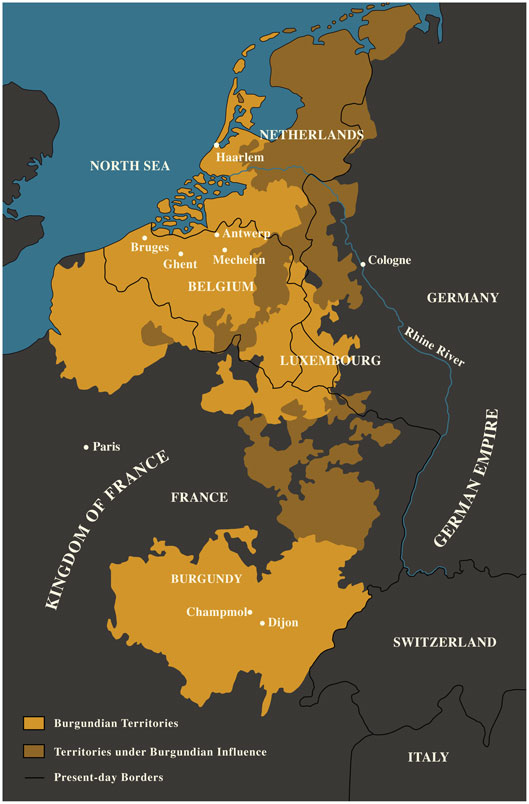
In the fifteenth century, the northern European countries we know today as Belgium, the Netherlands, Luxembourg and parts of France were controlled by the enormously wealthy Dukes of Burgundy. This region during the fifteenth century is often referred to, today, as the Burgundian Netherlands. The court of the Dukes of Burgundy were the most important patrons of the early Northern Renaissance, but newly wealthy private citizens also commissioned art as part of a growing interest in private meditation and prayer. Portraits were also commissioned in growing numbers.
Classical antiquity?
In Italy, the Renaissance was deeply influenced by the art and culture of Ancient Greece and Rome—in part because the art and architecture of antiquity was more immediately available (ruins were plentiful in many cities). Northern Europe however did not have such ready access to ancient monuments and so tended to draw instead more directly from medieval traditions such as manuscript illuminations.
A mercantile world
Though profoundly different, the Italian and Northern Renaissances shared a similar interest in the natural world and re-creating the illusion of reality in their paintings and sculptures. The great artists of this period created work that reflected their increasingly mercantile world, even when they worked for the court of the Dukes. The spiritual world reigned supreme but the representation of wealth and power were also a hugely important motive for patrons whether a pope, a duke, or a banker.
Oil paint
Though the medium of oil paint had been in use since the late Middle Ages, the artists of the North more fully exploited this medium’s unique characteristics. Using thin layers of paint, called glazes, northern artists created a depth of color that was entirely new, and because oil paint can imitate textures far better than fresco or tempera, it was perfectly suited to representing the material reality that was so important to Renaissance artists and their patrons. In the Northern Renaissance, we see artists making the most of oil paint—creating the illusion of light reflecting on metal surfaces or jewels, and textures that appear like real fur, hair, wool or wood.
Other important changes in northern Europe include the:
- invention of the printing press, c. 1450
- advent of mechanically reproducible media such as woodcuts and engravings
- formation of a merchant class of art patrons that purchased works in oil on panel
- Protestant Reformation and the translation of the Bible from the original languages into the vernacular or common languages such as German and French
- international trade in urban centers
The fifteenth century: van Eyck
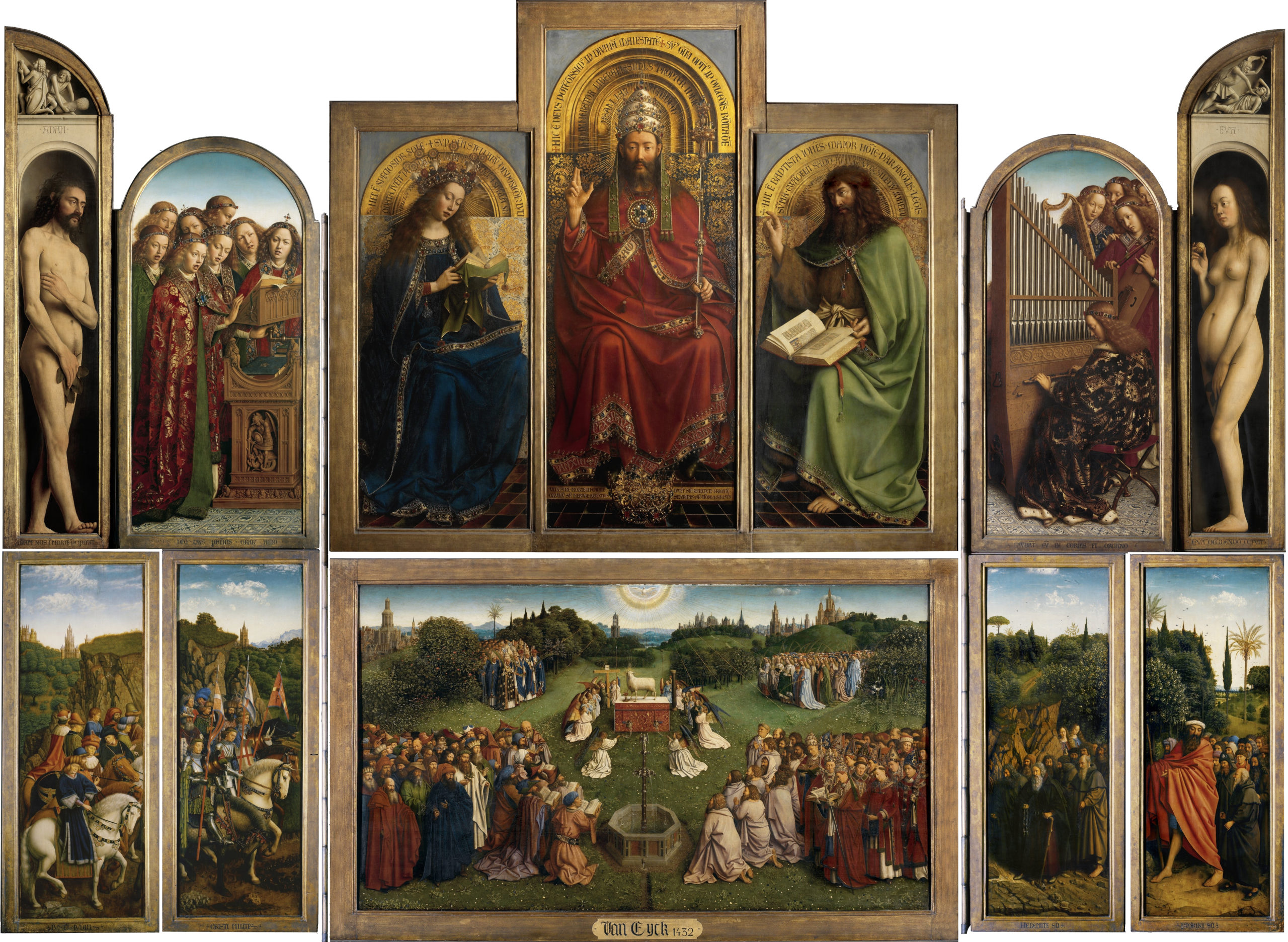
In the fifteenth century, northern artists such as Jan van Eyck introduced powerful and influential changes, such as the perfection of oil paint and almost impossible representation of minute detail, practices that clearly distinguish Northern art from Italian art as well as art from the preceding centuries. Jan and Hubert van Eyck’s Ghent Altarpiece, 1432 (Church of Saint Bavo, Ghent) exemplifies the grand scale and minute detail of Northern painting.
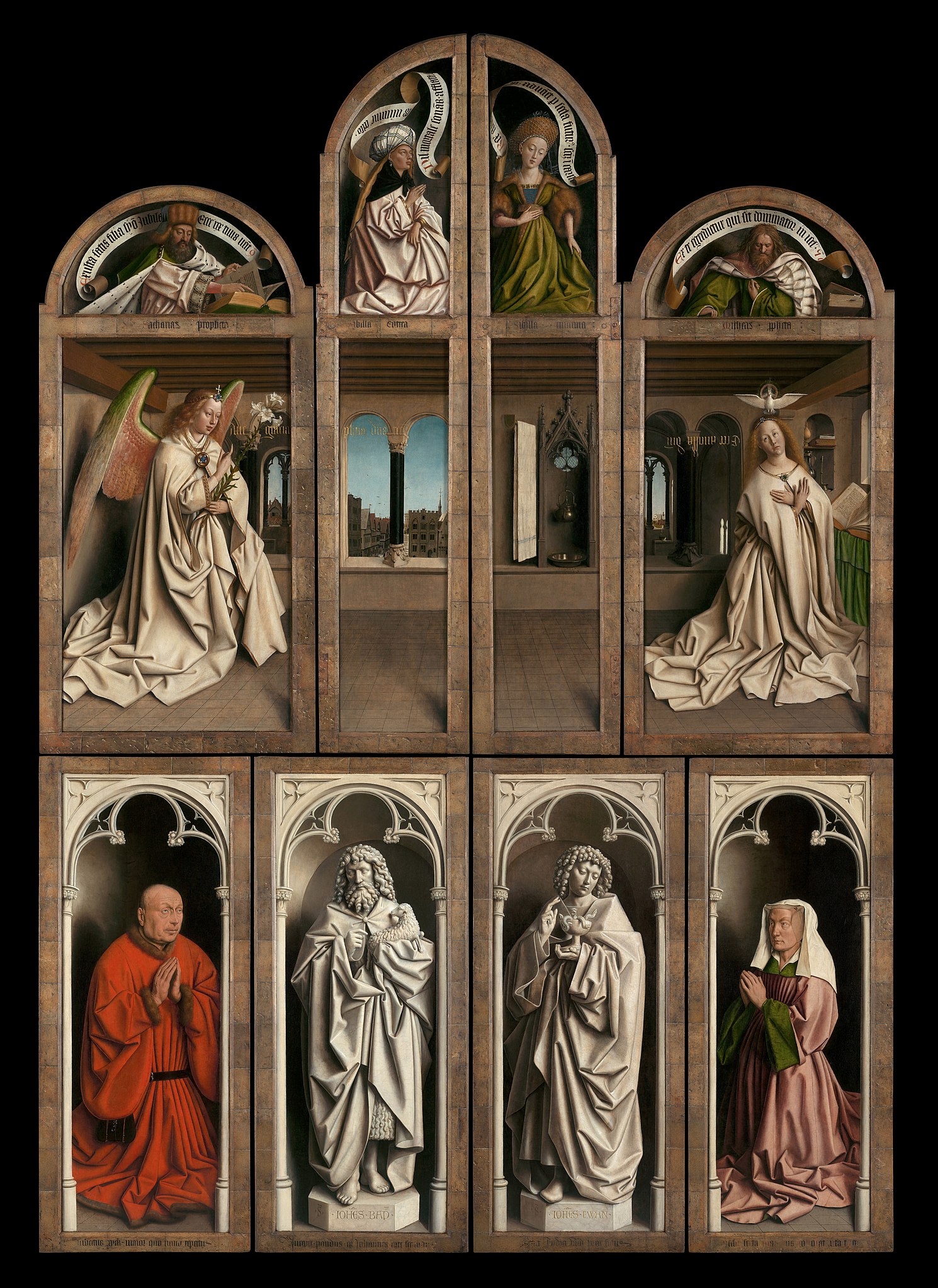
This public, religious picture has an open and closed position. On the interior, we see such holy figures as the Virgin, Christ, saints, and angels. It also showcases the largesse of the donors, depicted kneeling on the lowest corners of the exterior, who employed the van Eyck brothers to immortalize them in this very public work of art.
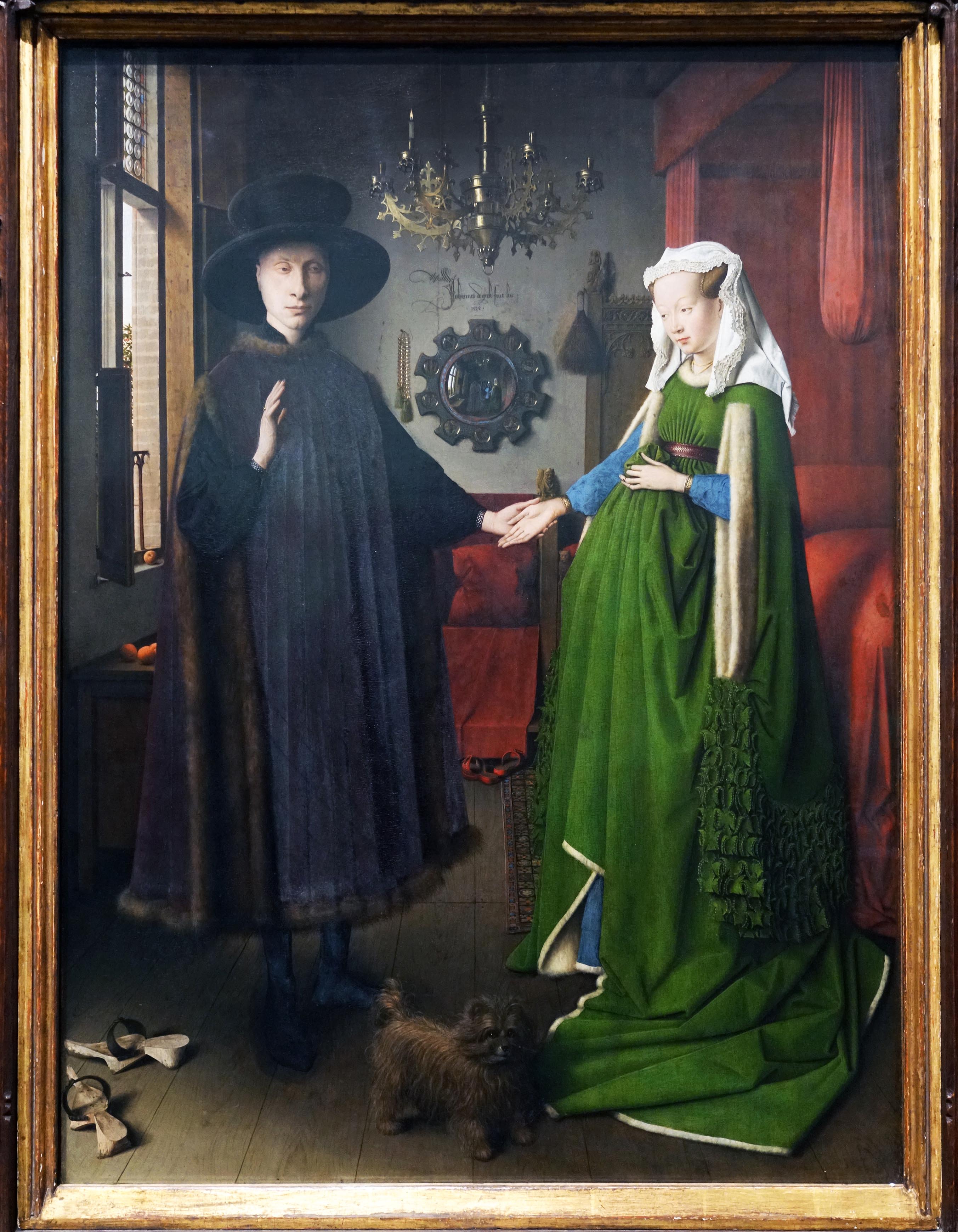
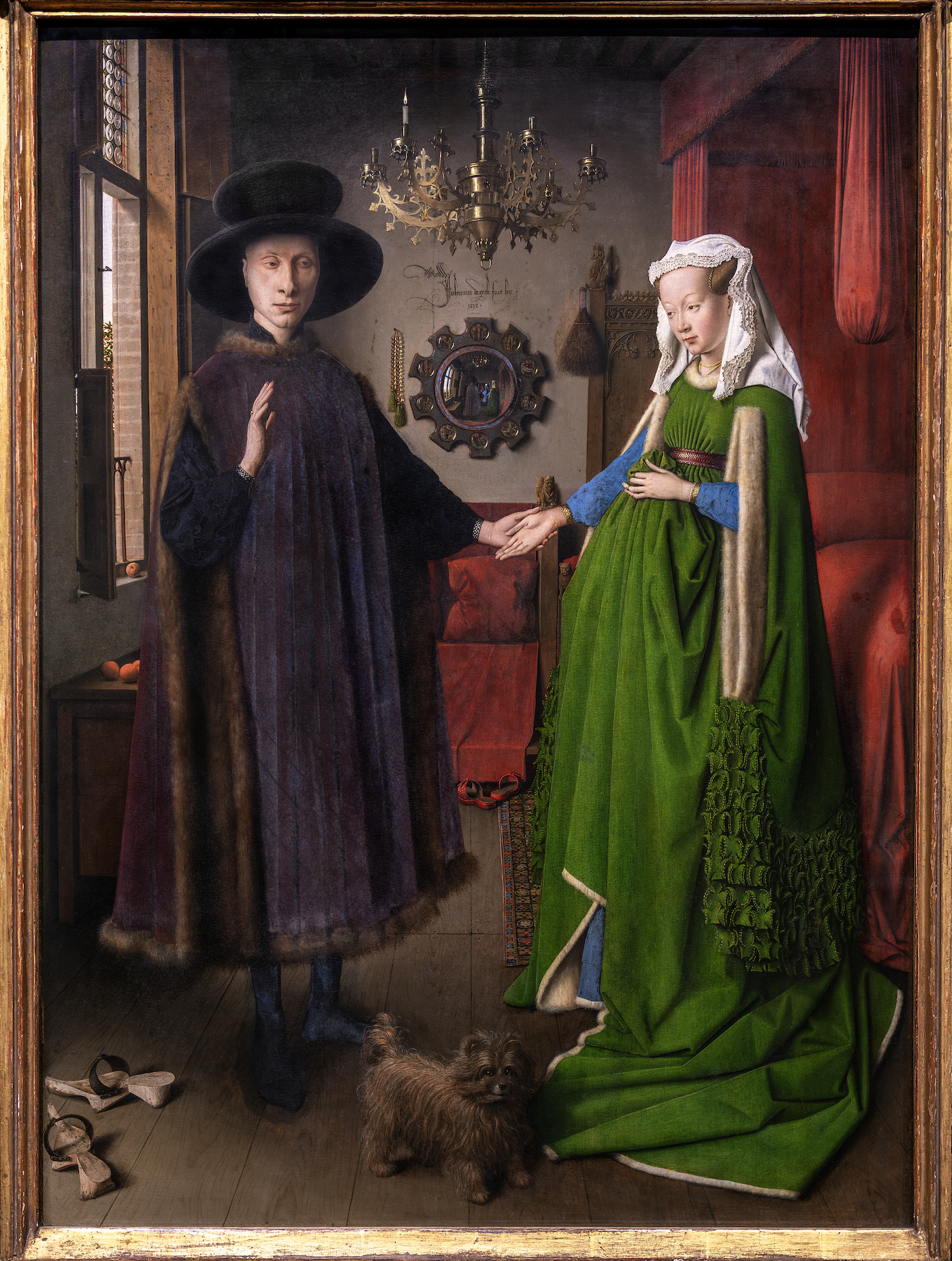
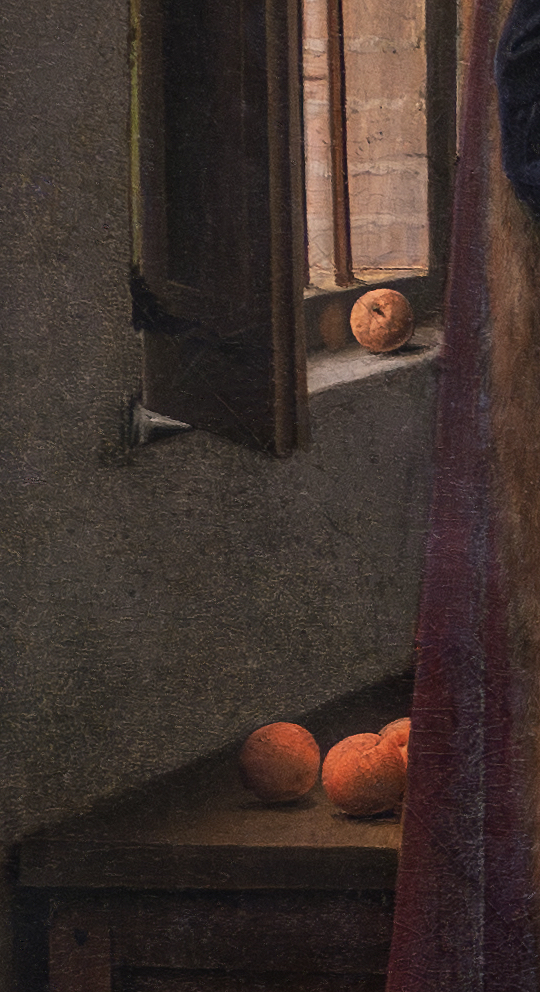
Jan van Eyck’s Arnolfini Portrait shows a well-to-do couple in a tasteful, bourgeois interior. The text in the back of the image identifies the date and Jan van Eyck as the artist. Art historians disagree about what is actually happening in the image, whether this is a betrothal or a marriage, or perhaps something else entirely. One of the most important aspects of this painting is the symbolic meanings of the objects, for instance that the dog may symbolize fidelity (“Fido”) or that the fruit on the windowsill may signify either wealth or temptation. This painting is a touchstone for the study of iconography, a method of interpreting works of art by deciphering symbolic meaning.
Though Jan van Eyck did not invent oil paint, he used the medium to greater effect than any other artist to date. Oil would become a predominant medium for painting for centuries, favored in art academies into the nineteenth century and beyond. The Arnolfinis counted as middle class because their wealth came from trade rather than inherited titles and land. The power of the merchant-class patrons of northern Europe cultivated a taste for art made for domestic display. Decorating one’s home is still a powerful motivation for art patrons.
15th-century Flanders, an introduction
Material splendor
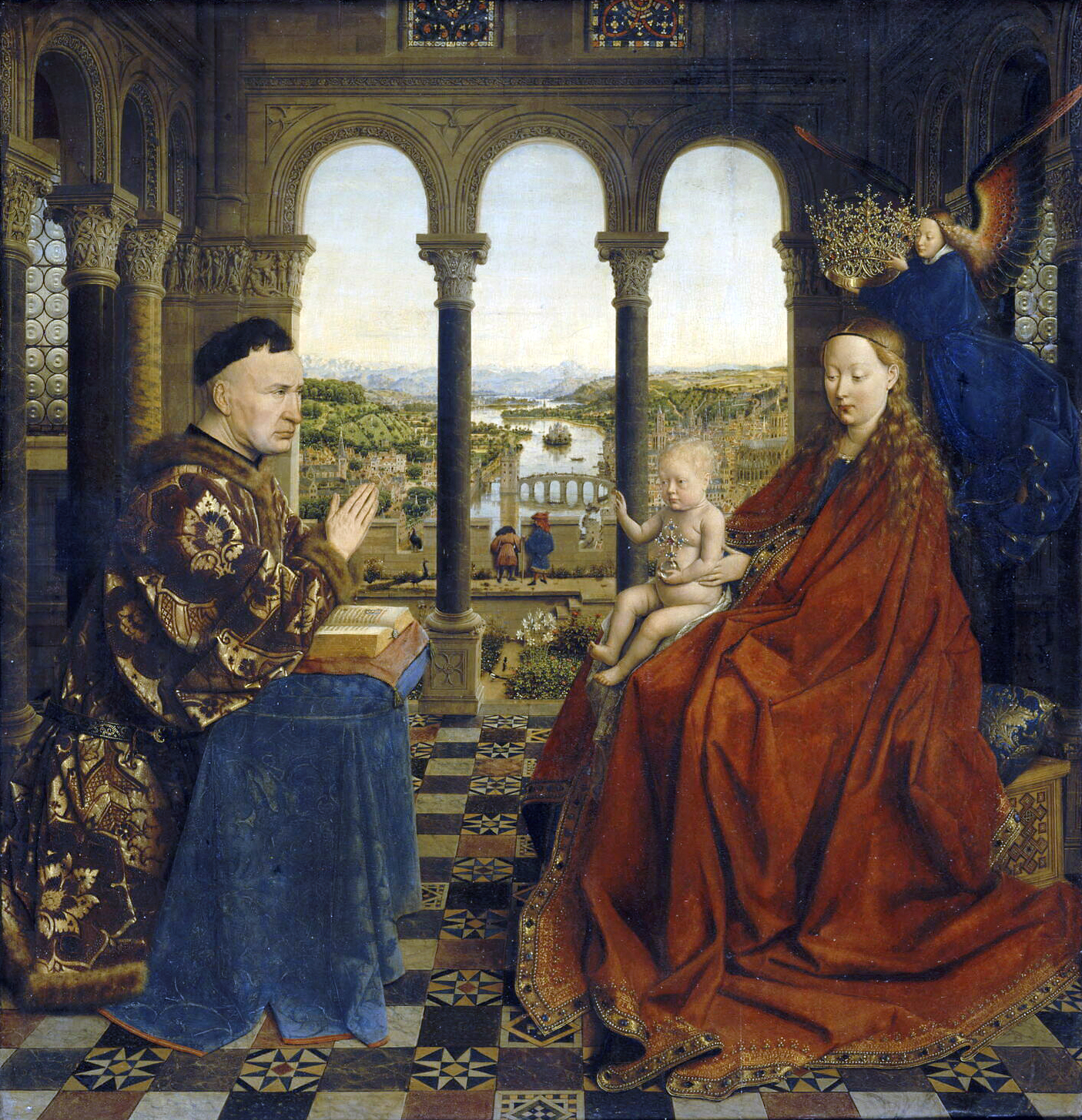
Jan van Eyck’s Rolin Madonna presents a series of objects and surfaces: a fur-lined damask robe, ceramic tiles, a golden crown, stone columns, warm flesh, flowers, translucent glass, and a reflective body of water. Even the air above the distant river seems palpable. The painting is a careful study of how light reacts to the varying textures. But the scene is an imagined one. Before a kneeling man, the Virgin presents on her lap the Christ child, and an angel holds a crown above her. No eye contact is made. It is as if we are seeing what the man has in his mind’s eye as he prays from the book in front of him. While the sumptuousness of the surroundings belies the otherworldliness of the Mother and Child, at the same time, they seem to augment rather than diminish their divinity. For Nicolas Rolin, the man in this image, it seems that attention to the magnificence and splendor of valuable arts and materials can provide a vision of the sacred, rather than distract from it.
Although Jan van Eyck’s painting is an exceptional artwork, it is typical of 15th-century Flemish art in the value it attributes to material splendor. The area of the southern Low Countries was one of the major contributors to what is often referred to as the Northern Renaissance—the efflorescence of artistic production that took place north of the Alps in the 15th and 16th centuries.
Flemish art
“Flemish art” is a difficult term: medieval Flanders does not have the same borders as it does today. It is used by art historians loosely to refer to artistic production in Flemish speaking towns—particularly Bruges, Ghent, Brussels, and Tournai. The term is also most often associated with painting. Painters like Jan van Eyck, Rogier van der Weyden, and Hugo van der Goes were as internationally famous in their time as they are now, finding patrons not only in the Low Countries (today Netherlands, Belgium, and northern Germany), but in Italy also, where their oil-paint technique had a considerable influence.
However, just as van Eyck was attentive to the range of crafted objects in the Rolin Madonna, we too should be observant of the many arts practiced in 15th-century Flanders. There were workshops across the major towns of Flanders for goldsmiths, ceramicists, cabinet-makers, manuscript illuminators, tapestry weavers, and sculptors in wood and stone.
More than paintings

The most expensive artworks were tapestries and goldwork, and nobles would commission these as gifts for their allies and relatives. The prominence painting is given today is partly because our culture values painting as a “fine art” alongside sculpture and architecture, and thus one distinct from the “decorative” or “applied” arts of other media. It is important to understand that these distinctions did not exist in the 15th-century Low Countries. Therefore, when visiting collections in search of Netherlandish art, also take time to seek out the rare surviving goldwork, tapestries, and sculpture. Singular pieces include the Liège statuette (a reliquary with images of Charles the Bold and Saint George in the Cathedral of Liège), the Burgundian tapestries at Bern Historical Museum, and the tombs of Mary of Burgundy and Charles the Bold in the Church of our Lady in Bruges.
A major trading center
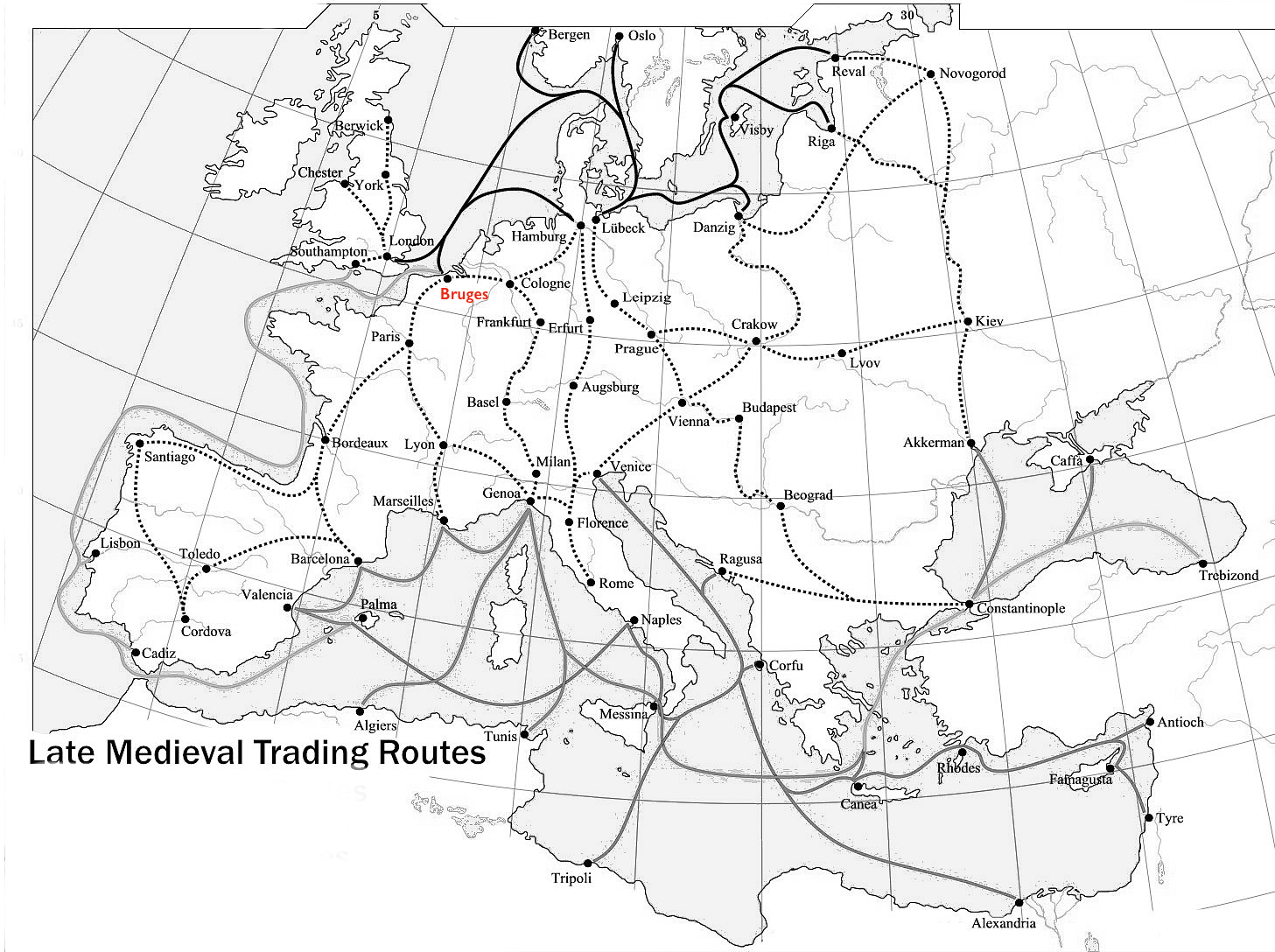
To understand why Flanders became the site of such intensive artistic production in the 15th century, it is useful to consider its place within the wider western European economy. Flanders was the most urbanized region of northern Europe in the 14th and 15th centuries. Between c. 1000 and 1300, its towns and ports grew in size and number as it became the major center for trade in northern Europe, acting as a nodal point for merchants from England, the Baltic, Italy, and France. For this reason, its cities, particularly Bruges and Ghent, became centers of artistic production.
Craftsmen of all types—including painters, tapestry manufacturers, manuscript illuminators, goldsmiths, and sculptors in wood and stone—could rely on the trade networks that brought raw materials to these cities. Painters and sculptors established their own workshops and joined guilds that regulated the quality of their products and the prices for which they could be sold as well as licensed those allowed to practice these crafts. The towns themselves often acted as patrons, often commissioning sculptures and coats-of-arms for their municipal buildings. Particularly wealthy citizens also acted as patrons for some of the most famous Flemish paintings: Hubert and Jan van Eyck’s famous Ghent Altarpiece, made in 1432 for Ghent’s cathedral of Saint Bavo, was financed by the Ghent merchant Jodocus Vijd; the Italian banker and Bruges resident Tommaso Portinari was the patron of van der Goes’s Portinari Altarpiece; whereas the guild of archers of Leuven commissioned van der Weyden’s Descent from the Cross.
The Flemish towns, therefore, functioned as a crucible for both the highly specialized workshop labor needed to produce high-quality paintings, goldwork, textiles, and sculptures, and for the wealthy patrons that the craftsmen relied on. The 15th-century efflorescence of art in Flanders also coincided with the demographic recovery after the shock of the Black plague in the mid-14th century. In addition, the wars between France and England, which had slowed the Flemish economy, gradually subsided during this period. But these were not the only factors in the development of Flemish visual art. Another major source of patronage came from the Burgundian court.
Part of the Burgundian court
In 1384 the count of Flanders, Louis II, died, and he was succeeded by his son-in-law, Philip the Bold, the fourth son of King John II of France and the Duke of Burgundy. Flanders was from then ruled by a series of Burgundian dukes, and many craftsmen from the Flemish towns were enlisted by the Burgundian court where they would work for the duke and his courtiers. To return to where we began, Nicolas Rolin, the man depicted in Van Eyck’s Rolin Madonna and the patron of that painting, was a high-ranking Burgundian courtier. In addition to being a patron of van Eyck, he also commissioned van der Weyden to make a large altarpiece for the hospice he endowed in Beaune (where it can still be seen).
After the death of Duke Charles the Bold in 1477, the Burgundian lands were partitioned between France and the Holy Roman Empire, and many Netherlandish artists lost the court’s patronage as a result. Furthermore, the towns of Bruges and Brussels were losing their economic importance to Antwerp, and the painters there favored a quicker method of painting suited for widespread sale on that city’s international markets, rather than the slower, more layered and labored technique of their forebears. However, the influence of 15th-century Netherlandish painting would continue into the next century, particularly in the closely observed still life and portrait paintings by court artists such as Hans Holbein the Younger and Albrecht Dürer.
Jan van Eyck, The Arnolfini Portrait
Marriage portrait, or memorial? This dense and detailed painting does not lack for symbols—or interpretations.
But is she pregnant?
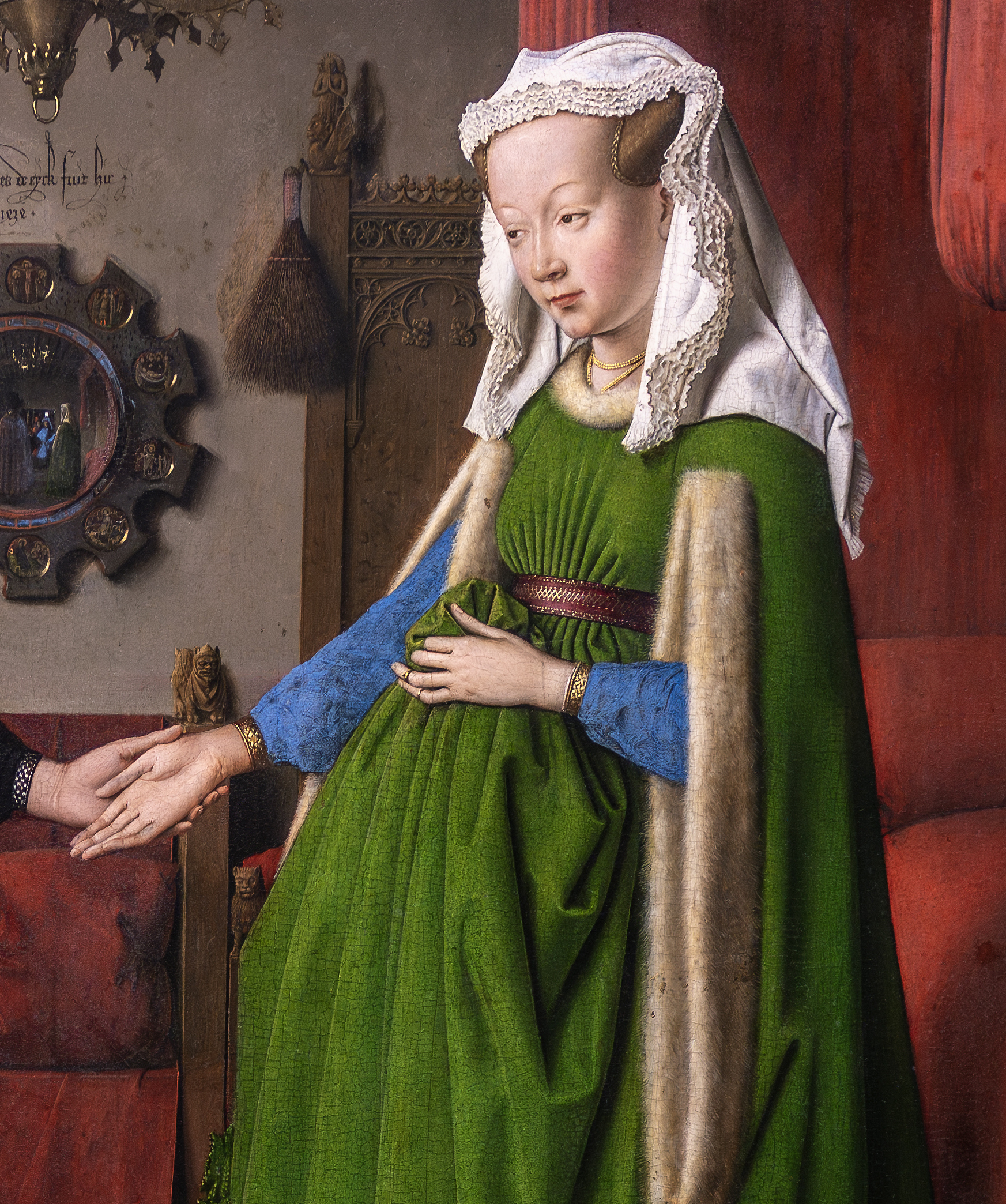
Jan van Eyck’s equally enigmatic and iconic Arnolfini Portrait often prompts art history newcomers and experts alike to ask: is the female figure pregnant? Questions about the presence of pregnancy in the portrait are so common that the London National Gallery’s website addresses the issue on the second line of the painting’s official explanatory text.[1]
Is the woman in the Arnolfini Portrait pregnant? The short answer is no. The illusion is caused because the figure collects her extensive skirts and presses the excess fabric to her abdomen where it springs outwards and creates a domelike silhouette. Her hand position is regularly read by modern viewers as a universal acknowledgment of pregnancy, but in the Renaissance this gesture would have been understood instead as a sign of adherence to female decorum. Young Renaissance women were encouraged to keep their hands demurely clasped around their girdles when in public, as this was seen as polite and unobtrusive.
The issue of pregnancy in the Arnolfini Portrait is a complex one: the figure is not literally pregnant, because painting or sculpting pregnancy violated the period’s artistic customs—yet pregnancy is nevertheless present in the picture. Both pregnancy symbolism and expectation are at play within the painting.
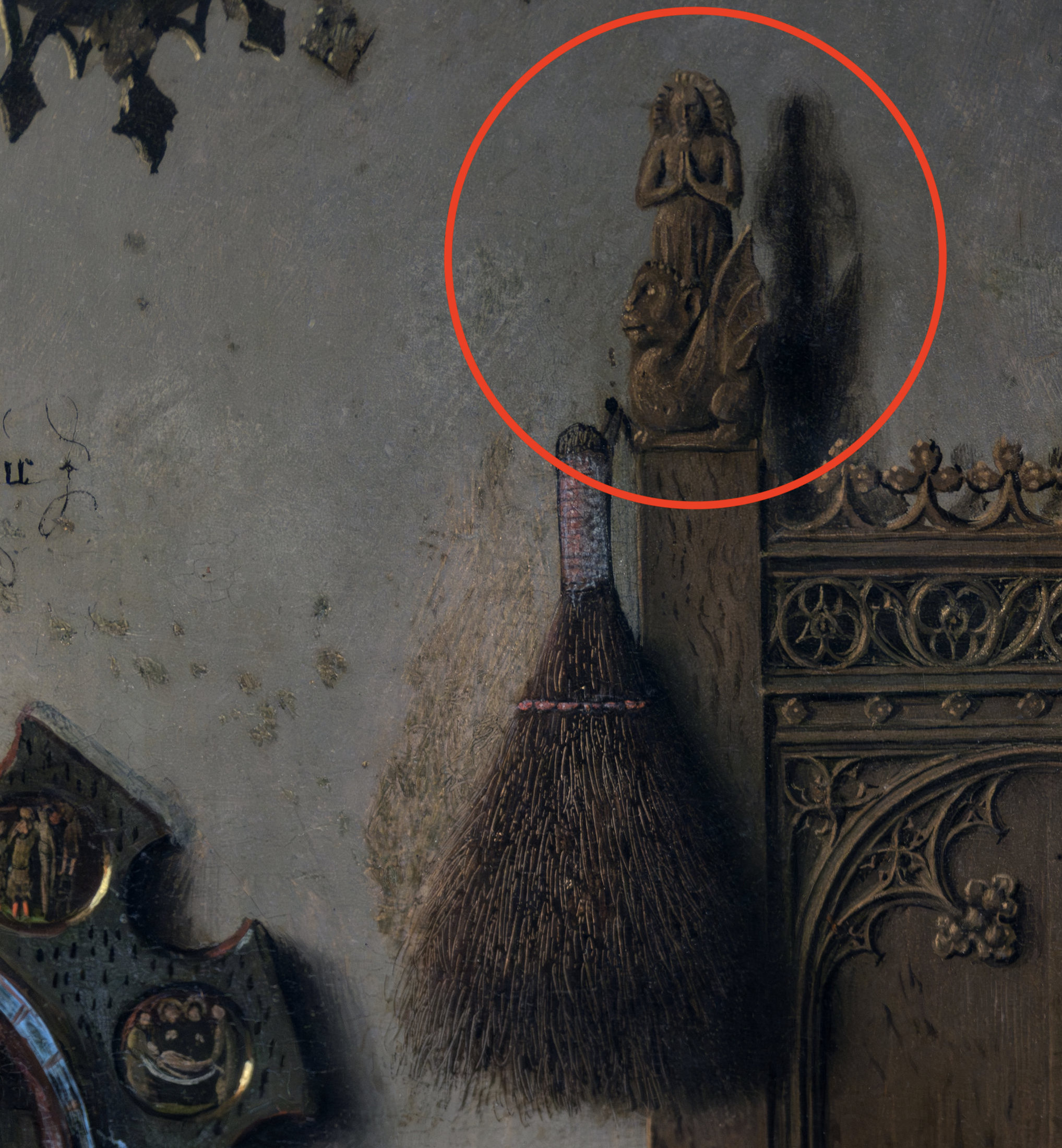
Objects alluding to future pregnancy pepper the composition, from the ripened fruit arranged on the windowsill, to the wooden statuette of Saint Margaret, the patron saint of childbirth, who is shown overcoming the dragon of heresy on the bed frame.
A new question
Perhaps the question we should be asking when considering the Arnolfini Portrait is not “is the female figure pregnant?” Instead, we can consider why the female figure appears to be pregnant. The persistent illusion asks us to consider Renaissance gender roles, as well as our own beliefs concerning depictions of women in pre-modern art. The woman in the green dress is not meant to be read as actually pregnant, yet—more significantly—she lived and died in a culture that expected near-constant pregnancy from women.
Jan Van Eyck, The Ghent Altarpiece
The altarpiece itself is a visual “moveable feast,” made up of 12 panels that fold against themselves. It is like frozen theatre, and when open, reveals a spiritual guidebook to divine revelation. The two videos below provide in-depth coverage of the iconography and history of Jan van Eyck’s iconic altarpiece.
Workshop of Robert Campin, Annunciation Triptych (Merode Altarpiece)
A painter and teacher of Rogier van der Weyden, Robert Campin was, with Van Eyck, a pioneer of realistic oil painting in the 15th-century Netherlands. Look closely—not only is the level of detail here astonishing, but these everyday objects embody religious symbols.
The Northern Renaissance in the 16th century, an introduction
While the Renaissance was happening in Italy, great artistic and social changes occurred in Germany and the Low Countries.
A bias in favor of Italian art among earlier generalizations of scholars made Italy the focus of artistic invention and the Northern Renaissance a less sophisticated imitation of the real thing. One might debate whether the North experienced a Renaissance, but the artistic, institutional, and intellectual changes are evident.
The 16th century: Dürer
Albrecht Dürer is the indisputable rock star of the German Renaissance. In addition to being a successful painter, Dürer built his reputation on his prints, both woodcut and engravings. Because prints can be made in multiples, he had an unusually broad audience. Mechanically reproducible media such as woodcuts and engraving not only helped Dürer disperse his ideas, they also made it possible for Northern artists to see Italian art without traveling.
Dürer likely had his first exposure to Italian art in Germany, in woodcut or engraved copies of Italian works. Looking at an Italian work of art in Germany may seem unremarkable to us. However, until prints were available all works of art were one of a kind, and the only way to see a new work of art was to travel. Prints were typically far less expensive than paintings and much lighter and therefore more portable. The switch from one-of-a-kind works of art to prints is in some ways comparable to the switch from buying or borrowing picture books to searching for images on Google.
Dürer, Melencholia I
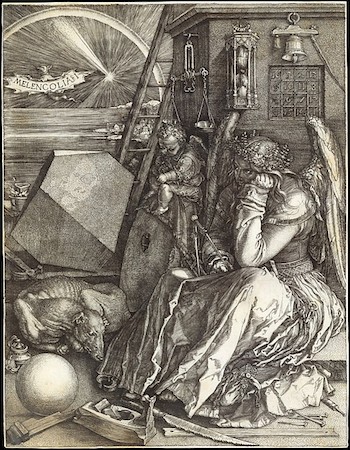
Albrecht Dürer, Melencolia I, 1514, engraving, 24 x 18.5 cm (The Metropolitan Museum of Art, License: Public Domain)
Among Dürer’s best-loved works is the engraving Melencholia I, 1514, which depicts the personification of melancholy, the temperament associated with artistic inspiration. The picture of the brooding figure, whose face resembles Dürer’s famous self portraits, may be male or female. Some scholars believe Dürer’s self portraits are androgenous. Though the face may be Dürer’s, the garment looks feminine.
Whatever the gender, the figure experiences the dreadful feeling of writer’s block. Surrounded by all the tools needed to create—a compass, a plane, nails—s/he sits still, head in hand, and does nothing. The wings are a painful reminder of our limitations. Gifted with intelligence, imagination, and the desire to soar, the figure’s small wings cannot lift such a weighty and substantial body. Bound up with the idea of frustrated creativity is the notion of creativity itself—which took on its present meaning during the Renaissance.
The space is like a fun house, never offering the viewer an opportunity to become oriented. Are we inside or outside? Where does the ladder start? Where does it lead to? The rhombohedron blocks the horizon, and all of the edges point out of the image, a seeming play of the logical system of horizon and orthogonal that create a unified space.
The printing press (images + text)
Perhaps the most influential aspect of the Northern Renaissance is the combination of printed image with text together in books. The printing press was invented in Germany around 1450. Until the printing press, books were laboriously copied and illustrated by hand, one at a time.
The combination of printed words and images created an explosion of information (rather like the change from typewriters to computers). The printing of books such as Luther’s translation of scripture and illustrated polemical pamphlets accelerated the Protestant Reformation, a movement that re-aligned religious and national boundaries, and ultimately would motivate migration to the New World.
Albrecht Dürer, Self-Portrait (1500)
A key figure of the Northern Renaissance, Albrecht Dürer melded Italian interest in the figure with attention to detail in prints, paintings, and drawings.
Practicing Visual Analysis
Albrecht Dürer’s Self-Portrait from 1500 blends together stylistic elements from Northern Europe and Italy to create a Renaissance vision of self-portraiture. Set against a dark background, the torso and face of Dürer are bathed in soft light that appears to come from the left-hand side. Dürer used chiaroscuro modeling to capture subtle highlights and shadows and create the illusion of three-dimensional space on the two-dimensional surface of the canvas. For his composition, Dürer placed his figurative form fully parallel to the picture plane, which is a position traditionally reserved for Christ. It’s an unusual choice for an artist, and the idea points to the prevalent humanist philosophy during the Renaissance. He also placed his signature and insignia right at his eye level in the composition. Looking closely at the painting, one notices the great attention to detail of texture. Attention to minute detail is signature to Northern Europe. Dürer delicately captured the detail of the texture of his fingers and the contrast to the fur of the fur-lined robe that he holds between his fingers. The contrast of textures contributes to the subtle overlap of forms within the painting adding to the nuance of pictorial space. All these details coalesce as a reminder that it was Dürer’s own hand that captured his likeness.
Albrecht Dürer’s woodcuts and engravings
Hans Holbein’s The Ambassadors
A German painter, printmaker, and designer active in Switzerland and England, Hans Holbein was sought after for his meticulously detailed portraits. In The Ambassadors, everything seems so perfect… Hang on, what’s that in the foreground? And why is that lute string broken?
One of the most famous portraits of the Renaissance is without question Hans Holbein the Younger’s The Ambassadors from 1533. Even today, it is a favored portrait to parody, mimic, or cite in art, TV, film, and social media, and it remains an important source for contemporary artists.
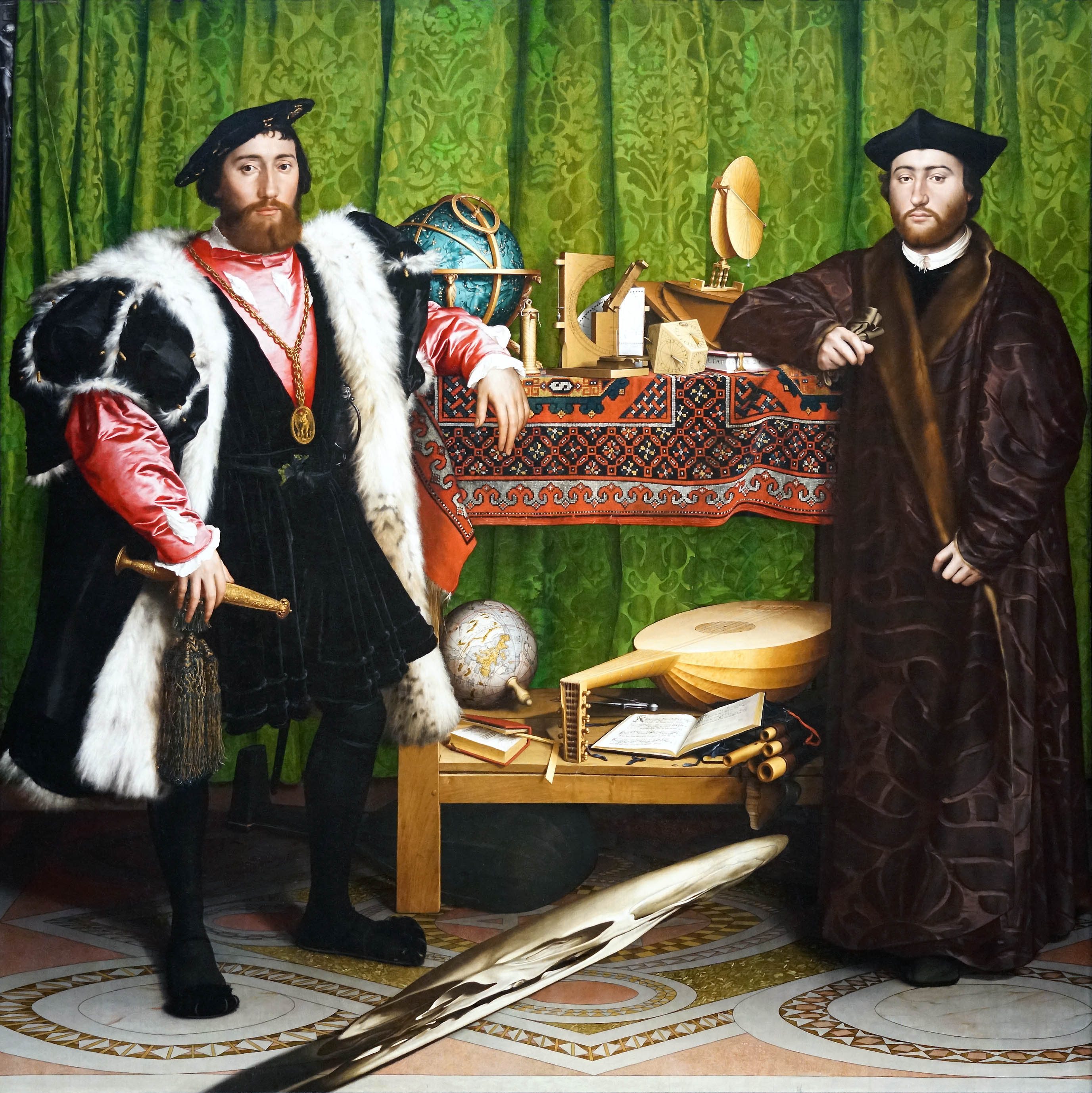
This double portrait depicts two men standing beside a high table covered in objects. On the left is Jean de Dinteville, age 29, a French ambassador sent by the French king, Francis I to the English court of Henry VIII. On the right is Georges de Selve, age 25, the bishop of Lavaur, France. They stand on an elaborate abstract pavement, which has been identified as belonging to the sanctuary in Westminster Abbey—the same space where Anne Boylen, second wife of Henry VIII, had been crowned and more recently, the Duke and Duchess of Cambridge were married.
The painting is filled with carefully rendered details, in a clear style that we have come to identify with Renaissance naturalism of the sixteenth century. The anamorphic skull in the foreground continues to delight and surprise viewers, and to inspire artists.
This article focuses on two details—the carpet and the globe—that speak about the globalized trade of the sixteenth century, and specifically European imperial ambitions and colonization.
The Anatolian carpet
Draped over the top level of the table between the two men is a carpet, usually referred to as a “Holbein Carpet” because of the artist’s fondness for painting this type of textile. This name, though, would not have been used in the sixteenth century. Instead, the carpet would have reminded observers of the place from where it was produced—in this case Turkey—which was controlled, in the sixteenth century, by the Ottomans. Anatolian carpets were popular luxury objects in Europe from the fifteenth century onward. Textiles from Turkey, as well as other parts of the eastern Mediterranean were highly sought after because of their extraordinary craftsmanship and beauty.
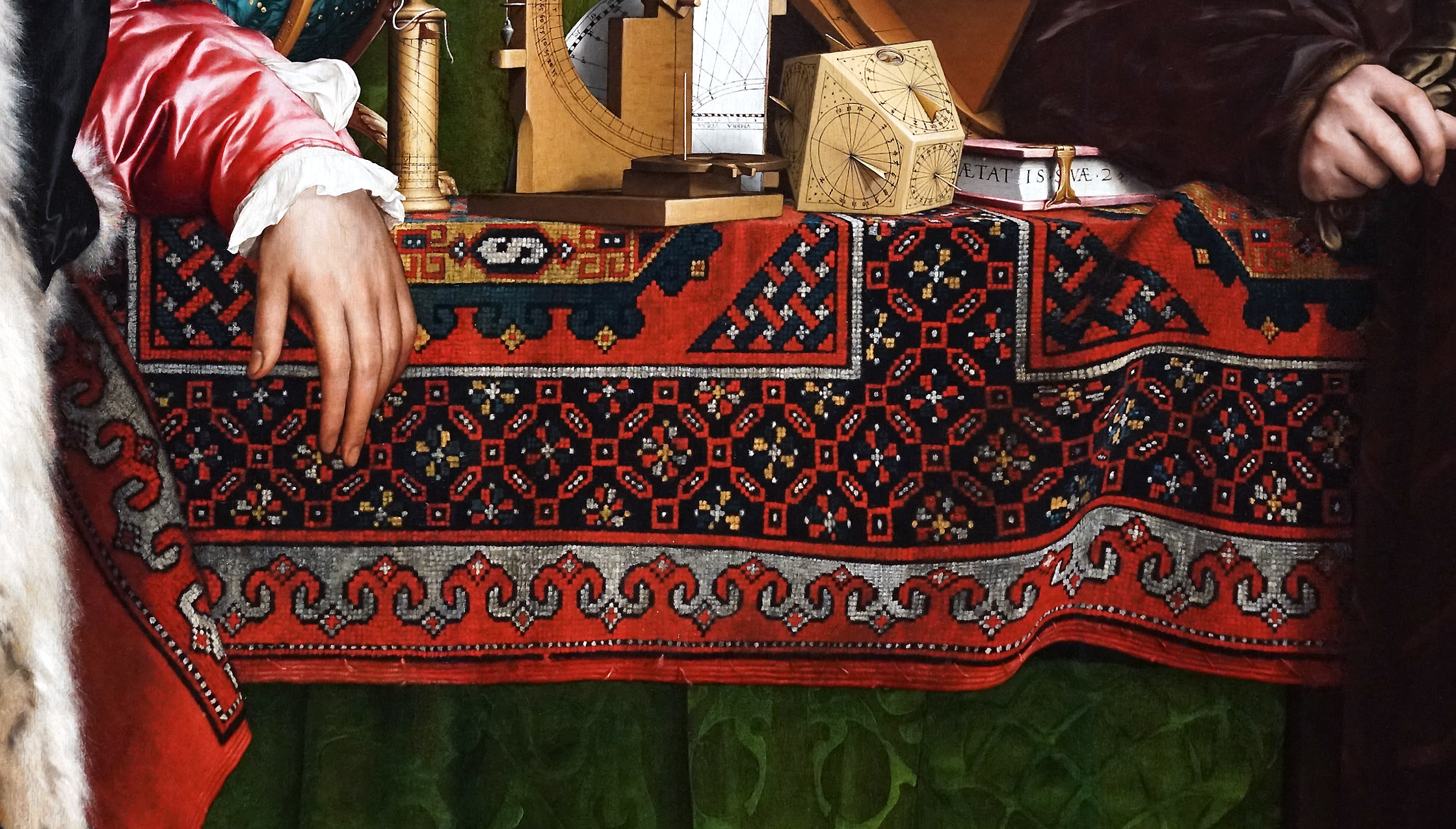
Often, so-called “Holbein carpets” display octagonal medallions, other stylized patterns, and sometimes borders with Kufic, a type of Arabic calligraphic script (which the one in The Ambassadors does not). This type of carpet became so popular in Europe, that other textile makers began to try to copy it, often with pseudo-Kufic designs intended to mimic the script.
Carpets like the one in Holbein’s painting were expensive. They figured prominently in elite European homes, and often cost as much as paintings and sculptures. Unlike today, a carpet of such expense would not be placed on the floor. It would be draped over a table, as shown in The Ambassadors, to be displayed as a beautiful object to observe and delight in. We can find similar carpets In other Renaissance paintings, often draped over parapets or tables. Occasionally such carpets are shown on the floor underneath the Virgin Mary to convey her elevated status as a holy figure.
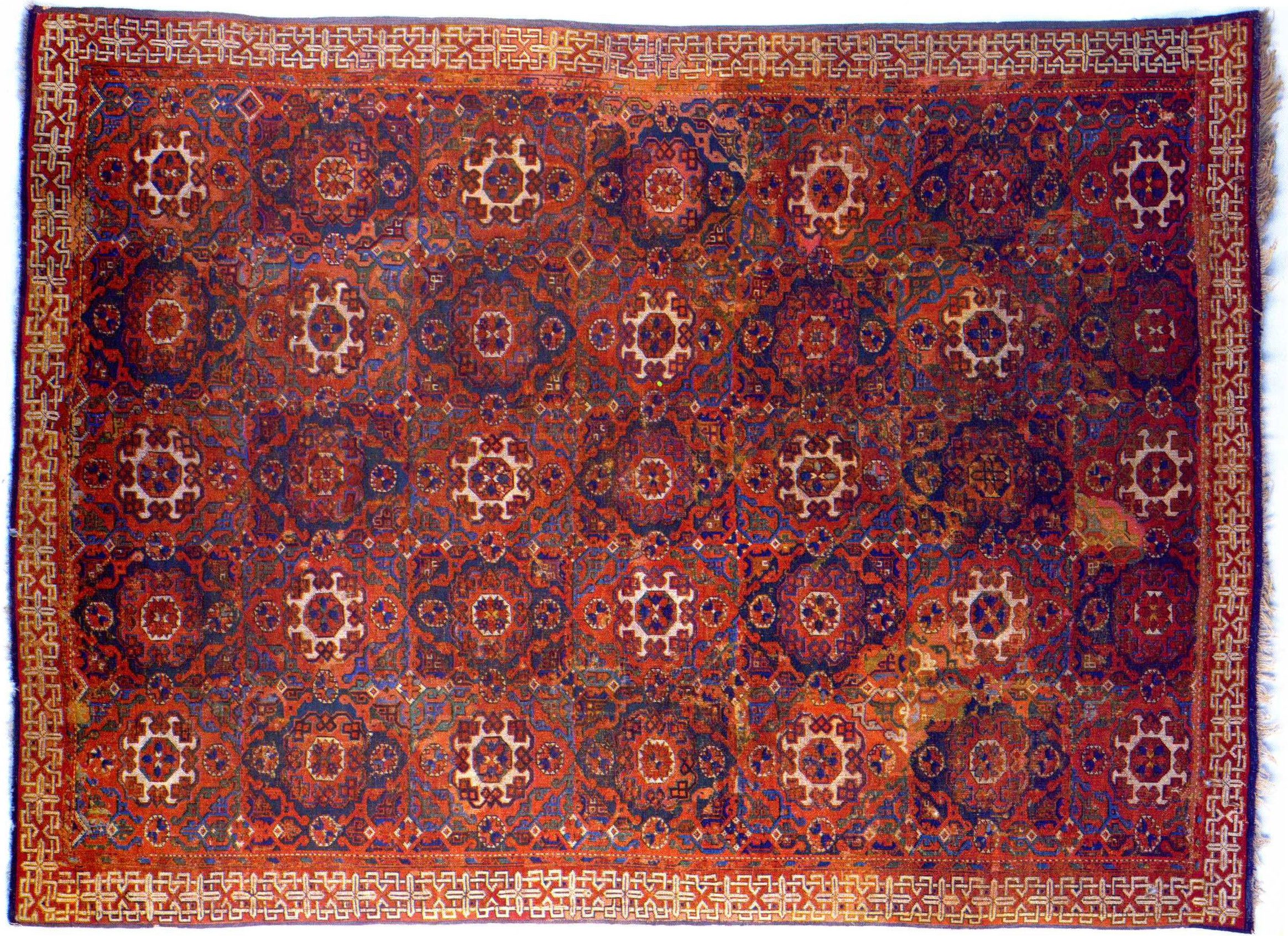
So why is a carpet in Holbein’s painting? The carpet is a luxury object meant to elevate the two men’s status. It also reminds us of the power and prestige of the Ottoman Empire at the time. The Ottomans were considered a threat to the European powers, even as Europeans desired Ottoman luxuries, such as carpets.
There is also likely another reason for the carpet’s appearance in the painting. Francis I, the French King, had recently aligned with King Henry VIII of England in an attempt to reduce the power of Charles V, the Holy Roman Emperor who controlled much of mainland Europe. Charles V was a powerful ruler, and Francis I and Henry VIII were concerned that he might try to wrest control away from them. Francis I also tried to cultivate relationships with the Papal States and the Ottomans, and he reached out to Süleyman the Magnificent, the Ottoman ruler. The carpet in Holbein’s painting may refer to the French ruler’s attempts to strengthen political ties to the Ottomans. Francis I no doubt coveted such a relationship as it would bolster his commercial ties, strengthening his ability to acquire Ottoman commodities and giving him greater access to goods from China and India that were also highly desirable.
The carpet has multiple meanings: politically, it speaks to Francis’s attempts to forge a political connection with the Ottoman ruler, and culturally, as an expensive, imported textile from the Anatolian peninsula. The carpet is a reminder that the Ottomans were an important part of European Renaissance culture.
The globe
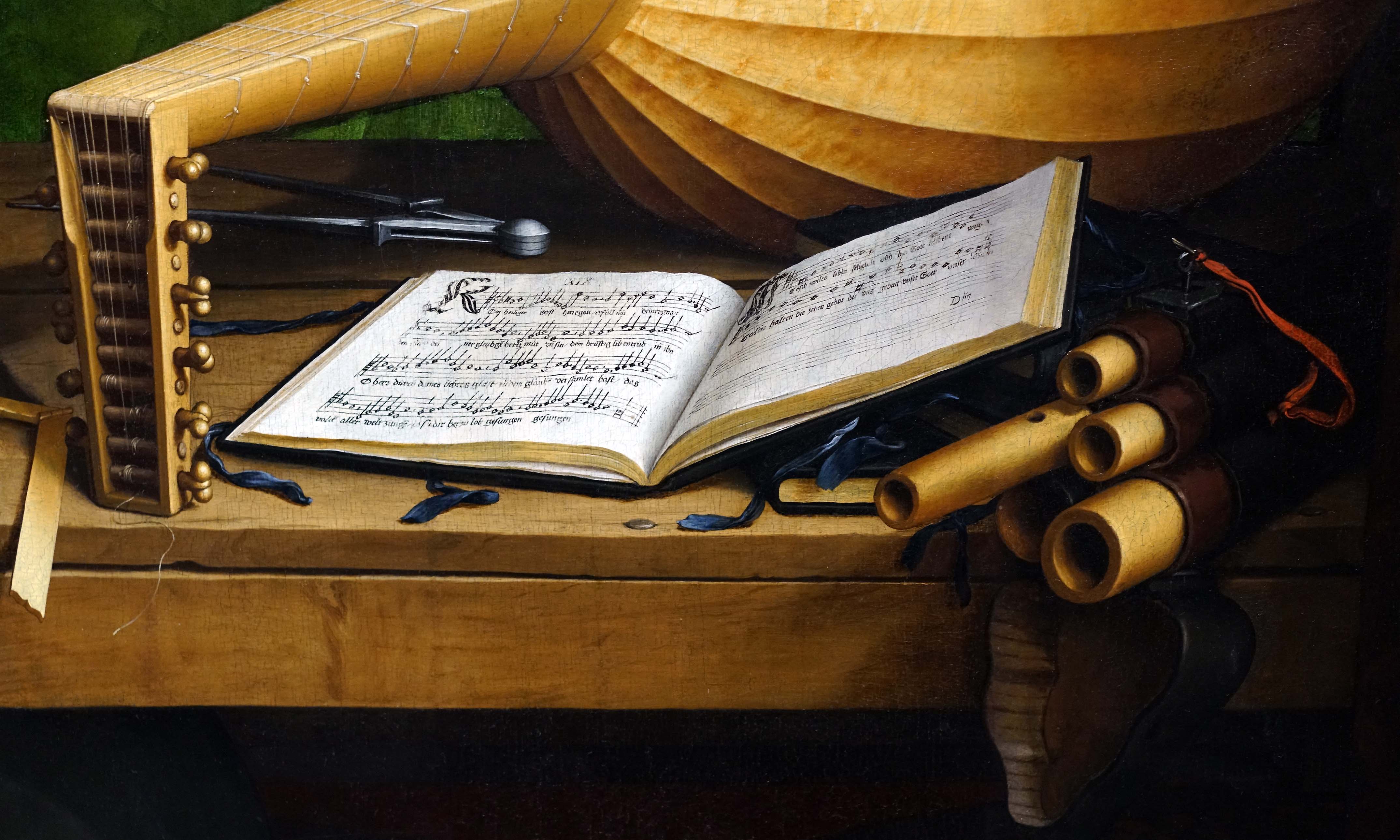
On the shelf below the carpet, there are a number of intriguing objects, including a lute with a broken string, a hymn book, and a globe. The lute’s broken string is thought to reference the discord that resulted from the Protestant Reformation, which the hymn book also calls to mind. Martin Luther, who initiated the Reformation, composed the hymns shown.
The globe, however, does not refer to the upheaval that resulted from the Reformation, but it does call to mind other types of transformations then taking place. The map on the globe is displayed upside down from a globe’s common orientation. Despite this, many parts of Europe have legibly written inscriptions. Holbein positioned Europe closest to the picture plane and painted it in a golden color to draw our eyes to it. We see Africa above, and beyond that parts of the Americas.
Interestingly, one of the legible inscriptions on the globe is “Brisillici R.” for Brazil. The visual clarity and reference to Brazil is important. The French crown made a claim to Brazil after it had sponsored an expedition to the Americas in 1522. Heading the expedition was Giovanni da Verrazano, who returned in 1524, helping France to stake a claim to lands across the Atlantic. Verrazano would return to Brazil in 1527 to collect Brazilwood, a valuable resource. The French crown attempted to establish trading posts in Brazil in order to claim control over this rich foreign land, an action that pit France against its colonial rival Portugal.
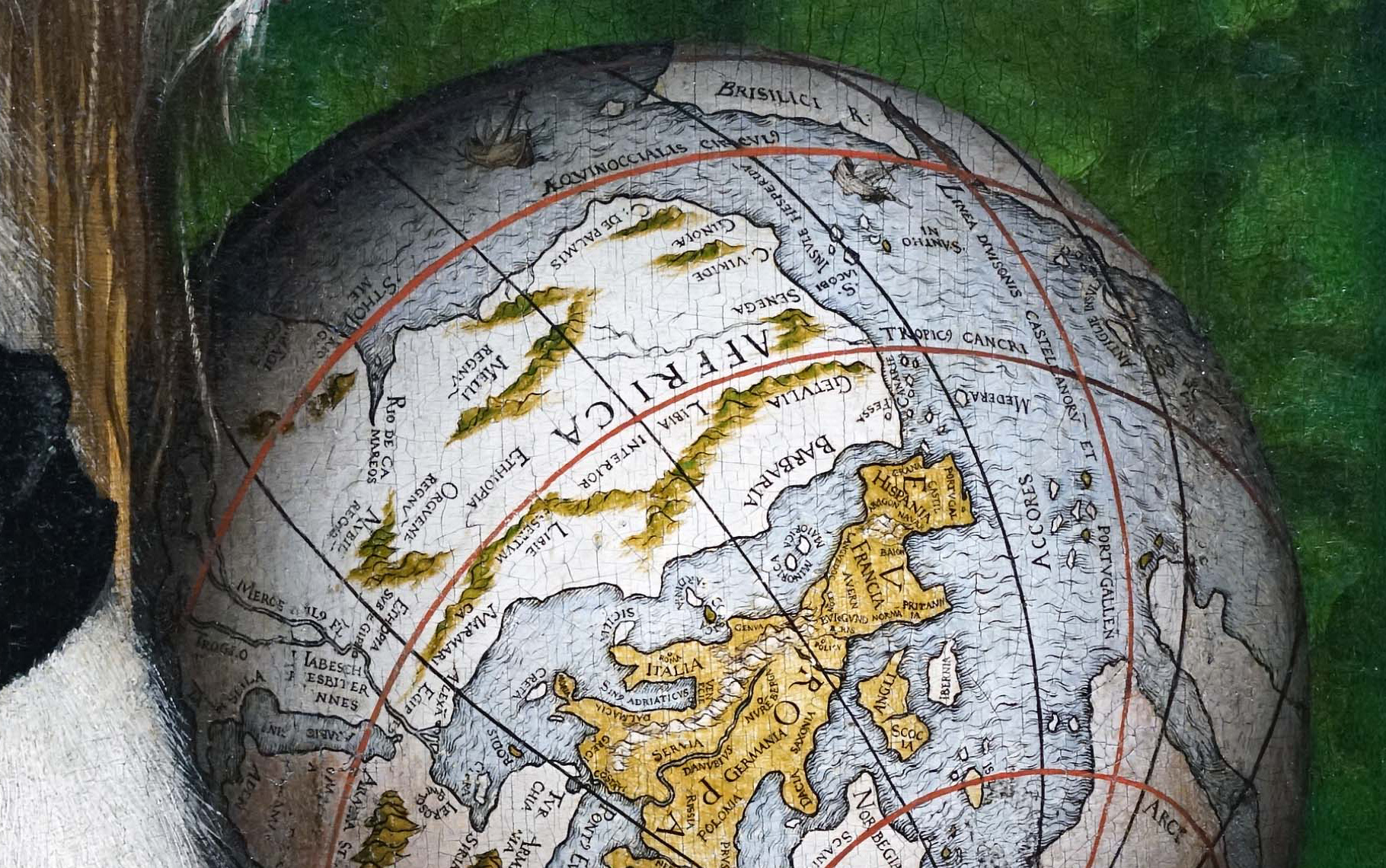
Several red lines also run through parts of the globe in Holbein’s portrait. One, which runs through Brazil and divides the Atlantic, was the line agreed to with the Treaty of Tordesillas in 1494. This treaty resulted in much of the Americas being granted to Spain, while Brazil was granted to the Portuguese. Another line, one that resulted from the Treaty of Saragossa in 1529 (once again between Spain and Portugal), divided the map in the other direction, giving the Portuguese the Moluccas, or Spice Islands. The inclusion of these lines reveals the importance of the competition between colonial powers for land, resources, and people, and the far-reaching implications that European maritime voyages and colonial expeditions would have across the globe.
What makes Holbein’s globe even more fascinating is that it replicates an actual globe from the sixteenth century. Holbein copied a Holbein copied a globe such as the replica in the Beinecke Rare Book & Manuscript Library at Yale University, from around 1526. The original was a printed globe, made possible by the revolution in print technology that had transformed Europe since the middle of the 15th century. The globe was likely printed in Nuremberg, and was popular in the 1520s and 30s. On the printed globe, there are clear references to Ferdinand Magellan’s circumnavigation of the globe which was completed in 1522. The globe then alludes to Habsburg dominance, since Charles V, a Habsburg, had sponsored Magellan. Despite Holbein’s borrowing from the printed globe, he omits the Magellan route. It has been suggested that this was an effort by Holbein, who was aware that his patron was a subject of Francis I, to downplay Habsburg power.
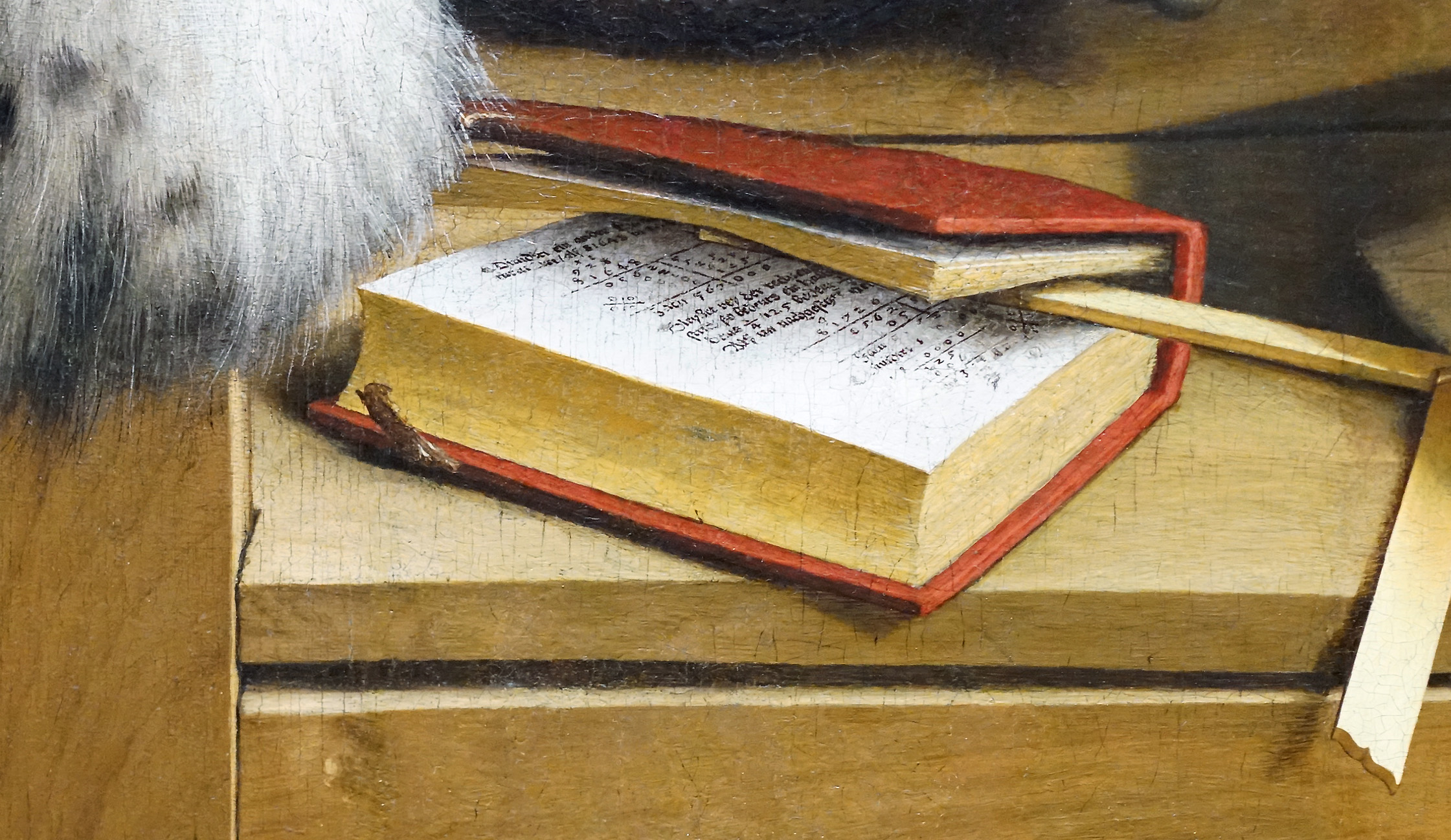
Like the globe and the Turkish carpet, the book that rests on the table just in front of the globe also alludes to the importance of trade. Holbein’s precise manner of painting the book allows us to identify it as an arithmetic text, specifically the German astronomer Peter Apian’s A New and Well-grounded Instruction in All Merchants’ Arithmetic (Eyn Newe unnd wolgegruündte underweysun aller Kauffmannss Rechnung). The book discusses profits and losses—an important aspect of mercantilism and trade in this period. The navigational instruments on the upper shelf also point to commercial activities that sponsored travel and exchange, but also imperialist expansion and colonization. Each is an important theme in this complex painting.
Conclusion:
The Renaissance in Northern Europe shared similar interests to its Italian counterpart: naturalism with its focus on rendering the illusion of three-dimensional space through linear perspective and chiaroscuro modeling. However, rather than emphasizing Classical antiquity, artists in the North favored an interest in detailed observation and symbolic content. In the regions of Flanders, the Netherlands, and the Holy Roman Empire, artists brought together Christian theology with everyday life to showcase attention to detail laden with iconographic meaning.
Citation and Licensing
The following sections were written by Chelsea Wright and licensed CC BY-NC-SA 4.0:
- Chapter Overview and Introduction
- Focus artwork and term list compiled by Chelsea Wright
- Practicing Visual Analysis
- Conclusion
The following articles from Smarthistory licensed CC BY-NC-SA 4.0 were remixed and adapted for the chapter:
- Dr. Bonnie Noble, “The Northern Renaissance, a brief introduction,” in Smarthistory, August 9, 2015.
- Dr. Andrew Murray, “15th-century Flanders, an introduction,” in Smarthistory, August 23, 2017.
- Dr. Lane Eagles, “Jan van Eyck, The Arnolfini Portrait,” in Smarthistory, January 16, 2025.
- Dr. Sally Hickson, “Jan Van Eyck, The Ghent Altarpiece,” in Smarthistory, August 9, 2015.
- Smarthistory, “Robert Campin,” in Smarthistory.
- Dr. Beth Harris and Dr. Steven Zucker, “Workshop of Robert Campin, Annunciation Triptych (Merode Altarpiece),” in Smarthistory, December 18, 2015.
- Dr. Bonnie Noble, “The Northern Renaissance in the 16th century, an introduction,” in Smarthistory, August 9, 2015.
- Smarthistory, “Albrecht Dürer,” in Smarthistory.
- Dr. Steven Zucker and Dr. Beth Harris, “Albrecht Dürer, Self-Portrait (1500),” in Smarthistory, December 9, 2015.
- Dr. David Drogin and Dr. Beth Harris, “Albrecht Dürer’s woodcuts and engravings,” in Smarthistory, December 11, 2015.
- Smarthistory, “Hans Holbein the Younger,” in Smarthistory.
- Dr. Lauren Kilroy-Ewbank, “The carpet and the globe: Holbein’s The Ambassadors reframed,” in Smarthistory, October 30, 2020.
- The Arnolfini Portrait at the National Portrait Gallery ↵