
Early Italian Renaissance
Chapter Overview and Introduction
The Renaissance is defined as the rebirth of the Classical Antiquity of Ancient Greece and Rome during the period of c.1400-1600. The Renaissance began in Florence, Italy and spread across Europe. As Italy emerged from the medieval period, artists like Giotto di Bondone were transitioning from the Italo-Byzantine medieval style to early Renaissance concepts. Artists, including Giotto, Brunelleschi, Donatello, and Botticelli, were all living and working around Florence. Florence was a remarkable city during the late 14th and early 15th centuries for its culture of competition and its strong patronage of the arts. As you read and watch the content, pay close attention to the role of the patron and the purpose competition served in the early Renaissance. Some of the most famous artists of this time competed against one another to earn commissions.
As part of the early Renaissance, the technique of linear perspective emerged to create the illusion of three-dimensional space on a two-dimensional surface. From the early Renaissance until the late 19th century, linear one-point perspective will be the dominant technique for representing pictorial space in two-dimensional artworks.
Focus Artworks
- Giotto Di Bondone, Lamentation, Arena Chapel, Padua, Italy, c. 1305, fresco
- Filippo Brunelleschi, Sacrifice of Isaac, competition panel for the east doors of the Florence Baptistery, 1401-1402, gilded bronze relief
- Lorenzo Ghiberti, Sacrifice of Isaac, competition panel for the east doors of the Florence Baptistery, 1401-1402, gilded bronze relief
- Filippo Brunelleschi, Dome of Florence Cathedral, Santa Maria del Fiore, 1420-1436
- Masaccio, Tribute Money, Brancacci Chapel, Santa Maria del Carmine, Florence, Italy, c. 1424-1427, fresco
- Sandro Botticelli, Birth of Venus, c. 1480, tempera on canvas
- Donatello di Niccolò di Betto Bardi, David, c. 1440-1460, bronze
Term List
- Renaissance
- Classical antiquity
- Humanism
- Quatrefoil
- Fresco
- Linear perspective
- Horizon line
- Vanishing point
- Orthogonal lines
- Freestanding
- Tempera
- Neo-Platonism
- Contrapposto
- Naturalism
Florence in the Early Renaissance
The Renaissance really gets going in the early years of the 15th century in Florence. In this period, which we call the Early Renaissance, Florence is not a city in the unified country of Italy, as it is now. Instead, Italy was divided into many city-states (Florence, Milan, Venice etc.), each with its own government (some were ruled by despots, and others were republics).
The Florentine Republic
We normally think of a Republic as a government where everyone votes for representatives who will represent their interests to the government (think of the United States pledge of allegiance: “and to the republic for which it stands…”). However, Florence was a Republic in the sense that there was a constitution which limited the power of the nobility (as well as laborers) and ensured that no one person or group could have complete political control (so it was far from our ideal of everyone voting, in fact a very small percentage of the population had the vote). Political power resided in the hands of middle-class merchants, a few wealthy families (such as the Medici, important art patrons who would later rule Florence) and the powerful guilds.
Why did the Renaissance begin in Florence?
There are several answers to that question: Extraordinary wealth accumulated in Florence during this period among a growing middle and upper class of merchants and bankers. With the accumulation of wealth often comes a desire to use it to enjoy the pleasures of life—and not an exclusive focus on the hereafter.
Florence saw itself as the ideal city state, a place where the freedom of the individual was guaranteed, and where many citizens had the right to participate in the government (this must have been very different than living in the Duchy of Milan, for example, which was ruled by a succession of Dukes with absolute power). In 1400 Florence was engaged in a struggle with the Duke of Milan. The Florentine people feared the loss of liberty and respect for individuals that was the pride of their Republic.
Luckily for Florence, the Duke of Milan caught the plague and died in 1402. Then, between 1408 and 1414 Florence was threatened once again, this time by the King of Naples, who also died before he could successfully conquer Florence. And in 1423 the Florentine people prepared for war against the son of the Duke of Milan who had threatened them earlier. Again, luckily for Florence, the Duke was defeated in 1425. The Florentine citizens interpreted these military “victories” as signs of God’s favor and protection. They imagined themselves as the “New Rome”—in other words, as the heirs to the Ancient Roman Republic, prepared to sacrifice for the cause of freedom and liberty.
The Florentine people were very proud of their form of government in the early 15th century. A republic is, after all, a place that respects the opinions of individuals, individualism was a critical part of the Humanism that thrived in Florence in the 15th century.
What was humanism?
Humanism was the educational and intellectual program of the Renaissance. Grounded in Latin and Greek literature, it developed first in Italy in the middle of the fourteenth century and then spread to the rest of Europe by the late fifteenth century. This program, called the studia humanitatis, or the humanities, was thought to teach citizens the morals necessary to lead an active, virtuous life, which its proponents contrasted with the contemplative life of ascetic monks and scholars. As a product of the Italian city-state republics, humanism was a system born in the city and made for the citizen. Although scholars in earlier centuries had embraced classical learning, humanists rediscovered many lost texts, read them with a critical and secular eye, and, through them, forged a new mentality that shaped Italian and European society from approximately the mid-14th to the mid-17th centuries.
Renaissance Humanism: Bridging the Classical with the Christian
In the new cultural context of 15th century Florence, humanism became a defining concept. Humanism celebrates the potential of humanity. Renaissance humanism combined elements of the Classical world with Christian theology. The presence of humanism along with a revised interest in naturalism and an increase in learning lead to a shift in artistic styles.
The video, “How to Recognize Italian Renaissance Art,” explores the stylistic shift from the medieval style to the early Renaissance through the work of artist Giotto di Bondone and into the High Renaissance with Michelangelo.
How to Recognize Italian Renaissance Art with Giotto
Considered an unrivaled painter in his own time, Giotto had a profound influence on the transition between the medieval and the Gothic in Italy.
A Culture of Competition
With Italy as a series of competing city-states during the Renaissance, the culture of competition extended to competition between city-states, leading families, and even between artists. As any competitive person knows, good competition makes you want to improve and ultimately, to win.
During the Middle Ages and into the Renaissance, cathedrals were symbols of civic pride. As cities competed for political, cultural, and economic power on the Italian peninsula, the construction of main cathedrals served as symbols of strength. This is the case with Santa Maria del Fiore, the spiritual heart of Florence. Competitions took place for several architectural and artistic components of Santa Maria del Fiore, including its baptistry and for the roof.
The Competition Panels and the Florentine Renaissance
Filippo Brunelleschi, Dome of the Cathedral of Florence
The Dome of the Florence Cathedral represents the enormous ambition of Brunelleschi and of Florence in the 15th century.
Introducing Linear Perspective
Like almost all Renaissance artists, Filippo Brunelleschi mastered multiple mediums. Trained as a goldsmith and experienced in bronze and architecture, Brunelleschi was also a master draftsman. He excelled at drawing. Brunelleschi and his contemporary Masaccio began to work with the technique of linear perspective. Art historians believe linear perspective may have originated in the Ancient Greco-Roman world, with Ancient Roman wall paintings demonstrating the illusion of three-dimensional space. It’s during the Renaissance that linear perspective is “re-discovered.”
First, learn how linear perspective works. Then, see how Masaccio used linear perspective in his fresco painting of the Tribute Money in his work for the Brancacci Chapel in Florence.
How one-point linear perspective works
Masaccio, The Tribute Money and Expulsion in the Brancacci Chapel
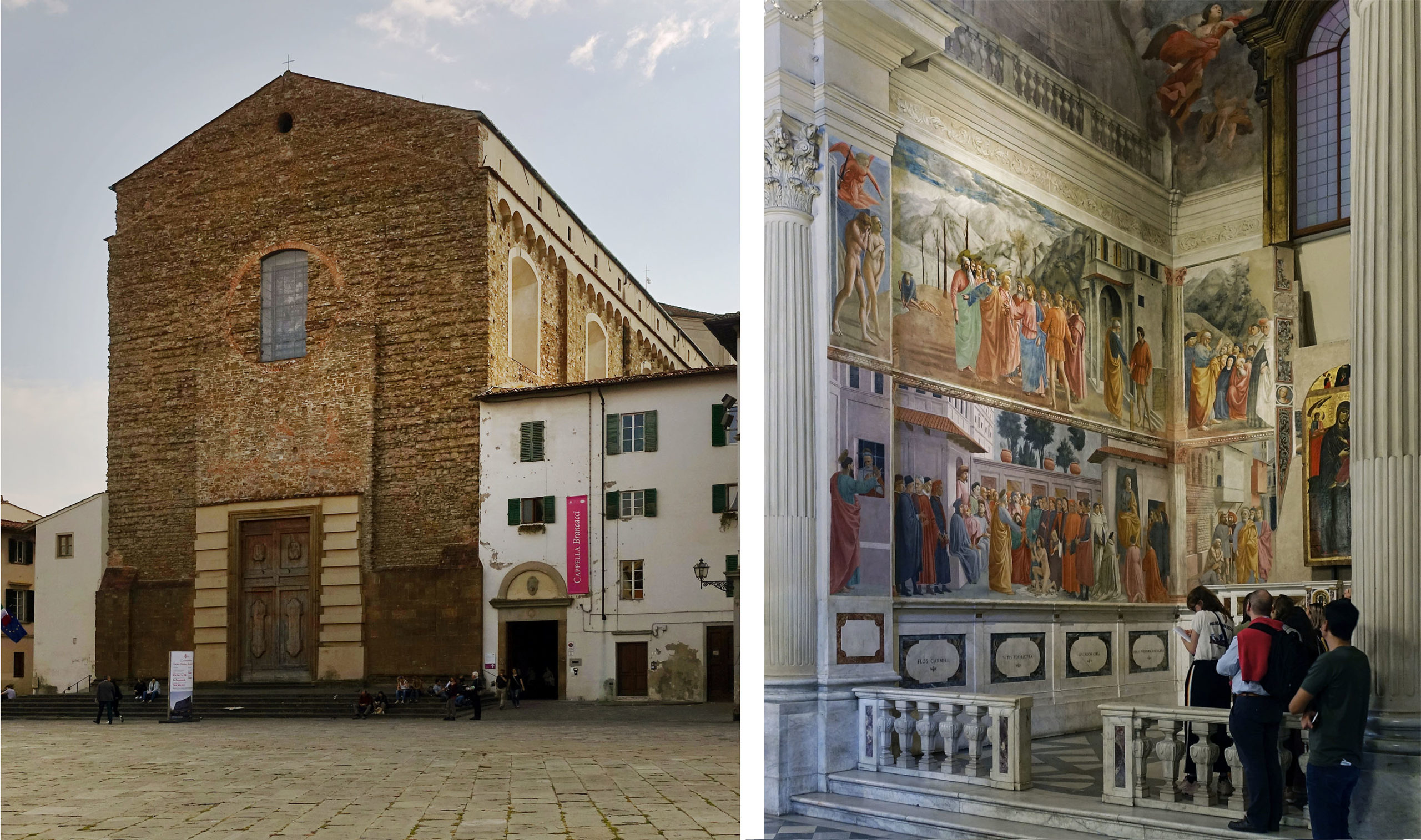
The Tribute Money is one of many frescoes painted by Masaccio (and another artist named Masolino (with later additions by Filippino Lippi) in the Brancacci chapel in Santa Maria del Carmine in Florence—when you walk into the chapel, the fresco is on your upper left. All of the frescoes in the chapel tell the story of the life of St. Peter. The story of the Tribute Money is told in three separate scenes within the same fresco. This way of telling an entire story in one painting is called a continuous narrative.
A story unfolds and a miracle is performed
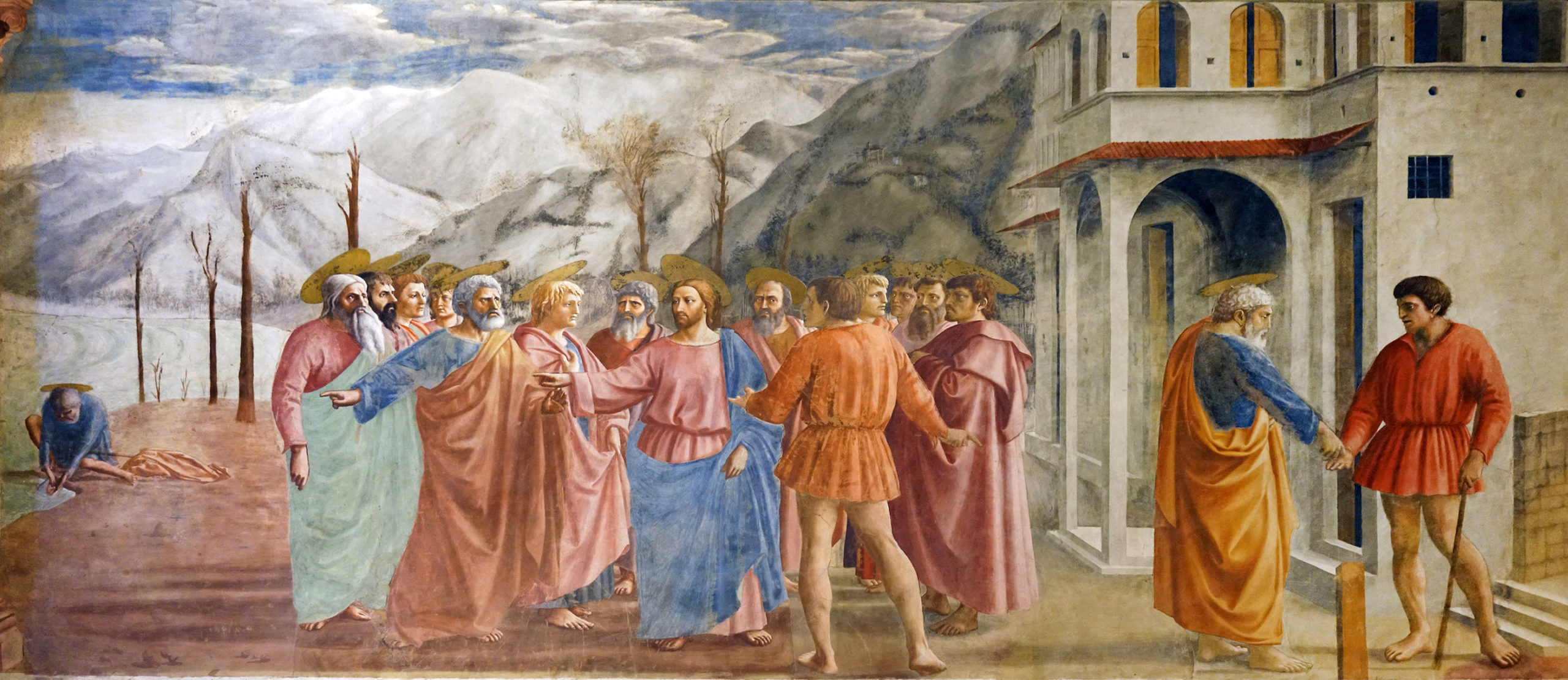
In the Tribute Money, a Roman tax collector (the figure in the foreground in a short orange tunic and no halo) demands tax money from Christ and the twelve apostles who don’t have the money to pay.
Christ (in the center, wearing a pinkish robe gathered in at the waist, with a blue toga-like wrap) points to the left, and says to Peter “so that we may not offend them, go to the lake and throw out your line. Take the first fish you catch; open its mouth and you will find a four-drachma coin. Take it and give it to them for my tax and yours” (Matthew 17:27). Christ performed a miracle—and the apostles have the money to pay the tax collector.
In the center of the fresco (scene 1), we see the tax collector demanding the money, and Christ instructing Peter. On the far left (scene 2), we see Peter kneeling down and retrieving the money from the mouth of a fish, and on the far right (scene 3), St. Peter pays the tax collector. In the fresco, the tax collector appears twice, and St. Peter appears three times (you can find them easily if you look for their clothing).
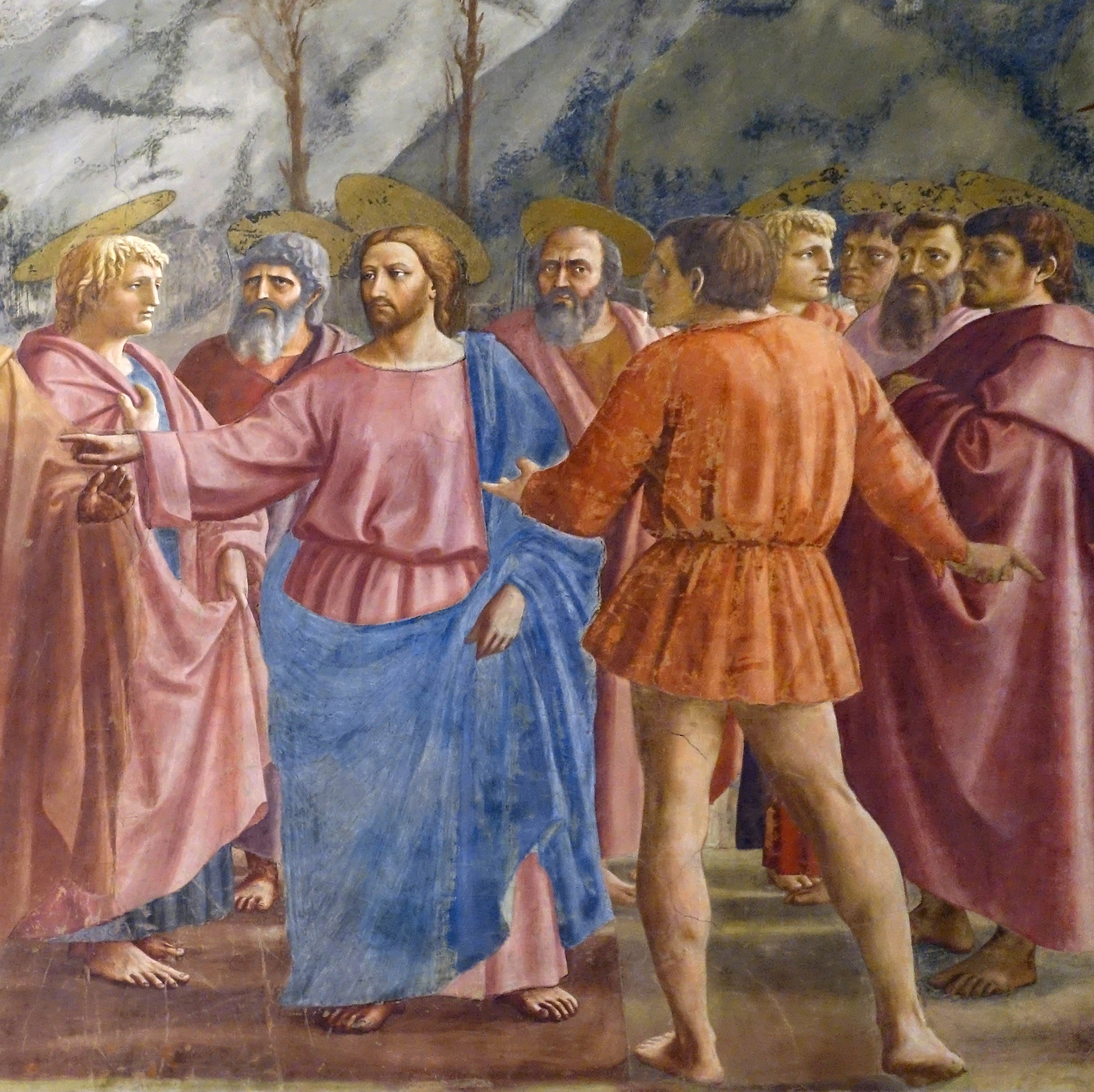
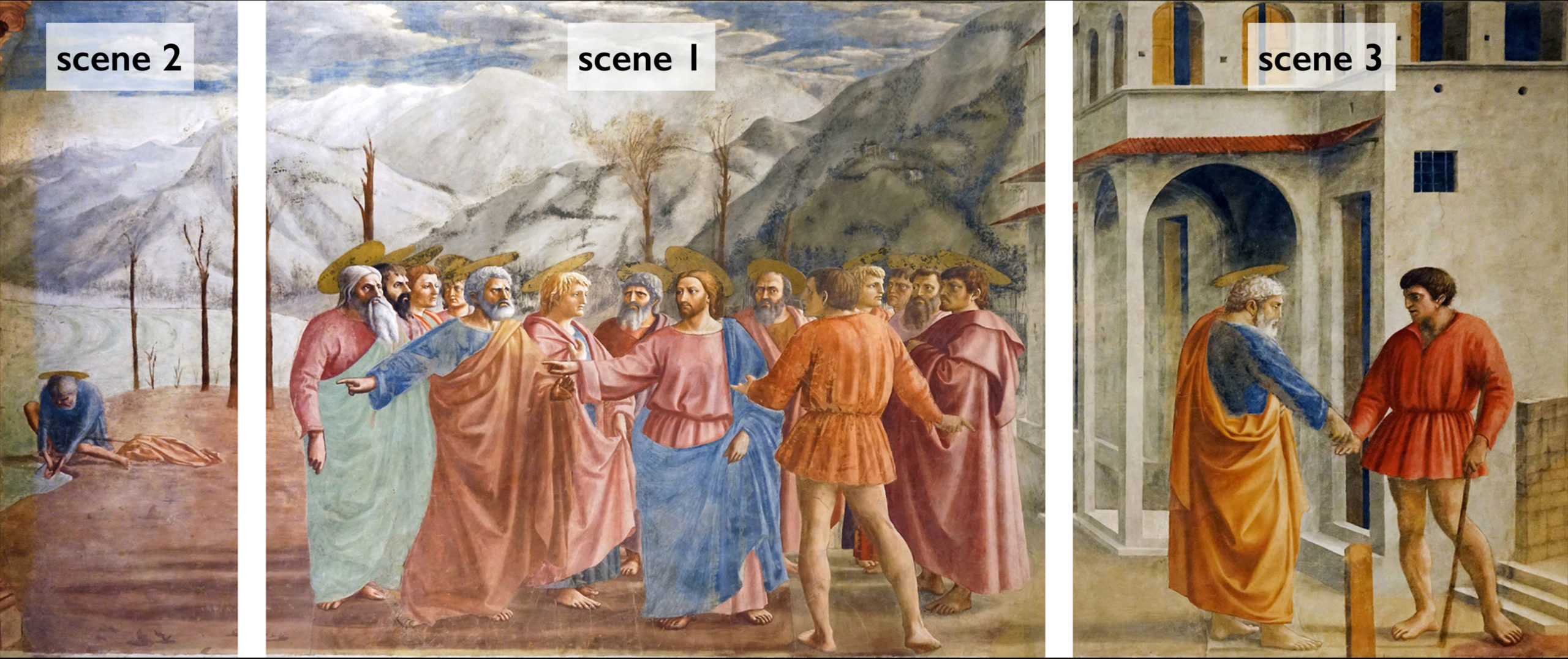
We are so used to one moment appearing in one frame (think of a comic book, for example) that the unfolding of the story within one image (and out of order!) seems very strange to us. But with this technique (a continuous narrative)—which was also used by the ancient Romans—Masaccio is able to make an entire drama unfold on the wall of the Brancacci chapel.
In the central, first scene, the tax collector points down with his right hand, and holds his left palm open, impatiently insisting on the money from Christ and the apostles. He stands with his back to us, which helps to create an illusion of three dimensional space in the image (a goal which was clearly important to Masaccio as he also employed both linear and atmospheric perspective to create an illusion of space). Like Donatello’s St. Mark from Orsanmichele in Florence, he stands naturally, in contrapposto, with his weight on his left leg, and his right knee bent. The apostles (Christ’s followers) look worried and anxiously watch to see what will happen. St. Peter (wearing a large deep orange colored toga draped over a blue shirt) is confused, as he seems to be questioning Christ and pointing over to the river, but he also looks like he is willing to believe Christ.

The gestures and expressions help to tell the story. Peter seems confused and points to the lake—mirroring Christ’s gesture; the tax collector looks upset, and has his hand out insistently asking for the money—he stands in contrapposto with his back turned to us (contrapposto is a standing position, where the figure’s weight is shifted to one leg). Only Christ is completely calm because he is performing a miracle.

Look down at the feet—how the light travels through the figures, and is stopped when it encounters the figures. The figures cast shadows—Masaccio is perhaps the first artist since classical antiquity to paint cast shadows. What this does is make the fresco so much more real—it is as if the figures are truly standing out in a landscape, with the light coming from one direction, and the sun in the sky, hitting all the figures from the same side and casting shadows on the ground. For the first time since antiquity, there is almost a sense of weather.
Humanism Made Visible
The renewed interest in the Ancient Classical world transformed ideas about representing pictorial space. It also transformed the way the human body was represented. From paintings to sculptures, Ancient Classical ideas about heroic nudity, naturalism, and celebrating the human body combined with Christian iconography and Biblical narratives. Works like Botticelli’s Birth of Venus and Donatello’s David reveal the presence of humanist ideas made visible.
Sandro Botticelli, The Birth of Venus
A student of Fra Filippo Lippi, Sandro Botticelli was highly sought after by the elite families of Florence; he also decorated parts of the Sistine Chapel. That shell! That pose! That wind! So much in Botticelli’s The Birth of Venus painting seems impossible, not least its divine beauty.
Donatello, David
An Early Renaissance sculptor, Donatello’s study of ancient Roman art informed the realistic anatomy and human character in his works. His nudity references classical antiquity, but David embodies the ideals and concerns of 15th-century Florence.
The study of anatomy. Picking up from the ancients
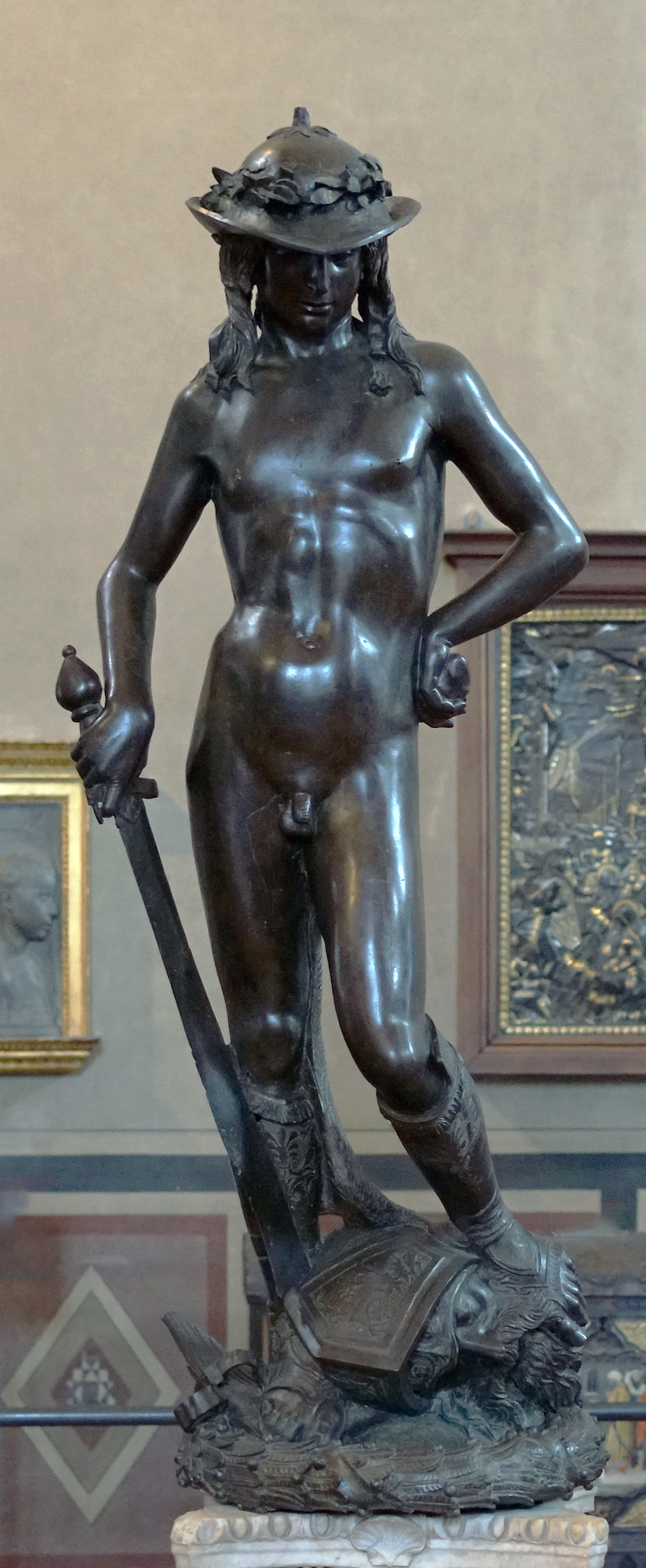
We can see from Donatello’s sculpture of David—with its careful depiction of bones and muscles and a nude figure—that the study of human anatomy was enormously important for Renaissance artists. They continued where the ancient Greeks and Romans had left off, with an interest in creating images of the human beings where bodies moved in natural ways—in correct proportion and feeling the pull of gravity.
Sculptures from ancient Greece and Rome reveal that classical artists closely observed the human body. Ancient Greek and Roman artists focused their attention on youthful bodies in the prime of life. Ancient sources indicate these artists used models to help them study the details of the body in the way that it looked and moved. These artists tried to show their viewers that they understood systems of muscles beneath the skin.
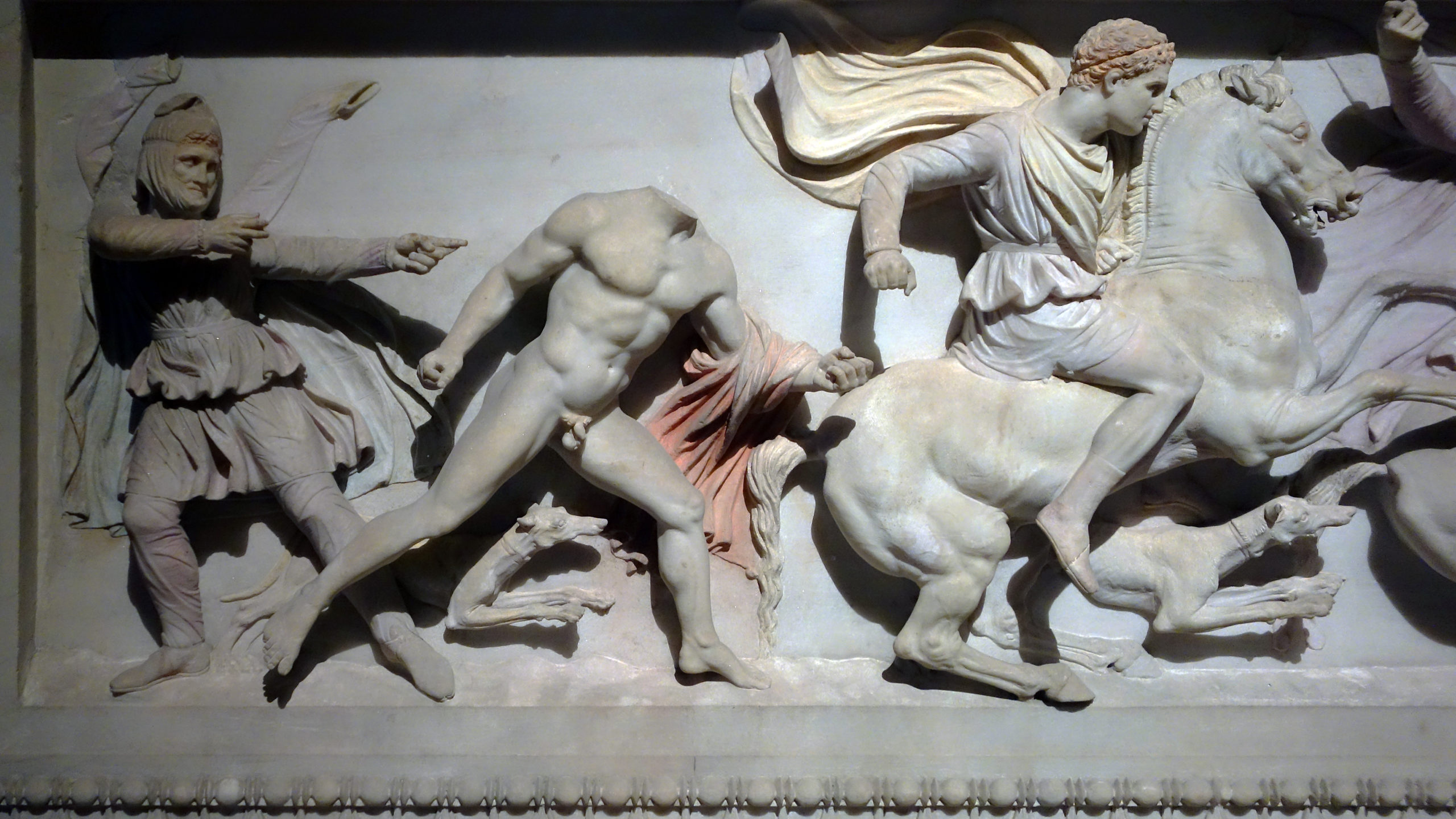
An interest in human anatomy and ideal bodies can be seen in this ancient Greek sarcophagus. Hunting scene (detail), The Alexander Sarcophagus, c. 312 B.C.E., Pentelic marble and polychromy, found in Sidon, 195 x 318 x 167 cm (İstanbul Archaeological Museums; photo: Steven Zucker, CC BY-NC-SA 2.0)
In the Middle Ages, there was very little interest in the human body, which was seen as only a temporary vessel for the soul. The body was seen as sinful, the cause of temptation. In the Old Testament, Adam and Eve eat the apple from the tree of knowledge, realize their nakedness, and cover themselves. Due to the nudity in this important story, Christians associated nudity with sin and the fall of humankind. Medieval images of naked bodies do not reflect close observation from real life or an understanding of the inner workings of bodies.
Dissection
The best way to learn human anatomy is not just to look at the outside of the body, but to study anatomy through dissection. Even though the Catholic Church prohibited dissection, artists and scientists performed dissection to better understand the body. Renaissance artists were anxious to gain specialized knowledge of the inner workings of the human body, which would allow them to paint and sculpt the body in many different positions.
The artists of the Early Renaissance used scientific tools (like linear perspective and the study of anatomy and geometry) to make their art more naturalistic, more like real life. The term “naturalism” describes this effort.
Scientific naturalism allowed artists in the Early Renaissance to begin to demand that society think of them as more than just skilled manual laborers. They argued that their work—which was based on science and math—was a product of their intellect just as much as their hands. They wanted artists to have the same status as intellectuals and philosophers, unlike the medieval craftsmen that came before them.
Practicing Visual Analysis
Donatello’s David stands around five feet tall. The scale of the sculpture makes it a large-scale bronze casting but not a monumental work. The scale is important for understanding the original purpose and location within the private home of the Medici family. Cast in bronze, the sculpture was polished and parts were gilded in gold leaf, such as the hair. Originally, the sculpture would have featured variation in both light and color. Comprised of both rectilinear and curvilinear forms, the composition of the sculpture operates on a vertical axis. The viewer’s eye is kept within the sculpture by David’s soft hat at the top, which angles downward along with his gaze. Following David’s gaze, we look at his feet, where his left foot rests on the large head of Goliath. Thus, two faces bookend the composition: the young, beardless, idealized face of David and the older, lined and bearded veristic face of Goliath. The rectilinear form of the sword placed at a diagonal angle from David’s hip further emphasizes the verticality of the sculpture and the eye’s movement toward Goliath’s decapitated head. Donatello highlights the dynamism of the human body by placing the figurative form of David in the contrapposto stance with David’s weight resting on one engaged leg.
Contrapposto explained
The ancient Greeks mastered the naturalistic representation of the human body, and the Renaissance revived it.
Conclusion
The Early Renaissance was an optimistic time of cultural revival, particularly focusing on a resurgence of Ancient Greek and Roman ideas. Under the influence of the Classical past, people reconceptualized their place in the world and even their relationship to the divine. Humanism became a defining feature of the Renaissance. The foundational ideas and techniques that emerged in the Early Renaissance in Florence – linear perspective, naturalism, heroic nudity, contrapposto, humanism – all lay the groundwork for artists of the High Renaissance.
Citation and Licensing
The following sections were written by Chelsea Wright and licensed CC BY-NC-SA 4.0:
- Chapter Overview and Introduction
- Focus artwork and term list compiled by Chelsea Wright
- Renaissance Humanism: Bridging the Classical with the Christian
- A Culture of Competition
- Introducing Linear Perspective
- Humanism Made Visible
- Practicing Visual Analysis
- Conclusion
The following articles from Smarthistory licensed CC BY-NC-SA 4.0 were remixed and adapted for the chapter:
- Dr. Steven Zucker and Dr. Beth Harris, “Florence in the Early Renaissance,” in Smarthistory, August 9, 2015.
- Dr. John M. Hunt, “Humanism in renaissance Italy,” in Smarthistory, August 1, 2021.
- Smarthistory, “Giotto,” in Smarthistory.
- Dr. Beth Harris and Dr. Steven Zucker, “How to recognize Italian Renaissance art,” in Smarthistory, February 2, 2017.
- Dr. Steven Zucker and Dr. Beth Harris, “Filippo Brunelleschi and Lorenzo Ghiberti, Sacrifice of Isaac,” in Smarthistory, May 5, 2021.
- Dr. Beth Harris and Dr. Steven Zucker, “Filippo Brunelleschi, Dome of the Cathedral of Florence,” in Smarthistory, January 16, 2026.
- Dr. Steven Zucker and Dr. Beth Harris, “How one-point linear perspective works,” in Smarthistory, December 10, 2015.
- Dr. Steven Zucker and Dr. Beth Harris, “Masaccio, The Tribute Money and Expulsion in the Brancacci Chapel,” in Smarthistory, August 9, 2015.
- Smarthistory, “Sandro Botticelli,” in Smarthistory.
- Dr. Beth Harris and Dr. Steven Zucker, “Sandro Botticelli, The Birth of Venus,” in Smarthistory, December 5, 2015.
- Dr. Steven Zucker and Dr. Beth Harris, “The study of anatomy,” in Smarthistory, August 9, 2015.
- Smarthistory, “Donatello,” in Smarthistory.
- Dr. Heather Graham, “Donatello, David,” in Smarthistory, December 18, 2025.
- Dr. Steven Zucker and Dr. Beth Harris, “Contrapposto explained,” in Smarthistory, December 16, 2015.