
Reading Foundations
Emergent Reading
Phonics: Understanding Parts of a Word
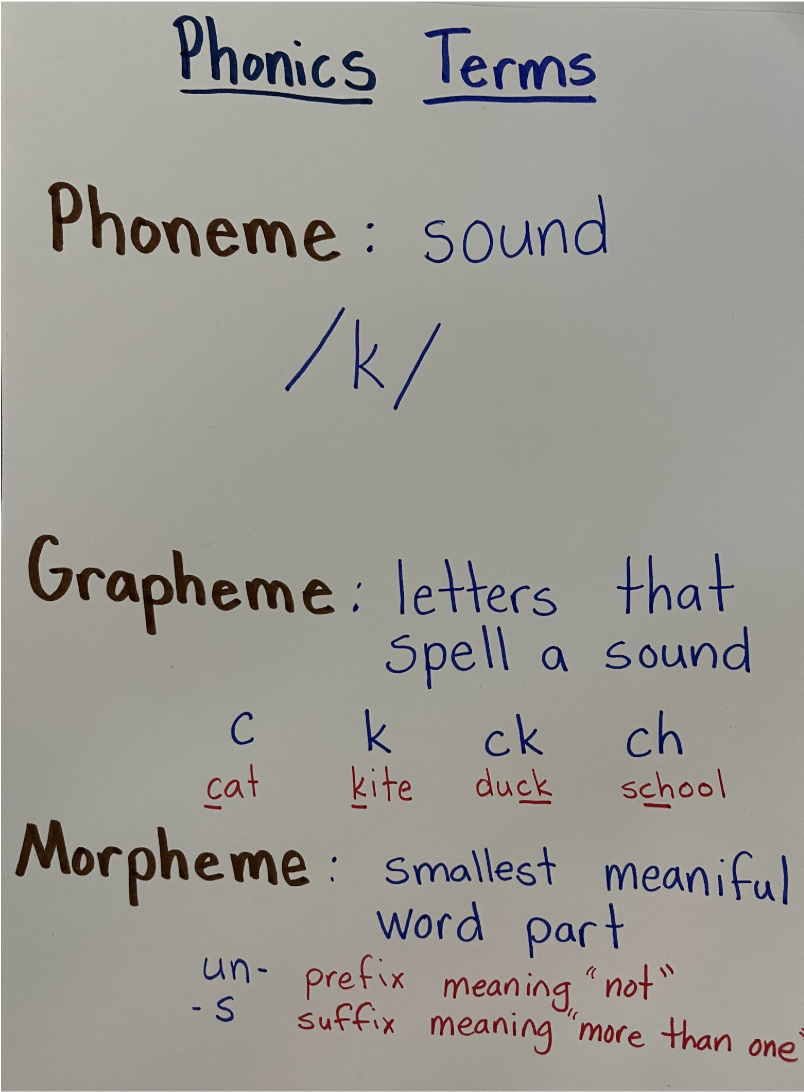
Phonics instruction is a foundational component of early reading education that emphasizes the relationship between sounds (phonemes) and their corresponding letters or letter combinations (graphemes). Through systematic and explicit instruction, children learn how to decode written language by recognizing letter-sound relationships, which is critical for reading fluency and comprehension. Effective phonics programs begin with simple sound-letter correspondences and progress to more complex patterns, ensuring that students build a strong decoding foundation. According to the National Reading Panel (2000), systematic phonics instruction significantly improves children’s reading and spelling skills, particularly in the early grades.
Phonemes, the smallest units of sound in spoken language, play a central role in phonics instruction. The English language contains approximately 44 phonemes, including consonant and vowel sounds, which can be represented by over 250 different spellings. Developing phonemic awareness, the ability to hear, identify, and manipulate these sounds, is an essential pre-reading skill that supports later phonics learning. Children who can isolate and blend phonemes are better equipped to decode unfamiliar words and develop spelling proficiency. Research by Ehri et al. (2001) emphasizes that phonemic awareness is a strong predictor of later reading success and should be explicitly taught alongside phonics.
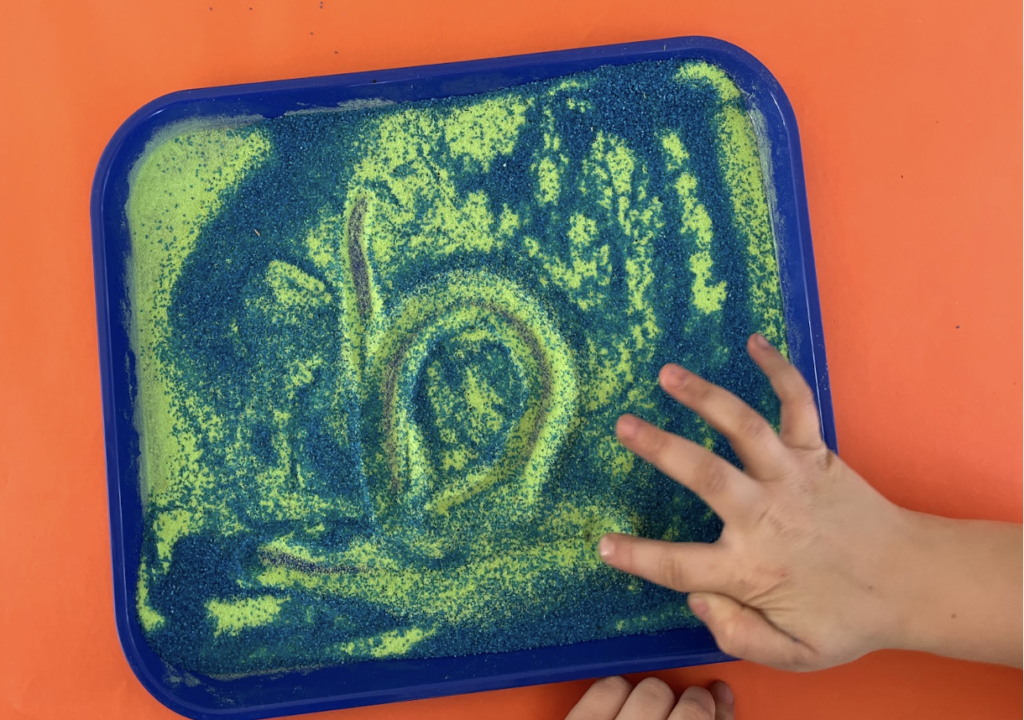
Phonics instruction also benefits from a multisensory approach that engages visual, auditory, kinesthetic, and tactile learning styles. This method helps reinforce the connection between phonemes and graphemes, making it easier for children to internalize and recall sound-letter relationships. For instance, students might trace letters in sand while saying the sound aloud or use gestures to represent sounds. Such interactive methods have been shown to improve engagement and retention in young learners (Birsh & Carreker, 2018). When phonics instruction is integrated with other literacy component, such as vocabulary, comprehension, and fluency, it forms a comprehensive reading program that supports all aspects of literacy development.
Consonant Phonemes and Common Graphemes
| Phoneme | Example Word | Common Graphemes |
|---|---|---|
| /p/ | pat | p |
| /b/ | bat | b |
| /t/ | top | t, tt, ed |
| /d/ | dog | d, dd, ed |
| /k/ | cat | c, k, ck, ch |
| /g/ | go | g, gg |
| /f/ | fan | f, ff, ph |
| /v/ | van | v, ve |
| /θ/ | thin | th |
| /ð/ | this | th |
| /s/ | sun | s, ss, c, sc |
| /z/ | zip | z, zz, s |
| /ʃ/ | ship | sh, ss, ch, ti |
| /ʒ/ | measure | s, si, z |
| /tʃ/ | chop | ch, tch |
| /dʒ/ | jump | j, g, ge, dge |
| /m/ | man | m, mm, mb |
| /n/ | nap | n, nn, kn, gn |
| /ŋ/ | ring | ng, n |
| /h/ | hat | h, wh |
| /l/ | lip | l, ll |
| /r/ | run | r, rr, wr |
| /j/ | yes | y |
| /w/ | wet | w, wh |
Vowel Phonemes and Common Graphemes
| Phoneme | Example Word | Common Graphemes |
|---|---|---|
| /æ/ | cat | a |
| /ɑː/ | father | a, ar |
| /ʌ/ | cup | u, o |
| /ɛ/ | bed | e, ea |
| /ɪ/ | sit | i, y |
| /iː/ | see | ee, ea, e, ie, y |
| /ɒ/ | hot | o |
| /ɔː/ | saw | aw, au, or, ough |
| /ʊ/ | book | u, oo |
| /uː/ | blue | oo, u, ue, ew, ou |
| /ə/ | about | a, e, o, u (unstressed vowels) |
| /eɪ/ | day | a, ai, ay, a-e, eigh |
| /aɪ/ | my | i, y, ie, igh |
| /ɔɪ/ | boy | oy, oi |
| /aʊ/ | now | ow, ou |
| /əʊ/ | go | o, oa, ow, oe |
| /ɪə/ | ear | ear, eer, ere |
| /eə/ | air | air, ear, are |
| /ʊə/ | pure | ure, our |
Morphemes
Morphemes are the smallest units of meaning in a language, playing a vital role in both vocabulary development and reading comprehension. Unlike phonemes, which are sounds, morphemes carry semantic content and can be either free (able to stand alone as words, such as “book” or “run”) or bound (must attach to other morphemes, like prefixes and suffixes such as “un-” or “-ing”). Understanding morphemes helps students decode unfamiliar words by analyzing their structure; for example, recognizing that “replay” consists of the prefix “re-” (again) and the root “play” allows learners to infer meaning. Morphological awareness supports spelling, vocabulary expansion, and reading fluency by helping students understand word patterns and relationships. Research indicates that explicit instruction in morphemes, especially affixes and roots, enhances literacy skills across grade levels (Carlisle, 2010).
| Morpheme | Type | Meaning | Example Word |
|---|---|---|---|
| un- | Prefix | not, opposite of | unhappy |
| re- | Prefix | again, back | reread |
| pre- | Prefix | before | preview |
| dis- | Prefix | not, opposite of | disconnect |
| mis- | Prefix | wrongly | misplace |
| in- | Prefix | not | incorrect |
| im- | Prefix | not | impossible |
| non- | Prefix | not | nonfiction |
| over- | Prefix | too much | overheat |
| under- | Prefix | too little, below | underfed |
| -ed | Suffix | past tense | walked |
| -ing | Suffix | present participle/ongoing action | running |
| -s/-es | Suffix | plural | books, boxes |
| -er | Suffix | one who, more (comparative) | teacher, taller |
| -est | Suffix | most (superlative) | fastest |
| -ful | Suffix | full of | hopeful |
| -less | Suffix | without | careless |
| -ness | Suffix | state or quality | kindness |
| -able/-ible | Suffix | capable of | readable, edible |
| -ly | Suffix | in the manner of | quickly |
| port | Root | carry | transport, import |
| scrib/script | Root | write | describe, manuscript |
| struct | Root | build | construct, structure |
| spect | Root | see | inspect, spectator |
| ject | Root | throw | reject, eject |
These morphemes are foundational for vocabulary development and understanding word structure, particularly in upper elementary through high school reading and writing instruction.
Examples
Following are a few common activities for learning phonics.
Word Sorts
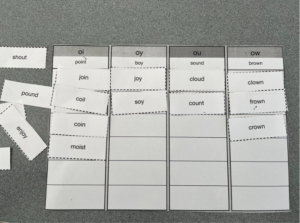 Students sort words by phonics patterns (e.g., vowel sounds, blends, digraphs), helping them visually and conceptually group similar spelling rules.
Example: Sort “cake,” “bike,” “rope” into long vowel patterns like a-e, i-e, o-e.
Phonics Scavenger Hunt
Learners search books or the classroom environment for words containing a target phonics pattern or rule.
Example: Find and list five words with the “sh” sound.
Making Words
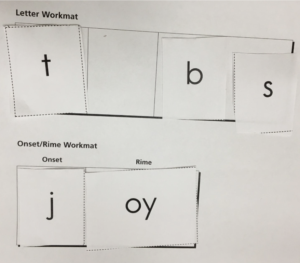
Students use magnetic letters or tiles to build words, manipulating one sound at a time to create new ones.
Example: Change “pan” → “pen” → “pet” → “net.”
Orton-Gillingham Multi-sensory
Using the Orton-Gillingham approach, students practice phonemes through multisensory techniques like tracing the phoneme in sand while saying it aloud, tapping out the letters, and writing them on a textured surface.
Example: tap sh, i, p and then write ship
Phonics Bingo
Create bingo boards with pictures or words that match phonics patterns being studied. As the teacher calls out a sound or word, students mark the correct space.
Example: Mark “snail” when /ai/ is called.
Nursery Rhymes and Poetry
Nursery rhymes and poetry promote phonemic awareness by playing with patterns of sound, such as rhyme, rhythm, and repetition. Silly songs and playful poems help children hear and highlight the beginning, middle, and ending sounds in words. Through chanting cheerful chants and repeating rhythmic rhymes, children strengthen sound skills that support successful reading.
Students sort words by phonics patterns (e.g., vowel sounds, blends, digraphs), helping them visually and conceptually group similar spelling rules.
Example: Sort “cake,” “bike,” “rope” into long vowel patterns like a-e, i-e, o-e.
Sight Words or High Frequency Words
Sight words are high-frequency words that readers are encouraged to recognize instantly without needing to decode them phonetically. These words often do not follow typical phonics rules, making them challenging for beginning readers to sound out. Mastery of sight words helps improve reading fluency and comprehension because these words appear frequently in texts and provide the foundation for smooth, automatic reading. Two of the most well-known sight word lists used in education are the Dolch Sight Word List and the Fry Word List. The Dolch list, developed by Edward Dolch in the 1930s and 1940s, contains 220 service words and 95 nouns that are commonly found in children’s reading materials. The Fry list, created by Dr. Edward Fry in the 1950s, expands on this by ranking 1,000 high-frequency words in order of difficulty and frequency of use, organized into groups of 100 words each.
While both lists serve similar purposes, they differ slightly in content and scope. The Dolch list focuses mainly on words that are not easily decodable and excludes many nouns, whereas the Fry list is more comprehensive, including both function words and a larger set of nouns. Educators often use these lists to guide instruction, emphasizing the recognition of these words to help students read more effortlessly and focus on comprehension. Incorporating sight word practice into literacy instruction supports students in developing a sight word vocabulary, which is essential for reading fluency. Research shows that repeated exposure and practice with these high-frequency words can significantly improve early reading skills and build confidence in young readers.
Examples
Following are common activities to teach sight words.
Three Period Lesson
The Montessori Three-Period Lesson is a structured teaching technique designed to help children learn new concepts, such as sight words, through clear, step-by-step instruction. In the first period, the teacher introduces the sight word by naming it and showing it to the child, creating an association between the spoken word and its written form. During the second period, the child is asked to identify or point to the sight word when named, reinforcing recognition and recall. In the third period, the child is prompted to verbally name the sight word independently, demonstrating mastery. This method supports sight word learning by breaking down the process into manageable steps that build understanding and confidence, encouraging active engagement and gradual internalization of word recognition skills essential for fluent reading.
Orton Gillingham Red Words
Orton-Gillingham Red Words are irregular sight words that do not follow standard phonetic rules and must be memorized because they cannot be easily decoded. These words, such as “said,” “was,” or “does,” are taught using multisensory strategies that engage visual, auditory, and kinesthetic learning pathways to support retention. Students might trace the word in sand, write it using large arm motions (skywriting), or tap out each letter on their fingers while saying it aloud. This multisensory repetition reinforces neural connections and helps students store these tricky words in long-term memory. Teaching Red Words this way is especially effective for students with dyslexia or other reading challenges, as it provides structured, explicit instruction that makes high-frequency, non-decodable words more accessible and automatic, improving overall reading fluency and confidence.
Bingo
Bingo is a fun and interactive way to reinforce sight word recognition and is especially effective in early literacy instruction. In a sight word bingo game, each student receives a bingo card filled with high-frequency words, and the teacher calls out sight words for students to find and mark. This activity promotes listening, word recognition, and quick recall, helping children develop automaticity with words they will encounter frequently in texts. Because it turns learning into a game, bingo boosts engagement and motivation, making repeated exposure to sight words enjoyable rather than tedious. Over time, students begin to recognize these words instantly, which supports reading fluency and overall confidence in their reading skills.
Reading Fluency
Reading fluency is the ability to read text accurately, quickly, and with appropriate expression. It serves as a crucial bridge between word recognition and reading comprehension, allowing students to focus less on decoding and more on understanding the meaning of what they read. Fluent readers read smoothly and naturally, with appropriate pauses, pitch, and tone, which contributes to better comprehension and engagement with the text. Without fluency, even strong decoders may struggle to grasp the full meaning of a passage because their cognitive energy is spent on identifying individual words.
There are several effective ways to build reading fluency in the classroom and at home. Repeated reading, where a child reads the same passage multiple times, helps improve speed and accuracy. Choral reading, where students read together with the teacher or peers, builds confidence and models fluent reading. Echo reading involves the teacher reading a sentence or passage first, followed by the student repeating it, mimicking the teacher’s pace and expression. Reader’s theater is another engaging method, allowing students to practice scripts and perform them, improving phrasing and intonation. These strategies not only improve fluency but also help students become more expressive, confident readers.
Popcorn reading, a practice where students take turns reading aloud randomly in class, is no longer widely used because it often creates anxiety, disrupts fluency, and provides limited instructional value. Many students feel nervous or embarrassed when called on unexpectedly, which can lead to reluctance or errors, especially among struggling readers. This method also results in uneven engagement, as students spend more time waiting for their turn than actively reading or listening. Additionally, popcorn reading lacks the repeated practice and modeling necessary for developing fluency and expression. Educators now favor more supportive and inclusive strategies like partner reading, echo reading, and choral reading, which promote confidence and provide consistent opportunities for all students to practice and improve their reading skills.
References
- Birsh, J. R., & Carreker, S. (2018). Multisensory teaching of basic language skills (4th ed.). Paul H. Brookes Publishing.
- Carlisle, J. F. (2010). Effects of instruction in morphological awareness on literacy achievement: An integrative review. Reading Research Quarterly, 45(4), 464–487. https://doi.org/10.1598/RRQ.45.4.5
- Dolch, E. W. (1948). Problems in reading. Bureau of Educational Research, University of Illinois.
- Ehri, L. C., Nunes, S. R., Stahl, S. A., & Willows, D. M. (2001). Systematic phonics instruction helps students learn to read: Evidence from the National Reading Panel’s meta-analysis. Review of Educational Research, 71(3), 393–447. https://doi.org/10.3102/00346543071003393
- Fry, E. (2004). The Fry instant sight words: Master list. Author.
- Gillingham, A., & Stillman, B. W. (2014). The Gillingham manual: Remedian reading, spelling, and penmanship (8th ed.). Educators Publishing Service.
- Institute for Multi-Sensory Education. (2021, July 27). How to teach Red words. IMSE Journal. https://imse.com/journal/article/wp/7672/
- Montessori, M. (1967). The discovery of the child (A. M. Joosten, Trans.). Ballantine Books. (Original work published 1909)
- National Reading Panel. (2000). Teaching children to read: An evidence-based assessment of the scientific research literature on reading and its implications for reading instruction. National Institute of Child Health and Human Development. https://www.nichd.nih.gov/sites/default/files/publications/pubs/nrp/Documents/report.pdf
Media Attributions
- Phonics © Kerry Diaz is licensed under a CC BY-NC-SA (Attribution NonCommercial ShareAlike) license
- Phonics Sensory © Kerry Diaz is licensed under a CC BY-NC-SA (Attribution NonCommercial ShareAlike) license
- Word Sorts © Kerry Diaz is licensed under a CC BY-NC-SA (Attribution NonCommercial ShareAlike) license
- Making Words © Kerry Diaz is licensed under a CC BY-NC-SA (Attribution NonCommercial ShareAlike) license