
Elementary School Math Standards and Activities
Common Core Standards in Elementary School
The Common Core State Standards for Mathematics provide a clear, consistent framework designed to build students’ conceptual understanding, procedural skill, and problem-solving abilities from elementary through high school. These standards are organized into major domains that guide mathematical learning across grade levels, including Operations and Algebraic Thinking, Number and Operations in Base Ten, Number and Operations, Fractions, Measurement and Data, and Geometry. As students progress into the upper grades, the standards expand to include more advanced domains such as Ratios and Proportional Relationships, The Number System, Expressions and Equations, Functions, and Statistics and Probability. Together, these connected domains ensure that students develop a deep, coherent understanding of mathematics that prepares them for college, careers, and real-world problem solving.
Counting and Cardinality
Counting and Cardinality is the foundational math domain for kindergarten students. It focuses on helping children develop an understanding of numbers, counting sequences, and the relationship between numbers and quantities. Students learn to count to 100 by ones and tens, recognize and write numbers, and compare quantities using terms like more, less, and equal. Cardinality is when children identify the last number counted. This early math thread sets the stage for all future number sense and operations by building a solid base in numerical literacy.
Examples
Here is a list of activities to practice counting and cardinality.
- Count
- During daily routines
- People (i.e., family members, friends, people at the park)
- Toys
- Hopscotch
- Sing songs with counting (i.e., One, Two, Buckle My Shoe”, “Five Little Monkeys”, etc.)
Operations and Algebraic Thinking
Operations and Algebraic Thinking (OA) begins in kindergarten and continues through fifth grade, gradually building children’s understanding of addition, subtraction, multiplication, and division. Students learn how to represent and solve problems using these operations, understand properties of operations, and explore patterns and relationships. By fifth grade, students begin to think algebraically, laying the groundwork for future study in algebra and more abstract mathematics.
One-to-one correspondence is the foundational math concept that each object being counted corresponds to one and only one number name. It means that as a child counts a group of items, they touch or move each object while saying one number word per item—ensuring no items are skipped or counted more than once. This skill helps children understand that numbers represent quantities and builds accuracy in counting. Mastering one-to-one correspondence is essential for future math learning, as it supports number sense, addition, subtraction, and the ability to compare groups of objects. It typically develops during early childhood through hands-on experiences and guided practice.
Examples
Here is a list of activities to practice one-to-one correspondence.
- Counting Unifix Cubes: Add one cube per count to build a staircase.
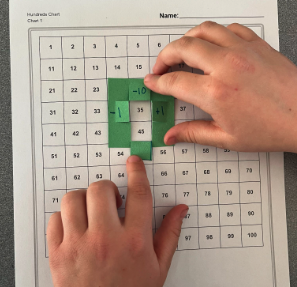
- Using a Hundred Chart: Color one square at a time as you count. The consistent structure makes it easier for children to practice counting, recognize skip-counting patterns, understand addition and subtraction, and make mental math connections like “10 more” or “1 less.” The hundred chart turns abstract number relationships into somethingchildren can see and explore.
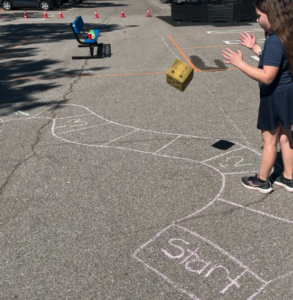
- Outdoor Board Game: Move forward one space per roll of a die or drawn card.
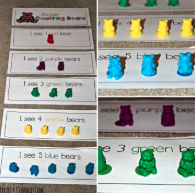
- Object Match-Up: Match one toy animal to each spot on a mat. Counting Bears are most often used but any object or toy would work.
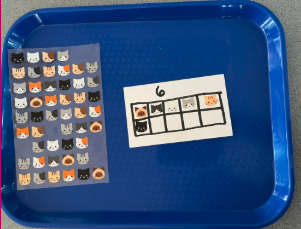
- Sticker Counting: Place one sticker in each box of a 10-frame. If a child places 9 stickers on a ten frame and notices that one box is still empty, they are building the foundation for understanding the addition fact 1 + 9 = 10 in the future.
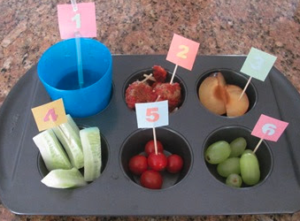
- Snack Counting: Count out one goldfish or cereal piece into each muffin tin compartment.
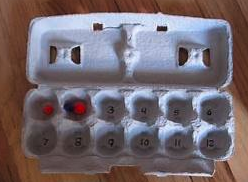
- Egg Carton Counting: Place the number of objects in each cup of the egg carton.
- Counting Songs: Songs that include acting out one object per verse.
- 5 Little Ducks
- 5 Green and Speckled Frogs
- The Ants Go Marching
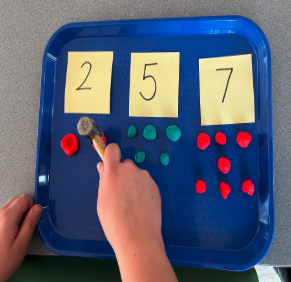
- Play Dough Smash: Smash one ball of dough for each number called out.
- Nature Count and Scavenger Hunt – Count the number of items you see on a nature walk.
Number and Operations in Base Ten
This domain spans kindergarten through fifth grade and emphasizes the place value system and operations with multi-digit whole numbers and decimals. Students start by learning to understand the place value of digits in numbers and gradually progress to fluently adding, subtracting, multiplying, and dividing large numbers. Mastery of base ten operations is essential for success in more complex mathematics, including fractions and decimals in upper elementary grades.
Understanding Place Value
Understanding and visualizing place value is essential before learning to add and subtract because it forms the foundation of how numbers work. Place value explains the true meaning of each digit in a number. For example, in the number 352, the digit 3 actually represents 300 because it is in the hundreds place. Without this understanding, students may treat each digit as a separate value, leading to confusion and errors.
Place value also supports key operations like regrouping, commonly known as carrying and borrowing. When adding 47 + 38, for instance, students need to recognize that if the ones add up to more than ten, they must carry a ten to the next place. Similarly, in subtraction problems like 52 – 37, students need to understand that borrowing one ten means converting it into ten ones. This process only makes sense if they understand that ten ones are equal to one ten.
Beyond helping with calculation procedures, place value also builds number sense. Students who understand it can estimate, compare numbers, and judge whether their answers are reasonable. For example, if a student adds 213 and 486 and gets an answer like 6,499, a strong sense of place value will alert them that the result is far too high.
Understanding place value also prepares students to work with larger numbers and decimals, since the structure of our base ten system remains consistent regardless of the size or type of number. This foundation encourages flexible thinking as well. Students who can decompose numbers, such as thinking of 46 as 40 + 6, can more easily use mental math strategies like breaking numbers apart when adding or subtracting.
In short, place value is not just another topic in the math curriculum, it is the structure that supports all numerical understanding. Without it, addition and subtraction become arbitrary rules to memorize. With it, these operations become logical and meaningful, enabling students to solve problems more effectively.
Examples
Below is a list of popular activities children participate in when learning numbers and operations by grade.
Kindergarten
Focus: Counting, number names, comparing numbers, understanding the relationship between numbers and quantities.
- Number Hunt (Counting to 20) Activity: Hide number cards (1–20) around the room. Students find and place them in order on a number line.
- Build a Number with Cubes Activity: Say a number (1–10) aloud. Students build that number using linking cubes.
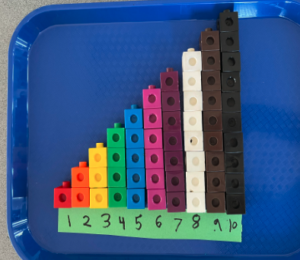
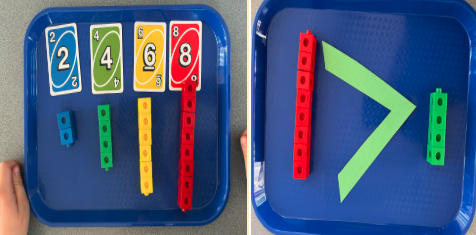
- Number Towers: Draw a card and build a tower with counting blocks. Once students master building with one card, they can compare quantities with two cards.
Grade 1
Focus: Place value (tens and ones), counting to 120, comparing two-digit numbers.
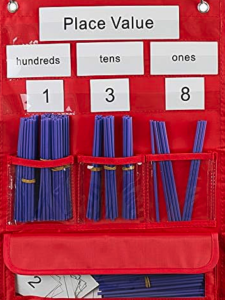
- Place Value Pockets Activity: Use a pocket chart with “tens” and “ones” columns. Place straws or sticks in bundles of 10s and singles, then write the number represented.
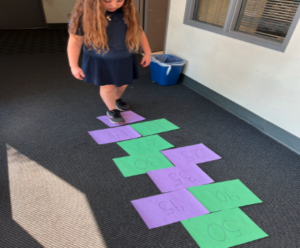
- Skip Count Hopscotch Activity: Create a hopscotch grid with skip-counting numbers. Students hop and say numbers aloud.
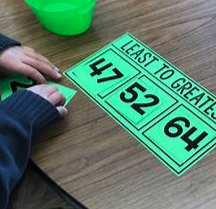
- Compare and ordering 2-digit numbers: Each student draws two or three cards, roll dice or use a spinner. Use >, <, or = symbols to compare the numbers or put the 3 numbers in order. Students can use base ten blocks for support.
Grade 2
Focus: Place value to 1,000, skip-counting, comparing numbers.
- Base Ten Block Builders Activity: Give a 3-digit number, and students build it with blocks. Then write it in expanded form.
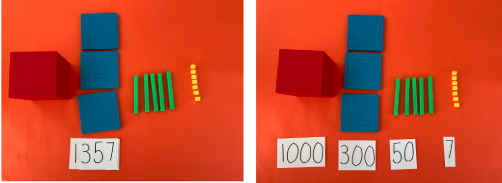
- Number Line Jump Activity: Create a large number line on the floor. Students jump in 5s or 10s from a starting point to a target number.
- Mystery NumberObjective: Understand place value. Activity: Give clues like “My number has 4 tens and 3 ones.” Students build or write the number.
Grade 3
Focus: Rounding, 3-digit addition/subtraction, understanding hundreds, tens, and ones.
- Rounding Relay: Students in teams race to a board and round a 2- or 3-digit number correctly.
- Place Value Spin and Write: Spin a ones, tens, and hundreds spinner. Build the number and write it in standard and expanded form.
- Place Value War: Students flip three digit cards and form a number. Higher number wins the round.
Grade 4
Focus: Multi-digit numbers, comparing, rounding, and place value to the millions.
- Build the Biggest Number Activity: Draw digit cards and try to build the largest number possible using all digits. Compare with peers.
- Place Value Dice Game Activity: Roll dice to create 4- to 6-digit numbers. Students write numbers in word, standard, and expanded form.
- Number Sort Given 10 different numbers (to 1,000,000), students work in groups to sort from least to greatest.
Grade 5
Focus: Place value with decimals, powers of ten, and operations with multi-digit numbers.
- Decimal War Flip cards with decimals. The player with the greater value wins.
- Powers of Ten Chart Challenge Complete a chart showing what happens when numbers are multiplied/divided by 10, 100, and 1,000.
- Decimal Place Value Mystery: Activity: Read clues like “My number has a 7 in the hundredths place and a 2 in the tenths place,” then write and explain.
Addition
Addition is one of the foundational operations in mathematics, representing the process of combining quantities to find a total. For school-age learners, addition begins with concrete experiences such as counting objects, joining groups, or using fingers, and gradually develops into more abstract thinking with numbers and symbols. Understanding addition supports number sense, problem-solving, and logical reasoning, and serves as a building block for more complex mathematical concepts such as subtraction, multiplication, and algebra. Effective instruction in addition emphasizes conceptual understanding, multiple strategies, and real-world applications to help learners make meaningful connections with numbers.
Examples
Below is a list of popular activities children participate in when learning addition by grade.
Kindergarten
- Counting Objects and Adding: Use manipulatives like unifix cubes or counters to add two groups together.
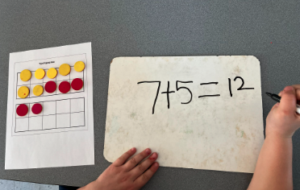
- Ten Frames: Place items in a ten frame to visualize combinations that make ten (e.g., 7 yellow dots + 5 red dots = 12).
- Number Stories: Tell simple addition stories (“I had 2 apples, and I got 3 more. How many apples do I have?”).
- Dice Addition: Roll two dice, count the dots, and find the sum.
- Outdoor Addition Hunt: Collect natural items (like leaves or rocks), group them, and add them together.
Grade 1
- Number Line Hops: Use a number line and “hop” forward to show addition.
- Addition Fact Flash Cards: Practice sums to 20 with visual flashcards.
- Missing Addends: Use manipulatives to find missing numbers in problems like 4 + ___ = 9.
- Add It Up Bingo: Play bingo where students solve an addition problem to find the correct number.
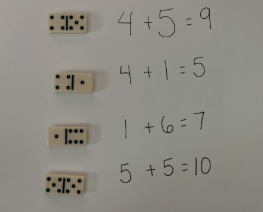
- Domino Addition: Add the two sides of a domino and write number sentences.
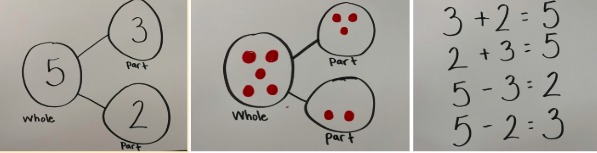
- Number bonds: Pairs of numbers that add together to make a larger, “whole” number
Grade 2
- Base Ten Block Addition: Use tens and ones blocks to add two-digit numbers.
- Regrouping Puzzles: Break apart and regroup numbers to add (e.g., 38 + 46).
- Addition War – Play with cards; each player flips two cards and adds them. Highest sum wins.
- Roll and Add Hundreds Chart: Use dice and a hundreds chart to find sums and patterns.
- Story Problem Journals: Solve and illustrate word problems involving addition.
Grade 3
- 3-Digit Addition with Regrouping: Use place value understanding to add large numbers.
- Estimation Challenges: Estimate sums before solving to build number sense.
- Add to Solve Real Problems :Solve problems involving money or measurement using addition.
- Math Board Games: Use games that require addition to advance on the board (e.g., Sum Swamp).
- Interactive Digital Games: Use apps or websites with timed addition games and challenges.
Grade 4
- Multi-Digit Addition with Decimals: Add numbers with decimals in contexts like money or measurement.
- Error Analysis: Analyze and correct mistakes in sample student addition problems.
- Create Word Problems: Students write their own multi-step word problems that involve addition.
- Mental Math Strategies: Practice adding large numbers mentally using rounding and compatible numbers.
- Addition Relay: In teams, students solve part of a problem and pass it along (e.g., add four 4-digit numbers).
Grade 5
- Add Fractions with Like/Unlike Denominators: Use visual models and LCM to add fractions.
- Adding Mixed Numbers: Practice breaking apart and recombining whole numbers and fractions.
- Decimals in Real Life: Solve multi-step problems involving adding decimals (e.g., grocery shopping).
- Number Talks: Use daily routines to discuss multiple ways to solve an addition problem.
- Math Projects: Create a class budget, meal plan, or event that involves adding real-world data.
When solving addition word problems, key words and phrases can help students identify that the operation needed is addition. Common addition clue words include “in all,” “altogether,” “total,” “combined,” “sum,” and “how many in all.” These words signal that quantities are being joined or brought together. For example, a problem that says, “Sarah has 4 apples and Tom has 5 apples. How many apples do they have in all?” clearly suggests addition. While these keywords provide helpful hints, it’s important for students to also understand the context of the problem, as relying only on keywords can sometimes be misleading. Teaching students to visualize or act out the problem and explain their reasoning reinforces a deeper understanding of when and why addition is used.
Subtraction
Subtraction is a fundamental mathematical operation that involves taking away, comparing, or finding the difference between quantities. For school-age learners, subtraction often begins with concrete experiences, such as removing objects from a group or determining how many remain. As understanding deepens, students learn to interpret subtraction in multiple ways, including “taking away,” “finding the difference,” and “missing addend” situations. Developing a strong conceptual foundation in subtraction supports number sense, flexible thinking, and problem-solving, and is closely connected to addition as its inverse operation. Effective instruction encourages the use of visual models, real-world contexts, and a variety of strategies to help learners build confidence and meaning in their mathematical thinking.
Examples
Below is a list of popular activities children participate in when learning subtraction by grade.
Kindergarten
- Take Away with Counters: Start with a set number of objects and physically remove some to see what’s left.
- Subtraction Stories with Toys: Use dolls or animals to act out simple subtraction stories.
- Ten Frame Subtraction: Fill a ten frame and remove counters to see how many remain.
- Finger Subtraction: Use fingers to model subtraction facts up to 10.
- Subtraction Song and Movement: Sing songs like “Five Little Ducks” that model subtracting one at a time.
Grade 1
- Number Line Subtraction: Jump backward on a number line to model subtraction.
- Roll and Subtract Dice Game: Roll two dice, subtract the smaller from the larger, and record the result.
- Subtraction Matching Cards: Match subtraction equations to pictorial representations or answers.
- Missing Part Problems: Use part-part-whole mats to find the missing number (e.g., 9 – ___ = 4).
- Domino Subtraction: Use the higher number on a domino and subtract the lower number.
Grade 2
- Two-Digit Subtraction with Base Ten Blocks: Use tens and ones blocks to regroup and subtract.
- Subtraction War: Each player flips two cards and subtracts. Player with the highest difference wins.
- Story Problem Journals: Write and solve subtraction word problems using pictures and numbers.
- Spin and Subtract: Spin two number wheels and subtract the smaller number from the larger.
- Balance Scale Activity: Use a balance scale to explore the concept of difference.
Grade 3
- Three-Digit Subtraction with Regrouping: Practice borrowing across zeros with place value models.
- Estimation Practice: Estimate differences before solving to build number sense.
- Subtraction Riddles: Solve subtraction problems to reveal the answer to a riddle or puzzle.
- Money Subtraction Problems: Use play money to solve change-making and purchase scenarios.
- Timed Fluency Games: Use online tools or flashcards for timed subtraction fact practice.
Grade 4
- Multi-Digit Subtraction Without Calculator: Subtract numbers into the thousands with and without regrouping.
- Error Analysis: Find and correct mistakes in subtraction problems.
- Subtraction Across Zeros: Focus on the tricky concept of regrouping when multiple zeros are present.
- Real-World Scenarios: Use subtraction to figure out how much time has passed or how far apart two locations are.
- Multi-Step Word Problems: Combine subtraction with other operations to solve complex problems.
Grade 5
- Subtracting Fractions with Like and Unlike Denominators: Use visual models and common denominators.
- Subtracting Decimals: Practice subtracting decimals in contexts like money and measurements.
- Negative Numbers Introduction: Use number lines to explore subtraction that results in negative numbers.
- Data Analysis Subtraction: Find differences between data points in graphs or charts.
- Math Projects: Use subtraction to calculate change, time passed, or remaining inventory in project-based learning.
Subtraction word problems often include specific keywords that signal the need to find the difference between amounts. Common subtraction keywords include “how many are left,” “how much more,” “how many more,” “difference,” “take away,” “less,” “fewer,” “remain,” and “subtract.” For example, a question like, “If John had 12 marbles and gave away 5, how many does he have left?” uses the phrase “gave away” to indicate subtraction. It’s important to note that students should not rely solely on keywords, as context matters—some phrases like “how many more” might suggest subtraction in a comparison, while in other cases, addition may be appropriate. Encouraging students to model the situation and think about what is actually happening helps develop deeper mathematical reasoning.
Multiplication
Multiplication is a fundamental mathematical operation that represents repeated addition and the combination of equal groups. For school-age learners, multiplication begins with concrete experiences, such as grouping objects, creating arrays, and recognizing patterns. As students develop their understanding, they learn to use multiplication to describe situations involving equal groups, scaling, and comparison. Building a strong conceptual foundation in multiplication supports number sense, efficiency in computation, and problem-solving, and prepares learners for more advanced concepts such as division, fractions, and algebra. Effective instruction emphasizes visual models, real-world applications, and flexible strategies to help students develop both understanding and fluency.
Examples
Below is a list of popular activities children participate in when learning multiplication by grade. This is a concept that is not introduced until the third grade.
Grade 3
- Array Building with Objects: Use counters or tiles to build arrays (e.g., 3 rows of 4 counters).
- Skip Counting Games: Practice skip counting with songs or movement (e.g., skip count by 6s using a jump rope).
- Multiplication Bingo: Match products to multiplication problems on a game board.
- Equal Groups with Manipulatives: Group objects and write multiplication sentences to match (e.g., 4 groups of 5).
- Fact Family Triangles: Use triangle flashcards to explore the relationship between multiplication and division.
Grade 4
- Area Model Practice: Break apart numbers using the area (box) method to solve 2-digit × 2-digit problems.
- Multiplication War with Cards: Flip two cards and multiply; highest product wins.
- Estimation Rounding Challenge: Round factors to estimate the product before solving.
- Real-World Word Problems: Solve problems involving equal groups, area, and multi-step multiplication.
- Interactive Multiplication Apps: Use digital games to reinforce facts and problem-solving with immediate feedback.
Grade 5
- Multiplying Decimals: Use place value understanding and visual models to multiply decimals (e.g., 0.3 × 0.6).
- Multi-Digit Long Multiplication: Practice multi-step multiplication with larger numbers (e.g., 3-digit × 2-digit).
- Project-Based Math (e.g., Planning a Party): Calculate total cost by multiplying quantities and prices.
- Pattern Investigation: Explore number patterns in multiples, such as the pattern in multiples of 9.
- Multiplication Races: Solve a series of problems in a relay team format to build speed and fluency.
In multiplication word problems, certain keywords and phrases often signal that multiplication is the operation needed. These include “each,” “every,” “times,” “in all,” “total,” “product,” “rows of,” “groups of,” and “altogether.” For example, the question “There are 6 baskets with 4 apples in each basket. How many apples are there in all?” suggests multiplication because of the structure of equal groups. While these keywords can be helpful clues, it’s crucial for students to consider the context of the problem. Teaching them to visualize or draw models like arrays or bar diagrams encourages understanding over memorization of keywords, supporting stronger problem-solving skills.
Division
Division is a fundamental mathematical operation that involves separating a quantity into equal parts or determining how many groups can be made from a set. For school-age learners, division often begins with concrete experiences, such as sharing objects fairly or grouping items into equal sets. As understanding develops, students learn to interpret division in multiple ways, including partitive (sharing) and quotative (grouping) situations. Division is closely connected to multiplication as its inverse operation, and together they support deeper number sense and problem-solving. Effective instruction emphasizes visual models, real-world contexts, and a variety of strategies to help learners build both conceptual understanding and computational fluency.
Examples
Below is a list of popular activities children participate in when learning division by grade. This is a concept that is not introduced until the third grade.
Grade 3
- Equal Sharing with Counters: Use real objects to divide into equal groups and write matching division equations.
- Array and Area Models: Build arrays to represent division facts and understand the relationship to multiplication.
- Division Fact Dominoes: Match division problems with their quotients using domino-style cards.
- Skip Counting Backward: Practice skip counting in reverse to help understand division as repeated subtraction.
- Division Stories: Create and solve word problems involving sharing or grouping.
Grade 4
- Base Ten Block Division: Use place value blocks to divide larger numbers with regrouping.
- Partial Quotients Method: Solve division problems by subtracting multiples of the divisor in steps.
- Division War with Cards: Flip two cards and divide the larger by the smaller; highest quotient wins.
- Estimate and Check: Estimate a quotient, then solve and check using multiplication.
- Division Puzzles: Fill in missing numbers in division fact families or complete number mazes.
Grade 5
- Long Division Practice: Solve multi-digit division problems with and without remainders.
- Divide Decimals: Use place value and grid models to divide decimals by whole numbers.
- Real-World Problem Solving: Solve multi-step word problems involving sharing quantities, rates, or measurement.
- Division Games Online: Use interactive apps to reinforce division fluency and strategy.
- Math Scenarios (e.g., Budgeting or Packing): Plan real-life situations like dividing items evenly into containers or splitting bills.
Division word problems often include clue words that indicate the need to separate, share, or distribute a quantity. Common division keywords include “each,” “shared equally,” “split,” “per,” “divided by,” “quotient,” “average,” and “how many in each.” For example, a problem that says, “24 cookies are shared equally among 6 friends. How many cookies does each friend get?” clearly suggests division. However, while keywords are useful signals, it’s important for students to analyze the situation to understand what is being asked—particularly when problems involve remainders or require interpreting what the quotient means in context. Visual models like bar diagrams or grouping objects help students grasp the concept of division beyond relying only on keywords.
Number and Operations with Fractions
Fractions are in important extension of number understanding, helping students make sense of quantities that are not whole. As students develop their, their understanding of fractions grows from concrete, visual experiences to more abstract reasoning and problem solving.
In early elementary (K-2), students begin building the foundations of fractional thinking through everyday experiences. They explore concepts such as sharing equally, recognizing parts of a whoe, and using informal language like “half” and “whole”. Learners may divide objects or shapes into equal parts and begin to understand that these parts must be equal in size. At this stage, the focus is on hands-on activities, visual models, and real-life contexts rather than formal notation.
In grades 3-5, students deepen and formalize their understanding of fractions. They learn to represent fractions using numbers and symbols, identify numerators and denominators, and place fractions on a number line. Students compare and order fractions, explore equivalent fractions, and begin performing operations such as addition and subtraction with like denominators, progressing to more complex fraction operations.
Across both stages, effective learning supports a progression from concrete to abstract thinking, helping students build a strong, connected understanding of fractions that prepares them for more advanced mathematics.
Examples
Below is a list of popular activities children participate in when learning fractions by grade.
Kindergarten – Grade 1
- Fair Share with Snacks: Divide cookies, crackers, or fruit slices equally among a group.
- Paper Folding: Fold paper to show halves and fourths, then label each part.
- Shape Sorting: Identify shapes that are split into equal parts versus unequal parts.
- Color the Fraction: Shade half or a quarter of shapes on worksheets.
Grade 2
- Fraction Pizza Craft: Create a paper pizza and divide it into equal slices (halves, thirds, fourths).
- Real-World Fractions: Identify fractions in everyday contexts like clocks, sandwiches, or measuring cups.
- Equal Parts Matching: Match pictures of shapes with written fractions (e.g., ½, ¼).
- Sharing Problems: Use story problems to divide items equally (e.g., 4 children share 2 apples).
- Fraction Towers: Build towers with colored cubes representing fractions (e.g., 3 out of 6 = ½).
Grade 3
- Number Line Fractions: Place fractions on a number line to show their value relative to whole numbers.
- Equivalent Fractions with Visuals: Use fraction bars or circles to find and compare equivalent fractions.
- Fraction Bingo: Match visual models and written fractions on a game board.
- Paper Plate Fractions: Cut and label paper plates into halves, thirds, fourths, etc.
- Sorting Fractions: Compare and sort fractions using fraction strips or interactive tools.
Grade 4
- Add and Subtract Fractions (Same Denominator): Use fraction strips or drawings to practice.
- Fraction Art: Create designs using fractions of colored shapes (e.g., ¼ red, ½ blue).
- Build Equivalent Fractions with Multiplication: Multiply numerator and denominator to find equivalents.
- Recipe Math: Use recipes to double or halve ingredients and work with real-life fractions.
- Fraction Word Problems: Solve one-step problems involving part of a whole or comparison.
Grade 5
- Add/Subtract Unlike Denominators: Use visual models and least common denominators.
- Multiply Fractions: Apply area models to multiply fractions by fractions or whole numbers.
- Divide Fractions: Use visual models or story problems to interpret division of fractions.
- Line Plot Graphing: Collect data and graph fractional measurements on line plots.
- Project-Based Learning: Plan an event or garden with fractional space, portions, or costs.
In fraction word problems, key words and phrases help students recognize that they are working with parts of a whole or parts of a group. Common keywords include “half,” “third,” “fourth,” “quarter,” “part of,” “shared equally,” “per piece,” “fraction of,” “split,” and “divide into equal parts.” For example, a problem that says, “Lena ate ¼ of the pizza” clearly signals a fraction is involved. When problems ask for a “fraction of a group,” such as “What is ⅓ of 12 students?” students should know this means division into equal parts. While keywords are helpful, understanding the context is crucial—students should visualize or model the situation to interpret the meaning of the fraction and ensure they apply the correct operation.
Measurement and Data
Measurement and Data is covered from kindergarten through fifth grade and includes skills such as telling time, measuring length, understanding volume and mass, and interpreting data through graphs and charts. Students learn to collect and represent data, solve problems involving measurement, and understand the attributes of different units. These skills connect math to real-world contexts and prepare students for data interpretation in later grades.
Examples
Below is a list of popular activities children participate in when learning measurement by grade.
Kindergarten
- Compare and Order Objects: Use terms like taller, shorter, heavier, and lighter.
- Nonstandard Measurement: Measure items using paperclips, blocks, or hands.
- Classroom Object Hunt: Find and sort objects by size, length, or weight.
- Measure with String: Use string to compare lengths of objects and match them.
- Graphing Favorites: Create simple bar graphs from class surveys (e.g., favorite fruit or color).
Grade 1
- Measure with Rulers: Use inch or centimeter rulers to measure classroom objects.
- Compare Lengths: Solve problems about how much longer or shorter one object is than another.
- Picture Graphs: Represent data using picture symbols to answer questions.
- Create a Class Tally Chart: Count and tally data from a classroom vote.
- Measuring Jumps or Steps: Use measuring tapes to record and compare distances.
Grade 2
- Measure with Standard Tools: Use rulers, yardsticks, and measuring tapes to measure in inches, feet, and centimeters.
- Line Plots: Collect measurement data (e.g., pencil lengths) and graph it on a line plot.
- Tell and Write Time: Use analog and digital clocks to tell time to the nearest 5 minutes.
- Estimate and Measure: Practice estimating length, then measure to check.
- Bar Graphs and Picture Graphs: Interpret and create graphs to answer questions using scaled data.
Grade 3
- Elapsed Time Word Problems: Solve problems involving start and end times.
- Mass and Volume Activities: Measure and compare the mass of objects and volume of liquids using grams, kilograms, and liters.
- Measure Perimeter: Use rulers or string to measure and calculate the perimeter of shapes.
- Create and Analyze Bar Graphs: Use class-collected data to create scaled bar graphs.
- Line Plot with Fractions: Record and interpret data on a line plot using fractions.
Grade 4
- Convert Units: Practice converting within measurement systems (e.g., inches to feet).
- Area and Perimeter Challenges: Solve real-world problems involving area and perimeter.
- Measure Angles: Use protractors to measure and classify angles.
- Line Plot Problems: Solve multi-step problems involving data on a line plot.
- Time Conversion Activities: Convert between hours, minutes, and seconds in word problems.
Grade 5
- Volume Exploration: Use unit cubes and formulas to find the volume of rectangular prisms.
- Complex Line Plots: Interpret data involving measurements in fractions.
- Multi-Step Graphing Tasks: Create and analyze data from surveys or experiments.
- Convert Customary and Metric Units: Solve problems requiring conversion between units.
- Real-Life Data Projects: Plan projects like creating a budget or tracking weather data over time.
Measurement and data word problems often include specific vocabulary that signals the need to measure, compare, convert, or analyze data. Common key words include “how much longer,” “how much more,” “difference,” “total length,” “distance,” “weight,” “capacity,” “volume,” “area,” “perimeter,” “elapsed time,” “data,” “graph,” and “measure.” For example, a question like “How much more does the watermelon weigh than the cantaloupe?” points to subtraction in a weight comparison. When students see phrases like “how many in all” in graphing problems, they know to find the total. Teaching students to recognize and interpret these key terms—alongside visual representations like rulers, clocks, graphs, or line plots—helps them better understand the context and operations involved in solving measurement and data problems.
Standard measurement, also known as the customary system, is the system of measurement primarily used in the United States and includes units such as inches, feet, pounds, and gallons. The metric system, used by most other countries and in scientific contexts worldwide, is based on units of ten, such as meters, grams, and liters. Understanding both systems is important for U.S. students because they encounter standard units in everyday life—like measuring ingredients or reading road signs—while the metric system is essential for science, international communication, and global careers. Learning both systems not only enhances mathematical flexibility and real-world readiness but also prepares students to work in diverse fields that require conversions and understanding of multiple measurement standards.
Geometry
Geometry spans from kindergarten through eighth grade, starting with basic shape recognition and moving toward understanding geometric attributes, properties, and the relationships between shapes. Younger students learn about two- and three-dimensional shapes, while older students explore area, volume, angles, congruence, and transformations. By middle school, students apply coordinate geometry and use geometric reasoning to solve complex problems.
Examples
Below is a list of popular activities children participate in when learning geometric shapes and attributes by grade.
Kindergarten
- Shape Hunt: Search the classroom or playground for circles, squares, triangles, etc.
- Pattern Block Pictures: Create animals or designs using pattern blocks and identify the shapes used.
- Sort and Classify Shapes : Group shapes by attributes such as size, number of sides, or whether they roll or stack.
- Build with 3D Shapes:Use building blocks or recycled materials to create structures with cubes, cones, and cylinders.
- Shape Songs and Movement: Sing songs about shapes and act them out with body movements.
Grade 1
- Shape Puzzles: Put together shapes to form new composite shapes and identify the parts.
- Geoboard Creations: Use rubber bands on geoboards to create 2D shapes and describe their attributes.
- Shape Collage: Cut and glue shapes from paper to create pictures, then name and count the shapes used.
- Attribute Games: Play games where students guess a shape based on clues (e.g., “I have 4 sides, but they are not all the same”).
- Symmetry Painting: Fold paper and paint on one side to explore symmetry.
Grade 2
- Partition Shapes: Divide shapes into halves, thirds, and fourths using drawings or paper folding.
- Shape Attribute Sorting: Sort shapes based on number of sides, vertices, or angles.
- Tangram Challenges: Use tangram pieces to build pictures and discuss the geometry involved.
- Geoboard Fractions: Represent fractional parts of a shape using geoboards.
- Draw and Label Polygons: Practice drawing and naming regular and irregular polygons.
Grade 3
- Angle Hunt: Look around the room for examples of right, acute, and obtuse angles.
- Polygon Sorting: Sort quadrilaterals, triangles, and other polygons by properties.
- Area with Square Tiles: Cover shapes with square tiles to find area and count square units.
- Perimeter Games: Use string or rulers to measure and compare the perimeters of various shapes.
- Shape Transformation Activities: Use paper folding or drawing to explore flips, turns, and slides.
Grade 4
- Classify Quadrilaterals: Explore the differences between trapezoids, rectangles, rhombuses, and squares.
- Lines and Angles: Identify and classify lines (parallel, perpendicular) and angles using rulers and protractors.
- Area and Perimeter Word Problems: Solve real-world problems involving rectangles and composite figures.
- Symmetry Scavenger Hunt: Search for symmetrical objects in the classroom or outside.
- Create and Analyze Patterns: Explore repeating and growing geometric patterns.
Grade 5
- Volume with Unit Cubes: Use cubes to build rectangular prisms and calculate volume.
- Coordinate Grid Games: Plot points, shapes, and paths on a coordinate plane.
- Classify 3D Shapes: Explore properties of three-dimensional figures (edges, vertices, faces).
- Decompose Shapes: Break down complex figures into known shapes to find area or volume.
- Geometry Art Projects: Create tessellations or geometric mosaics using specific rules.
Geometry word problems often include specific vocabulary that signals the type of concept being used, such as shape attributes, spatial relationships, or measurements of space.
Common key words include
- Sides
- Vertices
- Angles
- Edges
- Faces
- Area
- Perimeter
- Length
- Width
- Height
- Volume
- Symmetry
- Parallel
- Perpendicular
- Right angle
- Coordinate plane.
Phrases like “how much space does it cover” point to area, while “how far around” refers to perimeter. Geometry problems may also include words like “turn,” “slide,” or “flip,” signaling transformations. Understanding these terms helps students visualize and solve problems more effectively, especially when paired with hands-on tools or visual models like drawings, grids, and manipulatives.
References
- California Department of Education (CDE). (2013). California Common Core State Standards for Mathematics. https://www.cde.ca.gov/re/cc/
- Kerry Diaz. (2026). April 1, 2026. [Video]. YouTube. https://youtu.be/8RF9jhILtHY?si=9-YZjWImxydr2OrZ
- Kerry Diaz. (2026). April 2, 2026. [Video]. YouTube. https://youtube.com/shorts/QZI8Zevpq0E?si=nlwSa0denR265TD4
- National Governors Association Center for Best Practices & Council of Chief State School Officers. (2010). Common Core State Standards for Mathematics. Washington, DC: National Governors Association Center for Best Practices & Council of Chief State School Officers.
- Sambou, M. A., Nalukyamuzi, N., & Geyang, Z. (2026). Strategies for culturally responsive mathematics teaching: Secondary school teachers’ perspectives and experiences. International Journal of Studies in Education and Science (IJSES), 7(2), 167-187. https://doi.org/10.46328/ijses.5880
Media Attributions
- 100 chart © Kerry Diaz is licensed under a CC BY-NC-SA (Attribution NonCommercial ShareAlike) license
- Dice Hopscotch © Kerry Diaz is licensed under a CC BY-NC-SA (Attribution NonCommercial ShareAlike) license
- Matching bears © Kerry Diaz is licensed under a CC BY-NC-SA (Attribution NonCommercial ShareAlike) license
- Sticker Count © Kerry Diaz is licensed under a CC BY-NC-SA (Attribution NonCommercial ShareAlike) license
- Snack count © Kerry Diaz is licensed under a CC BY-NC-SA (Attribution NonCommercial ShareAlike) license
- Egg carton count © Kerry Diaz is licensed under a CC BY-NC-SA (Attribution NonCommercial ShareAlike) license
- Smash number © Kerry Diaz is licensed under a CC BY-NC-SA (Attribution NonCommercial ShareAlike) license
- Unifix © Kerry Diaz is licensed under a CC BY-NC-SA (Attribution NonCommercial ShareAlike) license
- Unifix place value © Kerry Diaz is licensed under a CC BY-NC-SA (Attribution NonCommercial ShareAlike) license
- Pocket Place Value © Kerry Diaz is licensed under a CC BY-NC-SA (Attribution NonCommercial ShareAlike) license
- Skip counting hopscotch © Kerry Diaz is licensed under a CC BY-NC-SA (Attribution NonCommercial ShareAlike) license
- least to greatest © Kerry Diaz is licensed under a CC BY-NC-SA (Attribution NonCommercial ShareAlike) license
- Place value breakdown © Kerry Diaz is licensed under a CC BY-NC-SA (Attribution NonCommercial ShareAlike) license
- Counter Math © Kerry Diaz is licensed under a CC BY-NC-SA (Attribution NonCommercial ShareAlike) license
- Domino Math © Kerry Diaz is licensed under a CC BY-NC-SA (Attribution NonCommercial ShareAlike) license
- Whole Parts © Kerry Diaz is licensed under a CC BY-NC-SA (Attribution NonCommercial ShareAlike) license