
Art Principles
Process vs Product Art
Understanding Process Art
Process art focuses on the experience of creating rather than the final outcome. In elementary classrooms, this approach encourages children to explore materials, express themselves freely, and make choices throughout the art-making process. There are no “right” or “wrong” results in process art; instead, the emphasis is on creativity, experimentation, and personal expression. This kind of art helps build confidence, problem-solving skills, and joy in discovery as students paint, sculpt, draw, and design with curiosity and imagination.
Understanding Product Art
Product art, on the other hand, is centered around creating a specific end result, often guided by teacher instructions or visual examples. Students may be expected to follow steps or use particular colors and shapes to make their artwork match a model. While this can teach important skills such as following directions, fine motor development, and exposure to techniques, it can also limit creativity if overly rigid. Product art is often used for display or to practice a skill, and may lead to beautiful outcomes but not always deep engagement in the creative process.
Balancing Both in the Classroom
In an effective elementary art program, both process and product art have value and can complement each other. Process art supports self-expression and developmental growth, while product art can introduce structure, technique, and goal-setting. Teachers can provide open-ended materials and time for exploration, while also guiding students through projects that build specific skills. By balancing both approaches, educators foster a classroom environment where creativity thrives and artistic learning is both joyful and meaningful.
Standards and Activities
The California Arts Standards provide a comprehensive framework for developing students’ artistic literacy across multiple disciplines, including visual arts, performing arts, dance, music, and digital arts. These standards emphasize creativity, expression, and cultural understanding by encouraging students to create, perform, respond, and connect through various artistic forms. In visual and digital arts, students explore design, media, and technology to communicate ideas and emotions. In dance and performing arts, they develop physical expression, collaboration, and storytelling skills. Music education fosters listening, performance, composition, and appreciation of diverse cultures and traditions. Together, the California Arts Standards cultivate well-rounded learners who can think critically, innovate, and engage meaningfully with the world through art.
Visual Arts
Visual arts standards aim to build visual literacy, technical skill, and critical reflection. Throughout the artistic processes, students create by exploring materials and ideas, present by preparing artworks for display, respond by perceiving and evaluating visual works, and connect by linking art to history, culture, and personal experience
Arts integration provides a dynamic and engaging approach to teaching by merging artistic expression with core academic content. This section will explore strategies for implementing arts integration in various forms—visual arts, music, drama, and creative writing—while focusing on their role in enhancing the cognitive and social development of school-age children.
Drawing, Painting, and Sculpture in the Classroom
The integration of visual arts, such as drawing, painting, and sculpture, plays an essential role in developing students’ creativity, problem-solving, and fine motor skills. Visual arts activities provide children with hands-on opportunities to explore materials, techniques, and concepts, offering a deeper connection to content learned in subjects like science, history, and literature. For example, students might create drawings of the water cycle to reinforce their understanding of the scientific process, or use painting to represent historical events and figures (Zhou & Brown, 2021). These activities also enhance spatial reasoning, which can be particularly helpful in subjects like mathematics.
Elements of Art
The elements of art are the basic components artists use to create visual works. They help students and viewers understand, analyze, and create art. The seven elements of art are:
- Line: A continuous mark that can vary in length, width, direction, and movement. Lines can be straight, curved, thick, thin, or implied.
- Shape: A flat, enclosed area created by lines or color changes. Shapes are two-dimensional and can be geometric (squares, circles) or organic (freeform, natural).
- Form: A three-dimensional object or the illusion of three dimensions in a work of art. Forms include cubes, spheres, and cylinders.
- Color: The visual perception of light reflected off objects. It includes hue (name), value (lightness/darkness), and intensity (brightness/dullness).
- Value: The lightness or darkness of a color or tone. Value helps create contrast and depth in art.
- Texture: How a surface feels or appears to feel. Texture can be actual (felt by touch) or implied (suggested visually).
- Space: The area around, between, or within objects. Space can be positive (filled) or negative (empty), and it creates depth or perspective.
Materials for Art Projects
Using a variety of materials in visual art is important because it encourages creativity, experimentation, and hands-on learning. Different tools and textures allow children to explore new techniques, express their ideas in diverse ways, and develop fine motor skills. By working with paint, clay, paper, fabric, and recycled objects, students gain a deeper understanding of artistic concepts such as color, shape, texture, and form. Exposure to a wide range of materials also fosters problem-solving, builds confidence, and keeps students engaged and excited about the creative process.
- Crayons: Great for layering color and texture.
Markers: Bright, bold colors for drawing and outlining. - Colored pencils: Ideal for detailed work and shading.
- Tempera paint: Washable and perfect for brush painting.
Watercolor paint: Light, blendable, and good for experimenting with transparency. - Oil pastels: Smooth, vibrant, and blendable for expressive work.
- Chalk pastels: Soft and powdery, good for smudging and shading.
- Construction paper: Colorful paper for cutting, tearing, and layering.
Tissue paper: Thin and translucent, great for collages and texture.
Glue sticks and liquid glue: For assembling collages and 3D projects. - Scissors: For cutting shapes, lines, and textures.
- Modeling clay or playdough: For hands-on sculpting and 3D art.
- Craft sticks (popsicle sticks): For building structures or creating puppets.
- Yarn and string: Used in weaving, collage, or mixed media projects.
- Recycled materials (e.g., cardboard, bottle caps, fabric scraps) – Encourages creative reuse and innovation.
Examples
Following are common activities to engage children in creative experiences.
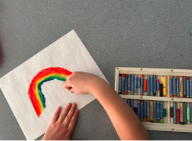
Crayon Resist Painting: Drawing with crayons and then painting over with watercolor to reveal hidden designs.
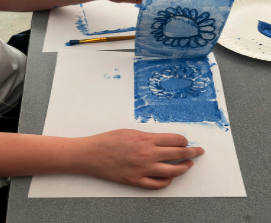
 Printing: Creating repeated patterns or images using stamps, blocks, or found objects. Children can draw on foam pieces to create printing.
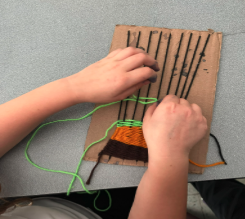
 Weaving: Interlacing paper strips, yarn, or fabric to make textured designs.
 Pot Making: Shaping clay into pots or containers through hand-building techniques.
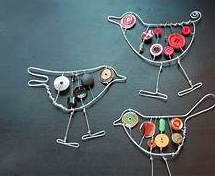
Wire Sculptures: Bending and twisting wire to create three-dimensional forms.
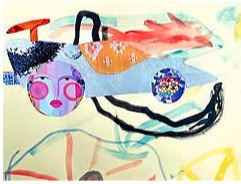
Collage: Gluing various materials like paper, fabric, and photos onto a surface to create a composition.
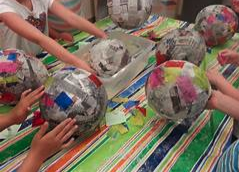
Paper Maché: Layering paper strips with adhesive, usually flour and water, to build sculptures or masks.
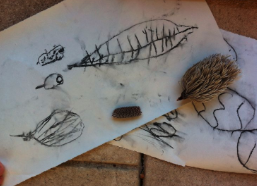
Drawing and Sketching: Using pencils, charcoal, or markers to create images on paper.
Stages of Drawing
Exercises
Please take a moment to watch the following video on Lowenfeld’s four stages of artistic development. Take notice of each stage and when they typically occur. This will help in designing.
The stages of drawing, as described by art educators like Viktor Lowenfeld and Betty Edwards, outline how children’s artistic abilities develop naturally over time through experience and practice. Lowenfeld, through extensive observation and study of children’s artwork, identified stages such as scribbling, preschematic, schematic, and realistic, showing how children progress from random marks to detailed and proportionate drawings. Betty Edwards built on this by emphasizing that drawing is a learned skill tied closely to how we see; she demonstrated through her teaching and research that with proper guidance and practice, anyone can develop the ability to draw realistically.
Both Lowenfeld and Edwards concluded that children need rich, varied art experiences to move through these stages effectively. Lowenfeld’s work showed that as children experiment with materials and receive encouragement, their fine motor skills, perception, and creativity grow. Edwards highlighted that developing drawing skills involves training the brain to observe accurately and translate that vision onto paper. Therefore, providing children with diverse art opportunities not only nurtures their creativity but also supports the essential perceptual and motor development necessary for advancing from simple scribbles to sophisticated, realistic art. Without these experiences, children may struggle to reach their full artistic potential.
Cross-Curricular Connections
Visual arts provide an ideal medium for making cross-curricular connections. A lesson about the Civil War can be enhanced by students creating period-appropriate artwork or sculpture to explore the experiences of different groups during the time period. Similarly, a unit on ecosystems could be supplemented with a drawing or sculpture activity in which students represent different habitats. By connecting art to other subjects, teachers can foster more comprehensive learning experiences and give students multiple avenues to engage with content (Zhou & Brown, 2021).
References
- California Department of Education. (2023). Visual and Performing Arts Standards. https://www.cde.ca.gov/ci/cr/vapa/
- Edwards, B. (1979). Drawing on the Right Side of the Brain. TarcherPerigee.
- Elizabeth Phillips. (2020). The Four Stages of Artistic Development. [Video]. YouTube. https://youtu.be/pIlnPvBhPMg?si=FO5uug4CGEFSVOzQ
- Lowenfeld, V., & Brittain, W. L. (1987). Creative and Mental Growth (8th ed.). Prentice Hall.
- National Association for the Education of Young Children (NAEYC). (2020). Creative expression and arts integration. https://www.naeyc.org/
- Zhou, W., & Brown, S. (2021). Arts integration in elementary curriculum (2nd ed.). Pearson.
Media Attributions
- Crayon Resist © Kerry Diaz is licensed under a CC BY-NC-SA (Attribution NonCommercial ShareAlike) license
- Paint Transfer © Kerry Diaz is licensed under a CC BY-NC-SA (Attribution NonCommercial ShareAlike) license
- Weaving © Kerry Diaz is licensed under a CC BY-NC-SA (Attribution NonCommercial ShareAlike) license
- Wire Birds © Kerry Diaz is licensed under a CC BY-NC-SA (Attribution NonCommercial ShareAlike) license
- Collage © Kerry Diaz is licensed under a CC BY-NC-SA (Attribution NonCommercial ShareAlike) license
- Paper Mache © Kerry Diaz is licensed under a CC BY-NC-SA (Attribution NonCommercial ShareAlike) license
- Sketch © Kerry Diaz is licensed under a CC BY-NC-SA (Attribution NonCommercial ShareAlike) license