
Chapter Overview and Introduction
Art historians divide Ancient Greek history into periods that correspond to stylistic qualities. There are four general periods of Ancient Greek history: Geometric, Archaic, Classical, and Hellenistic. After the fall of the Myceneans, Ancient Greece entered its dark ages. During the early Geometric period, the production of pottery signaled a re-emergence of culture and a revitalization of artistry. In the following Archaic period, Ancient Greek art focused on two forms: pottery and sculpture. Multiple techniques were used to shape and paint vases in Ancient Greece. Sculptural forms focused on the Kouros and Kore, providing a glimpse of the Greek attitude toward the human body.
Focus Artworks
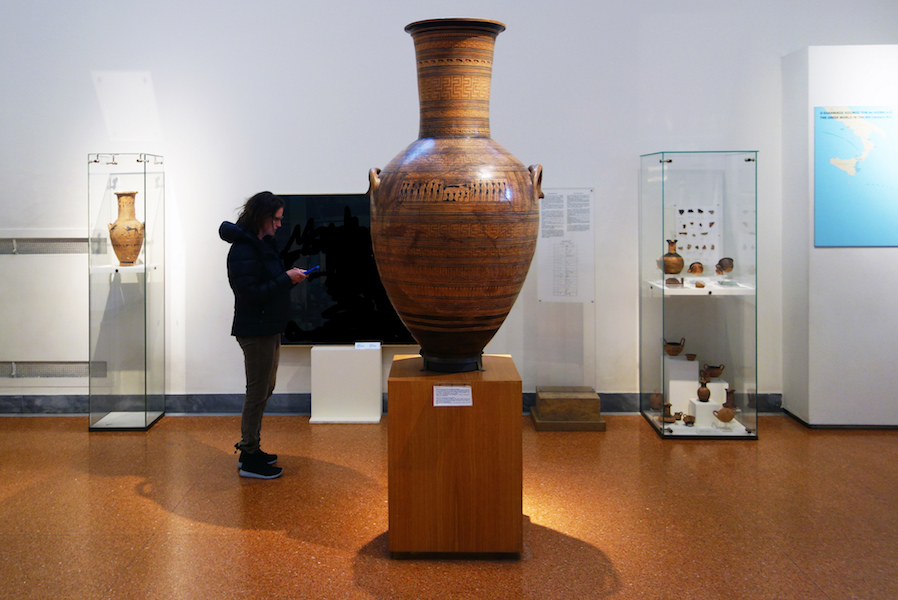
- Dipylon Amphora, c. 755–750 B.C.E., ceramic, 160 cm, Geometric period
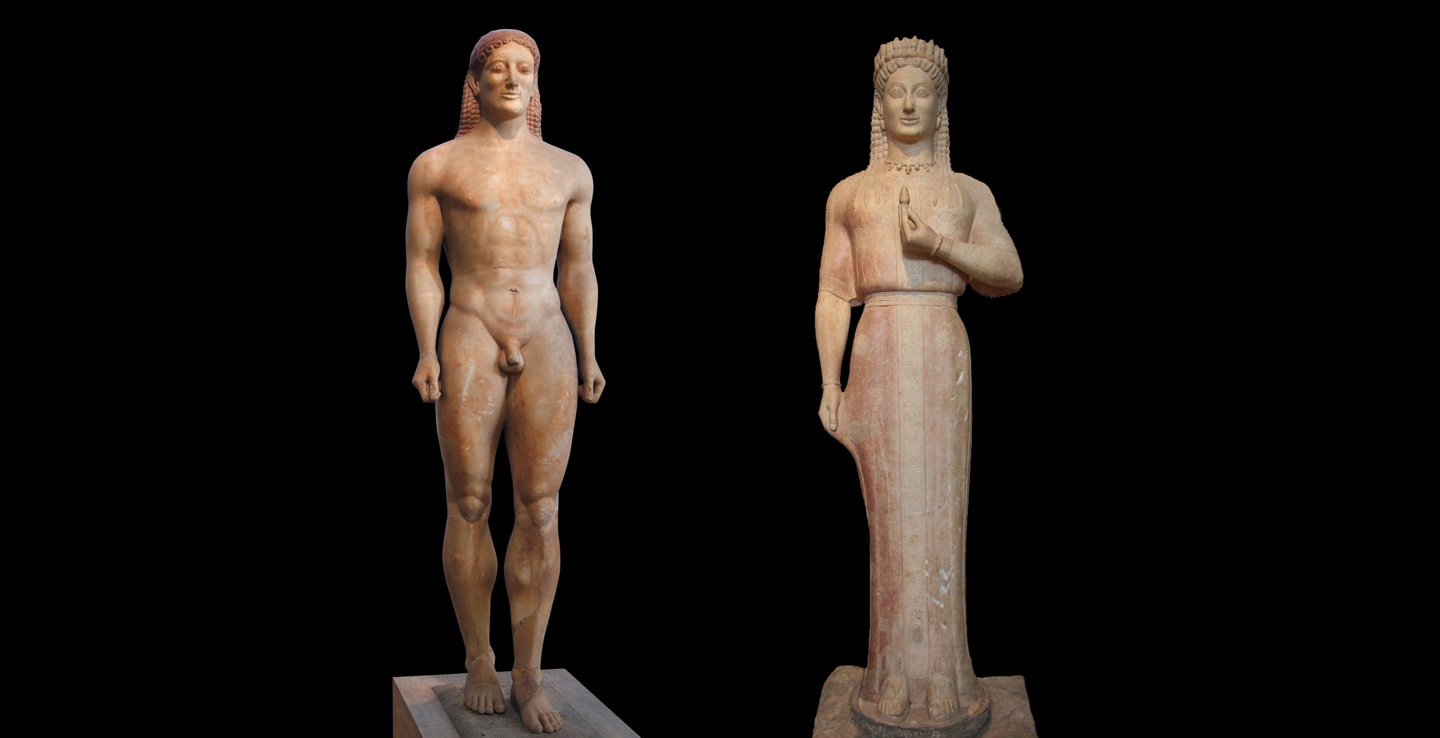
- Anavysos Kouros, c. 530 B.C.E., marble, Archaic period
- Peplos Kore, from the Acropolis, Athens, Greece, ca. 530 B.C.E., marble, Archaic period
- Exekias, Achilles and Ajax playing a dice game, Attic black-figure amphora, found in Vulci, Italy, c. 540-530 B.C.E., Archaic period
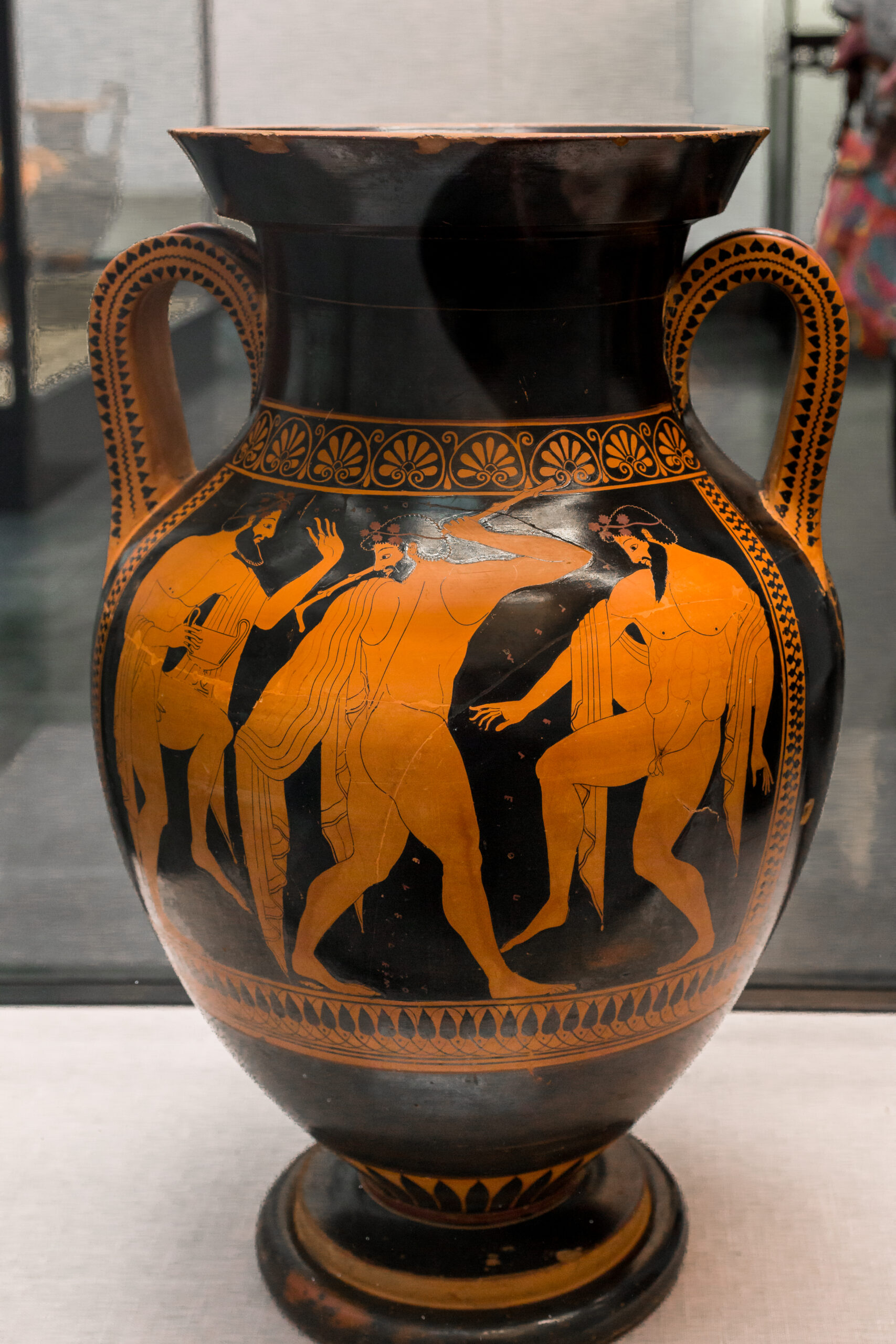
- Euthymides, Three Revelers, Athenian red-figure amphora, c. 510 B.C.E., Archaic period
Term List
- Polis/Poleis
- Panhellenic
- Dark Ages
- Geometric period
- Orientalizing period
- Amphora
- Archaic period
- Kouros
- Kore
- Archaic smile
- Terracotta
- Krater
- Symposion
- Slip
- Black-figure painting
- Red-figure painting
Introduction to Ancient Greek art with the Geometric Period
A shared language, religion, and culture
Ancient Greece can feel strangely familiar. From the exploits of Achilles and Odysseus, to the treatises of Aristotle, from the exacting measurements of the Parthenon (image above) to the rhythmic chaos of the Laocoön (image below), ancient Greek culture has shaped our world. Thanks largely to notable archaeological sites, well-known literary sources, and the impact of Hollywood (Clash of the Titans, for example), this civilization is embedded in our collective consciousness—prompting visions of epic battles, erudite philosophers, gleaming white temples, and limbless nudes (we now know the sculptures—even the ones that decorated temples like the Parthenon—were brightly painted, and, of course, the fact that the figures are often missing limbs is the result of the ravages of time).
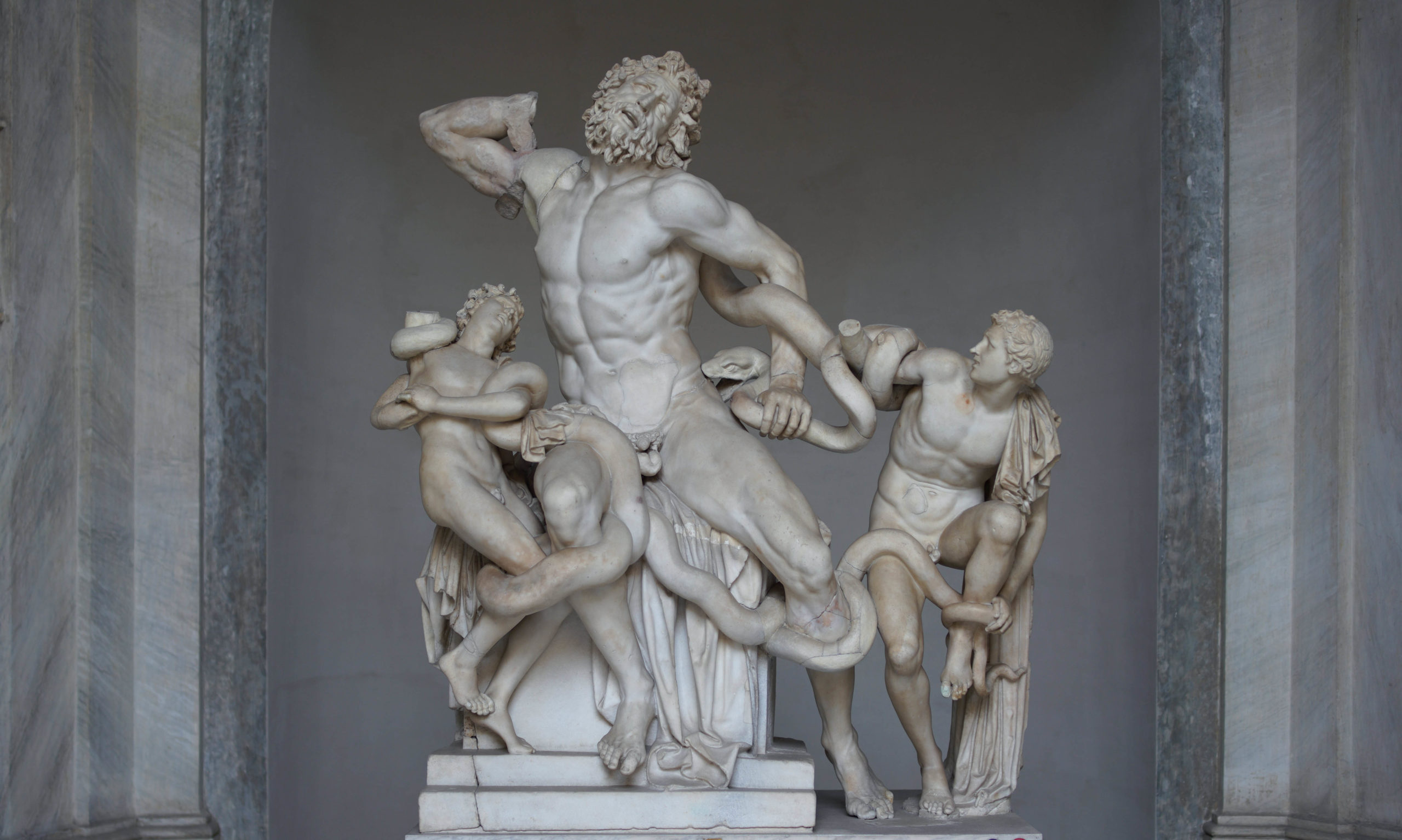
Dispersed around the Mediterranean and divided into self-governing units called poleis or city-states, the ancient Greeks were united by a shared language, religion, and culture. Strengthening these bonds further were the so-called “Panhellenic” sanctuaries and festivals that embraced “all Greeks” and encouraged interaction, competition, and exchange (for example the Olympics, which were held at the Panhellenic sanctuary at Olympia). Although popular modern understanding of the ancient Greek world is based on the classical art of fifth century B.C.E. Athens, it is important to recognize that Greek civilization was vast and did not develop overnight.
The Dark Ages (c. 1100–c. 800 B.C.E.) to the Orientalizing Period (c. 700–600 B.C.E.)
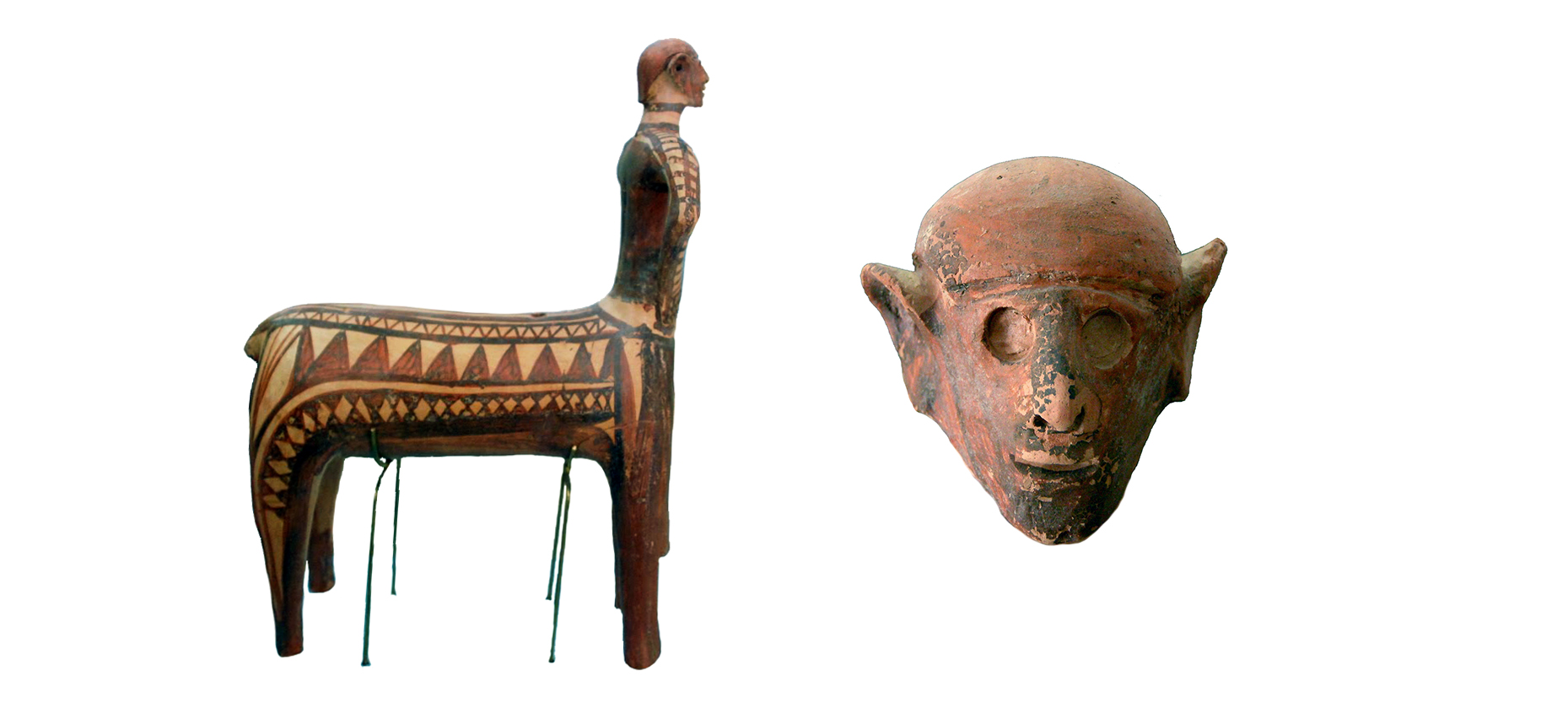
Following the collapse of the Mycenaean citadels of the late Bronze Age, the Greek mainland was traditionally thought to enter a “Dark Age” that lasted from c. 1100 until c. 800 B.C.E. Not only did the complex socio-cultural system of the Mycenaeans disappear, but also its numerous achievements (i.e., metalworking, large-scale construction, writing). The discovery and continuous excavation of a site known as Lefkandi, however, drastically alters this impression. Located just north of Athens, Lefkandi has yielded an immense apsidal structure (almost fifty meters long), a massive network of graves, and two heroic burials replete with gold objects and valuable horse sacrifices. One of the most interesting artifacts, ritually buried in two separate graves, is a centaur figurine (see photos below). At fourteen inches high, the terracotta creature is composed of a equine (horse) torso made on a potter’s wheel and hand-formed human limbs and features. Alluding to mythology and perhaps a particular story, this centaur embodies the cultural richness of this period.
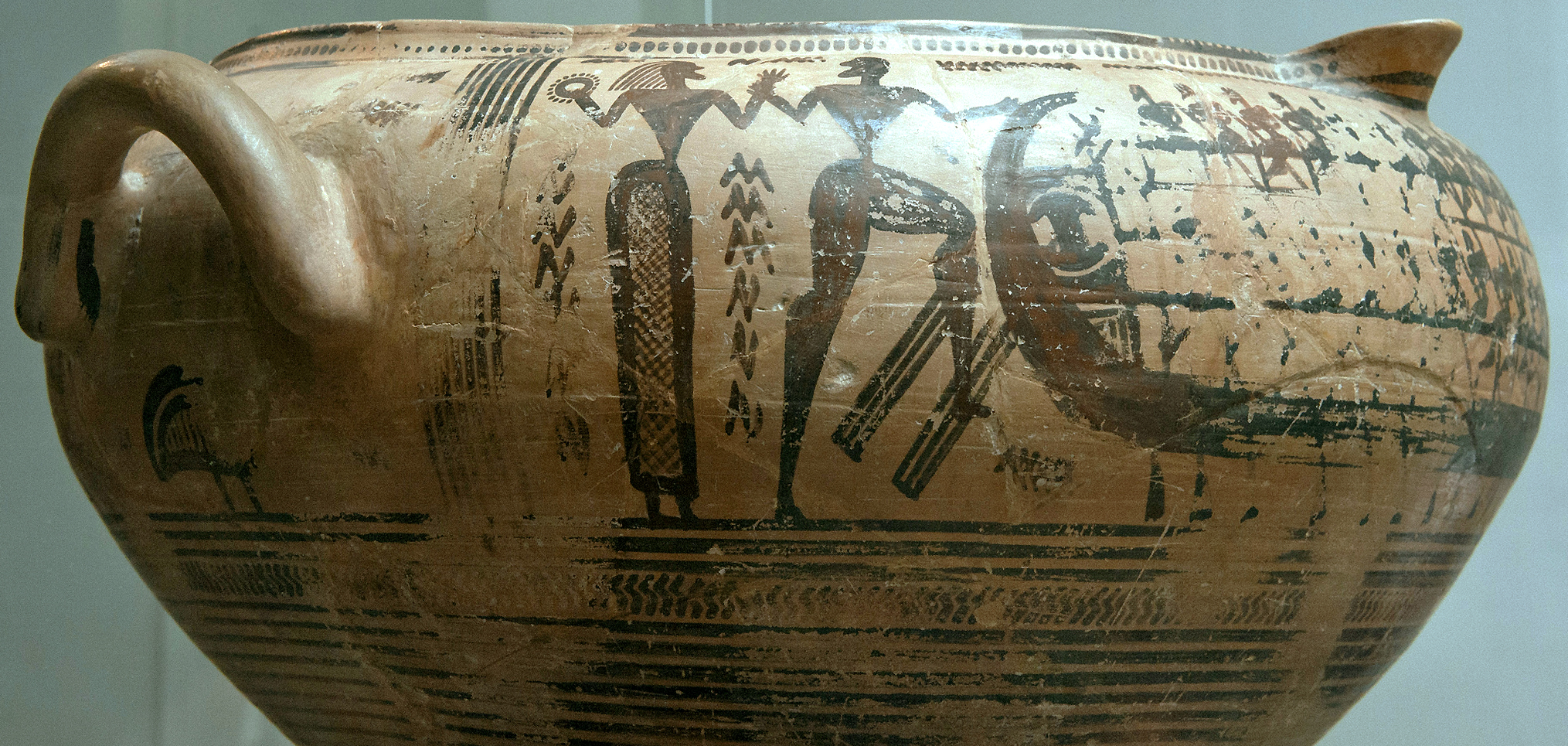
Similar in its adoption of narrative elements is a vase-painting likely from Thebes dating to c. 730 B.C.E. (see image below). Fully ensconced in the Geometric Period (c. 800–700 B.C.E.), the imagery on the vase reflects other eighth-century artifacts, such as the Dipylon Amphora, with its geometric patterning and silhouetted human forms. Though simplistic, the overall scene on this vase seems to record a story. A man and woman stand beside a ship outfitted with tiers of rowers. Grasping at the stern and lifting one leg into the hull, the man turns back towards the female and takes her by the wrist. Is the couple Theseus and Ariadne? Is this an abduction? Perhaps Paris and Helen? Or, is the man bidding farewell to the woman and embarking on a journey as had Odysseus and Penelope? The answer is unattainable.
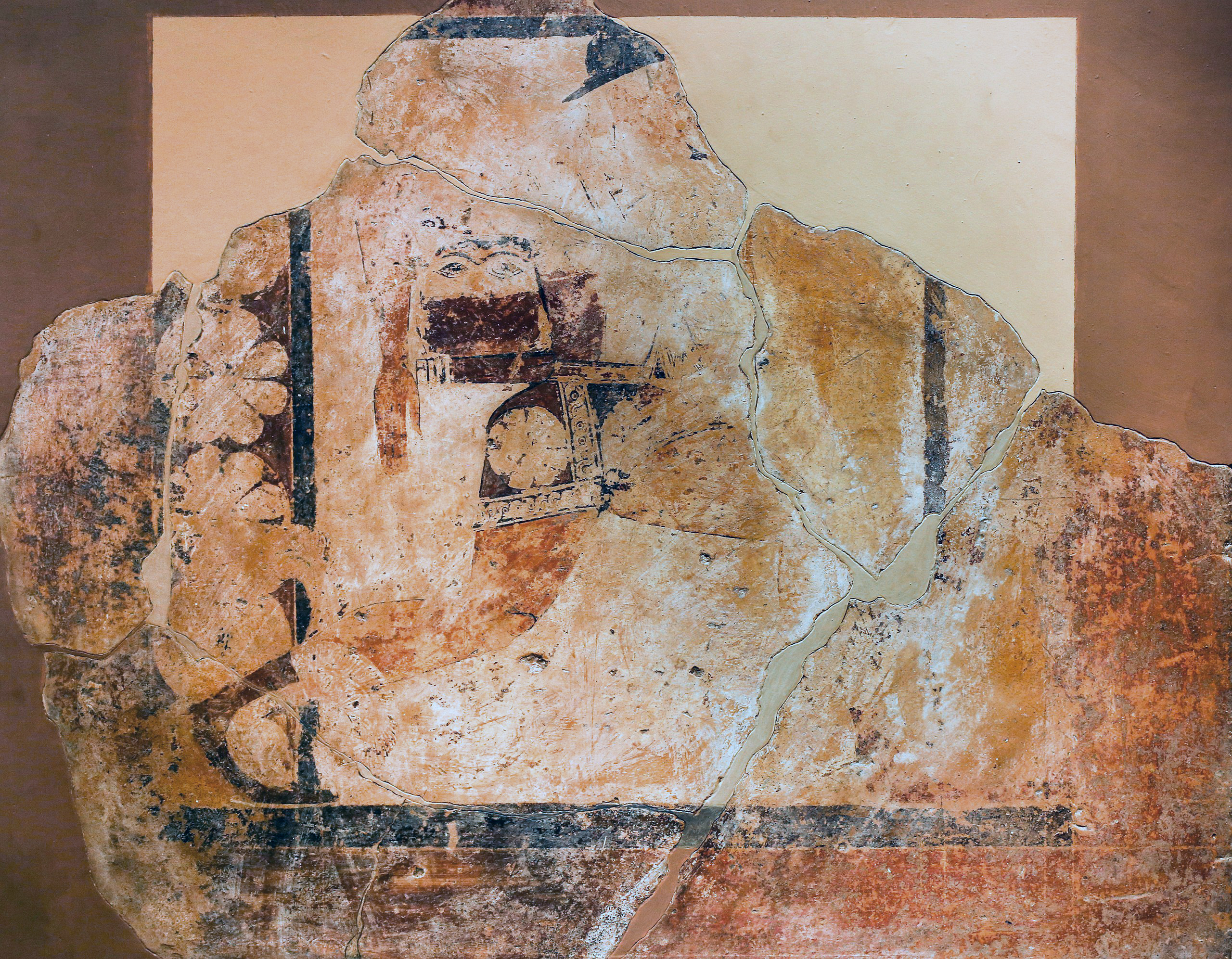
In the Orientalizing Period (700–600 B.C.E.), alongside Near Eastern motifs and animal processions, craftsmen produced more nuanced figural forms and intelligible illustrations. For example, terracotta painted plaques from the Temple of Apollo at Thermon (c. 625 B.C.E.) are some of the earliest evidence for architectural decoration in Iron Age Greece. Once ornamenting the surface of this Doric temple (most likely as metopes), the extant panels have preserved various imagery (watch this video to learn about the Doric order). On one plaque (see image below), a male youth strides towards the right and carries a significant attribute under his right arm—the severed head of the Gorgon Medusa (her face is visible between the right hand and right hip of the striding figure). Not only is the painter successful here in relaying a particular story, but also the figure of Perseus shows great advancement from the previous century. The limbs are fleshy, the facial features are recognizable, and the hat and winged boots appropriately equip the hero for fast travel.
Geometric Period: Dipylon Amphora
As tall as a person, this pot is covered with geometric patterns and early figural representations. The Dipylon Amphora dates from the Geometric Period of Ancient Greece.
Introduction to the Archaic Period (c. 600–480/479 B.C.E.)
While Greek artisans continued to develop their individual crafts, storytelling ability, and more realistic portrayals of human figures throughout the Archaic Period, the city of Athens witnessed the rise and fall of tyrants and the introduction of democracy by the statesman Kleisthenes in the years 508 and 507 B.C.E.
Kouroi and Korai
Visually, the period is known for large-scale marble kouros (male youth) and kore (female youth) sculptures (see below). Showing the influence of ancient Egyptian sculpture (like this example of the Pharaoh Menkaure and his wife in the MFA, Boston), the kouros stands rigidly with both arms extended at the side and one leg advanced. Frequently employed as grave markers, these sculptural types displayed unabashed nudity, highlighting their complicated hairstyles and abstracted musculature (below left). The kore, on the other hand, was never nude. Not only was her form draped in layers of fabric, but she was also ornamented with jewelry and adorned with a crown. Though some have been discovered in funerary contexts, like Phrasiklea (below right), a vast majority were found on the Acropolis in Athens. Ritualistically buried following desecration of this sanctuary by the Persians in 480 and 479 B.C.E., dozens of korai were unearthed alongside other dedicatory artifacts. While the identities of these figures have been hotly debated in recent times, most agree that they were originally intended as votive offerings to the goddess Athena.
Archaic ideals
From 600 to 480 B.C.E., ancient Greek cemeteries and sanctuaries were filled with marble statues of beautiful young men and women. The images of nude young men are today called kouroi (singular: kouros), the ancient Greek word for boy, though we do not know if they were called kouroi in antiquity. Their female counterparts, korai (singular: kore), wear richly painted robes and accessories made of expensive metals. Kouroi and korai are highly idealized images. Rather than showing people as they actually looked, they are representations of youthful perfection as envisioned by the Greek aristocrats who commissioned them in the Archaic period. These elite individuals conflated bodily beauty with moral excellence, so from their viewpoint, the idealized statues of young men and women that they commissioned displayed both inner and outer greatness. Kouroi and korai broadcasted the wealth and ideals of their patrons, revealing much about Archaic society.
Anavysos Kouros
“Stay and mourn at the monument of dead Kroisos, who raging Ares slew as he fought in the front ranks.”
Peplos Kore
What’s in a name? Discover whether this ancient Greek offering is an idealized young woman or a goddess.
Greek Vase-Painting, an introduction
Useful for scholars
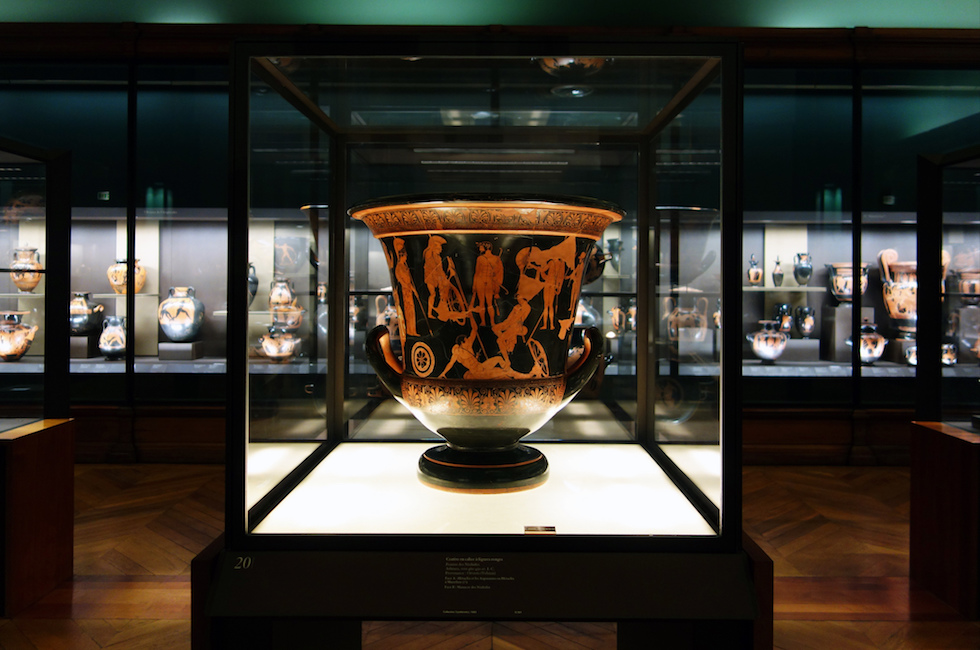
Pottery is virtually indestructible. Though it may break into smaller pieces (called sherds), these would have to be manually ground into dust in order to be removed from the archaeological record. As such, there is an abundance of material for study, and this is exceptionally useful for modern scholars. In addition to being an excellent tool for dating, pottery enables researchers to locate ancient sites, reconstruct the nature of a site, and point to evidence of trade between groups of people. Moreover, individual pots and their painted decoration can be studied in detail to answer questions about religion, daily life, and society.
Shapes and themes
Made of terracotta (fired clay), ancient Greek pots and cups, or “vases” as they are normally called, were fashioned into a variety of shapes and sizes, and very often a vessel’s form correlates with its intended function. For example, the krater was used to mix water and wine during a Greek symposion. It allows an individual to pour liquids into its wide opening, stir the contents in its deep bowl, and easily access the mixture with a separate ladle or small jug. Or, the vase known as a hydria was used for collecting, carrying, and pouring water. It features a bulbous body, a pinched spout, and three handles (two at the sides for holding and one stretched along the back for tilting and pouring).
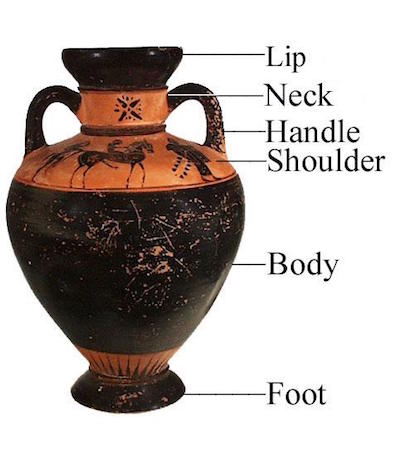
In order to discuss the different zones of vessels, specialists have adopted terms that relate to the parts of the body. The opening of the pot is called the mouth; the stem is referred to as the neck; the slope from the neck to the body is called the shoulder; and the base is known as the foot).
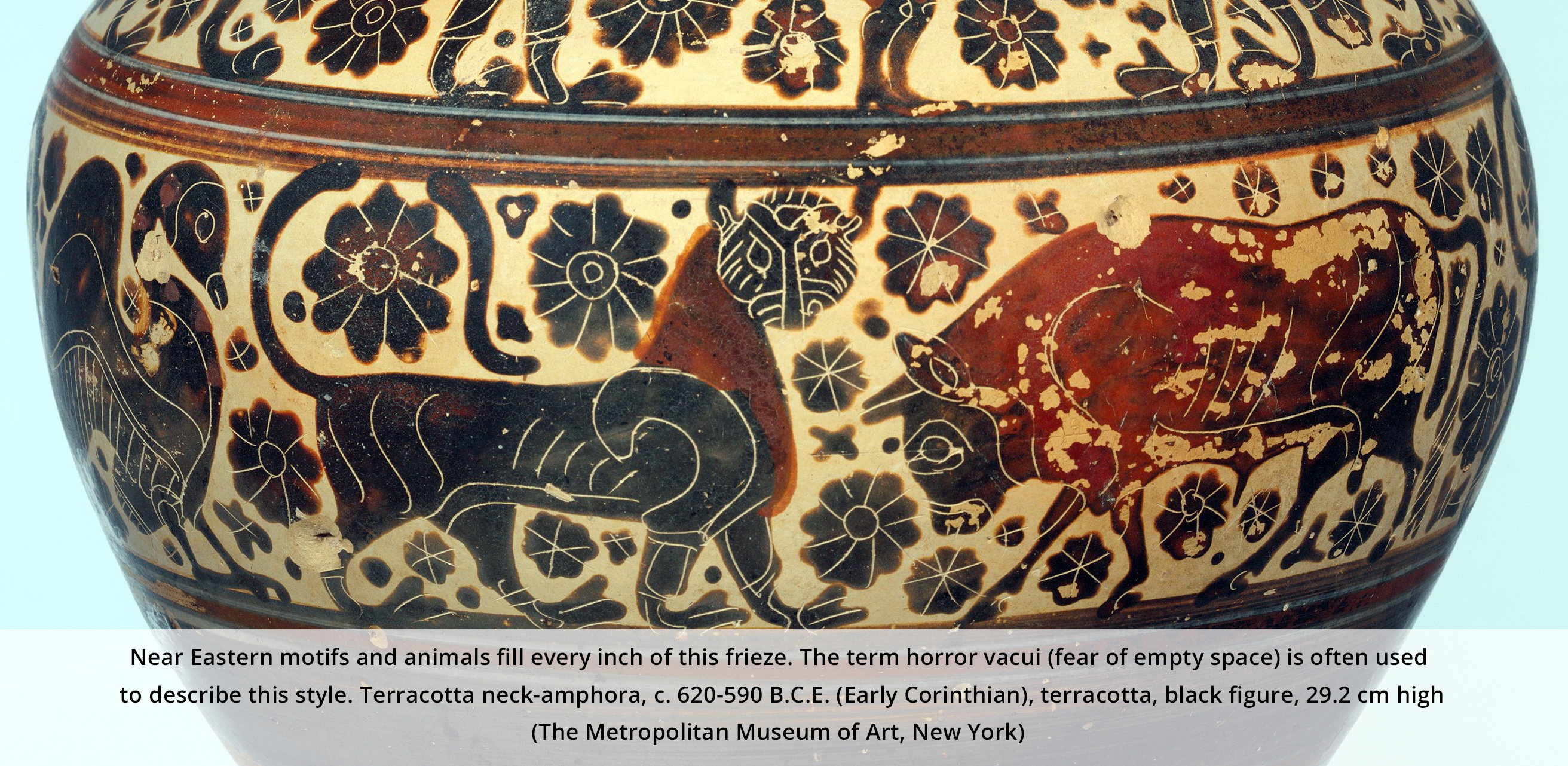
On the exterior, Greek vases exhibit painted compositions that often reflect the style of a certain period. For example, the vessels created during the Geometric Period feature geometric patterns, as seen on the famous Dipylon amphora, while those decorated in the Orientalizing Period display animal processions and Near Eastern motifs, as is visible on this early Corinthian amphora.
Later, during the Archaic and Classical Periods, vase-paintings primarily display human and mythological activities. These figural scenes can vary widely, from daily life events (e.g., fetching water at the fountain house) to heroic deeds and Homeric tales (e.g., Theseus and the bull, Odysseus and the Sirens), from the world of the gods (e.g., Zeus abducting Ganymede) to theatrical performances and athletic competitions (for example, the Oresteia, chariot racing). While it is important to stress that such painted scenes should not be thought of as photographs that document reality, they can still aid in reconstructing the lives and beliefs of the ancient Greeks.
Techniques, painters and inscriptions
To produce the characteristic red and black colors found on vases, Greek craftsmen used liquid clay as paint (termed “slip”) and perfected a complicated three-stage firing process. Not only did the pots have to be stacked in the kiln in a specific manner, but the conditions inside had to be precise. First, the temperature was stoked to about 800° centigrade and vents allowed for an oxidizing environment. At this point, the entire vase turned red in color. Next, by sealing the vents and increasing temperature to around 900–950° centigrade, everything turned black and the areas painted with the slip vitrified (transformed into a glassy substance). Finally, in the last stage, the vents were reopened and oxidizing conditions returned inside the kiln. At this point, the unpainted zones of the vessel became red again while the vitrified slip (the painted areas) retained a glossy black hue. Through the introduction and removal of oxygen in the kiln and, simultaneously, the increase and decrease in temperature, the slip transformed into a glossy black color.

Briefly, ancient Greek vases display several painting techniques, and these are often period specific. During the Geometric and Orientalizing periods, painters employed compasses to trace perfect circles and used silhouette and outline methods to delineate shapes and figures.
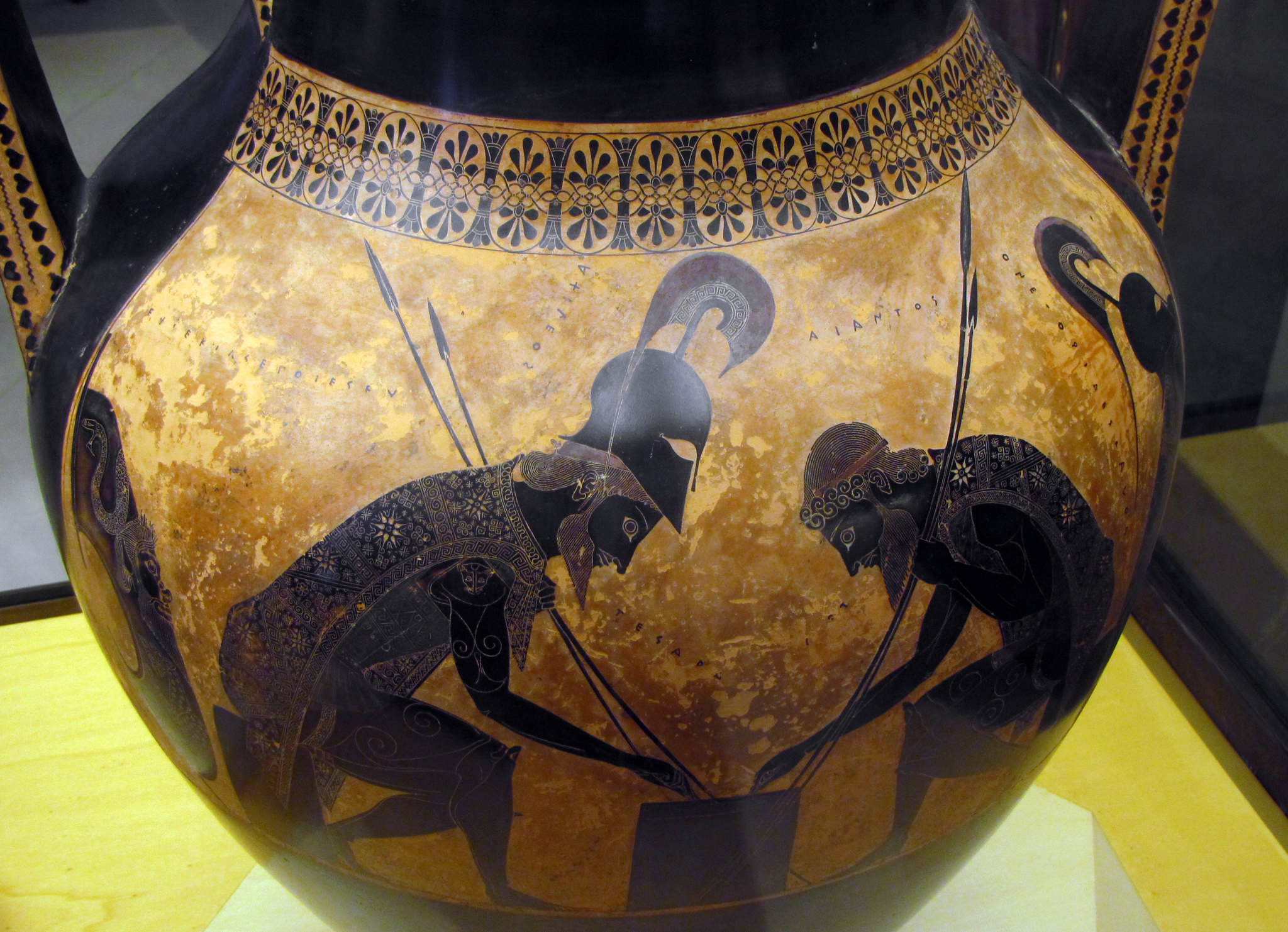
Around 625–600 B.C.E., Athens adopted the black-figure technique (i.e., dark-colored figures on a light background with incised detail). Originating in Corinth almost a century earlier, black-figure uses the silhouette manner in conjunction with added color and incision. Incision involves the removal of slip with a sharp instrument, and perhaps its most masterful application can be found on an amphora by Exekias. Often described as Achilles and Ajax playing a game, the seated warriors lean towards the center of the scene and are clothed in garments that feature intricate incised patterning. In addition to displaying more realistically defined figures, black-figure painters took care to differentiate gender with color: women were painted with added white, men remained black.
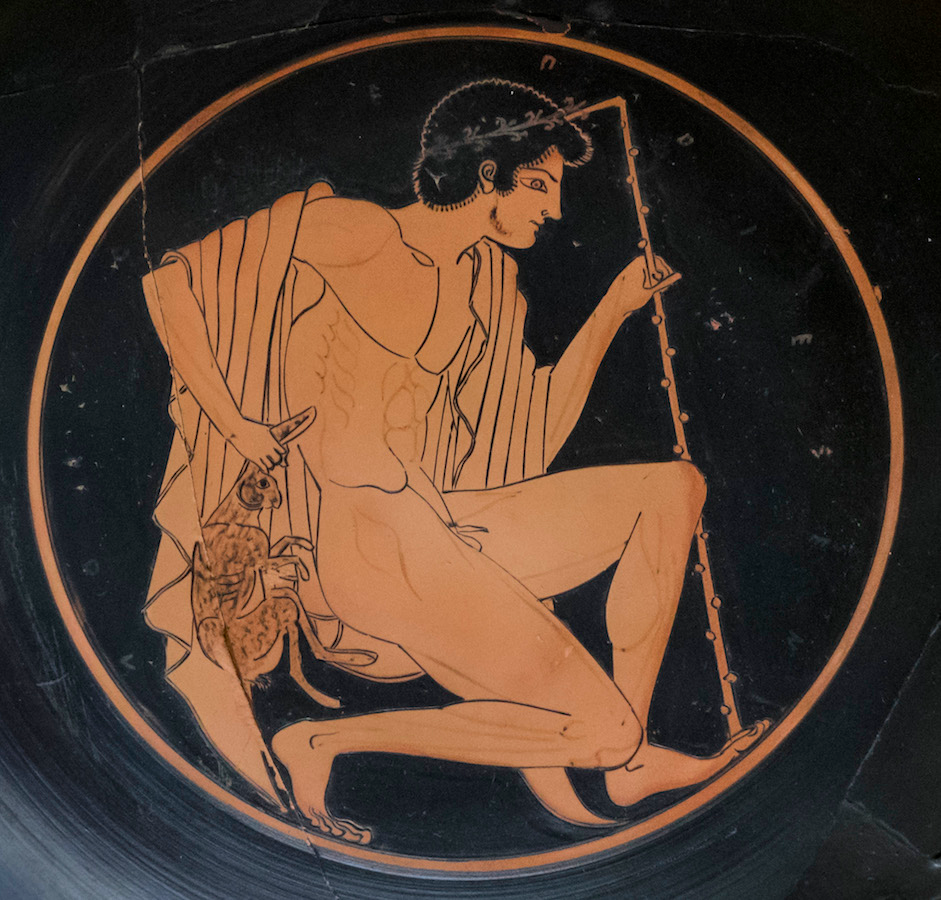
The red-figure technique was invented in Athens around 525–520 B.C.E. and is the inverse of black-figure. Here light-colored figures are set against a dark background. Using added color and a brush to paint in details, red-figure painters watered down or thickened the slip in order to create different effects.
Watered down slip or “dilute glaze” has the appearance of a wash and was used for hair, fur, and anatomy, as exemplified by the sketchy coat of the hare and the youth’s musculature on the interior of this cup by Gorgos. When thickened, the slip was used to form so-called “relief lines” or lines raised prominently from the surface, and these were often employed to outline forms. Surprisingly similar to red-figure is the white-ground technique.
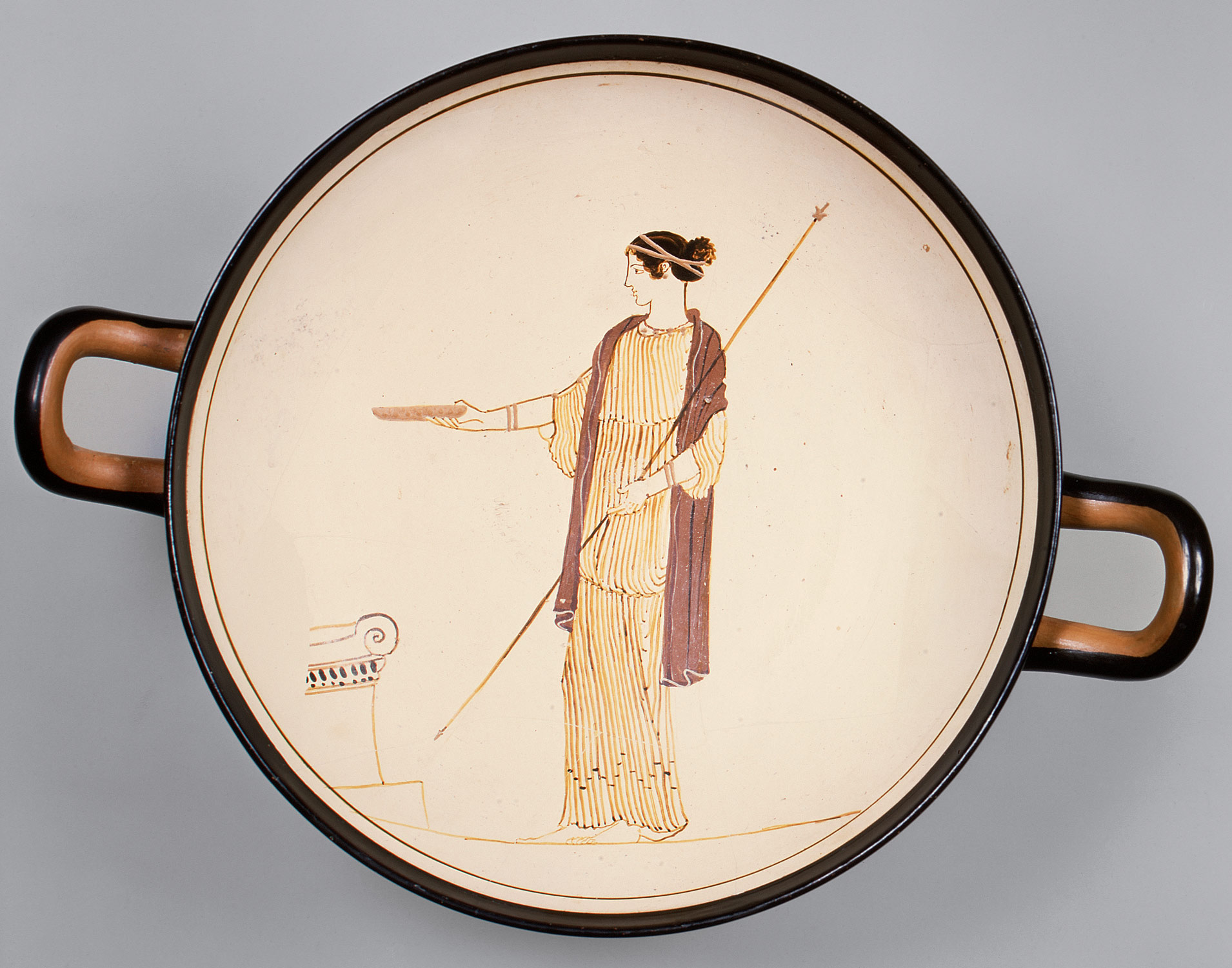
Though visually quite different with its polychrome figures on a white-washed background, white-ground requires the craftsman to paint in the details of forms just like red-figure, rather than incise them.
Alongside figures and objects, one can sometimes find inscriptions. These identify mythological figures, beautiful men or women contemporaneous with the painter (“kalos” / “kale” inscriptions), and even the painter or potter himself (“egrapsen” / “epoiesen”). Inscriptions, however, are not always helpful. Mimicking the appearance of meaningful text, “nonsense inscriptions” deceive the illiterate viewer by arranging the Greek letters in an incoherent fashion.
Vases and reception
The overall attractive quality of Greek vases, their relatively small size, and—at one point in time—their easily obtainable nature, led them to be highly coveted collector’s items during the eighteenth and nineteenth centuries. Since the later part of the 19th century, however, the study of vases became a scholarly pursuit and their decoration was the obsession of connoisseurs gifted with the ability to recognize and attribute the hands of individual painters.
The most well-known vase connoisseur of the 20th century, a researcher concerned with attribution, typology, and chronology, was Sir John Davidson Beazley. Interested in Athenian black-, red-figure, and white-ground techniques, Beazley did not favor beautifully painted specimens; he was impartial and studied pieces of varying quality with equal attention. From his tedious and exhaustive examinations, he compiled well-over 1000 painters and groups, and he attributed over 30,000 vases. Although some researchers since Beazley’s death continue to attribute and examine the style of specific painters or groups, vase scholars today also question the technical production of vessels, their archaeological contexts, their local and foreign distribution, and their iconography.
Exekias, Attic black figure amphora with Ajax and Achilles playing a game
Achilles and Ajax, heroes of the Trojan War, break from battle to play a friendly game that hints at a tragic future.
Euthymides, Three Revelers
Competition
“As never Ephronios [could do]” wrote painter Euthymides after painting his new amphora. Euthymides had a clear sense of achievement and was indeed proud of his work, boastfully challenging his friend and rival—Euphronios. He would see Euphronios often, as well as other painters in the Kerameikos—the potter’s quarter in Athens. They would be curious to see one another’s new work, sometimes with appreciation, sometimes with a bit of jealousy. In the evenings they often had a good time together at a symposium. They would drink wine mixed with water, become garrulous, loud and—if drinking went on for too long—they might even start singing and even dancing. Perhaps what is depicted on this amphora is a scene similar to those Euthymides witnessed at one of these long parties. Euphronios indeed was a master potter and painter, and Euthymides knew that and had a full appreciation for his work. He thought however, that his figures seemed much more lively, caught in a split of a moment, in a dancing movement.
The beginnings of red-figure painting

Euthymides worked mainly between 515 and 500 B.C.E., in a time when artists were exploring the possibilities of red-figure technique, invented in Athens around 530 B.C.E. Both Euthymides and Euphronios belonged to a kind of camaraderie of artists, often dubbed the “Pioneer Group” by art historians—referring to their innovative efforts in the new technique. In the red-figure technique, an artist sketches figures on the red clay of a freshly fashioned vessel, then covers all the background with a slip, which turns black after final firing. Details, like elements of anatomy, folds of drapery, etc., can be freely added with a thin brush; the slip can be darker, sometimes more diluted, brownish, adding even more variety. In the black-figure technique which was used previously, an artist had to fill the figures with slip, and then incise the details with a sharp burin which was much more difficult to handle. At the time of the “Pioneers,” there is a general trend in Greek art to observe the reality and represent human body more realistically, leaving the more stiff archaic models behind.
Hector departs for war
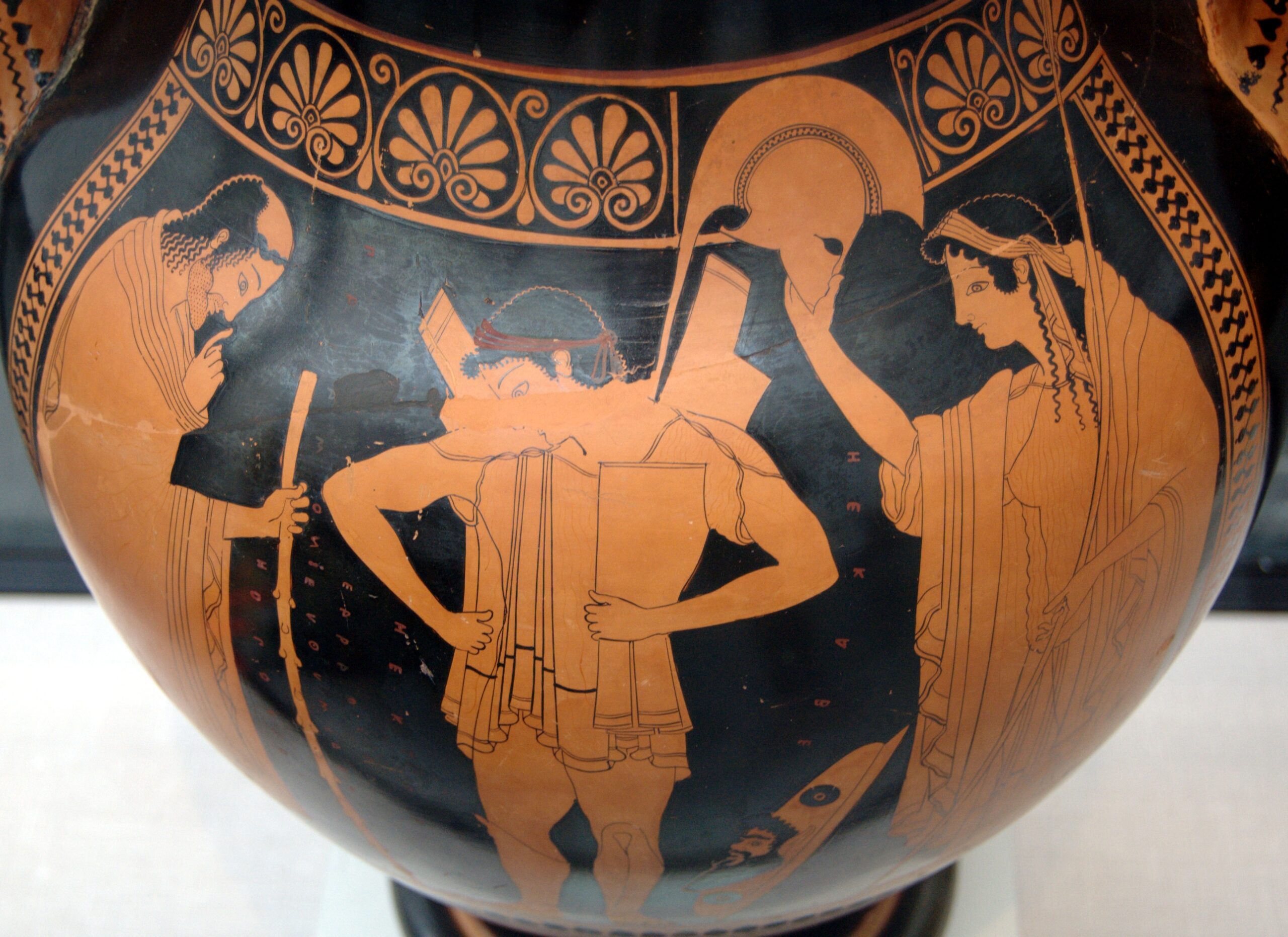
Coming back again to the “Three Revelers” vase—on one side of his amphora the artist decided to decorate with a mythological scene—a solemn moment of Hector departing for the Trojan War, receiving the helmet from his mother Hecube.
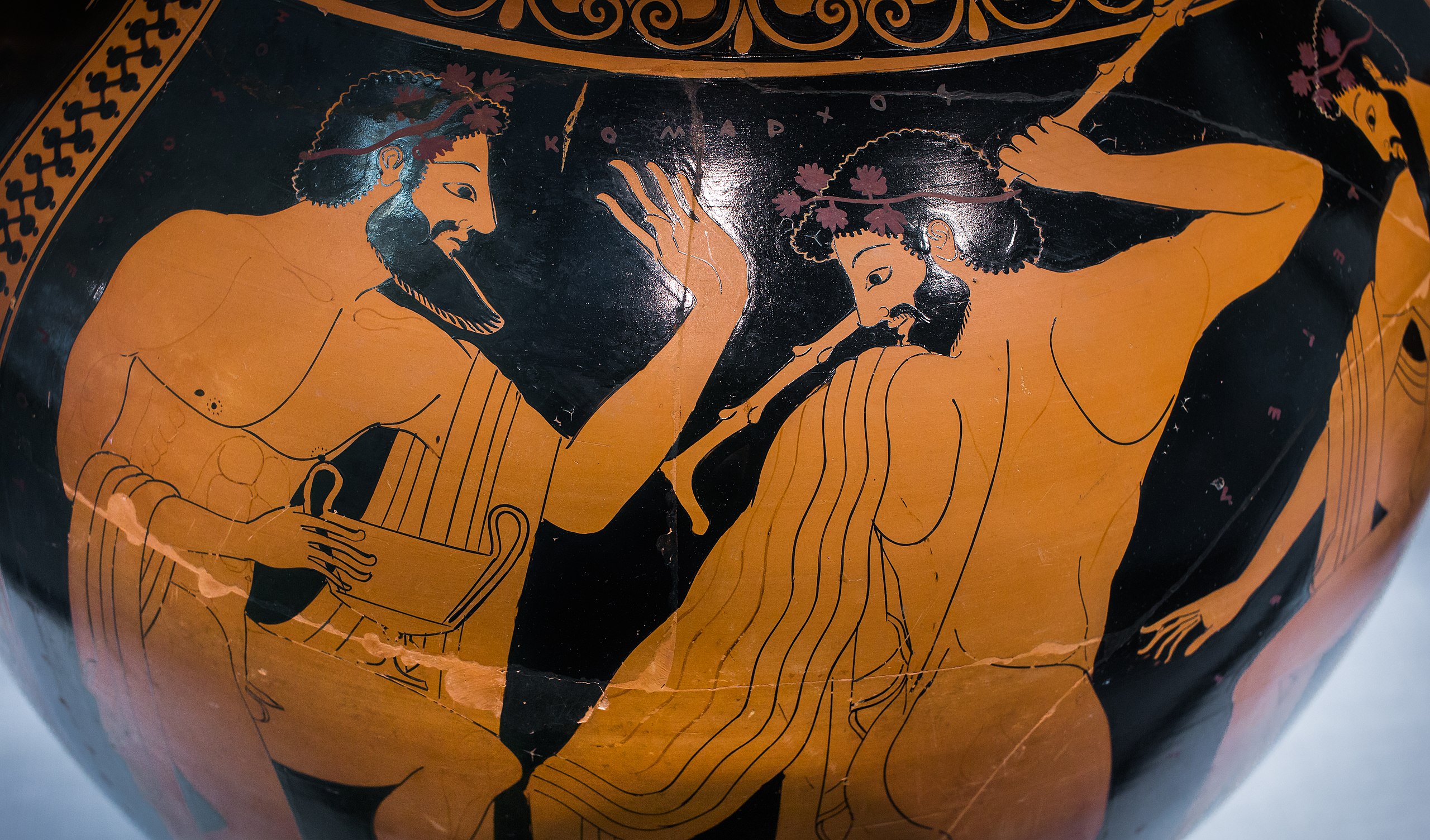
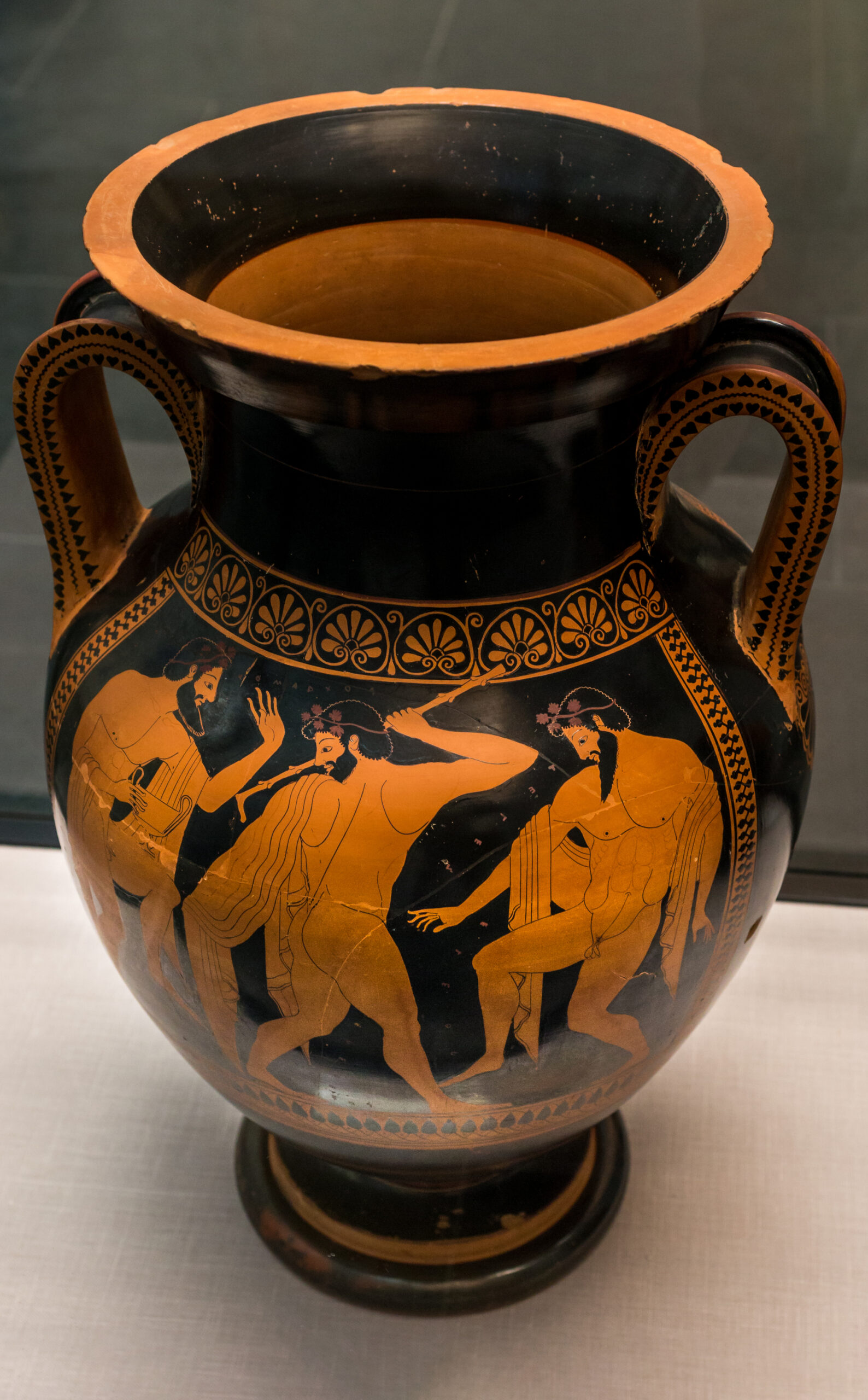
On the other side of the vase, which is probably better known, the artist gave way to his keen sense of observation, giving us a glimpse into everyday life. Three rather tipsy men dance around, enjoying their moment during a long symposium. The one on the left still keeps in his hand a kantharos—a wine cup with long handles. Euthymides made an effort to show them neither completely frontally, nor completely in profile, but rather in three quarters view, using foreshortening to convey a vivid, realistic image. The poses are very diversified, the man in the center is represented in a twisted view. The artist brought his keen sense of observation to describing human anatomy and movement. Greek vase painters often give us clear insight into everyday life—allowing us to understand daily habits, details of clothing and customs. Of course, these painted vases cannot be treated as documents, since we would not expect men to be naked at a symposium. However, appreciation for the human body and nudity was a usual part of ancient Greek culture, and it provided a way for the artist to showcase his ability.
The vase displays balance and harmony of proportions, with its elegant and graceful shape, and carefully planned pictorial decoration. The main scenes on both sides of the amphora are complemented by a delicate ornament. Despite the beauty of the vase, the potters and painters in ancient Greece did not have the status an artist has in our modern society. Their work was looked upon as a physical labor, not as an activity inspired by the muses. In fact, there was no muse of painting. The decorated vases were produced in large amounts to answer the growing demand of the markets, both in Greece, as well as abroad (especially in Etruria, and in Greek colonies). The Euthymides vase was in fact found in an Etruscan tomb at Vulci in Italy. Many Greek vases survived untouched because the Etruscans buried their deceased in large underground tombs with many everyday objects.
Most of the vases were simply everyday items, although a big, beautifully painted amphora like the one discussed here was also a luxury item, testifying to its owner’s good taste and social standing. Despite their status as craftsmen, the artists around the time of Euthymides had a sense of personal value and achievement, hence the inscription “As never Euphronious [could do]”. Because of the inscription “Euthymides egraphsen” (“Euthymides painted me”) we are sure that he was the painter—and today we definitely think of him as an artist.
Conclusion
Around 500 B.C.E., there was a shift in thinking about how to represent the human body in Ancient Greek art. It is evident in both the red-figure style vase painting and in sculpture. Artists began to move toward capturing a greater sense of naturalism. Kouroi and korai began to decline in popularity towards the end of the sixth century B.C.E. They were so emblematic of Archaic elite ideals that they likely seemed conservative to viewers after a new, more democratic government came to power in Athens and began shifting focus towards civic (rather than individual) greatness. When the Persian Empire invaded Athens and burned much of the Acropolis to the ground in 480 B.C.E., the Archaic period ended and kouroi and korai fell out of fashion entirely. After the Persian attack, Athenians carefully buried the damaged korai that once stood on the Acropolis in the sacred ground, disposing of them in a respectful manner. They and their male counterparts were replaced by increasingly realistic images of men and women in dynamic postures. The rigidity of the Archaic period was abandoned, and naturalism became a key artistic trait of the Classical period that followed.
Citation and Licensing
The following sections were written by Chelsea Wright and are licensed CC BY-NC-SA 4.0:
- Chapter Overview and Introduction
- Focus artwork and term list compiled by Chelsea Wright
The following articles from Smarthistory licensed CC BY-NC-SA 4.0 were remixed and adapted for the chapter:
- Dr. Renee M. Gondek, “Introduction to ancient Greek art,” in Smarthistory, August 14, 2016.
- Dr. Steven Zucker and Dr. Beth Harris, “Dipylon Amphora,” in Smarthistory, December 14, 2015.
- Dr. Monica Bulger, “Kouroi and Korai, an introduction,” in Smarthistory, May 11, 2021.
- Dr. Monica Bulger, “Anavysos Kouros,” in Smarthistory, December 11, 2023.
- Dr. Monica Bulger, “Peplos Kore,” in Smarthistory, February 1, 2024.
- Dr. Renee M. Gondek, “Greek Vase-Painting, an introduction,” in Smarthistory, September 9, 2016.
- Dr. Beth Harris and Dr. Steven Zucker, “Exekias, Attic black figure amphora with Ajax and Achilles playing a game,” in Smarthistory, December 9, 2015.
- Katarzyna Minollari, “Euthymides, Three Revelers,” in Smarthistory, August 8, 2015.

_-_Athens_NAM_AD_2_-_01.jpg)


.jpg)


.jpg)
.jpg)