
Chapter Overview and Introduction
The New Kingdom of Ancient Egypt was a prosperous time featuring massive building projects. One such project was the Temple of Amun-Re at Karnak, which demonstrates components of Ancient Egyptian traditional religion and corresponding artistic forms. At one point during the New Kingdom, Egypt was ruled by the female pharaoh Hatshepsut, who fully utilized traditional royal aesthetics during her reign. It was also during the New Kingdom that Egypt experienced the controversial Amarna period. Begun by the Pharaoh Akhenaten, the Amarna period dramatically changed ancient Egyptian religion and style. The Amarna era ended during the rule of Egypt’s most well-known pharaoh: Tutankhamun. Although the chapter concludes with the Amarna period, it is not the last phase of Ancient Egyptian history. After the Amarna period, Egypt returned to traditional style and religion and massive building projects by pharaohs continued. The last phase of Ancient Egypt falls under the Ptolemaic period and the defeat of the Ptolemaic dynasty by the Romans.
Focus Artworks
- Hypostyle Hall, from Temple of Amon-Re, c. 1250 B.C.E. (hall), 18th and 19th Dynasties, New Kingdom, sandstone and mud brick, Karnak, at Luxor, Egypt
- Large Kneeling Statue of Hatshepsut, c. 1479–1458 B.C.E., New Kingdom, Egypt, granite
- House Altar depicting Akhenaten, Nefertiti and Three of their Daughters, c. 1350 B.C.E., New Kingdom, Amarna period, 18th dynasty, limestone
- Death Mask from innermost coffin, Tutankhamun’s tomb, New Kingdom, 18th Dynasty, c. 1323 B.C.E., gold with inlay of enamel and semiprecious stones
Term List
- New Kingdom
- Amun-Re
- Valley of the Kings
- Amarna Period
- Aten
- Karnak
- Hypostyle hall
- Clerestory windows
- Zep tepi
- Divine cult statues
- Sunken relief
- Ankhs
- Sarcophagus
- Crook and flail
- Nekhbet
- Wadjet
- Amarna style
- Akhenaten
New Kingdom and Third Intermediate Period, an introduction
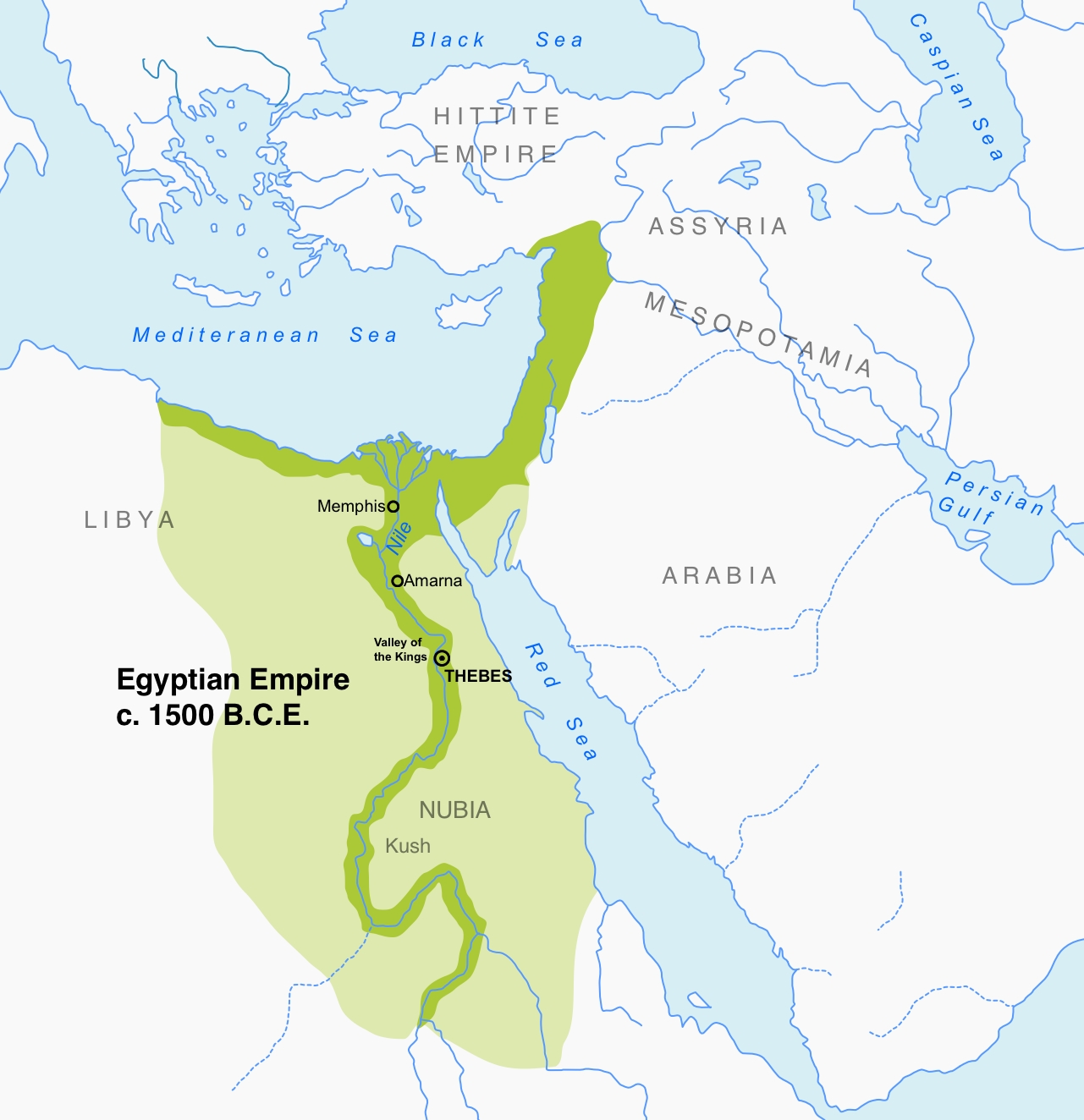
Born in battle, the New Kingdom was initiated by the Theban king Ahmose who brought the Egyptian armies north against the Hyksos kings at Avaris and drove them out of the Nile delta.
The early Eighteenth Dynasty (the first dynasty of the New Kingdom) was characterized by military campaigns that continually pushed the borders of Egypt into Asia Minor and Nubia. Later kings of this dynasty relied more heavily on diplomatic relationships, achieving a position of power and cultural dynamism in the Mediterranean world due to their successes in foreign policy.
After the Eighteenth Dynasty experienced a unique and disruptive era of significant religious and political alteration (known as the Amarna Period), the early Nineteenth Dynasty kings reasserted traditional social and cultural beliefs. These rulers emphasized their strategic and physical prowess on the battlefield. Scenes of successful battles, showing the king at the head of his armies triumphing over the chaotic enemy, appear prominently on temple walls as proof of the ruler’s abilities. Later in the New Kingdom, repeated incursions from outside forces (such as the Libyans and the migratory Sea Peoples), weakened the country, eventually leading to a fracturing of centralized control and the Third Intermediate Period.
New Kingdom (c. 1550–1070 B.C.E.)
Spanning more than 500 years and encompassing Dynasties 18–20, the New Kingdom is often considered to be the peak of ancient Egyptian culture. The early Eighteenth Dynasty rulers were warrior kings who carried out numerous military campaigns to expand their borders and areas of control, both to the north and the south. These incursions were primarily intended to create a buffer around the Egyptian homeland, exploit valuable resources, and gain control of trade routes.
Eager to reestablish a centralized authority after the chaos of the Second Intermediate Period, the royal court moved back to Memphis, the ancient seat of power from the golden age of the great pyramids. Thebes, however, remained the religious capital. The local god Amun was merged with the sun god Ra and became Amun-Ra—King of the Gods. Amun’s shrine at Karnak developed into the largest temple complex in the country.
A new royal burial site, now known as the Valley of the Kings, was initiated in the hills on the west side of the Nile from Thebes; the first royal tomb cut into the cliffs was for Thutmosis I. Kings dug deep subterranean tombs into the limestone Valley and paired those hidden tombs with grand memorial temples, constructed closer to the Nile edge of cultivation, that served to maintain the king’s cult after death.
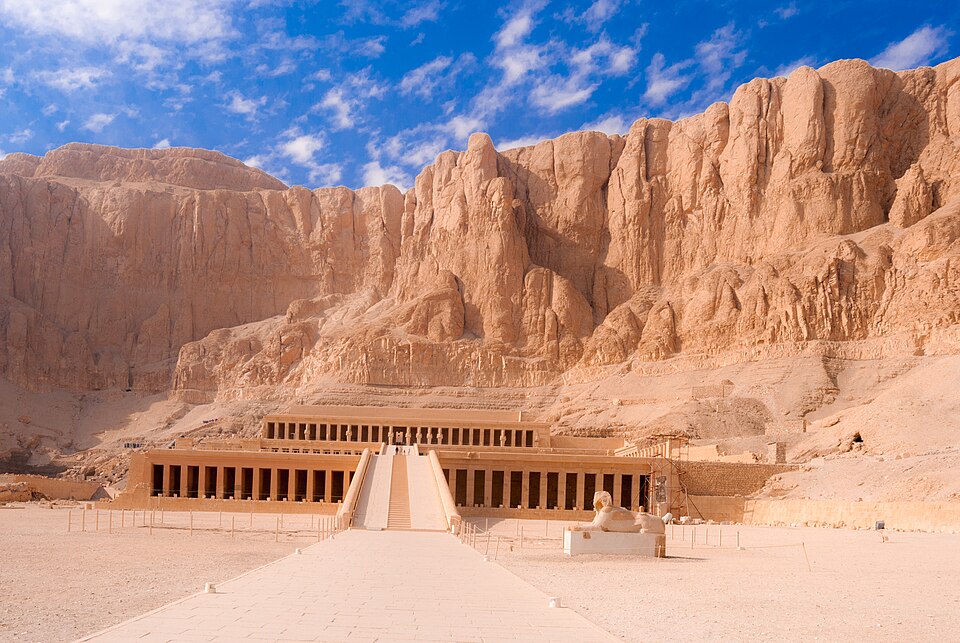
One of the most stunning structures from the ancient world is one of these memorial temples, which stands against the dramatic cliffs at Deir el Bahri just opposite the Valley of the Kings. This terraced temple was built by Hatshepsut, the powerful female ruler who controlled Egypt for roughly 20 years at the height of the Eighteenth Dynasty. She built her memorial monument directly adjacent to the memorial temple of Nebhepetre Mentuhotep II, founder of the Middle Kingdom, clearly identifying her righteous rule as a continuation of those who came before.
After ongoing military campaigns under Thutmosis III led to Egypt’s furthest borders, later kings sought more diplomatic solutions in their relations with other powers in the Near East. These included diplomatic marriages, such as that between Thutmosis IV and the daughter of Mitannian ruler Artatama, and greatly reduced expansionist tendencies. This led to an era of wealth and relative peace under Thutmosis IV’s successor, Amenhotep III. This king focused on developing the religious landscape—enlarging numerous existing chapels and founding several new temples, including the magnificent Luxor Temple. He commissioned an incredible number of divine statues to emphasize his connections to the gods, and authorized some images that gave himself and his chief wife, Tiye, divine attributes.
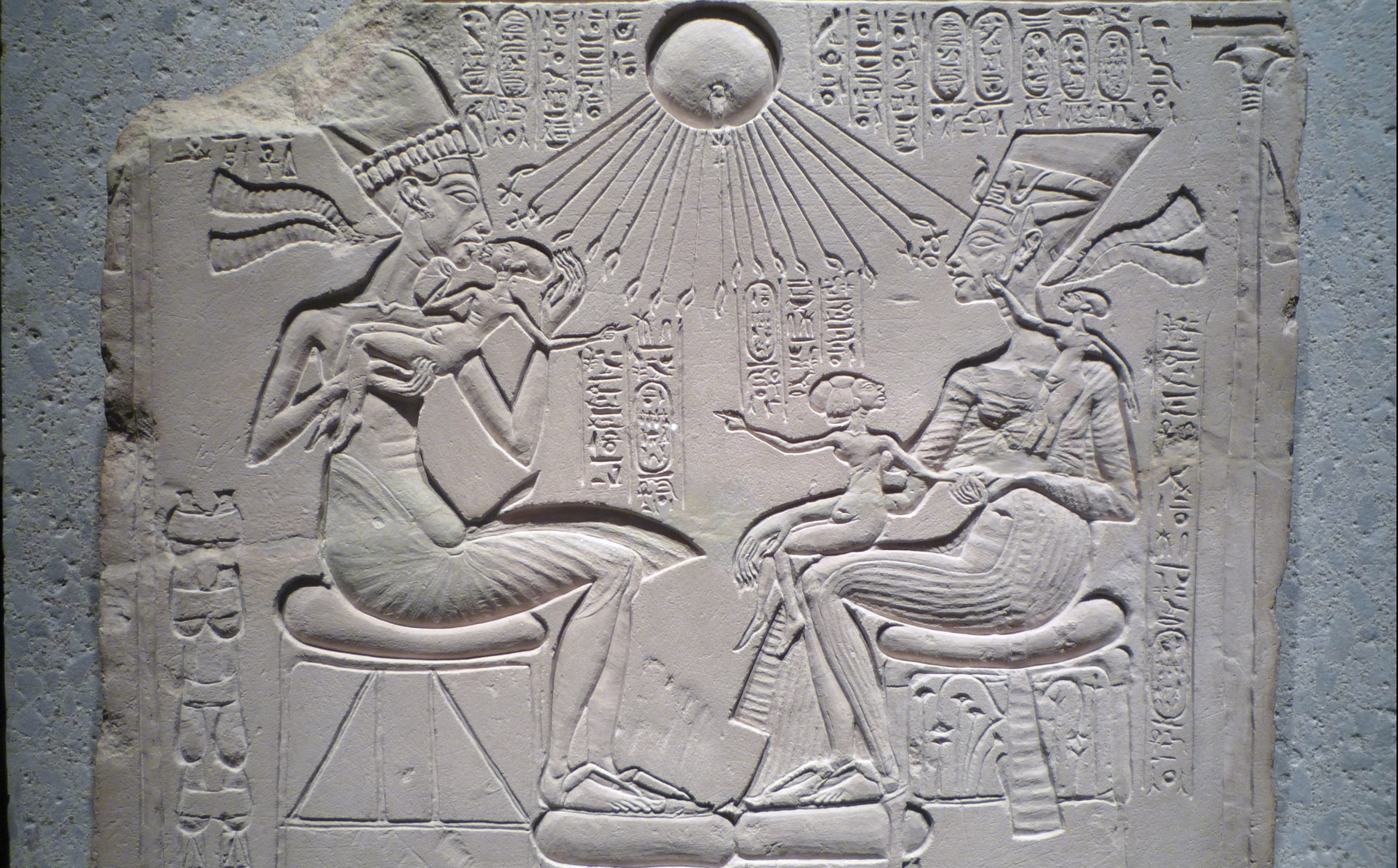
Their son was Amenhotep IV, who changed his name early in his reign to Akhenaten. Akhenaten and his chief wife, Nefertiti, were dedicated to the cult of the Aten, a specific form of the sun god that manifested as a disc. Akhenaten made the radical choice to move the capital to a brand new location at Akhet-Aten (modern Amarna) and centralized control, both secular and religious, in himself as the sole representative of the Aten on earth. In general, this significant break with tradition was not well-received and it did not last.
Akhenaten’s young successor and son Tutankhamun (better known as King Tut), moved the religious capital back to Thebes, re-establishing Amun-Ra as the chief national deity. Akhenaten’s reign was viewed as a time of chaos by later kings; the king list at Seti I’s temple in Abydos jumps from Amenhotep III directly to Horemhab, completely skipping over the contentious reigns of Akhenaten and his immediate successors, Tutankhamun and Ay.
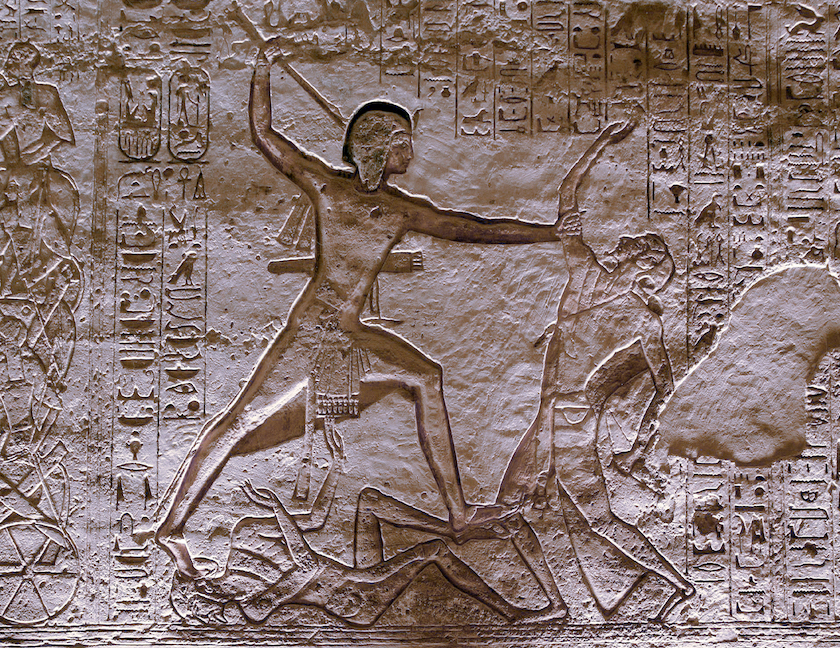
Early Nineteenth Dynasty kings resumed military campaigns and re-established Egyptian authority over parts of the Near East. One of the best-known kings from Egypt was Rameses II. He ruled for sixty-seven years, fought great battles with the Hittites, and constructed a huge number of monuments throughout the country. Triumphant battle scenes adorn many of these temples, many depicting the battle of Kadesh despite the fact that he didn’t actually conquer the Hittites—the conflict was instead settled by negotiation and diplomatic agreements.
Later kings of the Nineteenth and Twentieth Dynasties faced successive waves of invasions by foreign powers, such as the Libyans and the enigmatic migratory group known as the Sea Peoples. These conflicts were an obvious strain and led to the reduction of the king’s reach and sphere of influence. By the end of the Twentieth Dynasty, the pharaoh ruling from Memphis had little apparent control over a powerful family in Thebes whose members served as high priests at Karnak and who endowed themselves with royal titles.
Third Intermediate Period (c. 1070–713 B.C.E.)
This era was characterized by a distinct split between north and south. During the Twenty-first Dynasty, the kings ruled from the delta while the south was controlled by the high priests of Amun at Thebes. These ruling families were related and often intermarried, helping to maintain a sense of continuity.
Many social and religious customs changed, including the royal mortuary practices. The Twenty-first Dynasty kings at Tanis in the delta initiated a completely new form of royal burial where the burial chamber and chapel were contained within a temple precinct, in the courtyard of the god’s temple, a design that remained in use for royal burials until the Ptolemaic period. Several of these tombs were discovered intact with silver coffins, incredible jewelry, and marvelous vessels. The elaborately decorated private tombs of the New Kingdom became less common. Focus was shifted to remarkable painted coffins, papyri, and wooden stelae that presented most of the required imagery for the ritual provisioning for the afterlife.
Highly skilled metalworking during this time is evidenced in small-scale metal sculptures of divine, royal, and private individuals. These were often exquisitely finished with multiple metals inlaid into the surface in delicate patterns. One of the most beautiful examples is that of Karomama, a queen and Divine Adoratrice of Amun. This elegant statue (53 cm in height) was hollow-cast in bronze and intricately inlaid with gold, silver, and copper to create the elaborate patterns of her costume.
During the Twenty-second Dynasty, a Libyan chieftain who had risen through the ranks became king in the north. He also placed several members of his family in top positions in the Amun priesthood at Karnak in an effort to exercise control over the south. However, later in the dynasty this practice led to a civil war between the regions. Subsequent rulers further complicated royal control when an offshoot of the Libyan royal family founded a rival dynasty that was favored by the Thebans. This period of political instability encouraged local governors to exercise their own authority, further exacerbating the situation.
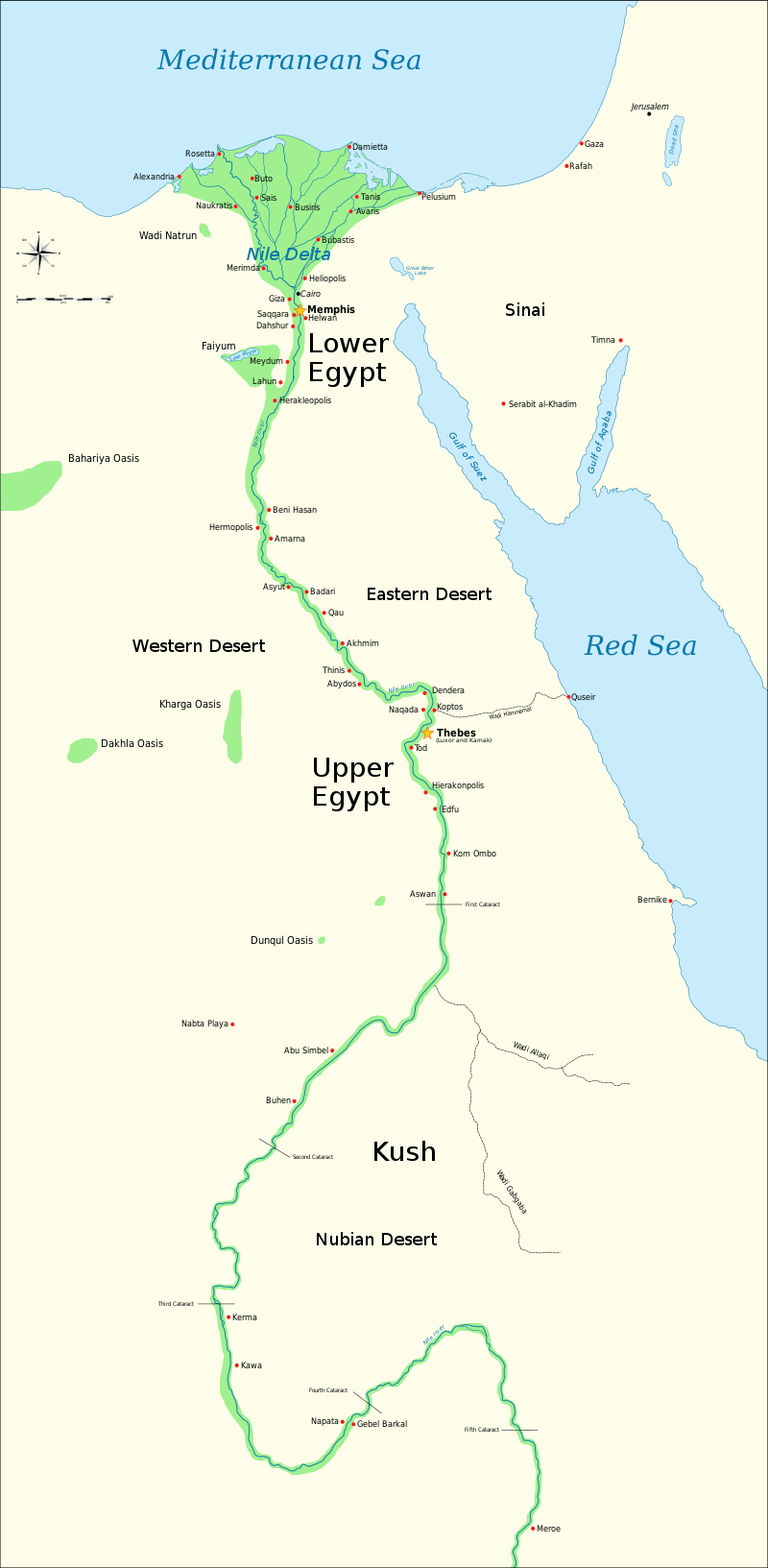
At this same time, to the south in Nubia, the kingdom of Kush was again on the rise. They pushed their borders north to Thebes, establishing themselves as kings of Egypt and founding the Twenty-fifth Dynasty, bringing the disjointed Third Intermediate Period to a close.
Ancient Egyptian Religious Practices: Temple of Amun-Re and the Hypostyle Hall, Karnak
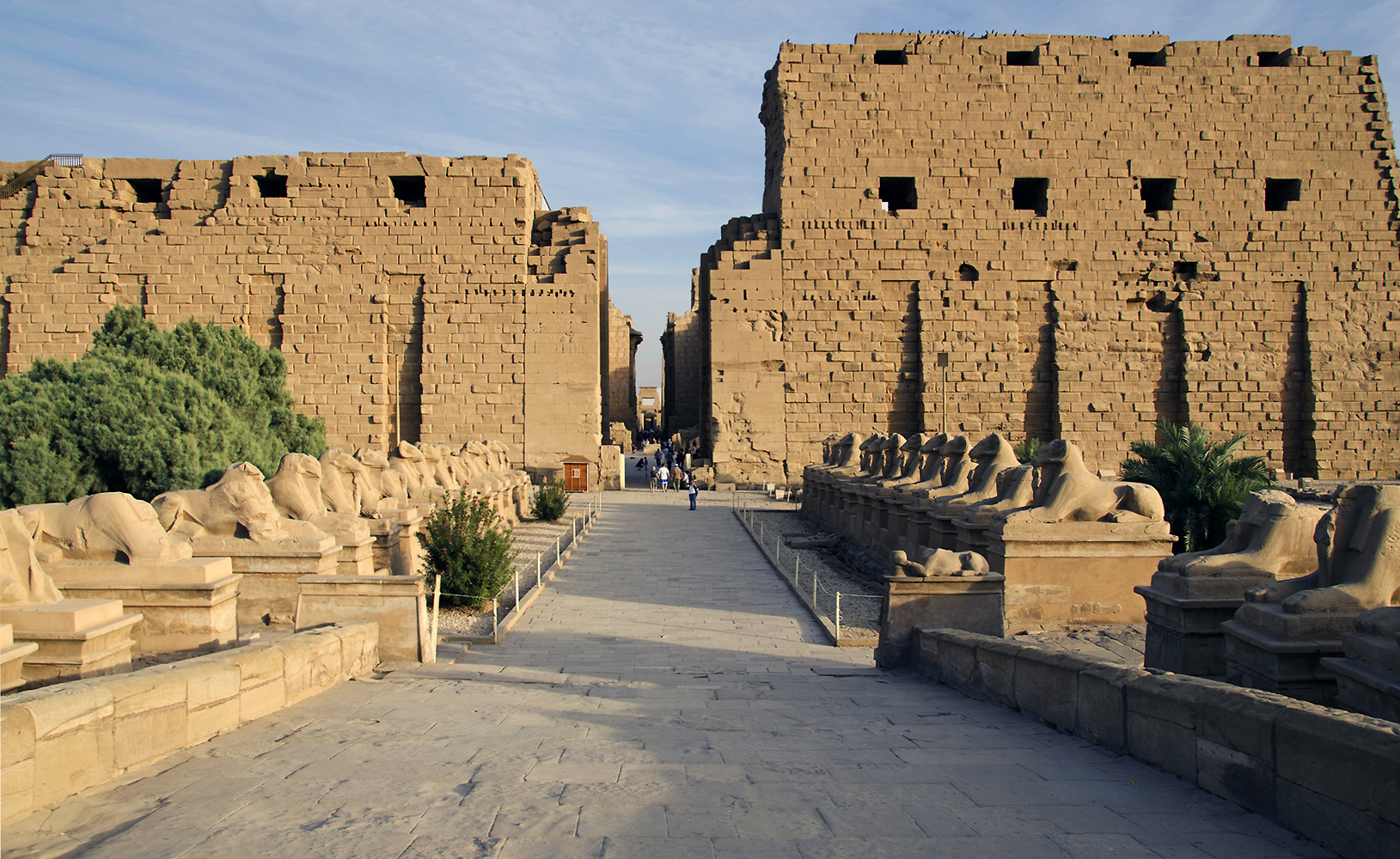
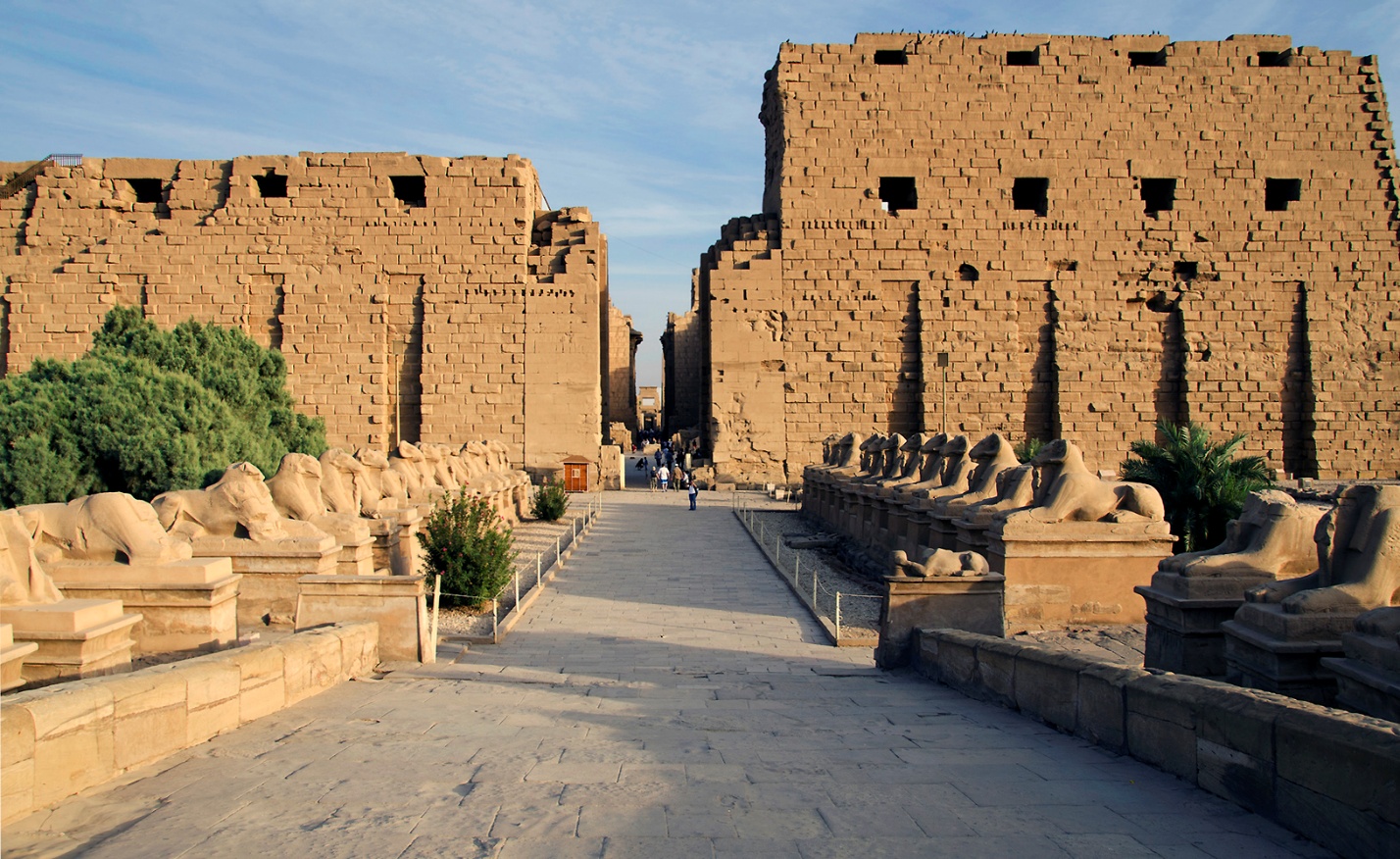
The massive temple complex of Karnak was the principal religious center of the god Amun-Re in Thebes during the New Kingdom (which lasted from 1550 until 1070 B.C.E.). The complex remains one of the largest religious complexes in the world. However, Karnak was not just one temple dedicated to one god—it held not only the main precinct to the god Amun-Re—but also the precincts of the gods Mut and Montu. Compared to other temple compounds that survive from ancient Egypt, Karnak is in a poor state of preservation but it still gives scholars a wealth of information about Egyptian religion and art.
“The Most Select of Places”
The site was first developed during the Middle Kingdom (2055–1650 B.C.E.) and was initially modest in scale but as new importance was placed on the city of Thebes, subsequent pharaohs began to place their own mark on Karnak. The main precinct alone would eventually have as many as twenty temples and chapels. [1] Karnak was known in ancient times as “The Most Select of Places” (Ipet-isut) and was not only the location of the cult image of Amun and a place for the god to dwell on earth but also a working estate for the priestly community who lived on site. Additional buildings included a sacred lake, kitchens, and workshops for the production of religious accoutrements.
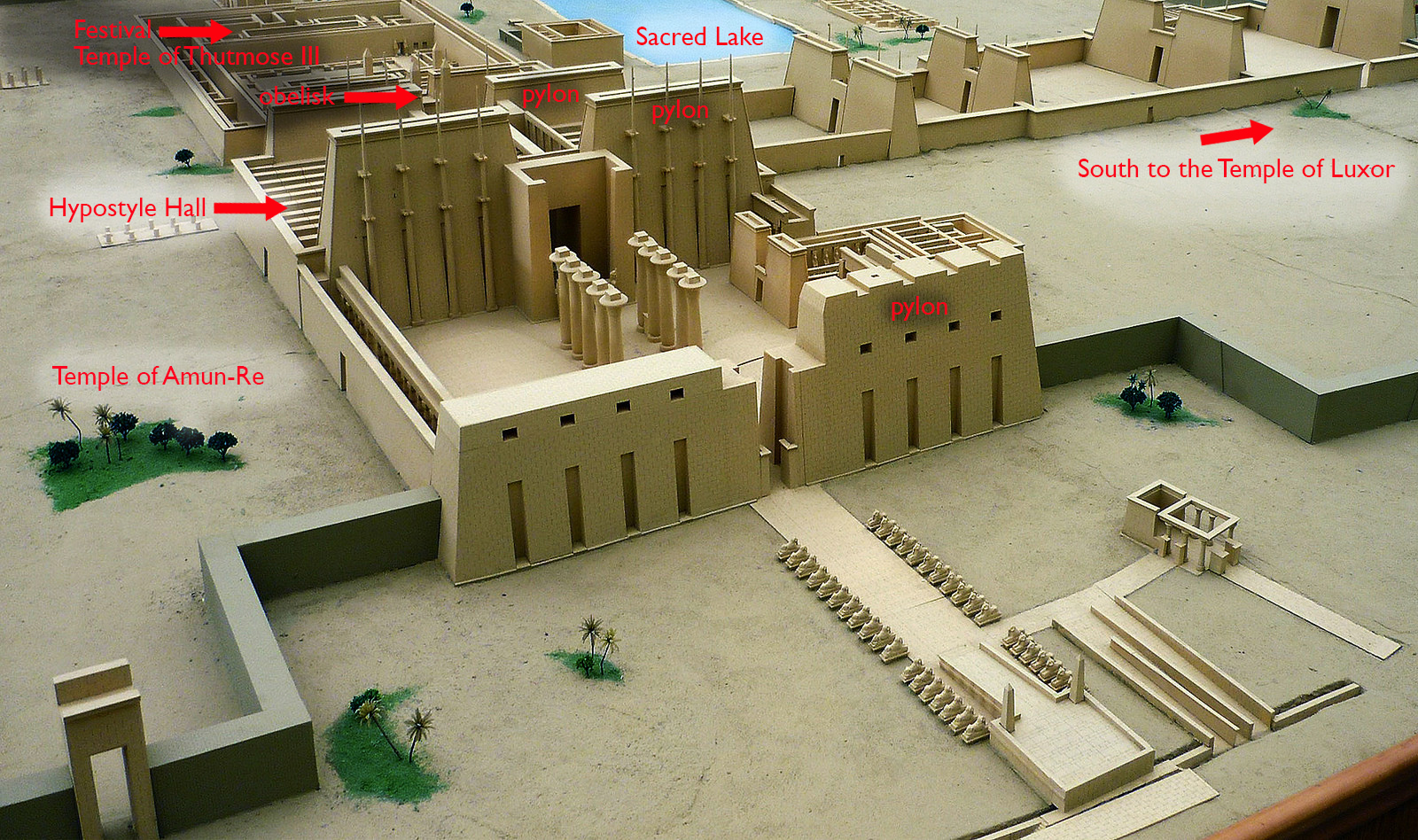
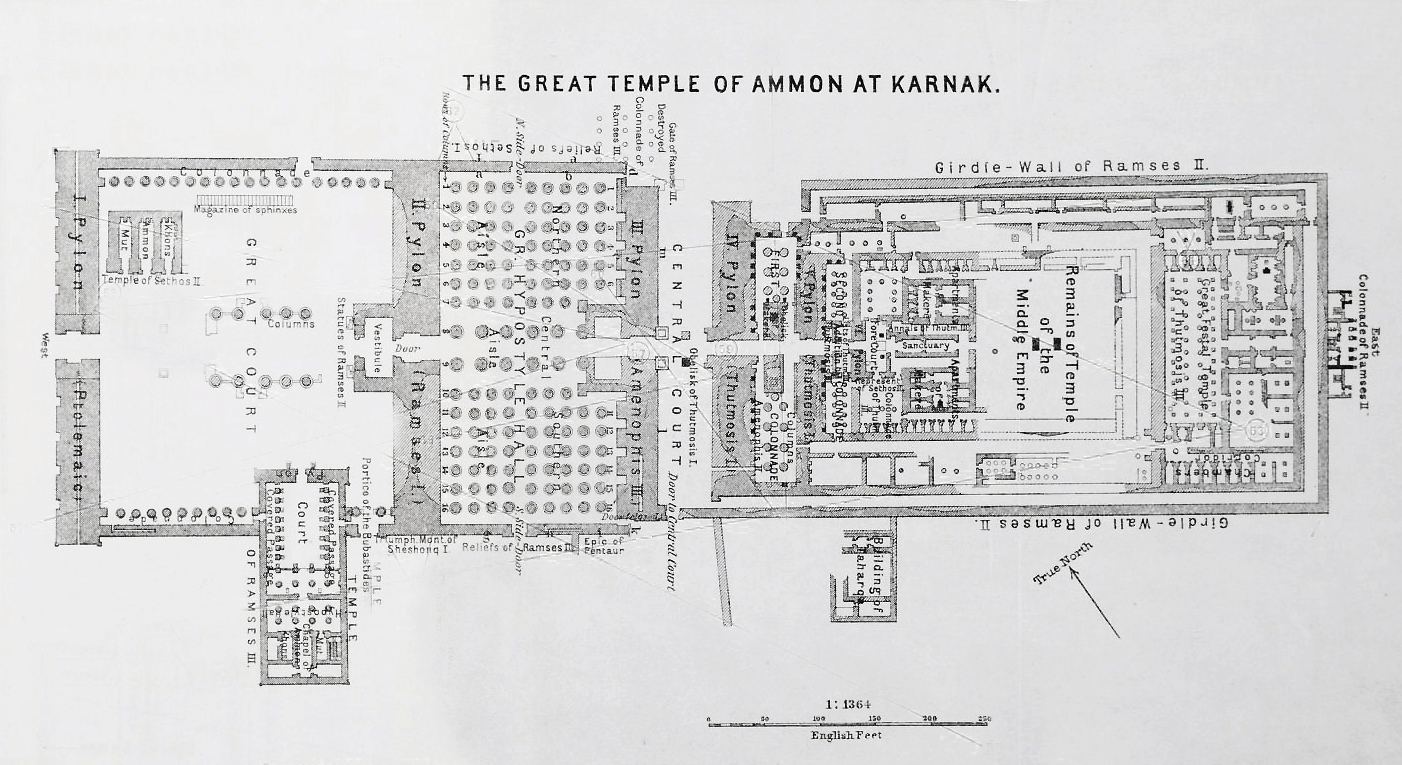
The main temple of Amun-Re had two axes—one that went north/south and the other that extended east/west. The southern axis continued towards the temple of Luxor and was connected by an avenue of ram-headed sphinxes.
While the sanctuary was plundered for stone in ancient times, there are still a number of unique architectural features within this vast complex. For example, the tallest obelisk in Egypt stood at Karnak and was dedicated by the female pharaoh Hatshepsut who ruled Egypt during the New Kingdom. Made of one piece of red granite, it originally had a matching obelisk that was removed by the Roman emperor Constantine and re-erected in Rome. Another unusual feature was the Festival Temple of Thutmose III, which had columns that represented tent poles, a feature this pharaoh was no doubt familiar with from his many war campaigns.
Hypostyle hall
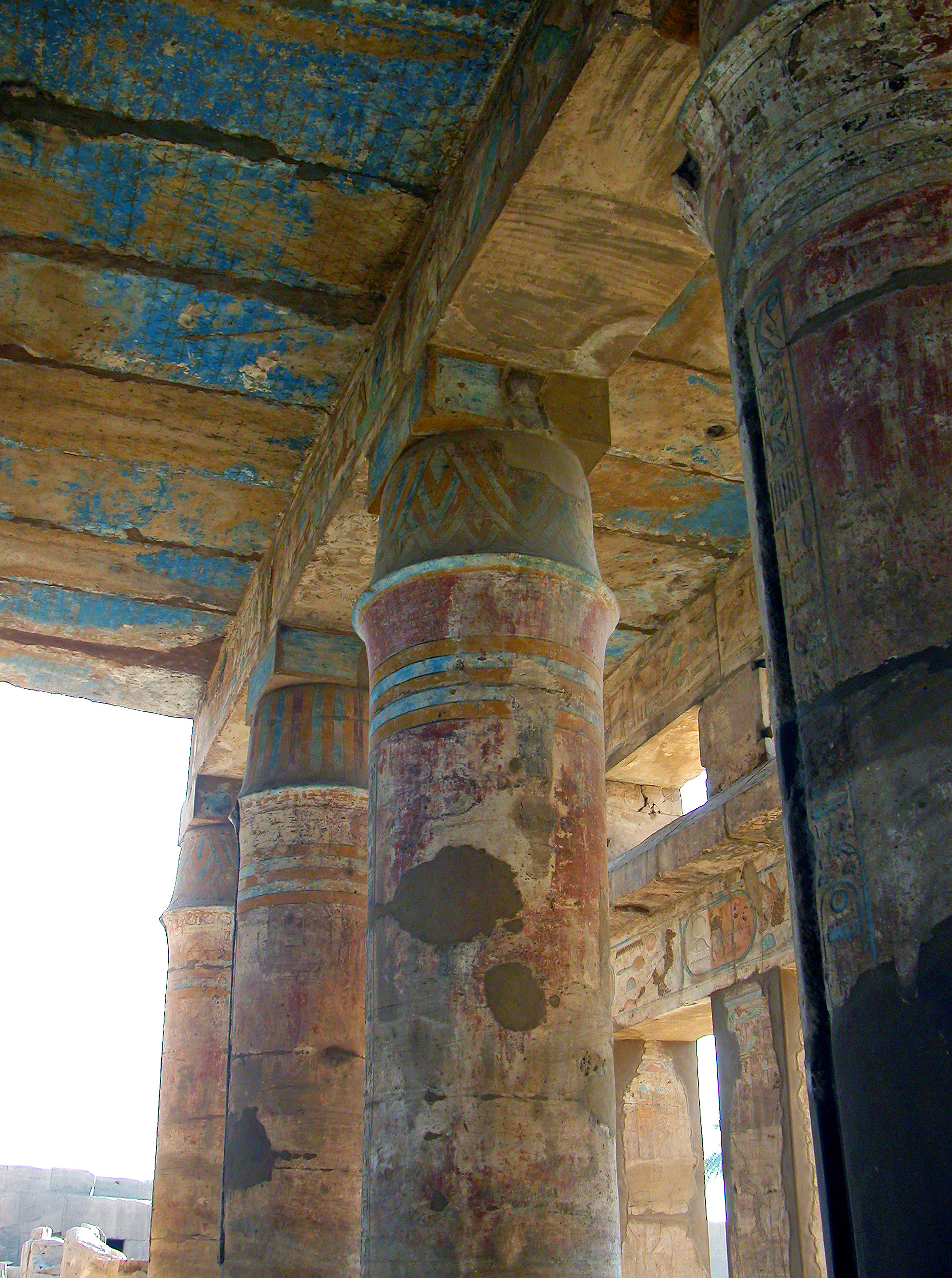
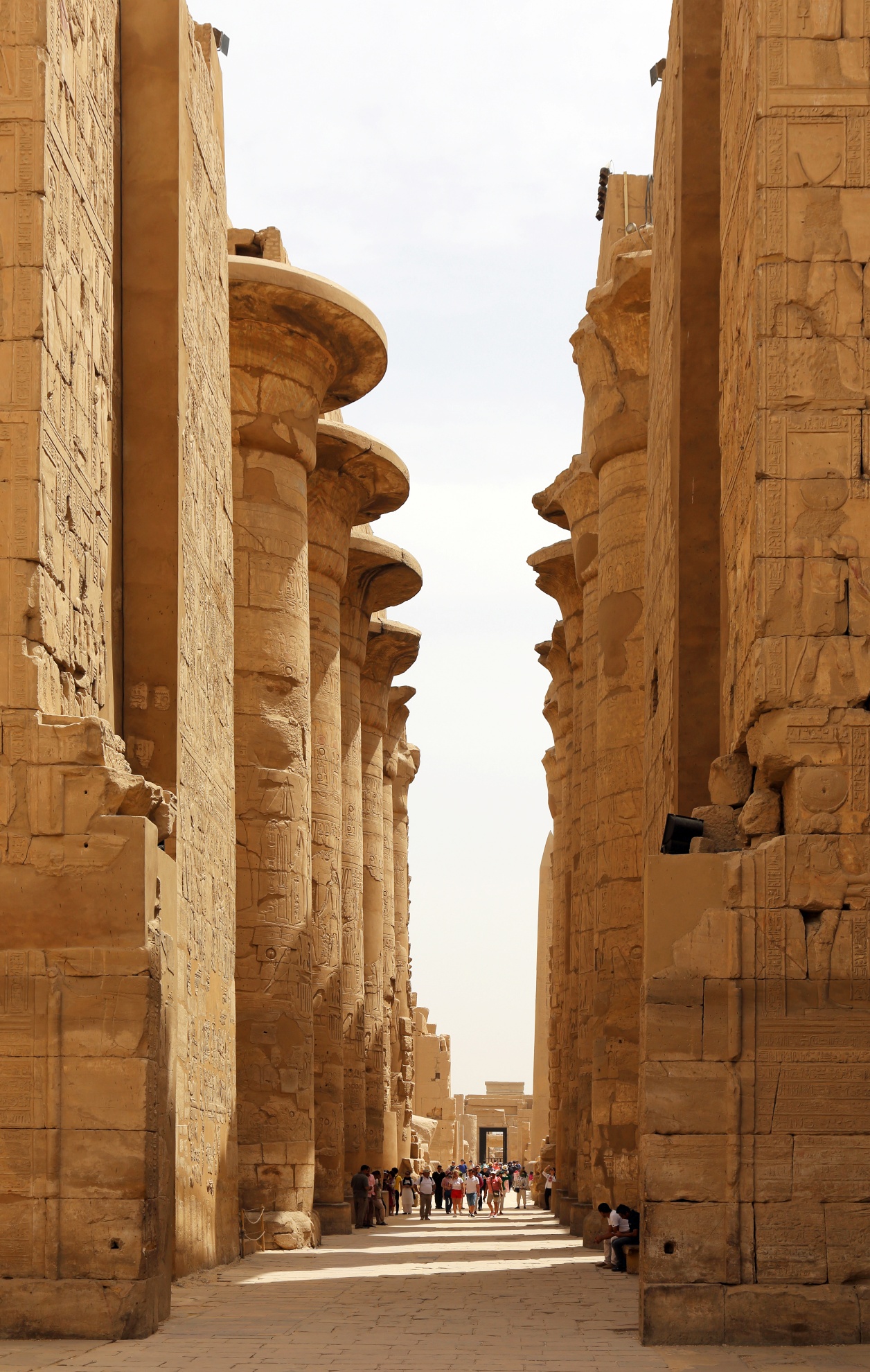
One of the greatest architectural marvels of Karnak is the hypostyle hall (a space with a roof supported by columns) built during the Ramesside period. The hall has 134 massive sandstone columns with the center twelve columns standing at 69 feet. Like most of the temple decoration, the hall would have been brightly painted and some of this paint still exists on the upper portions of the columns and ceiling today. With the center of the hall taller than the spaces on either side, the Egyptians allowed for clerestory lighting (a section of wall that allowed light and air into the otherwise dark space below). In fact, the earliest evidence for clerestory lighting comes from Egypt. Not many ancient Egyptians would have had access to this hall, since the further one went into the temple, the more restricted access became.
Temple as cosmos
Conceptually, temples in Egypt were connected to the idea of zep tepi, or “the first time,” the beginnings of the creation of the world. The temple was a reflection of this time, when the mound of creation emerged from the primeval waters. The pylons, or gateways in the temple represent the horizon, and as one moves further into the temple, the floor rises until it reaches the sanctuary of the god, giving the impression of a rising mound, like that during creation. The temple roof represented the sky and was often decorated with stars and birds. The columns were designed with lotus, papyrus, and palm plants in order to reflect the marsh-like environment of creation. The outer areas of Karnak, which was located near the Nile River, would flood during the annual inundation—an intentional effect by the ancient designers no doubt, in order to enhance the temple’s symbolism. [2]
Mortuary Temple and Large Kneeling Statue of Hatshepsut
Egyptian kings were typically men, but Hatshepsut became pharaoh and used art to convey her divine and royal authority. Hatshepsut controlled Egypt for roughly 20 years at the height of the Eighteenth Dynasty. Built opposite the Valley of the Kings on the west side of the Nile from Thebes, the Mortuary temple to Hatshepsut served to assert her authority and connect her reign with Egyptian pharaohs of the past.
Amarna Style: House Altar depicting Akhenaten, Nefertiti and Three of their Daughters
Upon becoming pharaoh, Akhenaten revolutionized the religion and artistic style of Egypt—at least until his death. The son of Amenhotep III and Tiye, Amenhotep IV changed his name to Akhenaten. Akhenaten was dedicated to Aten, a form of the sun god who manifested as a disc. He relocated the capital from Thebes to Akhet Aten (Amarna) and took control as the singular representative of Aten. Akhenaten’s reforms developed into an artistic style remarkably different from traditional Egyptian conventions.
From Amarna back to tradition: Tutankhamun’s tomb (innermost coffin and death mask)
Akhenaten’s young successor and son Tutankhamun (better known as King Tut), moved the religious capital back to Thebes, re-establishing Amun-Ra as the chief national deity. Akhenaten’s reign was viewed as a time of chaos by later kings. Later pharaohs intentionally removed the record of Akhenaten and his immediate successors, Tutankhamun and Ay.
Nearly lost to history
Tutankhamun was only the age of nine when he became king of Egypt during the 18th dynasty of the New Kingdom (c. 1332–1323 B.C.E.). His story would have been lost to history if it were not for the discovery of his tomb in 1922 by the archaeologist Howard Carter in the Valley of the Kings. His nearly intact tomb held a wealth of objects that give us unique insights into this period of ancient Egyptian history.
Tutankhamun ruled after the Amarna age, when the pharaoh Akhenaten, Tutankhamun’s probable father, turned the religious attention of the kingdom to the worship of the god Aten, the sun disc. Akhenaten moved his capital city to the site of Akhetaten (also known as Amarna), in Middle Egypt—far from the previous pharaoh’s capital. After Akhenaten’s death and the rule of a short-lived pharaoh, Smenkhkare, Tutankhamen shifted the focus of the country’s worship back to the god Amun and returned the religious center back to Thebes.
Tutankhamun married his half-sister, Ankhesenamun, but they did not produce an heir. This left the line of succession unclear. Tutankhamun died at the young age of eighteen, leading many scholars to speculate on the manner of his death—chariot accident, murder by blow to the head, and even a hippopotamus attack! The answer is still unclear. Tutankhamun’s much-older advisor (and possible step-grandfather), Ay, married the widowed Ankhesenamun and became pharaoh.
The tomb
During the early twentieth century, Howard Carter, a British Egyptologist, excavated for many years in the Valley of the Kings—a royal burial ground located on the west bank of the ancient city of Thebes. He was running out of money to support his archaeological digs when he asked for funding for one more season from his financial backer, the fifth Earl of Carnarvon. Lord Carnarvon granted him one more year—and what a year it was!
At the beginning of November 1922, Carter came upon the first of twelve steps of the entrance that led to the tomb of Tutankhamun. He quickly recovered the steps and sent a telegram to Carnarvon in England so they could open the tomb together. Carnarvon departed for Egypt immediately and on November 26, 1922, they made a hole in the entrance of the antechamber in order to look in. Carter states:
“At first I could see nothing, the hot air escaping from the chamber causing the candle flame to flicker, but presently, as my eyes grew accustomed to the lights, details of the room within emerged slowly from the mist, strange animals, statues, and gold—everywhere the glint of gold.[3]”
The task of cataloging the finds was an immense undertaking for the team. Carter spent a decade systematically recording the finds and having them photographed.
The innermost coffin
Tutankhamun’s sarcophagus (a box-like stone container) held not one but three coffins in which to hold the body of the king. The outer two coffins were crafted in wood and covered in gold along with many semiprecious stones, such as lapis lazuli and turquoise.
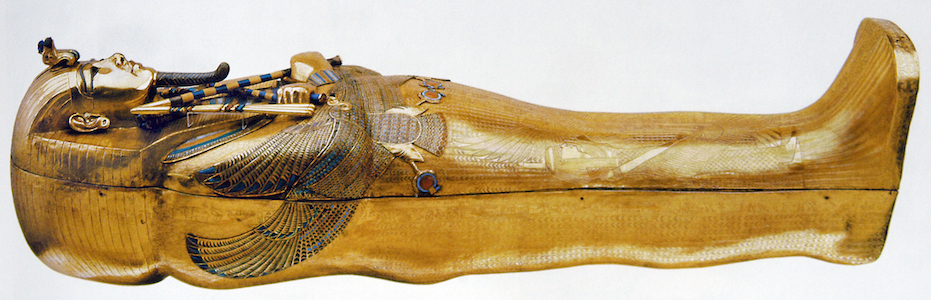
The inner coffin, however, was made of solid gold. When Howard Carter first came upon this coffin, it was not the shiny golden image we see in the Egyptian Museum today. In his excavation notes, Carter states, it was
“covered with a thick black pitch-like layer which extended from the hands down to the ankles (top image). This was obviously an anointing liquid which had been poured over the coffin during the burial ceremony and in great quantity (some two buckets full).[4]”
The image of the pharaoh is that of a god. The gods were thought to have skin of gold, bones of silver, and hair of lapis lazuli—so the king is shown here in his divine form in the afterlife. He holds the crook and flail, symbols of the king’s right to rule. The goddesses Nekhbet (vulture) and Wadjet (cobra), inlaid with semiprecious stones, stretch their wings across his torso. Beneath these goddesses are two more—Isis and Nephthys—etched into the gold lid.
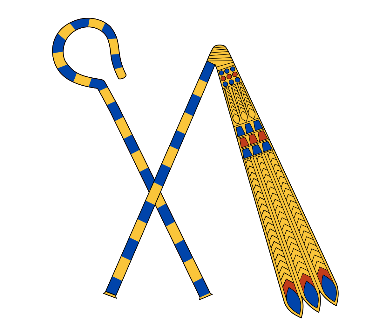
The death mask of Tutankhamun
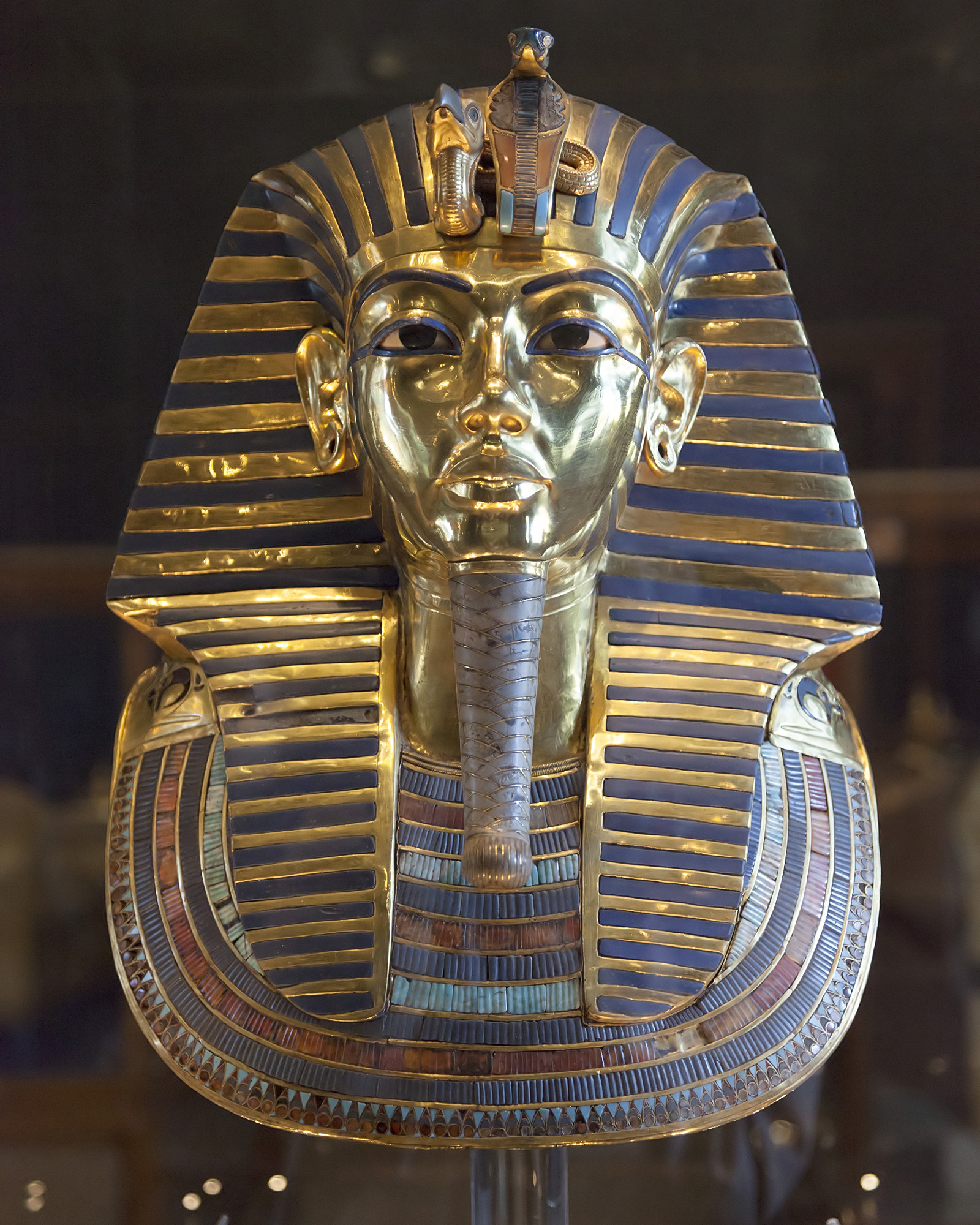
The death mask is considered one of the masterpieces of Egyptian art. It originally rested directly on the shoulders of the mummy inside the innermost gold coffin. It is constructed of two sheets of gold that were hammered together and weighs 22.5 pounds (10.23 kg). Tutankhamen is depicted wearing the striped nemes headdress (the striped head-cloth typically worn by pharaohs in ancient Egypt) with the goddesses Nekhbet and Wadjet depicted again protecting his brow. He also wears a false beard that further connects him to the image of a god as with the inner coffin. He wears a broad collar, which ends in terminals shaped as falcon heads. The back of the mask is covered with Spell 151b from the Book of the Dead, which the Egyptians used as a road map for the afterlife. This particular spell protects the various limbs of Tutankhamun as he moves into the underworld.
Practicing Visual Analysis
The Death Mask of Tutankhamun is an iconic work of art. Egyptian artists seamlessly blended the formal elements with iconographic symbolism. As a figurative form, the viewer can clearly identify the idealized portrait of an Egyptian king. Almost perfectly symmetrical in composition, the artists crafted the smooth texture of golden color skin for Tutankhamun. Black contour lines define the eyes while Tutankhamun wears the patterned nemes headdress alternating with the colors of blue and gold. A similar alternating pattern of color occurs on the false beard. The rectilinear lines of the striped nemes lead the viewer’s eye toward the face of the youthful, expressionless king.
Conclusion
With Tutankhamun’s reign and death, Egypt returned to its long-standing traditional polytheistic religion and artistic style. Interestingly, Tutankhamun’s tomb featured artifacts showing elements of the Amarna style begun by Akhenaten. This includes Tutankhamun’s throne. However, other artworks found in Tutankhamun’s tomb, from the death mask to the innermost coffin, utilized the traditional Egyptian style: youthful, front facing, symmetrical, and idealized. Tutankhamun is shown with royal symbols, including the crook and flail in the coffin and the false beard, uraeus, and nemes in the death mask. These stylistic features and symbols connected back to the traditional symbols of ancient Egyptian kingship used since the predynastic and Old Kingdom periods.
Citation and Licensing
The following sections were written by Chelsea Wright and are licensed CC BY-NC-SA 4.0:
- Chapter Overview and Introduction
- Focus artwork and term list compiled by Chelsea Wright
- Practicing Visual Analysis
- Conclusion
The following articles from Smarthistory licensed CC BY-NC-SA 4.0 were remixed and adapted for the chapter:
- Dr. Amy Calvert, “New Kingdom and Third Intermediate Period, an introduction,” in Smarthistory, February 14, 2022.
- Dr. Elizabeth Cummins, “Temple of Amun-Re and the Hypostyle Hall, Karnak,” in Smarthistory, November 27, 2015.
- Dr. Beth Harris and Dr. Steven Zucker, “Mortuary Temple and Large Kneeling Statue of Hatshepsut,” in Smarthistory, August 9, 2015.
- Dr. Steven Zucker and Dr. Beth Harris, “House Altar depicting Akhenaten, Nefertiti and Three of their Daughters,” in Smarthistory, December 6, 2015.
- Dr. Elizabeth Cummins, “Tutankhamun’s tomb (innermost coffin and death mask),” in Smarthistory, August 8, 2015.
- R. Wilkinson, The Complete Temples of Ancient Egypt (New York: Thames & Hudson, 2000), p. 154. ↵
- Wilkinson (2000), p. 77. ↵
- Howard Carter and A. C. Mace, The Tomb of Tut-ankh-amen, volume 1 (New York: Cooper Square Publishers, 1933), pp. 95–96. ↵
- Nicholas Reeves, The Complete Tutankhamun (London: Thames and Hudson, 1990), pp. 108–09. ↵