Chapter Overview and Introduction
Even today, Ancient Egypt continues to capture imaginations. The aesthetics of Ancient Egyptian art and architecture developed during the Predynastic and Old Kingdom periods. During these eras, ancient Egyptians established a canon of proportions that lasted over 2,500 years! The Egyptian canon of proportions used in royal portraiture (King Menkaure and queen) contrasted greatly with the aesthetics used for non-royal portraiture (Seated Scribe). As the only surviving “Seven Wonders of the Ancient World,” the iconic Pyramid of Khufu exemplifies the role of the Pharaoh in ancient Egyptian society.
Focus Artworks
- Palette of King Narmer, from Hierakonpolis, Egypt, Predynastic, c. 3000-2920 B.C.E., slate
- Great Pyramids, Giza, Egypt, Fourth Dynasty. Pyramid of Khufu, c. 2551–2528 B.C.E.
- King Menkaure (Mycerinus) and queen, c. 2490–2472 B.C.E. Egyptian, Old Kingdom, Dynasty 4, reign of Menkaure, greywacke
- Seated Scribe, c. 2500 B.C.E., c. 4th Dynasty, Old Kingdom, painted limestone with rock crystal, magnesite, and copper/arsenic inlay for the eyes and wood for the nipples, found in Saqqara
Term List
- Ma’at
- Isfet
- Ka
- Pharaoh
- Horus
- Kingdoms
- Periods
- Divine cult statue
- Registers
- Hierarchy of scale
- Hieroglyphs
- Low relief carving
- Pyramid
- Mastaba
- Ben-ben stone
- Shendjet
- Nemes
- Uraeus
Ancient Egypt, an introduction
Egypt’s impact on other cultures was undeniably immense. From the earliest periods of Predynastic Egypt, there is evidence of trade connections that extended as far east as the Indus Valley. These trade routes passed through the Near East, resulting in an early exchange of motifs and ideas between the civilizations of Mesopotamia and Egypt. The New Kingdom brought even more active connections with Western Asia, including robust commercial and diplomatic relationships as well as a mutual exchange of imagery and concepts with cultures like the Assyrians and the Hittites. Lively interactions with the south contributed to dynamic cultures, such as the Kushites, who ruled Egypt during the 25th Dynasty and whose monuments displayed an innovative blend of local Nubian and pharaonic imagery.
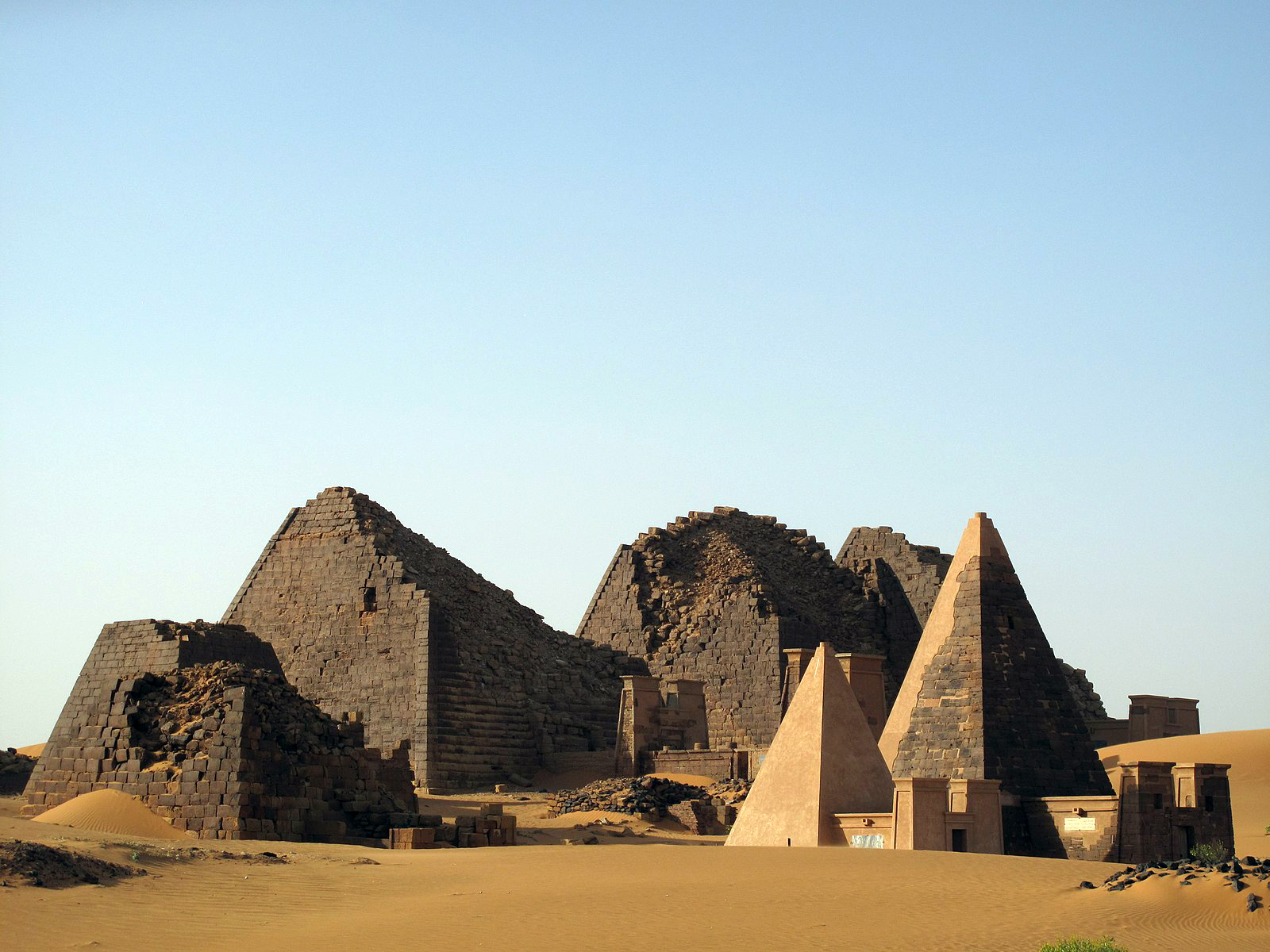
Rulers and the elite from Meroe, in modern Sudan, were buried in pyramid tombs for many centuries—with more than 200 having been identified, that country actually contains more pyramids within its borders than Egypt does. Egypt also provided some of the building blocks for the Aegean, Greek, and Roman cultures and, through them, influenced many aspects of Western tradition.
Today, Egyptian imagery, concepts, and perspectives are found everywhere; when you know what to look for, you will see them in architectural forms, on money, and in our day-to-day lives. Many cosmetic surgeons, for example, use the silhouette of Queen Nefertiti (whose name means “the beautiful one has come”) in their advertisements.
Longevity
Ancient Egyptian civilization lasted for more than 3,000 years and showed a stunning level of continuity. That is more than 15 times the age of the United States, and consider how often our culture shifts; as recently as 2003, there was no Facebook, Twitter, or YouTube.
While today we consider the Greco-Roman period to be in the distant past, it should be noted that Cleopatra VII’s reign is closer to our own time than it was to that of the construction of the pyramids of Giza. It took humans nearly 4,000 years to build something—anything—taller than the Great Pyramid. Contrast that span to modern times; we get excited when a record lasts longer than a decade.
Consistency and stability

Egypt’s stability is in stark contrast to the Ancient Near East of the same period, which endured an overlapping series of cultures and upheavals with amazing regularity. The earliest royal monuments, such as the Narmer Palette carved around 3100 B.C.E., display identical royal costumes and poses as those seen on later rulers, even Ptolemaic kings and Roman emperors on their temples more than three millennia later.
This consistency and stability is closely linked with one of the central foundational concepts in the way ancient Egyptians saw the world around them. In their view, creation occurred when order triumphed over chaos and harnessed that amorphous power to bring the land of Egypt into existence. The perfect cosmic balance that resulted created the consistent cycles they saw in their natural world, such as the daily rising and setting of the sun and the Nile’s annual inundation. This divine order was known as ma’at—embodying truth, righteousness, justice, and cosmic law—and was eventually personified as a goddess. There was a perpetual struggle between ma’at and the chaos, known as isfet. From early in Egypt’s history, a primary role of the pharaoh was to be the champion of ma’at and preserve that cosmic order to help protect Egypt from the isfet that surrounded them. The ongoing preservation of ma’at was seen as fundamentally important and the drive to maintain that perfect cosmic balance permeated the culture on multiple levels.
A vast amount of Egyptian imagery, especially royal imagery that was governed by decorum (a sense of what was ‘appropriate’), remained extraordinarily consistent throughout its history. This is why, especially to the untrained eye, their art appears extremely static—and in terms of symbols, gestures, and the way the body is rendered, it was. It was intentional, as the consistency was the whole point. The Egyptians were well aware of their consistency, which they viewed as stability, divine balance, and clear evidence of ma’at and the correctness of their culture.
This consistency was also closely related to a fundamental belief that depictions had an impact beyond the image itself—tomb scenes of the deceased receiving food or temple scenes of the king performing perfect rituals for the gods were functionally causing those things to occur in the divine realm. If the image of the bread loaf was omitted from the deceased’s table, they had no bread in the afterlife; if the king was depicted with the incorrect ritual implement, the ritual was incorrect and could have dire consequences. This belief led to active resistance to change in codified depictions.
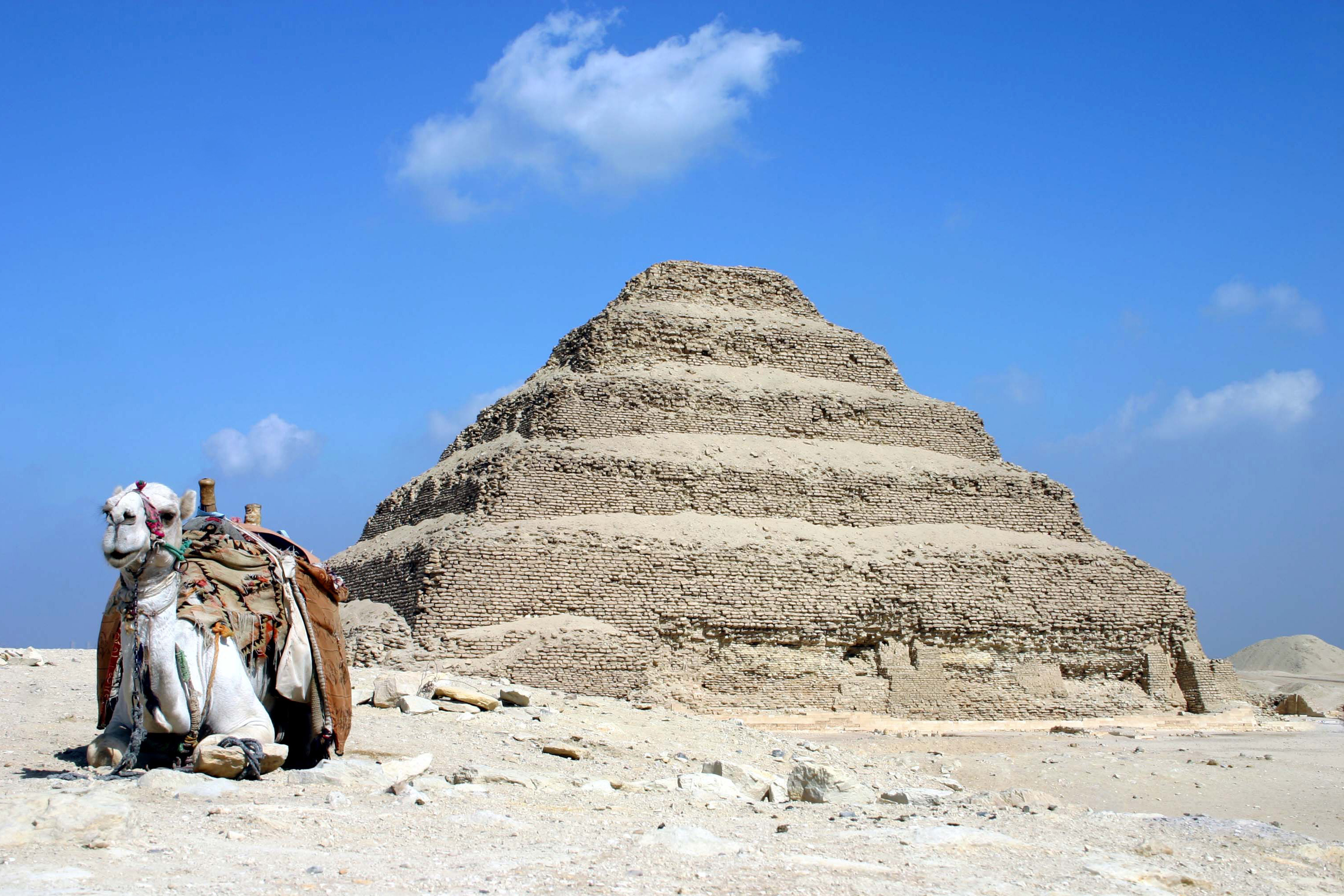
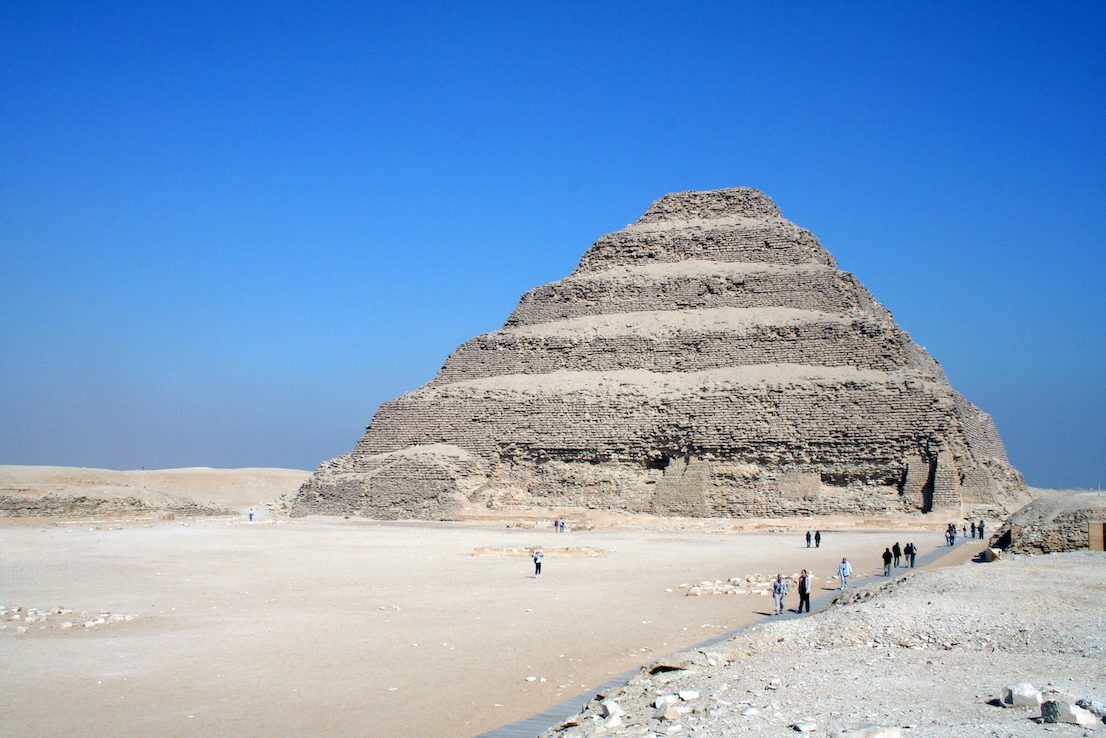
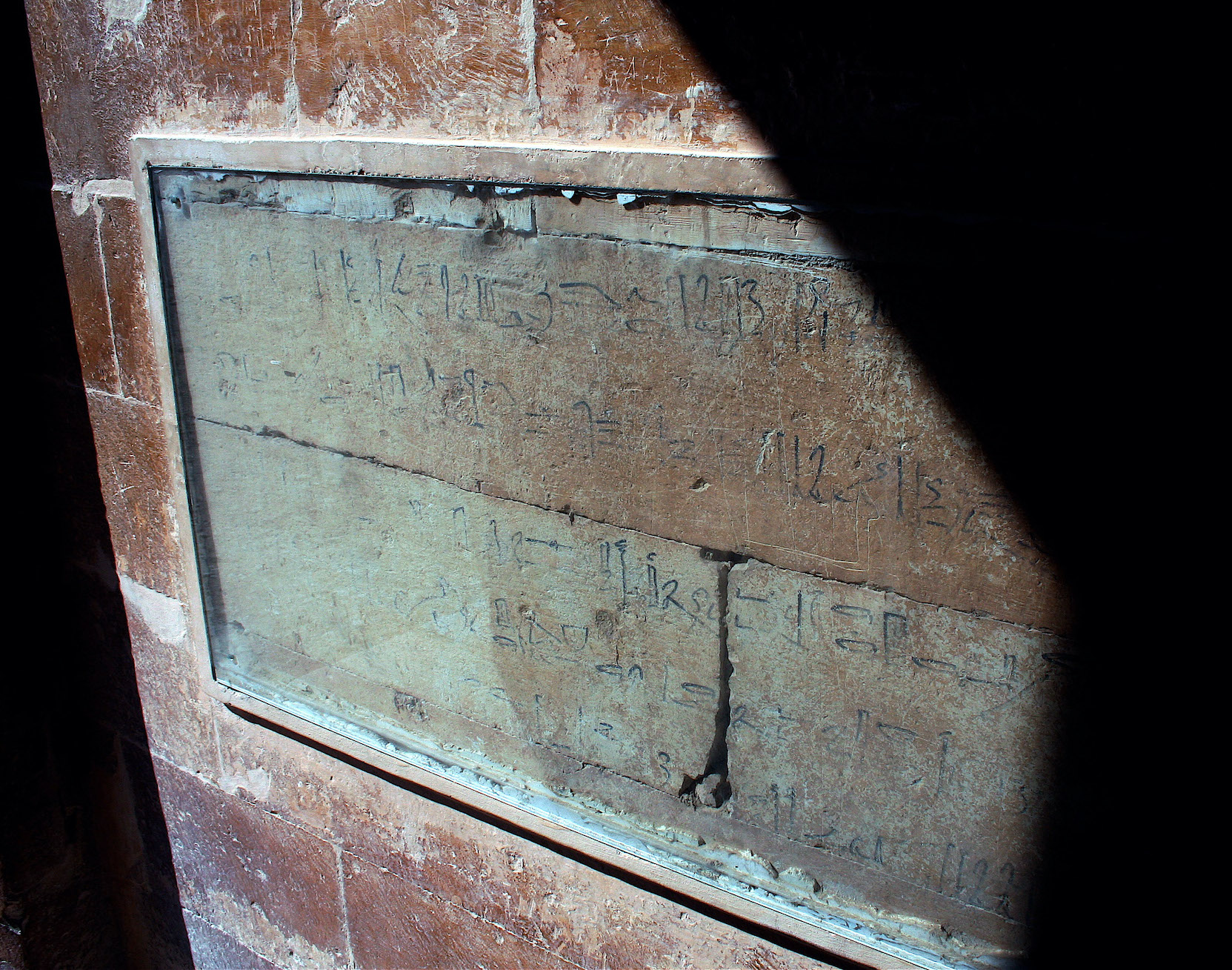
The earliest recorded “tourist graffiti” on the planet came from a visitor from the time of Ramses II, who left their appreciative mark at the already 1300-year-old site of the Step Pyramid at Saqqara, the earliest of the massive royal stone monuments. They were understandably impressed by the works of their ancestors and wrote of their desire to continue that ancient legacy.
Geography
Egypt is a land of duality and cycles, both in topography and culture. The geography is almost entirely rugged, barren desert, except for an explosion of green that straddles either side of the Nile as it flows the length of the country. The river emerges from far to the south, deep in Africa, and empties into the Mediterranean sea in the north after spreading from a single channel into a fan-shaped system, known as a delta, in its northernmost section. The river valley is flanked by imposing cliffs of limestone and sandstone, with deposits of other, harder stones like granite and granodiorite being found in the area of Aswan to the south.
One of the reasons for the overall stability of Egyptian culture was that it was largely isolated by virtue of its geography. With high cliffs and expansive deserts bordering the east and west, the sea at the north, and a series of huge rapids in the Nile to the south (known as cataracts), the stretch of the river valley that gave rise to dynastic Egypt was quite closed off from the outside. Egypt was undoubtedly the “gift of the Nile,” as the Greek historian Herodotus famously wrote. The influence of this river on Egyptian culture and development cannot be overstated without its presence, the civilization would have been entirely different. The Nile provided not only a constant source of life-giving water, but created the fertile lands that fed the growth of this unique (and uniquely resilient) culture.
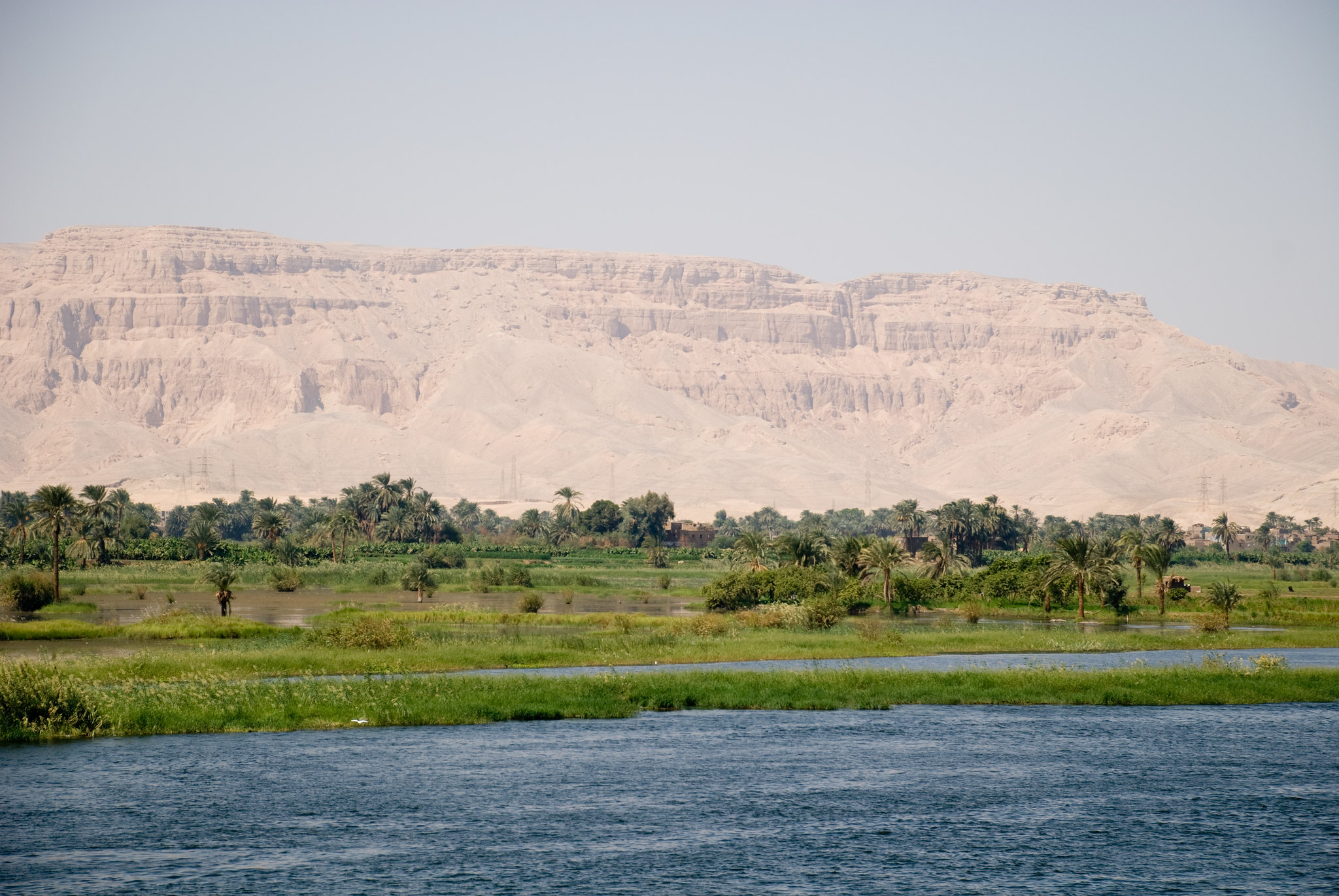
Each year, fed by melting snow in the far-off headlands deep in Africa, the Nile overflowed its banks in an annual flood that covered the ground with rich, black silt and produced incredibly fertile fields. The Egyptians referred to this area as Kemet, the “Black Lands,” and contrasted this dense, dark soil against the Deshret, the “Red Lands” of the sterile desert; the line between these zones was (and in most cases still is) a literal line. The visual effect is stark, appearing almost artificial in its precision.
Time—cyclical and linear
The annual inundation of the Nile was also a reliable and measurable cycle that helped form their concept of the passage of time. In fact, the calendar we use today in the west is derived from one developed by the ancient Egyptians. They divided the year into 3 seasons: akhet (“inundation”), peret (“growing/emergence”), and shemw (“harvest”); each season was divided into four 30-day months.
Although this annual cycle, paired with the daily solar cycle that is so evident in the desert, led to a powerful drive to see the universe in terms of cyclical time, this idea existed simultaneously with the reality of linear time. These two concepts—the cyclical and the linear—came to be associated with two of their primary deities: Osiris, the eternal lord of the dead, and Ra, the sun god who was reborn with each dawn.
The pharaoh—not just a king
Rulers in Egypt were complex intermediaries that straddled the terrestrial and divine realms. They were, obviously, living humans, but upon accession to the throne, they also embodied the eternal office of kingship itself. The ka, or spirit, of kingship was often depicted as a separate entity standing behind the human ruler. This divine aspect of the office of kingship was what gave authority to the individual person who was the king. The living king was associated with the god Horus, the powerful, virile falcon-headed god who was believed to bestow the throne to the first human king.
Horus’s immensely important father, Osiris, was the lord of the underworld. One of the original divine rulers of Egypt, this deity embodied the promise of regeneration. Cruelly murdered by his brother Seth, the god of the chaotic desert, Osiris was revived through the potent magic of his wife Isis. Through her knowledge and skill, Osiris was able to sire the miraculous Horus, who avenged his father and threw his criminal uncle off the throne to take his rightful place.
Osiris became ruler of the realm of the dead, the eternal source of regeneration in the afterlife. Deceased kings were identified with this god, creating a cycle where the dead king fused with the divine ruler of the dead, and his successor “defeated” death to take his place on the throne as Horus.
The development of Ancient Egypt
The civilization of Egypt obviously did not spring fully formed from the Nile mud; although the massive pyramids at Giza may appear to the uninitiated to have appeared out of nowhere, they were founded on thousands of years of cultural and technological development and experimentation.
Ancient Egyptian chronology
Dynasties, periods, and reigns
It is important to recognize that the dynastic divisions modern scholars use were not used by the ancients themselves. These divisions were created in the first chronological history of Egypt, written by an Egyptian priest named Manetho in the 3rd century B.C.E. Each of the 30 dynasties included a series of rulers usually related by family connections or the location of their seat of power. Egyptian history is also divided into larger chunks, known as “kingdoms” and “periods,” to distinguish times of strength and unity (kingdoms) from those of change, foreign rule, or disunity (periods).
Like many other ancient cultures, the Egyptians themselves referred to their history in relation to the ruler of the time. Years were recorded as the regnal dates of the ruling king, so that with each new reign, the numbers began anew. The usual dating format included the day of the month and season, along with the regnal year of the king—for example, “day 4 of the second month of the season peret in the third year of Khafre.” This ancient practice creates challenges for modern historians, making it difficult to determine exact dating for many events and reigns; this is the reason that different resource books on ancient Egypt may provide slightly different dates for the same object. Generally, dates are provided here as “circa,” (c.) or approximate, for this reason.
| Period | Dates |
|---|---|
| Predynastic | c. 5000–3000 B.C.E. |
| Early Dynastic | c. 3000–2686 B.C.E. |
| Old Kingdom (the ‘pyramid age’) | c. 2686–2150 B.C.E. |
| First Intermediate Period | c. 2150–2030 B.C.E. |
| Middle Kingdom | c. 2030–1640 B.C.E. |
| Second Intermediate Period
(Northern Delta region ruled by Asiatics) |
c. 1640–1540 B.C.E. |
| New Kingdom | c. 1550–1070 B.C.E. |
| Third Intermediate Period | c. 1070–713 B.C.E. |
| Late Period
(a series of rulers from foreign dynasties, including Nubian, Libyan, and Persian rulers) |
c. 713–332 B.C.E. |
| Ptolemaic Period
(ruled by Greco-Romans) |
c. 332–30 B.C.E. |
| Roman Period | c. 30 B.C.E.–395 C.E. |
Periods and main characteristics
Egypt went through many waves of cultural development. Although its early development of beliefs, social structures, and imagery remained stable and iconic for millennia to come, later periods introduced new ideas that required adjustment. The Egyptians were extremely flexible because of their core stability, based on central beliefs that were set very early in their history.
Ancient Egyptian art
Appreciating and understanding Ancient Egyptian art
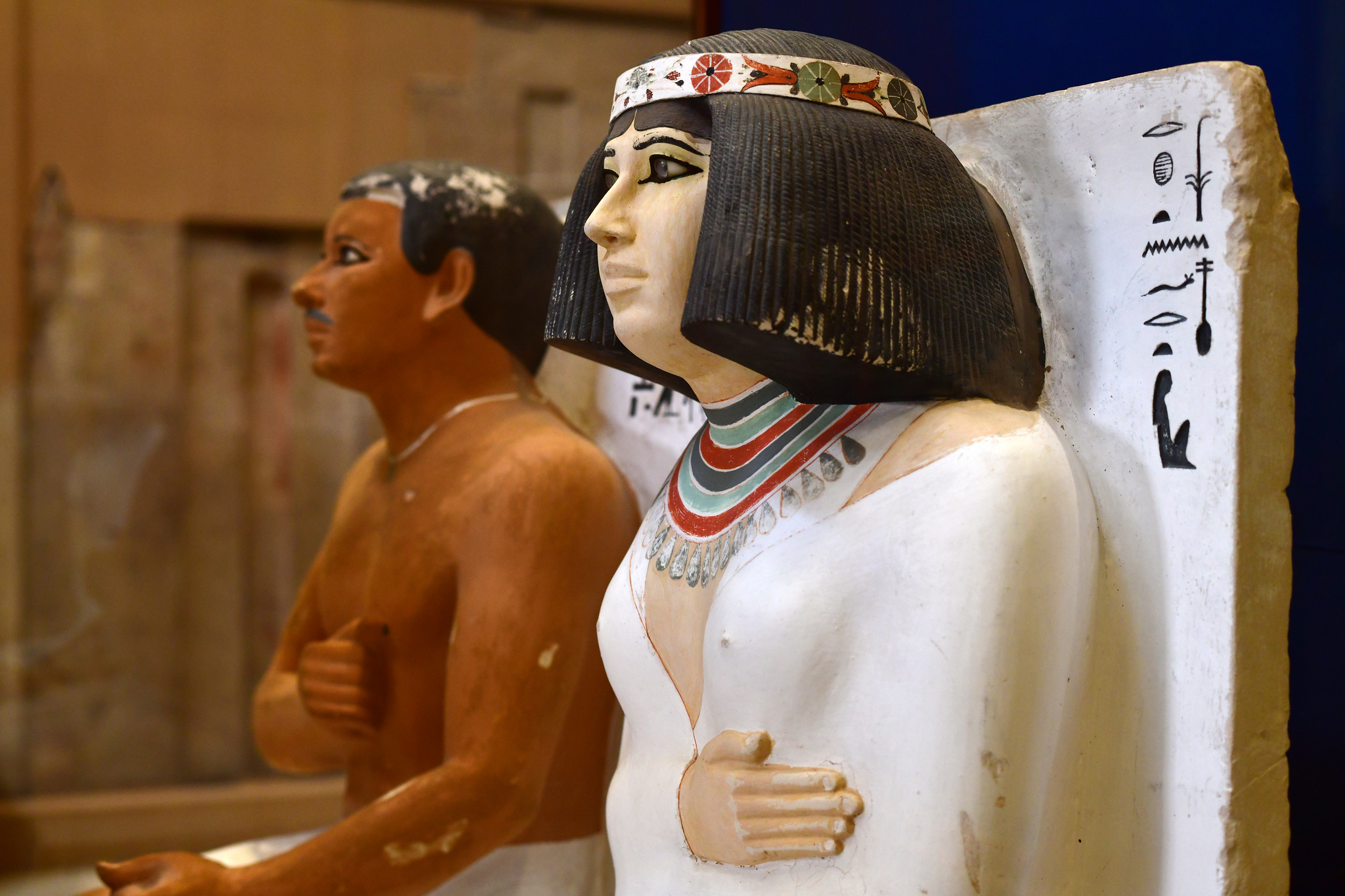
Ancient Egyptian art must be viewed from the standpoint of the ancient Egyptians to understand it. The somewhat static, usually formal, strangely abstract, and often blocky nature of much Egyptian imagery has, at times, led to unfavorable comparisons with later, and much more “naturalistic,” Greek or Renaissance art. However, the art of the Egyptians served a vastly different purpose than that of these later cultures.
Art not meant to be seen
While today we marvel at the glittering treasures from the tomb of Tutankhamun, the sublime reliefs in New Kingdom tombs, and the serene beauty of Old Kingdom statuary, it is imperative to remember that the majority of these works were never intended to be seen—that was simply not their purpose.
The function of Egyptian art
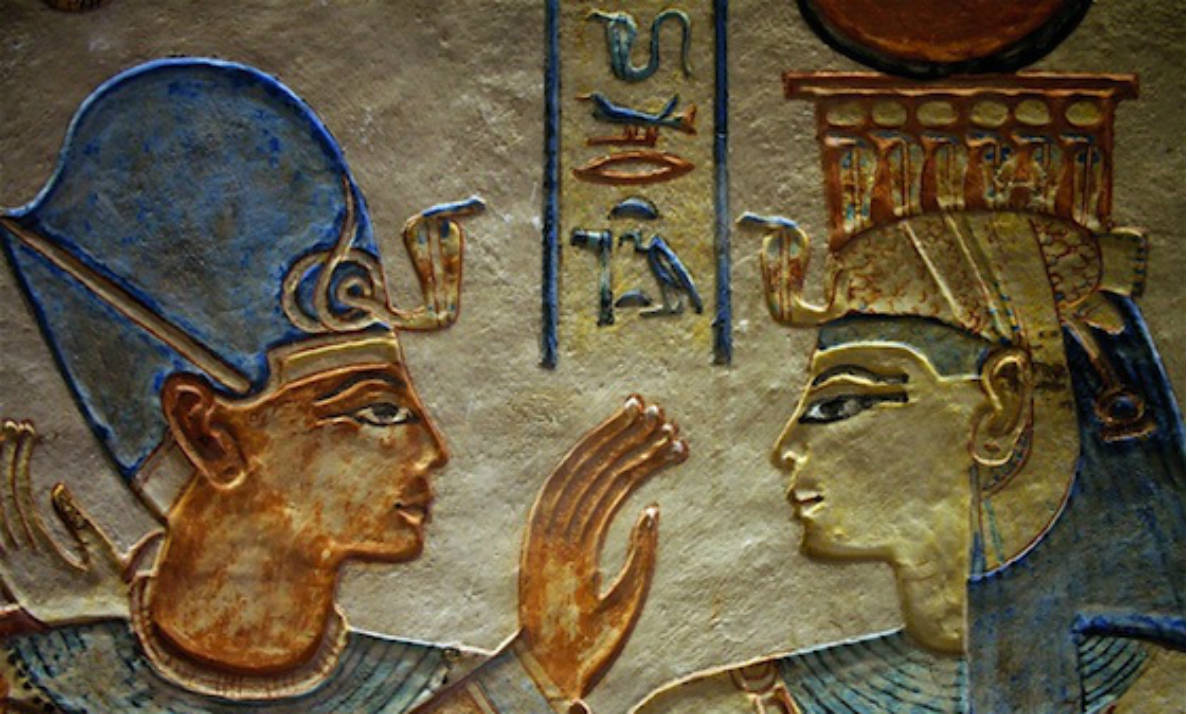
These images, whether statues or reliefs, were designed to benefit a divine or deceased recipient. Statuary provided a place for the recipient to manifest and receive the benefit of ritual action. Most statues show a formal frontality, meaning they are arranged straight ahead, because they were designed to face the ritual being performed before them. Many statues were also originally placed in recessed niches or other architectural settings—contexts that would make frontality their expected and natural mode.
Statuary, whether divine, royal, or elite, provided a kind of conduit for the spirit (or ka) of that being to interact with the terrestrial realm. Divine cult statues (few of which survive) were the subject of daily rituals of clothing, anointing, and perfuming with incense and were carried in processions for special festivals so that the people could “see” them—they were almost all entirely shrouded from view, but their “presence” would have been felt.
Royal and elite statuary served as intermediaries between the people and the gods. Family chapels with the statuary of a deceased forefather could serve as a sort of “family temple.” There were festivals in honor of the dead, where the family would come and eat in the chapel, offering food for the Afterlife, flowers (symbols of rebirth), and incense (the scent of which was considered divine). Preserved letters let us know that the deceased was actively petitioned for their assistance, both in this world and the next.
What we see in museums
Generally, the works we see on display in museums were products of royal or elite workshops; these pieces fit best with our modern aesthetic and ideas of beauty. Most museum basements, however, are packed with hundreds (even thousands!) of other objects made for people of lower status—small statuary, amulets, coffins, and stelae (similar to modern tombstones) that are completely recognizable, but rarely displayed. These pieces generally show less quality in the workmanship; sometimes being oddly proportioned or poorly executed, they are less often considered “art” in the modern sense. However, these objects served the exact same function of providing benefit to their owners, and to the same degree of effectiveness, as those made for the elite.
Modes of representation for three-dimensional art
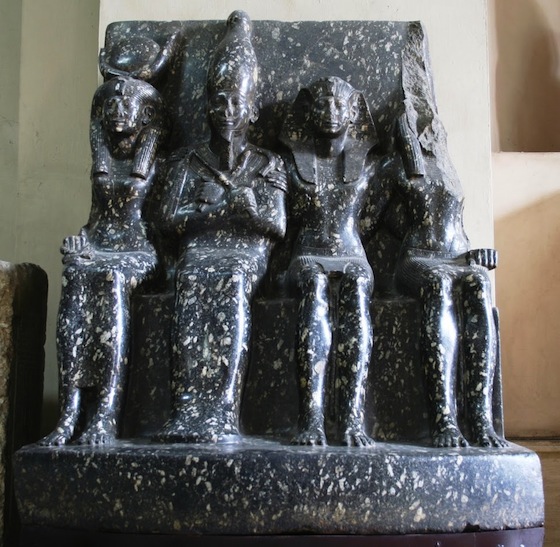
Three-dimensional representations, while being quite formal, also aimed to reproduce the real-world—statuary of gods, royalty, and the elite was designed to convey an idealized version of that individual. Some aspects of ‘naturalism’ were dictated by the material. Stone statuary was quite closed, with arms held close to the sides, limited positions, a strong back pillar that provided support, and with the fill spaces left between limbs.
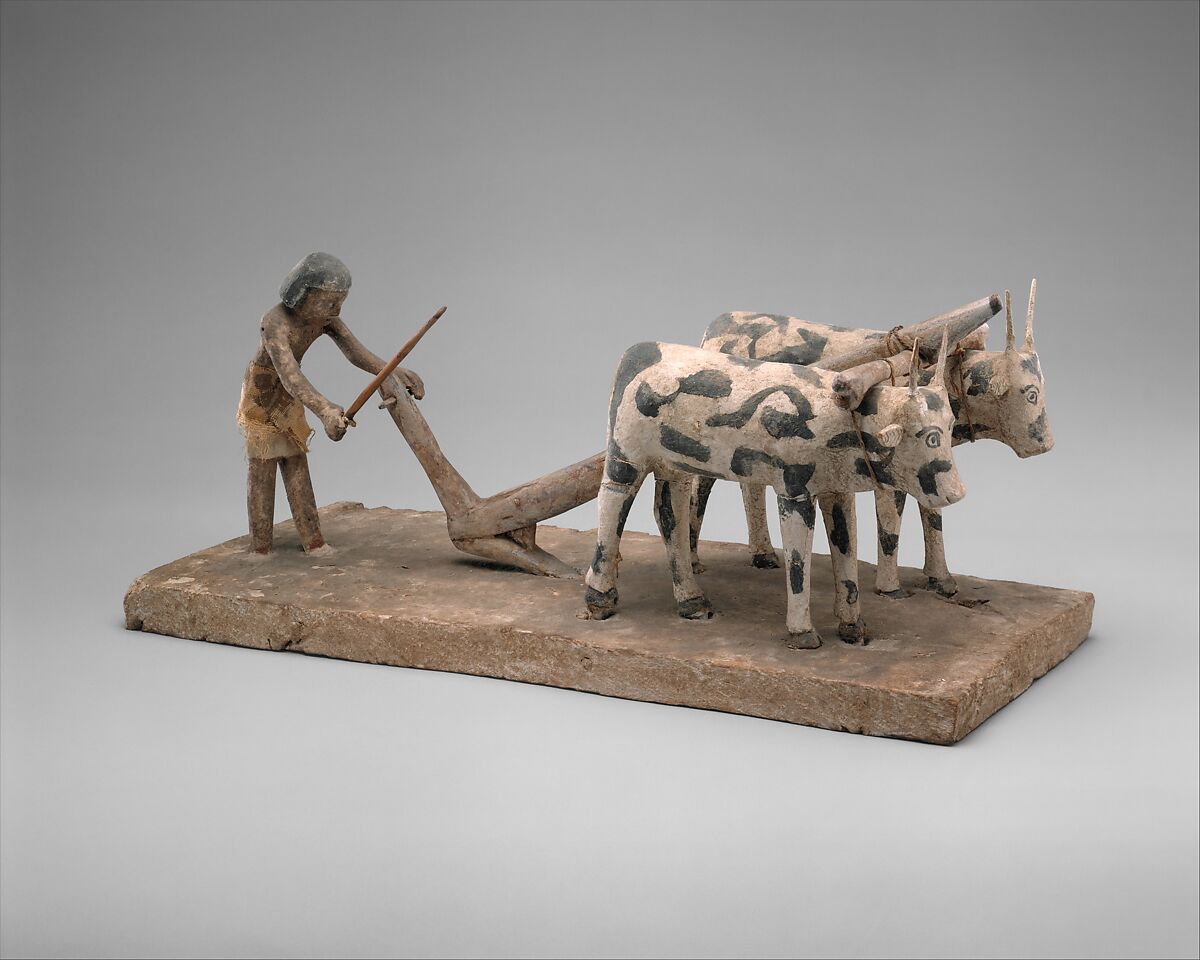
Wood and metal statuary, in contrast, was more expressive—arms could be extended and hold separate objects, spaces between the limbs were opened to create a more realistic appearance, and more positions were possible. Stone, wood, and metal statuary of elite figures, however, all served the same functions and retained the same type of formalization and frontality. Only statuettes of lower-status people displayed a wide range of possible actions, and these pieces were often focused on the actions which benefited the elite owner, not the people involved.
Modes of representation for two-dimensional art
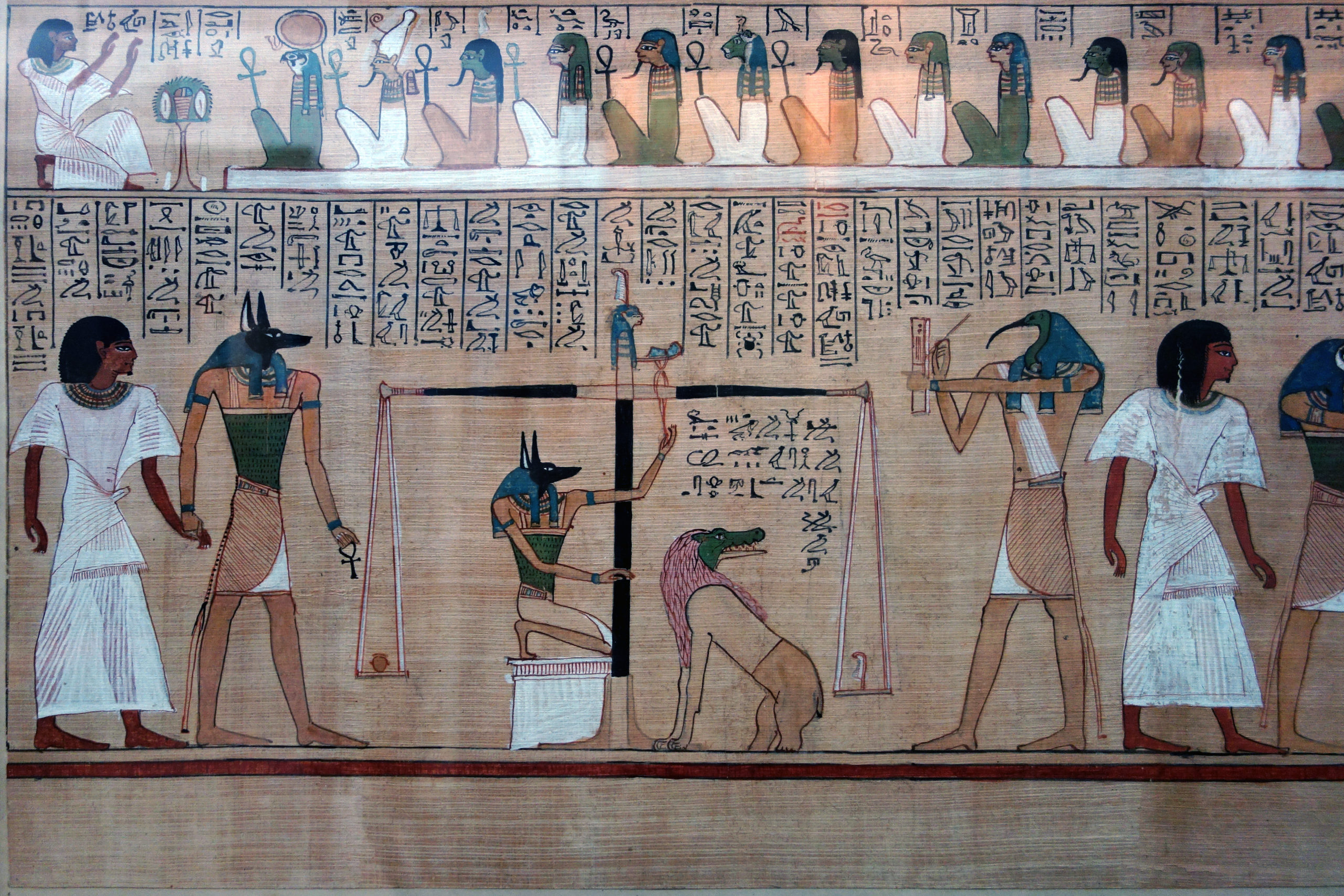
Two-dimensional art was quite different in the way the world was represented. Egyptian artists embraced two-dimensionality and attempted to provide the most representational aspects of each element in the scenes rather than attempting to create vistas that replicated the real world.
Each object or element in a scene was rendered from its most recognizable angle, and these were then grouped together to create the whole. This is why images of people show their face, waist, and limbs in profile, but eye and shoulders frontally. These scenes are complex composite images that provide complete information about the various elements, rather than ones designed from a single viewpoint, which would not be as comprehensive in the data they conveyed.
Registers
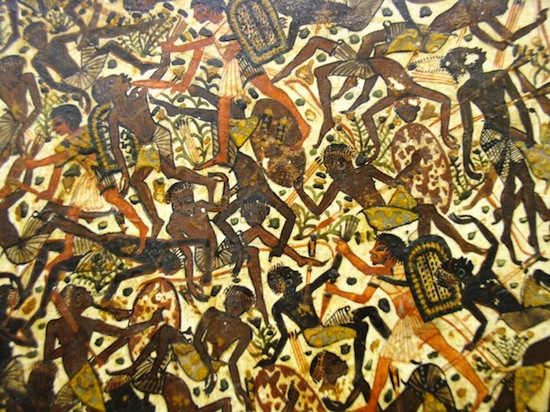
Scenes were ordered in parallel lines, known as registers. These registers separate the scene as well as provide ground lines for the figures. Scenes without registers are unusual and were generally only used to specifically evoke chaos; battle and hunting scenes will often show the prey or foreign armies without groundlines. Registers were also used to convey information about the scenes—the higher up in the scene, the higher the status; overlapping figures imply that the ones underneath are further away, as are those elements that are higher within the register.
Hierarchy of scale
Difference in scale was the most commonly used method for conveying hierarchy—the larger the scale of the figure, the more important they were. Kings were often shown at the same scale as deities, but both are shown larger than the elite and far larger than the average Egyptian.
Text and image
Text accompanied almost all images. In statuary, identifying text will appear on the back pillar or base, and relief usually has captions or longer texts that complete and elaborate on the scenes. Hieroglyphs were often rendered as tiny works of art in themselves, even though these small pictures do not always stand for what they depict; many are instead phonetic sounds. Some, however, are logographic, meaning they stand for an object or concept.
The lines blur between text and image in many cases. For instance, the name of a figure in the text on a statue will regularly omit the determinative (an unspoken sign at the end of a word that aids identification—for example, verbs of motion are followed by a pair of walking legs, names of men end with the image of a man, names of gods with the image of a seated god, etc.) at the end of the name. In these instances, the representation itself serves this function.

Predynastic: Palette of King Narmer
Vitally important, but difficult to interpret
Some artifacts are of such vital importance to our understanding of ancient cultures that they are truly unique and utterly irreplaceable. The gold mask of Tutankhamun was allowed to leave Egypt for display overseas; the Narmer Palette, on the other hand, is so valuable that it has never been permitted to leave the country.
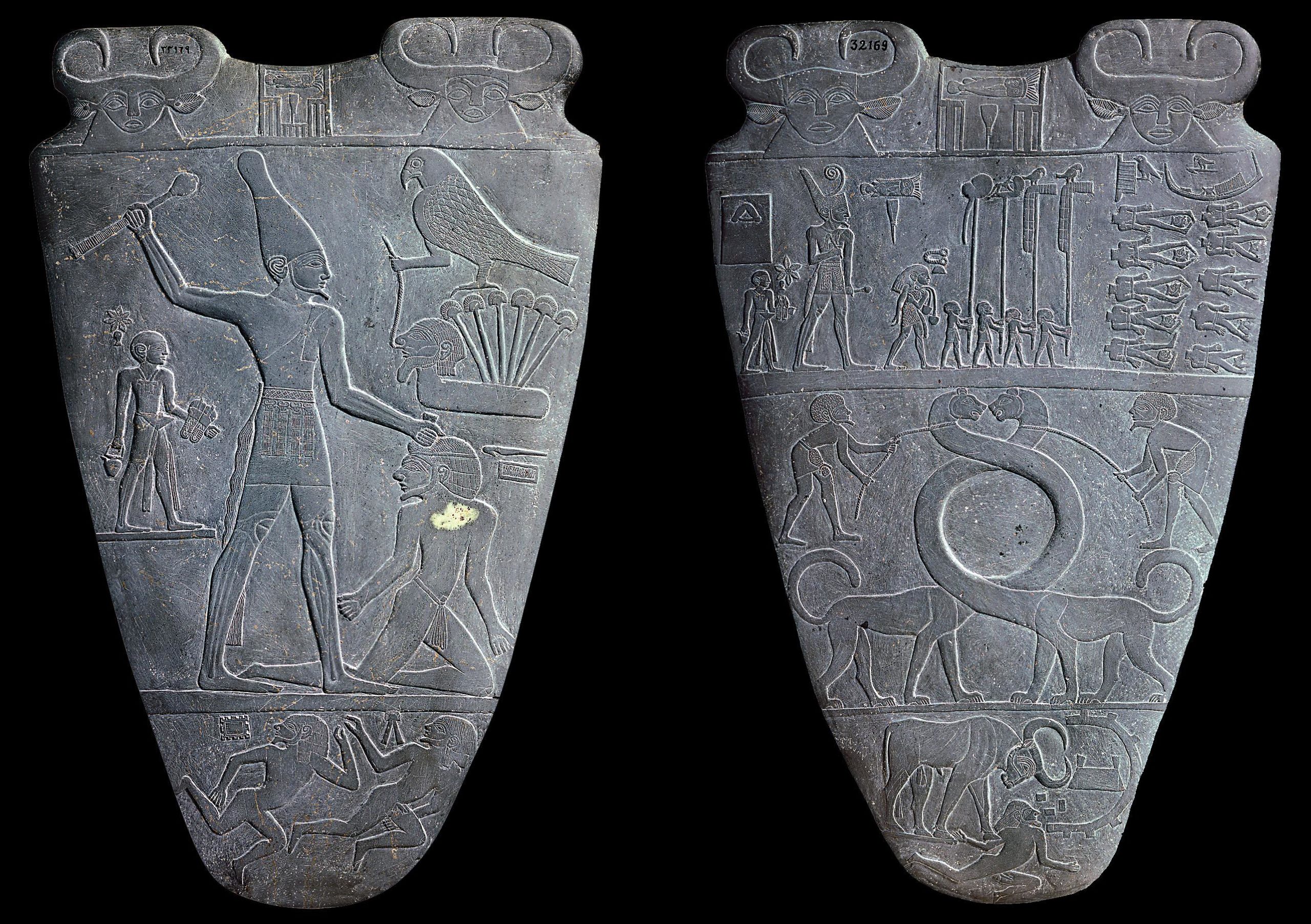
Discovered among a group of sacred implements ritually buried in a deposit within an early temple of the falcon god Horus at the site of Hierakonpolis (a capital of Egypt during the Predynastic period), this large ceremonial object is one of the most important artifacts from the dawn of Egyptian civilization. The beautifully carved palette, 63.5 cm (more than 2 feet) in height and made of smooth greyish-green siltstone, is decorated on both faces with detailed low relief. These scenes show a king, identified by name as Narmer, and a series of ambiguous scenes that have been difficult to interpret and have resulted in a number of theories regarding their meaning.
The high quality of the workmanship, its original function as a ritual item dedicated to a god, and the complexity of the imagery clearly indicate that this was a significant object, but a satisfactory interpretation of the scenes has been elusive.
What was the palette used for?
The object itself is a monumental version of a type of daily use item commonly found in the Predynastic period—palettes were generally flat, minimally decorated stone objects used for grinding and mixing minerals for cosmetics. Dark eyeliner was an essential aspect of life in the sun-drenched region; like the dark streaks placed under the eyes of modern athletes, black cosmetic lines around the eyes served to reduce glare. Basic cosmetic palettes were among the typical grave goods found during this early era.
In addition to these simple, purely functional, palettes however, there were also a number of larger, far more elaborate palettes created in this period. These objects still served the function of being a ground for grinding and mixing cosmetics, but they were also carefully carved with relief sculpture. Many of the earlier palettes display animals—some real, some fantastic—while later examples, like the Narmer Palette, focus on human actions. Research suggests that these decorated palettes were used in temple ceremonies, perhaps to grind or mix makeup to be ritually applied to the image of the god. Later temple rituals included elaborate daily ceremonies involving the anointing and dressing of divine images; these palettes likely indicate an early incarnation of this process.
A ceremonial object, ritually buried
The Narmer Palette was discovered in 1898 by James Quibell and Frederick Green. It was found with a collection of other objects that had been used for ceremonial purposes and then ritually buried within the temple at Hierakonpolis.
Temple caches of this type are not uncommon. There was a great deal of focus on ritual and votive offering in temples. Every ruler, elite individual, and anyone else who could afford it donated items to the temple to show their piety and increase their connection to the deity. After a period of time, the temple would be full of these objects and space needed to be made for new votive donations. However, since they had been dedicated to a temple and sanctified, the old items that needed to be cleared out could not simply be thrown away or sold. Instead, the general practice was to bury them in a pit dug under the temple floor. Often, these caches include objects from a range of dates and a mix of types, from royal statuary to furniture.
The “Main Deposit” at Hierakonpolis, where the Narmer Palette was discovered, contained many hundreds of objects, including a number of large relief-covered ceremonial mace-heads, ivory statuettes, carved knife handles, figurines of scorpions and other animals, stone vessels, and a second elaborately decorated palette (now in the Ashmolean Museum at Oxford) known as the Two Dogs Palette.
Conventions that remain the same for thousands of years
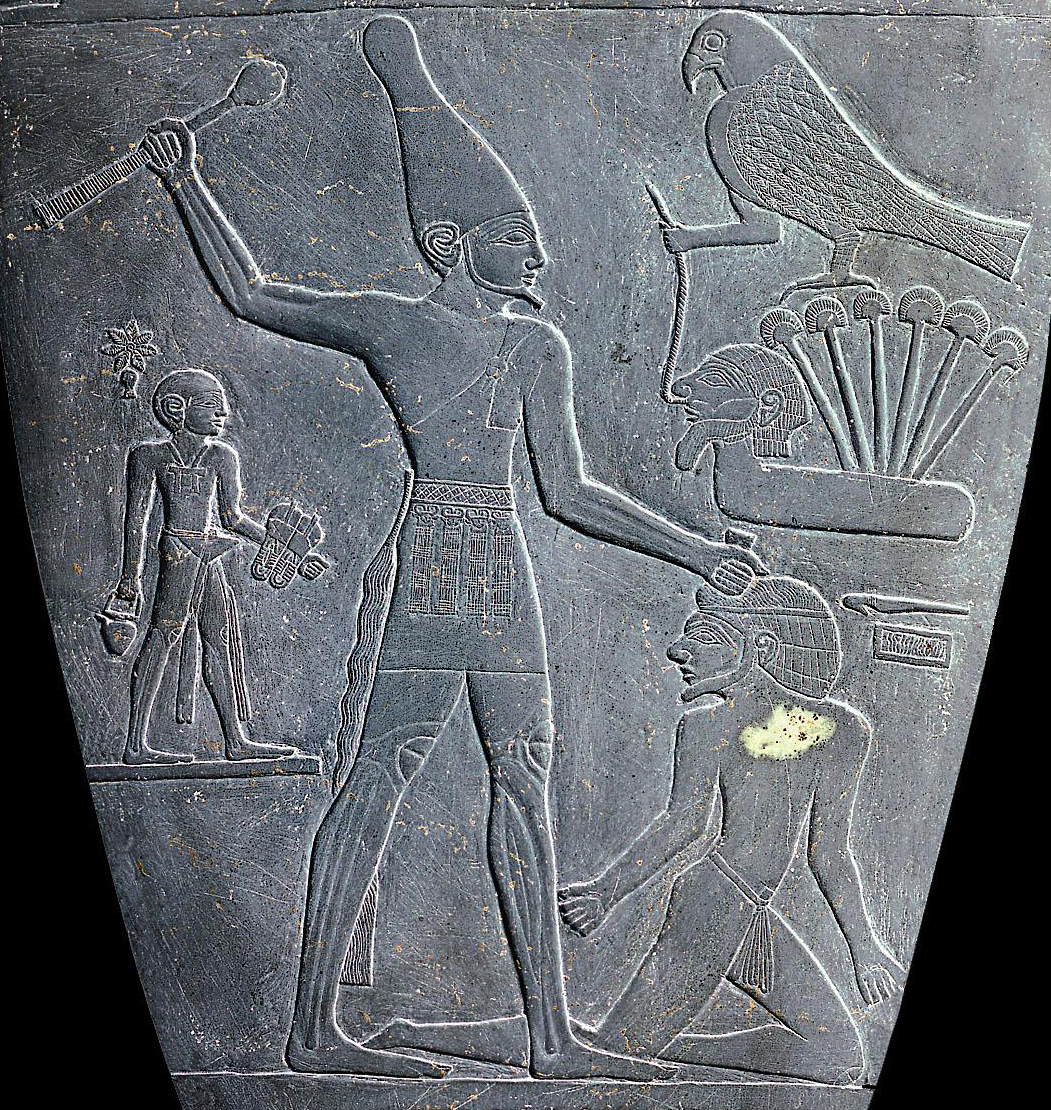
There are several reasons the Narmer Palette is considered to be of such importance. First, it is one of very few such palettes discovered in a controlled excavation, which means that we know it is authentic. Second, there are a number of formal and iconographic characteristics appearing on the Narmer Palette that remain conventional in Egyptian two-dimensional art for the following three millennia. These include the way the figures are represented, the scenes being organized in regular horizontal zones known as registers, and the use of hierarchical scale to indicate relative importance of the individuals. In addition, much of the regalia worn by the king, such as the crowns, kilts, royal beard, and bull tail, as well as other visual elements, including the pose Narmer takes on one of the faces where he grasps an enemy by the hair and prepares to smash his skull with a mace, continue to be utilized from this time all the way through the Roman era more than 3000 years later.
What we see on the palette
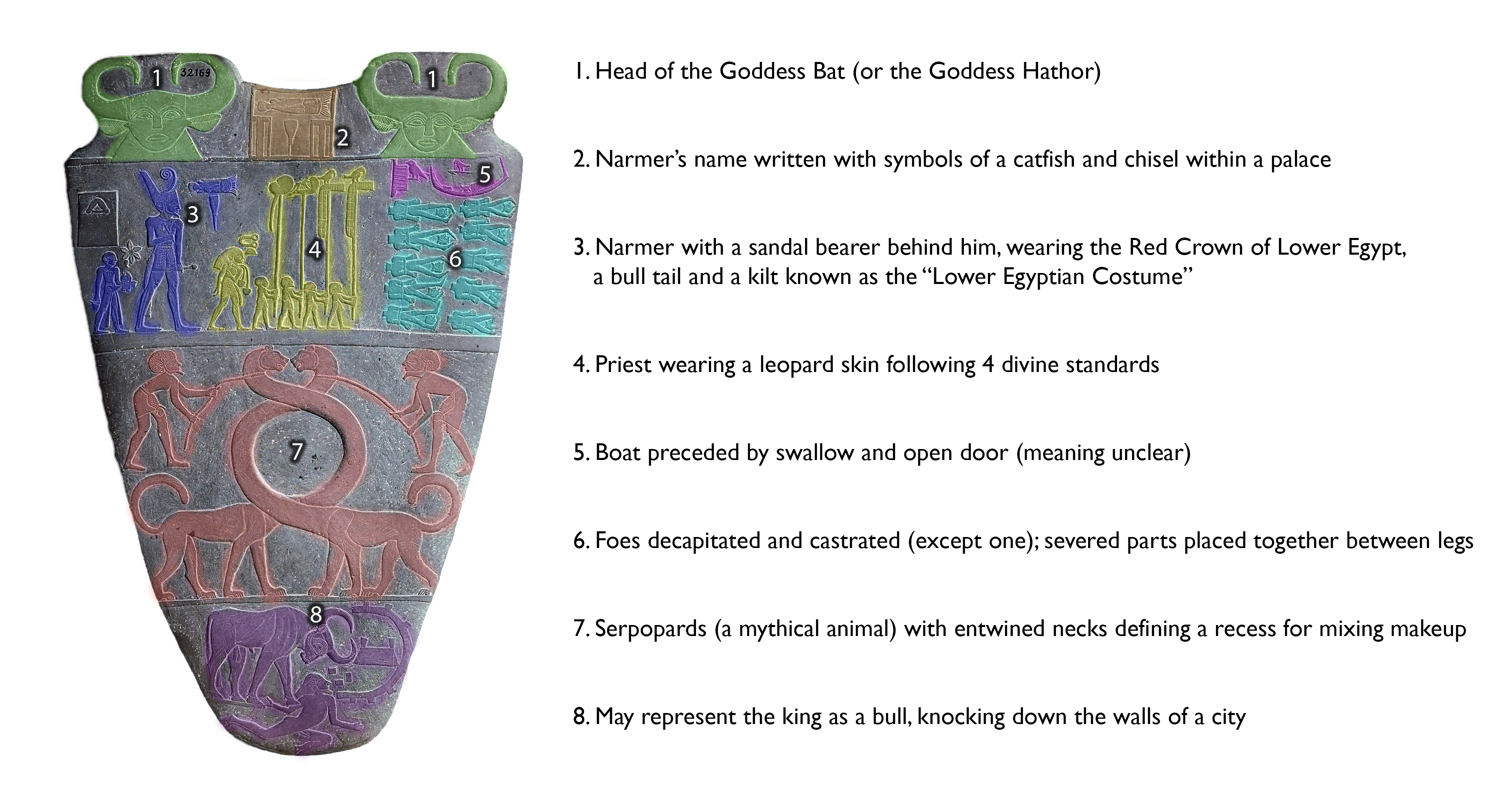
The king is represented twice in human form, once on each face, followed by his sandal-bearer. He may also be represented as a powerful bull, destroying a walled city with his massive horns, in a mode that again becomes conventional—pharaoh is regularly referred to as “Strong Bull” in later texts.
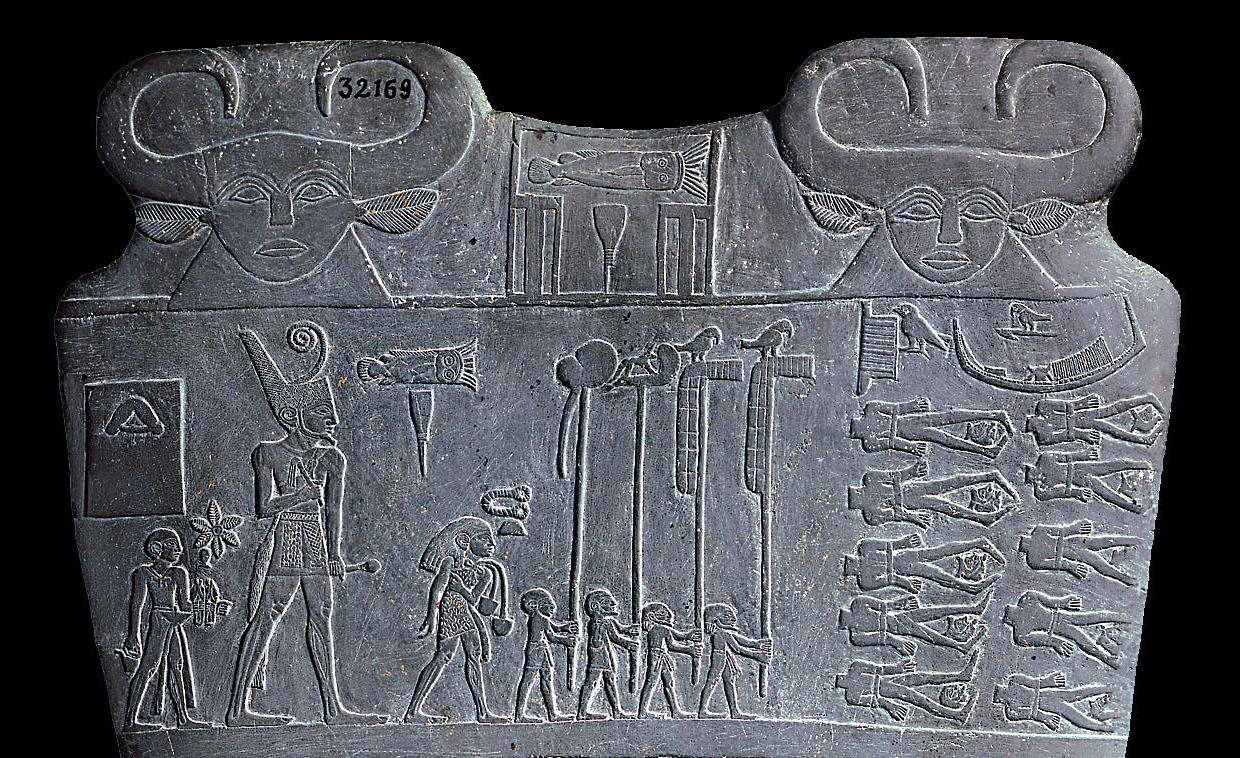
In addition to the primary scenes, the palette includes a pair of fantastic creatures, known as serpopards—leopards with long, snaky necks—who are collared and controlled by a pair of attendants. Their necks entwine and define the recess where the makeup preparation took place. The lowest register on both sides include images of dead foes, while both uppermost registers display hybrid human-bull heads and the name of the king. The frontal bull heads are connected to a sky goddess known as Bat and are related to heaven and the horizon. The name of the king, written hieroglyphically as a catfish and a chisel, is contained within a squared element that represents a palace facade.
Possible interpretation: unification of Upper and Lower Egypt
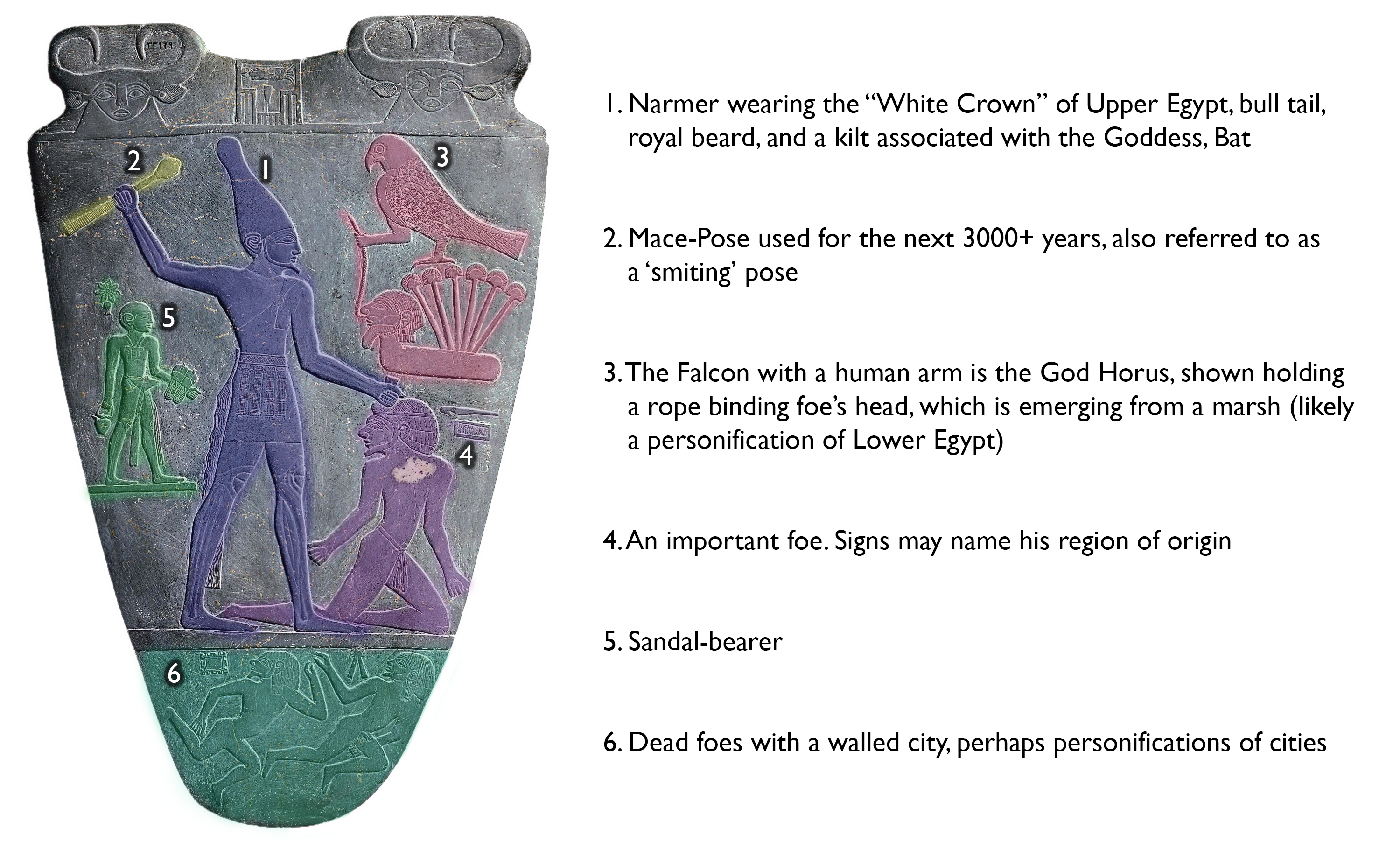
As mentioned above, there have been a number of theories related to the scenes carved on this palette. Some have interpreted the battle scenes as a historical narrative record of the initial unification of Egypt under one ruler, supported by the general timing (as this is the period of the unification) and the fact that Narmer sports the crown connected to Upper Egypt on one face of the palette and the crown of Lower Egypt on the other—this is the first preserved example where both crowns are used by the same ruler. Other theories suggest that, rather than an actual historical representation, these scenes were purely ceremonial and related to the concept of unification in general.
Another interpretation: the sun and the king
More recent research on the decorative program has connected the imagery to the careful balance of order and chaos (known as ma’at and isfet) that was a fundamental element of the Egyptian idea of the cosmos. It may also be related to the daily journey of the sun god that became a central aspect in the Egyptian religion in the subsequent centuries.
The scene showing Narmer wearing the Lower Egyptian Red Crown* (with its distinctive curl) depicts him processing towards the decapitated bodies of his foes. The two rows of prone bodies are placed below an image of a high-prowed boat preparing to pass through an open gate. This may be an early reference to the journey of the sun god in his boat. In later texts, the Red Crown is connected with bloody battles fought by the sun god just before the rosy-fingered dawn on his daily journey and this scene may well be related to this. It is interesting to note that the foes are shown as not only executed, but rendered completely impotent—their castrated penises have been placed atop their severed heads.
On the other face, Narmer wears the Upper Egyptian White Crown* (which looks rather like a bowling pin) as he grasps an inert foe by the hair and prepares to crush his skull with a mace. The White Crown is related to the dazzling brilliance of the full midday sun at its zenith as well as the luminous nocturnal light of the stars and moon. By wearing both crowns, Narmer may not only be ceremonially expressing his dominance over the unified Egypt, but also the early importance of the solar cycle and the king’s role in this daily process.
This fascinating object is an incredible example of early Egyptian art. The imagery preserved on this palette provides a peek ahead to the richness of both the visual aspects and religious concepts that develop in the ensuing periods. It is a vitally important artifact of extreme significance for our understanding of the development of Egyptian culture on multiple levels.
*The Red Crown of Lower Egypt and the White Crown of Upper Egypt were the earliest crowns worn by the king and are closely connected with the unification of the country that sparks full-blown Egyptian civilization. The earliest representation of them being worn by the same ruler is on the Narmer Palette, signifying that the king was ruling over both areas of the country. Soon after the unification, the fifth ruler of the First Dynasty is shown wearing the two crowns simultaneously, combined into one. This crown, often referred to as the Double Crown, remains a primary crown worn by pharaoh throughout Egyptian history. The separate Red and White crowns, however, continue to be worn as well and retain their geographic connections. There are a number of Egyptian words used for these crowns (nine for the White and 11 for the Red), but the most common—deshret and hedjet—refer to the colors red and white, respectively. It is from these identifying terms that we take their modern name. Early texts make it clear that these crowns were believed to be imbued with divine power and were personified as goddesses.
Old Kingdom: The Great Pyramids of Giza

One of the Seven Wonders of the ancient world
The last remaining of the Seven Wonders of the ancient world, the great pyramids of Giza, are perhaps the most famous and discussed structures in history. These massive monuments were unsurpassed in height for thousands of years after their construction and continue to amaze and enthrall us with their overwhelming mass and seemingly impossible perfection. Their exacting orientation and mind-boggling construction has elicited many theories about their origins, including unsupported suggestions that they had extra-terrestrial impetus. However, by examining the several hundred years prior to their emergence on the Giza plateau, it becomes clear that these incredible structures were the result of many experiments, some more successful than others, and represent an apogee in line with the development of the royal mortuary complex.
Three pyramids, three rulers
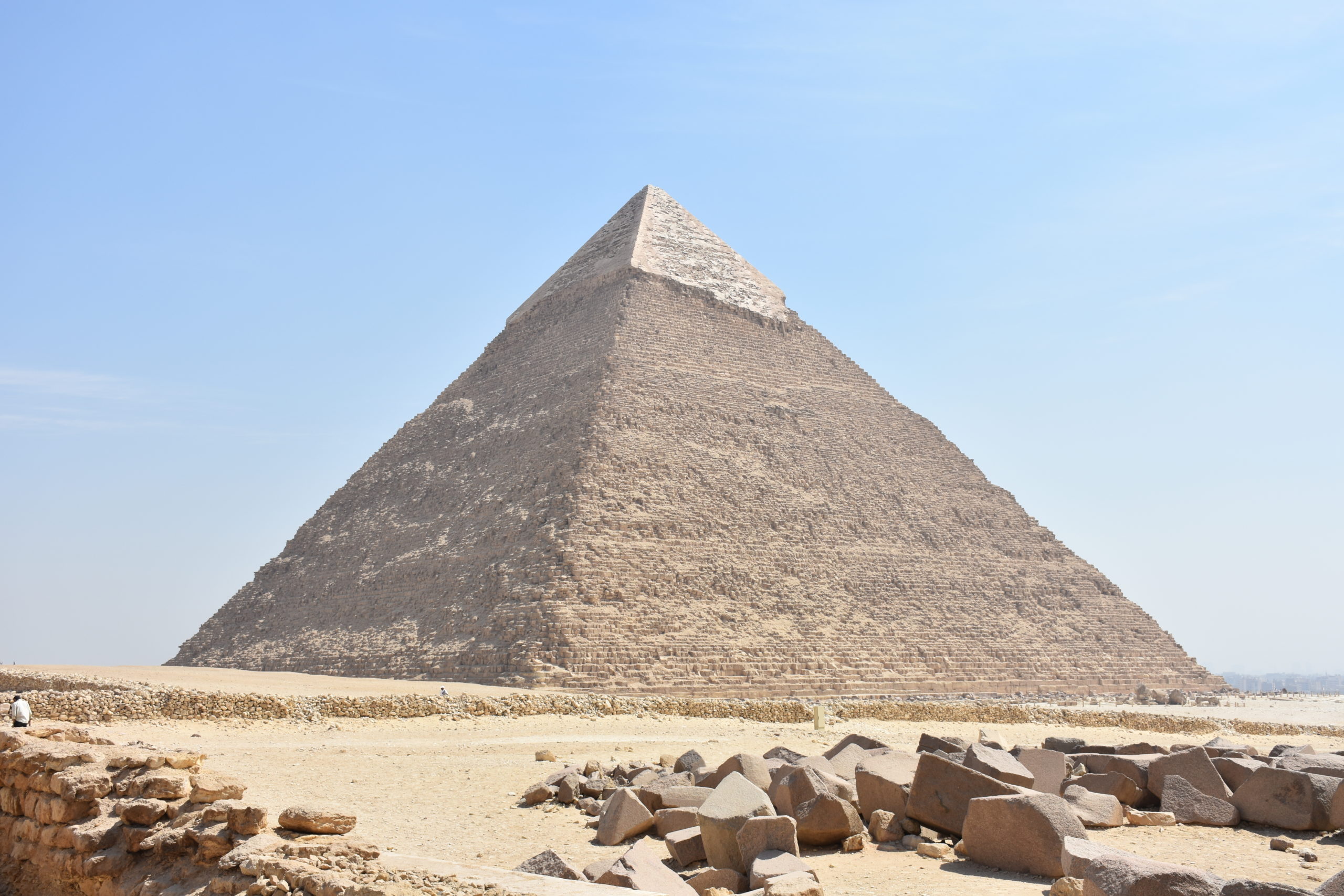
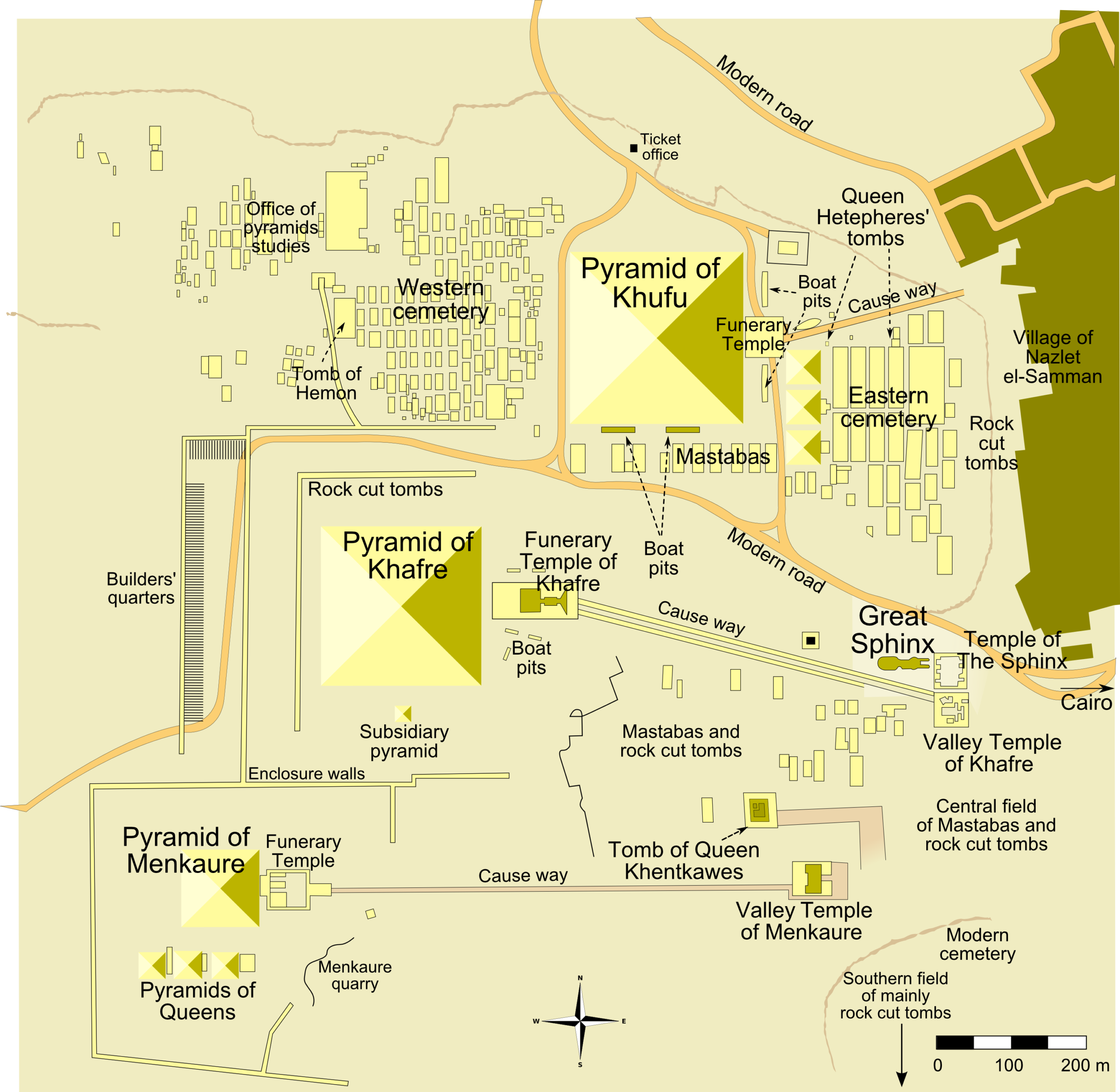
The three primary pyramids on the Giza plateau were built over the span of three generations by the rulers Khufu, Khafre, and Menkaure. Each pyramid was part of a royal mortuary complex that also included a temple at its base and a long stone causeway (some nearly 1 kilometer in length) leading east from the plateau to a valley temple on the edge of the floodplain.
Other (smaller) pyramids, and small tombs
In addition to these major structures, several smaller pyramids belonging to queens are arranged as satellites. A large cemetery of smaller tombs, known as mastabas (Arabic for ‘bench’ in reference to their shape—flat-roofed, rectangular, with sloping sides), fills the area to the east and west of the pyramid of Khufu. These were arranged in a grid-like pattern and constructed for prominent members of the court. Being buried near the pharaoh was a great honor and helped ensure a prized place in the Afterlife.
A reference to the sun
The shape of the pyramid was a solar reference, perhaps intended as a solidified version of the rays of the sun. Texts talk about the sun’s rays as a ramp the pharaoh mounts to climb to the sky—the earliest pyramids, such as the Step Pyramid of Djoser at Saqqara—were actually designed as a staircase. The pyramid was also clearly connected to the sacred ben-ben stone, an icon of the primeval mound that was considered the place of initial creation. The pyramid was viewed as a place of regeneration for the deceased ruler.
Construction
Many questions remain about the construction of these massive monuments, and theories abound as to the actual methods used. The workforce needed to build these structures is also still much discussed. Discovery of a town for workers to the south of the plateau has offered some answers. It is likely that there was a permanent group of skilled craftsmen and builders who were supplemented by seasonal crews of approximately 2000 conscripted peasants. These crews were divided into gangs of 200 men, with each group further divided into teams of 20. Experiments indicate that these groups of 20 men could haul the 2.5 ton blocks from quarry to pyramid in about 20 minutes, their path eased by a lubricated surface of wet silt. An estimated 340 stones could be moved daily from quarry to construction site, particularly when one considers that many of the blocks (such as those in the upper courses) were considerably smaller.
Pyramid of Khufu
Size
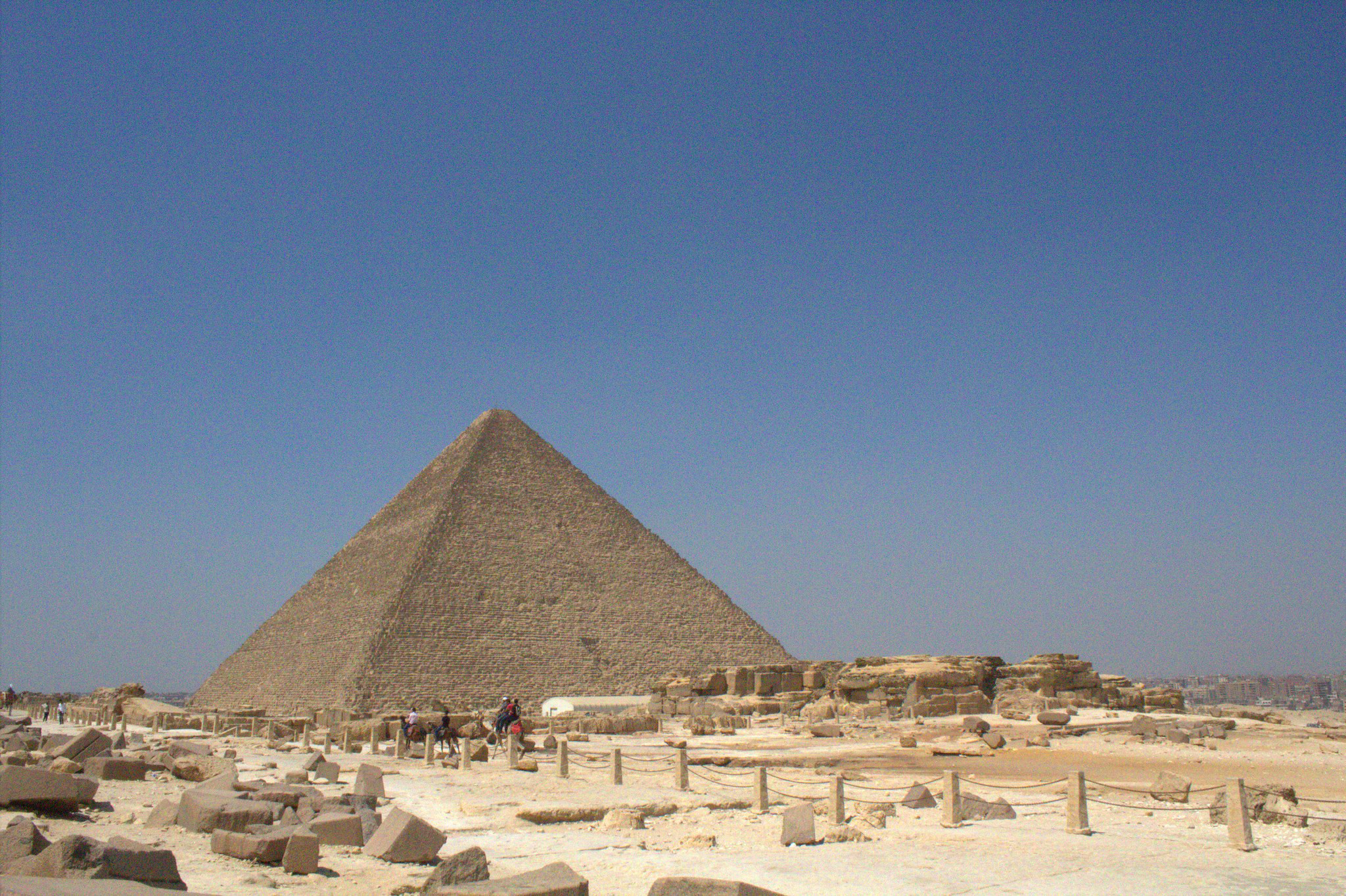
The Great Pyramid, the largest of the three main pyramids at Giza, was built by Khufu and rises to a height of 146 meters (481 feet). Humans constructed nothing taller than the Great Pyramid until 1221 C.E., when the steeple of Old St. Paul’s Cathedral was built in London and, at 149 meters (489 feet), surpassed it—at least until the steeple collapsed less than 350 years later.
It’s not just the height that is impressive, but also the precision with which the Great Pyramid was designed and executed. With a base length of more than 230 meters (750 feet) per side, the greatest difference in length among the four sides of the pyramid is a mere 4.4 cm (1 ¾ inches) and the base is level within 2.1 cm (less than an inch). This is an astonishing accomplishment that would be a challenge to replicate today even with modern equipment.
Construction: inner core stones, and outer casing stones
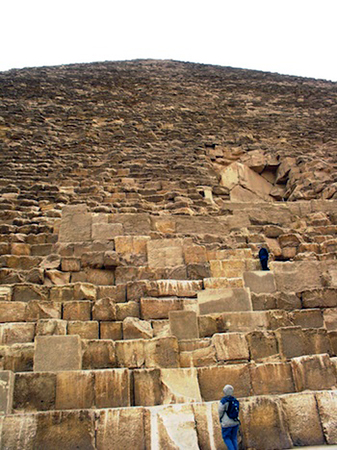
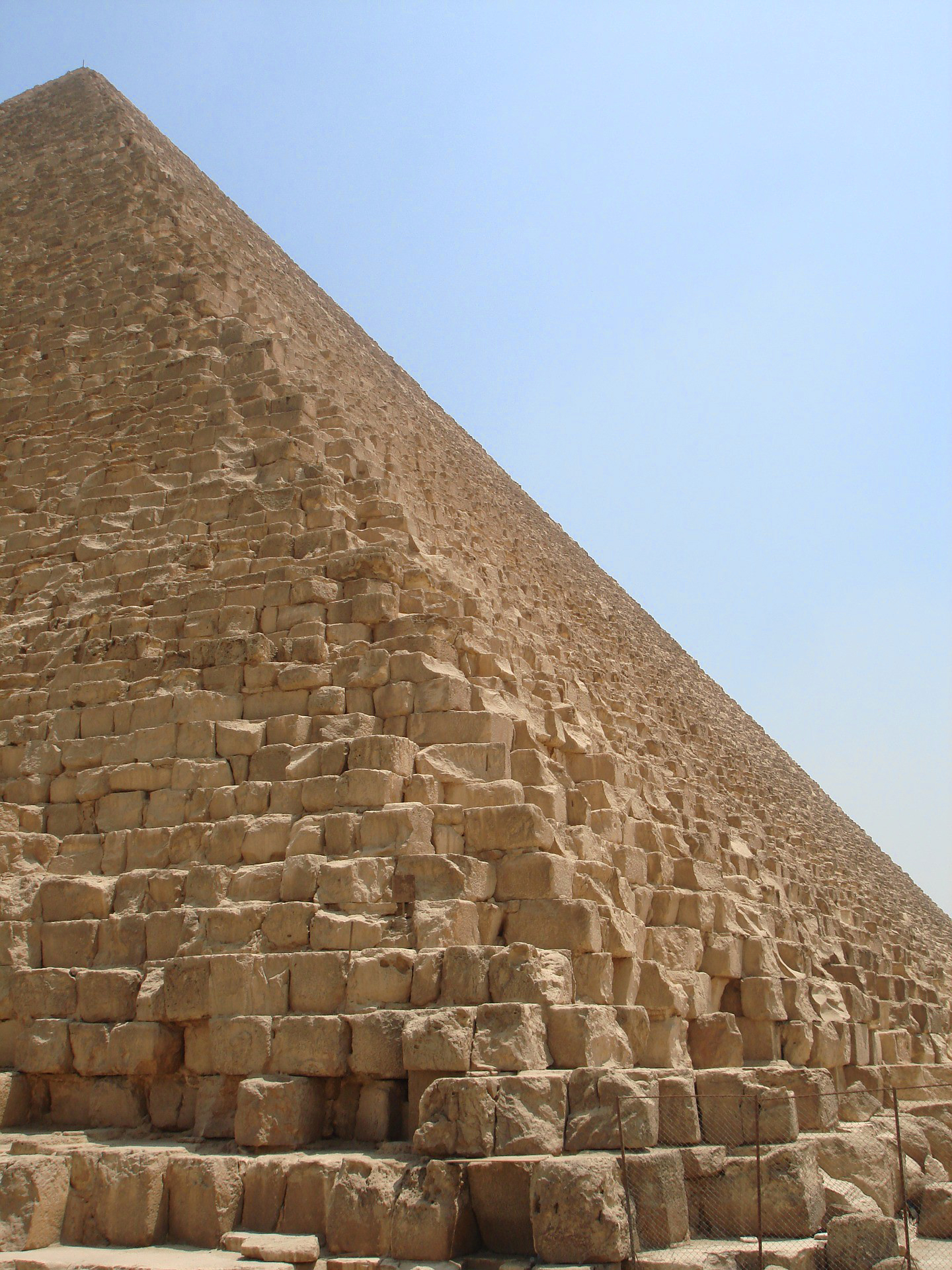
The pyramid contains an estimated 2,300,000 blocks, some of which are upwards of 50 tons. Like the pyramids built by his predecessor Snefru and those that followed on the Giza plateau, Khufu’s pyramid is constructed of inner, rough-hewn, locally quarried core stones (which is all that we see today) and angled, outer casing blocks laid in even horizontal courses with spaces filled with gypsum plaster.
The fine outer casing stones, which have long since been removed, were laid with great precision. These blocks of white Tura limestone would have given the pyramid a smooth surface and been quite bright and reflective. At the very top of the pyramid would have sat a capstone, known as a pyramidion, that may have been covered in gold. This dazzling point, shining in the intense sunlight, would have been visible for a great distance.
Interior
The interior chambers and passageways of Khufu’s pyramid are unique and include a number of enigmatic features. There is an unfinished subterranean chamber whose function is mysterious as well as a number of so-called ‘air shafts’ that radiate out from the upper chambers.
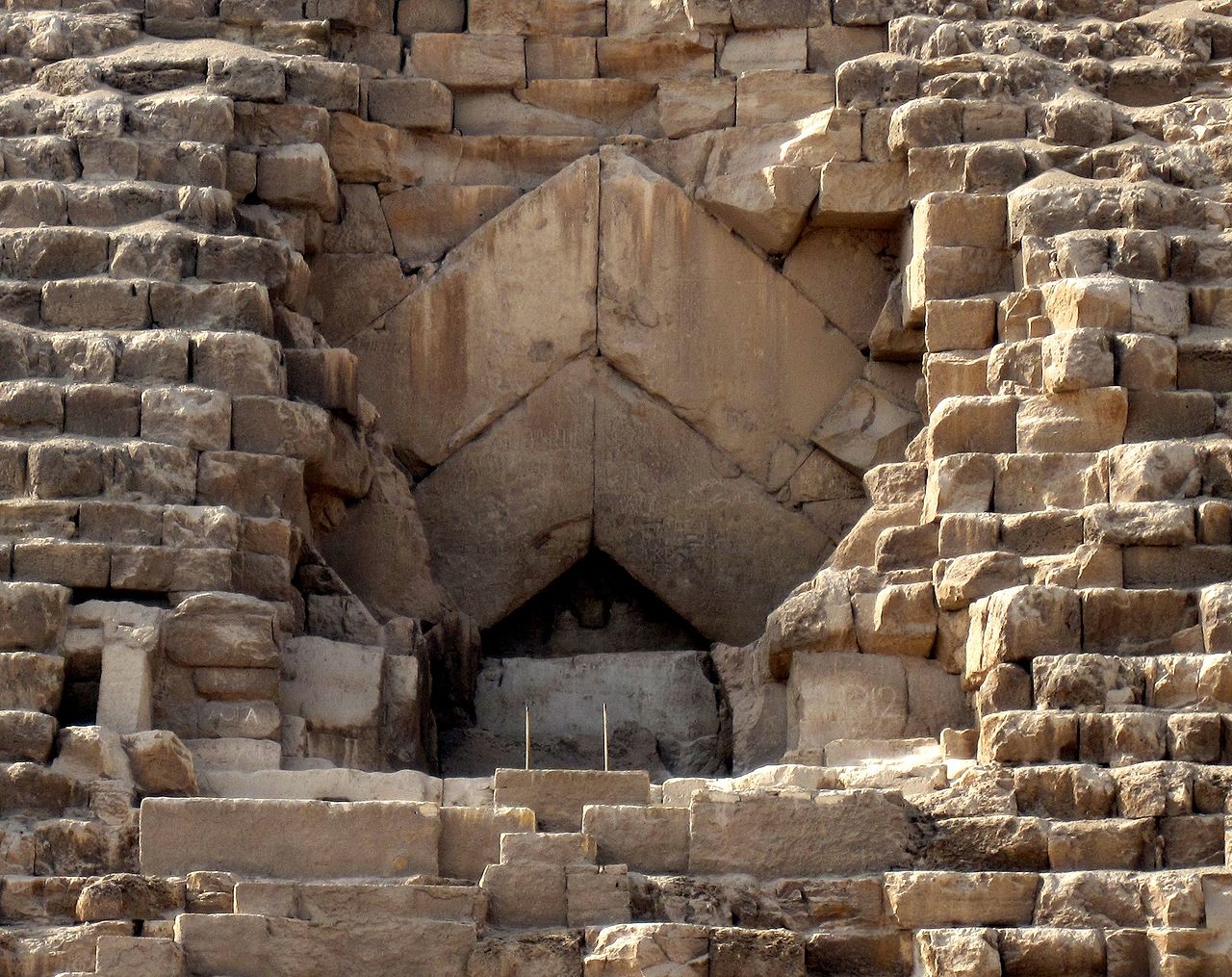
These have been explored using small robots, but a series of blocking stones have obscured the passages. When entering the pyramid, one has to crawl up a cramped ascending chamber that opens suddenly into a stunning space known as the Grand Gallery. This corbelled passage soars to a height of 8.74 meters (26 feet) and leads up to the King’s Chamber, which is constructed entirely from red granite brought from the southern quarries at Aswan.
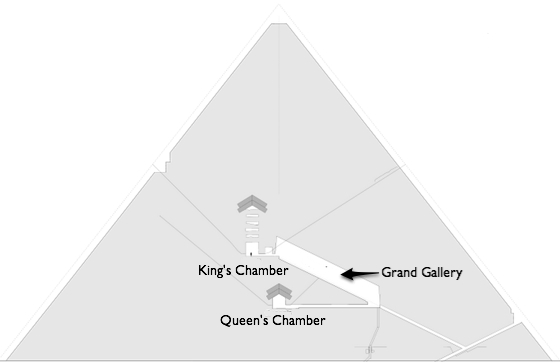
Above the King’s Chamber are five stress-relieving chambers of massive granite blocks topped with immense cantilevered slabs forming a pent roof to distribute the weight of the mountain of masonry above it. The king’s sarcophagus, also carved from red granite, sits empty at the exact central axis of the pyramid. This burial chamber was sealed with a series of massive granite blocks and the entrance to the shaft filled with limestone in an effort to obscure the opening.
Boats for the afterlife
Khufu’s mortuary complex also included seven large boat pits. Five of these are located to the east of the pyramid and were a sort of model; these brick-lined boat shaped elements were probably intended for use in the Afterlife to transport the king to stellar destinations. Boat burials of this type had a long history in royal mortuary contexts—a fleet of 14 such pits, with actual wooden boats averaging 18-19 meters (60 feet) in length encased inside, were discovered at a Dynasty 1 mortuary enclosure in Abydos, cemetery of Egypt’s earliest kings. Often, however, as with Khufu, the pits were simply boat shaped models rather than containing actual boats.
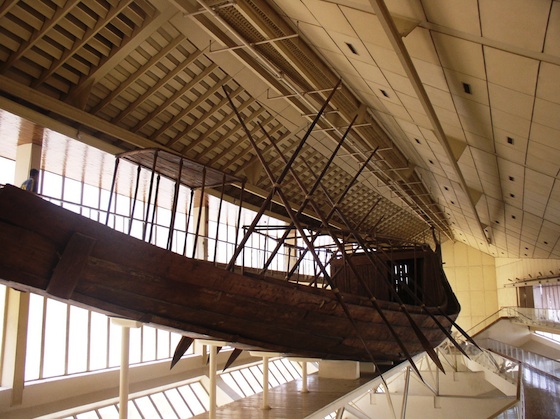
In addition to his boat pits, however, on the south side of the pyramid Khufu had two massive, rectangular stone-lined pits that contained completely disassembled boats. One of these has been removed and reconstructed. This cedar boat measures 43.3 meters (142 feet) in length and was constructed of 1,224 separate pieces stitched together with ropes. These boats appear to have been used for the last earthly voyage of the king—his funerary procession—before being dismantled and interred.
Old Kingdom: Royal Portraiture, King Menkaure (Mycerinus) and queen
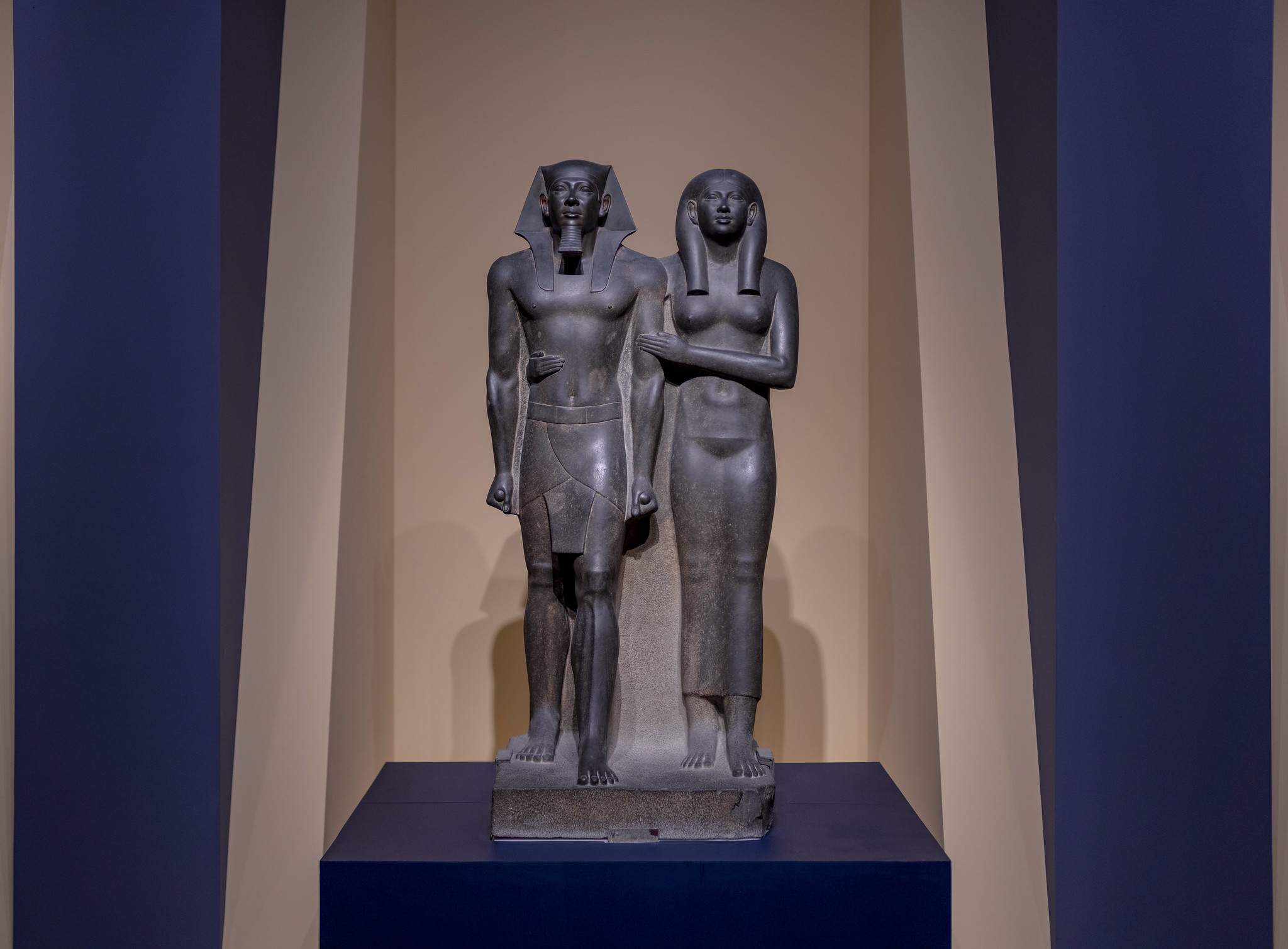
Serene ethereal beauty, raw royal power, and evidence of artistic virtuosity have rarely been simultaneously captured as well as in this breathtaking, nearly life-size statue of the pharaoh Menkaure and a queen from c. 2490–2472 B.C.E. Smooth as silk, the meticulously finished surface of the dark stone captures the physical ideals of the time and creates a sense of eternity and immortality even today.
Undoubtedly, the most iconic structures from Ancient Egypt are the massive and enigmatic Great Pyramids that stand on a natural stone shelf, now known as the Giza plateau, on the south-western edge of modern Cairo. The three primary pyramids at Giza were constructed during the height of a period known as the Old Kingdom and served as burial places, memorials, and places of worship for a series of deceased rulers—the largest belonging to King Khufu, the middle to his son Khafre, and the smallest of the three to his son Menkaure.
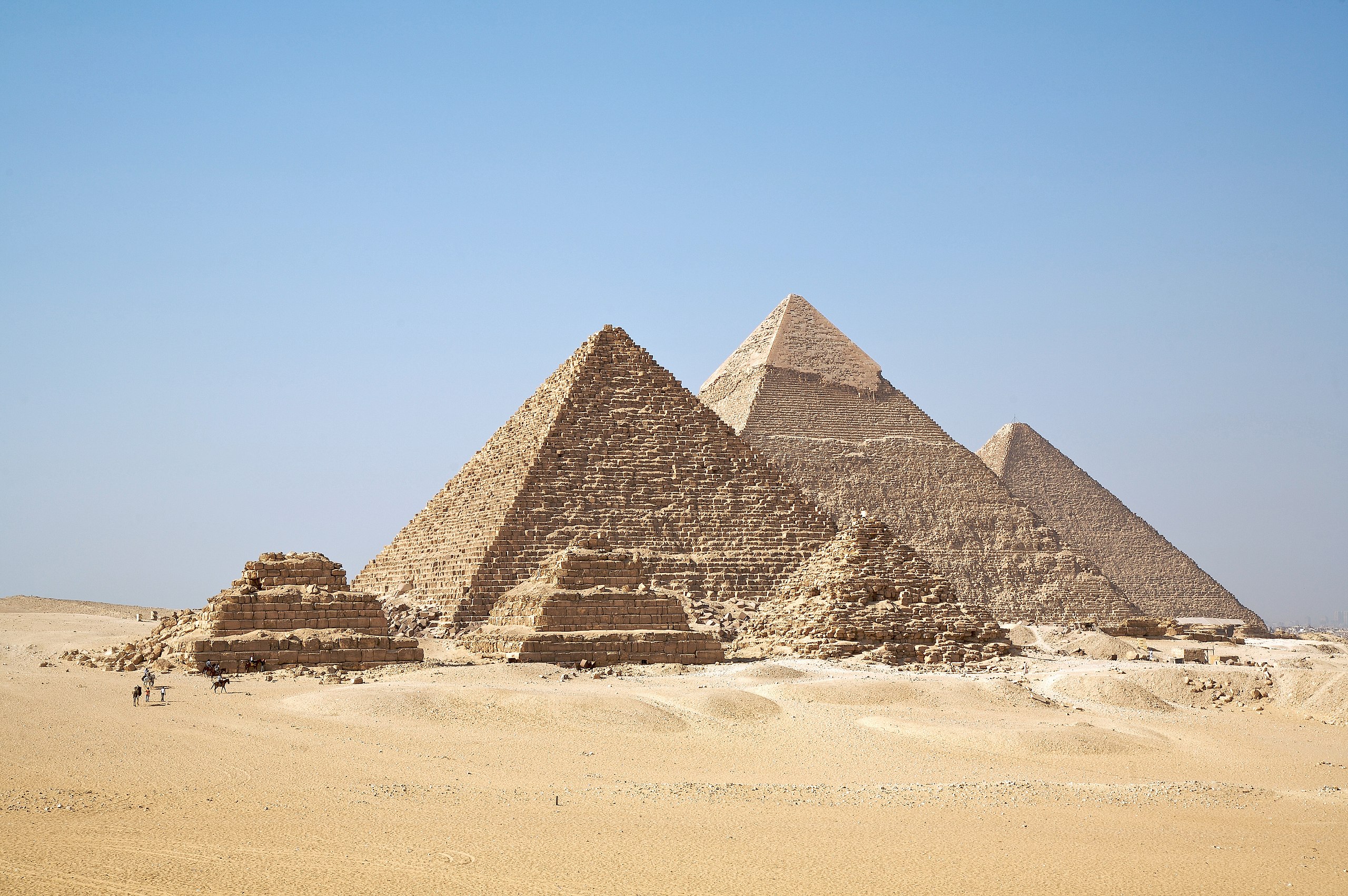
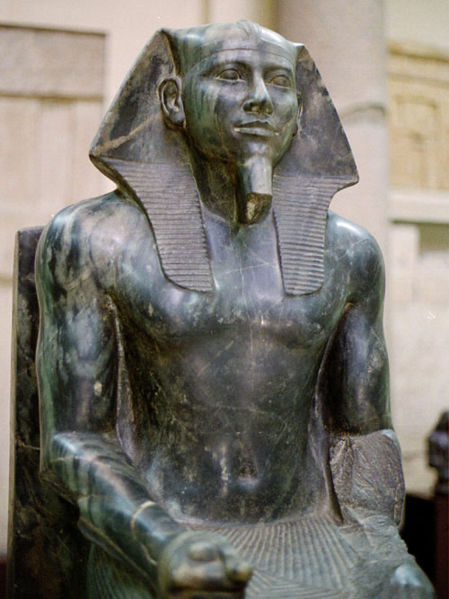
Pyramids are not stand-alone structures. Those at Giza formed only a part of a much larger complex that included a temple at the base of the pyramid itself, long causeways and corridors, small subsidiary pyramids, and a second temple (known as a valley temple) some distance from the pyramid. These Valley Temples were used to perpetuate the cult of the deceased king and were active places of worship for hundreds of years (sometimes much longer) after the king’s death. Images of the king were placed in these temples to serve as a focus for worship—several such images have been found in these contexts, including the magnificent enthroned statue of Khafre with the Horus falcon wrapped around his headdress.
On January 10, 1910, excavators under the direction of George Reisner, head of the joint Harvard University-Museum of Fine Arts, Boston, Expedition to Egypt, uncovered an astonishing collection of statuary in the Valley Temple connected to the Pyramid of Menkaure. Menkaure’s pyramid had been explored in the 1830’s (using dynamite, no less). His carved granite sarcophagus was removed (and subsequently lost at sea), and while the Pyramid Temple at its base was in only mediocre condition; the Valley Temple was—happily—basically ignored.
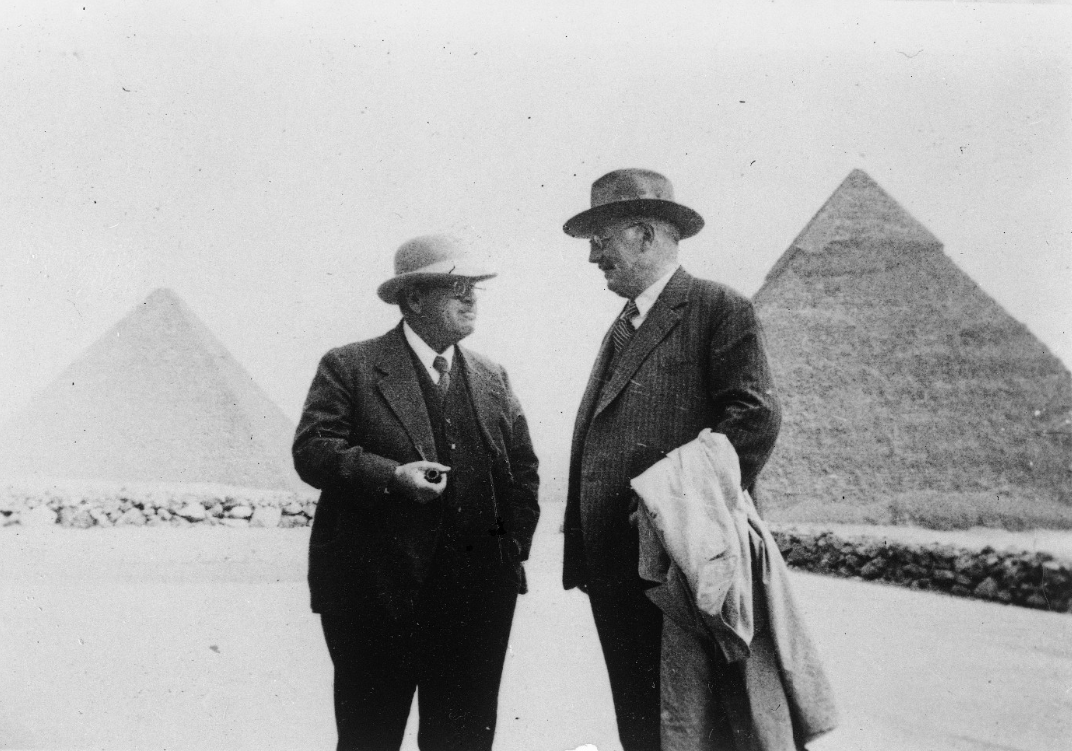
Reisner had been excavating on the Giza plateau for several years at this point; his team had already explored the elite cemetery to the west of the Great Pyramid of Khufu before turning their attention to the Menkaure complex, most particularly the barely-touched Valley Temple.
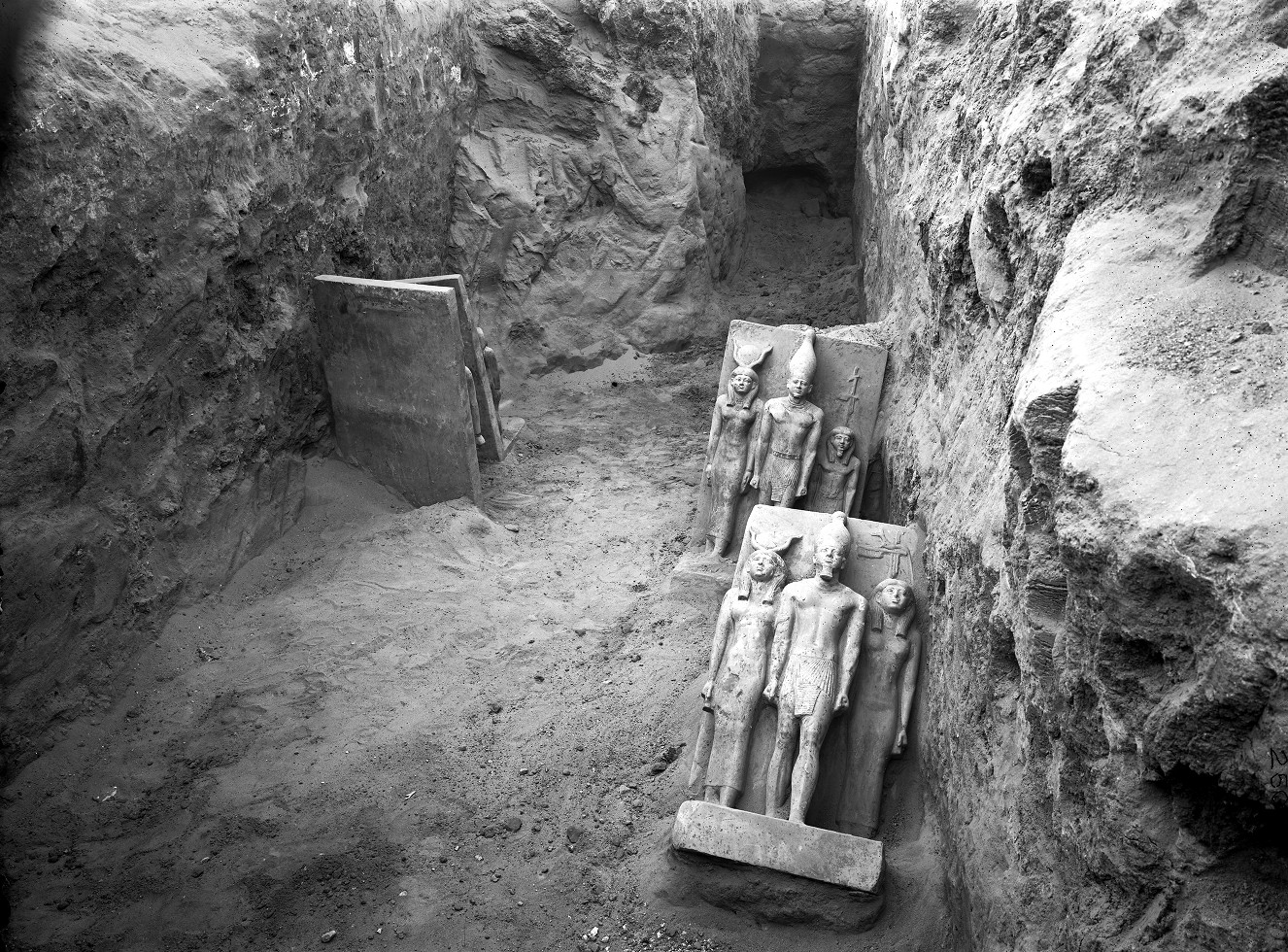
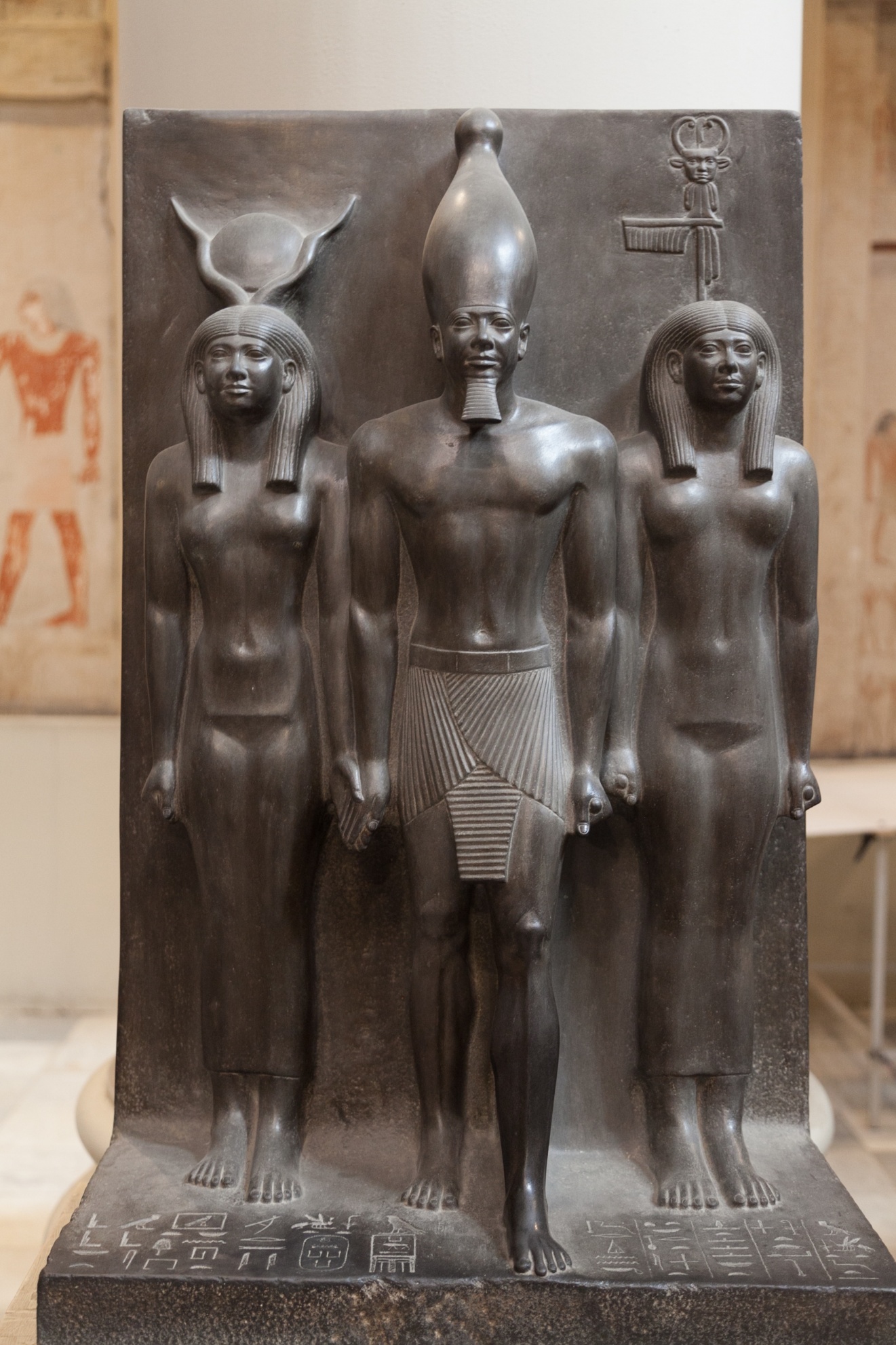
In the southwest corner of the structure, the team discovered a magnificent cache of statuary carved in a smooth-grained dark stone called greywacke or schist. There were a number of triad statues—each showing 3 figures; the king, the fundamentally important goddess Hathor, and the personification of a nome (a geographic designation, similar to the modern idea of a region, district, or county). Hathor was worshipped in the pyramid temple complexes along with the supreme sun god Re and the god Horus, who was represented by the living king. The goddess’s name is actually ‘Hwt-hor’, which means “The House of Horus”, and she was connected to the wife of the living king and the mother of the future king. Hathor was also a fierce protector who guarded her father Re; as an “Eye of Re” (the title assigned to a group of dangerous goddesses), she could embody the intense heat of the sun and use that blazing fire to destroy his enemies.
There were 4 complete triads, one incomplete, and at least one other in a fragmentary condition. The precise meaning of these triads is uncertain. Reisner believed that there was one for each ancient Egyptian nome, meaning there would have originally been more than thirty of them. More recent scholarship, however, suggests that there were originally 8 triads, each connected with a major site associated with the cult of Hathor. Hathor’s prominence in the triads (she actually takes the central position in one of the images) and her singular importance to kingship lends weight to this theory.
In addition to the triads, Reisner’s team also revealed the extraordinary dyad statue of Menkaure and a queen that is breathtakingly singular.
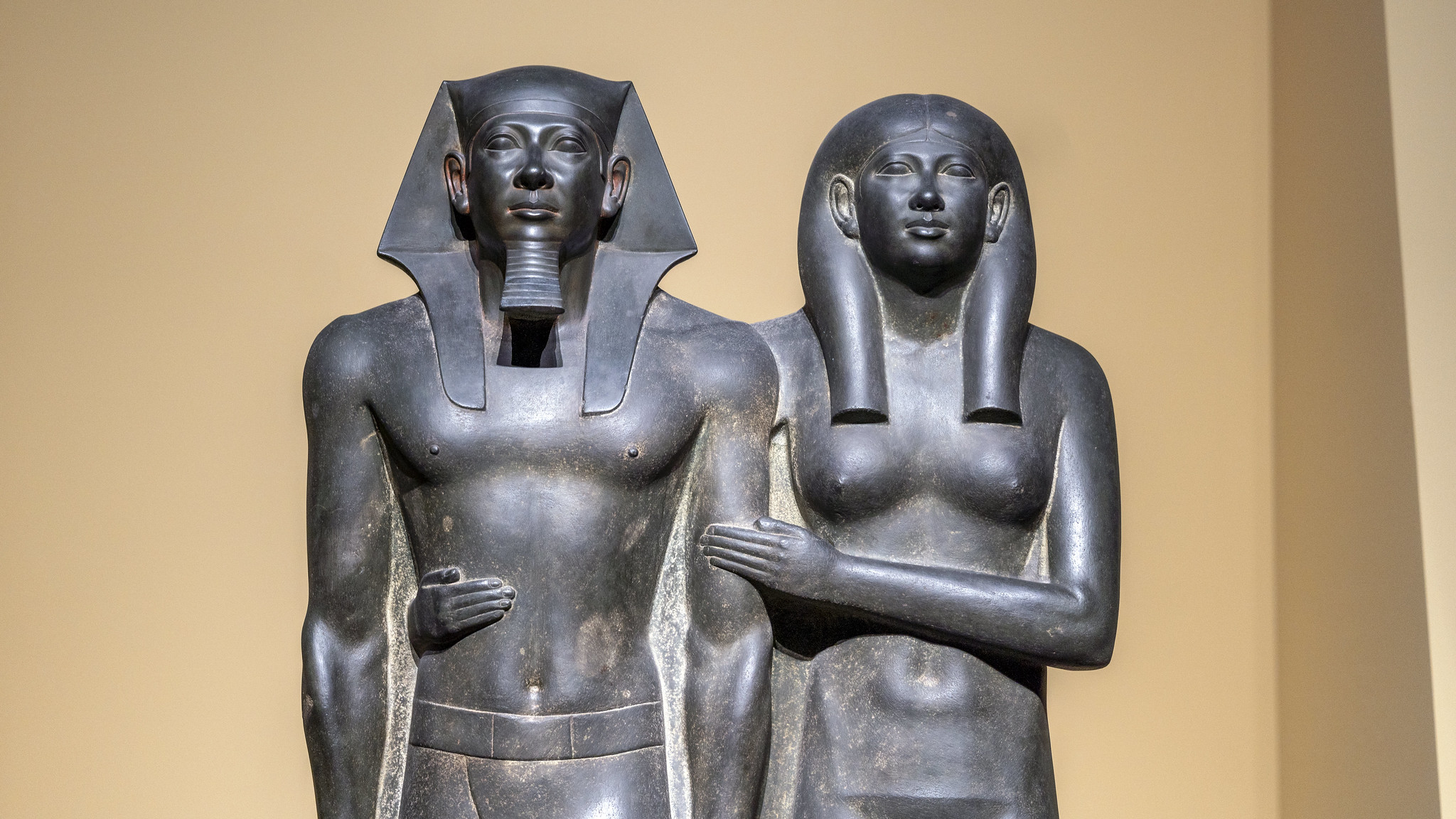
The two figures stand side-by-side on a simple, squared base and are supported by a shared back pillar. They both face to the front, although Menkaure’s head is noticeably turned to his right—this image was likely originally positioned within an architectural niche, making it appear as though they were emerging from the structure.
The broad-shouldered, youthful body of the king is covered only with a traditional short pleated kilt, known as a shendjet, and his head sports the primary pharaonic insignia of the iconic striped nemes headdress (so well known from the mask of Tutankhamun) and an artificial royal beard. In his clenched fists, held straight down at his sides, Menkaure grasps ritual cloth rolls. His body is straight, strong, and eternally youthful with no signs of age. His facial features are remarkably individualized with prominent eyes, a fleshy nose, rounded cheeks, and full mouth with protruding lower lip.
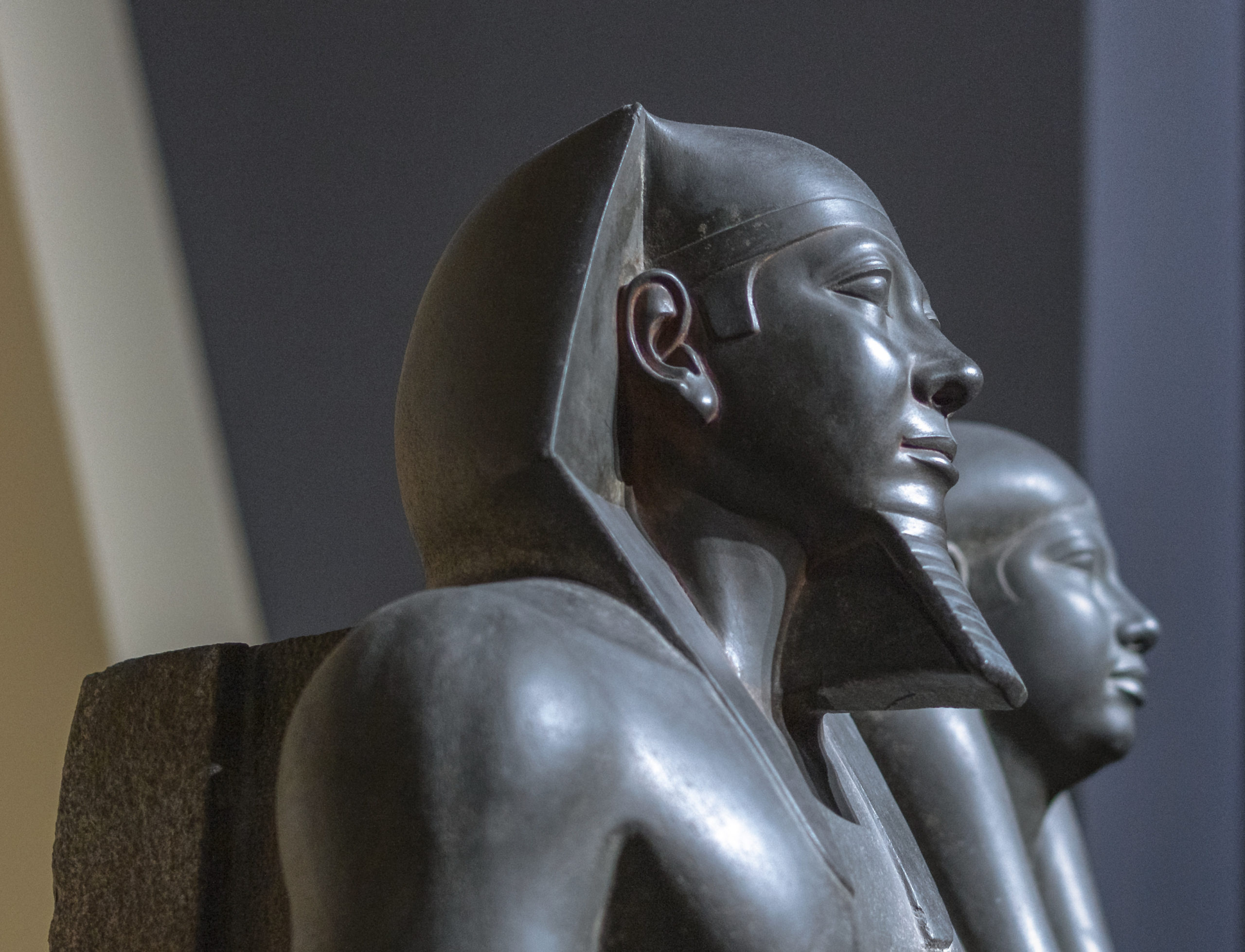
Menkaure’s queen provides the perfect female counterpart to his youthful masculine virility. Sensuously modeled with a beautifully proportioned body emphasized by a clinging garment, she articulates ideal mature feminine beauty. There is a sense of the individual in both faces. Neither Menkaure nor his queen are depicted in the purely idealized manner that was the norm for royal images. Instead, through the overlay of royal formality we see the depiction of a living person filling the role of pharaoh and the personal features of a particular individual in the representation of his queen.
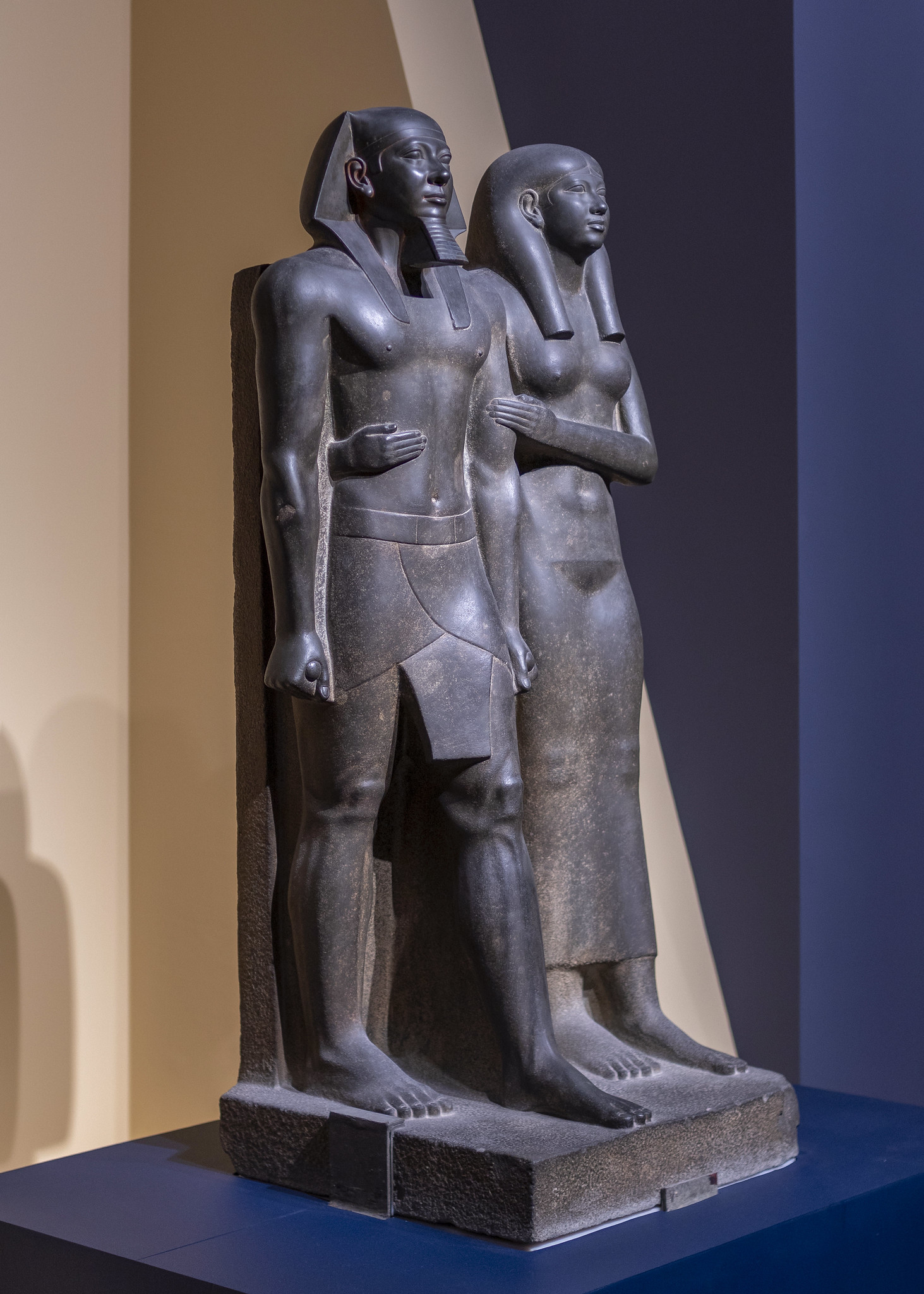
Menkaure and his queen stride forward with their left feet—this is entirely expected for the king, as males in Egyptian sculpture almost always do so, but it is unusual for the female since they are generally depicted with feet together. They both look beyond the present and into timeless eternity, their otherworldly visage displaying no human emotion whatsoever.
The dyad was never finished—the area around the lower legs has not received a final polish, and there is no inscription. However, despite this incomplete state, the image was erected in the temple and was brightly painted; there are traces of red around the king’s ears and mouth and yellow on the queen’s face. The presence of paint atop the smooth, dark greywacke on a statue of the deceased king that was originally erected in his memorial temple courtyard brings an interesting suggestion—that the paint may have been intended to wear away through exposure and, over time, reveal the immortal, black-fleshed “Osiris” Menkaure (for more information on the symbolic associations of Egyptian materials, see Materials and techniques in ancient Egyptian art).
Unusual for a pharaoh’s image, the king has no protective cobra (known as a uraeus) perched on his brow. This notable absence has led to the suggestion that both the king’s nemes and the queen’s wig were originally covered in a sheath of precious metal and that the ubiquitous cobra would have been part of that addition.
Based on comparison with other images, there is no doubt that this sculpture shows Menkaure, but the identity of the queen is a different matter. She is clearly a royal female. She stands at nearly equal height with the king and, of the two of them, she is the one who is entirely frontal. In fact, it may be that this dyad is focused on the queen as its central figure rather than Menkaure. The prominence of the royal female—at equal height and frontal—in addition to the protective gesture she extends has suggested that, rather than one of Menkaure’s wives, this is actually his queen-mother. The function of the sculpture in any case was to ensure rebirth for the king in the Afterlife.
Old Kingdom: Non-royal portraiture, The Seated Scribe
Seated cross-legged, with rolls of belly fat, this painted statue differs from the ideal statues of pharaohs. Ancient Egyptians used a different set of conventions for representing non-royal individuals.
Conclusion
Unlike its Ancient Mesopotamian neighbors, Ancient Egypt maintained a relatively consistent and stable artistic program from more than 2,500 years. Features of royal portraiture included idealism, symmetry, frontality, youthfulness, and strength. Royal symbolism remained consistent in such forms as the false beard, uraeus, nemes, and shendjet. The principles of ma’at and isfet grounded Egypt in the idea of a cosmic balance. To the ancient Egyptians, consistency was synonymous with stability and thus, the foundation of a strong civilization. Many traditional Egyptian conventions began in the Predynastic and Old Kingdom periods and lasted through the Middle Kingdom and well into the New Kingdom.
Citation and Licensing
The following sections were written by Chelsea Wright and are licensed CC BY-NC-SA 4.0:
- Chapter Overview and Introduction
- Focus artwork and term list compiled by Chelsea Wright
- Conclusion
The following articles from Smarthistory licensed CC BY-NC-SA 4.0 were remixed and adapted for the chapter:
- Dr. Amy Calvert, “Ancient Egypt, an introduction,” in Smarthistory, August 8, 2015.
- Dr. Amy Calvert, “Ancient Egyptian chronology and historical framework,” in Smarthistory, February 4, 2022.
- Dr. Amy Calvert, “Ancient Egyptian art,” in Smarthistory, August 8, 2015.
- Dr. Amy Calvert, “Palette of King Narmer,” in Smarthistory, August 8, 2015.
- Dr. Amy Calvert, “The Great Pyramids of Giza,” in Smarthistory, August 8, 2015.
- Dr. Amy Calvert, “Pyramid of Khufu,” in Smarthistory, August 8, 2015.
- Dr. Amy Calvert, “King Menkaure (Mycerinus) and queen,” in Smarthistory, August 14, 2025.
- Dr. Beth Harris and Dr. Steven Zucker, “The Seated Scribe,” in Smarthistory, November 25, 2015.



.svg)