
Chapter Overview and Introduction
The monotheistic religion of Islam began on the Arabian Peninsula in the 7th century with the Prophet Muhammad. At the time, the Arabian Peninsula was home to nomadic tribes practicing polytheistic faiths. It was also neighbors to the nearby Orthodox Christian Byzantine Empire. While the Byzantine Empire was flourishing from its capital city of Constantinople, Islam and Islamic art and architecture began to expand in the regions of the Middle East, North Africa, and Europe (Spain). With Islam emerging in this larger cultural context, early Muslims debated upon the role of images in religious art. During the period of early Islamic art, the concept of iconoclasm began to determine aesthetics, and mosque architecture developped.
Focus Artworks
-
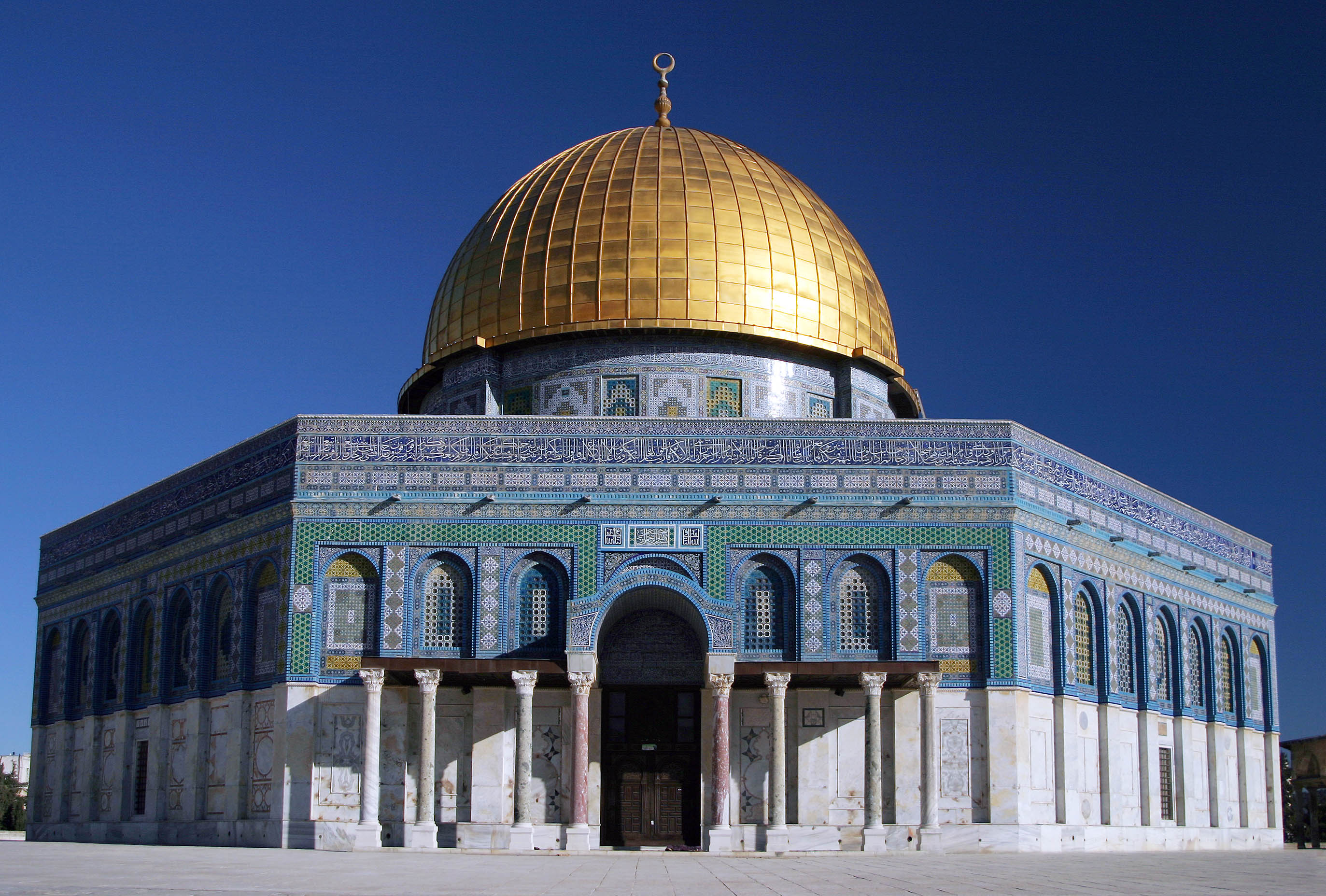
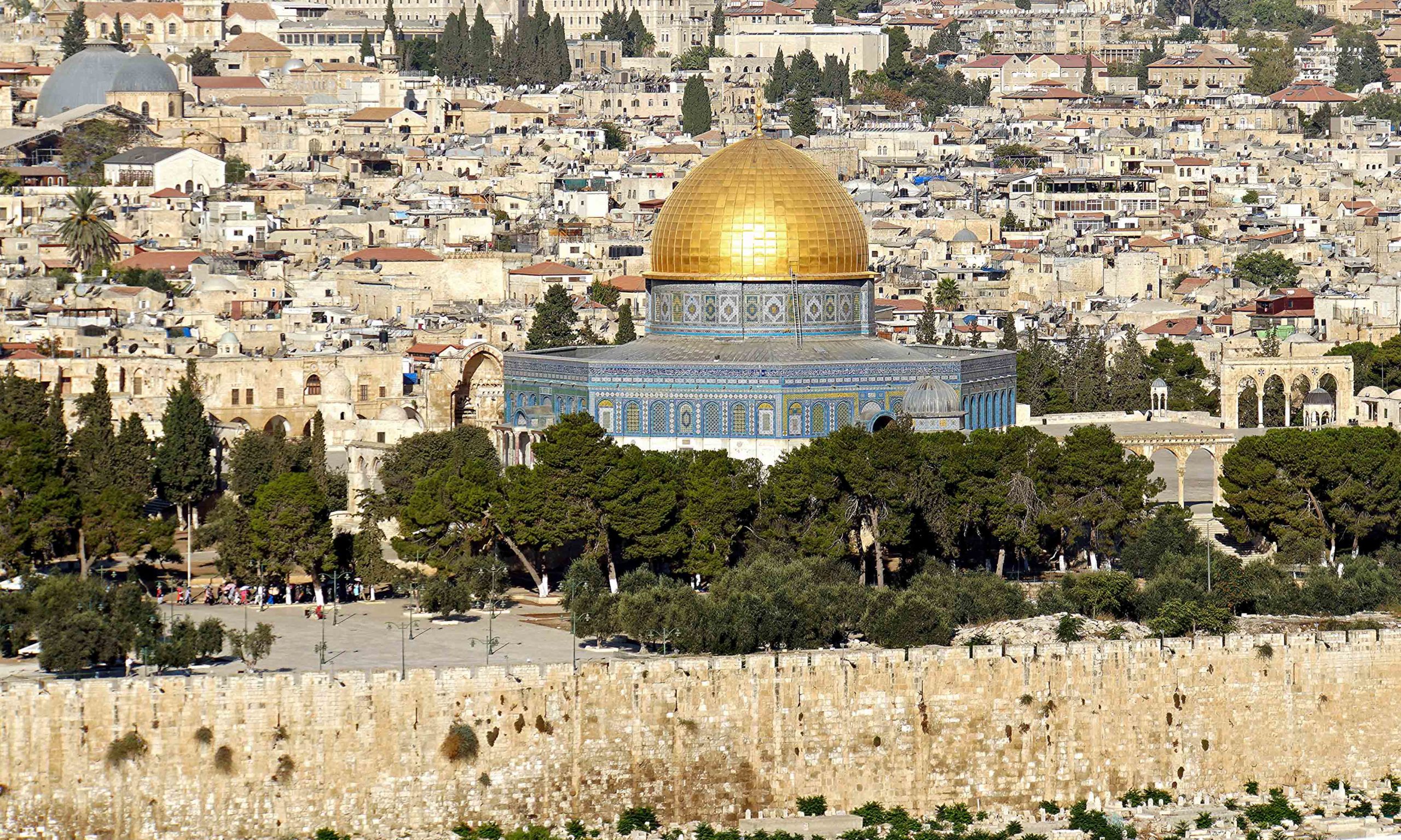
The Dome of the Rock (Qubbat al-Sakhra), Jerusalem, 691–92 (Umayyad), stone masonry, wooden roof, decorated with glazed ceramic tile, mosaics, and gilt aluminum and bronze dome, with multiple renovations, patron the Caliph Abd al-Malik
-
Great Mosque at Córdoba, Spain, begun 786 and enlarged during the 9th and 10th centuries
-
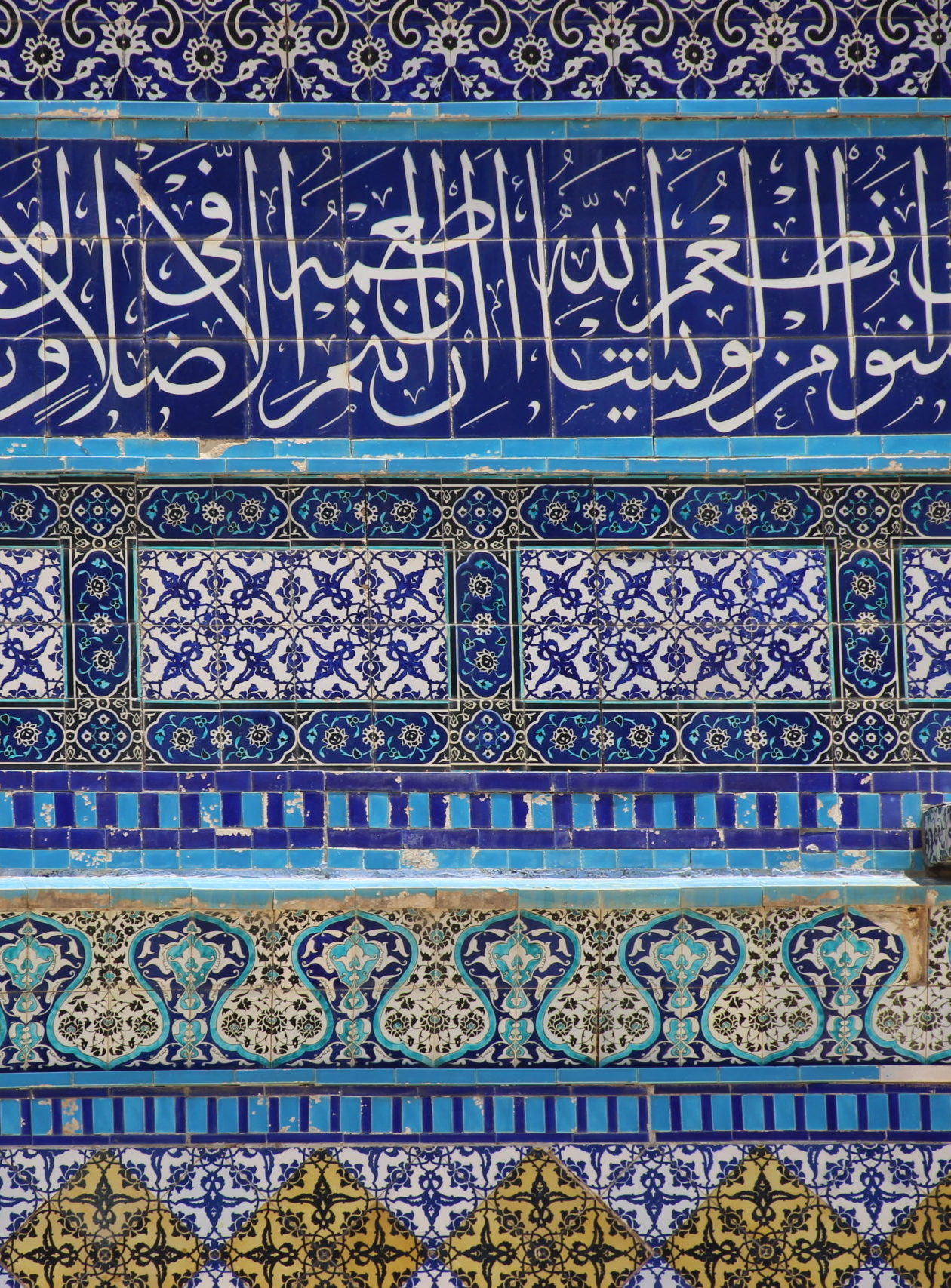
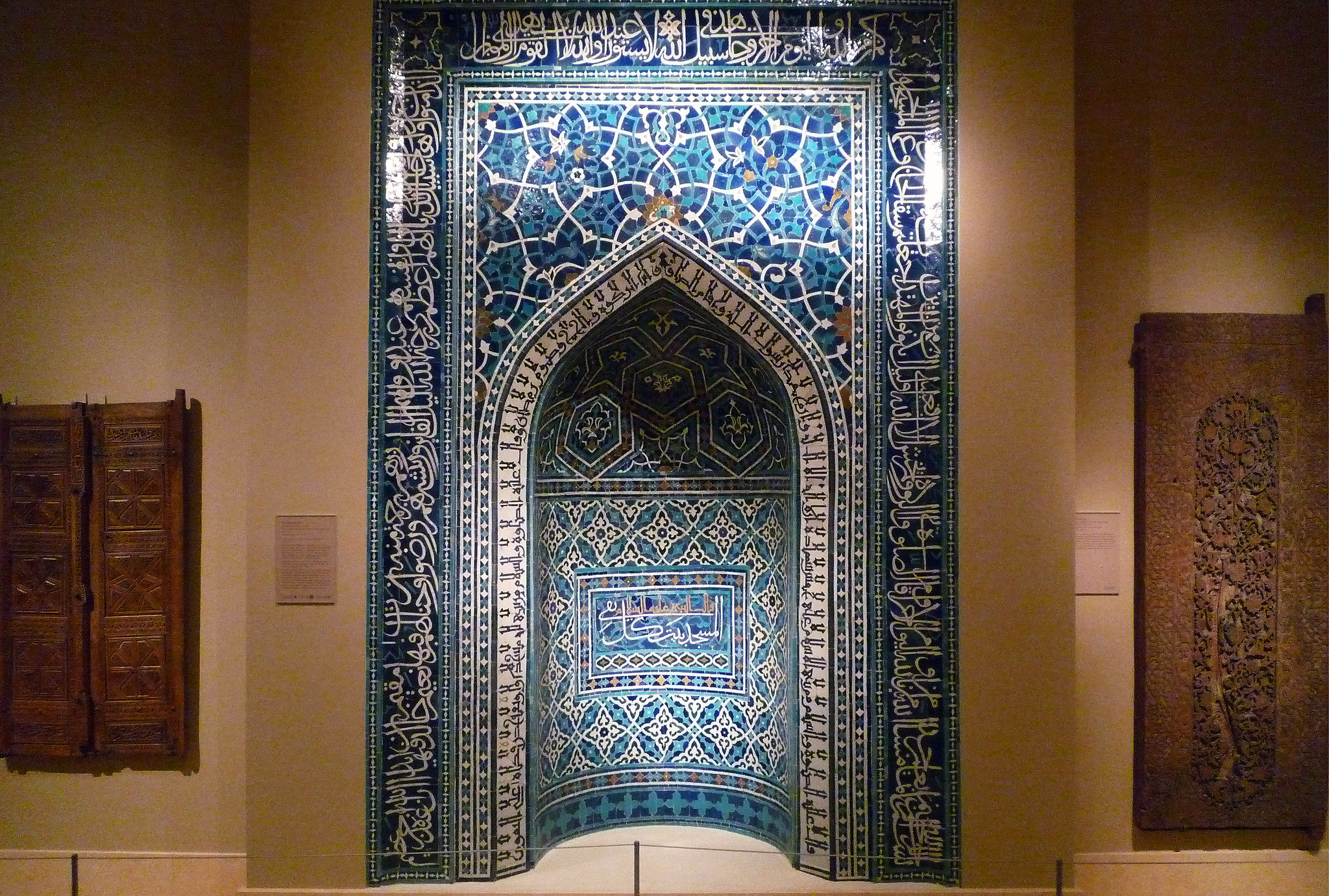
Mihrab (prayer niche), 1354–55 (A.H. 755), just after the Ilkhanid period, Isfahan, Iran, polychrome glazed tiles
Term List
-
Islam
-
Muhammad
-
Qur‘an
-
Pilgrimage
-
Caliph
-
Calligraphy
-
Aniconic
-
Umayyad
-
Abbasid
-
Arabesque
-
Middle East
-
Faience
-
Ambulatory
-
Colonnade
-
Mosque
-
Sahn
-
Mihrab
-
Minaret
-
Qubba
-
Al-Andalus
-
Hypostyle hall
-
Horeshoe arch
-
Silk Road
-
Iwan
Islam, an introduction
Origins and the life of Muhammad the Prophet
Islam, Judaism, and Christianity are three of the world’s great monotheistic faiths. They share many of the same holy sites, such as Jerusalem, and prophets, such as Abraham. Collectively, scholars refer to these three religions as the Abrahamic faiths, since Abraham and his family played vital roles in the formation of these religions.
Islam was founded by Muhammad (c. 570–632 C.E.), a merchant from the city of Mecca, now in modern-day Saudi Arabia. Mecca was a well-established trading city. The Kaaba (in Mecca) is the focus of pilgrimage for Muslims.
The Qur’an, the holy book of Islam, provides very little detail about Muhammad’s life; however, the hadiths, or sayings of the Prophet, which were largely compiled in the centuries following Muhammad’s death, provide a larger narrative for the events in his life. Muhammad was born in 570 C.E. in Mecca, and his early life was unremarkable. He married a wealthy widow named Khadija. Around 610 C.E., Muhammad had his first religious experience, where he was instructed to recite by the Angel Gabriel. After a period of introspection and self-doubt, Muhammad accepted his role as God’s prophet and began to preach word of the one God, or Allah in Arabic. His first convert was his wife.
Muhammad’s divine recitations form the Qur’an; unlike the Bible or Hindu epics, it is organized into verses, known as ayat. During one of his many visions, in 621 C.E., Muhammad was taken on the famous Night Journey by the Angel Gabriel, travelling from Mecca to the farthest mosque in Jerusalem, from where he ascended into heaven. The site of his ascension is believed to be the stone around which the Dome of the Rock was built. Eventually in 622, Muhammad and his followers fled Mecca for the city of Yathrib, which is known as Medina today, where his community was welcomed. This event is known as the hijra, or emigration. 622, the year of the hijra (A.H.), marks the beginning of the Muslim calendar, which is still in use today.
Between 625–630 C.E., there were a series of battles fought between the Meccans and Muhammad and the new Muslim community. Eventually, Muhammad was victorious and reentered Mecca in 630.
One of Muhammad’s first actions was to purge the Kaaba of all of its idols (before this, the Kaaba was a major site of pilgrimage for the polytheistic religious traditions of the Arabian Peninsula and contained numerous idols of pagan gods). The Kaaba is believed to have been built by Abraham (or Ibrahim as he is known in Arabic) and his son, Ishmael. The Arabs claim descent from Ishmael, the son of Abraham and Hagar. The Kaaba then became the most important center for pilgrimage in Islam.
In 632, Muhammad died in Medina. Muslims believe that he was the final in a line of prophets, which included Moses, Abraham, and Jesus.
After Muhammad’s death
The century following Muhammad’s death was dominated by military conquest and expansion. Muhammad was succeeded by the four “rightly-guided” Caliphs (khalifa or successor in Arabic): Abu Bakr (632–34 C.E.), Umar (634–44 C.E.), Uthman (644–56 C.E.), and Ali (656–661 C.E.). The Qur’an is believed to have been codified during Uthman’s reign. The final caliph, Ali, was married to Fatima, Muhammad’s daughter and was murdered in 661. The death of Ali is a very important event; his followers, who believed that he should have succeeded Muhammad directly, became known as the Shi’a, meaning the followers of Ali. Today, the Shi’ite community is composed of several different branches, and there are large Shi’a populations in Iran, Iraq, and Bahrain. The Sunnis, who do not hold that Ali should have directly succeeded Muhammad, compose the largest branch of Islam; their adherents can be found across North Africa, the Middle East, as well as in Asia and Europe.
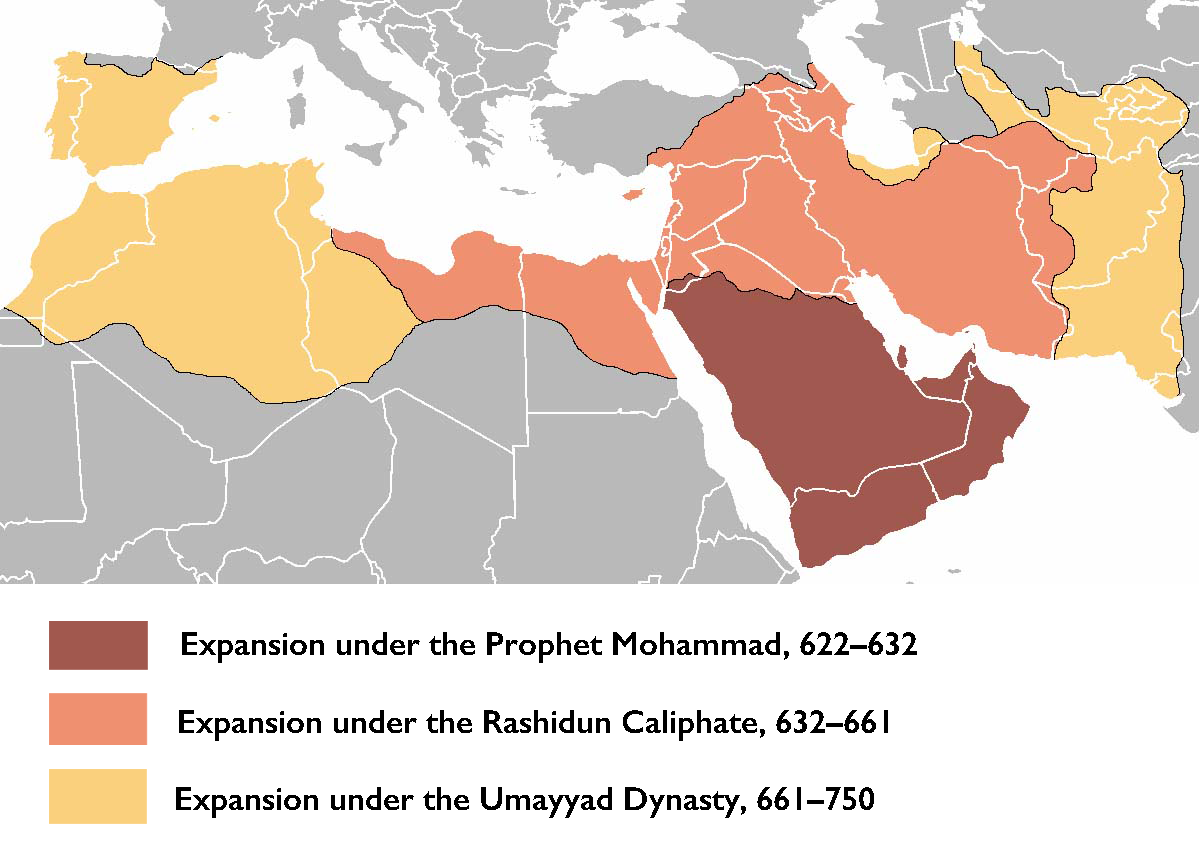
During the seventh and early eighth centuries, the Arab armies conquered large swaths of territory in the Middle East, North Africa, the Iberian Peninsula, and Central Asia, despite on-going civil wars in Arabia and the Middle East. Eventually, the Umayyad Dynasty emerged as the rulers, with Abd al-Malik completing the Dome of the Rock, one of the earliest surviving Islamic monuments, in 691/2 C.E. The Umayyads reigned until 749/50 C.E., when they were overthrown, and the Abbasid Dynasty assumed the Caliphate and ruled large sections of the Islamic world. However, with the Abbasid Revolution, no one ruler would ever again control all of the Islamic lands.
Arts of the Islamic world
What is Islamic Art?
The Dome of the Rock, the Taj Mahal, a Mina’i ware bowl, a silk carpet, a Qur‘an; all of these are examples of Islamic art. But what is Islamic art?
Islamic art is a modern concept, created by art historians in the nineteenth century to categorize and study the material first produced under the Islamic peoples that emerged from Arabia in the seventh century.
Today Islamic art describes all of the arts that were produced in the lands where Islam was the dominant religion or the religion of those who ruled. Unlike the terms Christian, Jewish, and Buddhist art, which refer only to religious art of these faiths, Islamic art is not used merely to describe religious art or architecture, but applies to all art forms produced in the Islamic World.
Thus, Islamic art refers not only to works created by Muslim artists, artisans, and architects or for Muslim patrons. It encompasses the works created by Muslim artists for a patron of any faith, including Christians, Jews, or Hindus, and the works created by Jews, Christians, and others, living in Islamic lands, for patrons, Muslim and otherwise.
One of the most famous monuments of Islamic art is the Taj Mahal, a royal mausoleum, located in Agra, India. Hinduism is majority religion in India; however, because Muslim rulers, most famously the Mughals, dominated large areas of modern-day India for centuries, India has a vast range of Islamic art and architecture. The Great Mosque of Xi’an, China, is one of the oldest and best preserved mosques in China. First constructed in 742 C.E., the mosque’s current form dates to the fifteenth century C.E. and follows the plan and architecture of a contemporary Buddhist temple. In fact, much Islamic art and architecture was—and still is—created through a synthesis of local traditions and more global ideas.

Islamic art is not a monolithic style or movement; it spans 1,300 years of history and has incredible geographic diversity—Islamic empires and dynasties controlled territory from Spain to western China at various points in history. However, few if any of these various countries or Muslim empires would have referred to their art as Islamic. An artisan in Damascus thought of his work as Syrian or Damascene—not as Islamic.
As a result of thinking about the problems of calling such art Islamic, certain scholars and major museums, like the Metropolitan Museum of Art, have decided to omit the term Islamic when they renamed their new galleries of Islamic art. Instead, they are called “Galleries for the Art of the Arab Lands, Turkey, Iran, Central Asia, and Later South Asia,” thereby stressing the regional styles and individual cultures. Thus, when using the phrase, Islamic art, one should know that it is a useful, but artificial, concept.
In some ways, Islamic art is a bit like referring to the Italian Renaissance. During the Renaissance, there was no unified Italy; it was a land of independent city-states. No one would have thought of one’s self as an Italian, or of the art they produced as Italian, rather one conceived of one’s self as a Roman, a Florentine, or a Venetian. Each city developed a highly local, remarkable style. At the same time, there are certain underlying themes or similarities that unify the art and architecture of these cities and allow scholars to speak of an Italian Renaissance.
Themes
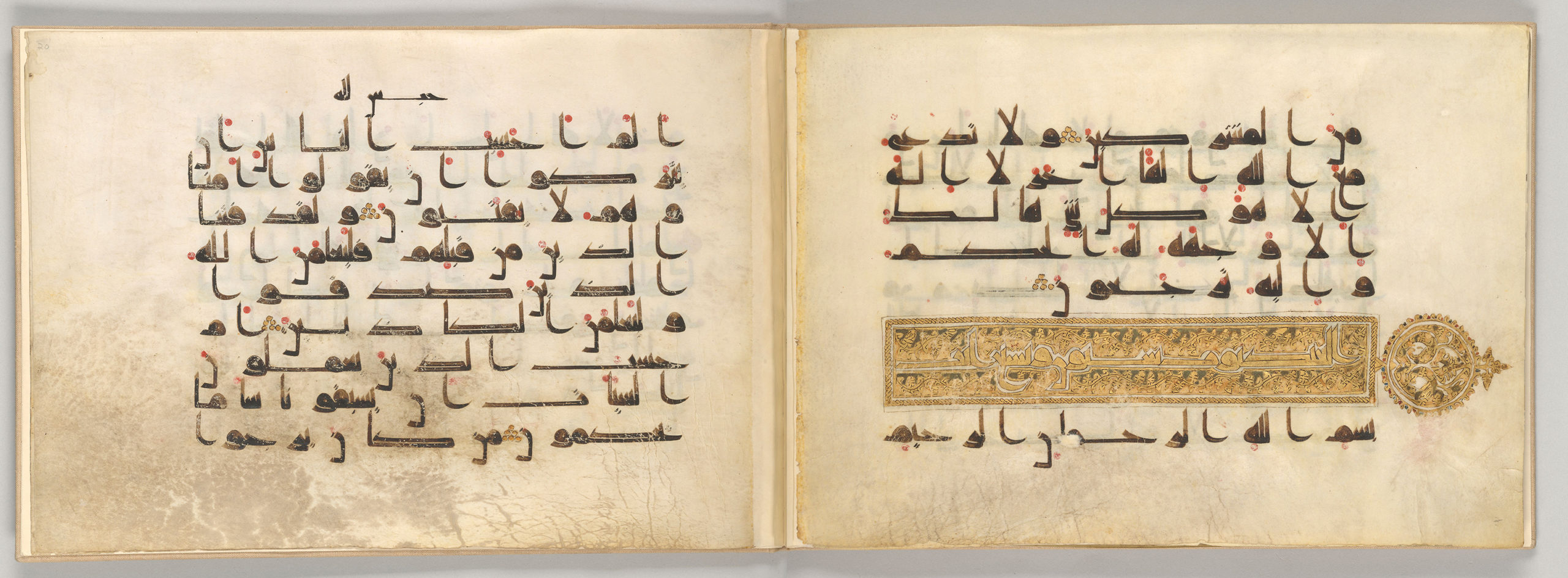
Similarly, there are themes and types of objects that link the arts of the Islamic World together. Calligraphy is a very important art form in the Islamic world. The Qur’an, written in elegant scripts, represents Allah’s (or God’s) divine word, which Muhammad received directly from Allah during his visions. Quranic verses, executed in calligraphy, are found on many different forms of art and architecture. Likewise, poetry can be found on everything from ceramic bowls to the walls of houses. Calligraphy’s omnipresence underscores the value that is placed on language, specifically Arabic.
Geometric and vegetative motifs are very popular throughout the lands where Islam was once or still is a major religion and cultural force, appearing in the private palaces of buildings such as the Alhambra (in Spain) as well as in the detailed metal work of Safavid Iran. Likewise, certain building types appear throughout the Muslim world: mosques with their minarets, mausolea, gardens, and madrasas (religious schools) are all common. However, their forms vary greatly.
One of the most common misconceptions about the art of the Islamic world is that it is aniconic; that is, the art does not contain representations of humans or animals. Religious art and architecture, almost from the earliest examples, such as the Dome of the Rock, the Aqsa Mosque (both in Jerusalem), and the Great Mosque of Damascus, built under the Umayyad rulers, did not include human figures and animals. However, the private residences of sovereigns, such as Qasr ‘Amra or Khirbat Mafjar, were filled with vast figurative paintings, mosaics, and sculpture.
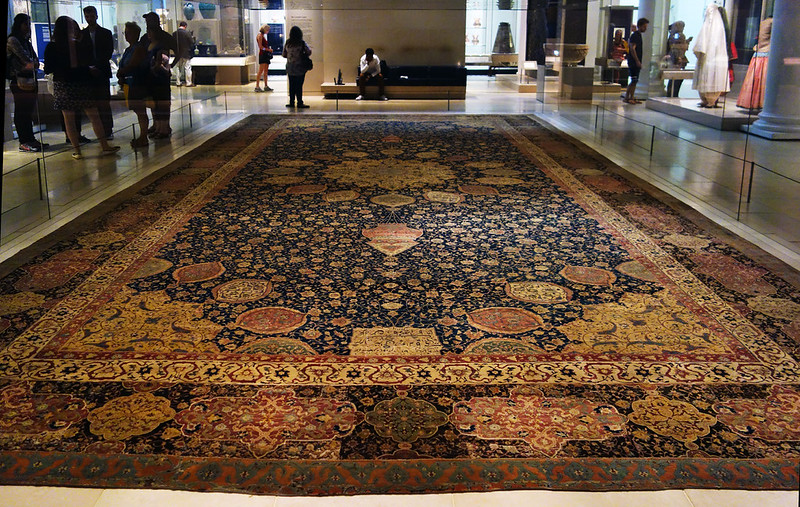
The study of the arts of the Islamic world has also lagged behind other fields in art history. There are several reasons for this. First, many scholars are not familiar with Arabic or Farsi (the dominant language in Iran). Calligraphy, particularly Arabic calligraphy, as noted above, is a major art form and appears on almost all types of architecture and arts. Second, the art forms and objects prized in the Islamic world do not correspond to those traditionally valued by art historians and collectors in the Western world. The so-called decorative arts—carpets, ceramics, metalwork, and books—are types of art that Western scholars have traditionally valued less than painting and sculpture. However, the last fifty years has seen a flourishing of scholarship on the arts of the Islamic world.
Arts of the Islamic world
Here, we have decided to use the phrase “arts of the Islamic world” to emphasize the art that was created in a world where Islam was a dominant religion or a major cultural force, but was not necessarily religious art. Often when the word “Islamic” is used today, it is used to describe something religious; thus using the phrase, Islamic art, potentially implies, mistakenly, that all of this art is religious in nature. The phrase, “arts of the Islamic world,” also acknowledges that not all of the work produced in the “Islamic world” was for Muslims or was created by Muslims.
Note on organization
The material in this section is organized into three chronological periods: early, medieval and late. When starting to learn about a new area of art, chronological organization often enables students to grasp the material and its fundamentals before going on to more complex analysis, like comparing building types or styles. Within each of these chronological groups, we have focused on creating geographic groups or groupings to organize the material further. The Islamic world was only unified very briefly in its history under the Umayyads (661–750 C.E.) and the early Abbasids (750–932 C.E.). Soon various dynasties or rulers simultaneously commanded sections of territory, many of which had no cultural commonalities, aside from their religion.
Arts of the Islamic world: The early period
The caliphates
The umbrella term “Islamic art” casts a pretty big shadow, covering several continents and more than a dozen centuries. So to make sense of it, we first have to first break it down into parts. One way is by medium—say, ceramics or architecture—but this method of categorization would entail looking at works that span three continents. Geography is another means of organization, but modern political boundaries rarely match the borders of past Islamic states.
A common solution is to consider instead, the historical caliphates (the states ruled by those who claimed legitimate Islamic rule) or dynasties. Though these distinctions are helpful, it is important to bear in mind that these are not discrete groups that produced one particular style of artwork. Artists throughout the centuries have been affected by the exchange of goods and ideas and have been influenced by one another.
Umayyad (661–750)
Four leaders, known as the Rightly Guided Caliphs, continued the spread of Islam immediately following the death of the Prophet. It was following the death of the fourth caliph that Mu’awiya seized power and established the Umayyad caliphate, the first Islamic dynasty. During this period, Damascus became the capital and the empire expanded West and East.
The first years following the death of Muhammad were, of course, formative for the religion and its artwork. The immediate needs of the religion included places to worship (mosques) and holy books (Korans) to convey the word of God. So, naturally, many of the first artistic projects included ornamented mosques where the faithful could gather and Korans with beautiful calligraphy.
Because Islam was still a very new religion, it had no artistic vocabulary of its own, and its earliest work was heavily influenced by older styles in the region. Chief among these sources were the Coptic tradition of present-day Egypt and Syria, with its scrolling vines and geometric motifs, Sasanian metalwork and crafts from what is now Iraq with their rhythmic, sometimes abstracted qualities, and naturalistic Byzantine mosaics depicting animals and plants.
These elements can be seen in the earliest significant work from the Umayyad period, the most important of which is the Dome of the Rock in Jerusalem. This stunning monument incorporates Coptic, Sasanian, and Byzantine elements in its decorative program and remains a masterpiece of Islamic architecture to this day.
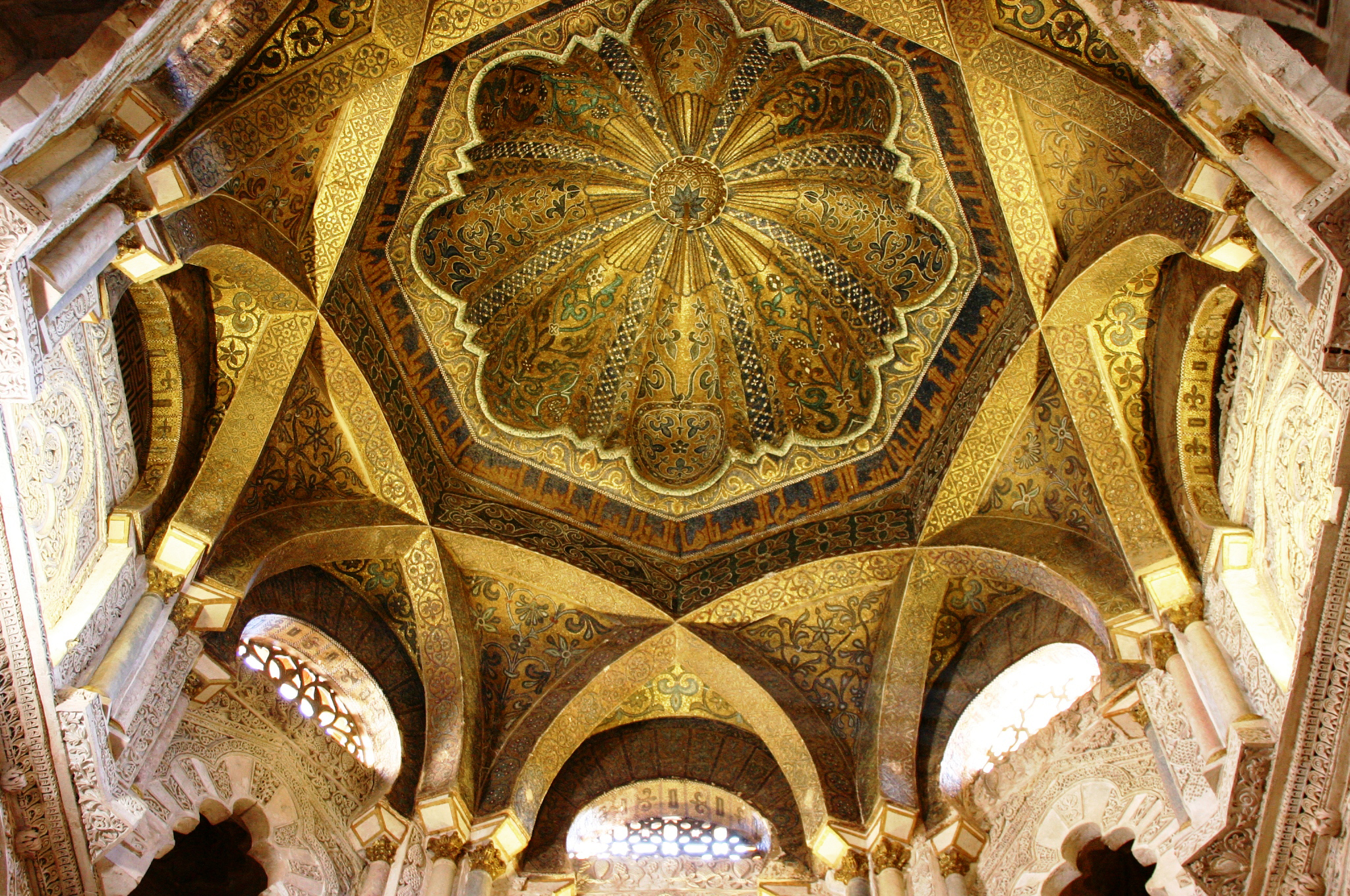
Remarkably, just one generation after the religion’s inception, Islamic civilization had produced a magnificent, if singular, monument. While the Dome of the Rock is considered an influential work, it bears little resemblance to the multitude of mosques created throughout the rest of the caliphate. It is important to point out that the Dome of the Rock is not a mosque. A more common plan, based on the house of the Prophet, was used for the vast majority of mosques throughout the Arab peninsula and the Maghreb. Perhaps the most remarkable of these is the Great Mosque of Córdoba (784–786) in Spain, which, like the Dome of the Rock, demonstrates an integration of the styles of the existing culture in which it was created.
Abbasid (750–1258)
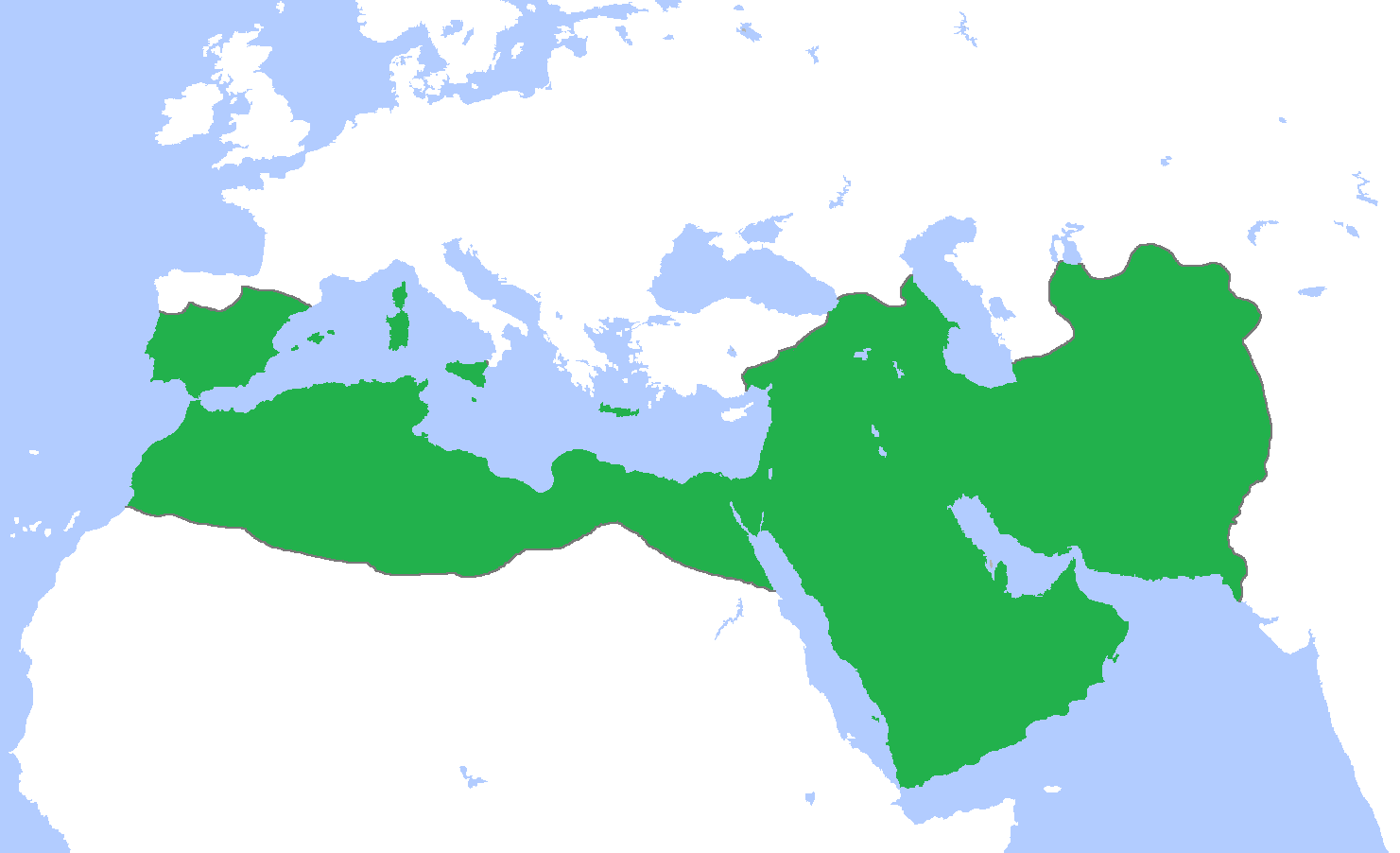
The Abbasid revolution in the mid-eighth century ended the Umayyad dynasty, resulted in the massacre of the Umayyad caliphs (a single caliph escaped to Spain, prolonging Umayyad work after dynasty) and established the Abbasid dynasty in 750. The new caliphate shifted its attention eastward and established cultural and commercial capitals at Baghdad and Samarra.
The Umayyad dynasty produced little of what we would consider decorative arts (like pottery, glass, metalwork), but under the Abbasid dynasty production of decorative stone, wood and ceramic objects flourished. Artisans in Samarra developed a new method for carving surfaces that allowed for curved, vegetal forms (called arabesques) which became widely adopted. There were also developments in ceramic decoration. The use of luster painting (which gives ceramic ware a metallic sheen) became popular in surrounding regions and was extensively used on tile for centuries. Overall, the Abbasid epoch was an important transitional period that disseminated styles and techniques to distant Islamic lands.
The Abbasid empire weakened with the establishment and growing power of semi-autonomous dynasties throughout the region, until Baghdad was finally overthrown in 1258. This dissolution signified not only the end of a dynasty, but marked the last time that the Arab-Muslim empire would be united as one entity.
Umayyad Caliphate: The Dome of the Rock (Qubbat al-Sakhra)
“The Dome of the Rock is a building of extraordinary beauty, solidity, elegance, and singularity of shape… Both outside and inside, the decoration is so magnificent and the workmanship so surpassing as to defy description. The greater part is covered with gold so that the eyes of one who gazes on its beauties are dazzled by its brilliance, now glowing like a mass of light, now flashing like lightning.” Ibn Battuta (14th century travel writer)
A glorious mystery
One of the most iconic images of the Middle East is undoubtedly the Dome of the Rock shimmering in the setting sun of Jerusalem. Sitting atop the Haram al-Sharif, the highest point in old Jerusalem, the Dome of the Rock’s golden-color Dome and Turkish Faience tiles dominates the cityscape of Old Jerusalem and in the 7th century served as a testament to the power of the new faith of Islam. The Dome of the Rock is one of the earliest surviving buildings from the Islamic world. This remarkable building is not a mosque, as is commonly assumed, and scholars still debate its original function and meaning.
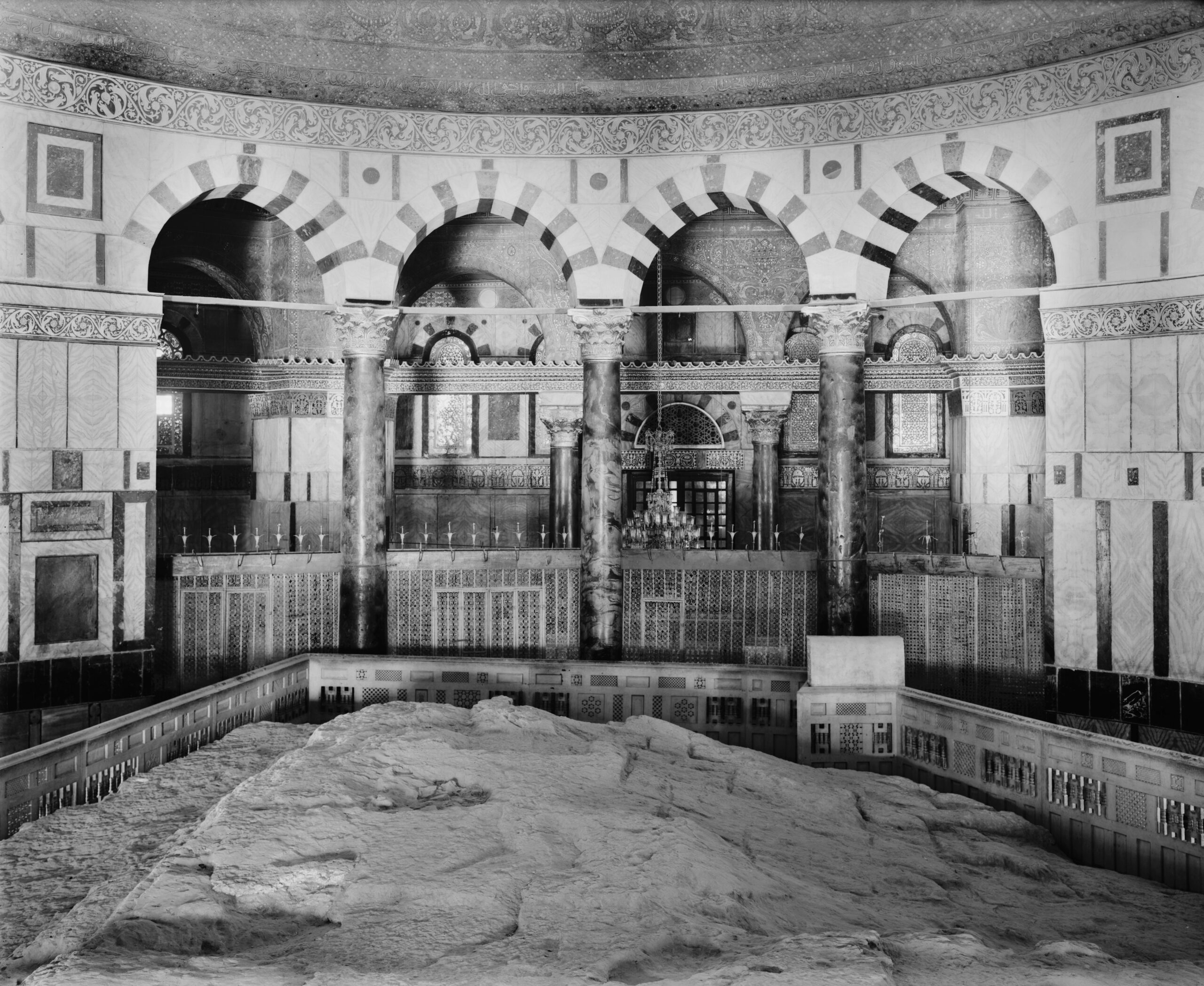
Between the death of the prophet Muhammad in 632 and 691/2, when the Dome of the Rock was completed, there was intermittent warfare in Arabia and Holy Land around Jerusalem. The first Arab armies who emerged from the Arabian peninsula were focused on conquering and establishing an empire—not building.
The Dome of the Rock was one of the first Islamic buildings ever constructed. It was built between 685 and 691/2 by Abd al-Malik, arguably the most important Umayyad caliph, as a religious focal point for his supporters, while he was fighting a civil war against Ibn Zubayr. When Abd al-Malik began construction on the Dome of the Rock, he did not have control of the Kaaba, the holiest shrine in Islam, which is located in Mecca.
The Dome is located on the Haram al-Sharif, an enormous open-air platform that now houses Al-Aqsa mosque, madrasas and several other religious buildings. Few places are as holy for Christians, Jews, and Muslims as the Haram al-Sharif. It is the Temple Mount, the site of the Jewish second temple, which the Roman Emperor Titus destroyed in 70 C.E. while subduing the Jewish revolt; a Roman temple was later built on the site. The Temple Mount was abandoned in Late Antiquity.
The rock in the Dome of the Rock
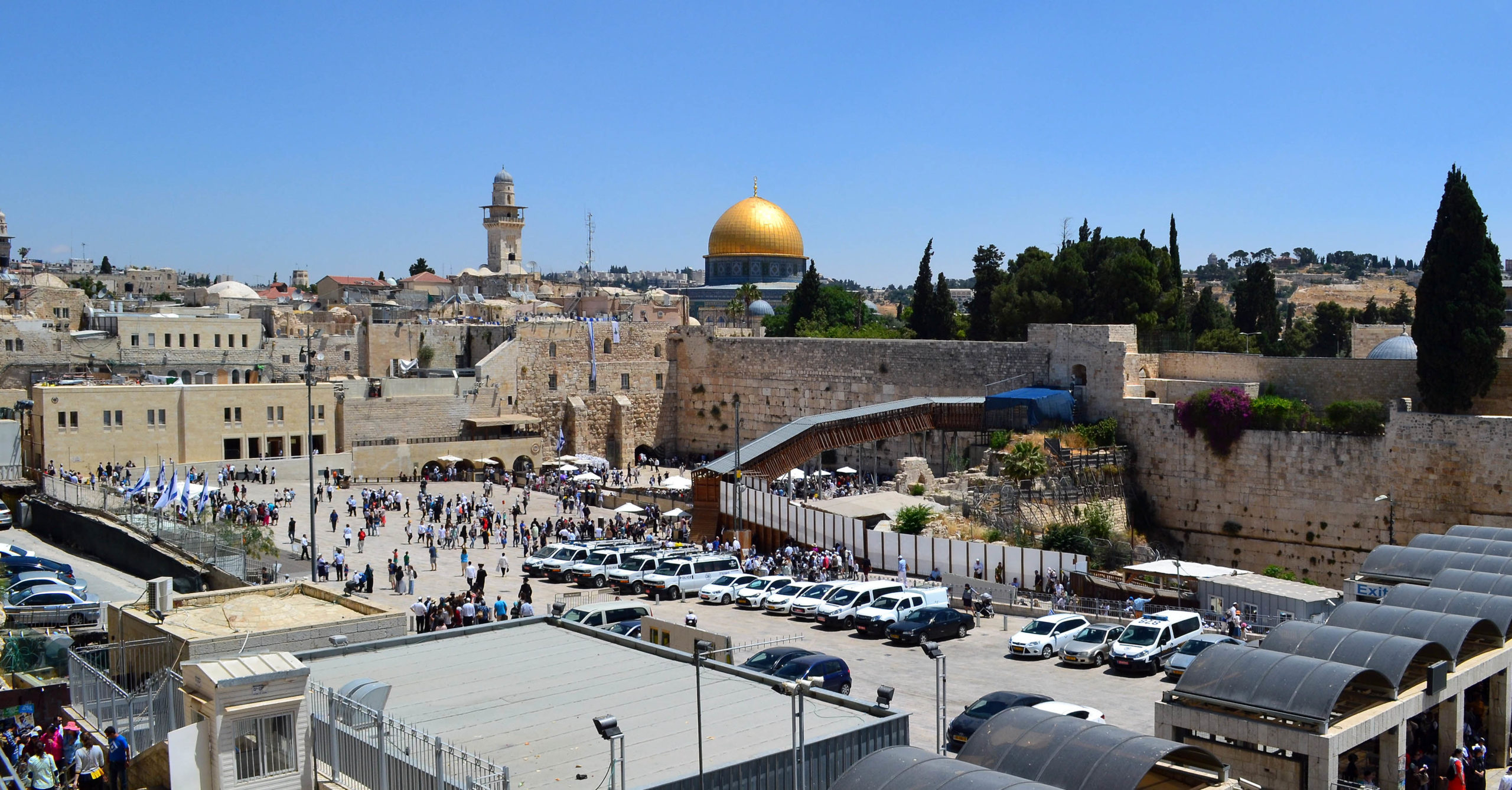
At the center of the Dome of the Rock sits a large rock, which is believed to be the location where Abraham was prepared to sacrifice his son Ishaq (Isaac in the Judeo/Christian tradition). Today, Muslims believe that the Rock commemorates the night journey of Muhammad. One night the Angel Gabriel came to Muhammad while he slept near the Kaaba in Mecca and took him to al-Masjid al-Aqsa (the farthest mosque) in Jerusalem. From the Rock, Muhammad journeyed to heaven, where he met other prophets, such as Moses and Christ, witnessed paradise and hell and finally saw God enthroned and circumambulated by angels.
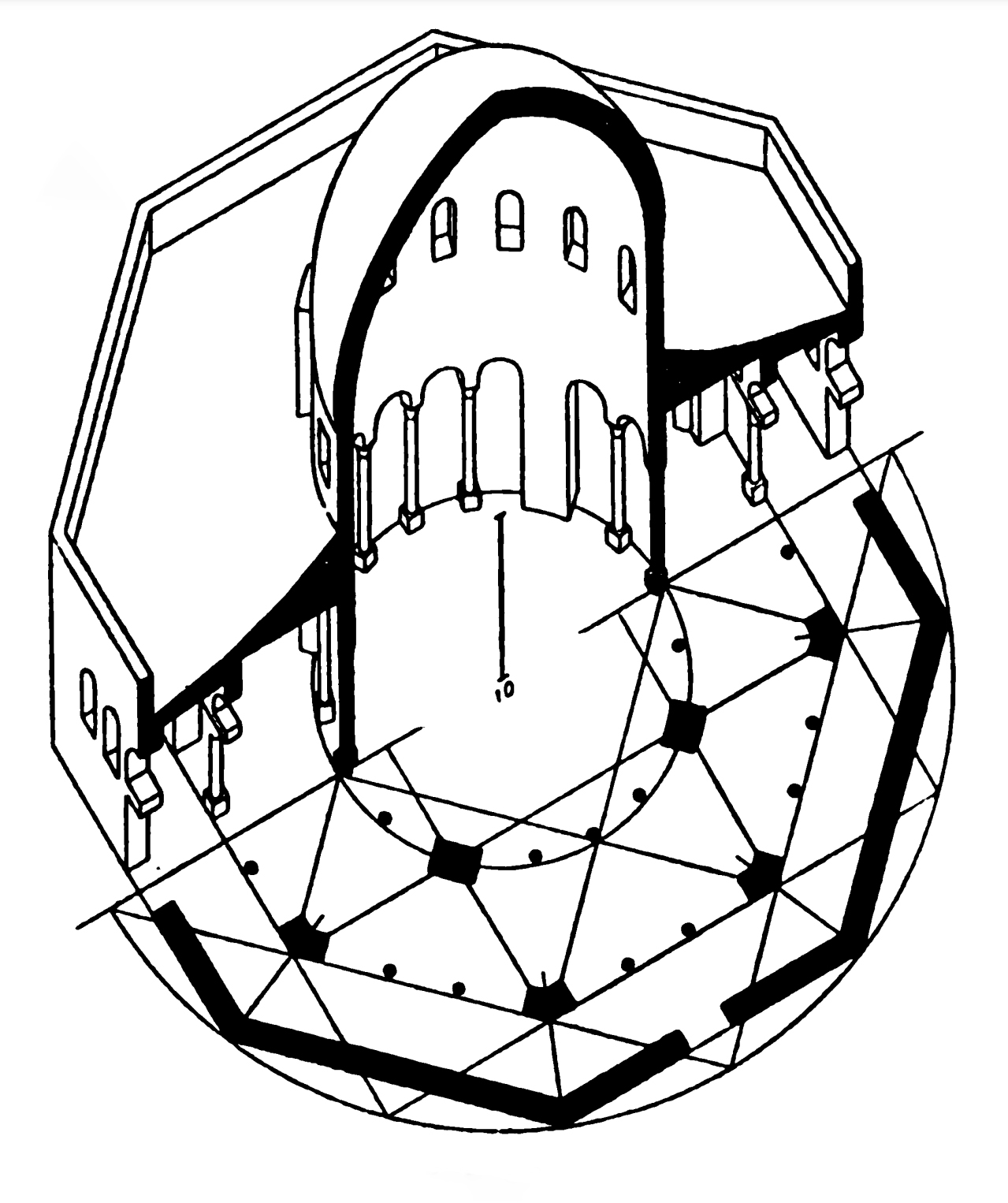
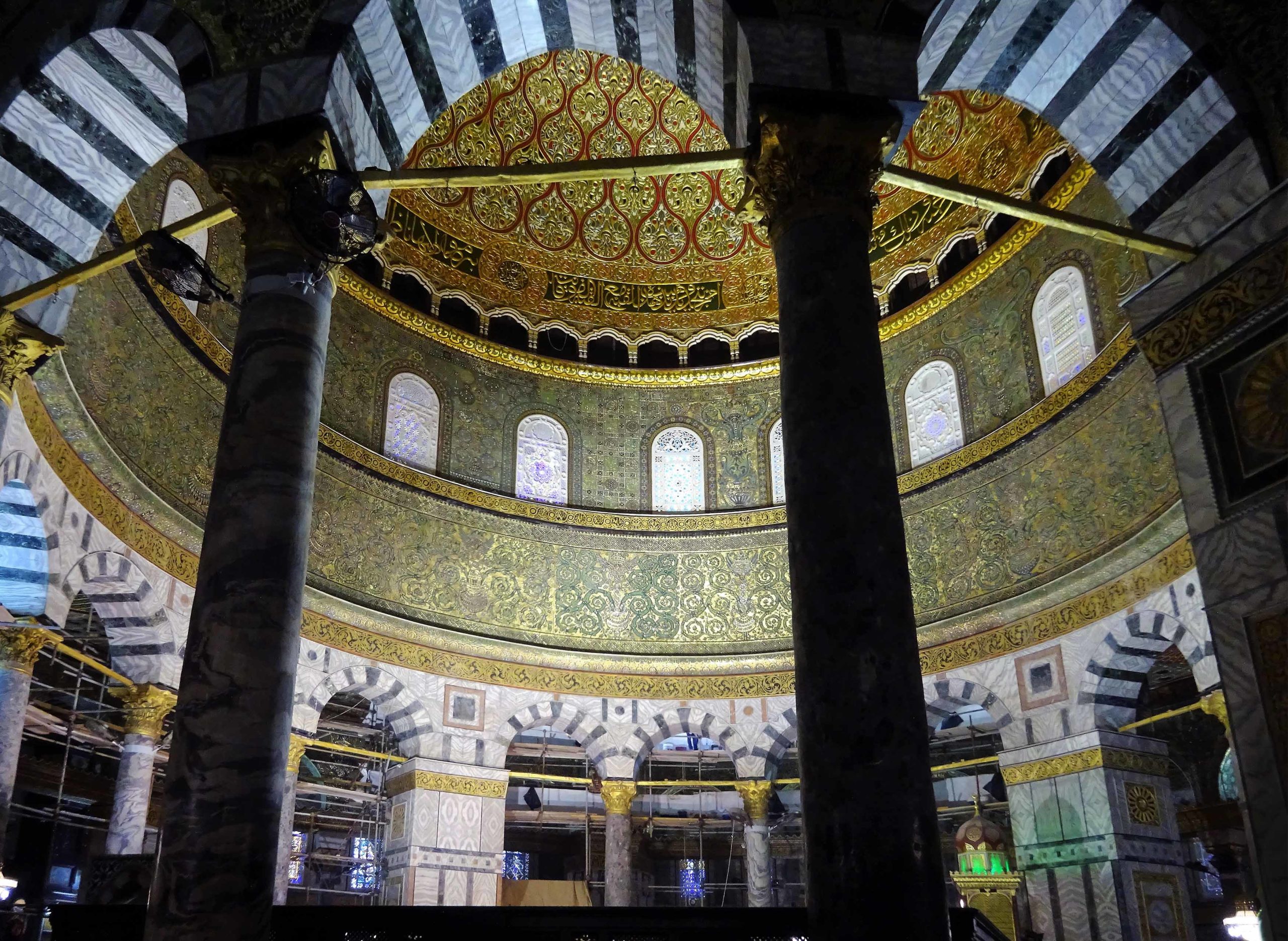
The Rock is enclosed by two ambulatories (in this case the aisles that circle the rock) and an octagonal exterior wall. The central colonnade (row of columns) was composed of four piers and twelve columns supporting a rounded drum that transitions into the two-layered dome more than 20 meters in diameter.
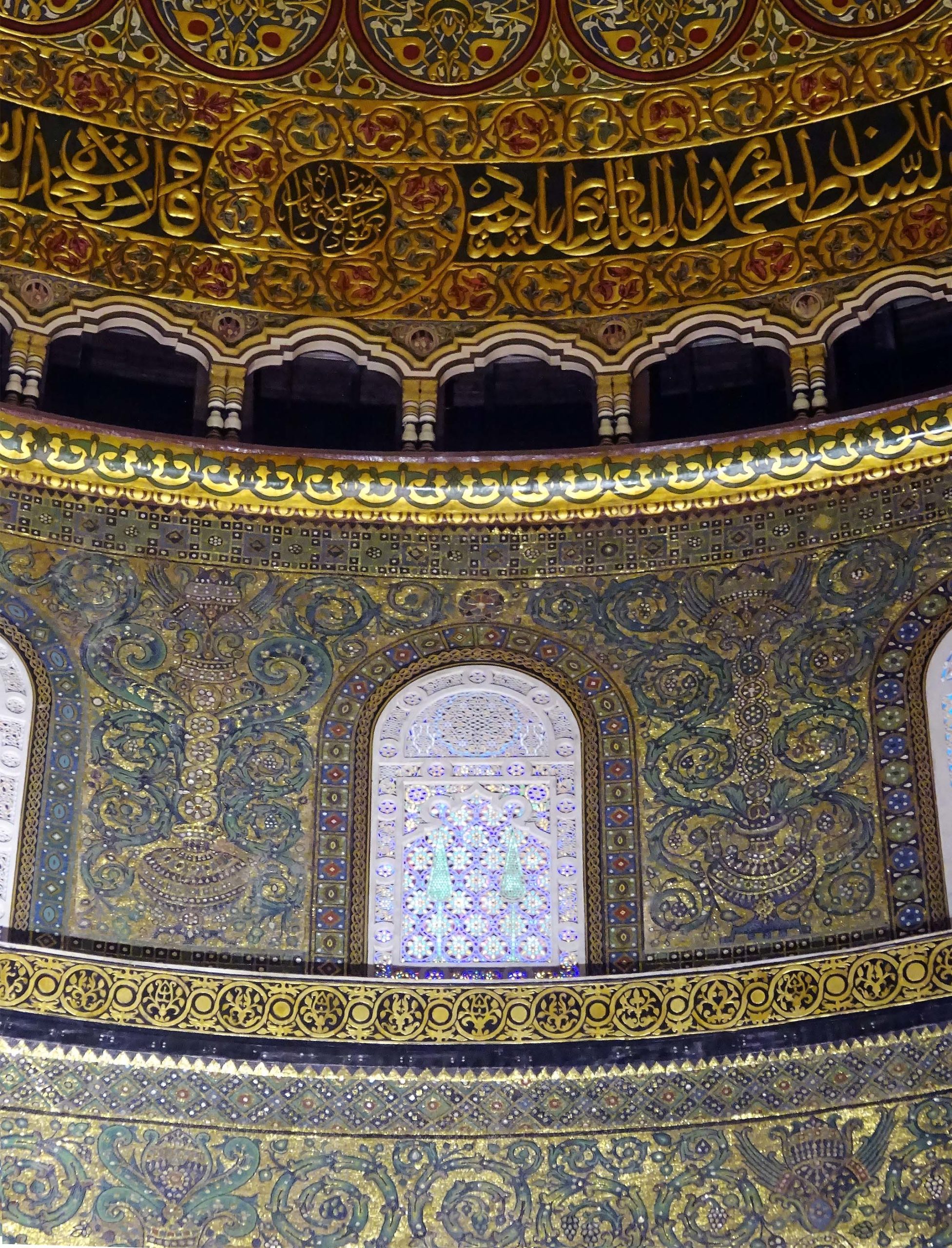
The colonnades are clad in marble on their lower registers, and their upper registers are adorned with exceptional mosaics. The ethereal interior atmosphere is a result of light that pours in from grilled windows located in the drum and exterior walls. Golden mosaics depicting jewels shimmer in this glittering light. Byzantine and Sasanian crowns in the midst of vegetal motifs are also visible.
The Byzantine Empire stood to the North and to the West of the new Islamic Empire until 1453, when its capital, Constantinople, fell to the Ottoman Turks. To the East, the old Sasanian Empire of Persia imploded under pressure from the Arabs, but nevertheless provided winged crown motifs that can be found in the Dome of the Rock.
Mosaics
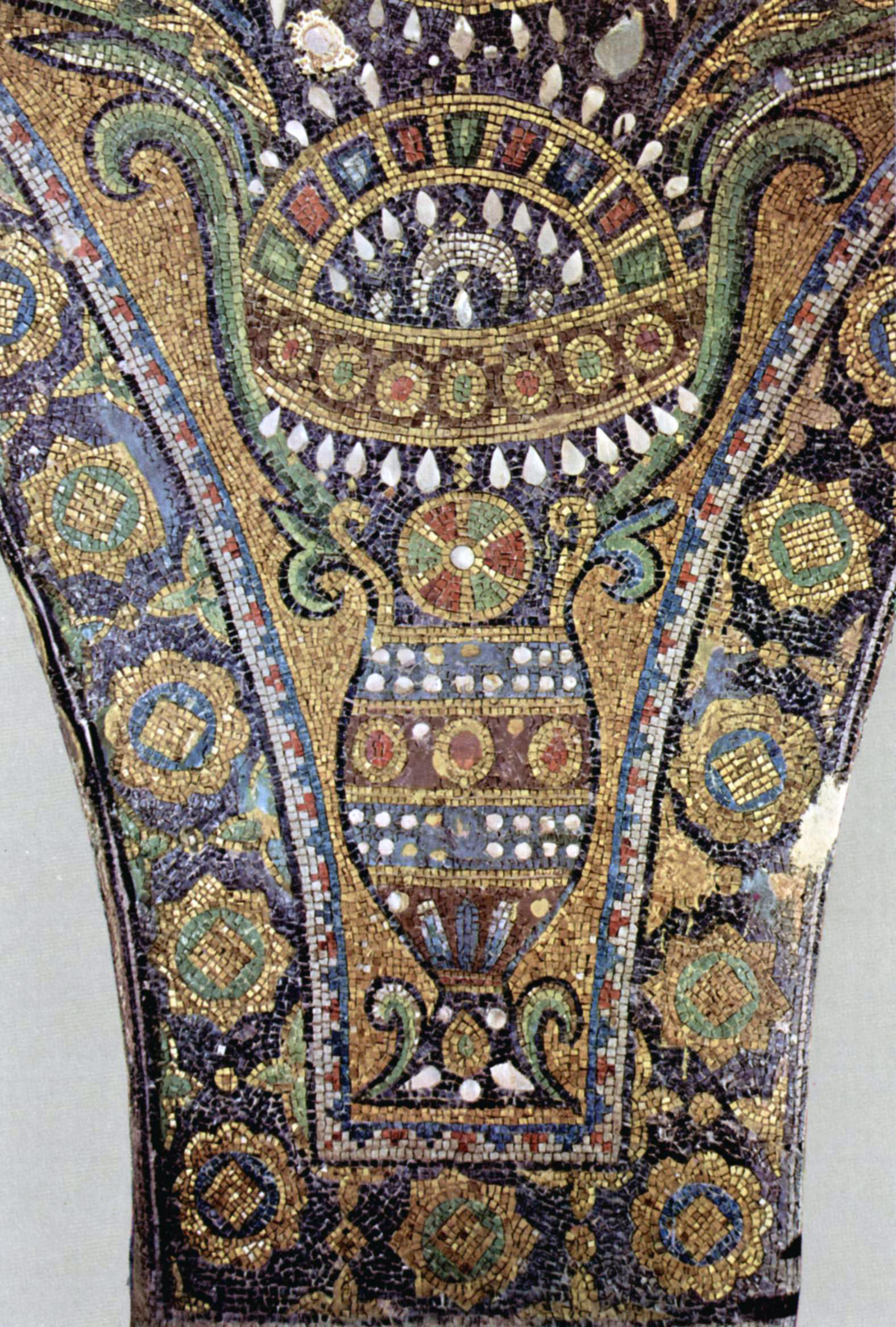
Wall and ceiling mosaics became very popular in Late Antiquity and adorn many Byzantine churches, including San Vitale in Ravenna and Hagia Sophia in Constantinople. Thus, the use of mosaics reflects an artistic tie to the world of Late Antiquity. Late Antiquity is a period from about 300–800, when the Classical world dissolves and the Medieval period emerges.
The mosaics in the Dome of the Rock contain no human figures or animals. While Islam does not prohibit the use of figurative art per se, it seems that in religious buildings, this proscription was upheld. Instead, we see vegetative scrolls and motifs, as well as vessels and winged crowns, which were worn by Sasanian kings. Thus, the iconography of the Dome of the Rock also includes the other major pre-Islamic civilization of the region, the Sasanian Empire, which the Arab armies had defeated.
A reference to local churches
Scholars used to think that the building enclosing the Rock derived its form from the imperial mausolea (the burial places) of Roman emperors, such as Augustus or Hadrian. However, its octagonal form and Dome more likely referenced earlier local churches. The Church of the Holy Sepulcher in Jerusalem was built to enclose the tomb of Christ. The Church of the Holy Sepulcher and the Dome of the Rock have domes that are almost identical in size; this suggests that the elevated position of the Dome of the Rock and the comparable size of its dome was a way that Muslims in the late 8th century proclaimed the superiority of their newly formed faith over Christians. Furthermore, the octagonal form of the Dome may derive from the Church of the Kathisma, a 5th-century church, later converted to a mosque, that was located between Jerusalem and Bethlehem. It was constructed over the rock where Mary reportedly sat on her way to Bethlehem. It is octagonal in shape and had an aisle that allowed circumambulation around the center. Therefore, rather than looking to the monuments of Rome, which was now far less important than Constantinople and Jerusalem, these local buildings may have been more important models.
The inscription
The Dome of the Rock also contains an inscription, 240 meters long, that includes some of the earliest surviving examples of verses from the Qur‘an—in an architectural context or otherwise. The bismillah, the phrase that starts each verse of the Qu’ran, and the shahada, the Islamic confession of faith, which states that there is only one God and Muhammad is his prophet, are also included in the inscription. The inscription also refers to Mary and Christ and proclaims that Christ was not divine but a prophet. Thus the inscription also proclaims some of the core values of the newly formed religion of Islam. It also demonstrates the importance of calligraphy as a decorative form in Islamic Art.
Below the Rock is a small chamber, whose purpose is not fully understood even to this day. For those who are fortunate enough to be able to enter the Dome of the Rock, the experience is moving, regardless of one’s faith.
Mosque architecture, an introduction
From Indonesia to the United Kingdom, the mosque in its many forms is the quintessential Islamic building. The mosque, masjid in Arabic, is the Muslim gathering place for prayer. Masjid simply means “place of prostration.” Though most of the five daily prayers prescribed in Islam can take place anywhere, all men are required to gather together at the mosque for the Friday noon prayer.
Mosques are also used throughout the week for prayer, study, or simply as a place for rest and reflection. The main mosque of a city, used for the Friday communal prayer, is called a jami masjid, literally meaning “Friday mosque,” but it is also sometimes called a congregational mosque in English. The style, layout, and decoration of a mosque can tell us a lot about Islam in general, but also about the period and region in which the mosque was constructed.
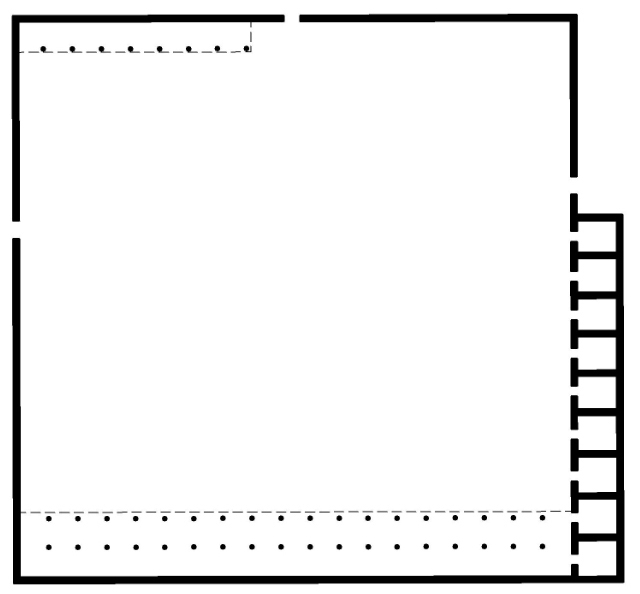
The home of the Prophet Muhammad is considered the first mosque. His house, in Medina in modern-day Saudi Arabia, was a typical 7th-century Arabian style house, with a large courtyard surrounded by long rooms supported by columns. This style of mosque came to be known as a hypostyle mosque, meaning “many columns.” Most mosques built in Arab lands utilized this style for centuries.
Common features
The architecture of a mosque is shaped most strongly by the regional traditions of the time and place where it was built. As a result, style, layout, and decoration can vary greatly. Nevertheless, because of the common function of the mosque as a place of congregational prayer, certain architectural features appear in mosques all over the world.
Sahn (courtyard)
The most fundamental necessity of congregational mosque architecture is that it be able to hold the entire male population of a city or town (women are welcome to attend Friday prayers, but not required to do so). To that end congregational mosques must have a large prayer hall. In many mosques this is adjoined to an open courtyard, called a sahn. Within the courtyard one often finds a fountain, its waters both a welcome respite in hot lands, and important for the ablutions (ritual cleansing) done before prayer.
Mihrab (niche)
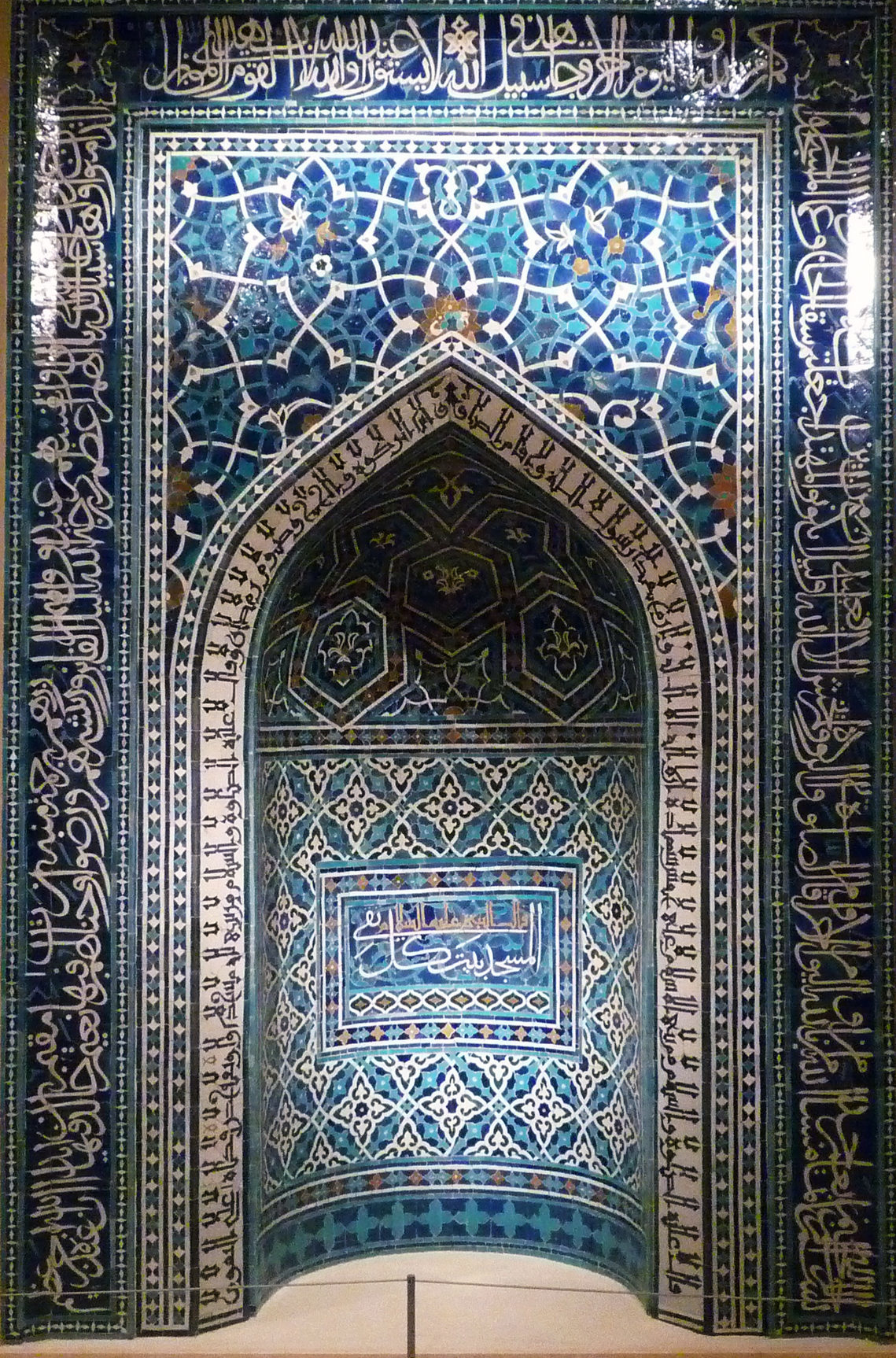
Another essential element of a mosque’s architecture is a mihrab—a niche in the wall that indicates the direction of Mecca, towards which all Muslims pray. Mecca is the city in which the Prophet Muhammad was born, and the home of the most important Islamic site, the Kaaba. The direction of Mecca is called the qibla, and so the wall in which the mihrab is set is called the qibla wall. No matter where a mosque is, its mihrab indicates the direction of Mecca (or as near that direction as science and geography were able to place it). Therefore, a mihrab in India will be to the west, while a one in Egypt will be to the east. A mihrab is usually a relatively shallow niche, as in the example from Istanbul, above left. In an example from Spain, the mihrab’s niche takes the form of a small room, which is more rare.
Minaret (tower)
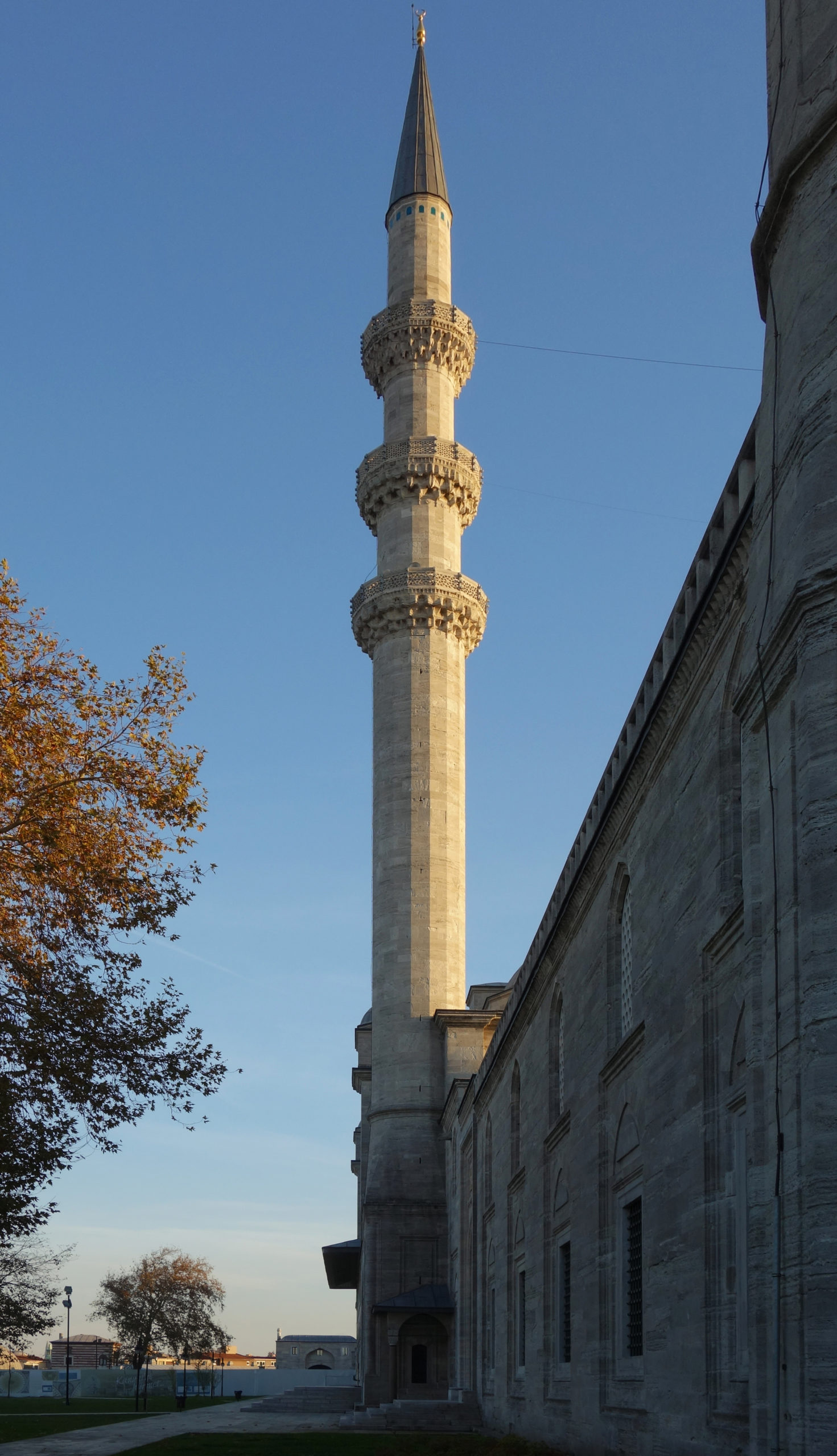
One of the most visible aspects of mosque architecture is the minaret, a tower adjacent or attached to a mosque, from which the call to prayer is announced.
Minarets take many different forms—from the famous spiral minaret of Samarra, to the tall, pencil minarets of Ottoman Turkey. Not solely functional in nature, the minaret serves as a powerful visual reminder of the presence of Islam.
Qubba (dome)
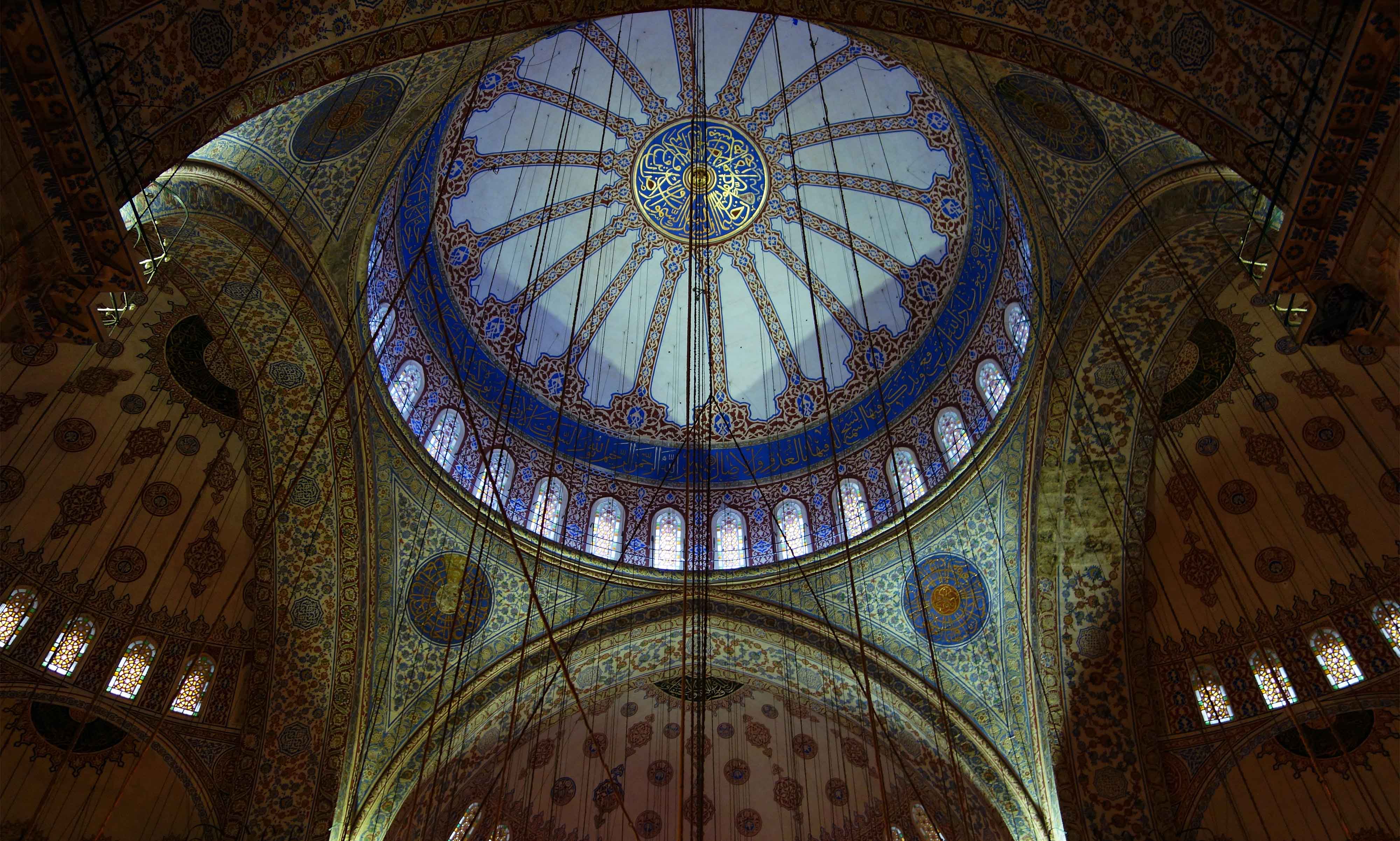
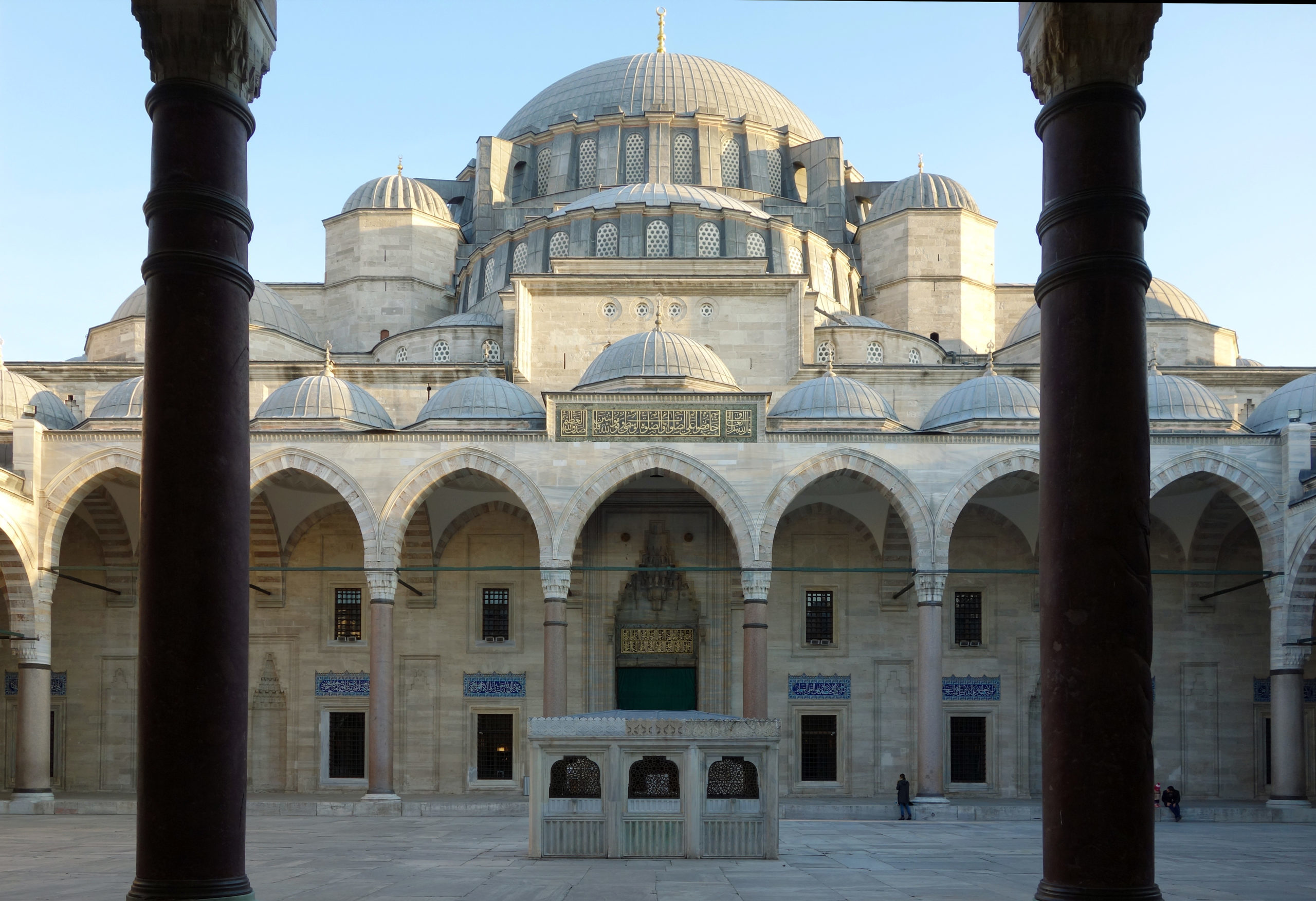
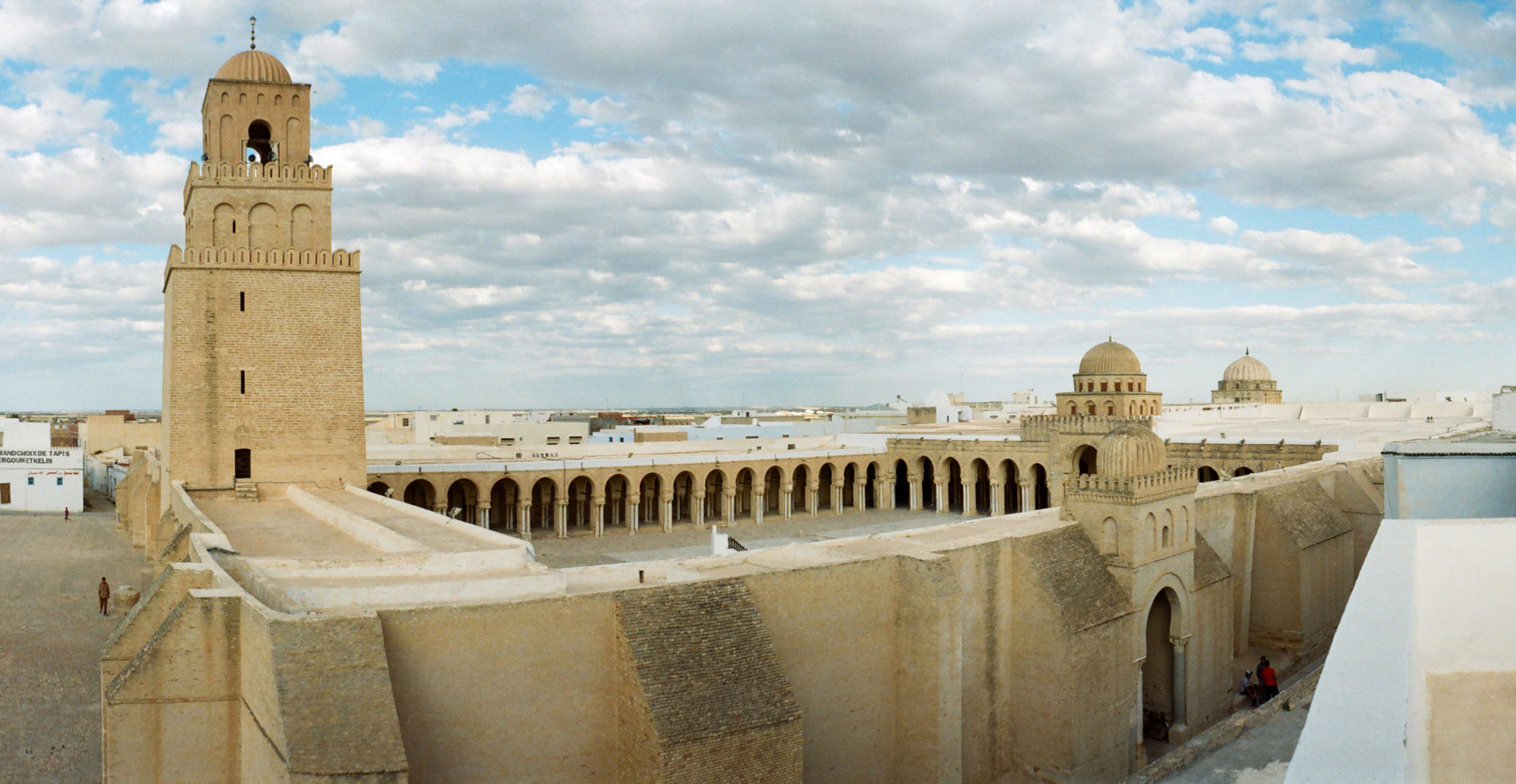
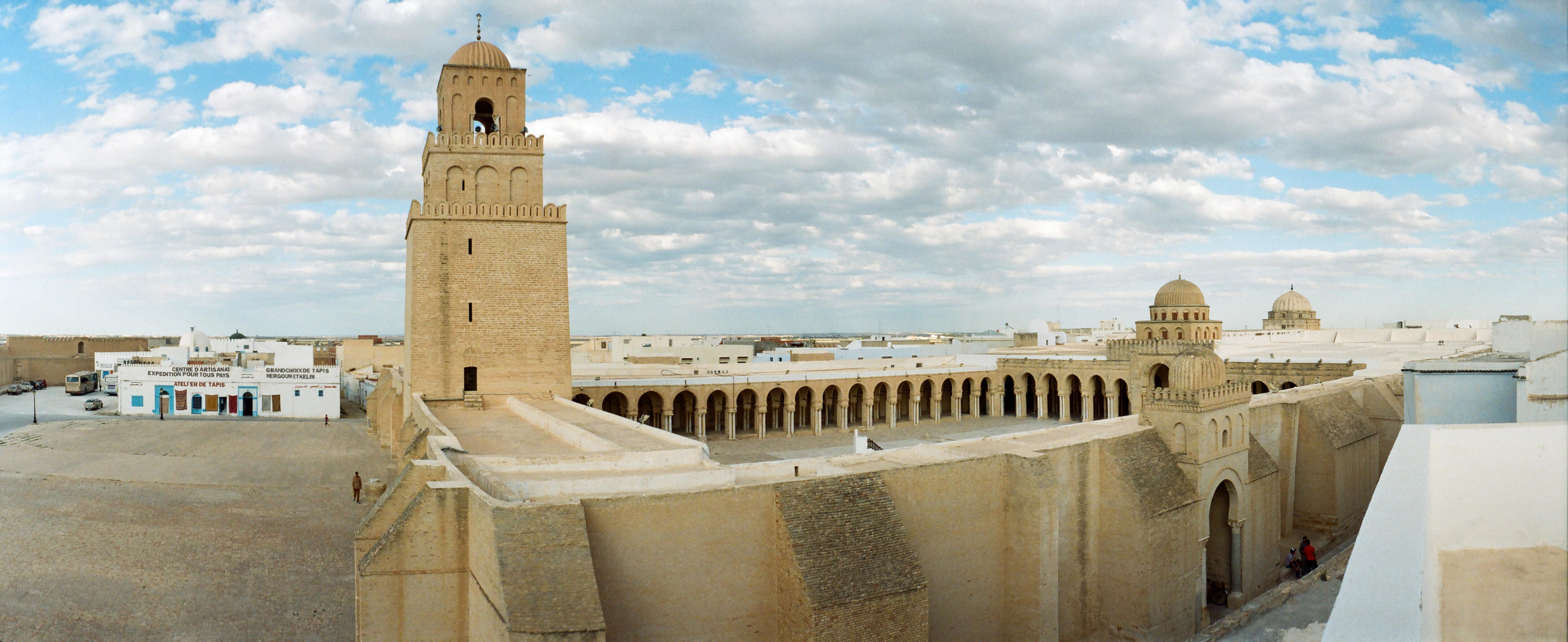
Most mosques also feature one or more domes, called qubba in Arabic. While not a ritual requirement like the mihrab, a dome does possess significance within the mosque—as a symbolic representation of the vault of heaven. The interior decoration of a dome often emphasizes this symbolism, using intricate geometric, stellate, or vegetal motifs to create breathtaking patterns meant to awe and inspire. Some mosque types incorporate multiple domes into their architecture (as in the Ottoman Süleymaniye Mosque pictured at the top of the page), while others only feature one. In mosques with only a single dome, it is invariably found surmounting the qibla wall, the holiest section of the mosque. The Great Mosque of Kairouan in Tunisia has three domes: one atop the minaret, one above the entrance to the prayer hall, and one above the qibla wall.
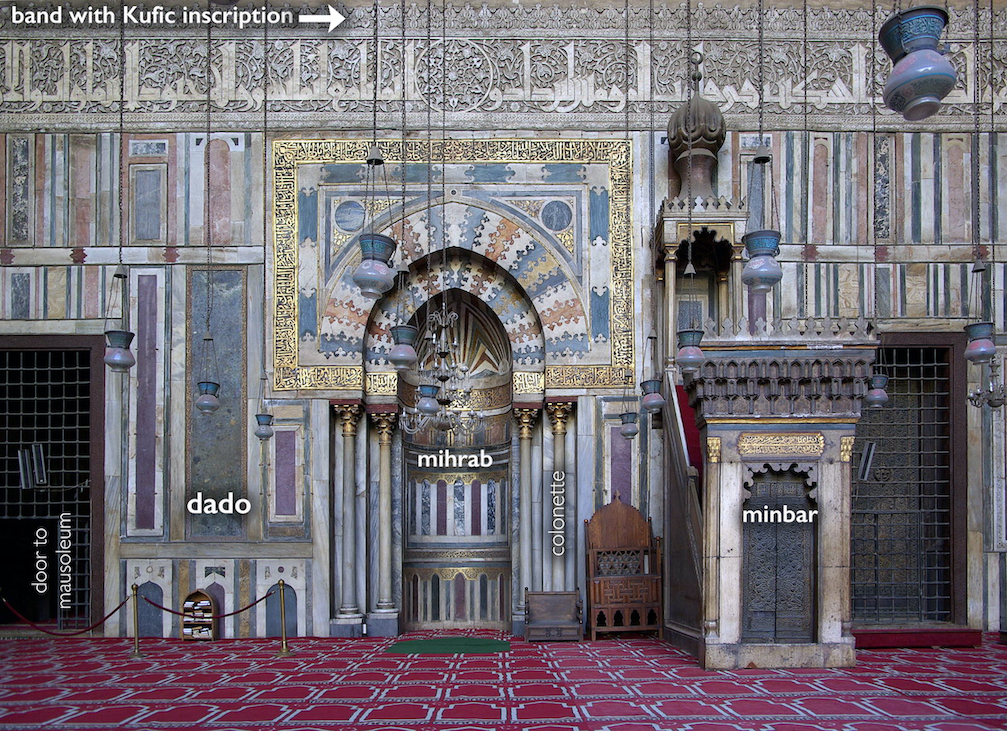
Because it is the directional focus of prayer, the qibla wall, with its mihrab and minbar, is often the most ornately decorated area of a mosque. The rich decoration of the qibla wall is apparent in this image of the mihrab and minbar of the Mosque of Sultan Hasan in Cairo, Egypt.
Furnishings
There are other decorative elements common to most mosques. For instance, a large calligraphic frieze or a cartouche with a prominent inscription often appears above the mihrab. In most cases the calligraphic inscriptions are quotations from the Qur’an, and often include the date of the building’s dedication and the name of the patron. Another important feature of mosque decoration are hanging lamps, also visible in the photograph of the Sultan Hasan mosque. Light is an essential feature for mosques, since the first and last daily prayers occur before the sun rises and after the sun sets. Before electricity, mosques were illuminated with oil lamps. Hundreds of such lamps hung inside a mosque would create a glittering spectacle, with soft light emanating from each, highlighting the calligraphy and other decorations on the lamps’ surfaces. Although not a permanent part of a mosque building, lamps, along with other furnishings like carpets, formed a significant—though ephemeral—aspect of mosque architecture.
Mosque patronage
Most historical mosques are not stand-alone buildings. Many incorporated charitable institutions like soup kitchens, hospitals, and schools. Some mosque patrons also chose to include their own mausoleum as part of their mosque complex. The endowment of charitable institutions is an important aspect of Islamic culture, due in part to the third pillar of Islam, which calls for Muslims to donate a portion of their income to the poor.
The commissioning of a mosque would be seen as a pious act on the part of a ruler or other wealthy patron, and the names of patrons are usually included in the calligraphic decoration of mosques. Such inscriptions also often praise the piety and generosity of the patron. For instance, the mihrab now at the Metropolitan Museum of Art, bears the inscription:
And he [the Prophet], blessings and peace be upon him, said: “Whoever builds a mosque for God, even the size of a sand-grouse nest, based on piety, [God will build for him a palace in Paradise].”
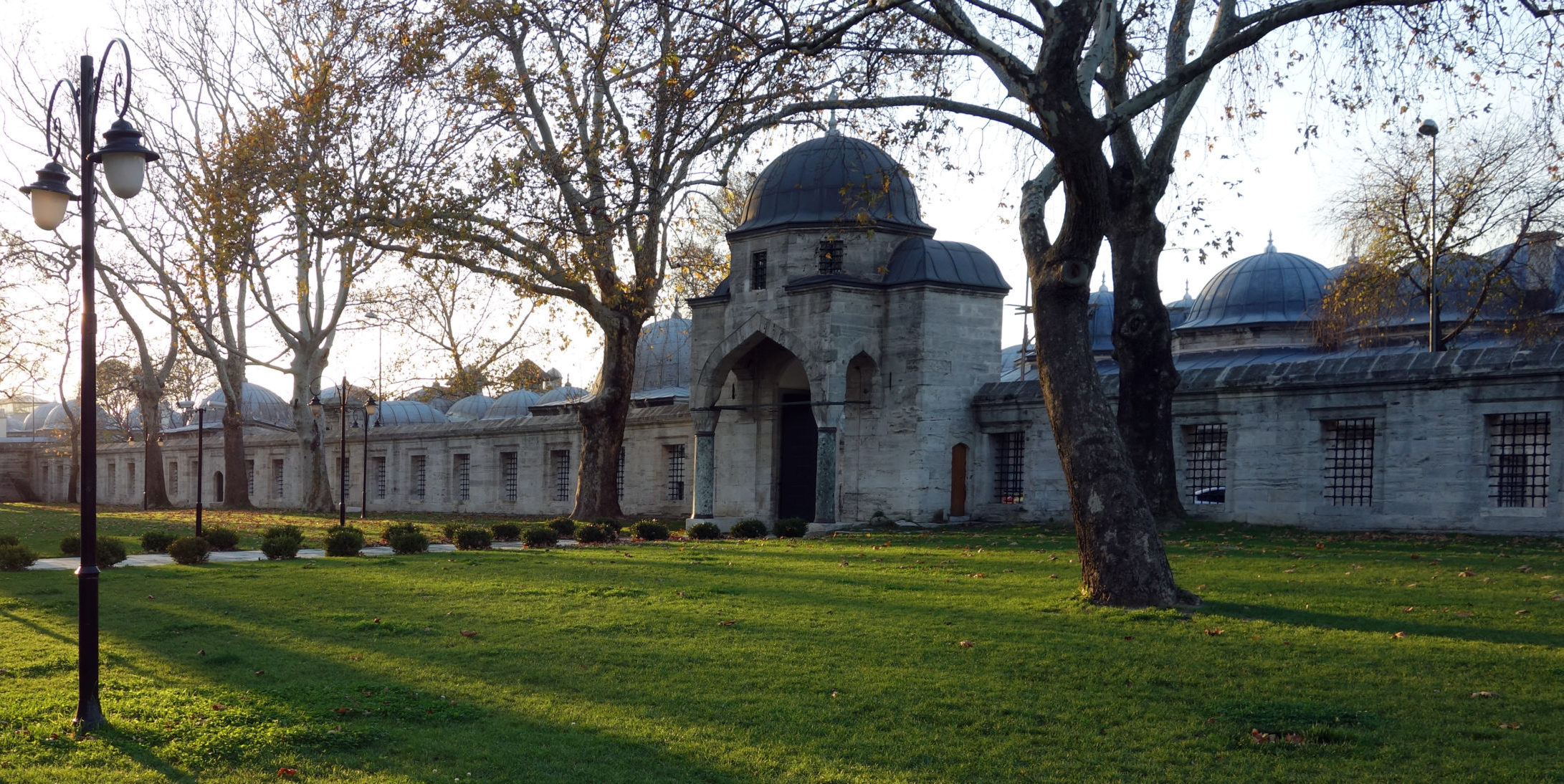
The patronage of mosques was not only a charitable act therefore, but also, like architectural patronage in all cultures, an opportunity for self-promotion. The social services attached the mosques of the Ottoman sultans are some of the most extensive of their type. In Ottoman Turkey the complex surrounding a mosque is called a kulliye. The kulliye of the Mosque of Sultan Suleyman, in Istanbul, is a fine example of this phenomenon, comprising a soup kitchen, a hospital, several schools, public baths, and a caravanserai (similar to a hostel for travelers). The complex also includes two mausoleums for Sultan Suleyman and his family members.
Umayyad Caliphate: The Great Mosque of Córdoba
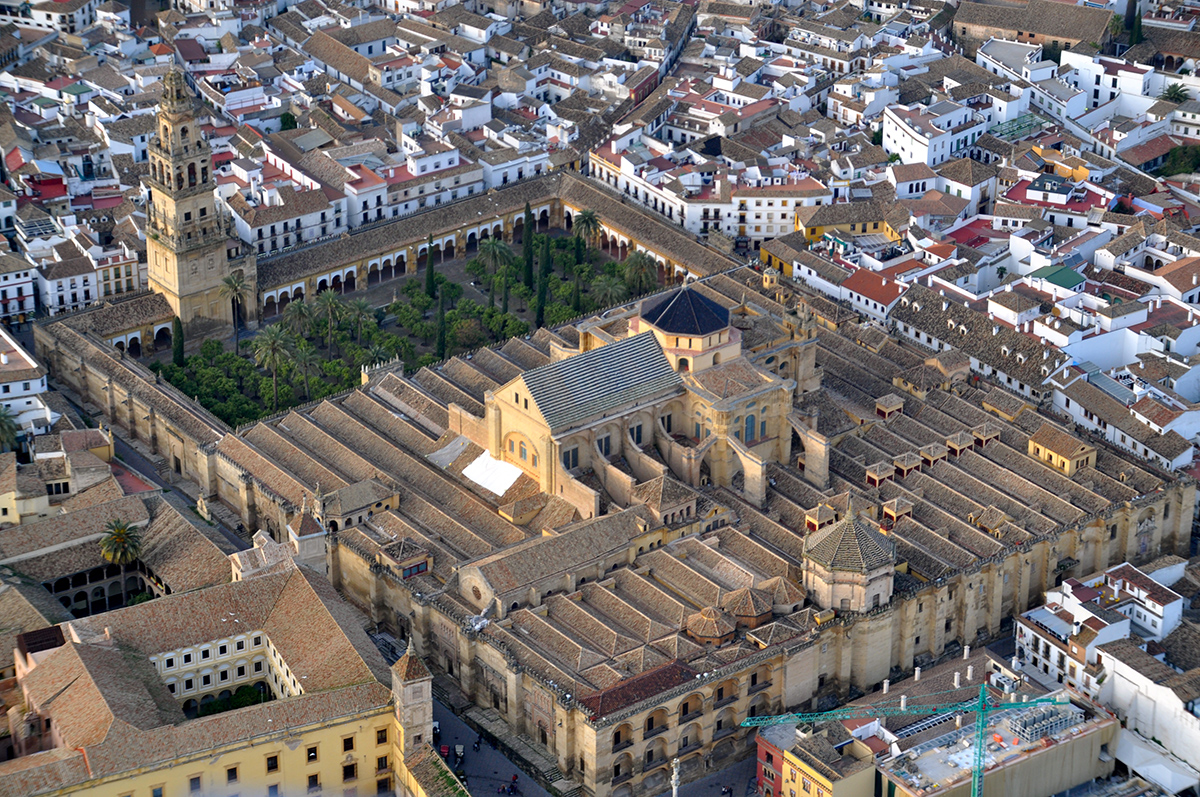
Known locally as Mezquita-Catedral, the Great Mosque of Córdoba is one of the oldest structures still standing from the time Muslims ruled Al-Andalus (Muslim Iberia including most of Spain, Portugal, and a small section of Southern France) in the late 8th century. Córdoba is a two hour train ride south of Madrid, and draws visitors from all over the world.
Temple/church/mosque/church
The buildings on this site are as complex as the extraordinarily rich history they illustrate. Historians believe that there had first been a temple to the Roman god, Janus, on this site. The temple was converted into a church by invading Visigoths who seized Córdoba in 572. Next, the church was converted into a mosque and then completely rebuilt by the descendants of the exiled Umayyads—the first Islamic dynasty who had originally ruled from their capital Damascus (in present-day Syria) from 661 until 750.
A new capital
Following the overthrow of his family (the Umayyads) in Damascus by the incoming Abbasids, Prince Abd al-Rahman I escaped to southern Spain. Once there, he established control over almost all of the Iberian Peninsula and attempted to recreate the grandeur of Damascus in his new capital, Córdoba. He sponsored elaborate building programs, promoted agriculture, and even imported fruit trees and other plants from his former home. Orange trees still stand in the courtyard of the Mosque of Córdoba, a beautiful, if bittersweet reminder of the Umayyad exile.
The hypostyle hall
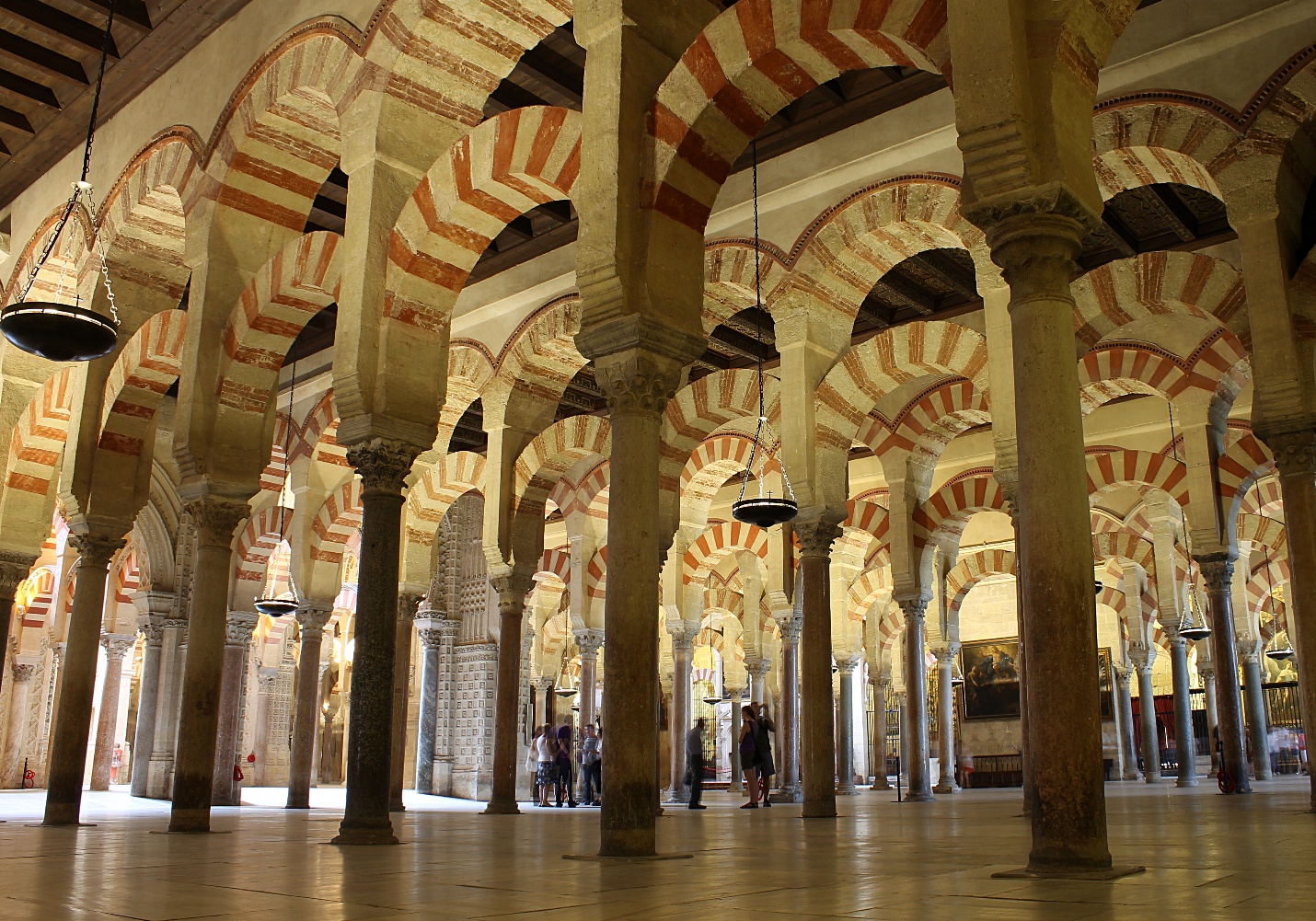
The building itself was expanded over two hundred years. It is comprised of a large hypostyle prayer hall (hypostyle means, filled with columns), a courtyard with a fountain in the middle, an orange grove, a covered walkway circling the courtyard, and a minaret (a tower used to call the faithful to prayer) that is now encased in a squared, tapered bell tower. The expansive prayer hall seems magnified by its repeated geometry. It is built with recycled ancient Roman columns from which sprout a striking combination of two-tiered, symmetrical arches, formed of stone and red brick.
The mihrab
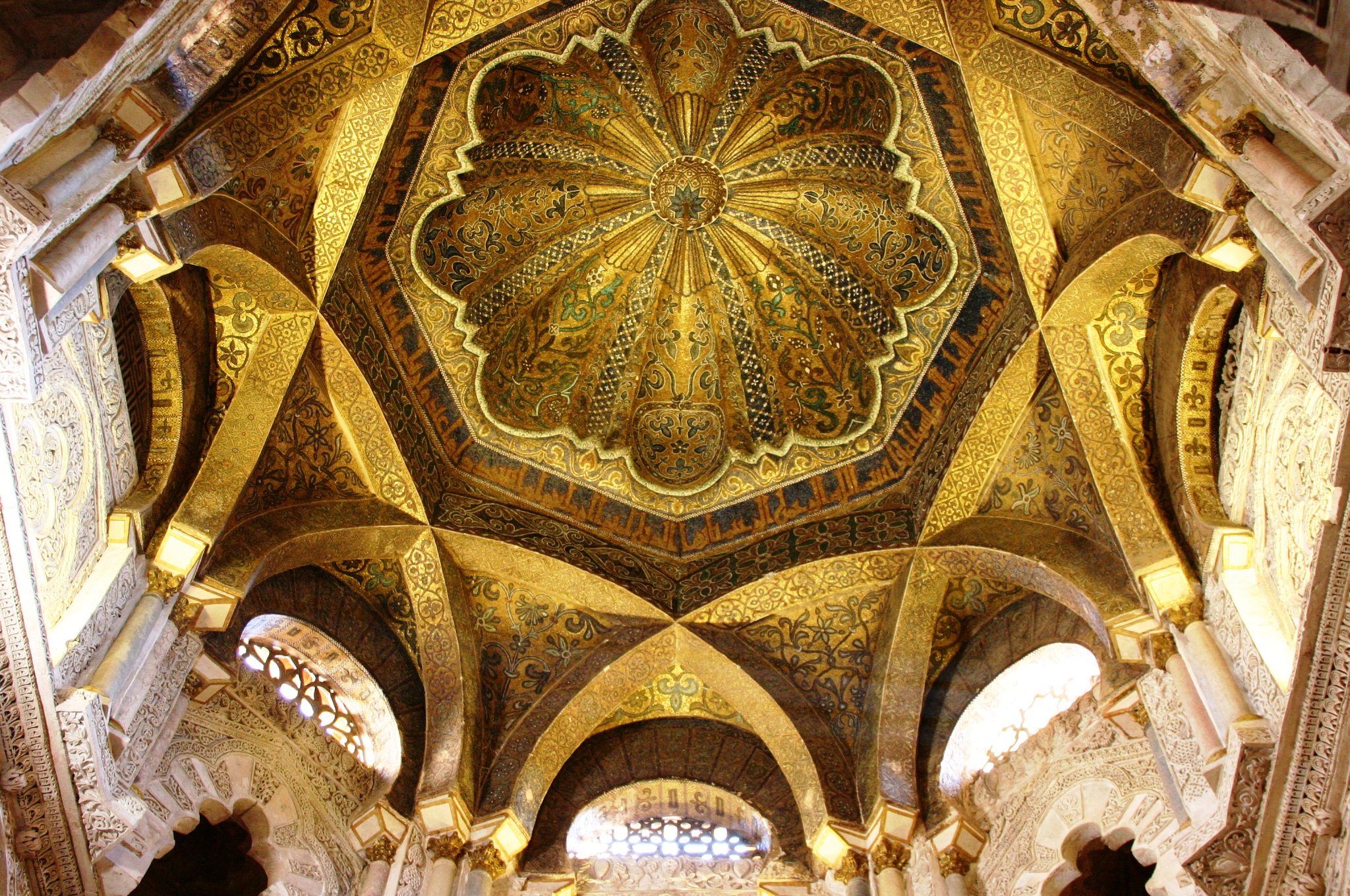
The focal point in the prayer hall is the famous horseshoe arched mihrab or prayer niche. A mihrab is used in a mosque to identify the wall that faces Mecca—the birth place of Islam in what is now Saudi Arabia. This is practical as Muslims face toward Mecca during their daily prayers. The mihrab in the Great Mosque of Córdoba is framed by an exquisitely decorated arch behind which is an unusually large space, the size of a small room. Gold tesserae (small pieces of glass with gold and color backing) create a dazzling combination of dark blues, reddish browns, yellows and golds that form intricate calligraphic bands and vegetal motifs that adorn the arch.
The horseshoe arch
The horseshoe-style arch was common in the architecture of the Visigoths, the people that ruled this area after the Roman empire collapsed and before the Umayyads arrived. The horseshoe arch eventually spread across North Africa from Morocco to Egypt and is an easily identified characteristic of Western Islamic architecture (though there are some early examples in the East as well).
The dome
Above the mihrab, is an equally dazzling dome. It is built of crisscrossing ribs that create pointed arches all lavishly covered with gold mosaic in a radial pattern. This astonishing building technique anticipates later Gothic rib vaulting, though on a more modest scale.
The Great Mosque of Córdoba is a prime example of the Muslim world’s ability to brilliantly develop architectural styles based on pre-existing regional traditions. Here is an extraordinary combination of the familiar and the innovative, a formal stylistic vocabulary that can be recognized as “Islamic” even today.
Arts of the Islamic world: The medieval period
For many, the Muslim world in the medieval period (900–1300) means the crusades. While this era was marked, in part, by military struggle, it is also overwhelmingly a period of peaceable exchanges of goods and ideas between West and East. Both the Christian and Islamic civilizations underwent great transformations and internal struggles during these years. In the Islamic world, dynasties fractured and began to develop distinctive styles of art. For the first time, disparate Islamic states existed at the same time. And although the Abbasid caliphate did not fully dissolve until 1258, other dynasties began to form, even before its end.
Fatimid (909–1171)
In the tenth century, the Fatimid dynasty emerged and posed a threat to the rule of the Abbasids. The Fatimid rulers, part of the Shi’ia faction, took their name from Fatima, Muhammad’s daughter, from whom they claimed to be descended. The Sunnis, on the other hand, had previously pledged their alliance to Mu’awiya, the founder of the Umayyad dynasty. At the height of their power, the Fatimids claimed lands from present-day Algeria to Syria. They conquered Egypt in 969 and founded the city of Cairo as their capital.
The Fatimid rulers expanded the power of the caliph and emphasized the importance of palace architecture. Mosques too were commissioned by royalty and every aspect of their decoration was of the highest caliber, from expertly-carved wooden minbars (where the spiritual leader guides prayers inside the mosque) to handcrafted metal lamps.
The wealth of the Fatimid court led to a general bourgeoning of the craft trade even outside of the religious context. Centers near Cairo became well known for ceramics, glass, metal, wood, and especially for lucrative textile production. The style of ornament developed as well, and artisans began to experiment with different forms of abstracted vegetal ornament and human figures.
This period is often called the Islamic renaissance, for its booming trade in decorative objects as well as the high quality of its artwork.
Seljuk (1040–1157/1081–1307)
The Seljuk rulers were of Central Asian Turkic origin. Once they assumed power after 1040, the Seljuks introduced Islam to places it had not been heretofore. The Seljuks of Rum ruled much of central and eastern Anatolia from 1071 to 1243, when the Mongols took over and turned the Seljuqs into their vassals. The Seljuks of present-day Iran controlled the rest of the empire (between 1040 and 1157).
The Seljuks of Iran were great supporters of education and the arts and they founded a number of important madrasas (schools) during their brief reign. The congregational mosques they erected began using a four-iwan plan: these incorporate four immense doorways (iwans) in the center of each wall of a courtyard.
The art of the Anatolian Seljuks looks quite different, perhaps explaining why it is often labeled as a distinct sultanate. The inhabitants of this newly conquered land in Anatolia included members of various religions (largely Buddhists and Shamen), other heritages, and the Byzantine and Armenian Christian traditions. Seljuk projects often drew from these existing indigenous traditions—just as had been the case with the earliest Islamic buildings. Building materials included stone, brick, and wood, and there existed a widespread representation of animals and figures (some human) that had all but disappeared from architecture elsewhere in Islamic-ruled lands. The craftsmen here made great strides in the area of woodcarving, combining the elaborate scrolling and geometric forms typical of the Arabic aesthetic with wood, a medium indigenous to Turkey (and rarer in the desert climate of the Middle East).
Mamluk (1250–1517)
The name ‘Mamluk’, like many names, was given by later historians. The word itself means ‘owned’ in Arabic. It refers to the Turkic slaves who served as soldiers for the Ayyubid sultanate before revolting and rising to power. The Mamluks ruled over key lands in the Middle East, including Mecca and Medina. Their capital at Cairo became the artistic and economic center of the Islamic world at this time.
The period saw a great production of art and architecture, particularly those commissioned by the reigning sultans. Patronizing the arts and creating monumental structures was a way for leaders to display their wealth and make their power visible within the landscape of the city. The Mamluks constructed countless mosques, madrasas and mausolea that were lavishly furnished and decorated. Mamluk decorative objects, particularly glasswork, became renowned throughout the Mediterranean. The empire benefitted from the trade of these goods economically and culturally, as Mamluk craftsmen began to incorporate elements gleaned from contact with other groups. The growing prevalence of trade with China and exposure to Chinese goods, for instance, led to the Mamluk production of blue and white ceramics, an imitation of porcelain typical of the Far East.
The Mamluk sultanate was generally prosperous, in part supported by pilgrims to Mecca and Medina as well as a flourishing textile market, but in 1517 the Mamluk sultanate was overtaken and absorbed into the growing Ottoman empire.
The Great Mosque (or Masjid-e Jameh) of Isfahan
Most cities with sizable Muslim populations possess a primary congregational mosque. Diverse in design and dimensions, they can illustrate the style of the period or geographic region, the choices of the patron, and the expertise of the architect. Congregational mosques are often expanded in conjunction with the growth and needs of the umma, or Muslim community; however, it is uncommon for such expansion and modification to continue over a span of a thousand years. The Great Mosque of Isfahan in Iran is unique in this regard and thus enjoys a special place in the history of Islamic architecture. Its present configuration is the sum of building and decorating activities carried out from the 8th through the 20th centuries. It is an architectural documentary, visually embodying the political exigencies and aesthetic tastes of the great Islamic empires of Persia.
Another distinctive aspect of the mosque is its urban integration. Positioned at the center of the old city, the mosque shares walls with other buildings abutting its perimeter. Due to its immense size and its numerous entrances (all except one inaccessible now), it formed a pedestrian hub, connecting the arterial network of paths crisscrossing the city. Far from being an insular sacred monument, the mosque facilitated public mobility and commercial activity, thus transcending its principal function as a place for prayer alone.
The mosque’s core structure dates primarily from the 11th century, when the Seljuq Turks established Isfahan as their capital. Additions and alterations were made during Il-Khanid, Timurid, Safavid, and Qajar rule. An earlier mosque with a single inner courtyard already existed in the current location. Under the reign of Malik Shah I and his immediate successors, the mosque grew to its current four-iwan design. Indeed, the Great Mosque of Isfahan is considered the prototype for future four-iwan mosques.
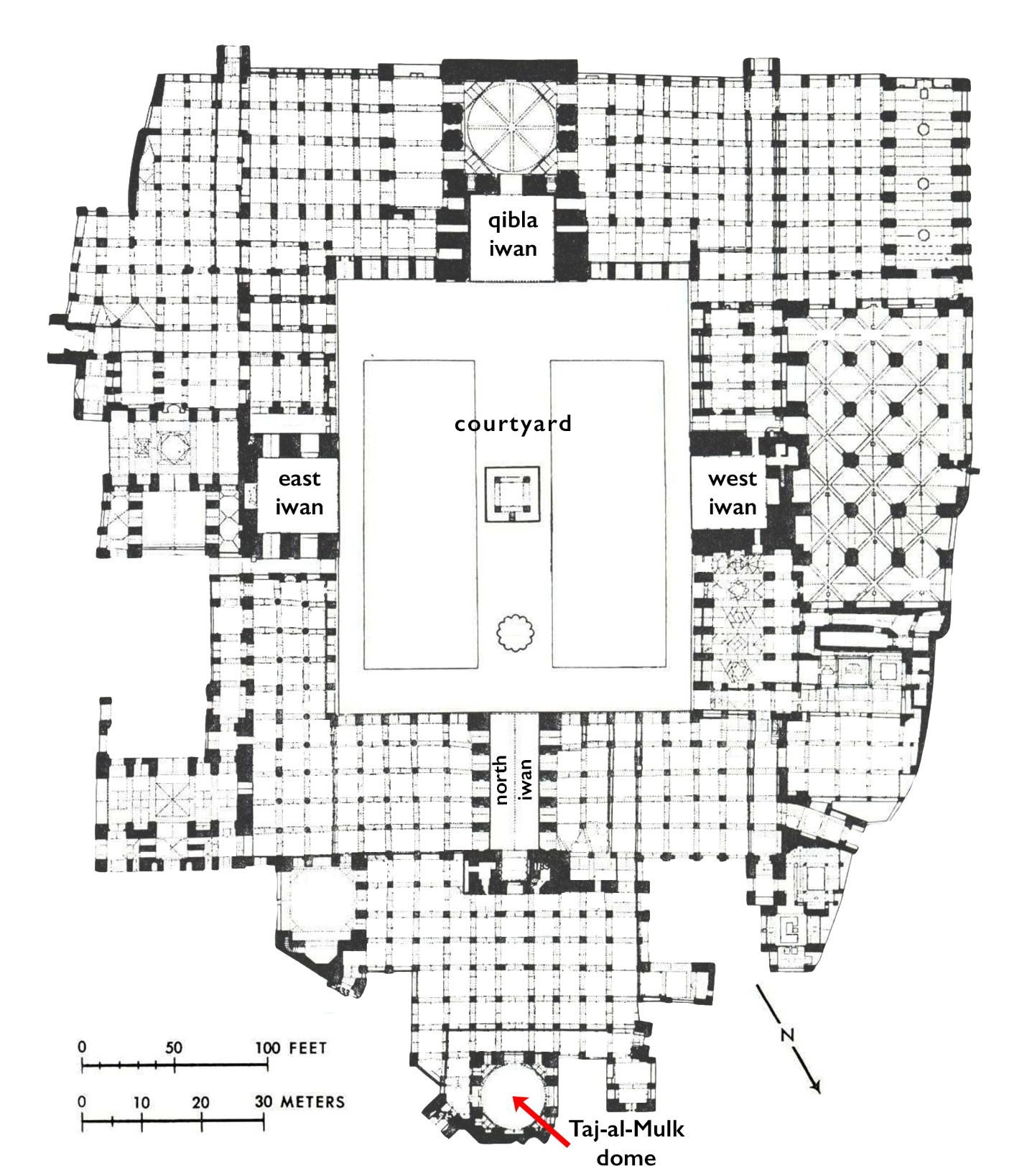
Linking the four iwans at the center is a large courtyard open to the air, which provides a tranquil space from the hustle and bustle of the city. Brick piers and columns support the roofing system and allow prayer halls to extend away from this central courtyard on each side. Aerial photographs of the building provide an interesting view; the mosque’s roof has the appearance of “bubble wrap” formed through the panoply of unusual but charming domes crowning its hypostyle interior.
This simplicity of the earth-colored exterior belies the complexity of its internal decor. Dome soffits (undersides) are crafted in varied geometric designs and often include an oculus, a circular opening to the sky. Vaults, sometimes ribbed, offer lighting and ventilation to an otherwise dark space. Creative arrangement of bricks, intricate motifs in stucco, and sumptuous tile-work (later additions) harmonize the interior while simultaneously delighting the viewer at every turn. In this manner, movement within the mosque becomes a journey of discovery and a stroll across time.
Given its sprawling expanse, one can imagine how difficult it would be to locate the correct direction for prayer. The qibla iwan on the southern side of the courtyard solves this conundrum. It is the only one flanked by two cylindrical minarets and also serves as the entrance to one of two large, domed chambers within the mosque.
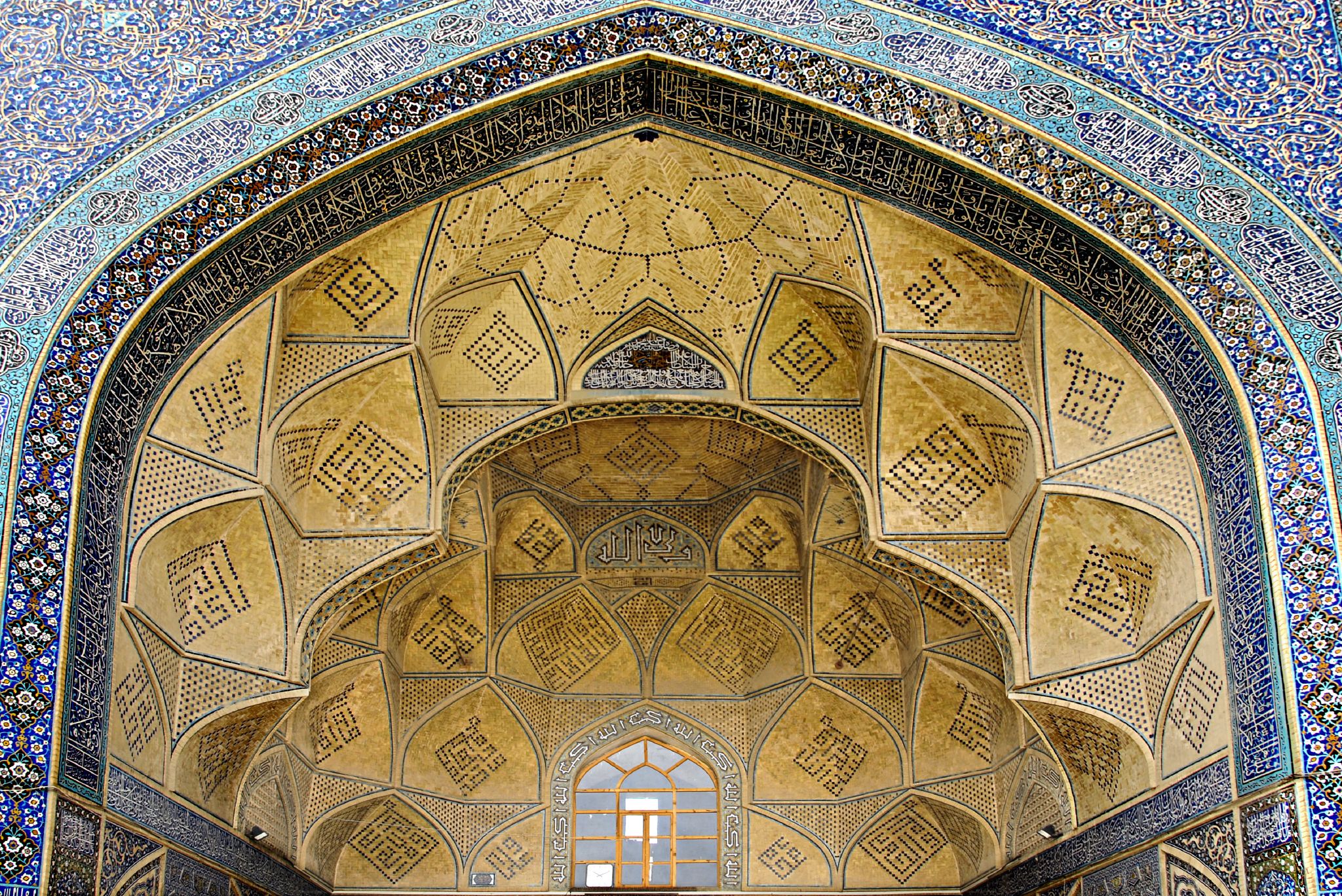
Similar to its three counterparts, this iwan sports colorful tile decoration and muqarnas or traditional Islamic cusped niches. The domed interior was reserved for the use of the ruler and gives access to the main mihrab of the mosque.
The second domed room lies on a longitudinal axis right across the double-arcaded courtyard. This opposite placement and varied decoration underscore the political enmity between the respective patrons; each dome vies for primacy through its position and architectural articulation. Nizam al-Mulk, vizier to Malik Shah I, commissioned the qibla dome in 1086. But a year later, he fell out of favor with the ruler and Taj al-Mulk, his nemesis, with support from female members of the court, quickly replaced him. The new vizier’s dome, built in 1088, is smaller but considered a masterpiece of proportions.
When Shah Abbas I, a Safavid dynasty ruler, decided to move the capital of his empire from Qazvin to Isfahan in the late 16th century, he crafted a completely new imperial and mercantile center away from the old Seljuq city. While the new square and its adjoining buildings, renowned for their exquisite decorations, renewed Isfahan’s prestige among the early modern cities of the world, the significance of the Seljuq mosque and its influence on the population was not forgotten. This link amongst the political, commercial, social, and religious activities is nowhere more emphasized than in the architectural layout of Isfahan’s covered bazaar. Its massive brick vaulting and lengthy, sinuous route connects the Safavid center to the city’s ancient heart, the Great Mosque of Isfahan.
Mihrab from Isfahan (Iran)
This prayer niche once pointed students towards Mecca. Its blue and white patterns comprise verses from the Qur’an.
Practicing Visual Analysis
The Mihrab from Isfahan is both three-dimensional architecture and two-dimensional tile work. As a functional artwork (prayer niche), it would have been part of a larger architectural feature: the qibla wall. The color program selected by the artists unifies the composition. The artists chose tones of blue, from light to dark blue and turquoise, punctuated by white and the occasional gold color. Around the perimeter of the niche is a rectangular band featuring highly curved calligraphic script. Calligraphy is the art of drawn language. Calligraphic script is found in both the perimeter band and in the center of the composition within the niche (watch the above video for historical information on the writing, including Arabic and Kufic script). Directly above the shape of the pointed arch are abstract patterns of vegetation. Interlacing lines of white and turquoise alternate and weave through symmetrically. The concept of symmetry permeates the entire composition, including the borders and inside of the niche. Bands of geometric shapes made of turquoise and white set within a darker blue background run around the borders. In the inside of the niche around the rectangular shape holding the Kufic script are more patterned vegetal designs. In the internal pointed section of the arch, symmetry is again found in the rhythmic patterning of both vegetal and geometric shapes. Lines interlace and interweave to create a shallow sense of pictorial space emphasizing flatness rather than the illusion of three-dimensional space. Thus, the artist blended the concept of pictorial flatness with literal depth in the curved hallow of the niche itself.
Arts of the Islamic world: The later period
What does the Taj Mahal have to do with the Tamerlane? What do Persian carpets have to do with Turkish tiles? Quite a bit, as it turns out. By the fourteenth century, Islam had spread as far East as India and Islamic rulers had solidified their power by establishing prosperous cities and a robust trade in decorative arts along the all-important Silk Road. This is a complex period with competing and overlapping cultures and empires. Read below for an introduction to the later Islamic dynasties.
Ottoman (1300–1924)
At its earliest stages, the Ottoman state was little more than a group formed as a result of the dissolution of the Anatolian Seljuq sultanate. However, in 1453, the Ottomans captured the great Byzantine capital, Constantinople, and in 1517, they defeated the Mamluks and took control of the most significant state in the Islamic world.
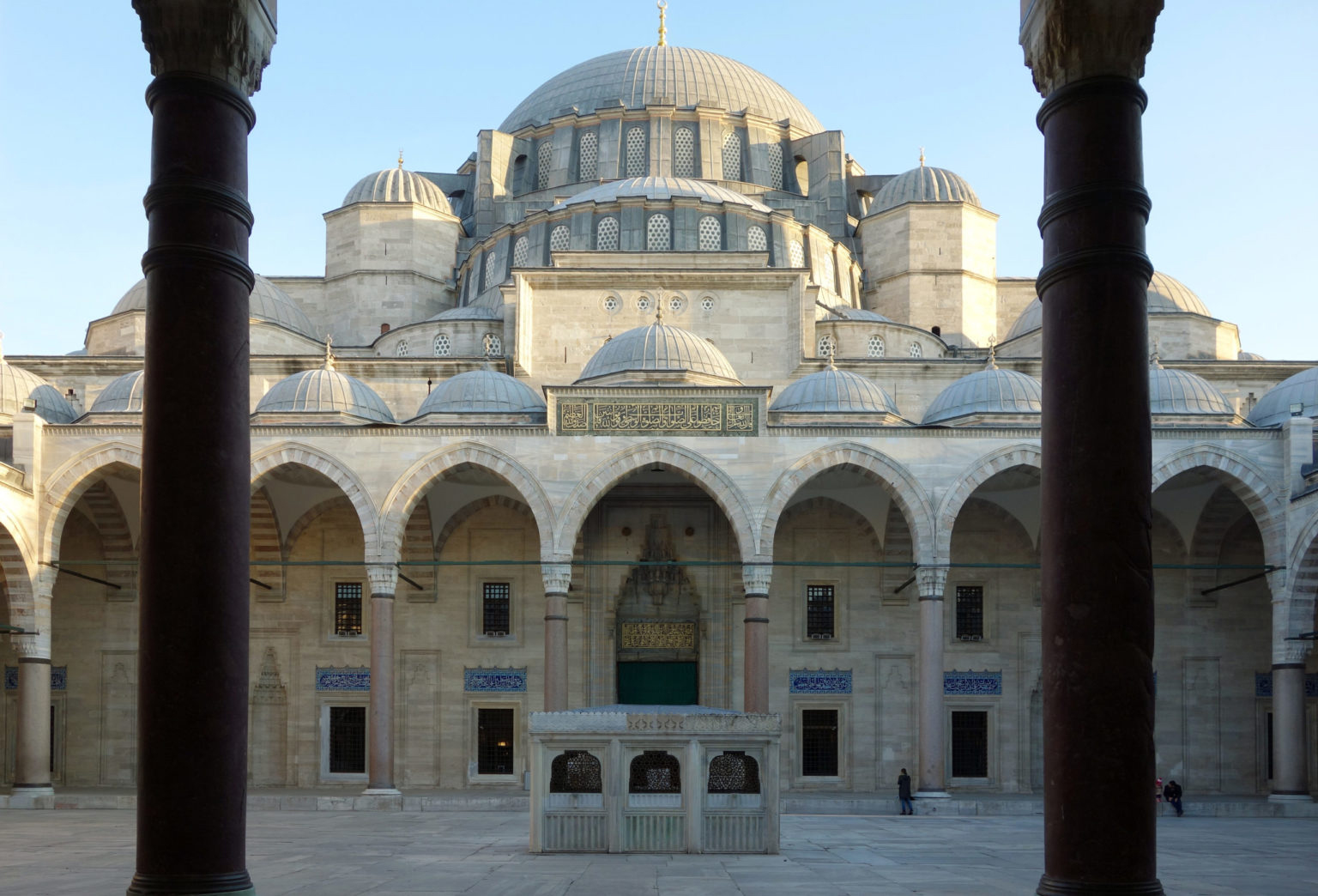
While the Ottomans ruled for many centuries, the height of the empire’s cultural and economic prosperity was achieved during Süleyman the Magnificent’s reign (r. 1520–66), a period often referred to as the Ottoman’s ‘golden age.’ In addition to large-scale architectural projects, the decorative arts flourished, chief among them, ceramics, particularly tiles. Iznik tiles, named for the city in Anatolia where they were produced, developed a trademark style of curling vines and flowers rendered in beautiful shades of blue and turquoise. These designs were informed by the blue and white floral patterns found in Chinese porcelain—similar to earlier Mamluk tiles, and Timurid art to the East. In addition to Iznik, other artistic hubs developed, such as Bursa, known for its silks, and Cairo for its carpets. The capital, Istanbul (formerly Constantinople), became a great center for all matters of cultural importance from manuscript illumination to architecture.
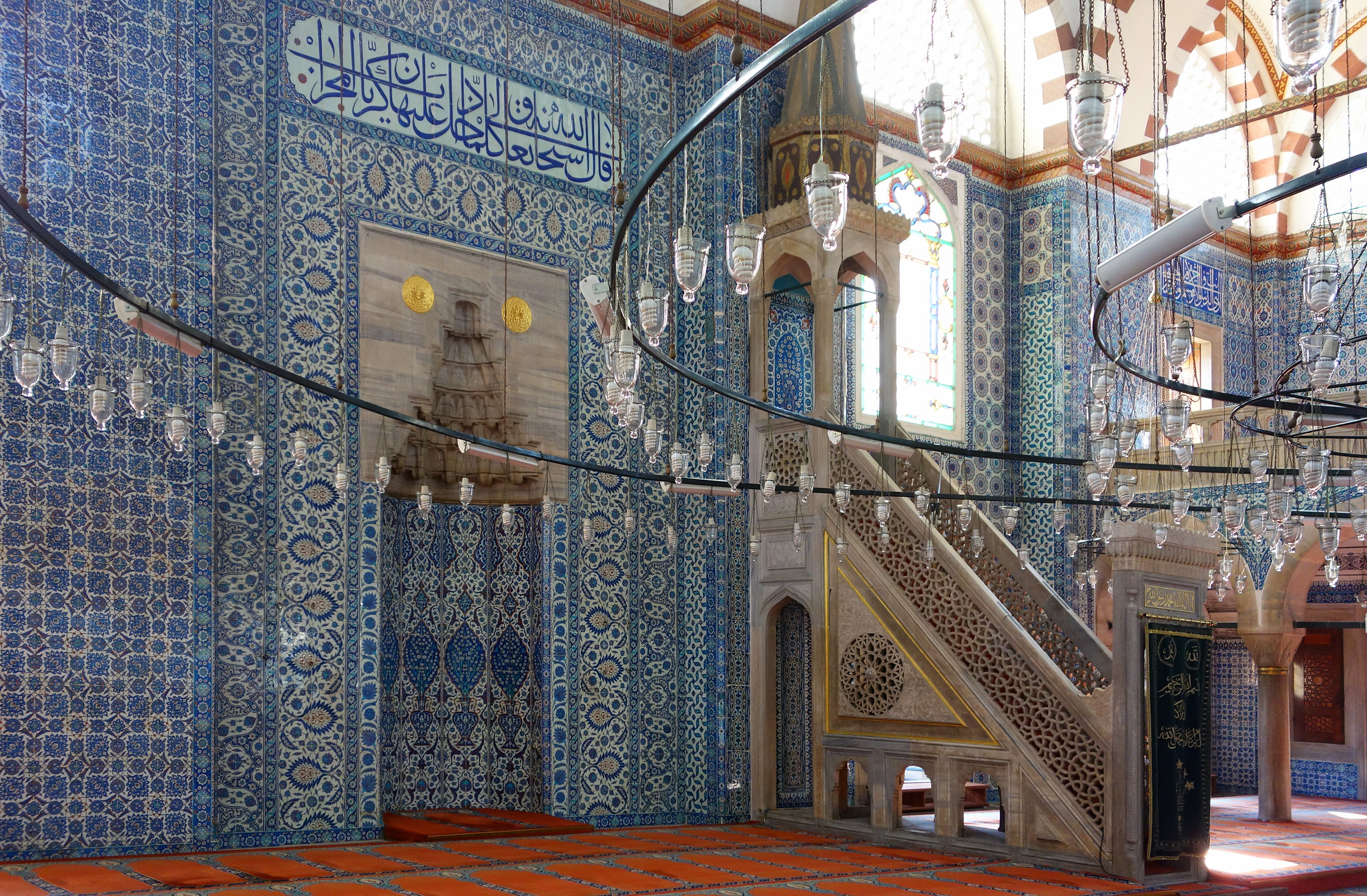
The architecture of the period, both sacred and secular, incorporates these decorative arts, from the dazzling blue tiles and monumental calligraphy that adorn the walls of Topkapi Palace (begun 1459) to the carpets that line the floors of the Süleymaniye Mosque (1550–58). Ottoman mosque architecture itself is marked by the use of domes, widely used earlier in Byzantium, and towering minarets. The Byzantine influence draws primarily from Hagia Sophia, a former church that was converted into a mosque (and is now a museum).
Timurid (1369–1502)
This powerful Central Asian dynasty was named for its founder, Tamerlane (r. 1370–1405), which is derived from Timur the Lame. Despite his rather pathetic epithet, he claimed to be a descendent of Genghis Khan and demonstrated some of his supposed ancestor’s ruthlessness in conquering neighboring territories.
After establishing a vast empire, Timur developed a monumental architecture befitting his power, and sought to make Samarkand the “pearl of the world.” Because the capital was situated at a major crossroads of the Silk Road (the crucial trade route linking the Middle East, Central Asia, and China), and because Timur had conquered so widely, the Timurids acquired a myriad of artisans and craftspeople from distinct artistic traditions. The resulting style synthesized aesthetic and design principles from as far away as India (then Hindustan) and the lands in between.
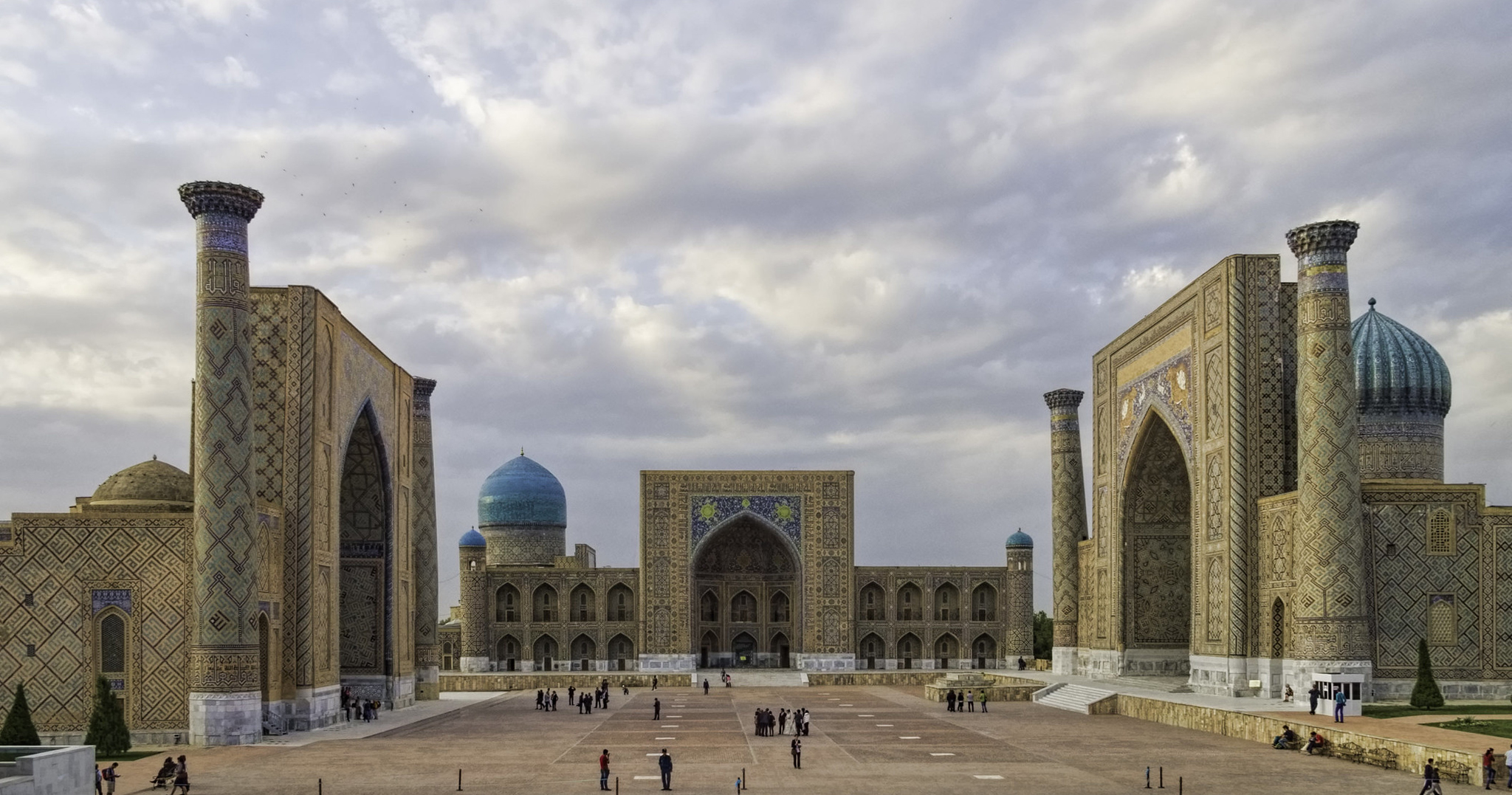
The result can be seen in cities filled with buildings created on a lavish scale that exhibited tall, bulbous domes and the finest ceramic tiles. The structures and even the cities themselves are often described foremost by the overwhelming use of blues and golds. While the Timurid dynasty itself was short-lived, its legacy survives not only in the grand architecture that it left behind but in its descendants who went on to play significant roles in the Ottoman, Safavid and Mughal empires.
Safavid (1502–1736)
The Safavids, a group with roots in the Sufic tradition (a mystical branch of Islam), came to power in Persia, modern-day Iran and Azerbaijan. In 1501 the Safavid rulers declared Shi’a Islam as its state religion; and in just ten years the empire came to include all of Iran.
The art of manuscript illumination was highly prized in the Safavid courts, and royal patrons made many large-scale commissions. Perhaps the most notable of these is the Shahnama (or ‘Book of Kings,’ a compilation of stories about earlier rulers of Iran) from the 1520s. While painting in this context did not have the same prominent and longstanding tradition as it does in Western art, the illustrations exhibit masterful workmanship and an incredible attention to detail.

Trade in carpets was also important, and even today, people understand the appeal of Persian carpets. These large-scale, high-quality pieces were created as luxurious furnishings for royal courts. The most famous—perhaps of all time—is a pair known as the Ardabil Carpets, created in 1539–40. The carpets were nearly identical, perfectly symmetrical and enormous. Every inch of space was filled with flowers, scrolling vines, and medallions.
The empire began to struggle financially and militarily until the rule of Shah Abbas (r. 1587–1629). He moved the capital to Isfahan where he built a magnificent new city and established state workshops for textiles, which, along with silk and other goods, were increasingly exported to Europe. The mosque architecture made use of earlier Persian elements, like the four-iwan plan and building materials of brick and glazed tiles reminiscent of Timurid architecture, with its blues and greens and bulbous domes. Even in such far-removed lands, the connections between these dynasties are evident in the art they created.
Mughal (1526–1858)
Though Islam had been introduced in India centuries before, the Mughals were responsible for some of the greatest works of art produced in the canons of both Indian and Islamic art. The empire established itself when Babur, himself a Timurid prince of Turkish and Central Asian descent, came to Hindustan and defeated the existing Islamic sultanate in Delhi.
Tracing their roots to Central Asia, the Mughals produced art, music and poetry that was highly influenced by Persian and Central Asian aesthetics. This is evident in the style and importance given to miniature paintings, created to illustrate manuscripts. The most grandiose of these was the Akbarnama, created to record the conquests of Akbar, widely regarded as the greatest Mughal emperor. The art and architecture created during his reign demonstrate a synthesis of indigenous Indian temple architecture with structural and design elements derived from Islamic sources farther West. The Mughals developed a unique architectural style which, in the years after Akbar’s reign, began to feature scalloped arches and stylized floral designs in white marble. The most famous example is the Taj Mahal, constructed by Shah Jahan from 1632–53.
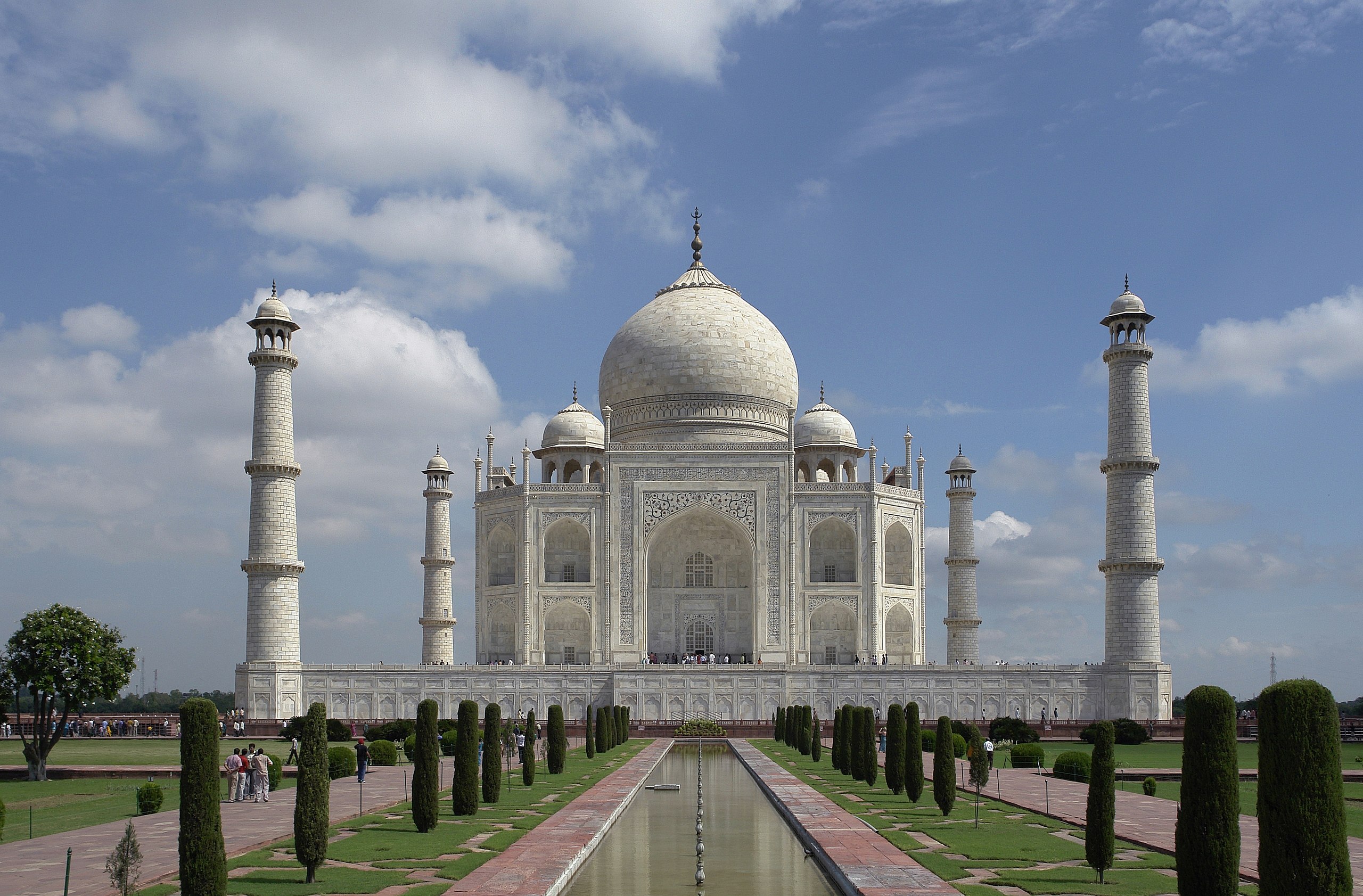
The Mughal dynasty left a lasting mark on the landscape of India and remained in power until the British completed their conquest of India in the nineteenth century.
Although historians generally agree that the major Islamic dynasties end in the nineteenth and early twentieth centuries, Islamic art and culture have continued to flourish. Muslim artists and Muslim countries are still producing art. Some art historians consider such work as simply modern or contemporary art while others see it within the continuity of Islamic art.
Conclusion
The arts of the Islamic world are varied in mediums, purpose, and intended audiences. The earliest artistic expressions emerged in the 7th century C.E. on the Arabian Peninsula. The development of the mosque with its characteristic features of the sahn, mihrab, minaret, and qibla wall, became the recognized format of Islamic religious architecture. Art in the service of the Islamic faith contrasted to that of its neighbors of the Orthodox Christian Byzantine Empire, who relied upon figurative representations of sacred figures. Instead, arts serving the Islamic faith tended toward aniconic representations by using calligraphy, vegetal interlacing lines, and geometric patterns. The influence of Islamic art spread across a vast geographic area, including in Western Europe. Islamic forces ruled a large portion of Spain for around 700 years in the Middle Ages. The Islamic style pointed arch will later be adapted into the Gothic style.
Citation and Licensing
The following sections were written by Chelsea Wright and are licensed CC BY-NC-SA 4.0:
-
Chapter Overview and Introduction
-
Focus artwork and term list compiled by Chelsea Wright
-
Practicing Visual Analysis
-
Conclusion
The following articles from Smarthistory licensed CC BY-NC-SA 4.0 were remixed and adapted for the chapter:
-
Dr. Elizabeth Macaulay, “Islam, an introduction,” in Smarthistory, August 8, 2015.
-
Dr. Elizabeth Macaulay, “Arts of the Islamic world,” in Smarthistory, August 8, 2015.
-
Glenna Barlow, “Arts of the Islamic world: The early period,” in Smarthistory, August 8, 2015.
-
Dr. Elizabeth Macaulay, “The Dome of the Rock (Qubbat al-Sakhra),” in Smarthistory, August 8, 2015.
-
Kendra Weisbin, “Mosque architecture, an introduction,” in Smarthistory, August 8, 2015.
-
Dr. Shadieh Mirmobiny, “The Great Mosque of Córdoba,” in Smarthistory, August 8, 2015.
-
Glenna Barlow, “Arts of the Islamic world: The medieval period,” in Smarthistory, August 8, 2015.
-
Dr. Radha Dalal, “The Great Mosque (or Masjid-e Jameh) of Isfahan,” in Smarthistory, August 8, 2015.
-
Dr. Elizabeth Macaulay and Dr. Steven Zucker, “Mihrab from Isfahan (Iran),” in Smarthistory, December 5, 2015.
-
Glenna Barlow, “Arts of the Islamic world: The later period,” in Smarthistory, July 8, 2019.

_02.jpg)

.jpg)
.jpg)

