
Chapter Overview and Introduction
The earliest expressions of the Christian faith in art and architecture showed iconographic and stylistic influences from Ancient Roman art: from the contrapposto in sculpture to the basilica in architecture. Early Christian architects under the patronage of the newly converted Roman Emperor Constantine changed the basilica from a secular, Roman building into early Christian architecture. With Christianity emerging in the 1st century C.E. in context of the Roman Empire, early Christians debated upon the role of images in religious art. The ideas and forms of early Christian aesthetics serve as a foundation for later Byzantine and Medieval art and architecture.
Focus Artworks
- Christ as the Good Shepherd, catacomb of Priscilla, Rome, 3rd century C.E., fresco
- Christ as the Good Shepherd, 300–350 C.E., marble
- Old St. Peter’s Basilica, Rome
- Sarcophagus of Junius Bassus, c. 359 C.E., marble
- The Good Shepherd, Mausoleum of Galla Placidia, Ravenna, c. 425-426 C.E., mosaic
Term List
- Jesus
- Gospel
- Apostles/disciples
- Constantine
- Theodosius
- Old Testament
- New Testament
- Nicene Creed
- Trinity
- Eucharist
- Public cult
- Mystery cult
- Monotheism
- Catacomb
- Cubiculum
- Loculi
- Liturgy
- Edict of Milan
- Chi Rho
- Basilica
- Narthex
- Nave
- Aisle
- Apse
- Transept
- Altar
- Sarcophagus
- Traditio legis
- Adventus
- Mosaic
- Tesserae
Christianity, an introduction
How little we know
Almost nothing is known about Jesus beyond biblical accounts, although we do know quite a bit more about the cultural and political context in which he lived—for example, Jerusalem in the first century. What follows is an introductory historical summary of Christianity. It hardly needs stating that there are many interpretations and disagreements among historians.
Jesus v. Rome
The biblical Jesus, described in the Gospels as the son of a carpenter, was a Jew and a champion of the underdog. He rebelled against the occupying Roman government in what was then Palestine (at this point the Roman Empire stretched across the Mediterranean). He was crucified for upsetting the social order and challenging the authority of the Romans and their local Jewish leaders. The Romans crucified Jesus, a typical method of execution—especially for those accused of crimes against the government.
Jesus’s followers claim that after three days he rose from the grave and later ascended into heaven. His original followers, known as disciples or apostles, traveled great distances and spread Jesus’s message. His life is recorded in the Gospels of Matthew, Mark, Luke, and John, which are found in the New Testament. “Christ” means messiah or savior (this belief in a savior is a traditional part of Jewish theology).
Old and New Testaments
Early on, there were many ways that Christianity was practiced and understood, and it wasn’t until the second century that Christianity began to be understood as a religion distinct from Judaism (it’s helpful to remember that Judaism itself had many different sects). Christians were sometimes severely persecuted by the Romans. In the early fourth century, the Roman Emperor Constantine experienced a miraculous conversion and made it legally acceptable to be a Christian. Less than a hundred years later, the Roman Emperor Theodosius made Christianity the official state religion.
The first Christians were Jews (whose bible we refer to as the Hebrew Bible or Tanakh). But soon pagans too converted to this new religion. Christians saw the predictions of the prophets in the Hebrew Bible come to fulfillment in the life of Jesus Christ—hence the “Bible” of the Christians includes both the Hebrew Bible (or the Old Testament) and the New Testament.
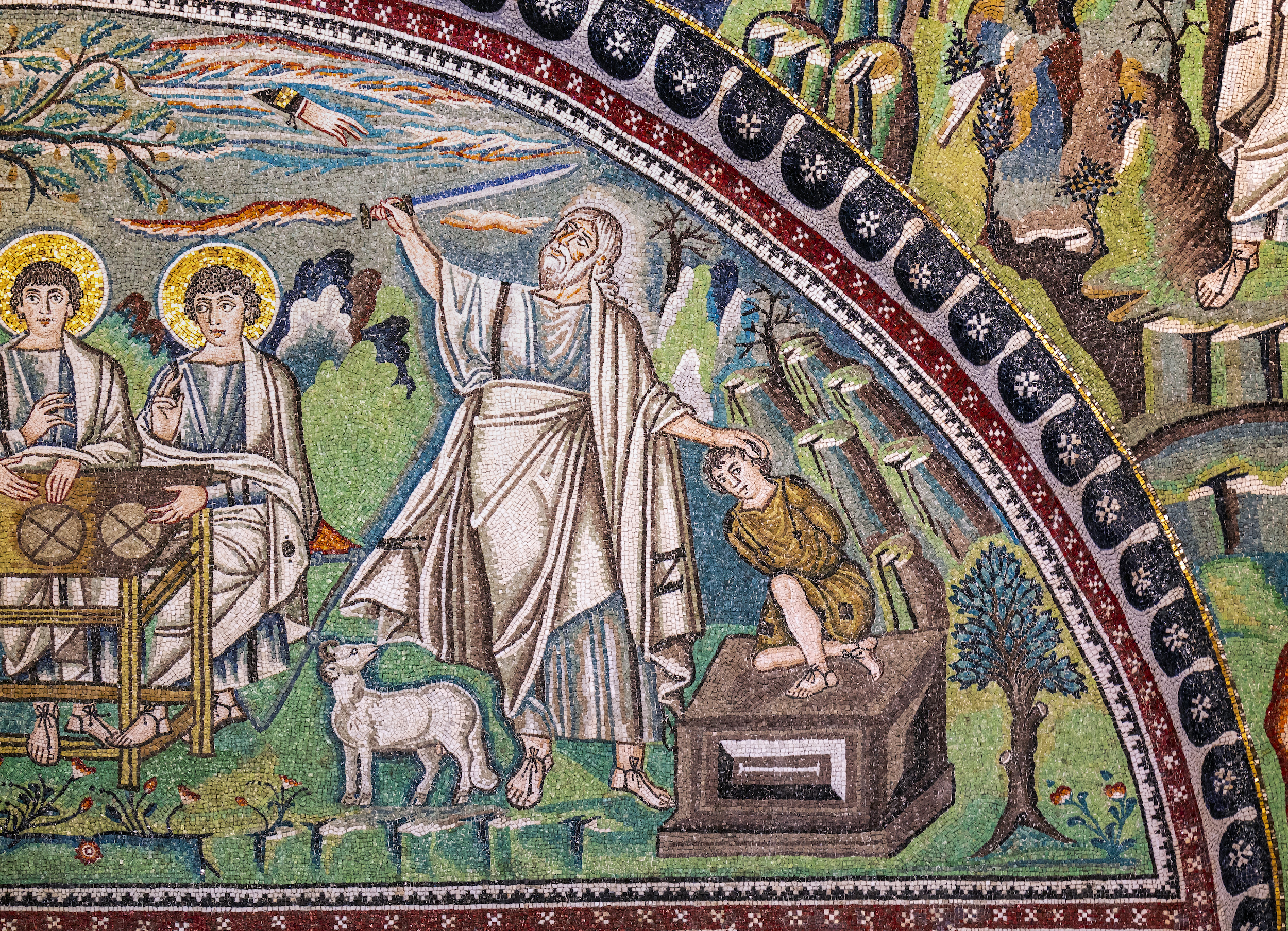
In addition to the fulfillment of prophecy, Christians saw parallels between the events of the Hebrew Bible and the New Testament. These parallels, or foreshadowings, are called typology. One example would be Abraham’s willingness to sacrifice his son, Isaac, and the later sacrifice of Christ on the cross. We often see these comparisons in Christian art offered as a revelation of God’s plan for the salvation of mankind.
Different Christianities
Unlike Greek and Roman religions (there was both an official “state” religion as well as other cults), Christianity emphasized belief and a personal relationship with God. The doctrines, or main teachings, of Christianity were determined in a series of councils in the early Christian period, such as the Council of Nicea in 325. This resulted in a common statement of belief known as the Nicene Creed, which is still used by some churches today.
Nevertheless, there is great diversity in Christian belief and practice. This was true even in the early days of Christianity, when, for example, Arians (who believed that the three parts of the Holy Trinity were not equal) and Donatists (who held that priests who had renounced their Christian faith during periods of persecution could not administer the sacraments), were considered heretics (someone who goes against official teaching). Today there are approximately 2.2 billion Christians who belong to a multitude of sects.
The two dominant early branches of Christianity were the Catholic and Orthodox Churches, rooted in Western and Eastern Europe respectively. Protestantism (and its different forms) emerged only later, at the beginning of the sixteenth century. Before that there was essentially just one church in Western Europe—what we would call the Roman Catholic church today (to differentiate it from other forms of Christianity in the West such as Lutheranism, Methodism etc.). Christianity spread throughout the world. In the sixteenth century, the Jesuits (a Catholic order), sent missionaries to Asia, North and South America, and Africa often in concert with Europe’s colonial expansion.
Doctrines
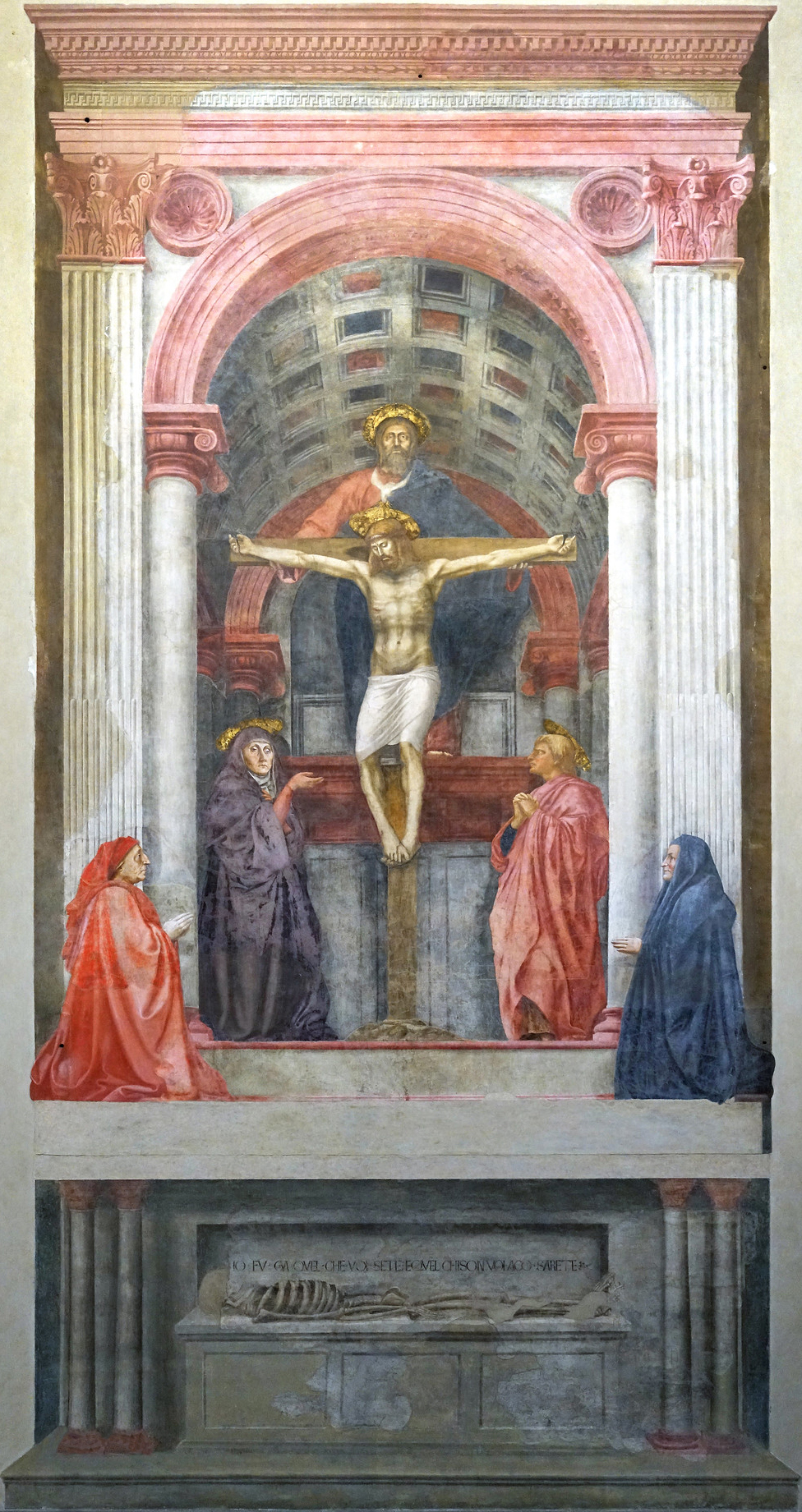
Christianity holds that God has a three-part nature—that God is a trinity (God the father, the Holy Spirit, and Jesus Christ) and that it was Jesus’s death on the cross—his sacrifice—that allowed for human beings to have the possibility of eternal life in heaven. [1] In Christian theology, Christ is seen as the second Adam, and Mary (Jesus’s mother) is seen as the second Eve. The idea here is that where Adam and Eve caused original sin, and were expelled from paradise (the Garden of Eden), Mary and Christ made it possible for human beings to have eternal life in paradise (heaven), through Christ’s sacrifice on the cross.
Christian practice centers on the sacrament of the Eucharist, which is sometimes referred to as Communion. Christians eat bread and drink wine to remember Christ’s sacrifice for the sins of humankind. Christ himself initiated this practice at the Last Supper. Catholics and Eastern Orthodox believe that the bread and wine literally transform into the body and blood of Christ, whereas Protestants and other Christians see the Eucharist as symbolic reminder and re-enactment of Christ’s sacrifice.
Christians demonstrate their faith by engaging in good (charitable) works (works of art—like the frescoes by Giotto in the Arena Chapel—were often created as good works). They often engage in rituals (sacraments) such as partaking of the Eucharist or being baptized. Traditional Christian churches have a hierarchical structure of clergy. Devout men and women sometimes become nuns or monks and may separate themselves from the world and live a cloistered life devoted to prayer in a monastery.
Early Christianity, an introduction
Key events
Two important moments played a critical role in the development of early Christianity:
1. The decision of the Apostle Paul to spread Christianity beyond the Jewish communities of Palestine into the Greco-Roman world.
2. When the Roman Emperor Constantine accepted Christianity and became its patron at the beginning of the fourth century.
The creation and nature of Christian art were directly impacted by these moments.
The spread of Christianity
As implicit in the names of his Epistles, Paul spread Christianity to the Greek and Roman cities of the ancient Mediterranean world. In cities like Ephesus, Corinth, Thessaloniki, and Rome, Paul encountered the religious and cultural experience of the Greco-Roman world. This encounter played a major role in the formation of Christianity.
Christianity as a mystery cult
Christianity in its first three centuries was one of a large number of mystery religions that flourished in the Roman world. Religion in the Roman world was divided between the public, inclusive cults of civic religions and the secretive, exclusive mystery cults. The emphasis in the civic cults was on customary practices, especially sacrifices. Since the early history of the polis or city-state in Greek culture, the public cults played an important role in defining civic identity.
As it expanded and assimilated more people, Rome continued to use the public religious experience to define the identity of its citizens. The polytheism of the Romans allowed the assimilation of the gods of the people it had conquered.
Thus, when the Roman Emperor Hadrian created the Pantheon in the early second century, the building’s dedication to all the gods signified the Roman ambition of bringing cosmos or order to the gods, just as new and foreign societies were brought into political order through the spread of Roman imperial authority. The order of Roman authority on earth is a reflection of the divine cosmos.
For most adherents of mystery cults, there was no contradiction in participating in both the public cults and a mystery cult. The different religious experiences appealed to different aspects of life. In contrast to the civic identity which was at the focus of the public cults, the mystery religions appealed to the participant’s concerns for personal salvation. The mystery cults focused on a central mystery that would only be known by those who had become initiated into the teachings of the cult.
Monotheism
These are characteristics Christianity shares with numerous other mystery cults. In early Christianity emphasis was placed on baptism, which marked the initiation of the convert into the mysteries of the faith. The Christian emphasis on the belief in salvation and an afterlife is consistent with the other mystery cults. The monotheism of Christianity, though, was a crucial difference from the other cults. The refusal of the early Christians to participate in the civic cults due to their monotheistic beliefs lead to their persecution. Christians were seen as anti-social.
Early Christian art
The beginnings of an identifiable Christian art can be traced to the end of the second century and the beginning of the third century. Considering the Old Testament prohibitions against graven images, it is important to consider why Christian art developed in the first place. The use of images will be a continuing issue in the history of Christianity. The best explanation for the emergence of Christian art in the early church is due to the important role images played in Greco-Roman culture.
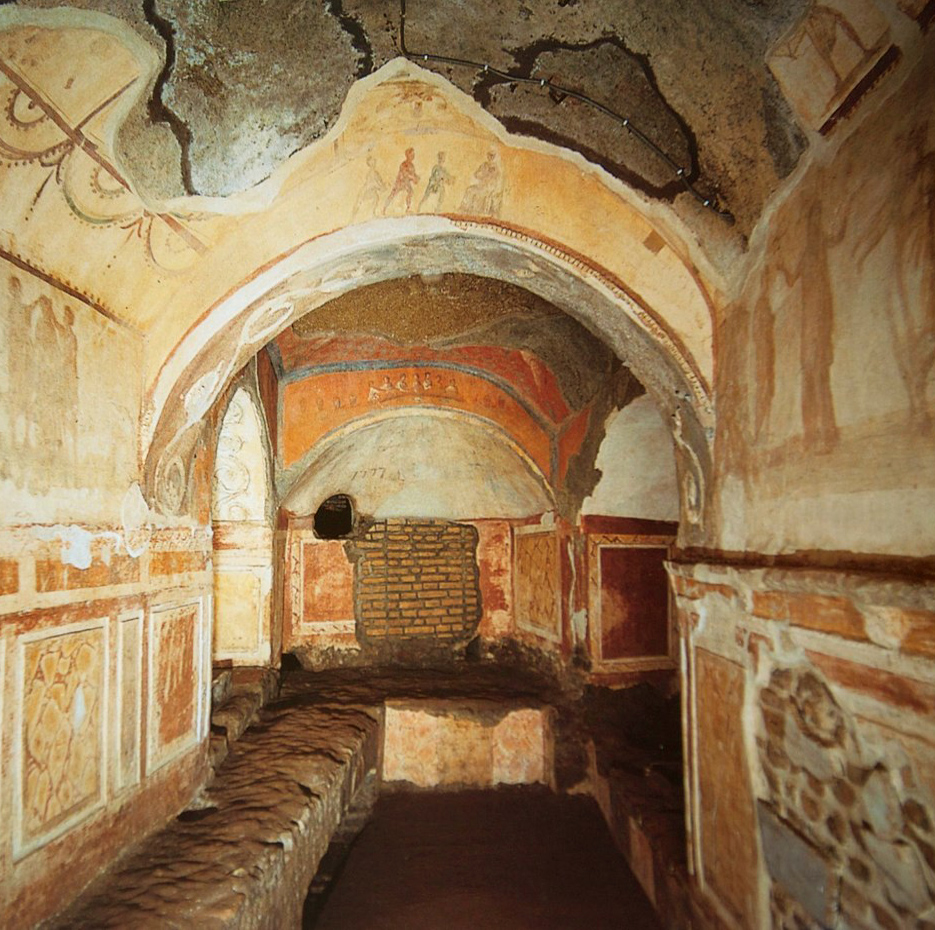
As Christianity gained converts, these new Christians had been brought up on the value of images in their previous cultural experience and they wanted to continue this in their Christian experience. For example, there was a change in burial practices in the Roman world away from cremation to inhumation. Outside the city walls of Rome, adjacent to major roads, catacombs were dug into the ground to bury the dead. Families would have chambers or cubicula dug to bury their members. Wealthy Romans would also have sarcophagi or marble tombs carved for their burial. The Christian converts wanted the same things. Christian catacombs were dug frequently adjacent to non-Christian ones, and sarcophagi with Christian imagery were apparently popular with the richer Christians.
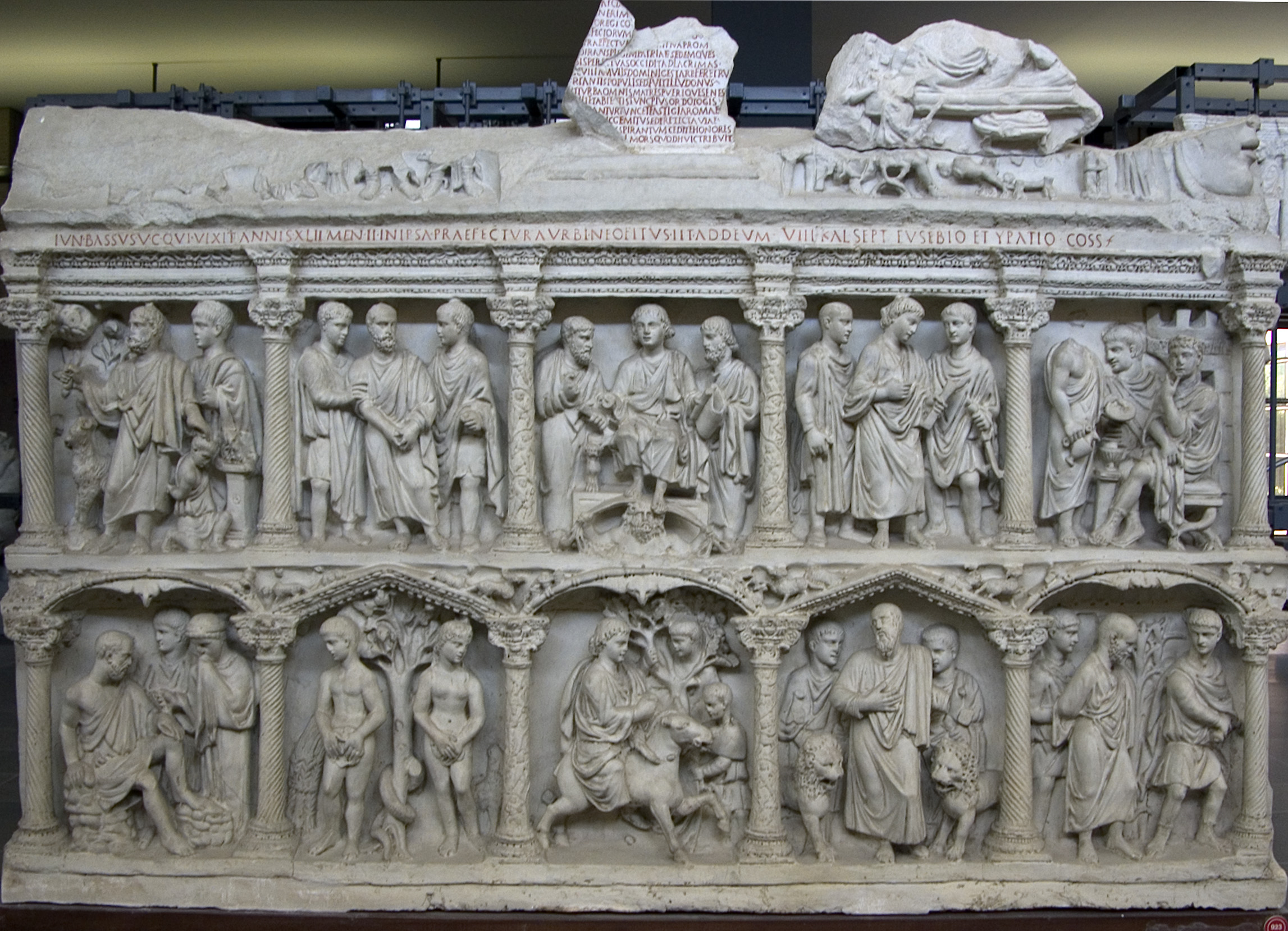
Junius Bassus, a Roman praefectus urbi or high ranking government administrator, died in 359 C.E. Scholars believe that he converted to Christianity shortly before his death accounting for the inclusion of Christ and scenes from the Bible.
Themes of death and resurrection
A striking aspect of the Christian art of the third century is the absence of the imagery that will dominate later Christian art. We do not find in this early period images of the Nativity, Crucifixion, or Resurrection of Christ, for example. This absence of direct images of the life of Christ is best explained by the status of Christianity as a mystery religion. The story of the Crucifixion and Resurrection would be part of the secrets of the cult.
While not directly representing these central Christian images, the theme of death and resurrection was represented through a series of images, many of which were derived from the Old Testament that echoed the themes. For example, the story of Jonah—being swallowed by a great fish and then after spending three days and three nights in the belly of the beast is vomited out on dry ground—was seen by early Christians as an anticipation or prefiguration of the story of Christ’s own death and resurrection. Images of Jonah, along with those of Daniel in the Lion’s Den, the Three Hebrews in the Firey Furnace, Moses Striking the Rock, among others, are widely popular in the Christian art of the third century, both in paintings and on sarcophagi.
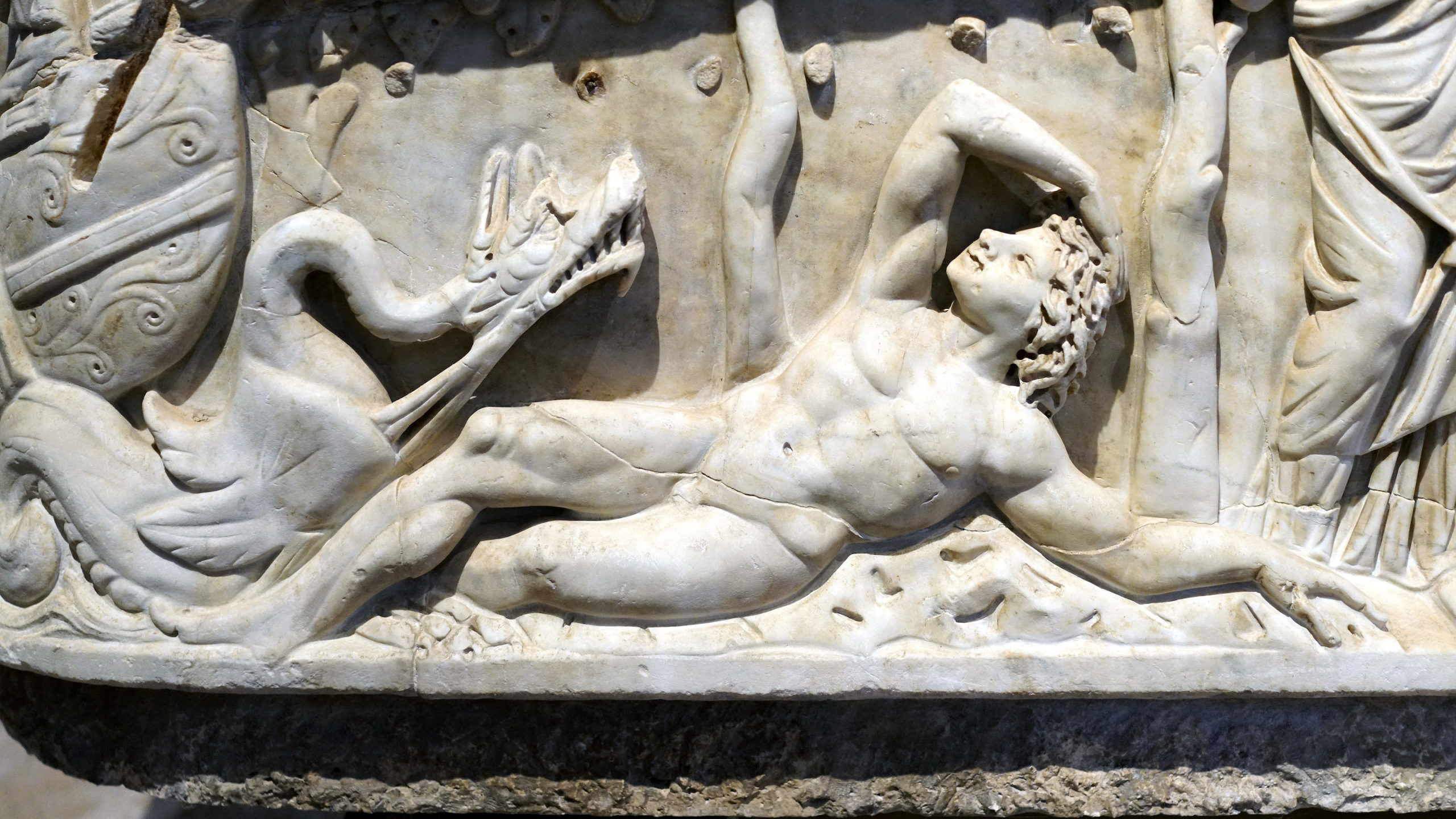
All of these can be seen to allegorically allude to the principal narratives of the life of Christ. The common subject of salvation echoes the major emphasis in the mystery religions on personal salvation. The appearance of these subjects frequently adjacent to each other in the catacombs and sarcophagi can be read as a visual litany: save me Lord as you have saved Jonah from the belly of the great fish, save me Lord as you have saved the Hebrews in the desert, save me Lord as you have saved Daniel in the Lion’s den, etc.
One can imagine that early Christians—who were rallying around the nascent religious authority of the Church against the regular threats of persecution by imperial authority—would find great meaning in the story of Moses of striking the rock to provide water for the Israelites fleeing the authority of the Pharaoh on their exodus to the Promised Land.
Christianity’s canonical texts and the New Testament
One of the major differences between Christianity and the public cults was the central role faith plays in Christianity and the importance of orthodox beliefs. The history of the early Church is marked by the struggle to establish a canonical set of texts and the establishment of orthodox doctrine.
Questions about the nature of the Trinity and Christ would continue to challenge religious authority. Within the civic cults there were no central texts and there were no orthodox doctrinal positions. The emphasis was on maintaining customary traditions. One accepted the existence of the gods, but there was no emphasis on belief in the gods.
The Christian emphasis on orthodox doctrine has its closest parallels in the Greek and Roman world to the role of philosophy. Schools of philosophy centered around the teachings or doctrines of a particular teacher. The schools of philosophy proposed specific conceptions of reality. Ancient philosophy was influential in the formation of Christian theology. For example, the opening of the Gospel of John: “In the beginning was the word and the word was with God…,” is unmistakably based on the idea of the “logos” going back to the philosophy of Heraclitus. Christian apologists like Justin Martyr writing in the second century understood Christ as the Logos or the Word of God who served as an intermediary between God and the World.
Early representations of Christ and the apostles
An early representation of Christ found in the Catacomb of Domitilla shows the figure of Christ flanked by a group of his disciples or students. Those experienced with later Christian imagery might mistake this for an image of the Last Supper, but instead this image does not tell any story. It conveys rather the idea that Christ is the true teacher.

Christ draped in classical garb holds a scroll in his left hand while his right hand is outstretched in the so-called ad locutio gesture, or the gesture of the orator. The dress, scroll, and gesture all establish the authority of Christ, who is placed in the center of his disciples. Christ is thus treated like the philosopher surrounded by his students or disciples.
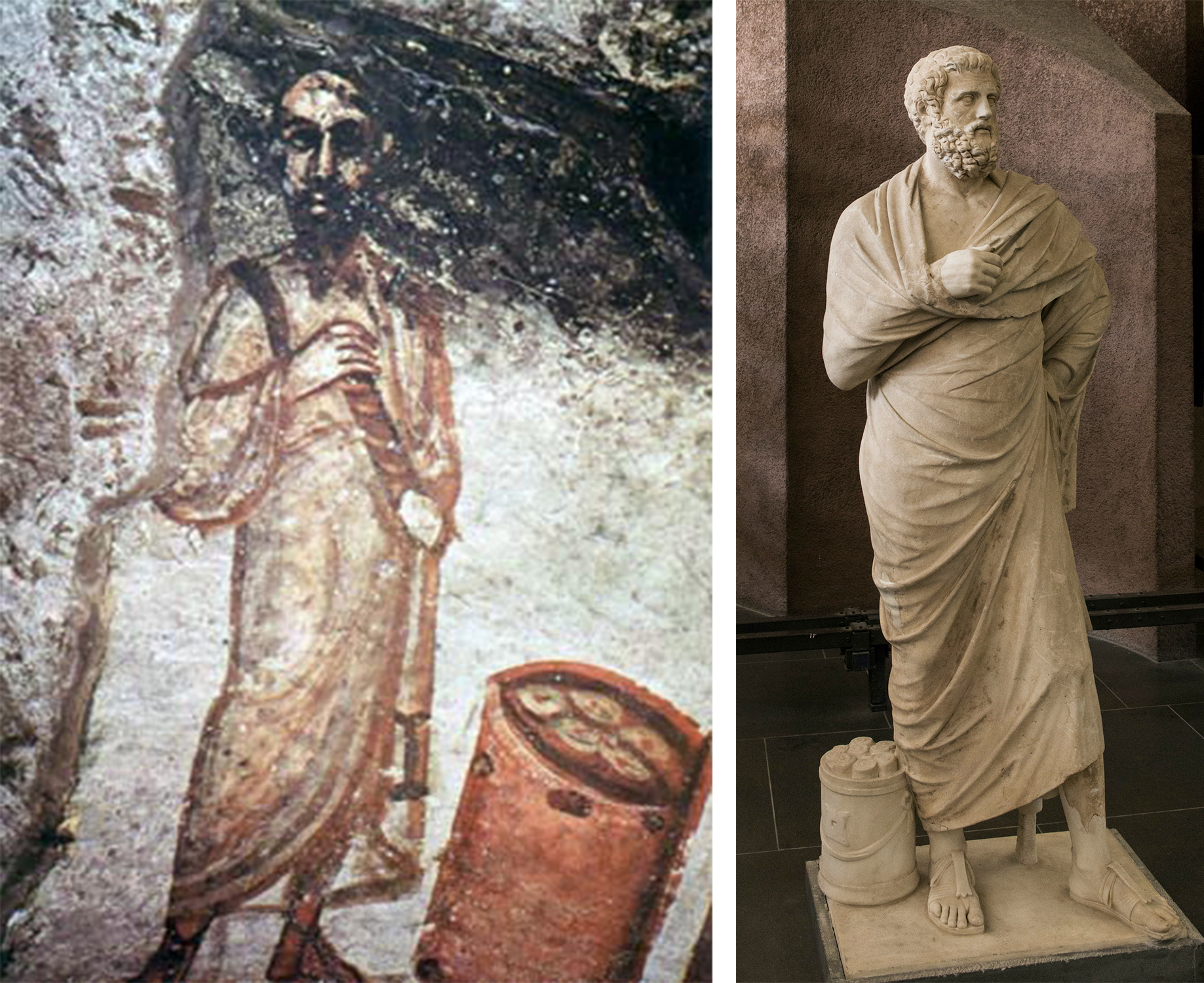
Comparably, an early representation of the apostle Paul, identifiable with his characteristic pointed beard and high forehead, is based on the convention of the philosopher, as exemplified by a Roman copy of a late fourth century B.C.E. portrait of the fifth century B.C.E. playwright Sophocles.
Catacomb of Priscilla, Rome
The Good Shepherd in Early Christianity
Early Christian art and architecture after Constantine
By the beginning of the 4th century Christianity was a growing mystery religion in the cities of the Roman world. It was attracting converts from different social levels. Christian theology and art was enriched through the cultural interaction with the Greco-Roman world. But Christianity would be radically transformed through the actions of a single man.
Rome becomes Christian and Constantine builds churches
In 312, the Emperor Constantine defeated his principal rival Maxentius at the Battle of the Milvian Bridge. Accounts of the battle describe how Constantine saw a sign in the heavens portending his victory. Eusebius, Constantine’s principal biographer, describes the sign as the Chi Rho, the first two letters in the Greek spelling of the name Christos.
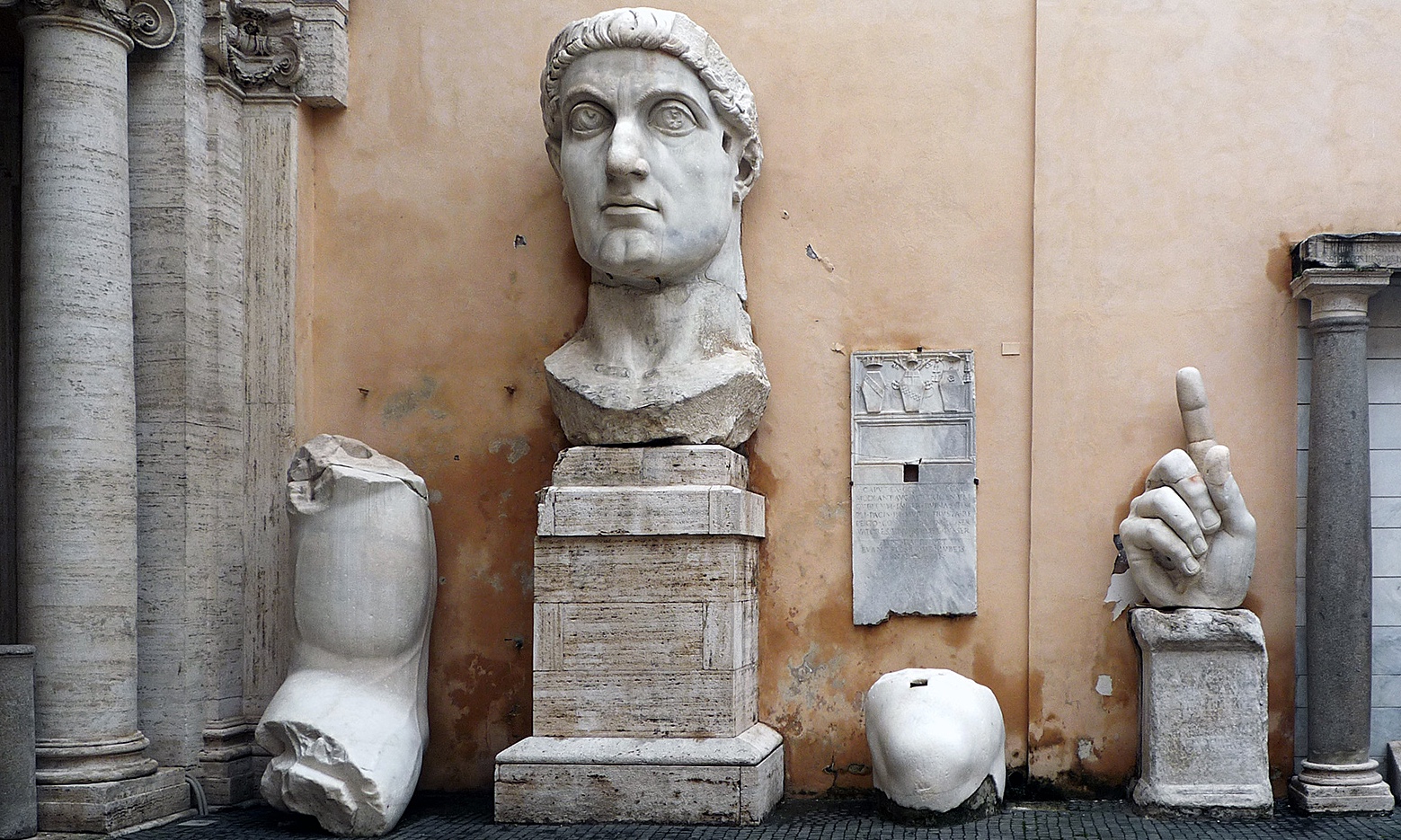
After that victory Constantine became the principal patron of Christianity. In 313 he issued the Edict of Milan which granted religious toleration. Although Christianity would not become the official religion of Rome until the end of the 4th century, Constantine’s imperial sanction of Christianity transformed its status and nature. Neither imperial Rome or Christianity would be the same after this moment. Rome would become Christian, and Christianity would take on the aura of imperial Rome.
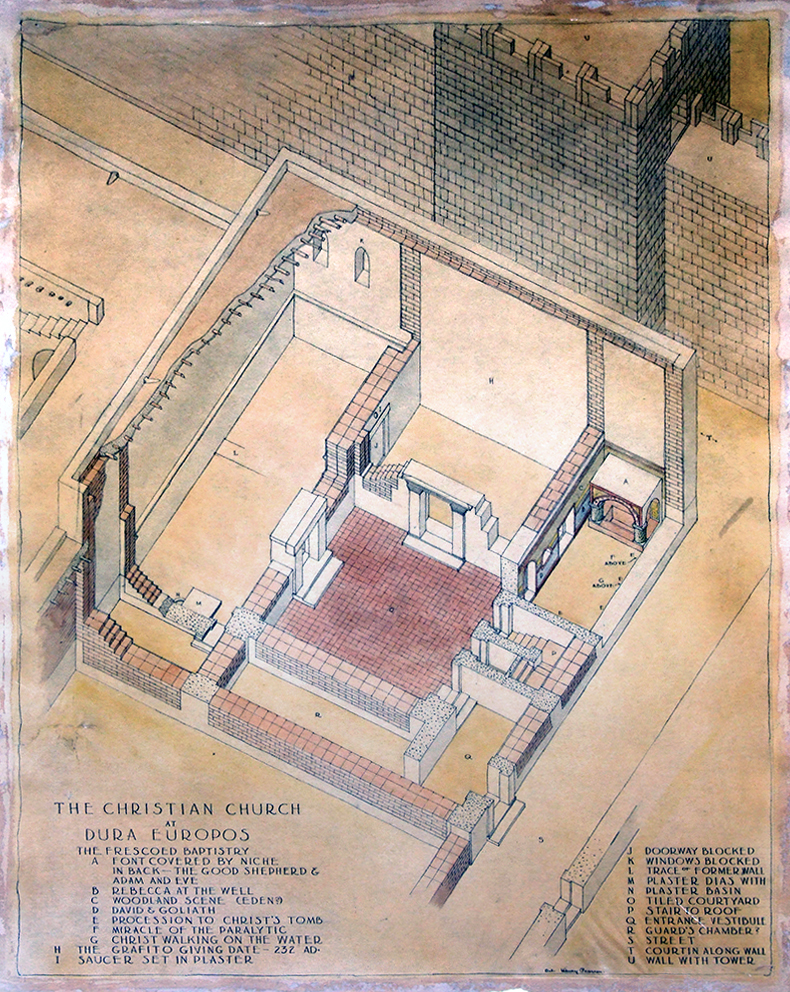
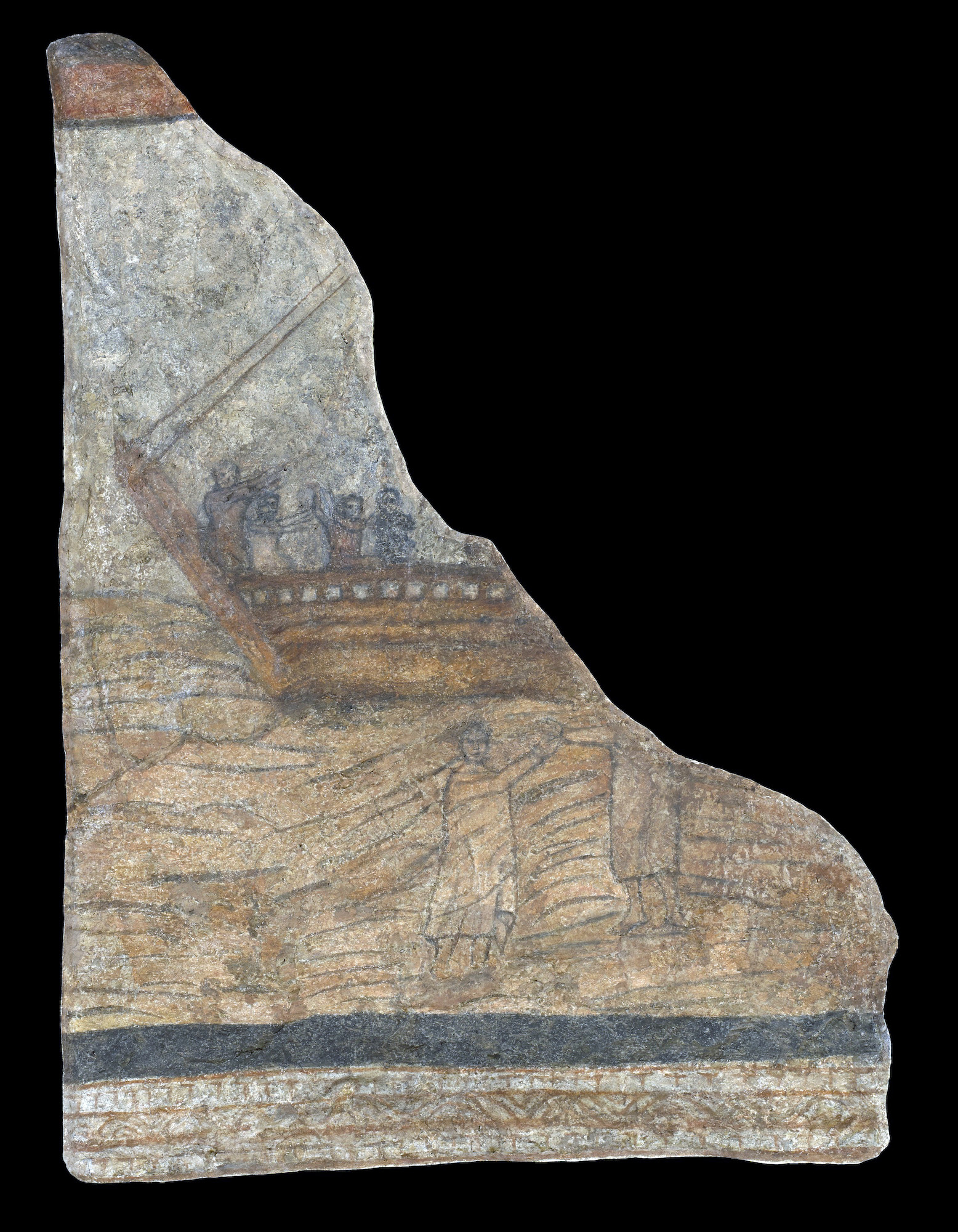
The transformation of Christianity is dramatically evident in a comparison between the architecture of the pre-Constantinian church and that of the Constantinian and post-Constantinian church. During the pre-Constantinian period, there was not much that distinguished the Christian churches from typical domestic architecture. A striking example of this is presented by a Christian community house, from the Syrian town of Dura-Europos. Here a typical home has been adapted to the needs of the congregation. A wall was taken down to combine two rooms: this was undoubtedly the room for services. It is significant that the most elaborate aspect of the house is the room designed as a baptistry. This reflects the importance of the sacrament of Baptism to initiate new members into the mysteries of the faith. Otherwise this building would not stand out from the other houses. This domestic architecture obviously would not meet the needs of Constantine’s architects.
Emperors for centuries had been responsible for the construction of temples throughout the Roman Empire. We have already observed the role of the public cults in defining one’s civic identity, and Emperors understood the construction of temples as testament to their pietas, or respect for the customary religious practices and traditions. Therefore, it was natural for Constantine to want to construct edifices in honor of Christianity. He built churches in Rome, including the Church of St. Peter, he built churches in the Holy Land, most notably the Church of the Nativity in Bethlehem and the Church of the Holy Sepulcher in Jerusalem, and he built churches in his newly-constructed capital of Constantinople.
The basilica
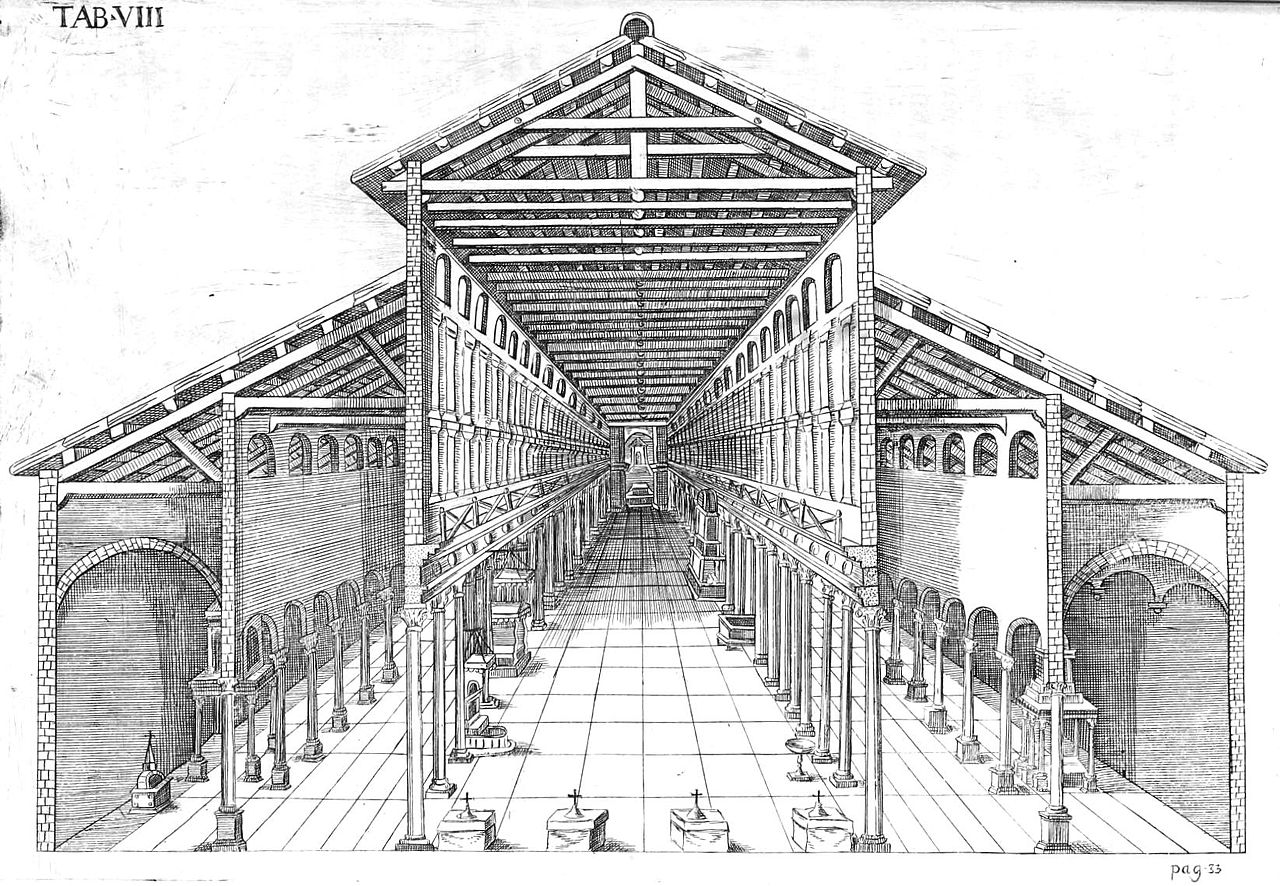
In creating these churches, Constantine and his architects confronted a major challenge: what should be the physical form of the church? Clearly the traditional form of the Roman temple would be inappropriate both from associations with pagan cults but also from the difference in function. Temples served as treasuries and dwellings for the cult; sacrifices occurred on outdoor altars with the temple as a backdrop. This meant that Roman temple architecture was largely an architecture of the exterior. Since Christianity was a mystery religion that demanded initiation to participate in religious practices, Christian architecture put greater emphasis on the interior. The Christian churches needed large interior spaces to house the growing congregations and to mark the clear separation of the faithful from the unfaithful. At the same time, the new Christian churches needed to be visually meaningful. The buildings needed to convey the new authority of Christianity. These factors were instrumental in the formulation during the Constantinian period of an architectural form that would become the core of Christian architecture to our own time: the Christian Basilica.
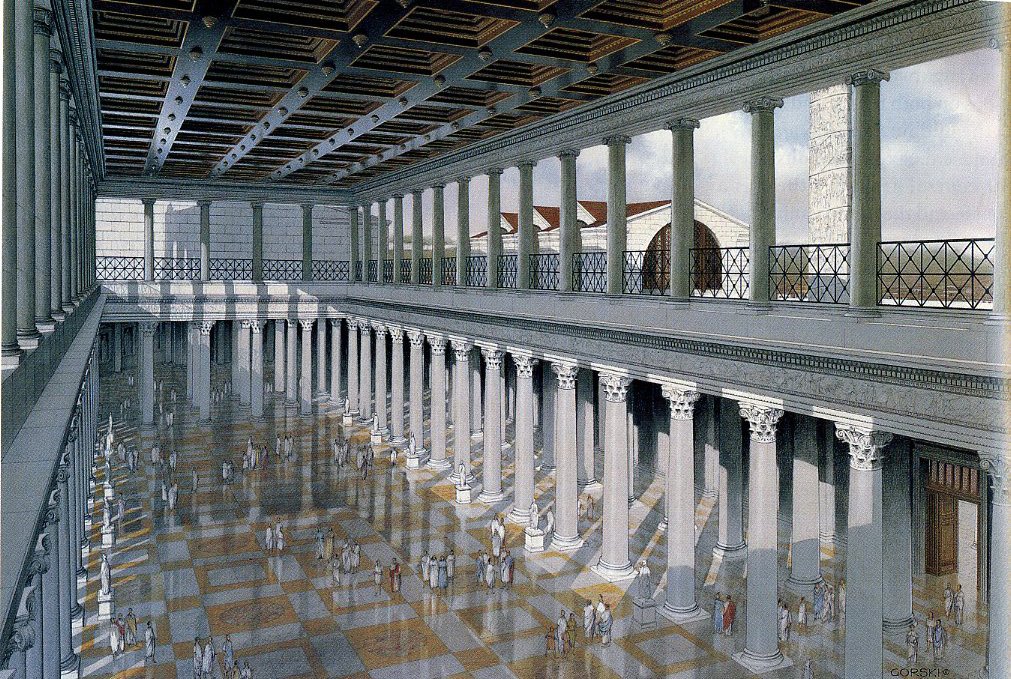
The basilica was not a new architectural form. The Romans had been building basilicas in their cities and as part of palace complexes for centuries. A particularly lavish one was the so-called Basilica Ulpia constructed as part of the Forum of the Emperor Trajan in the early 2nd century. Basilicas had diverse functions but essentially they served as formal public meeting places. One of the major functions of the basilicas was as a site for law courts. These were housed in an architectural form known as the apse. In the Basilica Ulpia, these semi-circular forms project from either end of the building, but in some cases, the apses would project off of the length of the building. The magistrate who served as the representative of the authority of the Emperor would sit in a formal throne in the apse and issue his judgments. This function gave an aura of political authority to the basilicas. Basilicas also served as audience halls as a part of imperial palaces, such as the basilica at Trier built by Constantine as part of a palace complex in Trier, which served as his northern capital. Either way, the association between basilicas and the emperor was clear.
Christian use of the Roman basilica
Not long after his conversion and subsequent legalization of Christianity, Constantine began an extensive building campaign to support his new state religion in major cities such as Rome, Jerusalem, and Constantinople. In looking for a structure to address the spatial needs of the developing Christian liturgy (such as increasing congregation size and more elaborate processions), he adapted the Roman basilica, which until that point had been used exclusively as a civic building, like the Basilica of Maxentius and Constantine.
Roman basilicas were long rectangular buildings, often with a central nave (a wide, center aisle) and two side aisles. There was at least one semicircular apse, often at one end of the building, in which the magistrates sat and heard their cases. The basilica was in many ways the perfect building to adapt into a church because it did not have the pagan associations that Roman temples did and was large enough to accommodate the growing Christian population.
Early Christian basilicas such as Santa Sabina and San Paolo fuori le Mura (Saint Paul’s Outside the Walls) maintained the basic structure of the Roman basilica, but distinctly Christian elements were added. The bema was retained from the synagogue and continued to be used as the raised platform from which priests preached (by the late Middle Ages this was often attached to a pillar to one side of the central aisle of the nave). Many churches added the ambo, an even higher platform, accessed by stairs, from which the Gospel was read and sermons were preached—in which case the bema was reserved for the recitation of prayers and the reading of the Epistles or Old Testament. Another distinctly Christian architectural element was the transept, which was added near the apse-end of the building to form a cross-shape and provide additional space.
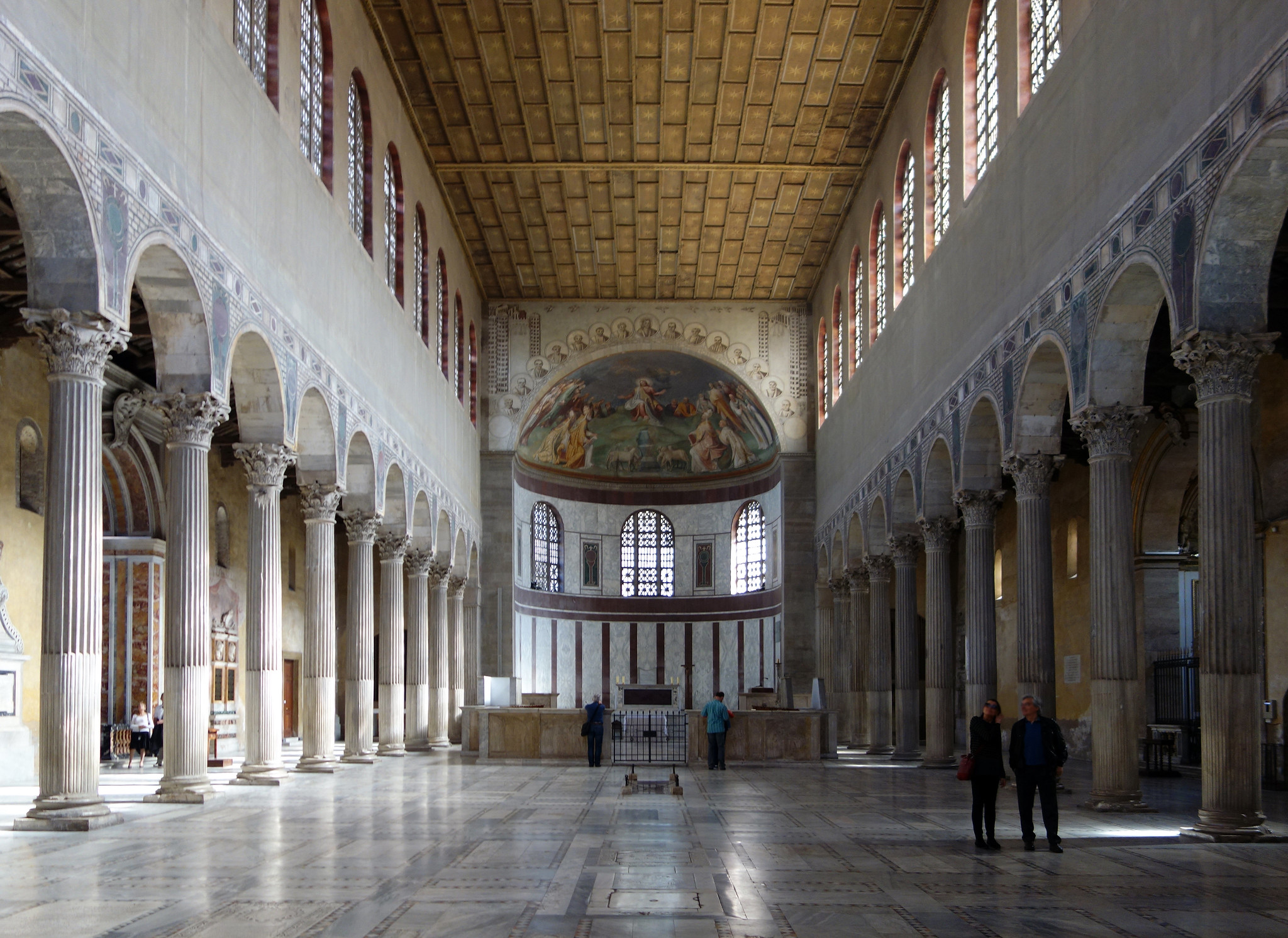
Most significant among the Christian additions to the basilica, and the central focus for the liturgy, was the altar upon which the eucharist was celebrated. Altars were located either right in front of or just inside of the apse (as in Santa Sabina)—that is, within the Christian equivalent of the Jewish Holy of Holies. Up until the Middle Ages, most altars were wooden table-like structures; they then transitioned into stone. In the early 5th century, the Church formally required the installation of saints’ relics (often bone fragments) in altars. This practice was based in part on the tradition of placing altars on top of martyrs’ tombs (like at Saint Peter’s Basilica in Rome) and the text of Revelation 6:9-10, which describes martyrs crying out for justice from under the altar in heaven. The three main areas of the church came to be ascribed with symbolic meaning: the narthex, or entry, was the world; the nave, or main hall, was the Kingdom of God; and the sanctuary, or altar area—like the Holy of Holies—was heaven.
Old St. Peter’s Basilica
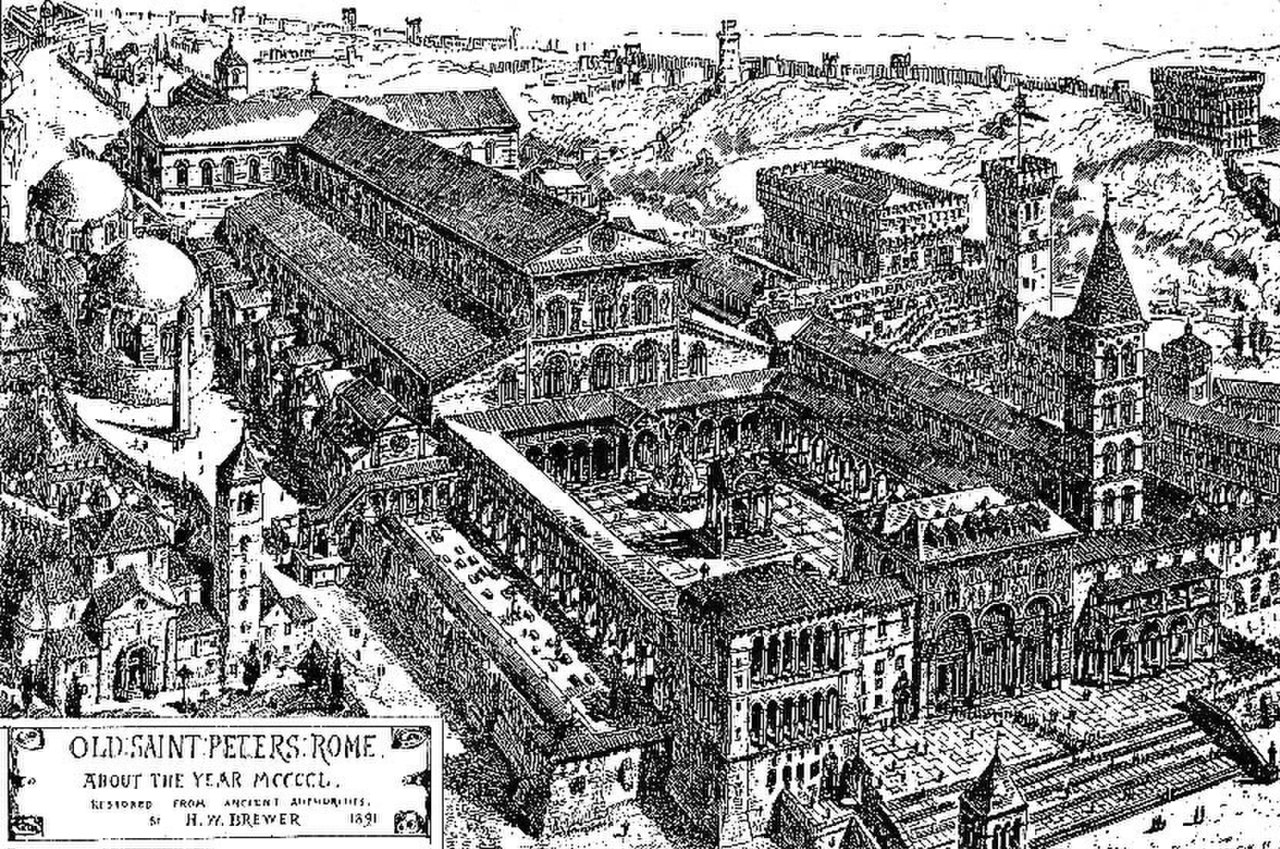
Old St Peter’s Basilica was erected by Constantine in the 4th century. During the ancient Roman era, the site was Nero’s Circus, a place where games and sporting events were performed. This was a place where Nero himself apparently rode a chariot. It was also a place where there was an ancient necropolis — burial ground — and by tradition, the place where Saint Peter himself was crucified and then buried.
The site is a very holy one—it is (according to the Catholic Church) the site of the burial of Saint Peter. Saint Peter is considered one of the Twelve Apostles of Jesus Christ and a leader of the early Church. Because of this, he is traditionally thought of as the first bishop of Rome, or Pope, given that job by Christ himself. The early Christians created a monument on the site, which was quite small and humble.
It is on this site that Constantine ordered the building of a basilica. The basilica, with its long axis that focuses attention on the altar, is the most popular type of church plan because of its practicality and ability to hold many worshippers. The architectural design of Old St. Peter’s Basilica utilized the common features of an early Christian basilica: nave, aisle, apse, altar, and transept.
The original church, Constantine’s Saint Peter’s, lasted for a little more than a thousand years. By the time of the Renaissance, Old St. Peter’s was in disrepair, and a massive rebuilding project began under Pope Juilius II. The resulting project becomes New St. Peter’s Basilica.
Sarcophagus of Junius Bassus
Made for a member of the Roman elite, this early tomb features Old and New Testament scenes in a classical style.
Christianity becomes legal
By the middle of the fourth century Christianity had undergone a dramatic transformation. Before Emperor Constantine’s acceptance, Christianity had a marginal status in the Roman world. Attracting converts in the urban populations, Christianity appealed to the faithful’s desires for personal salvation; however, due to Christianity’s monotheism (which prohibited its followers from participating in the public cults), Christians suffered periodic episodes of persecution. By the middle of the fourth century, Christianity under imperial patronage had become a part of the establishment. The elite of Roman society were becoming new converts.
Such an individual was Junius Bassus. He was a member of a senatorial family. His father had held the position of Praetorian prefect, which involved administration of the Western Empire. Junius Bassus held the position of praefectus urbi (“urban prefect”) for Rome, an office established in the early period under the kings, and was responsible for the administration of the city of Rome. It was a position held by members of the most elite families. When Junius Bassus died at the age of 42 in the year 359, a sarcophagus was made for him. As recorded in an inscription on the sarcophagus now in the Vatican collection, Junius Bassus had become a convert to Christianity shortly before his death.
The birth of Christian symbolism in art
The style and iconography of this sarcophagus reflects the transformed status of Christianity. This is most evident in the image at the center of the upper register. Before the time of Constantine, the figure of Christ was rarely directly represented, but here on the Junius Bassus sarcophagus we see Christ prominently represented not in a narrative representation from the New Testament but in a formula derived from Roman Imperial art. The traditio legis (“giving of the law”) was a formula in Roman art to give visual testament to the emperor as the sole source of the law.
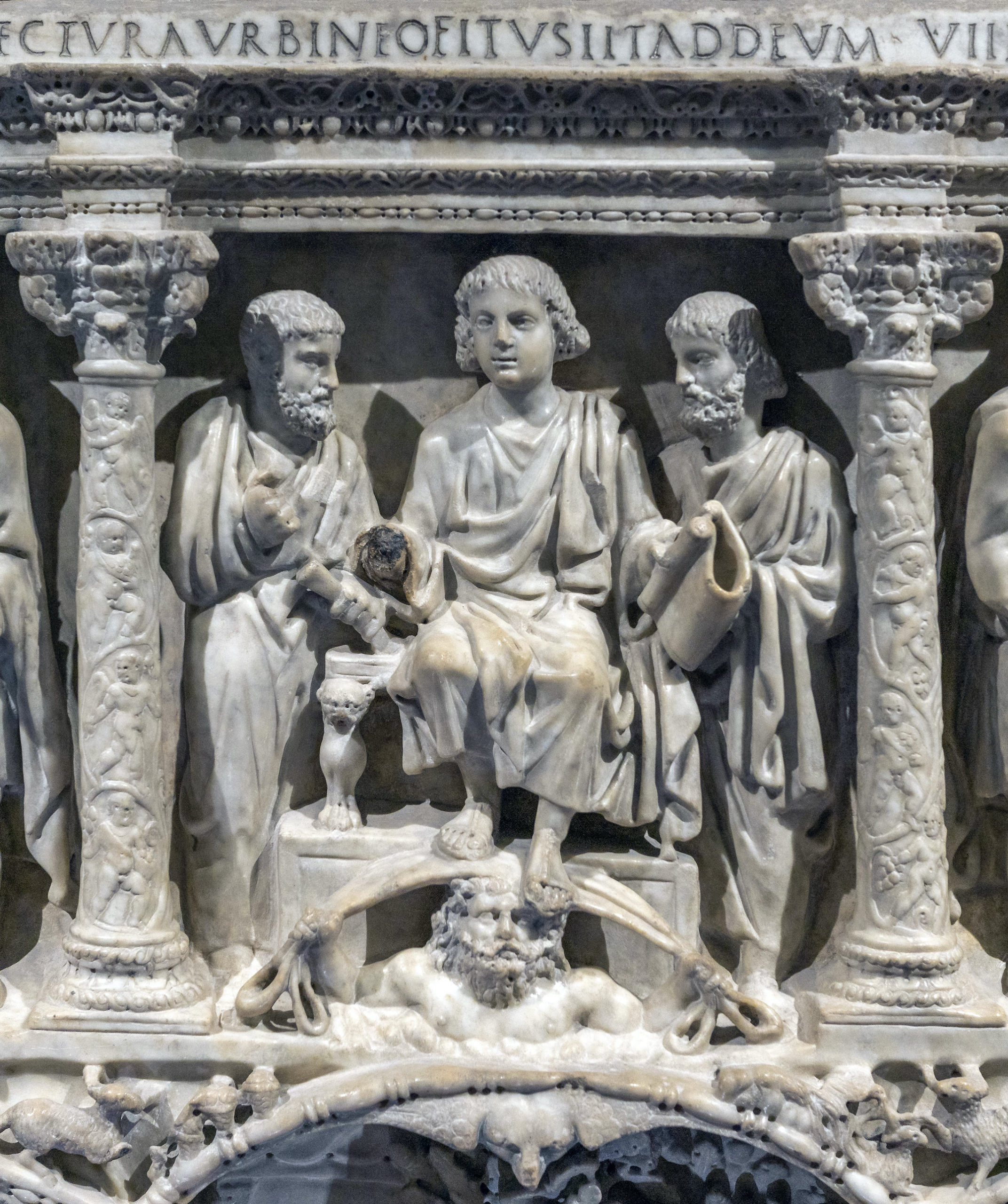
Already at this early period, artists had articulated identifiable formulas for representing Saints Peter and Paul. Peter was represented with a bowl haircut and a short cropped beard, while the figure of Paul was represented with a pointed beard and usually a high forehead. In paintings, Peter has white hair and Paul’s hair is black. The early establishment of these formulas was undoubtedly a product of the doctrine of apostolic authority in the early church. Bishops claimed that their authority could be traced back to the original Twelve Apostles.
Peter and Paul held the status as the principal apostles. The Bishops of Rome have understood themselves in a direct succession back to Saint Peter, the founder of the church in Rome and its first bishop. The popularity of the formula of the traditio legis in Christian art in the fourth century was due to the importance of establishing orthodox Christian doctrine.
In contrast to the established formulas for representing Saints Peter and Paul, early Christian art reveals two competing conceptions of Christ. The youthful, beardless Christ, based on representation of Apollo, vied for dominance with the long-haired and bearded Christ, based on representations of Jupiter or Zeus.
The feet of Christ in the Junius Bassus relief rest on the head of a bearded, muscular figure, who holds a billowing veil spread over his head. This is another formula derived from Roman art. A comparable figure appears at the top of the cuirass of the Augustus of Primaporta. The figure can be identified as the figure of Caelus, or the heavens. In the context of the Augustan statue, the figure of Caelus signifies Roman authority and its rule of everything earthly, that is, under the heavens. In the Junius Bassus relief, Caelus’s position under Christ’s feet signifies that Christ is the ruler of heaven.
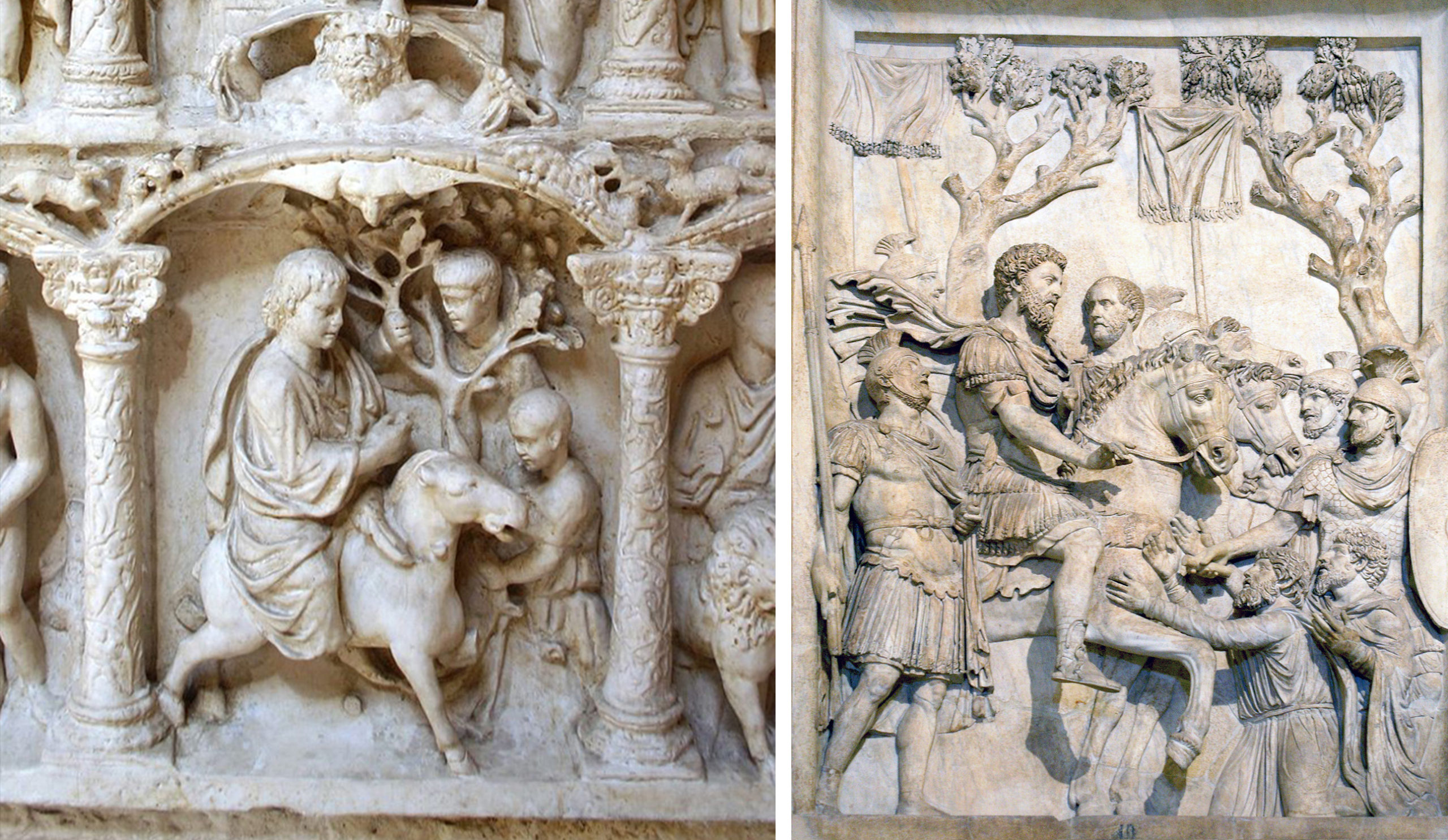
The lower register directly underneath depicts Christ’s Entry into Jerusalem. This image was also based on a formula derived from Roman imperial art. The adventus was a formula devised to show the triumphal arrival of the emperor with figures offering homage. A relief from the reign of Marcus Aurelius illustrates this formula. In including the Entry into Jerusalem, the designer of the Junius Bassus sarcophagus did not just use this to represent the New Testament story, but with the adventus iconography, this image signifies Christ’s triumphal entry into Jerusalem. Whereas the traditio legis above conveys Christ’s heavenly authority, it is likely that the Entry into Jerusalem in the form of the adventus was intended to signify Christ’s earthly authority. The juxtaposition of the Christ in Majesty and the Entry into Jerusalem suggests that the planner of the sarcophagus had an intentional program in mind.
Old and new together
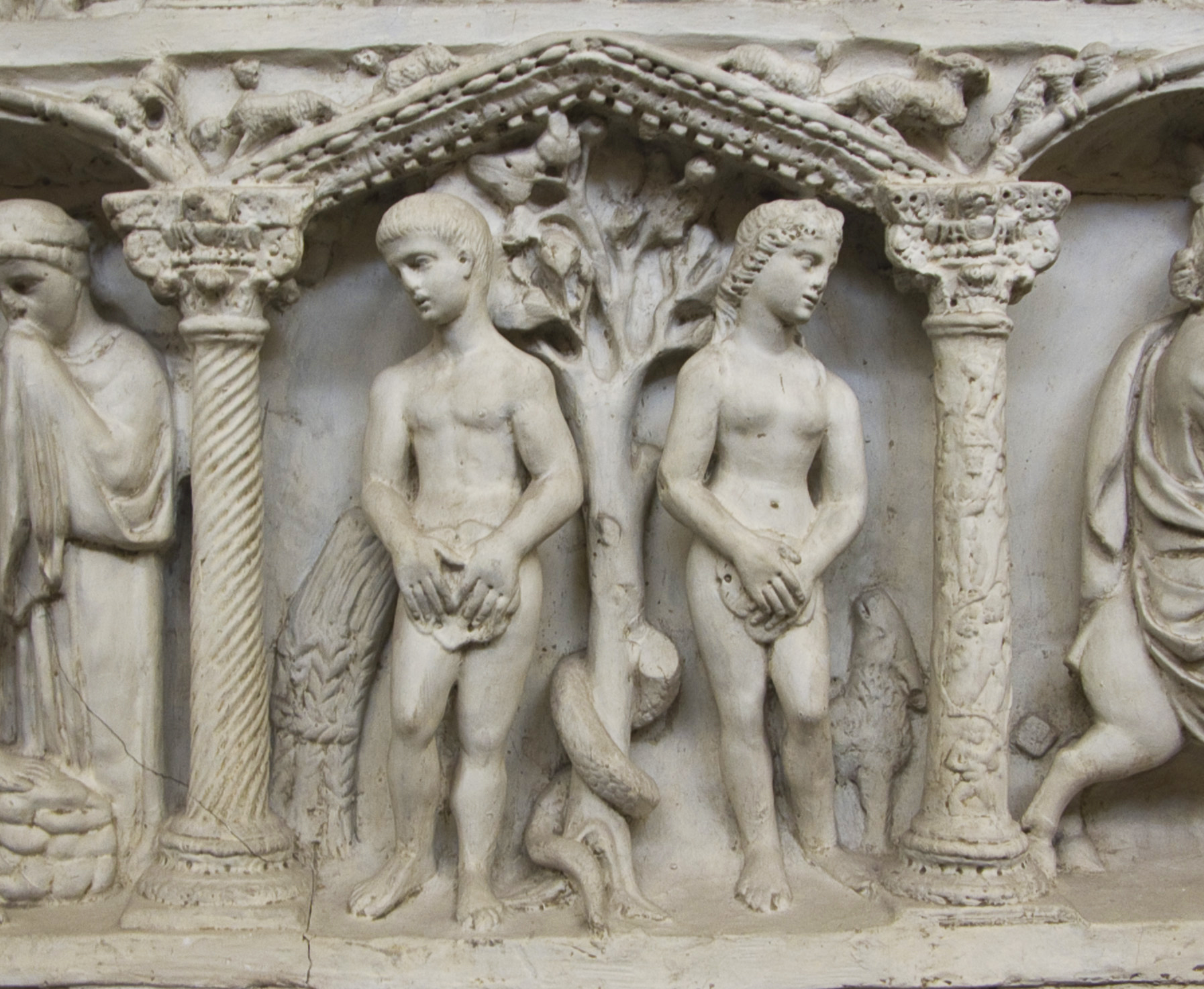
We can determine some intentionality in the inclusion of the Old and New Testament scenes. For example the image of Adam and Eve shown covering their nudity after the Fall was intended to refer to the doctrine of Original Sin that necessitated Christ’s entry into the world to redeem humanity through His death and resurrection. Humanity is thus in need of salvation from this world.
The inclusion of the suffering of Job on the left hand side of the lower register conveyed the meaning how even the righteous must suffer the discomforts and pains of this life. Job is saved only by his unbroken faith in God.
The scene of Daniel in the lion’s den to the right of the Entry into Jerusalem had been popular in earlier Christian art as another example of how salvation is achieved through faith in God.
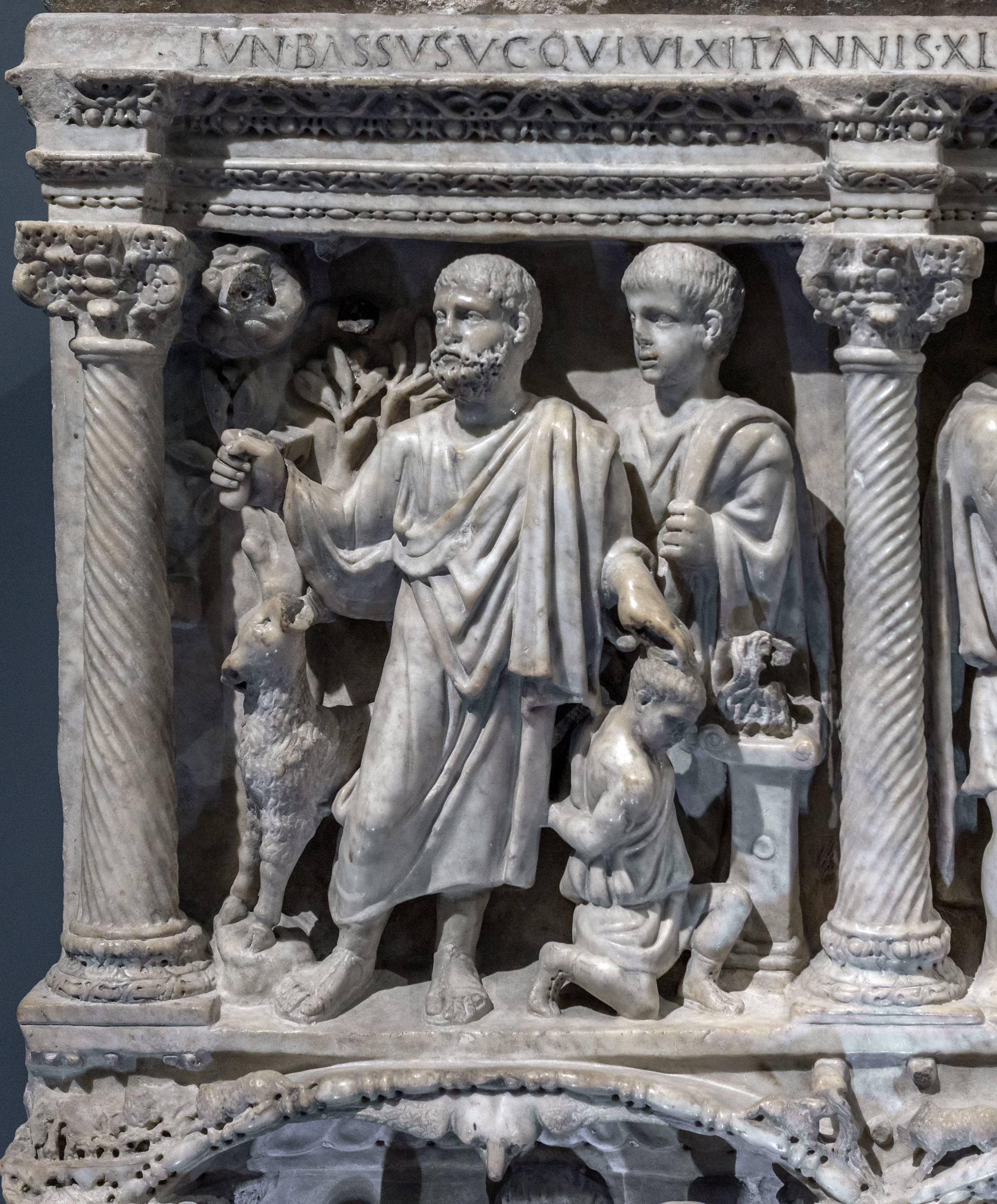
Salvation is a message in the relief of Abraham’s sacrifice of Isaac on the left hand side of the upper register. God challenged Abraham’s faith by commanding Abraham to sacrifice his only son Isaac. At the moment when Abraham is about to carry out the sacrifice his hand is stayed by an angel. Isaac is thus saved. It is likely that the inclusion of this scene in the context of the rest of the sarcophagus had another meaning as well. The story of the father’s sacrifice of his only son was understood to refer to God’s sacrifice of his son, Christ, on the Cross. Early Christian theologians attempting to integrate the Old and New Testaments saw in Old Testament stories prefigurations or precursors of New Testament stories. Throughout Christian art the popularity of Abraham’s Sacrifice of Isaac is explained by its typological reference to the Crucifixion of Christ.
Martyrdom
While not showing directly the Crucifixion of Christ, the inclusion of the Judgment of Pilate in two compartments on the right hand side of the upper register is an early appearance in Christian art of a scene drawn from Christ’s Passion. The scene is based on the formula in Roman art of Justitia, illustrated here by a panel made for Marcus Aurelius. Here the emperor is shown seated on the sella curulis dispensing justice to a barbarian figure. On the sarcophagus, Pilate is shown seated also on a sella curulis. The position of Pontius Pilate as the Roman prefect or governor of Judaea undoubtedly carried special meaning for Junius Bassus in his role as praefectus urbi in Rome. Junius Bassus as a senior magistrate would also be entitled to sit on a sella curulis.
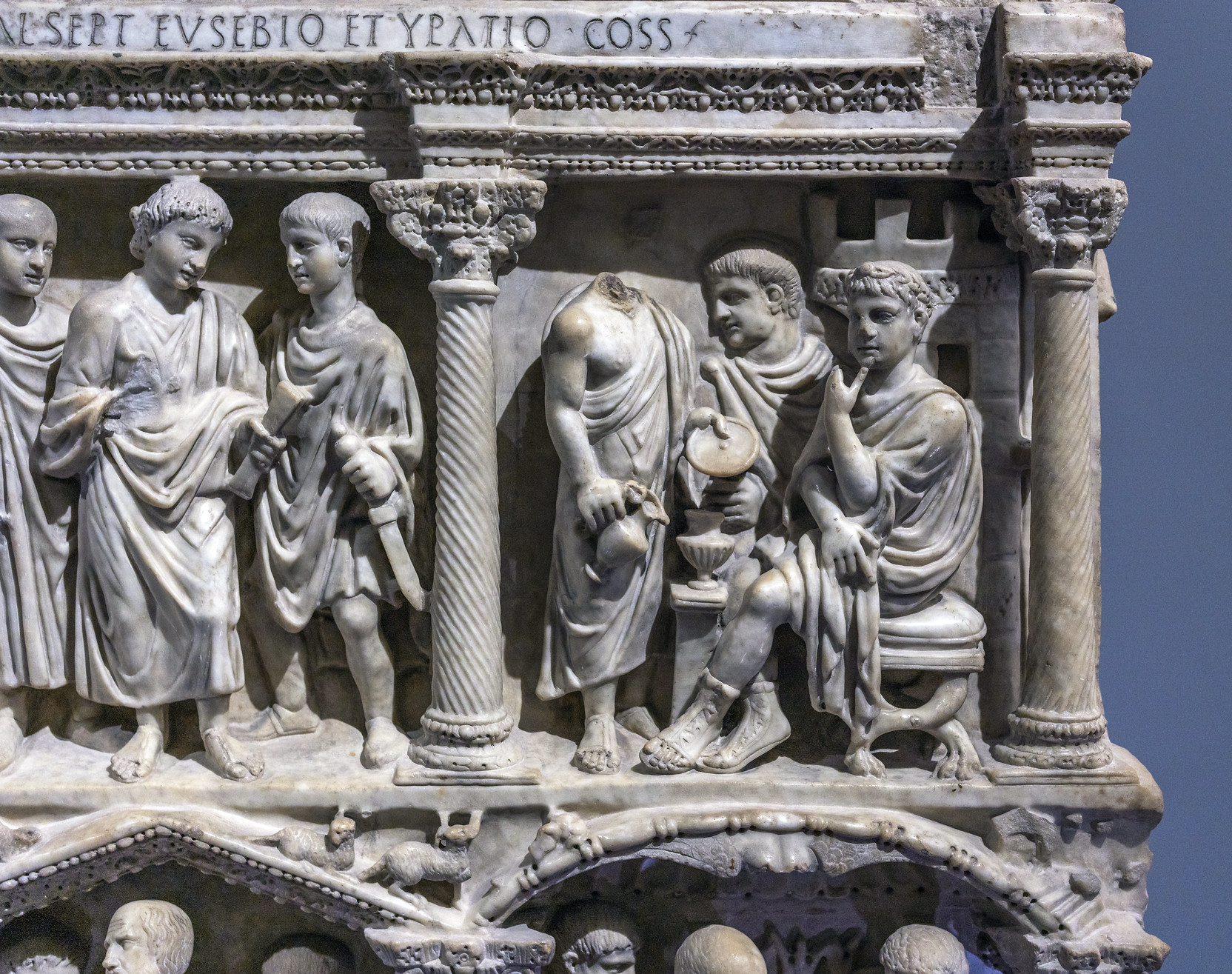
Just as Christ was judged by Roman authority, Saints Peter and Paul were martyred under Roman rule. The remaining two scenes on the sarcophagus represent Saints Peter and Paul being led to their martyrdoms. Peter and Paul as the principal apostles of Christ are again given prominence. Their martyrdoms witness Christ’s own death. The artists seem to be making this point by the visual pairing of the scene of Saint Peter being led to his martyrdom and the figure of Christ before Pilate. In both scenes the principal figure is flanked by two other figures.
The importance of Peter and Paul in Rome is made apparent in that two of the major churches that Constantine constructed in Rome were the Church of Saint Peter and the Church of Saint Paul Outside the Walls. The site of the Church of Saint Peter has long believed to be the place of Saint Peter’s burial. The basilica was constructed in an ancient cemetery. Although we can not be certain the the Junius Bassus Sarcophagus was originally intended for this site, it would make sense that a prominent Roman Christian like Junius Bassus would want to be buried in close physical proximity to the burial spot of the founder of the Church of Rome.
Competing styles
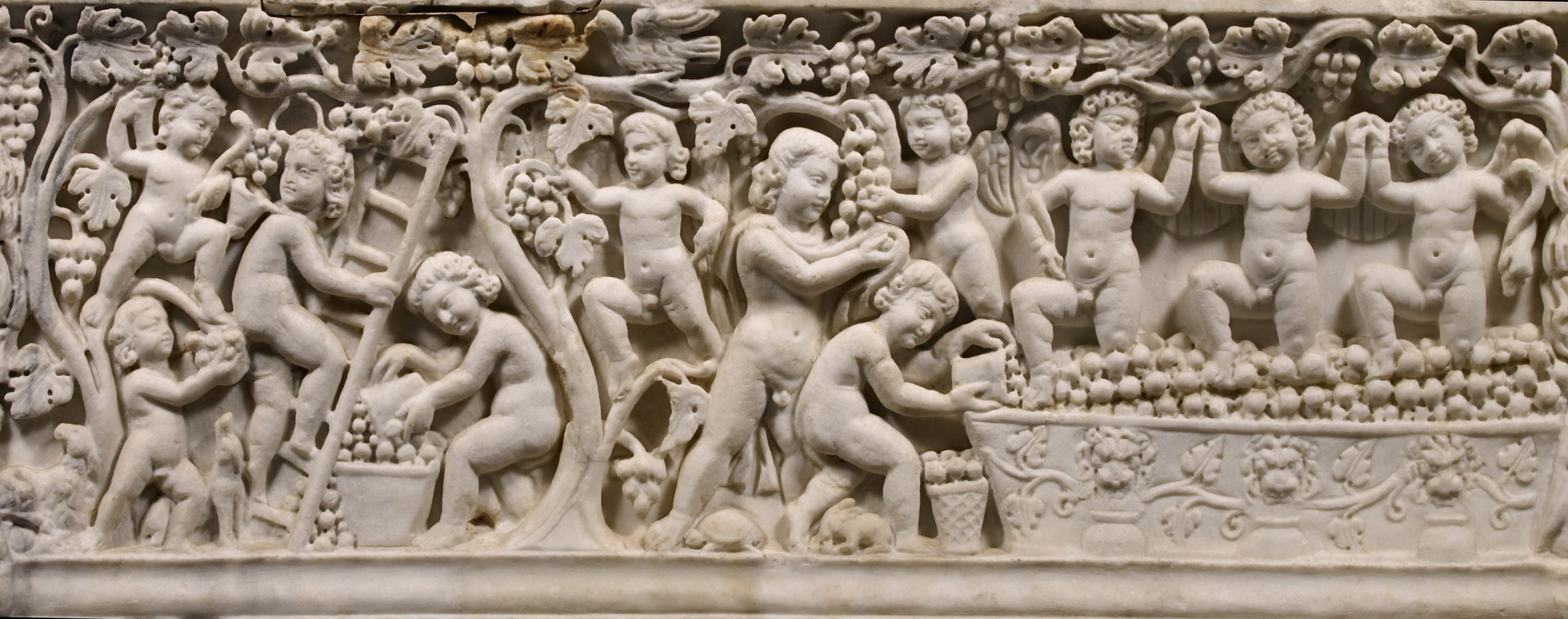
At either end of the Junius Bassus sarcophagus appear Erotes harvesting grapes and wheat. A panel with the same subject was probably a part of a pagan sarcophagus made for a child. This iconography is based on images of the seasons in Roman art. Again, the artists have taken conventions from Greek and Roman art and converted it into a Christian context. The wheat and grapes of the classical motif would be understood in the Christian context as a reference to the bread and wine of the Eucharist.

While the proportions are far from the standards of classical art, the style of the relief, especially with the rich folds of drapery and soft facial features, can be seen as classic or alluding to the classical style. Comparably the division of the relief into different registers and further subdivided by an architectural framework alludes to the orderly disposition of classical art. This choice of a style that alludes to classical art was undoubtedly intentional. The art of the period is marked by a number of competing styles. Just as rhetoricians were taught at this period to adjust their oratorical style to the intended audience, the choice of the classical style was seen as an indication of the high social status of the patron, Junius Bassus. In a similar way, the representation of the figures in togas was intentional. In Roman art, the toga was traditionally used as a symbol of high social status.
In both its style and iconography, the Junius Bassus Sarcophagus witnesses the adoption of the tradition of Greek and Roman art by Christian artists. Works like this were appealing to patrons like Junius Bassus who were a part of the upper level of Roman society. Christian art did not reject the classical tradition: rather, the classical tradition will be a reoccurring element in Christian art throughout the Middle Ages.
The Mausoleum of Galla Placidia, Ravenna
An unassuming brick exterior belies the luminous early medieval mosaics within this mausoleum located in the city of Ravenna, which was once the capital of the Western Roman Empire.
Practicing Visual Analysis
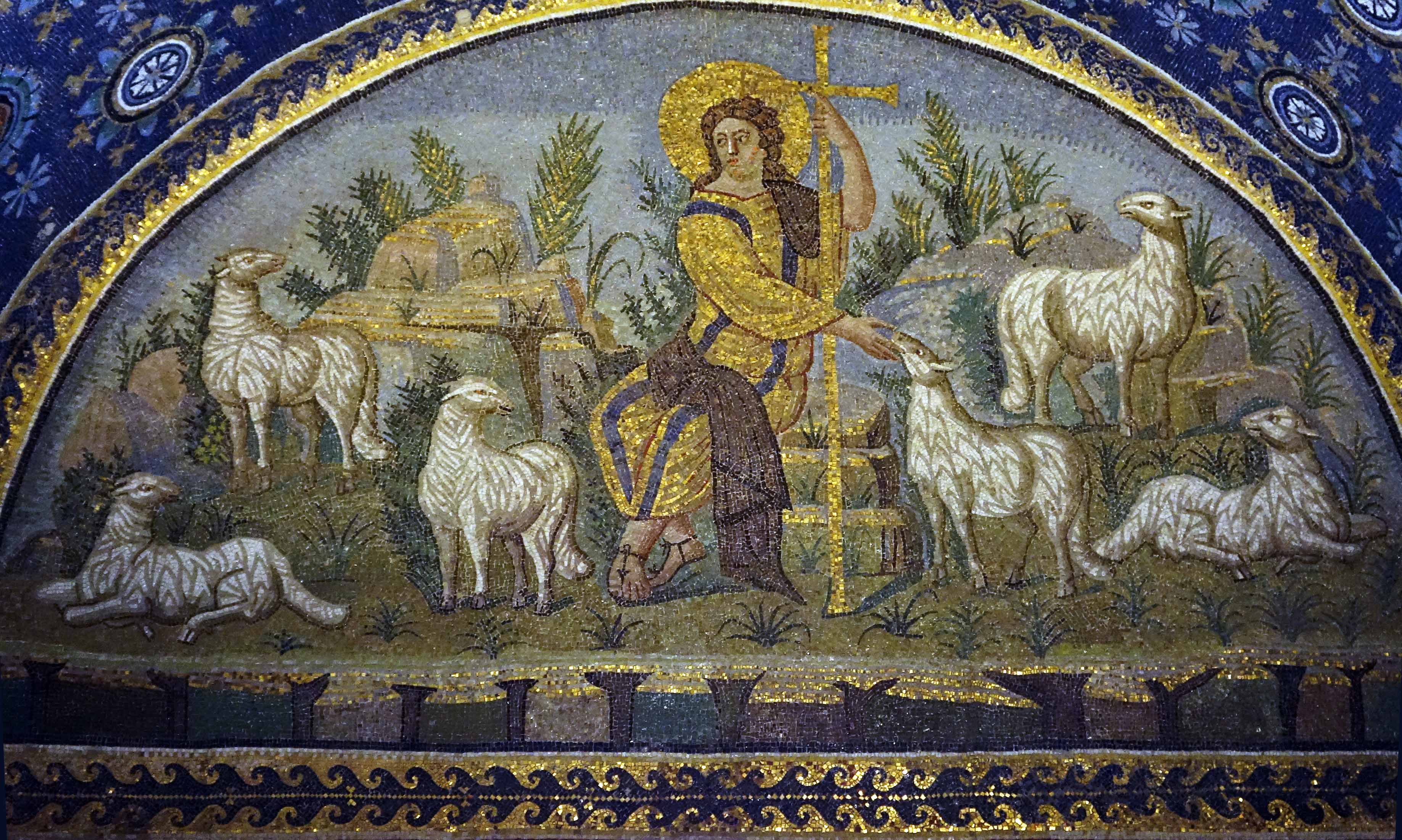
Christ as the Good Shepherd from the Mausoleum of Galla Placidia features the figurative form of Jesus Christ seated on a natural rock throne surrounded by six sheep. Dressed in the Roman imperial colors of gold and purple, his body twists to gently touch the underside of a sheep’s chin. He is set in a naturalistic pictorial space featuring rocks and greenery. By this point in time, Christianity is the official religion of the Roman Empire. As such, no camouflaged or hidden symbolism is needed as in the Catacomb of Priscilla. His head is surrounded by a golden halo while he holds a cross. Unlike later representations of Christ, he is youthful and beardless. Artists here blended Roman imperial iconography (colors, halo) with emerging Christian iconography (sheep, cross). The entire piece is a mosaic made of tesserae, which means this two-dimensional artwork has a literal texture to it of rough stone and glass. The artists used shading with highlights and shadows on the organic forms, including the sheep and the rocks, to create the illusion of three-dimensional space on the two-dimensional surface. Because gold leaf is baked into some of the glass tesserae, when light hits the mosaic, it would glimmer and reflect. The piece thus contains the illusion of light and the actual presence of it. Both curvilinear and rectilinear lines are used to create the contour lines for the forms of figures and natural elements. Implied lines from the sheep lead the viewer’s eye directly to Christ, who is seated at the center of the composition. Using light and shadow, overlapping, and variations in spatial proportions, the artists achieved a convincing sense of three-dimensional space.
Conclusion
The development of early Christian art was rooted in the Classical world of Ancient Greece and Rome. As Christianity became the official religion of the Roman Empire under the Emperor Theodosius, Christian art and architecture became increasingly associated with imperial iconography. Even the image of Christ transformed. The earliest representations of Christ, such as the Good Shepherd statues and catacomb paintings with their Roman-inspired design, gave way to an imperial-looking Christ with clear symbolism of power and authority. Already by the 5th century C.E., Christ as the Good Shepherd mosaic in the Mausoleum of Galla Placidia began to show changing ideas of Christ’s representation. The iconography of Christian imagery will develop in distinct styles divided between East and West. As the Western Roman Empire falls in 476 C.E., Western Europe enters the Middle Ages.
Citation and Licensing
The following sections were written by Chelsea Wright and are licensed CC BY-NC-SA 4.0:
- Chapter Overview and Introduction
- Focus artwork and term list compiled by Chelsea Wright
- Practicing Visual Analysis
- Conclusion
The following articles from Smarthistory licensed CC BY-NC-SA 4.0 were remixed and adapted for the chapter:
- Dr. Beth Harris, Dr. Steven Zucker and Dr. Nancy Ross, “Christianity, an introduction,” in Smarthistory, August 8, 2015.
- Dr. Allen Farber, “Early Christianity, an introduction,” in Smarthistory, August 8, 2015.
- Dr. Allen Farber, “Early Christian art,” in Smarthistory, August 8, 2015.
- Dr. Beth Harris and Dr. Steven Zucker, “Catacomb of Priscilla, Rome,” in Smarthistory, December 16, 2015.
- Dr. Beth Harris and Dr. Steven Zucker, “The Good Shepherd in Early Christianity,” in Smarthistory, July 29, 2020.
- Dr. Allen Farber, “Early Christian art and architecture after Constantine,” in Smarthistory, August 8, 2015.
- Dr. Jennifer Awes Freeman, “Architecture and liturgy,” in Smarthistory, August 8, 2015.
- Dr. Beth Harris and Dr. Steven Zucker, “Saint Peter’s Basilica,” in Smarthistory, August 9, 2015.
- Dr. Allen Farber, “Sarcophagus of Junius Bassus,” in Smarthistory, August 16, 2023.
- Dr. Beth Harris and Dr. Steven Zucker, “The Mausoleum of Galla Placidia,” in Smarthistory, December 12, 2025.
- There are also nontrinitian Christians. ↵