
Chapter Overview and Introduction
Rome transitioned from Republic to Empire with Augustus and his victory over Cleopatra. Under Augustus, Roman sculpture returned to the aesthetics of Classical Ancient Greece with an emphasis on idealism and youth. Ancient Romans increased their engineering capabilities with their monumental building programs often commissioned by the Roman Emperors, such as the Colosseum, the Column of Trajan, and the Pantheon. In this time, emperors successfully blended cultural influences to create works of art and architecture layered with propaganda in the service of the state.
Focus Artworks
- Ara Pacis Augustae, Rome, 9 B.C.E., marble
- Portrait of Augusts as imperator (General) from Primaporta, (Augustus of Primaporta), Italy, early first century CE copy of a bronze original of c. 20 B.C.E., marble
- Colosseum (Flavian Amphitheater, or Amphitheatrum Flavium), c. 70-80 C.E., Rome, concrete, travertine, tufa, brick, and marble
- Column of Trajan, Rome, completed 113 C.E., Luna marble, dedicated to Emperor Trajan (Marcus Ulpius Nerva Traianus b. 53, d. 117 C.E.) in honor of his victory over Dacia (now Romania) 101–102 and 105–06 C.E.
- The Pantheon, Rome, c. 125 C.E., concrete, marble
- Basilica of Maxentius and Constantine (Basilica Nova), Roman Forum, c. 306–312 C.E., brick, marble, concrete
Term List
- Roman Empire
- Augustus/Octavian
- Princeps
- Pax Romana
- Ara Pacis
- Bas relief (low relief)
- Cuirass
- Contrapposto
- Classical
- Flavian Amphitheater
- Amphitheater
- Velarium
- Dacia
- Pantheon
- Dome
- Drum
- Oculus
- Constantine
- Basilica
From Republic to Empire: Augustus and the Ara Pacis
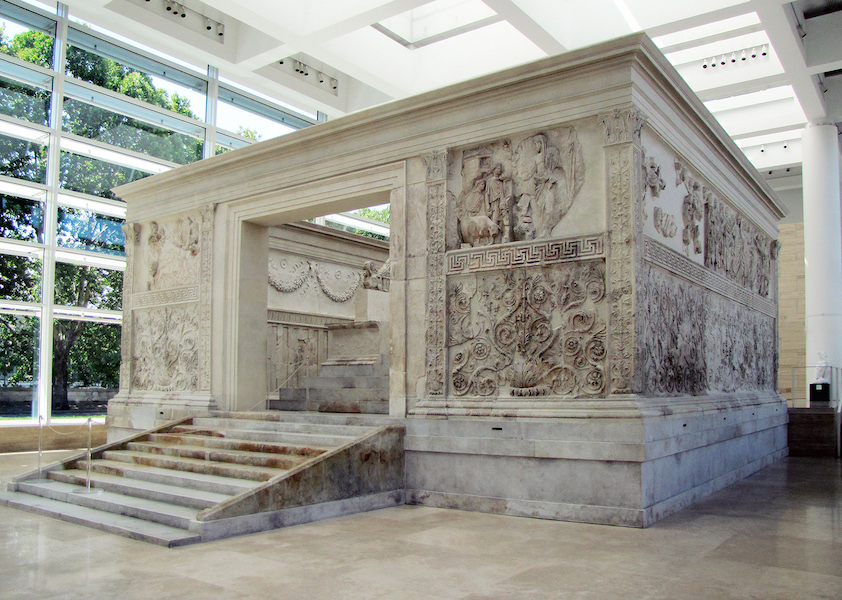
“Ara Pacis” means “altar of peace.” Augustus, the first emperor of Rome, established the Pax Romana: Roman Peace. The event that prompted the building of this altar to peace under Augustus was Augustus’s triumphal return from military campaigns in what is now Spain and France.
When he returned, the Senate vowed to create an altar commemorating the peace that he established in the empire: the Ara Pacis. The monument has been reconstructed from many, many fragments that were discovered, some in the 17th century, mostly in the 20th century.
The Ara Pacis is an altar. However, the visual arts program of relief sculptures focuses on the walls of the precinct around what is in the middle of the altar, where sacrifices would have occurred. The altar itself is interesting and important in relation to Augustus. Augustus is establishing centralized power. Since its earliest founding years, when it was under the rule of kings, Rome had been controlled by the Senate.
The Senate was basically a group of the leading elder citizens of Rome. Rome was a republic, and it really was a republic until Julius Caesar, who was the dictator and Augustus’s uncle. Then Caesar is assassinated, there’s civil war, and then peace is established by Augustus in 31 BCE when Augustus wins the Battle of Actium defeating Mark Antony and Cleopatra.
Augustus, whose real name was Octavian, is given the term “Augustus” as a way of representing his power. Augustus gave great power back to the Senate, but by doing so, he established the real and central authority for himself. He made himself “princeps,” or first among equals. But of course, he controlled everything. He also held the title of the head priest of the state religion, and so he held tremendous power. His uncle, Julius Caesar, had been made a god. And so he also represented himself as the son of a god.
The idea of establishing this altar has a political as well as spiritual significance. Augustus is looking back to the golden age of Greece of the 5th century B.C., but he’s also looking back to the Roman Republic. He is re-establishing some of the ancient rituals of traditional Roman religion. He is embracing traditional Roman values.
Even as Augustus is doing that, he is remaking Rome radically. He is changing Rome from a city of brick to a city of marble, and the Ara Pacis is a spectacular example of that. When looking closely at the Ara Pacis, this speaks to the sense of a golden age that Augustus brought about in the Roman Empire.
The Roman state religion in microcosm
The festivities of the Roman state religion were steeped in tradition and ritual symbolism. Sacred offerings to the gods, consultations with priests and diviners, ritual formulae, communal feasting—were all practices aimed at fostering and maintaining social cohesion and communicating authority. It could perhaps be argued that the Ara Pacis Augustae—the Altar of Augustan Peace—represents in luxurious, stately microcosm the practices of the Roman state religion in a way that is simultaneously elegant and pragmatic.
Vowed on July 4, 13 B.C.E., and dedicated on January 30, 9 B.C.E., the monument stood proudly in the Campus Martius in Rome (a level area between several of Rome’s hills and the Tiber River). It was adjacent to architectural complexes that cultivated and proudly displayed messages about the power, legitimacy, and suitability of their patron—the emperor Augustus. Now excavated, restored, and reassembled in a sleek modern pavilion designed by architect Richard Meier (2006), the Ara Pacis continues to inspire and challenge us as we think about ancient Rome.
Augustus himself discusses the Ara Pacis in his epigraphical memoir, Res Gestae Divi Augusti (“Deeds of the Divine Augustus”) that was promulgated upon his death in 14 C.E. Augustus states “When I returned to Rome from Spain and Gaul, having successfully accomplished deeds in those provinces … the senate voted to consecrate the altar of August Peace in the Campus Martius … on which it ordered the magistrates and priests and Vestal virgins to offer annual sacrifices” (Aug. RG 12).
An open-air altar for sacrifice
The Ara Pacis is, at its simplest, an open-air altar for blood sacrifice associated with the Roman state religion. The ritual slaughtering and offering of animals in Roman religion was routine, and such rites usually took place outdoors. The placement of the Ara Pacis in the Campus Martius (Field of Mars) along the Via Lata (now the Via del Corso) situated it close to other key Augustan monuments, notably the Horologium Augusti (a giant sundial) and the Mausoleum of Augustus.
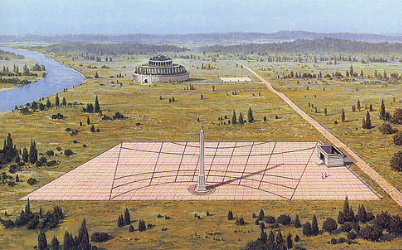
The significance of the topographical placement would have been quite evident to ancient Romans. This complex of Augustan monuments made a clear statement about Augustus’ physical transformation of Rome’s urban landscape. The dedication to a rather abstract notion of peace (pax) is significant in that Augustus advertises the fact that he has restored peace to the Romanstate after a long period of internal and external turmoil.
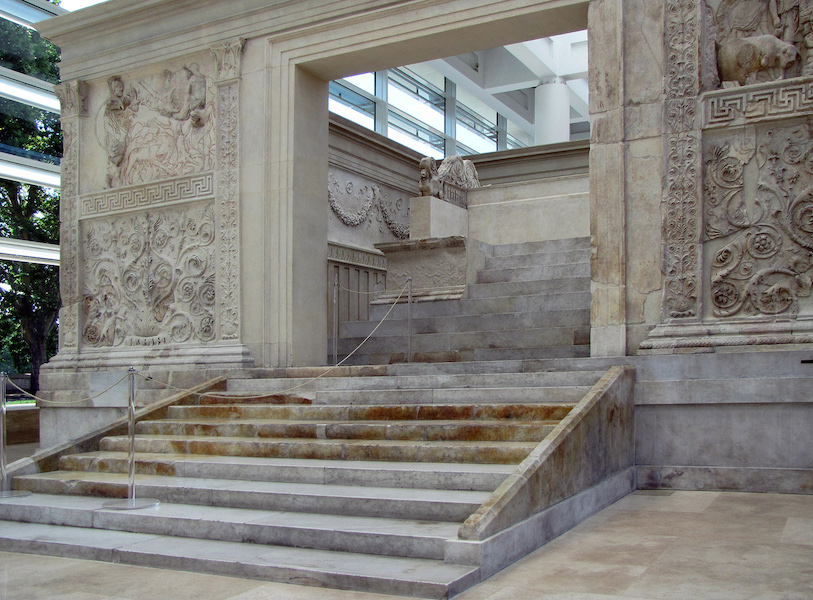
The altar (ara) itself sits within a monumental stone screen that has been elaborated with bas relief (low relief) sculpture, with the panels combining to form a programmatic mytho-historical narrative about Augustus and his administration, as well as about Rome’s deep roots. The altar enclosure is roughly square while the altar itself sits atop a raised podium that is accessible via a narrow stairway.
The Outer screen—processional scenes
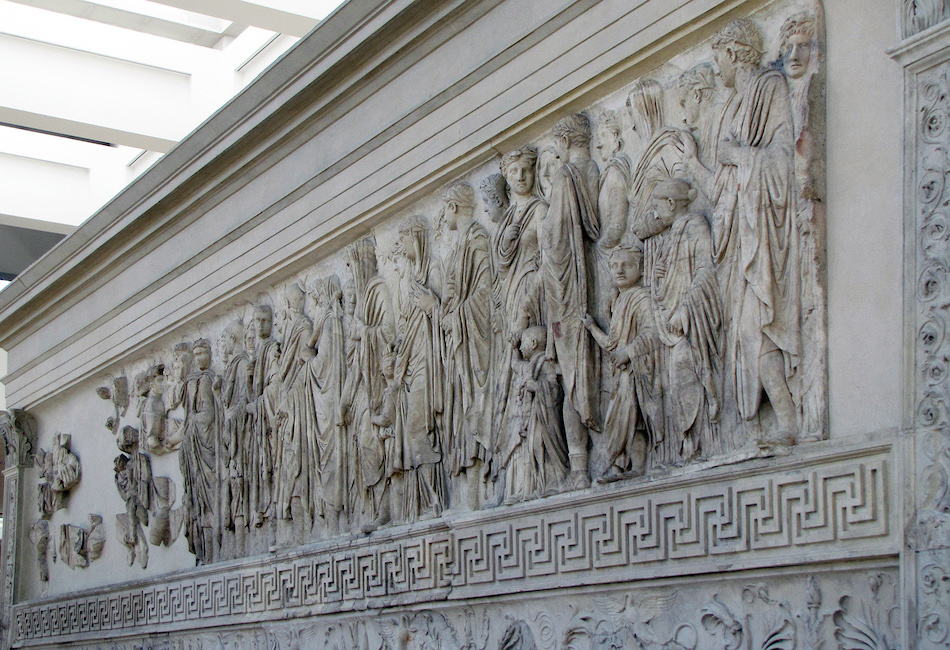
Processional scenes occupy the north and south flanks of the altar screen. The solemn figures, all properly clad for a rite of the state religion, proceed in the direction of the altar itself, ready to participate in the ritual. The figures all advance toward the west. The occasion depicted would seem to be a celebration of the peace (Pax) that Augustus had restored to the Roman empire. In addition four main groups of people are evident in the processions: (1) the lictors (the official bodyguards of magistrates), (2) priests from the major collegia of Rome, (3) members of the Imperial household, including women and children, and (4) attendants. There has been a good deal of scholarly discussion focused on two of three non-Roman children who are depicted.
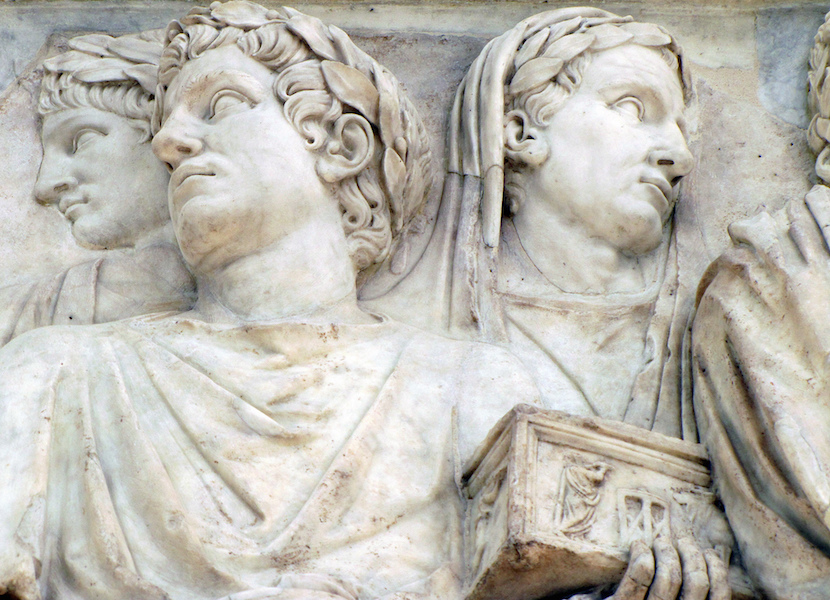
The north processional frieze, made up of priests and members of the Imperial household, is comprised of 46 figures. The priestly colleges (religious associations) represented include the Septemviri epulones (“seven men for sacrificial banquets”—they arranged public feasts connected to sacred holidays), whose members here carry an incense box (image above), and the quindecimviri sacris faciundis (“fifteen men to perform sacred actions”— their main duty was to guard and consult the Sibylline books (oracular texts) at the request of the Senate). Members of the imperial family, including Octavia Minor, follow behind.
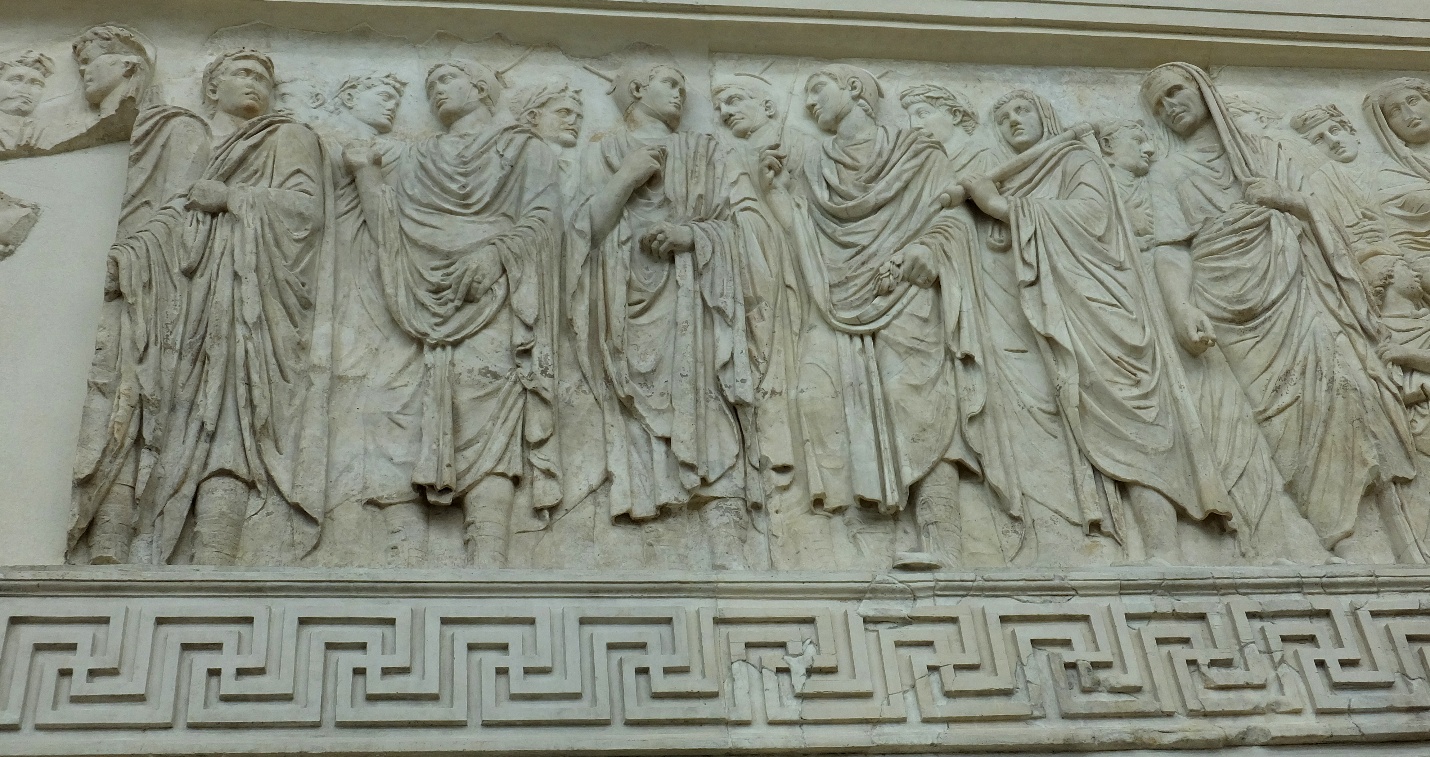
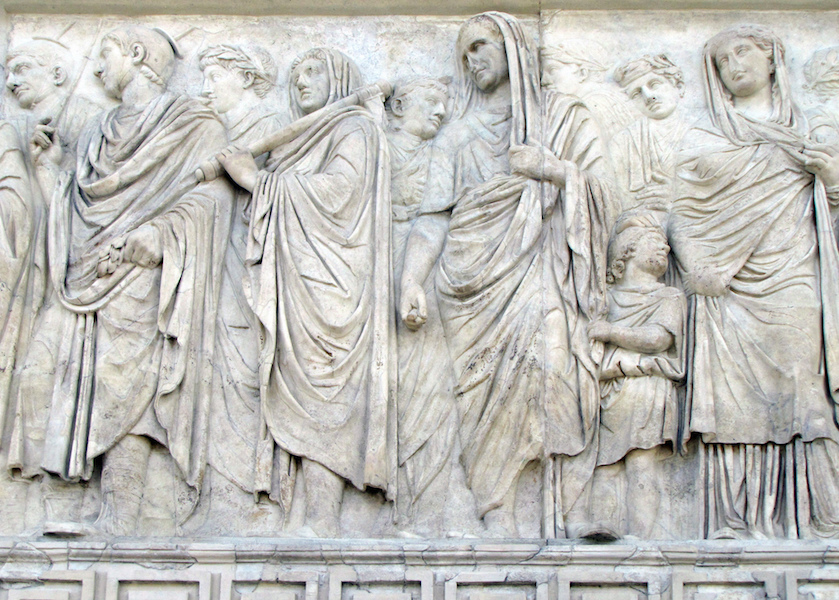
A good deal of modern restoration has been undertaken on the north wall, with many heads heavily restored or replaced. The south wall of the exterior screen depicts Augustus and his immediate family. The identification of the individual figures has been the source of a great deal of scholarly debate. Depicted here are Augustus (damaged, he appears at the far left in the image above) and Marcus Agrippa (friend, son-in-law, and lieutenant to Augustus, he appears, hooded, image below), along with other members of the imperial house. All of those present are dressed in ceremonial garb appropriate for the state sacrifice. The presence of state priests known as flamens (flamines) further indicate the solemnity of the occasion.
A running, vegetal frieze runs parallel to the processional friezes on the lower register. This vegetal frieze emphasizes the fertility and abundance of the lands, a clear benefit of living in a time of peace.
Mythological panels
Accompanying the processional friezes are four mythological panels that adorn the altar screen on its shorter sides. Each of these panels depicts a distinct scene:
- a scene of a bearded male making sacrifice (below)
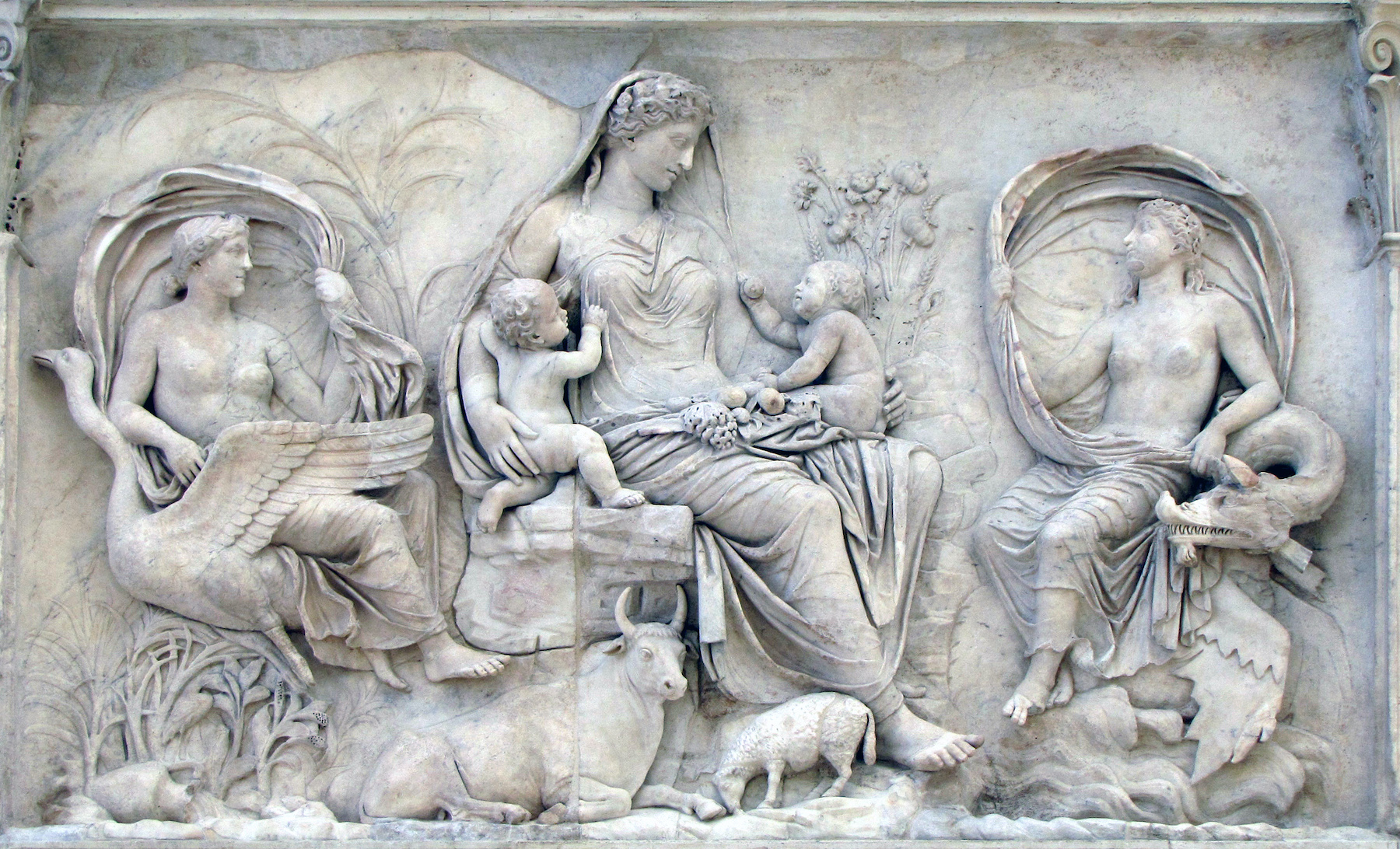
- a scene of seated female goddess amid the fertility of Italy (also below)
- a fragmentary scene with Romulus and Remus in the Lupercal grotto (where these two mythic founders of Rome were suckled by a she-wolf)
- and a fragmentary panel showing Roma (the personification of Rome) as a seated goddess.
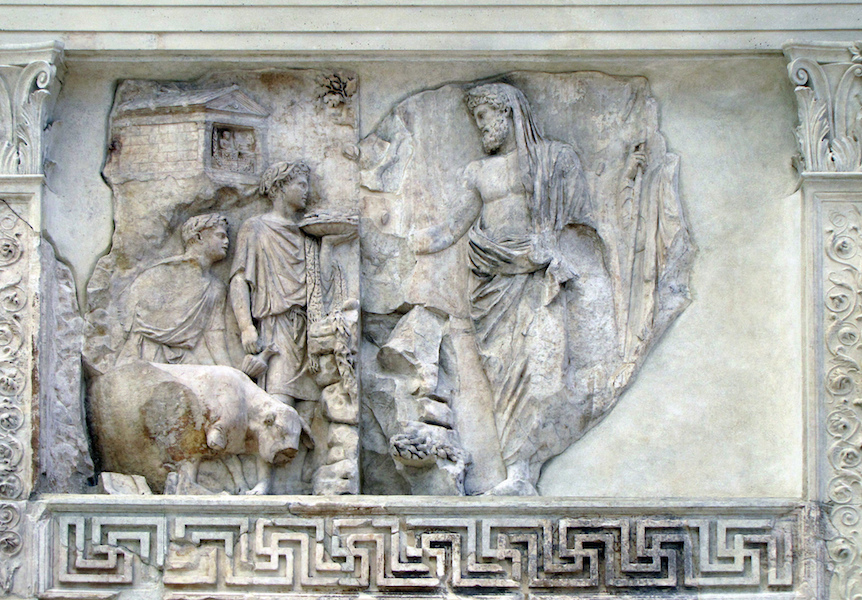
Since the early twentieth century, the mainstream interpretation of the sacrifice panel (above) has been that the scene depicts the Trojan hero Aeneas arriving in Italy and making a sacrifice to Juno. A recent re-interpretation offered by Paul Rehak argues instead that the bearded man is not Aeneas, but Numa Pompilius, Rome’s second king. In Rehak’s theory, Numa, renowned as a peaceful ruler and the founder of Roman religion, provides a counterbalance to the warlike Romulus on the opposite panel.
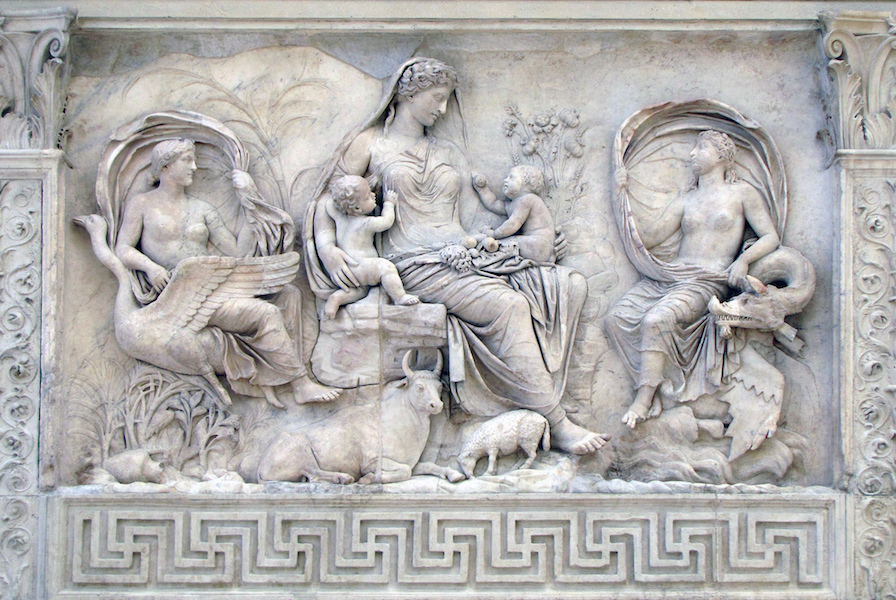
The better preserved panel of the east wall depicts a seated female figure (above) who has been variously interpreted as Tellus (the Earth), Italia (Italy), Pax (Peace), as well as Venus. The panel depicts a scene of human fertility and natural abundance. Two babies sit on the lap of the seated female, tugging at her drapery. Surrounding the central female is the natural abundance of the lands and flanking her are the personifications of the land and sea breezes. In all, whether the goddess is taken as Tellus or Pax, the theme stressed is the harmony and abundance of Italy, a theme central to Augustus’ message of a restored peaceful state for the Roman people—the Pax Romana.
The Altar
The altar itself (below) sits within the sculpted precinct wall. It is framed by sculpted architectural mouldings with crouching gryphons surmounted by volutes flanking the altar. The altar was the functional portion of the monument, the place where blood sacrifice and/or burnt offerings would be presented to the gods.
Implications and interpretation
The implications of the Ara Pacis are far reaching. Originally located along the Via Lata (now Rome’s Via del Corso), the altar is part of a monumental architectural makeover of Rome’s Campus Martius carried out by Augustus and his family. Initially the makeover had a dynastic tone, with the Mausoleum of Augustus near the river. The dedication of the Horologium (sundial) of Augustus and the Ara Pacis, the Augustan makeover served as a potent, visual reminder of Augustus’ success to the people of Rome. The choice to celebrate peace and the attendant prosperity in some ways breaks with the tradition of explicitly triumphal monuments that advertise success in war and victories won on the battlefield. By championing peace—at least in the guise of public monuments—Augustus promoted a powerful and effective campaign of political message making.
Enduring monumentality
The Ara Pacis Augustae continues both to engage us and to incite controversy. As a monument that is the product of a carefully constructed ideological program, it is highly charged with socio-cultural energy that speaks to us about the ordering of the Roman world and its society—the very Roman universe.
Augustus had a strong interest in reshaping the Roman world (with him as its sole leader) but he had to be cautious about how radical those changes seemed to the Roman populace. While he defeated enemies, both foreign and domestic, he was concerned about being perceived as too authoritarian–he did not wish to be labeled as a king (rex) for fear that this would be too much for the Roman people to accept. So, the Augustan scheme involved a declaration that Rome’s republican government had been “restored” by Augustus and he styled himself as the leading citizen of the republic (princeps). These political and ideological motives then influence and guide the creation of his program of monumental art and architecture. These monumental forms, of which the Ara Pacis is a prime example, served to both create and reinforce these Augustan messages.
It is important to remember that the sculptural reliefs were created in the first place to be easily legible so that the viewer could understand the messages of Augustus and his circle without the need to read elaborate texts. Augustus pioneered the use of such ideological messages that relied on clear iconography to get their message across. A great deal was at stake for Augustus and it seems, by virtue of history, that the political choices he made proved prudent. The messages of the Pax Romana, of a restored state, and of Augustus as a leading republican citizen, are all part of an effective and carefully constructed veneer.
Augustus of Primaporta
Nothing was more important to a Roman emperor than his image.
Augustus and the power of images
Today, politicians think very carefully about how they will be photographed. Think about all the campaign commercials and print ads we are bombarded with every election season. These images tell us a lot about the candidate, including what they stand for and what agendas they are promoting. Similarly, Roman art was closely intertwined with politics and propaganda. This is especially true with portraits of Augustus, the first emperor of the Roman Empire; Augustus invoked the power of imagery to communicate his ideology.
Augustus of Primaporta
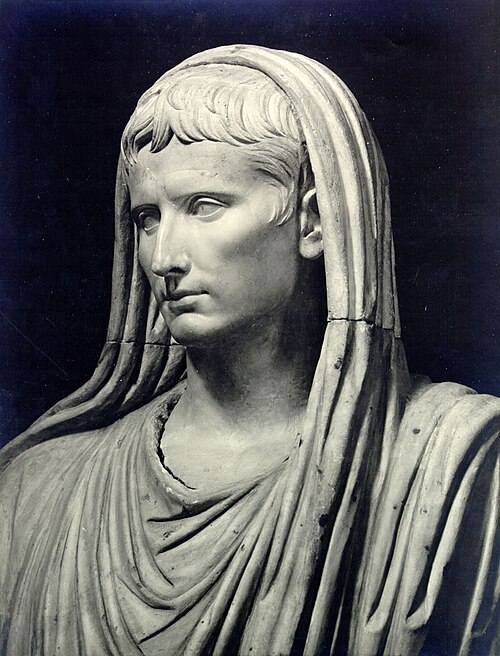
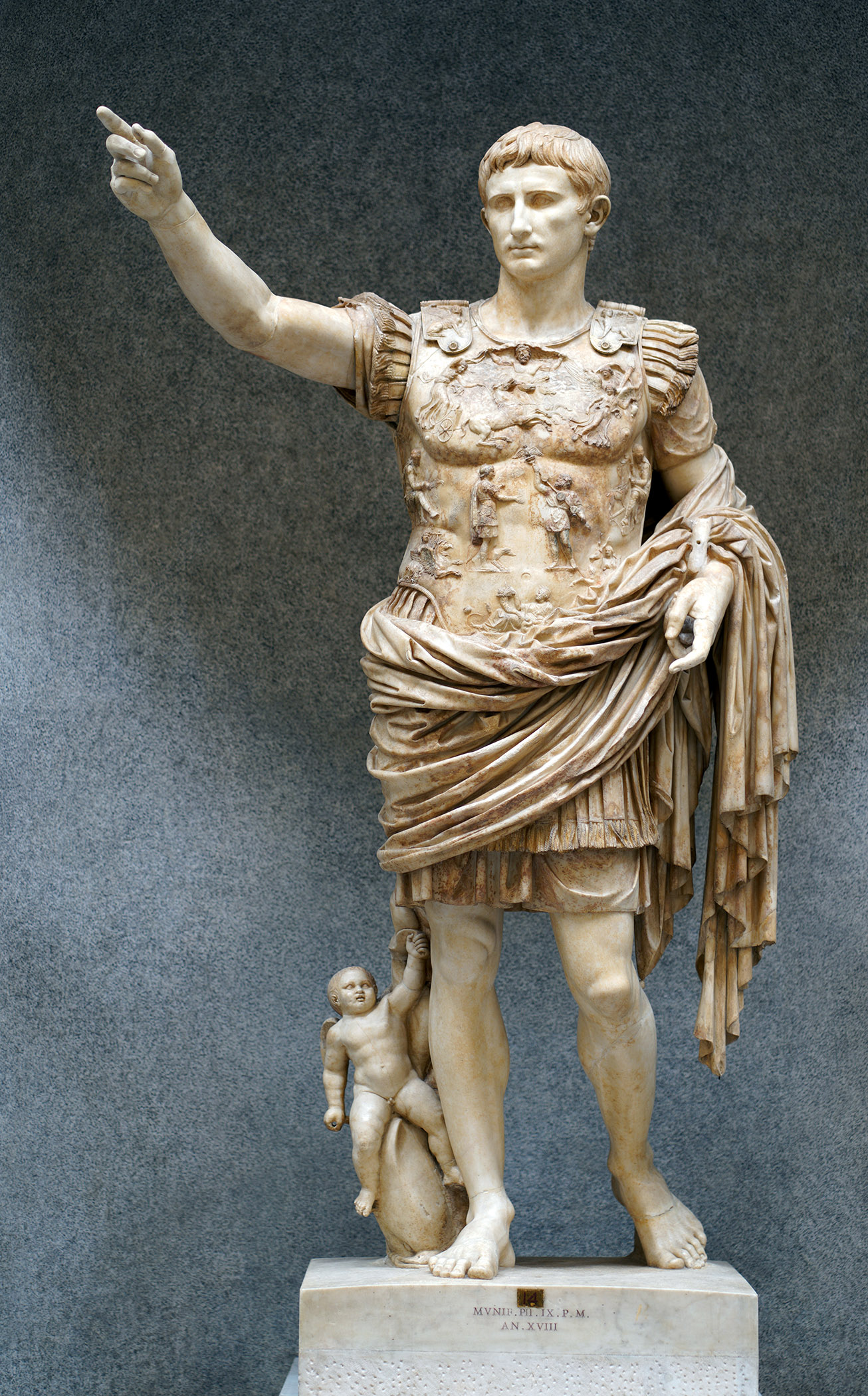
One of Augustus’ most famous portraits is the so-called Augustus of Primaporta of 20 B.C.E. (the sculpture gets its name from the town in Italy where it was found in 1863). At first glance this statue might appear to simply resemble a portrait of Augustus as an orator and general, but this sculpture also communicates a good deal about the emperor’s power and ideology. In fact, in this portrait Augustus shows himself as a great military victor and a staunch supporter of Roman religion. The statue also foretells the 200 year period of peace that Augustus initiated, called the Pax Romana.
Recalling the Golden Age of ancient Greece
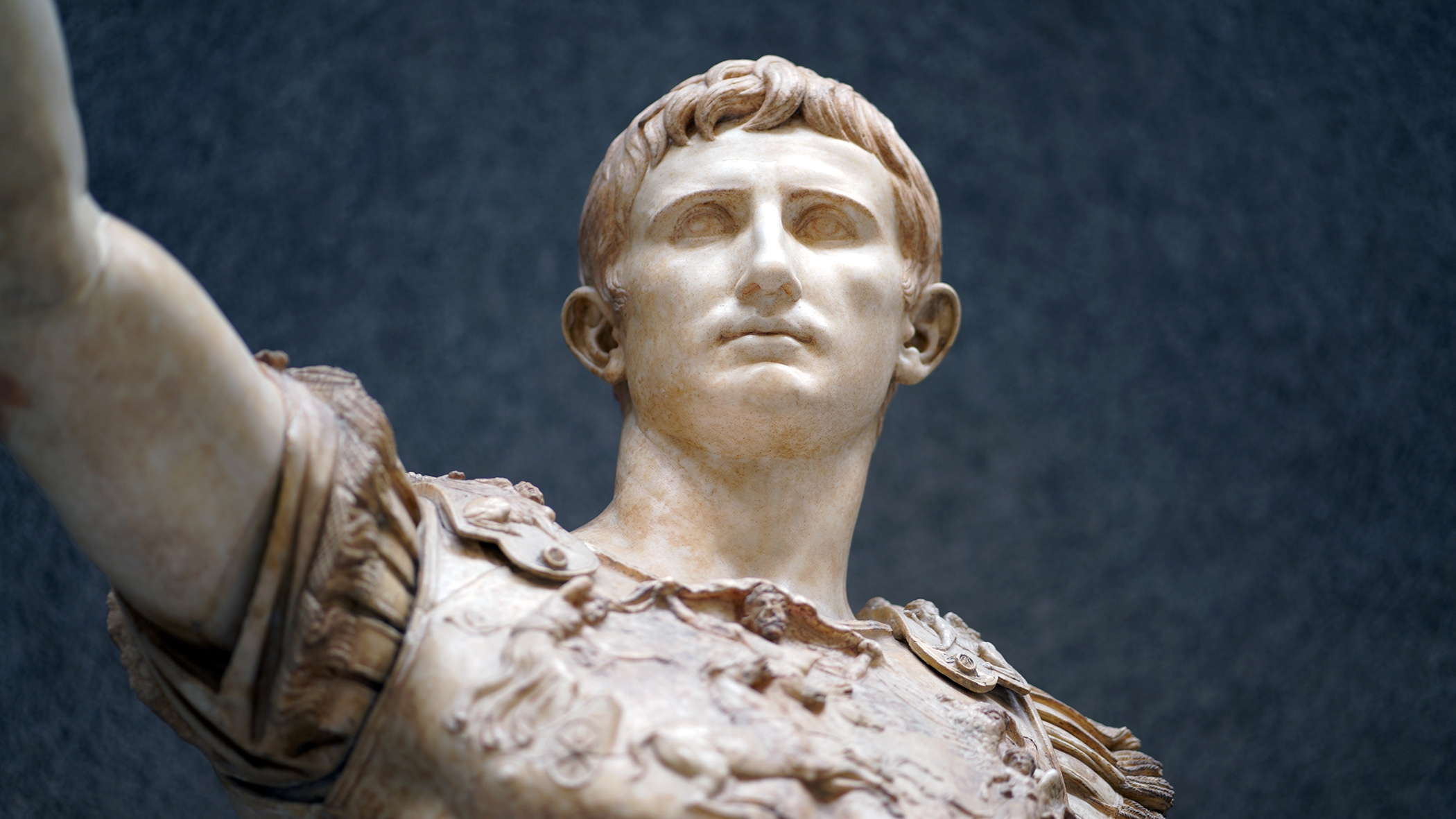
In this marble freestanding sculpture, Augustus stands in a contrapposto pose (a relaxed pose where one leg bears weight). The emperor wears military regalia and his right arm is outstretched, demonstrating that the emperor is addressing his troops. We immediately sense the emperor’s power as the leader of the army and a military conqueror.
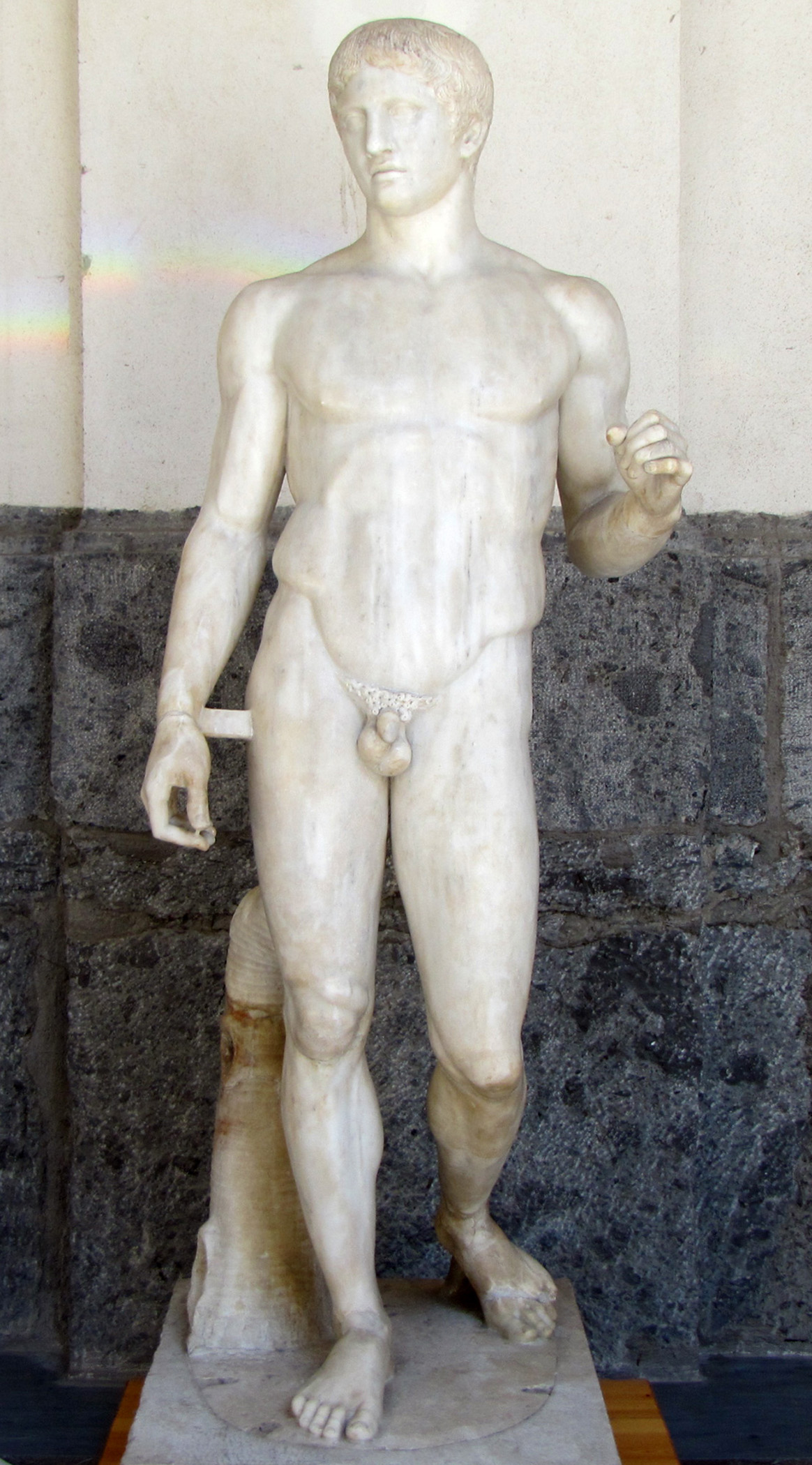
Delving further into the composition of the Primaporta statue, a distinct resemblance to Polykleitos’ Doryphoros, a Classical Greek sculpture of the fifth century B.C.E., is apparent. Both have a similar contrapposto stance and both are idealized. That is to say that both Augustus and the Spear-Bearer are portrayed as youthful and flawless individuals: they are perfect. The Romans often modeled their art on Greek predecessors. This is significant because Augustus is essentially depicting himself with the perfect body of a Greek athlete: he is youthful and virile, despite the fact that he was middle-aged at the time of the sculpture’s commissioning. Furthermore, by modeling the Primaporta statue on such an iconic Greek sculpture created during the height of Athens’ influence and power, Augustus connects himself to the Golden Age of that previous civilization.
The cupid and dolphin
So far the message of the Augustus of Primaporta is clear: he is an excellent orator and military victor with the youthful and perfect body of a Greek athlete. Is that all there is to this sculpture? Definitely not! The sculpture contains even more symbolism. First, at Augustus’ right leg is cupid figure riding a dolphin.
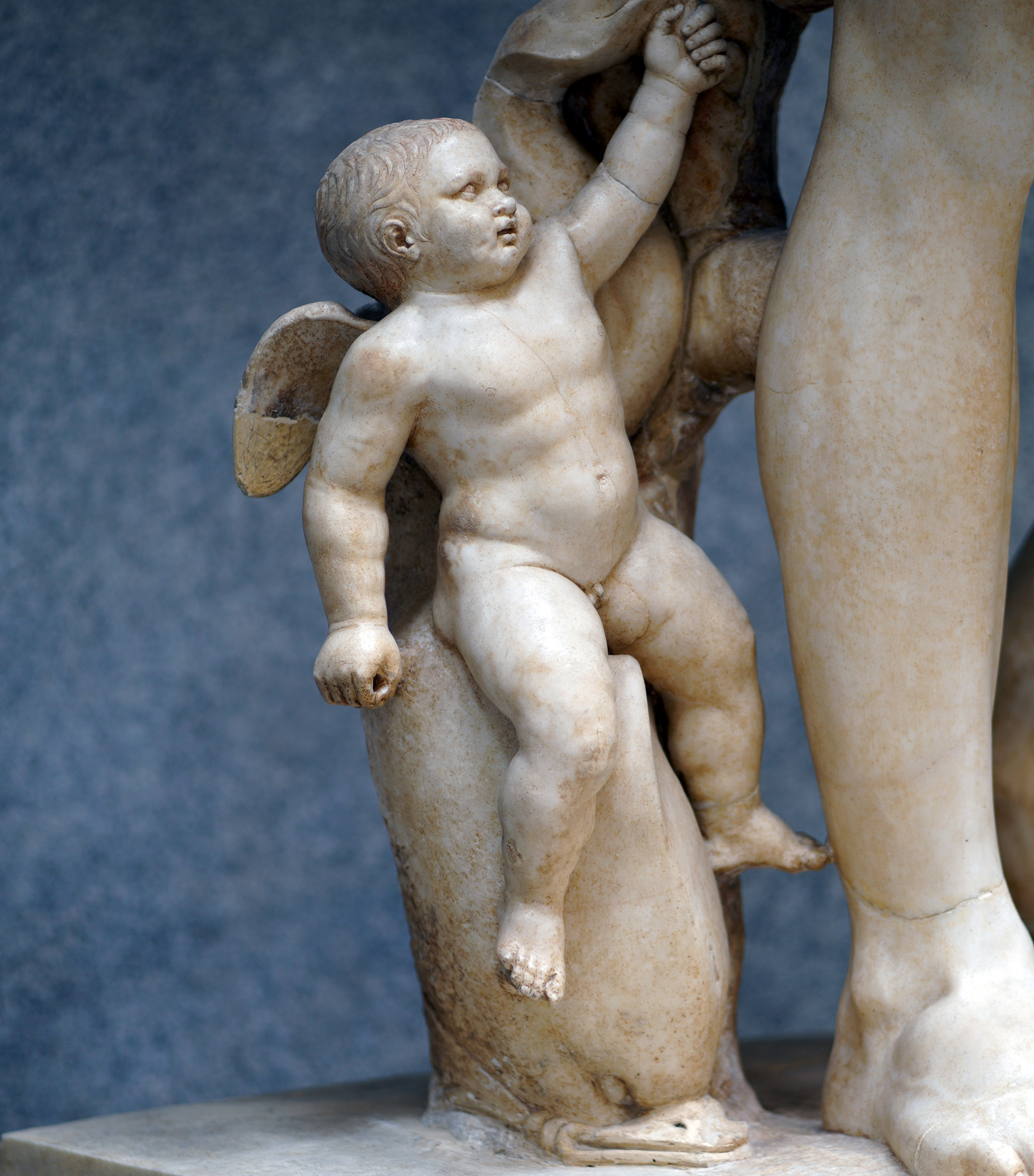
The dolphin became a symbol of Augustus’ great naval victory over Mark Antony and Cleopatra at the Battle of Actium in 31 BCE, a conquest that made Augustus the sole ruler of the Empire. The cupid astride the dolphin sends another message too: that Augustus is descended from the gods. Cupid is the son of Venus, the Roman goddess of love. Julius Caesar, the adoptive father of Augustus, claimed to be descended from Venus and therefore Augustus also shared this connection to the gods.
The breastplate
Finally, Augustus is wearing a cuirass, or breastplate, that is covered with figures that communicate additional propagandistic messages. Scholars debate over the identification over each of these figures, but the basic meaning is clear: Augustus has the gods on his side, he is an international military victor, and he is the bringer of the Pax Romana, a peace that encompasses all the lands of the Roman Empire.
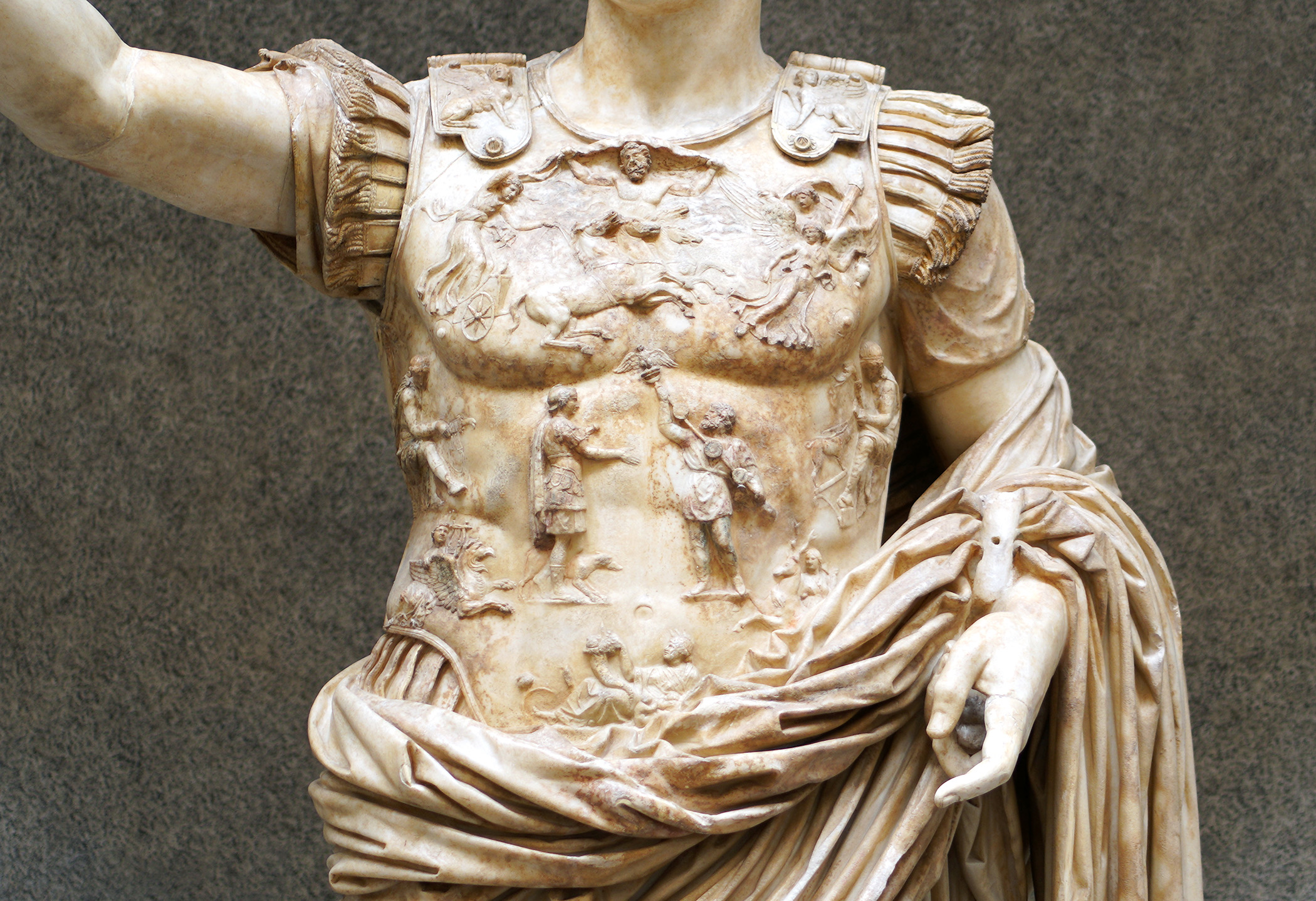
In the central zone of the cuirass are two figures, a Roman and a Parthian. On the right, the enemy Parthian returns military standards. This is a direct reference to an international diplomatic victory of Augustus in 20 B.C.E., when these standards were finally returned to Rome after a previous battle.
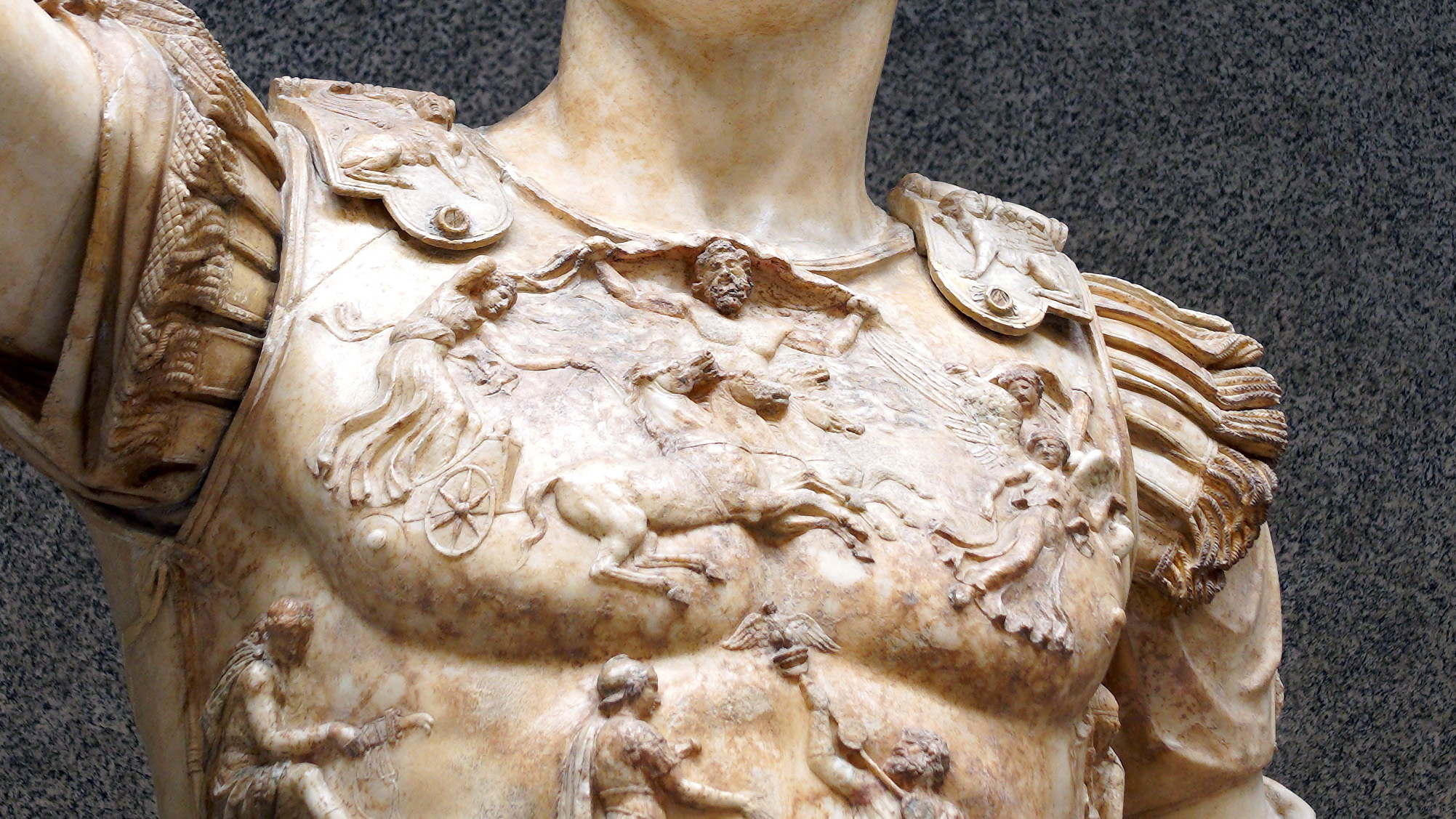
Surrounding this central zone are gods and personifications. At the top are Sol and Caelus, the sun and sky gods respectively. On the sides of the breastplate are female personifications of countries conquered by Augustus. These gods and personifications refer to the Pax Romana. The message is that the sun is going to shine on all regions of the Roman Empire, bringing peace and prosperity to all citizens. And of course, Augustus is the one who is responsible for this abundance throughout the Empire.
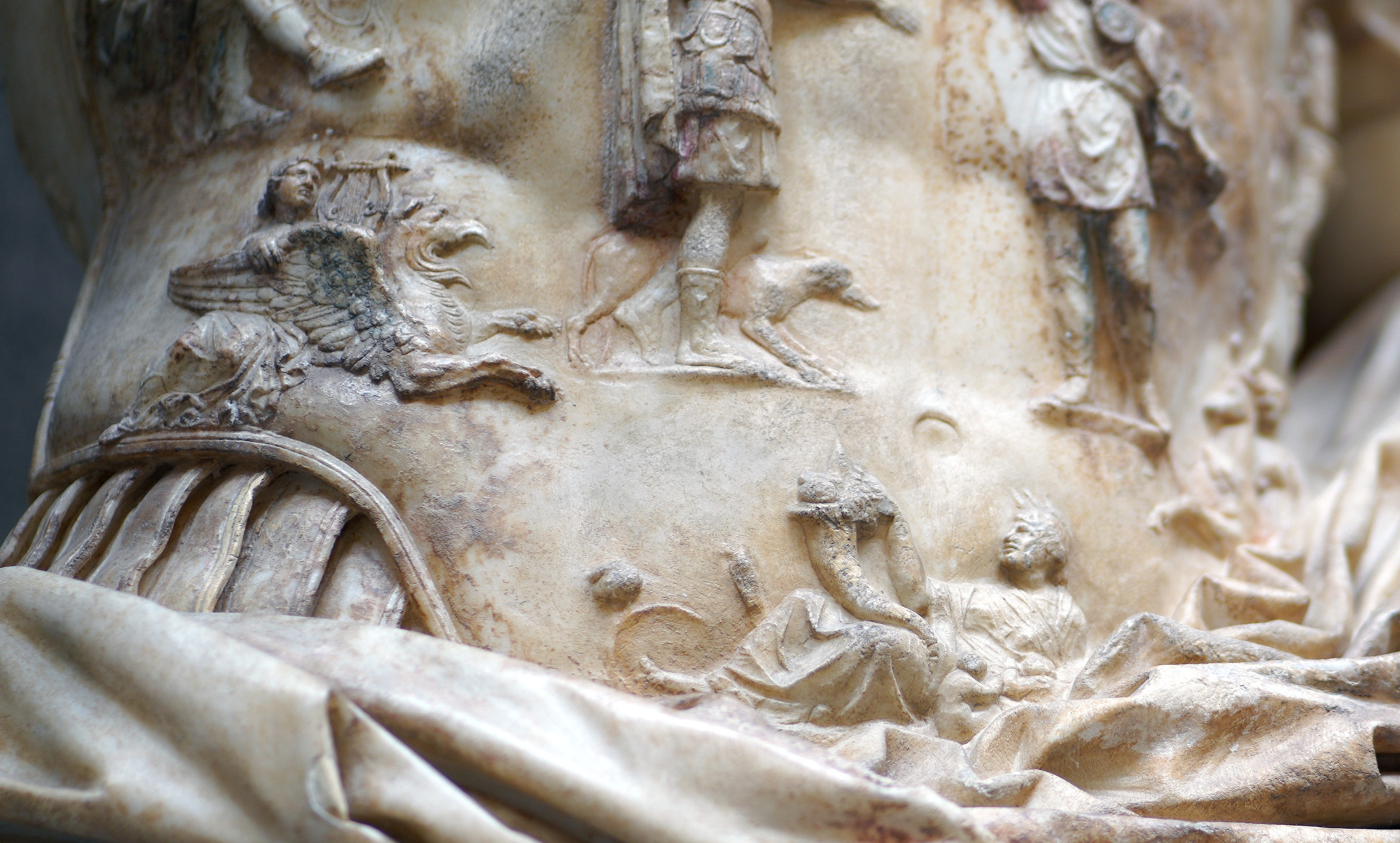
Beneath the female personifications are Apollo and Diana, two major deities in the Roman pantheon; clearly Augustus is favored by these important deities and their appearance here demonstrates that the emperor supports traditional Roman religion. At the very bottom of the cuirass is Tellus, the earth goddess, who cradles two babies and holds a cornucopia. Tellus is an additional allusion to the Pax Romana as she is a symbol of fertility with her healthy babies and overflowing horn of plenty.
Not simply a portrait
The Augustus of Primaporta is one of the ways that the ancients used art for propagandistic purposes. Overall, this statue is not simply a portrait of the emperor, it expresses Augustus’ connection to the past, his role as a military victor, his connection to the gods, and his role as the bringer of the Roman Peace.
Art in Imperial Rome
Augustus’s rise to power in Rome signaled the end of the Roman Republic and the formation of Imperial rule. Roman art was now put to the service of aggrandizing the ruler and his family. It was also meant to indicate shifts in leadership. The major periods in Imperial Roman art are named after individual rulers or major dynasties, they are:
Augustan (27 B.C.E.–14 C.E.)
Julio-Claudian (14–68 C.E.)
Flavian (69–98 C.E.)
Trajanic (98–117 C.E.)
Hadrianic (117–38 C.E.)
Antonine (138–93 C.E.)
Severan (193–235 C.E.)
Soldier Emperor (235–84 C.E.)
Tetrarchic (284–312 C.E.)
Constantinian (307–37 C.E.)
Imperial art often hearkened back to the Classical art of the past. “Classical”, or “Classicizing,” when used in reference to Roman art refers broadly to the influences of Greek art from the Classical and Hellenistic periods (480–31 B.C.E.). Classicizing elements include the smooth lines, elegant drapery, idealized nude bodies, highly naturalistic forms and balanced proportions that the Greeks had perfected over centuries of practice.
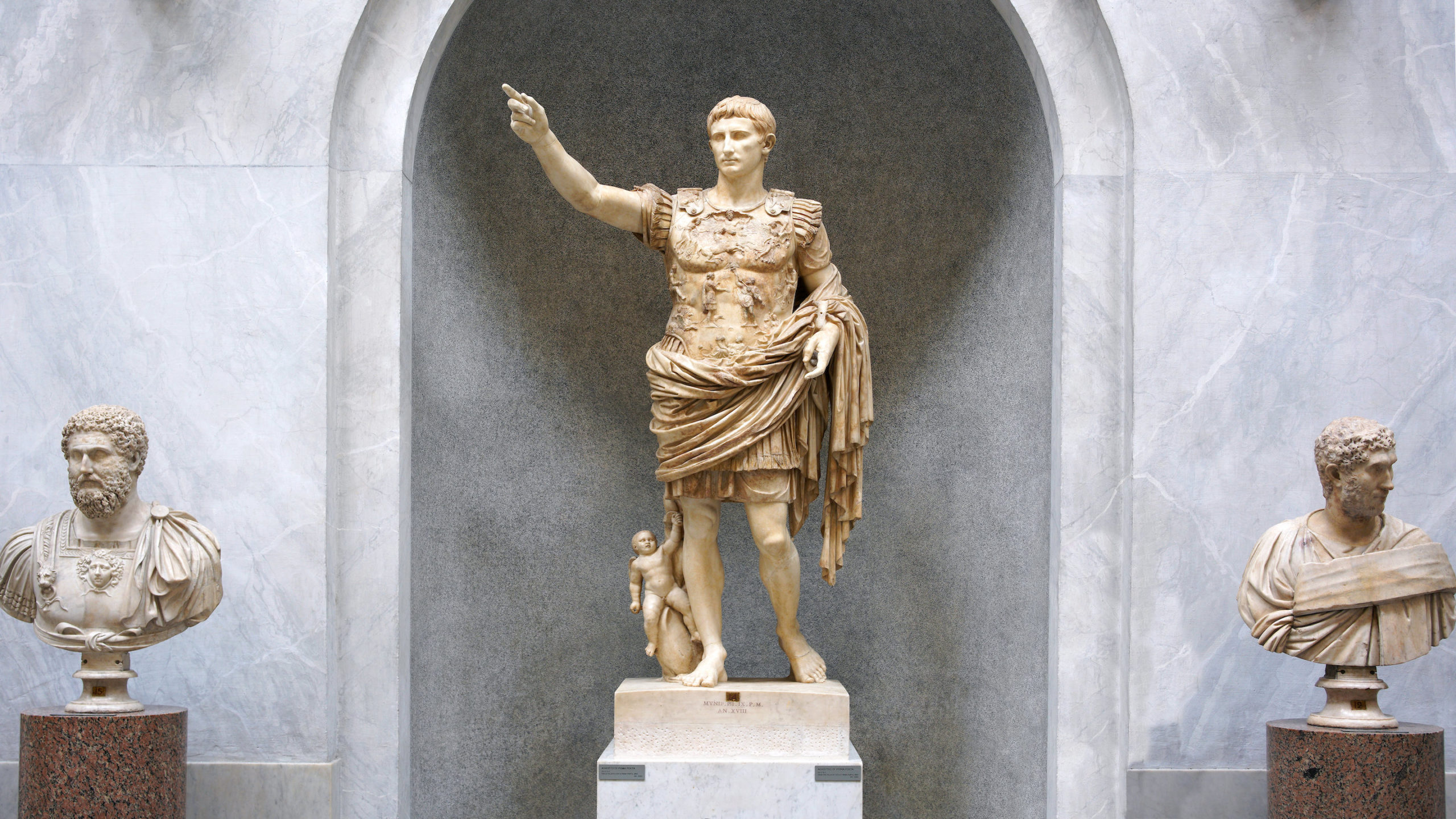
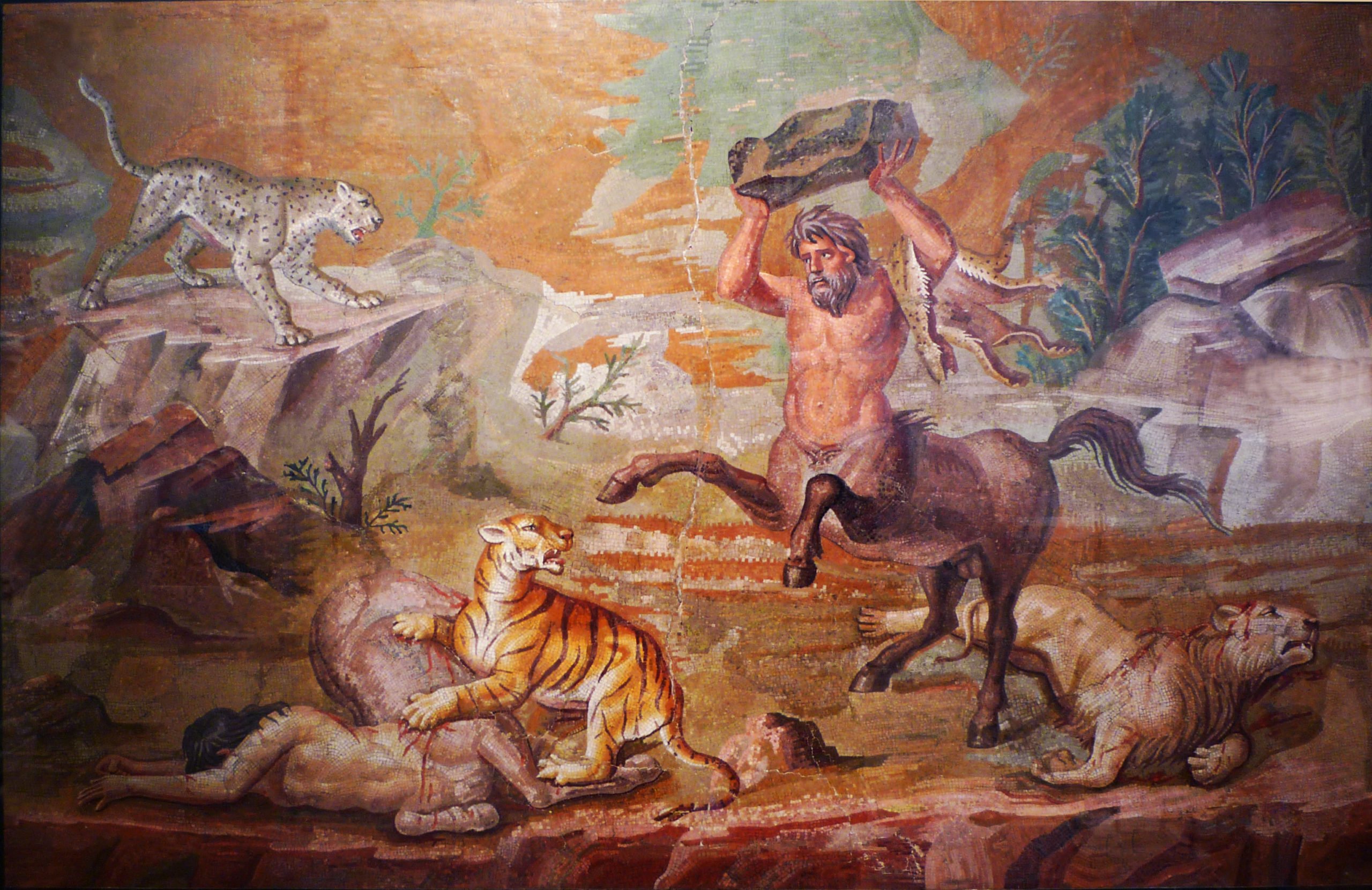
Augustus and the Julio-Claudian dynasty were particularly fond of adapting Classical elements into their art. The Augustus of Primaporta was made at the end of Augustus’s life, yet he is represented as youthful, idealized and strikingly handsome like a young athlete—all hallmarks of Classical art. The emperor Hadrian was known as a philhellene, or lover of all things Greek. The emperor himself began sporting a Greek “philosopher’s beard” in his official portraiture, unheard of before this time. Décor at his rambling Villa at Tivoli included mosaic copies of famous Greek paintings, such as Battle of the Centaurs and Wild Beasts by the legendary ancient Greek painter Zeuxis.
Who made Roman art?
We don’t know much about who made Roman art. Artists certainly existed in antiquity but we know very little about them, especially during the Roman period, because of a lack of documentary evidence such as contracts or letters. What evidence we do have, such as Pliny the Elder’s Natural History, pays little attention to contemporary artists and often focuses more on the Greek artists of the past. As a result, scholars do not refer to specific artists but consider them generally, as a largely anonymous group.
What did they make?
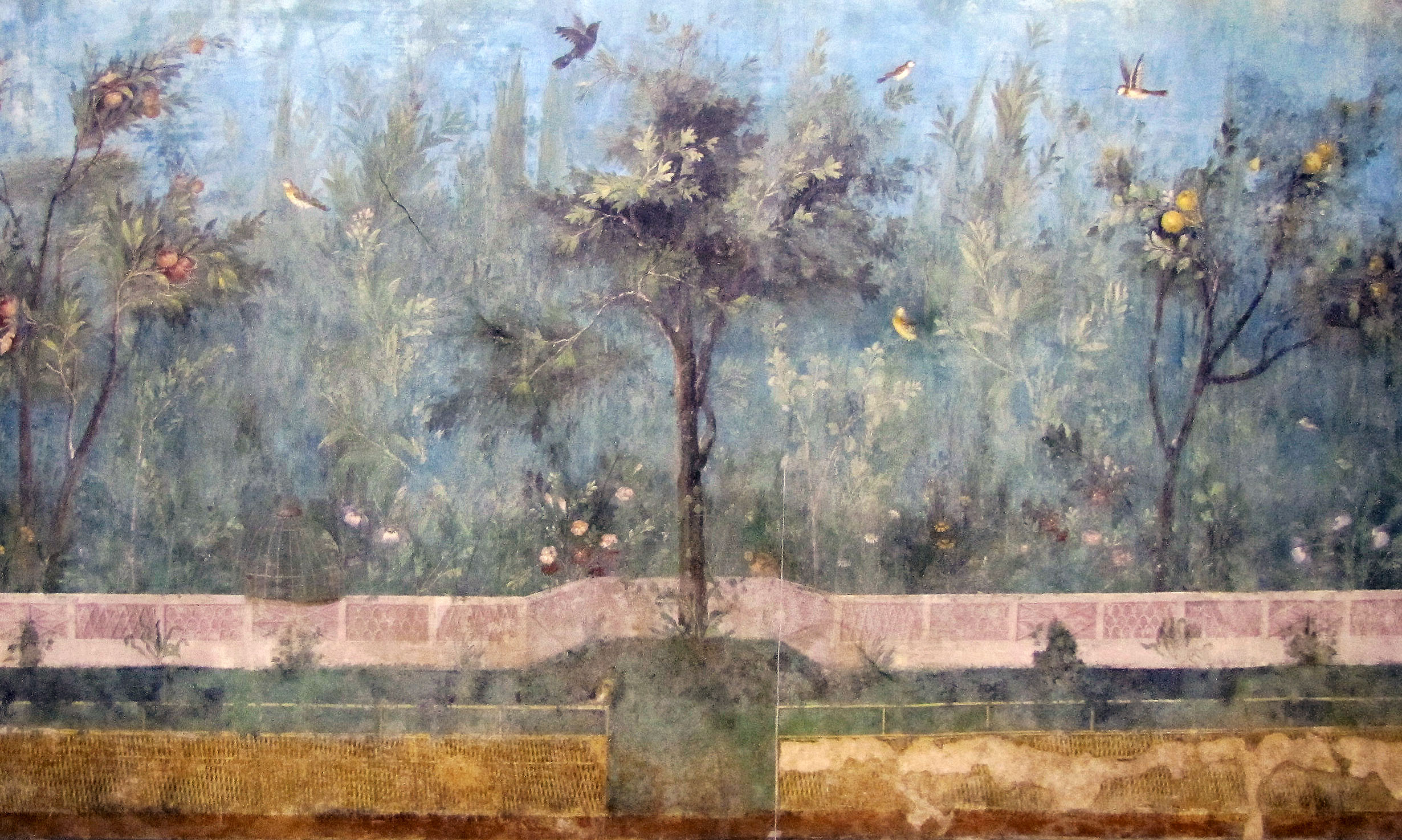
Roman art encompasses private art made for Roman homes as well as art in the public sphere. The elite Roman home provided an opportunity for the owner to display his wealth, taste and education to his visitors, dependents, and clients. Since Roman homes were regularly visited and were meant to be viewed, their decoration was of the utmost importance. Wall paintings, mosaics, and sculptural displays were all incorporated seamlessly with small luxury items such as bronze figurines and silver bowls. The subject matter ranged from busts of important ancestors to mythological and historical scenes, still lifes, and landscapes—all to create the idea of an erudite patron steeped in culture.
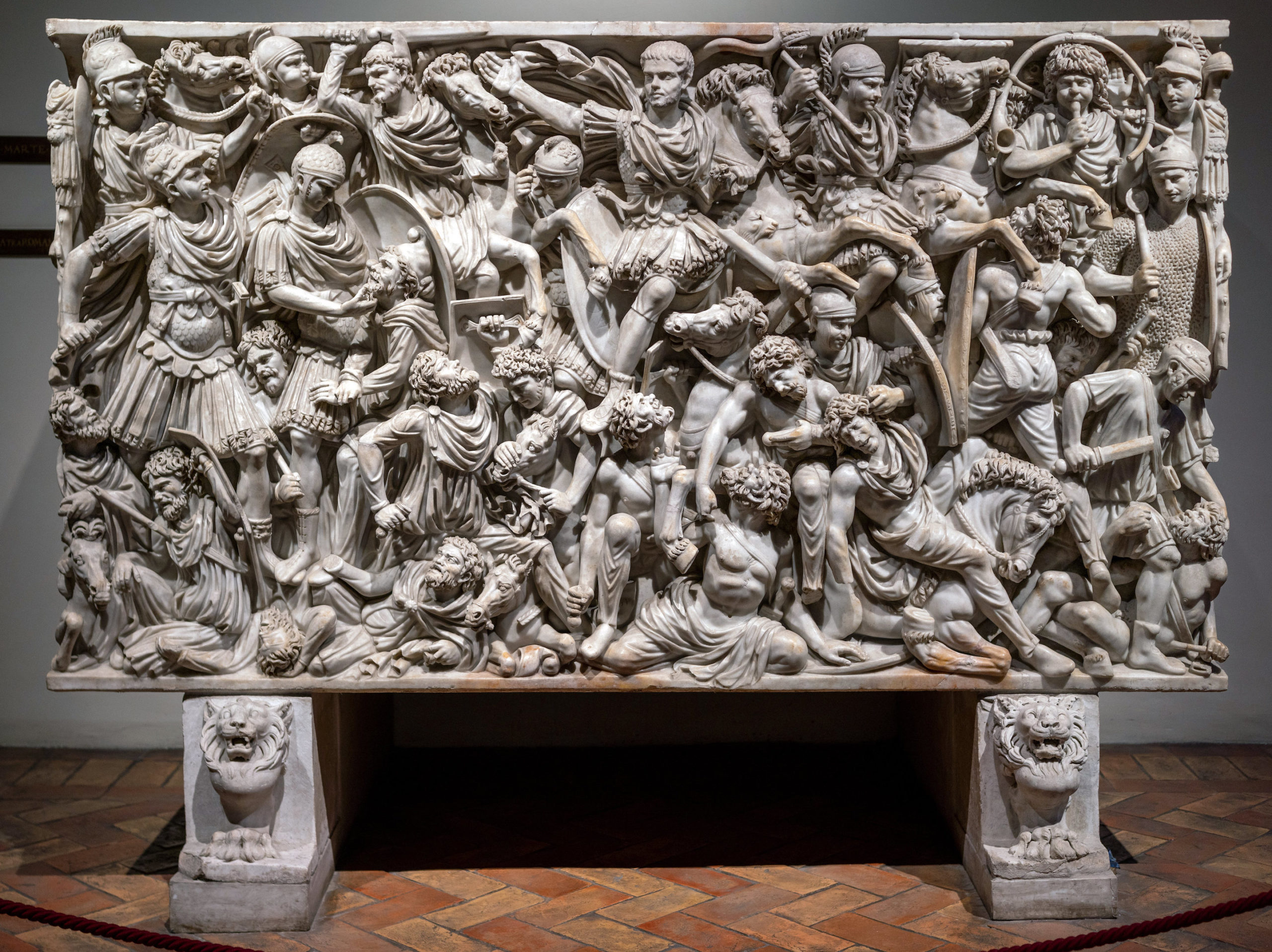
When Romans died, they left behind imagery that identified them as individuals. Funerary imagery often emphasized unique physical traits or trade, partners or favored deities. Roman funerary art spans several media and all periods and regions. It included portrait busts, wall reliefs set into working-class group tombs (like those at Ostia), and elite decorated tombs (like the Via delle Tombe at Pompeii). In addition, there were painted Faiyum portraits placed on mummies and sarcophagi. Because death touched all levels of society—men and women, emperors, elites, and freedmen—funerary art recorded the diverse experiences of the various peoples who lived in the Roman empire.
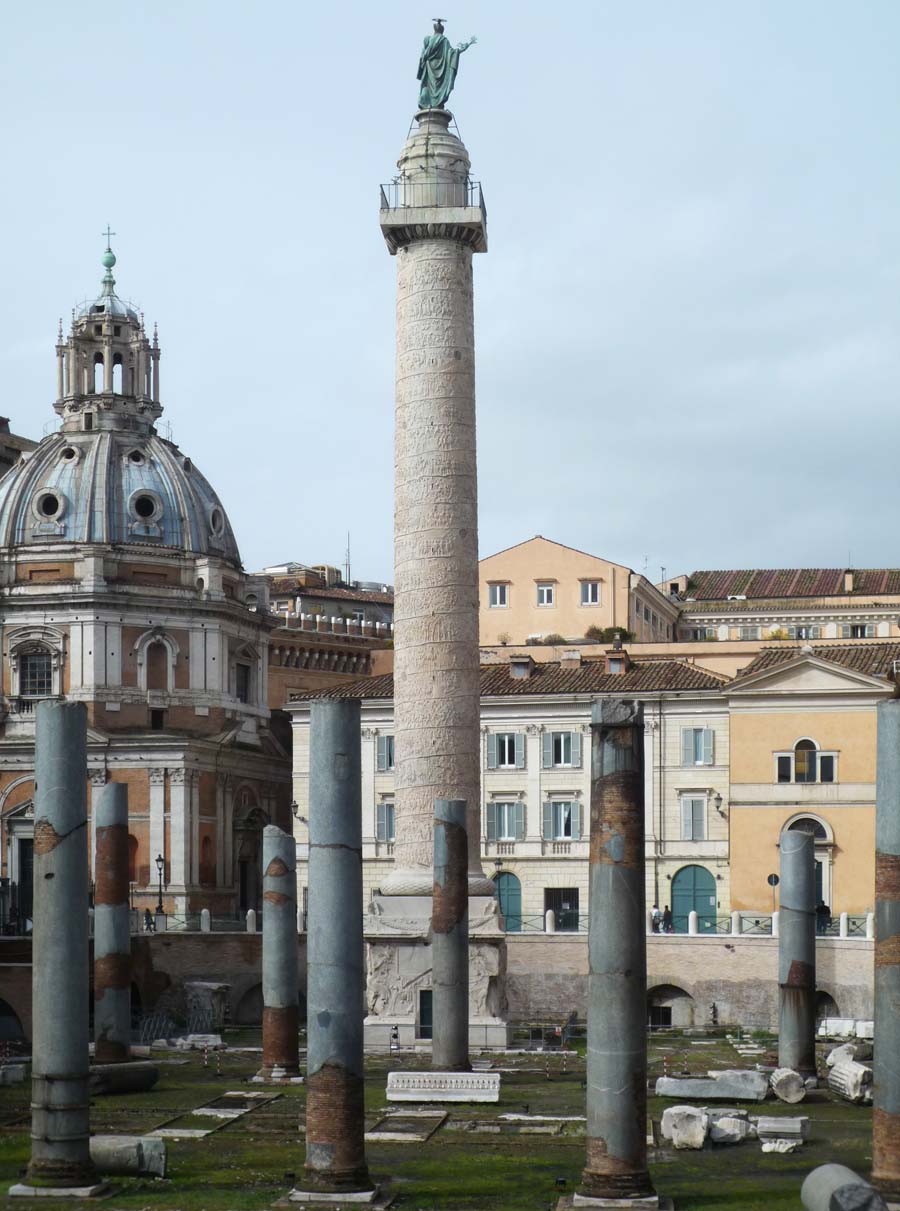
The public sphere is filled with works commissioned by the emperors such as portraits of the imperial family or bath houses decorated with copies of important Classical statues. There are also commemorative works like the triumphal arches and columns that served a didactic as well as a celebratory function. The arches and columns (like the Arch of Titus or the Column of Trajan), marked victories, depicted war, and described military life. They also revealed foreign lands and enemies of the state. They could also depict an emperor’s successes in domestic and foreign policy rather than in war, such as Trajan’s Arch in Benevento. Religious art is also included in this category, such as the cult statues placed in Roman temples that stood in for the deities they represented, like Venus or Jupiter. Gods and religions from other parts of the empire also made their way to Rome’s capital including the Egyptian goddess Isis, the Persian god Mithras, and ultimately Christianity. Each of these religions brought its own unique sets of imagery to inform proper worship and instruct their sect’s followers.
It can be difficult to pinpoint just what is Roman about Roman art, but it is the ability to adapt, to take in and to uniquely combine influences over centuries of practice that made Roman art distinct.
Roman Architecture in the Imperial period
The Emperor Nero began building his infamous Domus Aurea, or Golden House, after a great fire swept through Rome in 64 C.E. and destroyed much of the downtown area. The destruction allowed Nero to take over valuable real estate for his own building project; a vast new villa. Although the choice was not in the public interest, Nero’s desire to live in grand fashion did spur the architectural revolution in Rome. The architects, Severus and Celer, are known (thanks to the Roman historian Tacitus), and they built a grand palace, complete with courtyards, dining rooms, colonnades, and fountains. They also used concrete extensively, including barrel vaults and domes throughout the complex. What makes the Golden House unique in Roman architecture is that Severus and Celer were using concrete in new and exciting ways; rather than utilizing the material for just its structural purposes, the architects began to experiment with concrete in aesthetic modes, for instance, to make expansive domed spaces.
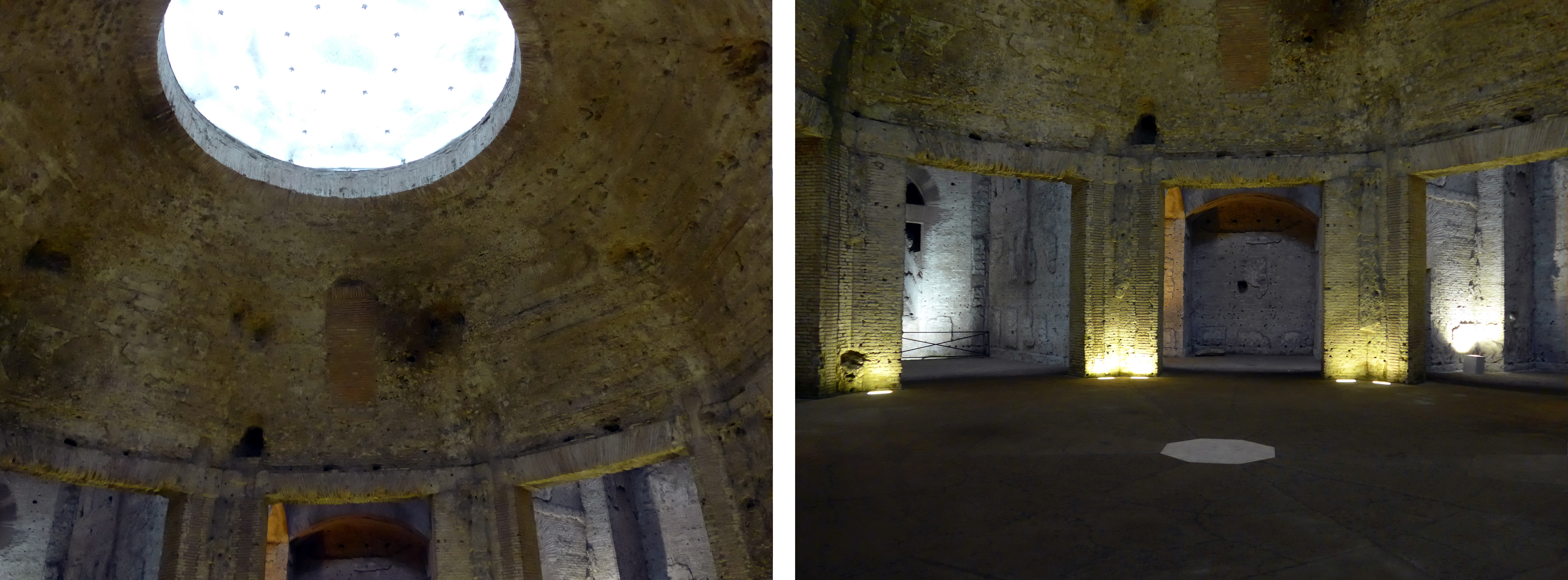
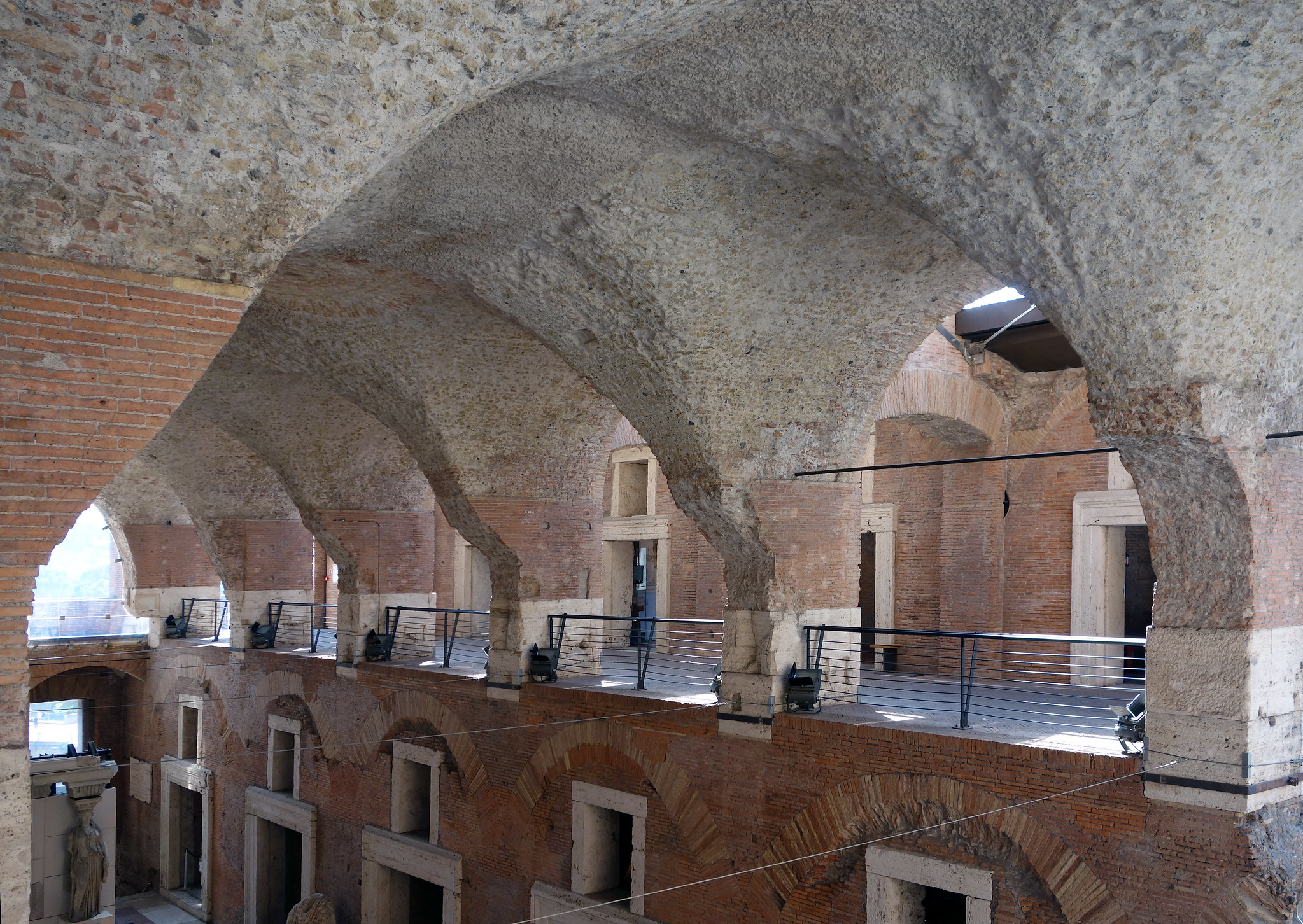
Nero may have started a new trend for bigger and better concrete architecture, but Roman architects, and the emperors who supported them, took that trend and pushed it to its greatest potential. Vespasian’s Colosseum, the Markets of Trajan, the Baths of Caracalla, and the Basilica of Maxentius are just a few of the most impressive structures to come out of the architectural revolution in Rome. Roman architecture was not entirely comprised of concrete, however. Some buildings, which were made from marble, hearkened back to the sober, Classical beauty of Greek architecture, like the Forum of Trajan. Concrete structures and marble buildings stood side by side in Rome, demonstrating that the Romans appreciated the architectural history of the Mediterranean just as much as they did their own innovation. Ultimately, Roman architecture is overwhelmingly a success story of experimentation and the desire to achieve something new.
Early Empire: The Colosseum
Early Empire: Column of Trajan
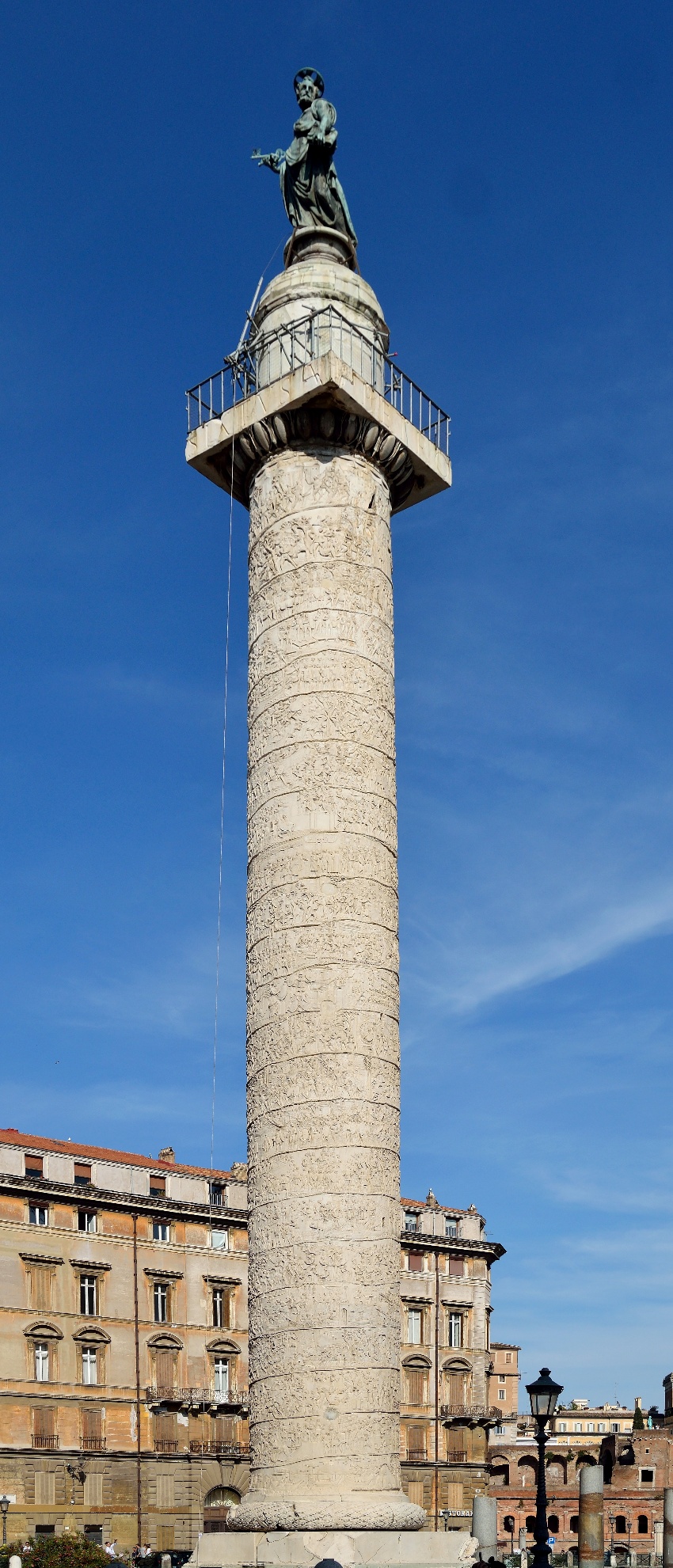
Trajan expanded the Roman Empire to its greatest extent, celebrating his victories with this monumental column.
The Triumph
The Triumph was a riotous military ritual celebrated by the Romans over the course of centuries—whenever their commander had won a spectacular victory. On the appointed day (or days) the city would be overflowing with crowds, pageantry, spoils, prisoners, depictions and souvenirs of foreign lands—but then, just as quickly as it began, the glorious tumult was over. The spectacles and the echoes of glory entrusted to the memory of those who had witnessed the event. Was the parade and its giant city-wide party enough to commemorate the glorious deeds of Rome’s armies? Or should a more permanent form of commemoration be adopted? Being pragmatists, the Romans enlisted both means of commemoration—the ephemeral and the permanent. The Column of Trajan (dedicated in May of 113 C.E.) might be the crowning example of the inborn need to commemorate—in more permanent form—historical deeds that dominates the psyche of Roman art and artists.
Returning from Dacia triumphant—100 days of celebrations
The emperor Trajan, who reigned from 98–117 C.E., fought a series of campaigns known as the Dacian Wars. Dacia (modern Romania), was seen as a troublesome neighbor by the Romans and the Dacians were seen to pose a threat to the province of Moesia, along the Danube frontier. In addition Dacia was rich in natural resources (including gold), that were attractive to the Romans. The first campaign saw Trajan defeat the Dacian leader Decebalus in 101 C.E., after which the Dacians sought terms from the Romans. Renewed Dacian hostilities brought about the second Dacian War that concluded in 106 C.E. Trajan’s victory was a substantial one—he declared over 100 days of official celebrations and the Romans exploited Dacia’s natural wealth, while incorporating Dacia as an imperial province.
After the first Dacian war Trajan earned the honorary epithet “Dacicus Maximus” (greatest Dacian) and a victory monument known as the Tropaeum Traiani (Trophy of Trajan) was built at Civitas Tropaensium (modern Adamclisi, Romania). Coins issued during Trajan’s reign depicted the defeated Dacia.
Iconography and themes
The iconographic scheme of the column illustrates Trajan’s wars in Dacia. The lower half of the column corresponds to the first Dacian War (c. 101–102 C.E.), while the top half depicts the second Dacian War (c. 105–106 C.E.). The first narrative event shows Roman soldiers marching off to Dacia, while the final sequence of events portrays the suicide of the enemy leader, Decebalus, and the mopping up of Dacian prisoners by the Romans.
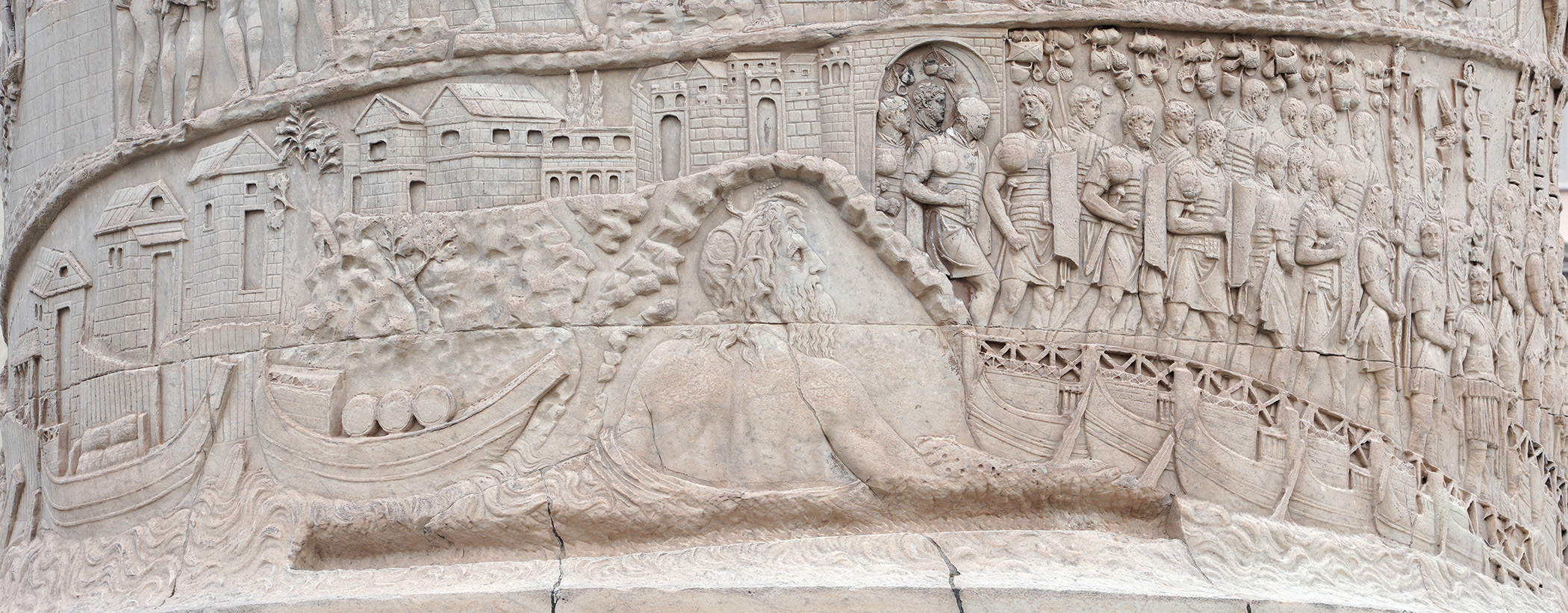
The execution of the frieze is meticulous and the level of detail achieved is astonishing. While the column does not carry applied paint now, many scholars believe the frieze was initially painted. The sculptors took great care to provide settings for the scenes, including natural backgrounds, and mixed perspectival views to offer the maximum level of detail. Sometimes multiple perspectives are evident within a single scene. The overall, unifying theme is that of the Roman military campaigns in Dacia, but the details reveal additional, more subtle narrative threads.
One of the clear themes is the triumph of civilization (represented by the Romans) over its antithesis, the barbarian state (represented here by the Dacians). The Romans are orderly and uniform, the Dacians less so. The Romans are clean shaven, the Dacians are shaggy. The Romans avoid leggings, the Dacians wear leggings (like all good barbarians did—at least those depicted by the Romans).

Combat scenes are frequent in the frieze. The detailed rendering provides a nearly unparalleled visual resource for studying the iconography of the Roman military, as well as for studying the actual equipment, weapons, and tactics. There is clear ethnic typing as well, as the Roman soldiers cannot be confused for Dacian soldiers, and vice versa.
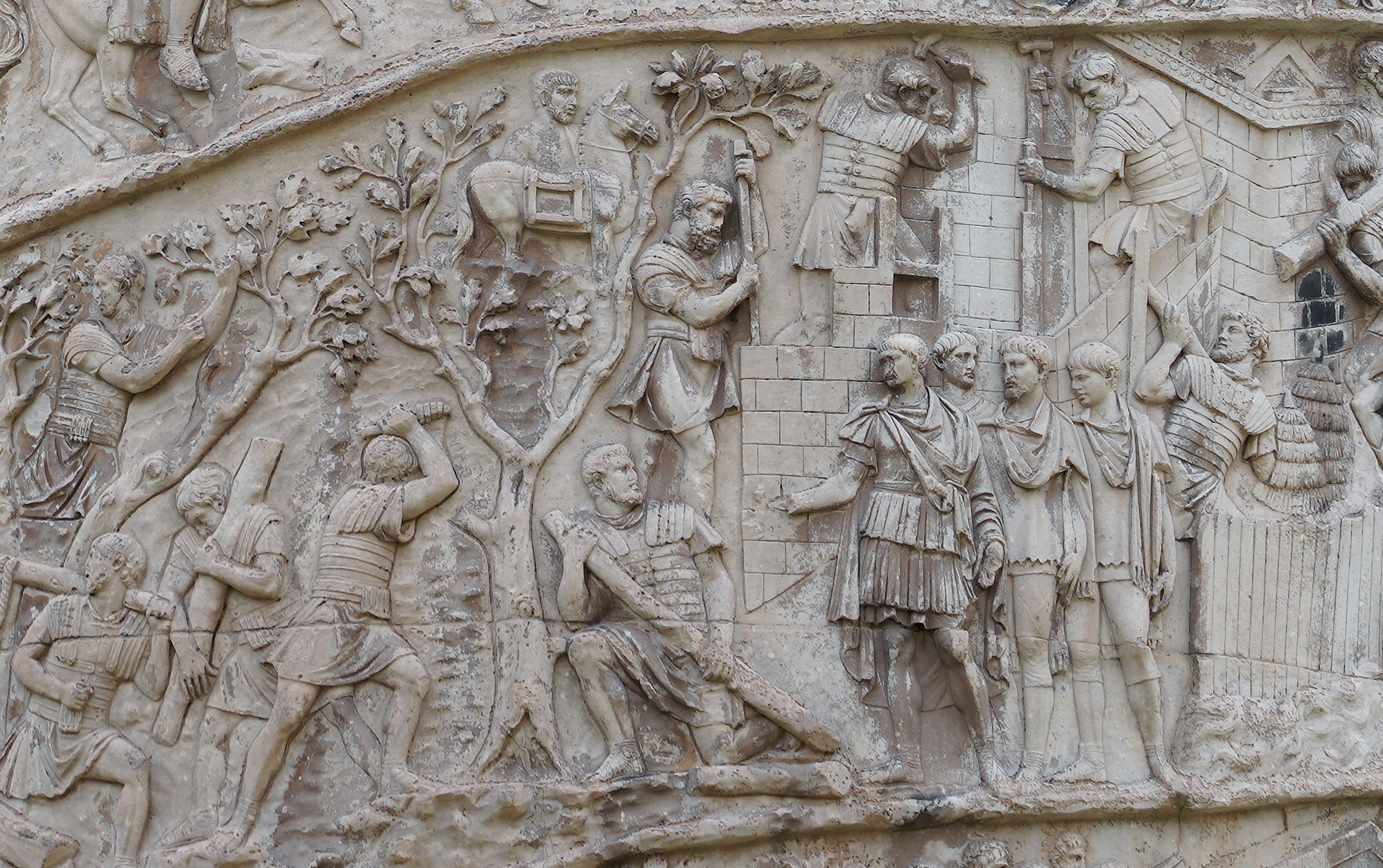
The viewer also sees the Roman army doing other chores while not fighting. One notable activity is building. In numerous scenes the soldiers may be seen building and fortifying camps. All of the Roman edifices depicted are solid, regular, and well designed—in stark contrast to the humble buildings of the Dacian world. Roman propaganda at work.
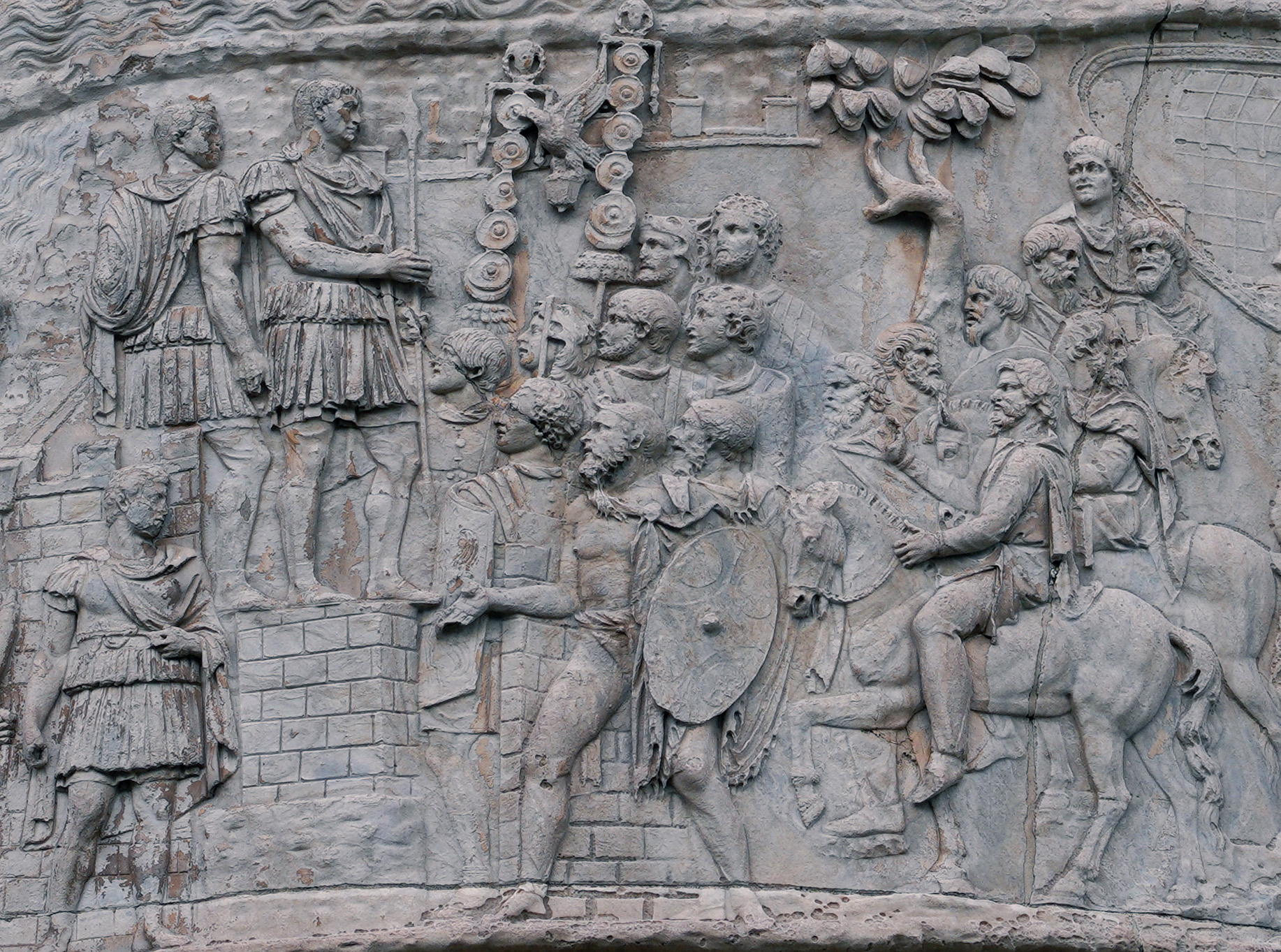
The emperor Trajan figures prominently in the frieze. Each time he appears, his position is commanding and the iconographic focus on his person is made clear. We see Trajan in various scenarios, including addressing his troops (ad locutio) and performing sacrifices. The fact that the figures in the scenes are focused on the figure of the emperor helps to draw the viewer’s attention to him.
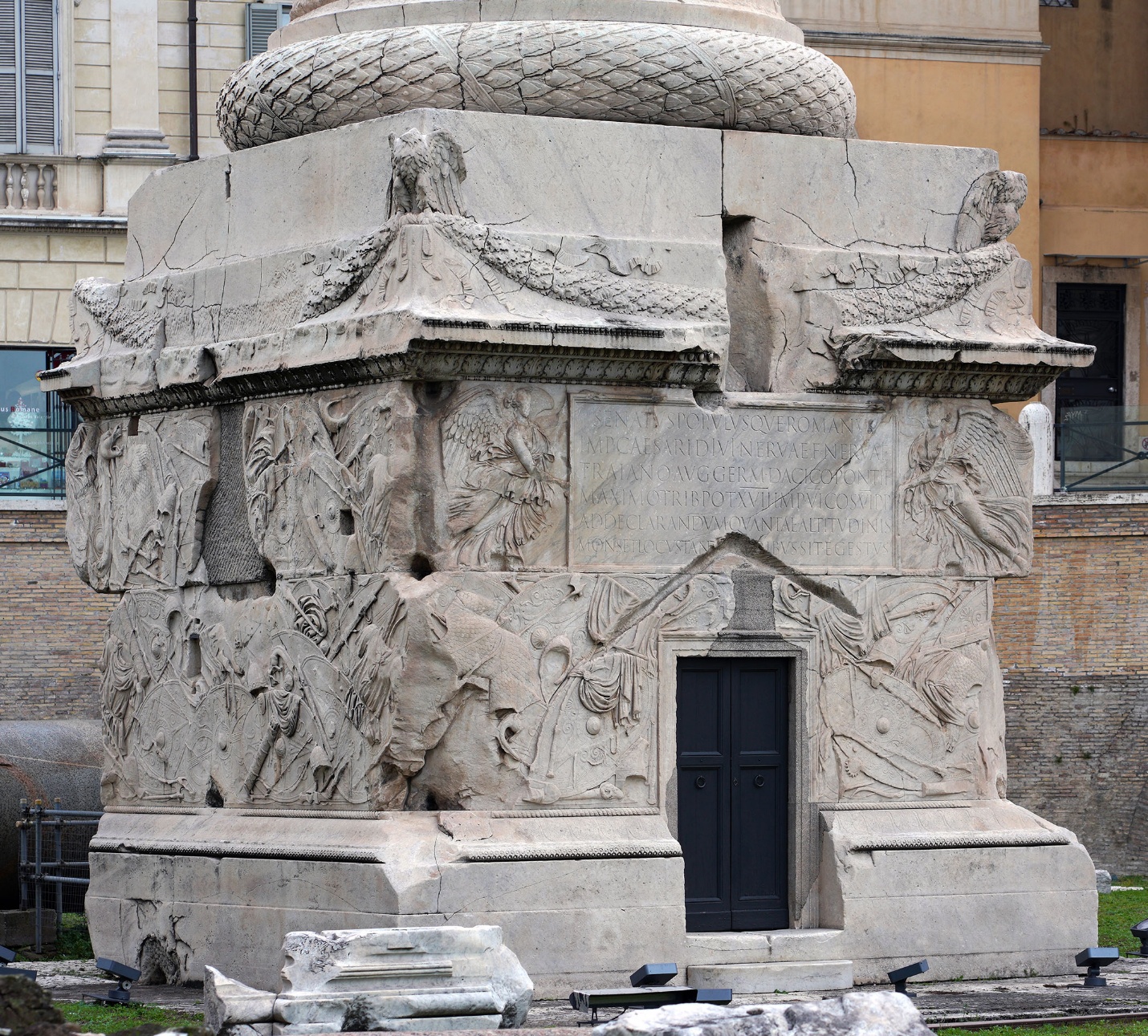
The base of the column eventually served as a tomb for Trajan’s ashes. He died while returning from foreign campaigns in 117 C.E. and was granted this unusual honor, in keeping with the estimation of the Roman people who deemed him optimus princeps or “the best first citizen”.
Specifications of the column and construction
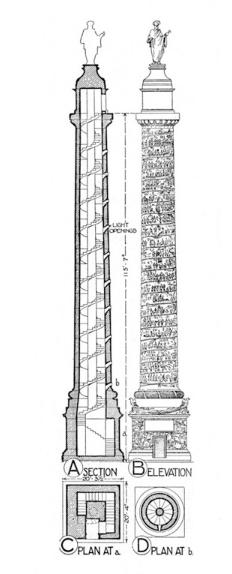
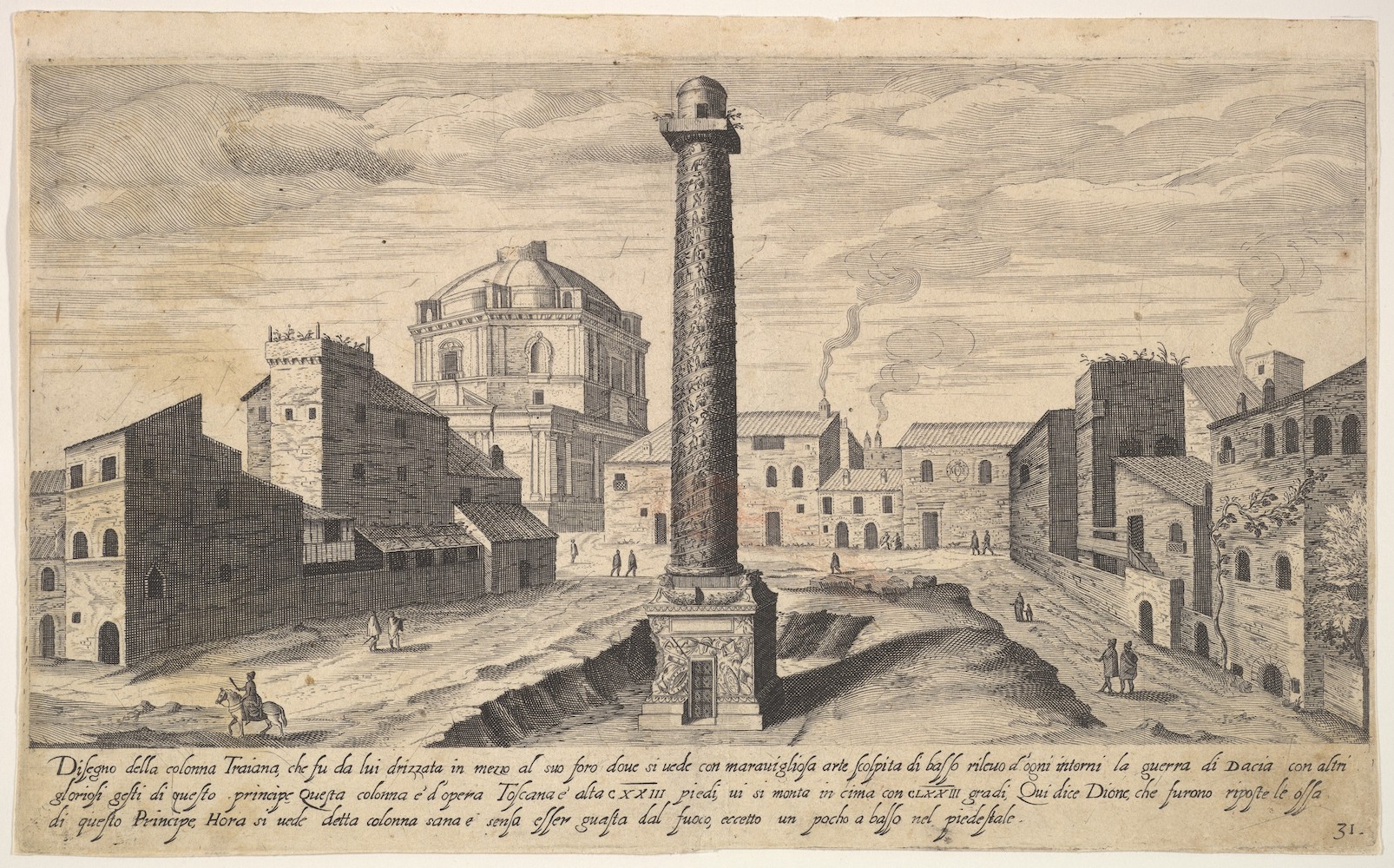
The column itself is made from fine-grained Luna marble and stands to a height of 38.4 meters (c. 98 feet) atop a tall pedestal. The shaft of the column is composed of 19 drums of marble measuring c. 3.7 meters (11 feet) in diameter, weighing a total of c. 1,110 tons. The topmost drum weighs some 53 tons. A spiral staircase of 185 steps leads to the viewing platform atop the column. The helical sculptural frieze measures 190 meters in length (c. 625 feet) and wraps around the column 23 times. A total of 2,662 figures appear in the 155 scenes of the frieze, with Trajan himself featured in 58 scenes.
The construction of the Column of Trajan was a complex exercise of architectural design and engineering. As reconstructed by Lynne Lancaster, the execution of the column itself was an immense engineering challenge that required complex lifting devices and, no doubt, careful planning to execute successfully. Materials had to be acquired and transported to Rome, some across long distances. With the appropriate technology in place, the adept Roman architects could carry out the project. The successful completion of the column demonstrates the complex tasks that Roman architects could successfully complete.
Significance and influence
The Column of Trajan may be contextualized in a long line of Roman victory monuments, some of which honored specific military victories and thus may be termed “triumphal monuments” and others that generally honor a public career and are thus “honorific monuments”. Among the earliest examples of such permanent monuments at Rome is the rostrate column (column rostrata) that was erected in honor of a naval victory celebrated by Caius Duilius after the battle of Mylae in 260 B.C.E. (this column does not survive). During the Republican period, a rich tradition of celebratory monuments developed, best known through the fornices (honorific arches) and triumphal arches. This tradition was continued in the imperial period, with both triumphal and honorific arches being erected at Rome and in the provinces.
The idea of the honorific column was carried forward by other victorious leaders—both in the ancient and modern eras. In the Roman world immediate, derivative monuments that draw inspiration from the Column of Trajan include the Column of Marcus Aurelius (c. 193 C.E.) in Rome’s Piazza Colonna, as well as monuments like the now-lost Column of Arcadius (c. 401 C.E.) and the Column of Justinian at Constantinople (c. 543 C.E.). The idea of the narrative frieze applied to the Column of Trajan proved influential in these other instances.
Honorific or triumphal columns inspired by that of Trajan were also created in honor of more recent victories. The column honoring Admiral Horatio Nelson in London’s Trafalgar Square (c. 1843) draws on the Roman tradition that included the Column of Trajan along with earlier, Republican monuments like the columna rostrata of Caius Duilius. The column dedicated to Napoleon I erected in the Place Vendôme in Paris (c. 1810) and the Washington Monument of Baltimore, Maryland (1829) both were directly inspired by the Column of Trajan.
Middle Empire: The Pantheon, Rome
The Pantheon has one of the most perfect interior spaces ever constructed—and it’s been copied ever since.
Later Imperial Art
Later Imperial art moved away from earlier Classical influences, and Severan art signals the shift to art of Late Antiquity. The characteristics of Late Antique art include frontality, stiffness of pose and drapery, deeply drilled lines, less naturalism, squat proportions, and lack of individualism. Important figures are often slightly larger or are placed above the rest of the crowd to denote importance.
In relief panels from the Arch of Septimius Severus from Lepcis Magna, Septimius Severus and his sons, Caracalla and Geta ride in a chariot, marking them out from an otherwise uniform sea of repeating figures, all wearing the same stylized and flat drapery. There is little variation or individualism in the figures and they are all stiff and carved with deep, full lines. There is an ease to reading the work; Septimius is centrally located, between his sons and slightly taller; all the other figures direct the viewer’s eyes to him.
Constantinian art continued to integrate the elements of Late Antiquity that had been introduced in the Severan period, but they are now developed even further. For example, on the oratio relief panel on the Arch of Constantine, the figures are even more squat, frontally oriented, similar to one another, and there is a clear lack of naturalism. Again, the message is meant to be understood without hesitation: Constantine is in power.
Late Empire: Basilica of Maxentius and Constantine
Constantine
The Emperor Constantine, called Constantine the Great, was significant for several reasons. These include his political transformation of the Roman Empire, his support for Christianity, and his founding of Constantinople (modern day Istanbul). Constantine’s status as an agent of change also extended into the realms of art and architecture. The Basilica of Constantine and the nearby Triumphal Arch of Constantine in Rome are superb examples of the ideological and stylistic changes Constantine’s reign brought to art. They also demonstrate the emperor’s careful adherence to traditional forms of Roman Imperial art and architecture.
Built using new technologies, this building is overwhelming and unprecedented—displaying Roman imperial power.
Practicing Visual Analysis
Visually analyzing architecture is different from analyzing a two-dimensional or three- dimensional artwork. Architecture is immersive in that it physically envelops the viewer. The Basilica of Maxentius and Constantine is massive in scale. Such a huge scale is intentional because the basilica architecture is associated with the Roman emperor. With a variety of materials being used at the Basilica of Maxentius and Constantine, including brick, concrete, and marble, an array of textures, colors, and patterns are present. When analyzing architecture, the overall layout or floor plan of a building is discussed. The Roman basilica is a rectangular shaped structure with a semi-circle (apse) on either end. The Roman basilica floorplan had four main elements: nave, aisles, apse, and entrances. It was longitudinal on a long axis with the entrances on the long sides. The long central rectangular part of a basilica is the nave. On either side of the nave are aisles separated by columns. Semi-circular apses are on the short ends of the basilica.
Conclusion
Roman emperors, from the time of Augustus, understood the relationship between art and propaganda. Many large-scale buildings, such as the Flavian Amphitheater, were given to the Roman people as gifts (munera). Set within the public sphere, such gifts were large-scale monuments meant to reaffirm the emperor’s power and control over a massive geographic area. At its height in the late 1st century C.E., the Roman Empire stretched from Judea to Britain encompassing the Mediterranean and parts of North Africa. The Roman Empire experienced periods of instability, including a tumultuous 3rd century C.E. Eventually the empire was divided into two: the Western Roman Empire and the Eastern Roman Empire. Under the Emperor Constantine, those two were brought back together; however, division and unrest continued. Eventually, the Western Roman Empire fell in the year 476 C.E. The Eastern Roman Empire, which later became known as the Byzantine Empire, continued until 1453. The Byzantine Empire is the subject of a later chapter.
Citation and Licensing
The following sections were written by Chelsea Wright and are licensed CC BY-NC-SA 4.0:
- Chapter Overview and Introduction
- Focus artwork and term list compiled by Chelsea Wright
- Conclusion
The following articles from Smarthistory licensed CC BY-NC-SA 4.0 were remixed and adapted for the chapter:
- “From Rome to Empire: Augustus and the Ara Pacis” remixed and parts revised by Chelsea Wright from Dr. Jeffrey A. Becker, “Ara Pacis Augustae,” in Smarthistory, October 4, 2020.
- Dr. Julia Fischer, “Augustus of Primaporta,” in Smarthistory, November 6, 2020.
- Dr. Jessica Leay Ambler, “Ancient Roman art, an introduction,” in Smarthistory, August 8, 2015.
- Dr. Jessica Leay Ambler, “Ancient Roman architecture, an introduction,” in Smarthistory, August 8, 2015.
- Dr. Bernard Frischer and Dr. Steven Zucker, “The Colosseum,” in Smarthistory, July 19, 2020.
- Dr. Jeffrey A. Becker, “Column of Trajan,” in Smarthistory, November 7, 2020.
- Dr. Paul A. Ranogajec, “The Pantheon, Rome,” in Smarthistory, December 11, 2015.
- Dr. Darius Arya and Dr. Beth Harris, “Basilica of Maxentius and Constantine,” in Smarthistory, December 15, 2015.
- Dr. Andrew Findley, “Arch of Constantine, Rome,” in Smarthistory, November 25, 2015.


.jpg)
