Chapter Overview and Introduction
The last phases of Ancient Greek history began with the Late Classical period and into the Hellenistic world of Alexander the Great. The first female nude sculpture in Ancient Greek history dates to the Late Classical period: Aphrodite of Knidos. In the Hellenistic period, new stylistic elements appeared for the first time, including drama and the depiction of emotion.
Focus Artworks
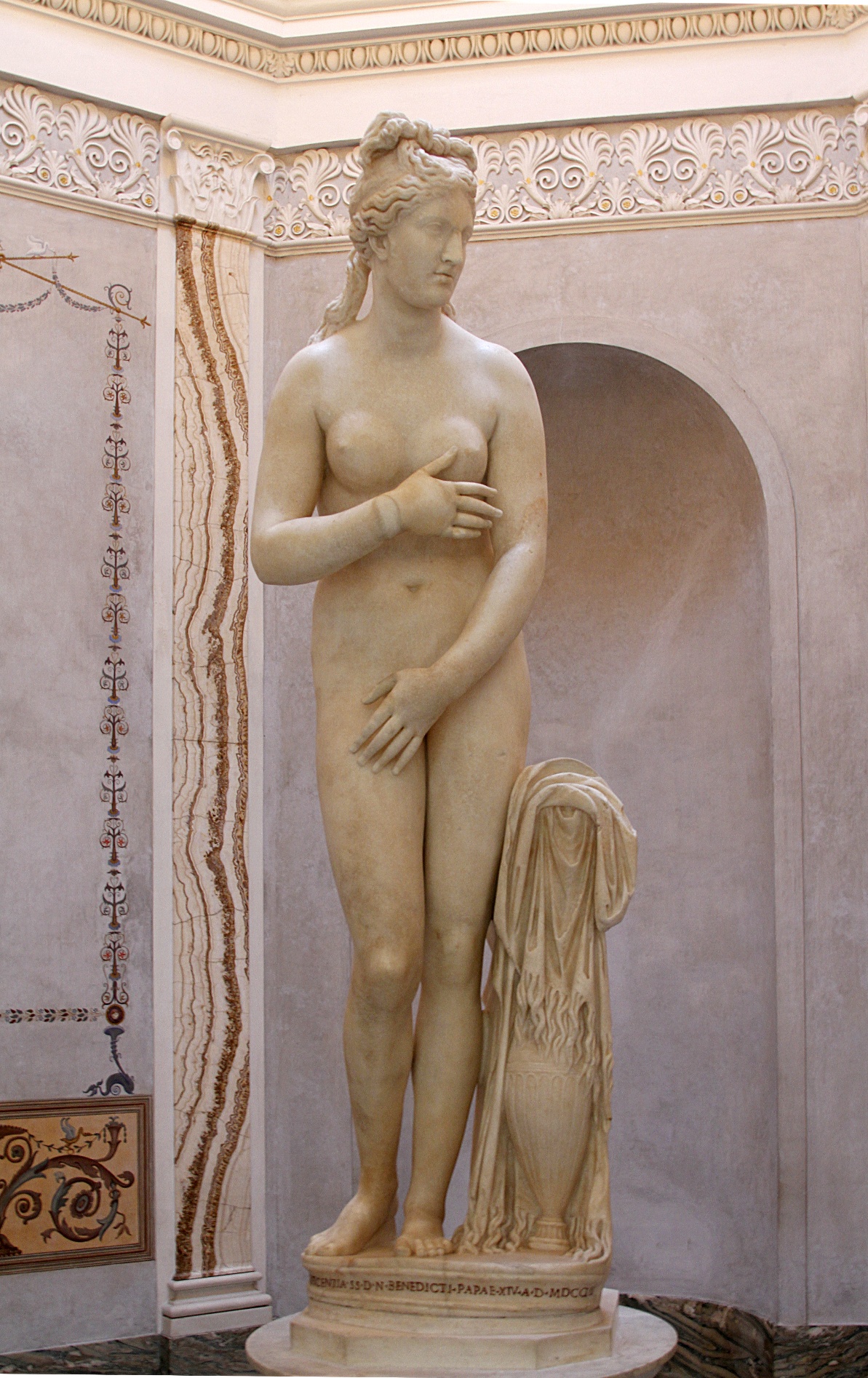
- Capitoline Venus, 2nd century C.E., marble, Roman copy of the Aphrodite of Knidos, a 4th century B.C.E. Greek original by Praxiteles
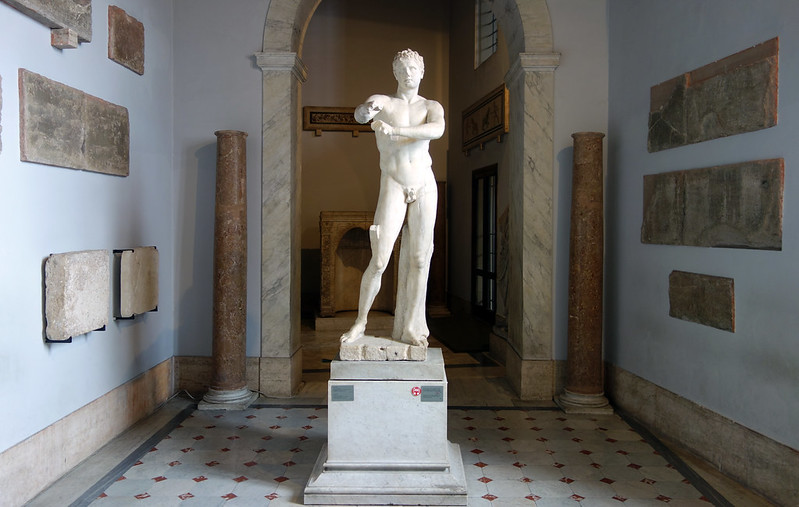
- Portrait of Alexander the Great (the so-called Azara Alexander), Roman marble copy of a Greek original, c. 1–50 C.E.
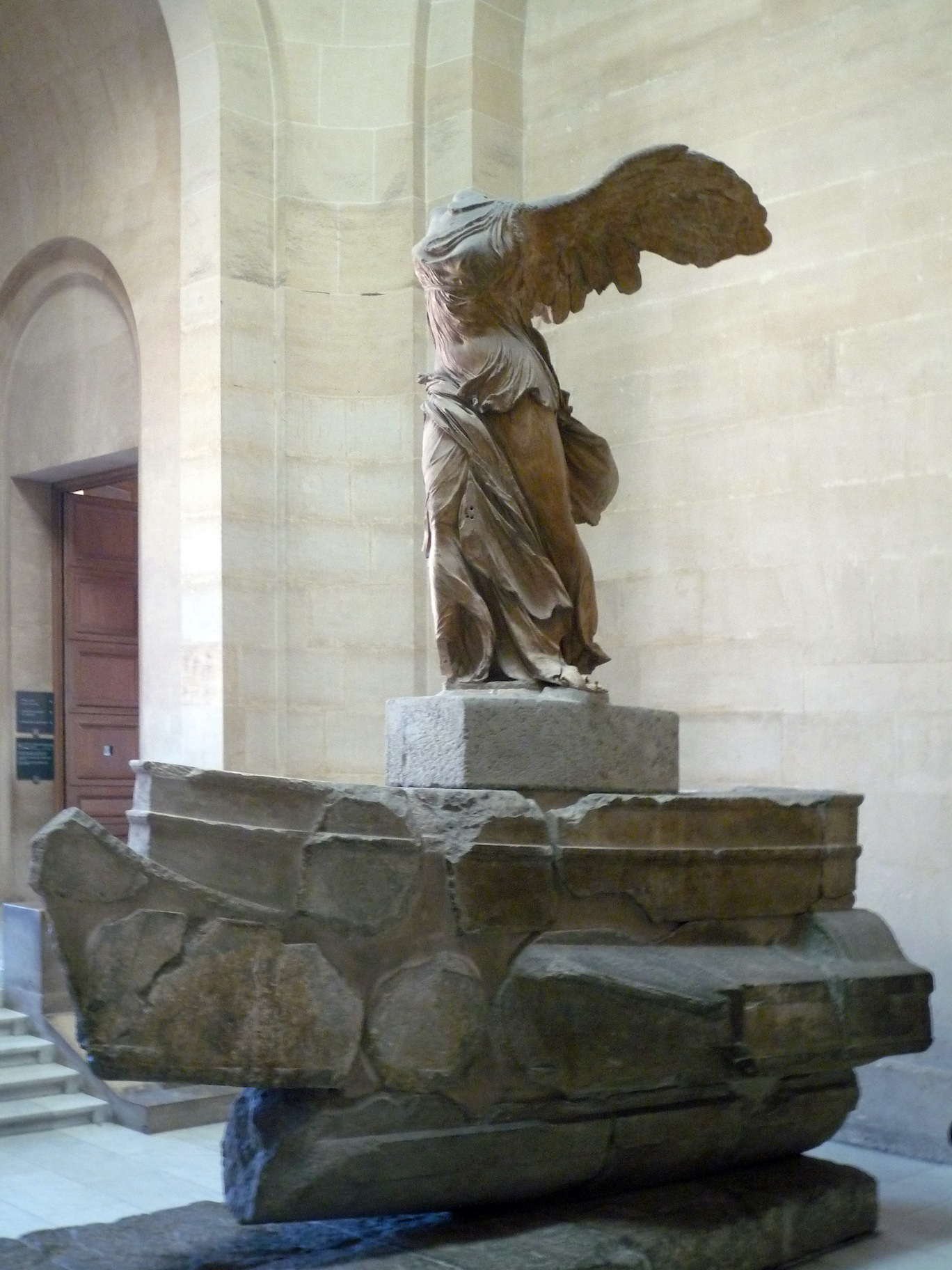
- Nike (Winged Victory) of Samothrace, Lartos marble (ship) and Parian marble (figure), c. 190 B.C.E., Hellenistic Period
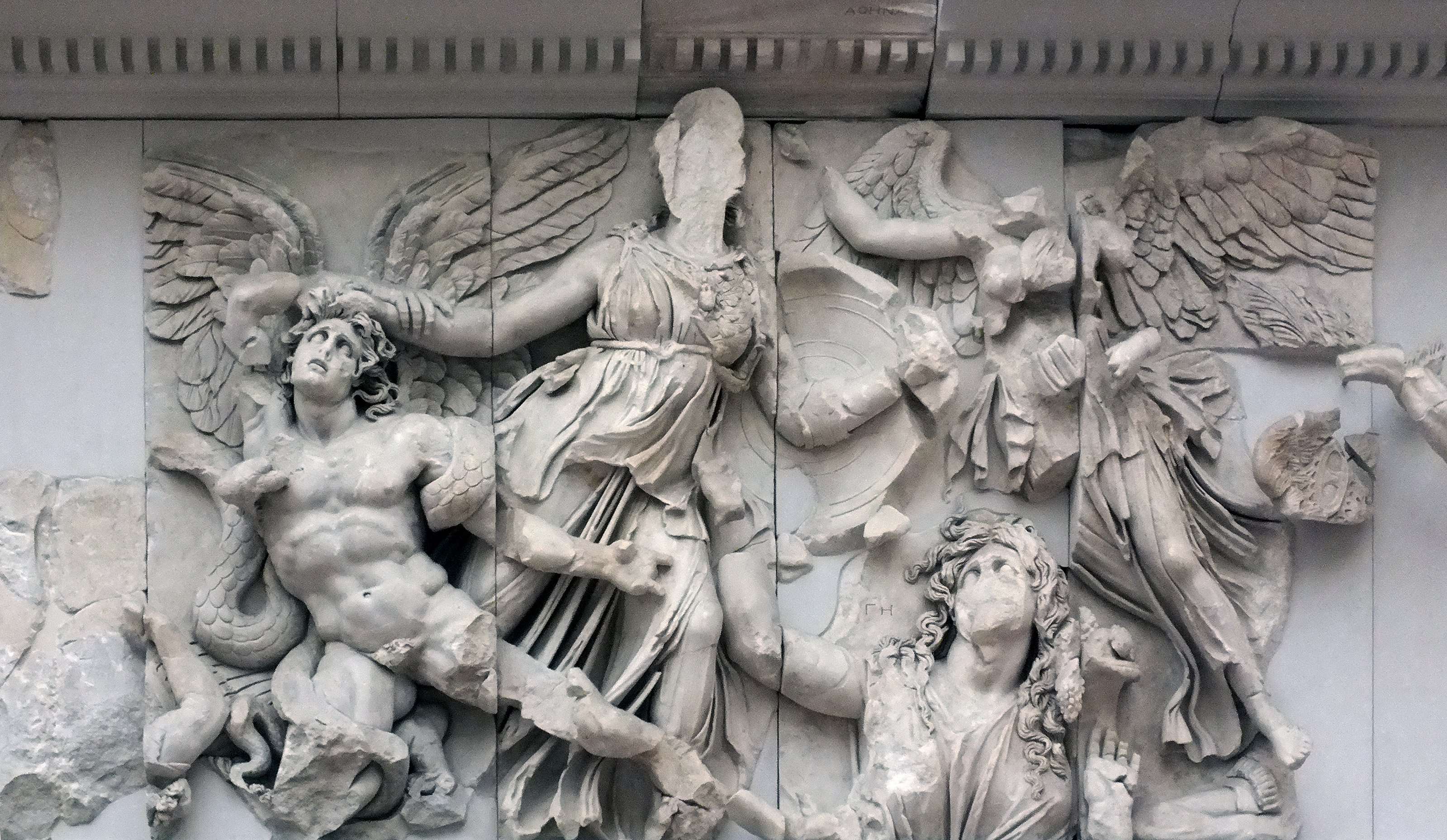
- The Pergamon Altar, c. 200-150 B.C.E., Hellenistic Period
- Athanadoros, Hagesandros, and Polydoros of Rhodes, Laocoön and his Sons, early 1st century C.E., marble
Term List
- Late Classical Period
- Peloponnesian War
- Pudica
- Aphrodite
- Modest Venus
- Hellenistic Period
- Alexander the Great
- Anastole
Late Classical Period
During the Classical Period, Athens, Sparta, and their mutual allies were embroiled in the Peloponnesian War, a bitter conflict that lasted for several decades and ended in 404 B.C.E. Despite continued military activity throughout the “Late Classical Period” (400–323 B.C.E.), artistic production and development continued apace. In addition to a new figural aesthetic in the fourth century known for its longer torsos and limbs, and smaller heads (for example, the Apoxyomenos), the first female nude was produced. Known as the Aphrodite of Knidos, c. 350 B.C.E., the sculpture pivots at the shoulders and hips into an S-Curve and stands with her right hand over her genitals in a pudica (or modest Venus) pose. Exhibited in a circular temple and visible from all sides, the Aphrodite of Knidos became one of the most celebrated sculptures in all of antiquity.
Capitoline Venus (copy of the Aphrodite of Knidos)
Aphrodite, goddess of love and beauty, emerges from her bath, but what did her nudity mean to the Greeks?
Practicing Visual Analysis
Aphrodite of Knidos was the first female nude sculpture from Ancient Greece. The sculpture began the tradition of the female nude in Western art. Despite the shock of the new, Praxiteles worked with existing visual arts traditions. Like other marble sculptures from the Ancient Greek world, the Aphrodite of Knidos would have been painted in vibrant natural colors. Aphrodite also stands in the contrapposto stance for the composition. Her right leg is relaxed, and her left leg is engaged. Unlike the heroic nudity of male sculptures, however, Praxiteles overlaps Aphrodite’s arms in front of her body: the right arm creates a 90-degree angle with the horizontal line of her arm just below her breasts. Her left arm angles diagonally toward her genital region. While the composition gives the appearance of modesty, it is a false modesty. The positioning of the arms only draws more attention to certain features of Aphrodite’s figurative form. The composition also holds more visual weight on the right hand-side of the sculpture. Next to Aphrodite sits a bathing urn for water and a cloak. Praxiteles refers to Aphrodite’s origin story: she is created fully formed carried on the waves of the sea. The iconography or symbolism Praxiteles gives, including the cloak to indicate the viewer has interrupted a private moment for Aphrodite at the bath, provides greater context and a reminder that the piece was originally intended as a religious sculpture and placed in an open-air, circular shrine.
The Hellenistic Period and Beyond (323 B.C.E.–31 B.C.E.)
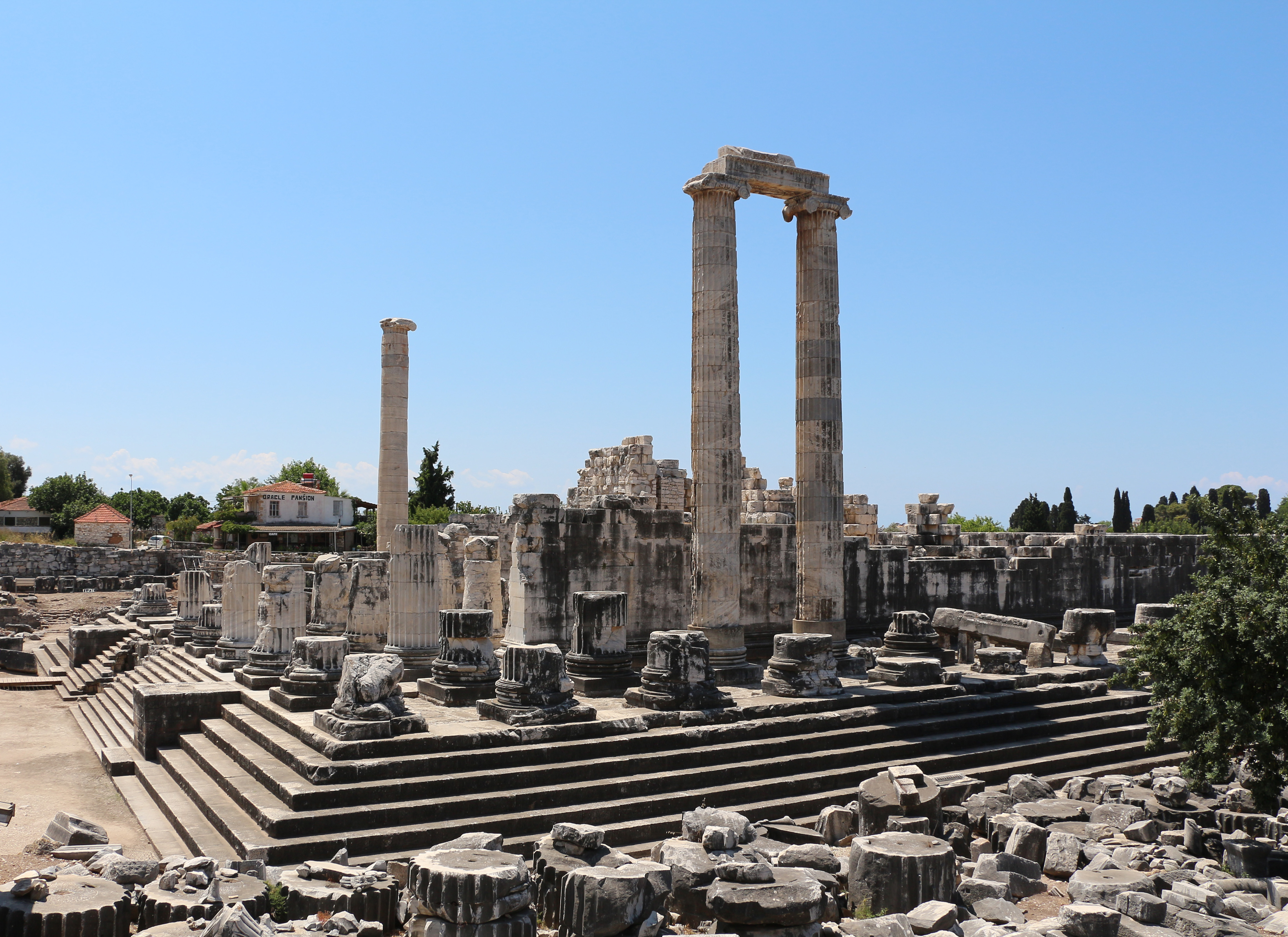
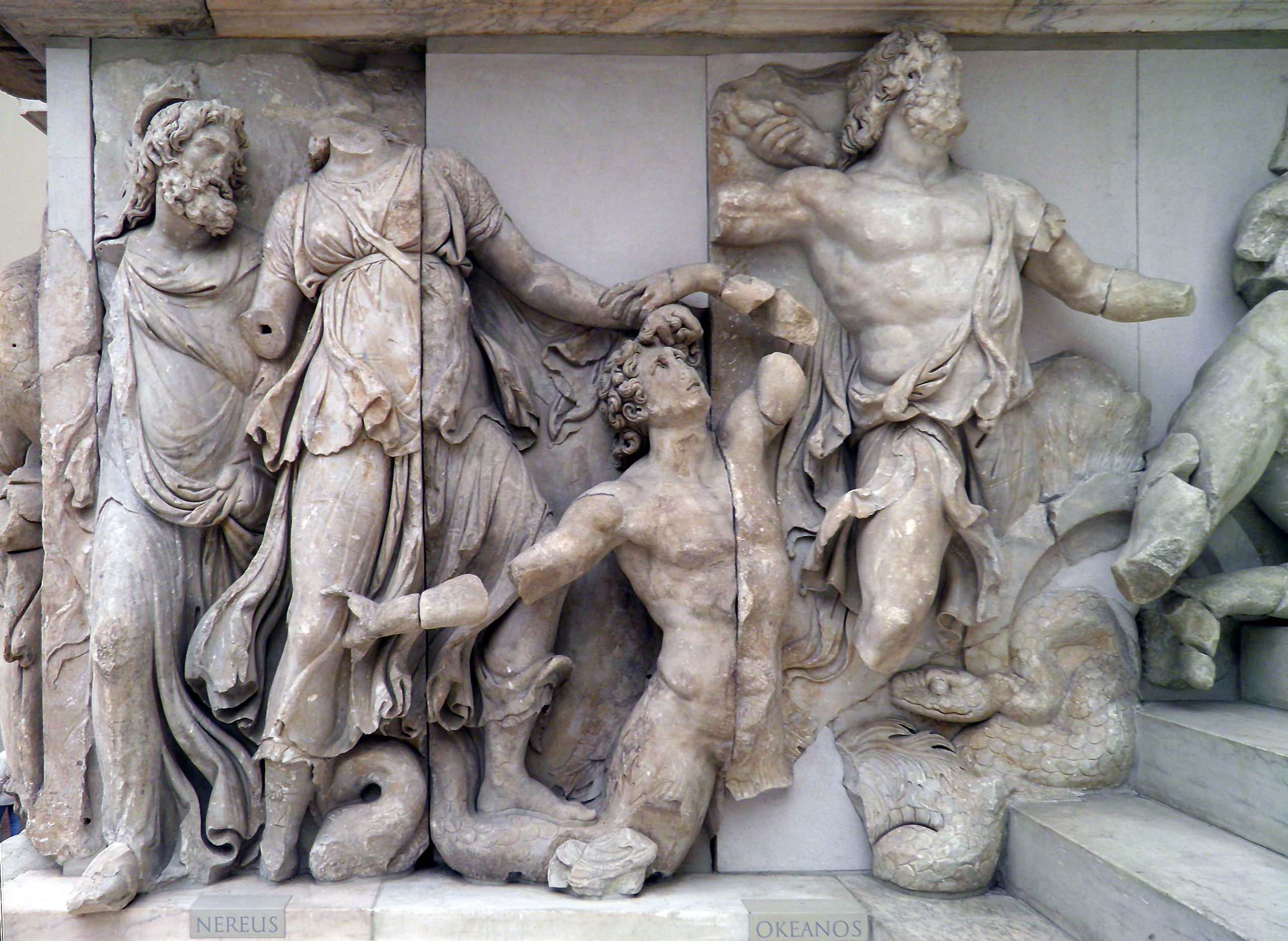
Following the death of Alexander the Great in 323 B.C.E., the Greeks and their influence stretched as far east as modern India. While some pieces intentionally mimicked the Classical style of the previous period such as Eutychides’ Tyche of Antioche (Louvre), other artists were more interested in capturing motion and emotion. For example, on the Great Altar of Zeus from Pergamon (below) expressions of agony and a confused mass of limbs convey a newfound interest in drama. Architecturally, the scale of structures vastly increased, as can be seen with the Temple of Apollo at Didyma, and some complexes even terraced their surrounding landscape in order to create spectacular vistas as can be seen at the Sanctuary of Asklepios on Kos.
Alexander the Great
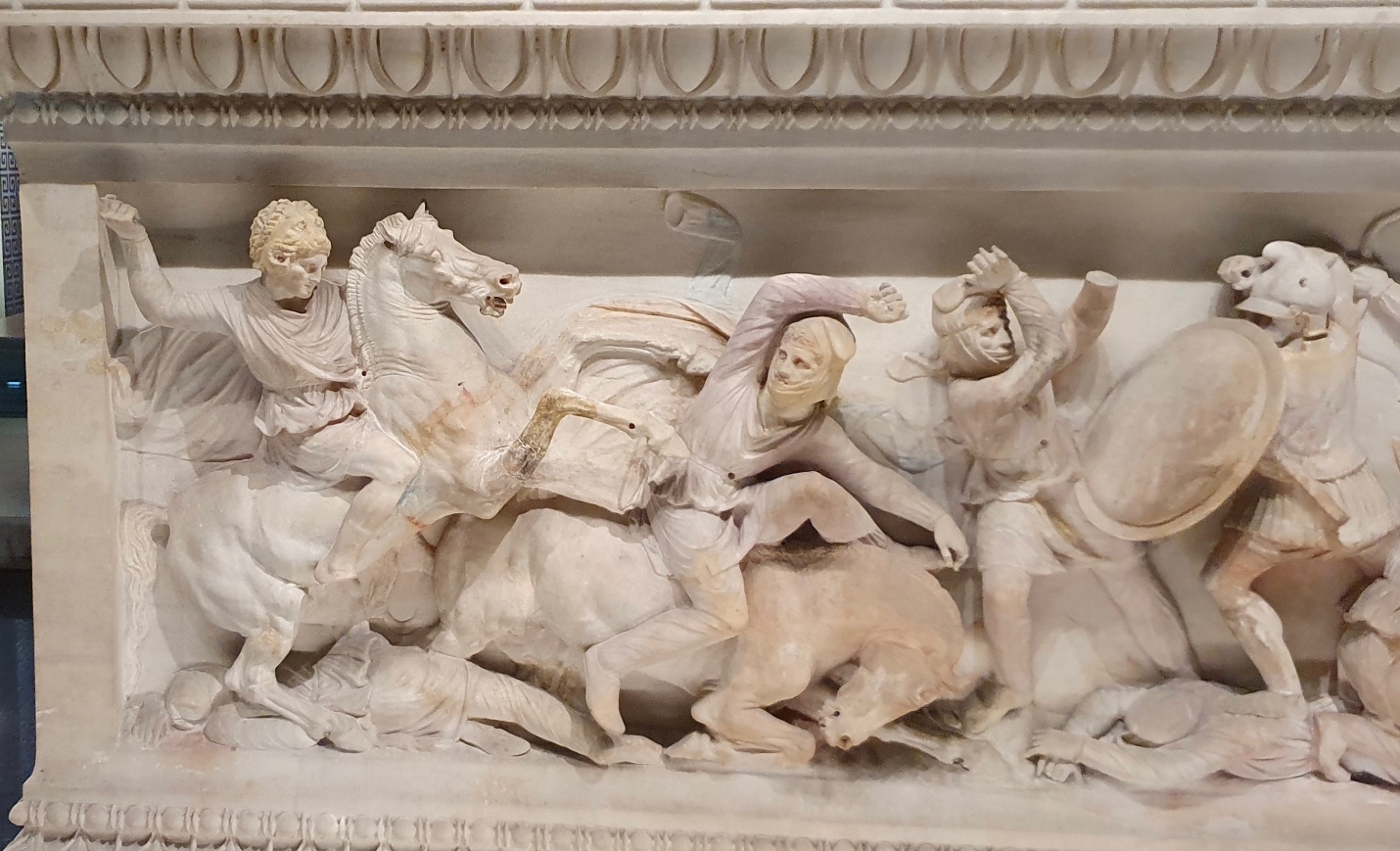
In 336 B.C.E. a young man named Alexander inherited control of a kingdom called Macedon in the area of modern day Greece. Alexander had military experience but was only 20 years old when his father was assassinated, leaving him in control of a large swath of land at a young age. [1] Over the next 13 years, Alexander aggressively expanded his territory. By the time he died in 323 B.C.E., his territory stretched all the way to modern day India. [2] His Macedonian Empire was one of the largest empires that ever existed. [3] It is one of the reasons that Alexander is today known as Alexander the Great.

The short and violent life of the Macedonian king Alexander the Great offers a useful case study in war’s repercussions for cultural heritage. As he fought his way through the Persian Empire in the late 4th century B.C.E., Alexander the Great famously destroyed monuments, such as the palace of Persepolis, an important political and administrative center in present-day Iran. At the same time, his conquest of the rich and powerful ancient kingdom of the Achaemenids also encouraged the creation of new works of art, for example, portraits of Alexander by the celebrated artists Lysippos and Apelles. And in his later years, Alexander became an increasingly significant rebuilder of monuments like the ziggurat of Babylon, better known as the Biblical Tower of Babel.
Alexander’s destruction, creation, and rebuilding of monuments illuminates ancient attitudes and practices toward cultural heritage in wartime. His actions suggest an ideal of protecting monuments during war, yet Alexander also used symbolic violence toward cultural heritage as a military and political strategy to demonstrate his absolute power and highlight the dangers of resistance. This has important repercussions for our understanding of ancient concepts of the protection of cultural heritage in wartime: an issue of critical importance in Alexander’s era, and one that remains highly relevant today.
Portraits of Alexander the Great
Alexander the Great ruled his empire long before modern media existed. He could not give televised speeches, nor could he circulate his image and ideas in newspapers. Very few people who lived under his rule ever saw him in person. Instead, Alexander was known to many through his portraits. Ancient authors suggest that Alexander the Great was well aware of the importance of his portraits and controlled them carefully. He had a favorite sculptor, Lysippos, whom he gave special permission to design his sculpted portraits. [4] While no original portrait of Alexander made by Lysippos survives, many copies of his work exist, as do other versions of Alexander’s portraits. Examining these copies can help us understand what is innovative about Alexander the Great’s portraits and how they were crafted to convey a certain message about the ruler to viewers.
Before we look at some of these portraits, we must consider two issues that complicate our study of them. The first is the difference between a portrait and a likeness. Although a portrait is a representation of an individual, it is not necessarily a likeness of that individual, meaning that it does not have to depict the individual as they actually appear. Portraits can remove flaws and exaggerate good features, resulting in idealized images. Of course, we have no photographs of Alexander the Great, so it is difficult to determine what he really looked like, but written sources suggest that he was idealized in his portraits. [5] Alexander the Great and the artists who worked for him were less interested in conveying his exact likeness and more interested in creating portraits that presented him as a capable young ruler.
The second major issue that complicates our understanding of portraits of Alexander the Great is the lack of surviving originals. Most portraits that have been identified as depicting Alexander were probably made long after his death. [6] Some might be copies of famous portraits by important artists like Lysippos, but this is difficult to determine because we can’t compare them to surviving originals. Scholars often rely on literary descriptions of Alexander and his images to identify his portraits. These portraits share some distinctive characteristics that are also mentioned in the written sources. By looking closely at a few of these sculptures we can become more familiar with the defining characteristics of Alexander the Great’s portraits.
The heads of Alexander

One portrait of Alexander the Great is today known as the Azara Alexander because it was once owned by a man whose last name was Azara. The bottom of this portrait bust is inscribed with Alexander the Great’s name, allowing us to securely identify him. However, we know that this is not a Greek original because the Greeks didn’t make portrait busts. Romans invented portrait busts, which only show the heads (and sometimes shoulders) of an individual. [7] The Roman artist who made the Azara Alexander attached the portrait head to a block-like bust that carries the identifying inscription. Some scholars believe this is a Roman copy of an original Greek portrait of Alexander by Lysippos. [8]
Many of the distinctive characteristics of Alexander the Great’s portraits are visible here. First, Alexander is shown without a beard. Prior to Alexander’s rule, Greek men were typically shown with beards, which signaled their maturity and adulthood. By appearing without a beard, Alexander the Great broke with tradition and emphasized his youthfulness. [9] Many kings that succeeded Alexander imitated his beardlessness in their own portraits.
Another defining trait of Alexander the Great is his hairstyle. The two locks of hair at the center of his forehead stand straight up and are parted slightly off center in a style that is called anastole. His hair is thick, with many long, wavy pieces. Ancient authors describe Alexander the Great as being lion-like in personality, and in his portraits, his leonine nature is expressed through his hairstyle: in its fullness and wildness, his hair recalls a lion’s mane. [10] Alexander’s hairstyle thus makes him more easily recognizable and conveys his lion-like fierceness.
Additional features typical of Alexander’s portraits are present in the Azara Alexander. The head turns slightly, adding a liveliness to the image, as if Alexander is engaged and responsive. The head also has a far off gaze, which is sometimes described as “melting” and was apparently a real physical trait of Alexander. [11] Ancient authors mention all four of these traits (beardlessness, anastole of leonine hair, turning head, and melting gaze) in their written descriptions of Lysippos’s portraits of Alexander, supporting the idea that this may be a Roman copy of a Greek sculpture by Lysippos. [12]

Other surviving portrait heads of Alexander the Great also have these defining traits. One head of Alexander that is now in Munich has also been recognized as a Roman copy of a Greek original by Lysippos. Alexander is beardless, with the typical anastole and leonine hair. His head turns towards the right, engaging the muscles in his neck, and his deep set eyes seem to gaze off into the faraway distance. [13] While we can’t be totally sure that this Roman statue is imitating a Greek sculpture by Lysippos, we can identify it as a portrait of Alexander.
The body of Alexander
We have learned to recognize Alexander the Great based on his distinctive features. But during his lifetime his sculpted portraits depicted his entire body, not just his head. To get a sense of how the rest of Alexander was depicted, we must once again turn to Roman copies of Greek statues.
One such Roman statue, Alexander the Great (the so-called Nelidow Alexander), is recognizable as Alexander because of its leonine hair with anastole, beardlessness, and faraway gaze. Here we find the king in the nude. He once held a spear in his left hand, planting it into the ground to indicate he is in control of the land upon which he stands. Alexander poses almost casually, showcasing his perfected musculature. His idealized body emulates the ideal that was developed by Greek sculptors during the High Classical period. [14] Alexander was a great fan of Greek culture and believed himself to be descended from the Greek heroes Herakles and Achilles. Indeed, in this portrait, he is so idealized that he looks like a Greek hero. Despite this he is still recognizable as Alexander because of his face and hair. Through the idealization of the nude body, this portrait exaggerates the physical prowess and power of the real ruler it represents.
An unconventional Alexander
All of Alexander’s portraits were carefully crafted to convey that he was a worthy leader, but a few of them broke with the conventional format defined above to show him in a more local style. These representations are still designed to prove his legitimacy to rule, but because they are doing this for a different audience, they look different than typical portraits of Alexander. For example, sometime after Alexander conquered northern Egypt, he made additions to a centuries-old temple at Karnak to simultaneously demonstrate his respect for the Egyptian gods and his power. The chapel he commissioned was decorated with dozens of reliefs that show him worshiping the Egyptian gods.

In this example, we see Alexander on the right approaching a god. He has neither leonine hair nor anastole, and his faraway gaze is gone. Instead, he is represented in a highly conventional Egyptian manner. [15] He wears an Egyptian kilt and headdress, while his body is shown in composite view, with his chest frontal and his head, arms, and legs in profile. His idealized musculature matches that of the god he faces. In fact, Alexander looks so much like other Egyptian rulers in this image that we can only be sure this is him because he is accompanied by hieroglyphs that spell out his name. Alexander has adapted the imagery of local Egyptian rulers in this temple so that he would be more easily recognizable as a leader to the Egyptians who visited this holy structure.
The legacy of Alexander’s portraits
Alexander the Great’s portraits were designed to portray him as an effective ruler. The goal of these portraits was not to represent Alexander exactly as he appeared, but to highlight his best traits and convey his strength to all who saw them. Certain physical characteristics make Alexander identifiable to us even today, including his clean shaven face, his long curling hair and anastole, and his faraway gaze. These same traits would have also enabled ancient viewers throughout his empire to recognize him. Occasionally Alexander’s portraits conform to a different ideal so that they can clearly express his power to a different audience, but even then, their goal is to make him recognizable as a leader.
The Macedonian Empire fractured into several different kingdoms soon after Alexander’s death in 323 B.C.E. Many of the leaders of these Hellenistic kingdoms continued to make portraits of Alexander, honoring him long after his death. These leaders believed that Alexander became a god after he died, so he sometimes acquired new characteristics that suggest his divinity in these later portraits, even while retaining his typical traits.
For example, in a portrait of Alexander on a coin made in Thrace after his death, Alexander wears a royal diadem. He also has ram’s horns sprouting from his head, which show he is descended from the Egyptian ram-god: the horns show Alexander’s godliness. [16] Despite these new features, Alexander is still recognizable because he is beardless and has his distinctive anastole and curls. The same kings who added such portraits of the deified Alexander to their coins also emulated Alexander in their own portraits, often representing themselves without beards. Alexander the Great’s influential portraits thus lived long after he did, on Hellenistic coins, in Roman copies, and in many other ways.
Nike (Winged Victory) of Samothrace
On the island of Samothrace, the wind whipped the clothing of this stone goddess of victory.
The Pergamon Altar
The battle between the gods and giants
The ancient Greeks represented the mythological battle between the Olympian gods and the giants in a wide variety of media—from miniature engraved gemstones and vase paintings, to over-life-sized architectural sculptures.
Perhaps the most famous and well-preserved of these decorates the Pergamon Altar. The Altar once stood in a sacred precinct on the acropolis of the ancient city of Pergamon (on the west coast of modern-day Turkey), which was ruled by the Attalid dynasty from 282–133 B.C.E.
In comparison to other Hellenistic kingdoms (kingdoms formed after the death of Alexander the Great in 323 B.C.E. and stretching from the eastern Mediterranean to Central Asia), Pergamon emerged relatively late on the scene. Monumental building projects—including the Altar—served as an important way for the Attalids to stake their claim as legitimate inheritors of Alexander’s empire and, by extension, the legacy of Classical Greece.
Athanadoros, Hagesandros, and Polydoros of Rhodes, Laocoön and his Sons
The writhing agony of the Trojan Laocoön made this Hellenistic sculpture famous throughout history.
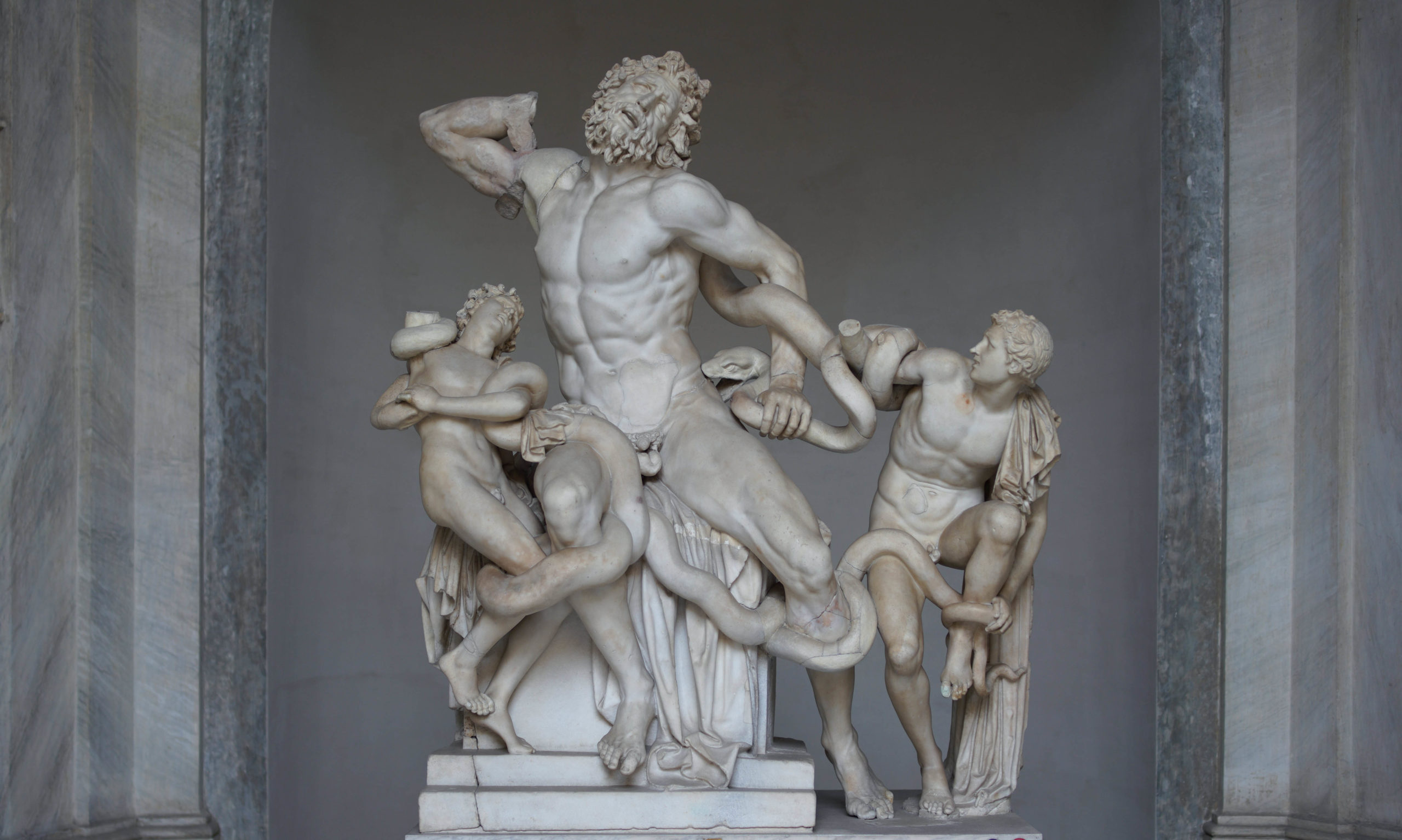
The sculptural group known today as the Laocoön or Laocoön and his Sons has been both one of the most influential ancient artworks in the history of art and one of the most fiercely debated. It has been copied by countless artists, and numerous books have been written about it, yet there is still little scholarly consensus about the circumstances of its creation.
The statue was discovered in 1506 on the Esquiline Hill in Rome by a farmer working in his vineyard. The Laocoön was only one of a number of ancient artworks that had been abandoned, forgotten, and eventually buried under later buildings and streets. During the Renaissance, a number of these artworks were rediscovered, either accidentally during construction projects or purposefully by people hunting for the artworks which had become greatly admired. One of the first people to see the statue was Michelangelo, who was sent by the pope, Julius II, along with architect Guiliano da Sangallo, to inspect the statue after its excavation. Julius, like many of his 16th-century Italian contemporaries, was a connoisseur and collector of ancient Greek and Roman art. He purchased the statue, and it has remained in the collection of the Vatican ever since.
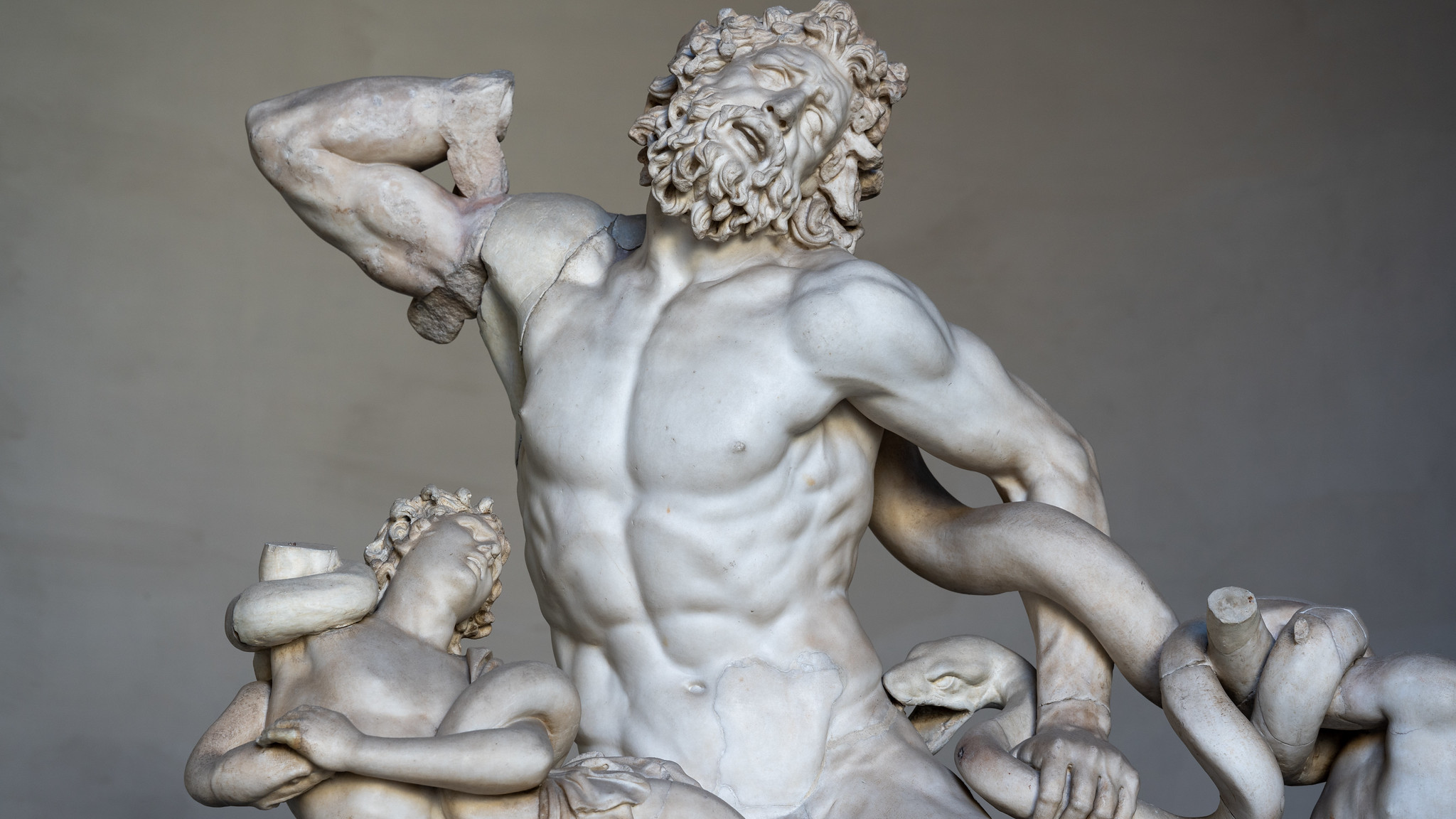
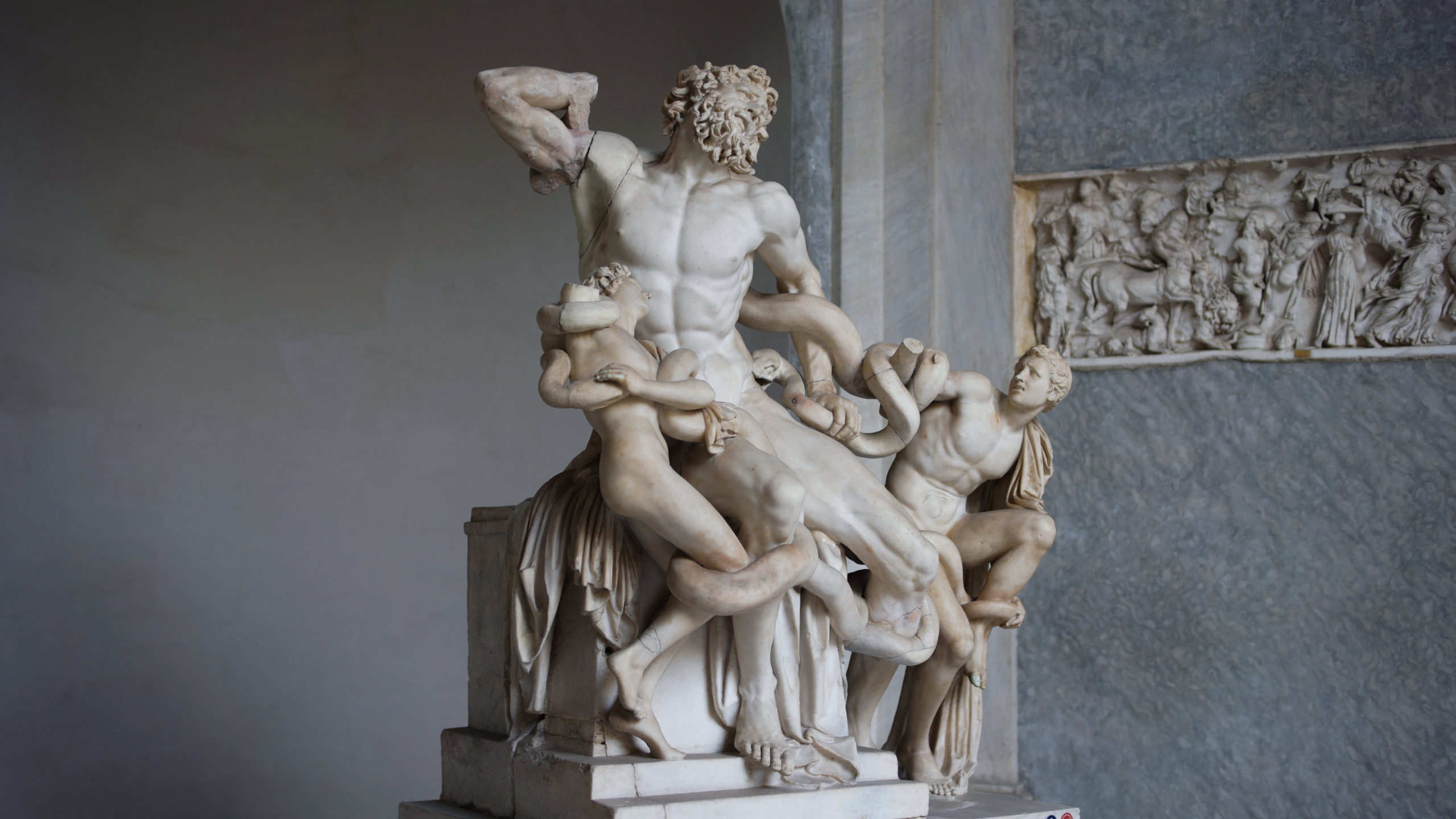
Most likely dating to the 1st century B.C.E. or 1st century C.E., the statue is made of six blocks of Greek Parian marble. It is over-life sized, at a height of 6’ 8”. The composition depicts the tortuous death of Laocoön and his two sons by snakes (read the full story below). All three are nude with clearly defined, exaggerated musculature. Bands of clenched muscles are visible under the skin of Laocoön’s torso as he reaches up to fight off the snakes. The statue, like all ancient Greek and Roman marble sculptures, would have been painted originally. The bright green of the twisting snakes and the red blood drawn by their bites would have stood out against the tan flesh of Laocoön and his sons.
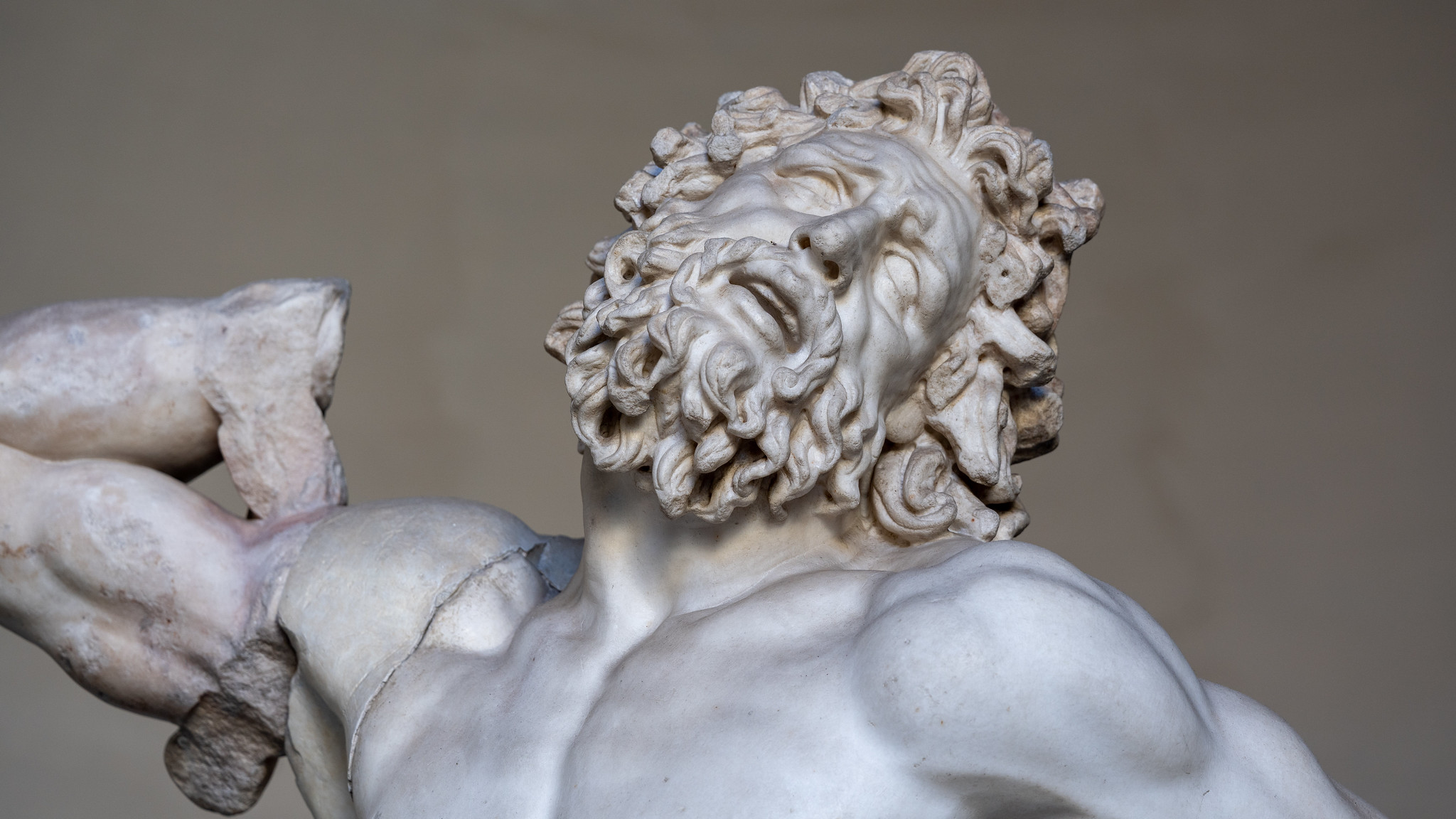
Laocoön is at the center of the composition, sitting in a twisted position on an altar. One snake sinks its teeth into his hip. Laocoön throws his head back as he screams in agony. His hair and beard curl in deeply carved locks, contributing to the sculpture’s dramatic tone. Based on surviving paint on his eyes, some scholars have argued that he has been blinded by the bites of the snakes.

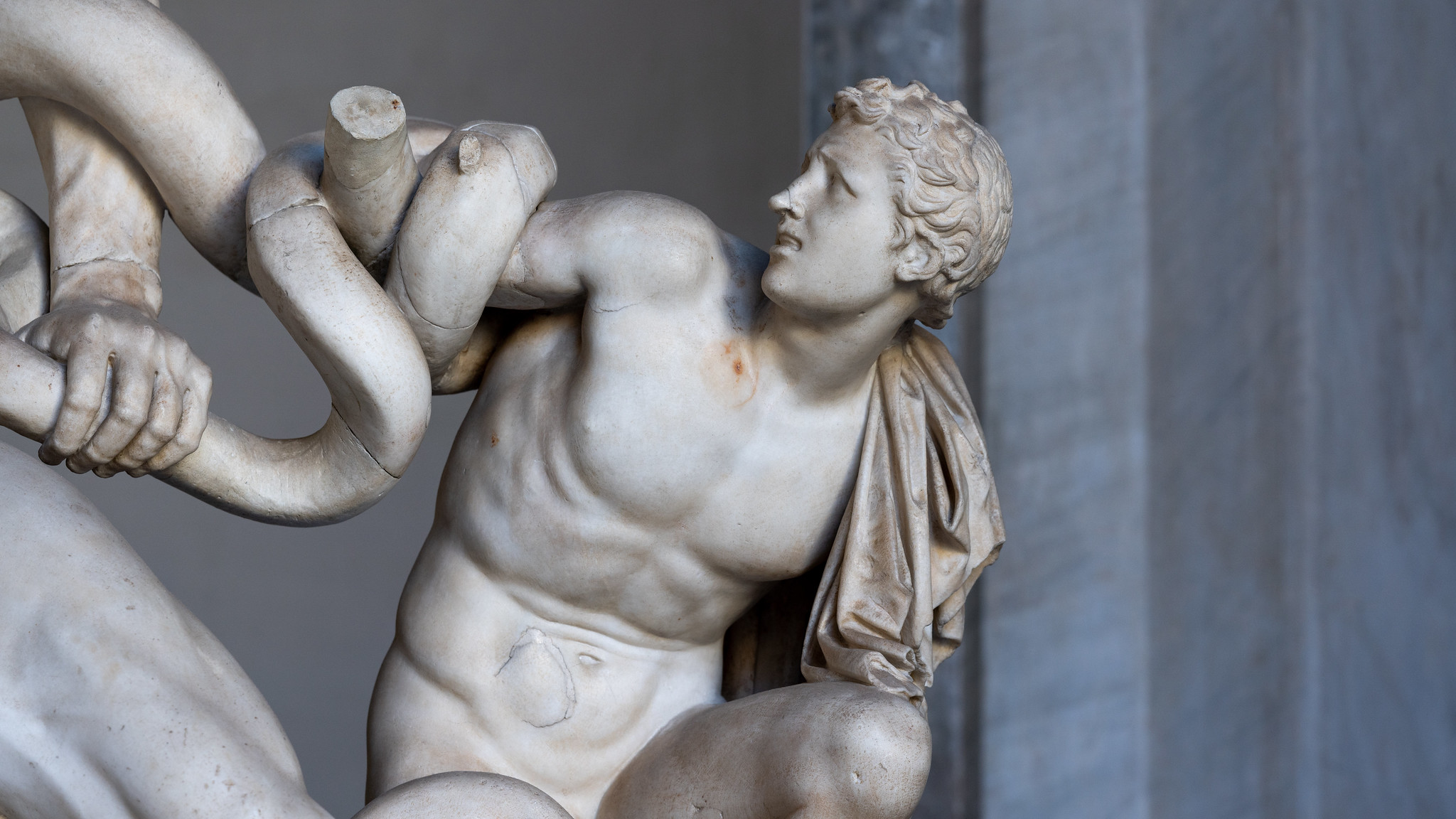
Laocoön is flanked by his two teenaged sons. The figure on the left, the younger of the two, has gone limp, and it is likely that he is already dead. The older son, on the right, pulls snake coils off his leg and arm. He turns to look at his father, an expression of horror and confusion on his face. With its emphasis on theatricality and exaggerated realism, it is similar to artworks of the so-called Hellenistic baroque, such as the Nike of Samothrace and the Great Altar at Pergamon. While the style is most closely associated with the city of Pergamon and the island Rhodes in the 2nd century B.C.E., Hellenistic baroque had an enduring popularity, and artworks in the style continued to be produced into the Roman Imperial period, with Rome becoming a center of Hellenistic art.
The Story of Laocoön
The myth of Laocoön dates back to the 7th century B.C.E. It was part of the Epic Cycle, a series of poems that told the story of the Trojan War (Greeks against the city of Troy, in present-day Turkey). Today, only the Iliad and the Odyssey survive, but we have fragments or descriptions of the other volumes. Laocoön appeared in the now-lost Ilioupersis (the sack of Troy) by Arktinos of Miletos. Versions of Laocoön’s story appeared after that, notably in a now-lost 5th-century B.C.E. play of Sophocles.
The version closest chronologically to the Laocoön statue appeared in Roman writer Vergil’s Aeneid, published in 19 B.C.E. The Aeneid tells the story of the Trojan warrior Aeneas who escapes from Troy during its destruction and makes his way to Italy, where he rules over the Latin people. The story of Laocoön forms part of book two, which recounts the sack of Troy. The Greeks pretended to give up their siege of Troy with its unbreakable walls, leaving only a large wooden horse as a final offering to the gods. In actuality, some hid out of sight while others hid inside the horse. Only a few Trojans spoke against bringing the horse inside the city. The first was Cassandra, who was blessed with the gift of prophecy, but cursed that no one would ever believe her. The other was Laocoön, a priest of Neptune (Greek Poseidon). He warned the Trojans with his now famous line, “I fear the Greeks, even when they bring gifts.” But the gods had decided the Greeks were to win the war, and no one, divine or mortal, can defy fate. So the gods sent a pair of snakes to silence Laocoön. They came from the sea, attacking Laocoön and his sons while he made a sacrifice. They bit and wrapped themselves around the three, killing first the sons and then Laocoön. This is the moment represented in the marble statue.
Trojan war stories were popular in ancient Rome, especially during the reigns of the Julio-Claudian emperors (27 B.C.E.–68 C.E.). The myths connected the Romans back to the ancient and revered past, giving them legitimacy as a cultural and military power through these connections. The Julian family traced their lineage directly back to the Trojan warrior Aeneas, and so actively promoted art and literature like the Aeneid that focused on Troy.
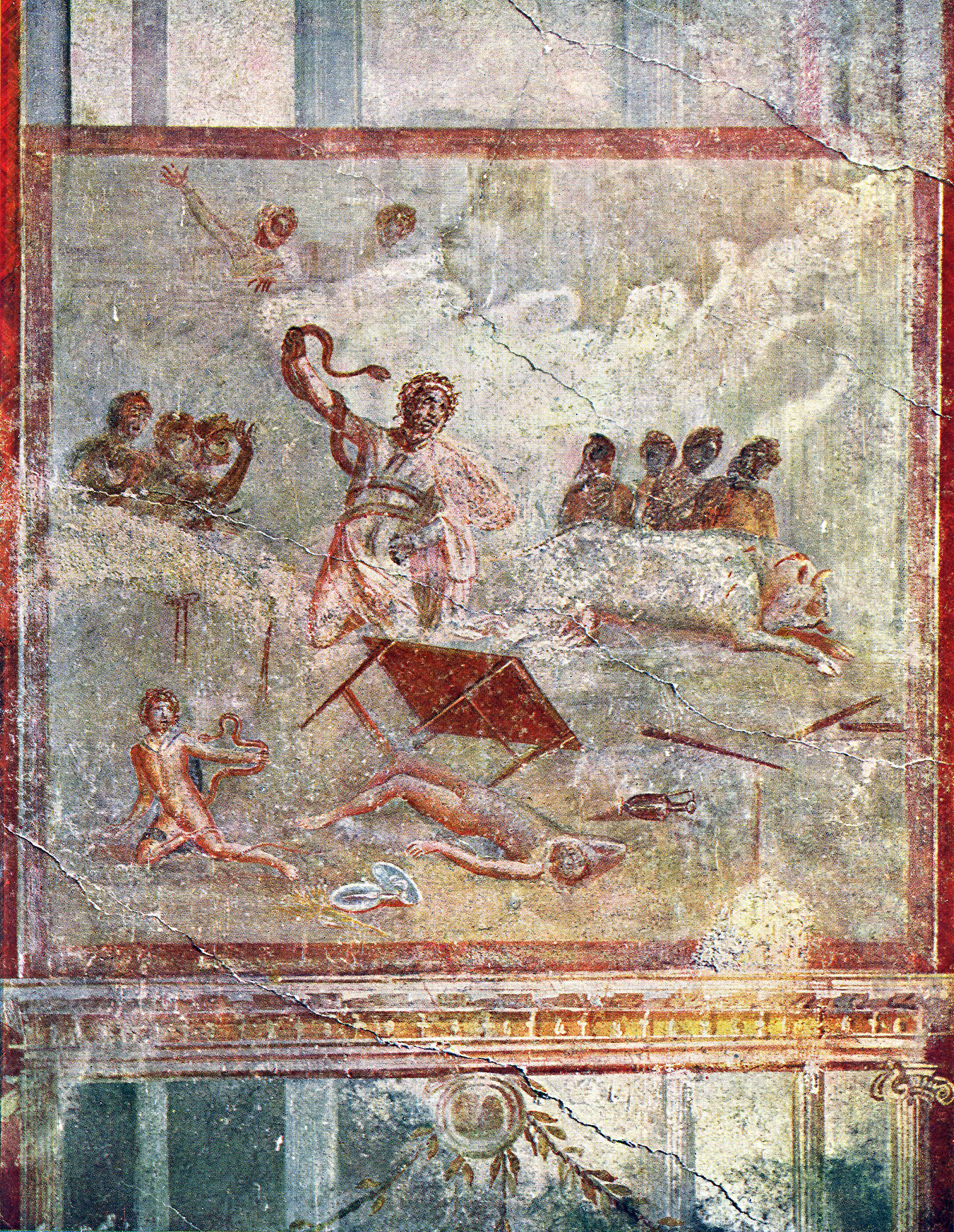
While Laocoön was a recurring subject in texts, he was not as popular in art. Images of Laocoön have been identified on a few pots made by south Italian Greeks in the 4th century B.C.E., but most of the known images are Roman. Gems dating to the late imperial period as well as two 1st-century C.E. paintings from houses in Pompeii depict the death of Laocoön. Artworks are few, however, and the marble statue is the only monumental depiction of the subject to survive.
Pliny and The Laocoön
The Laocoön is fairly unusual among surviving ancient artworks because it is described in an ancient text, Natural History, by Pliny the Elder. Most of the famous artworks described by ancient authors have been lost and those artworks that have survived are without ancient textual description.
Pliny, a Roman aristocrat and scholar, published the first volumes of The Natural History in 77 C.E. This encyclopedia was intended to record all known knowledge. In his discussion of famous statues, Pliny describes the Laocoön as he saw it in the house of the ancient Roman emperor Titus, and attributes it to the artists Hagesandros, Polydoros, and Athenodoros of Rhodes. Pliny praises the statue as superior to all other artworks. Despite some inconsistencies between the Laocoön statue and Pliny’s description, notably the statue is made of multiple blocks of stone rather than a single block as Pliny says, it is widely accepted that the Laocoön in the Vatican is the statue described by Pliny.
Dating the Laocoön
The circumstances surrounding the creation of the Laocoön, including its date, have been long debated by scholars. While one scholar proposed that the statue was actually a Renaissance forgery by Michelangelo, this theory has been widely discredited, and most scholars date the statue between 150 B.C.E. and 70 C.E. Each of these proposals examine why a statue in the Hellenistic Greek style was found in Rome, and the role of Romans as patrons and collectors of Greek sculpture.
The Romans, especially in the late Republic and early Empire, were active connoisseurs of Greek art. As they conquered Greek territories, they imported large numbers of Greek artworks to Italy, removing them from homes, public buildings, and sanctuaries. Romans displayed Greek artworks in their homes and public spaces, many in contexts far removed from their original locations and purposes. These artworks took on new meanings as symbols of the wealth and education of their owners. The Romans also commissioned copies of famous statues as well as new compositions inspired by Greek originals. Rome became a center of Hellenistic art as Greek artists moved to Italy to work for wealthy Romans.
Theories that posit the earliest date for the Laocoön propose that, based on stylistic similarities, the Laocoön is contemporary to the 2nd-century B.C.E. Great Altar at Pergamon and that it was made in the Greek island of Rhodes before being exported to Rome. Other scholars propose that the marble statue found in Rome was a copy of an earlier 2nd-century Greek original. Most writers, however, argue that the Laocoön was made in Rome for Roman patrons.
Support for a Roman context for the creation of the statue comes from the site of Sperlonga, located between Rome and Naples. Here, the emperor Tiberius had a grotto for dining and entertainment decorated with monumental marble statues. The statues are over-life sized and depict scenes from the Trojan war or the life of Odysseus. They are in the same dramatic, hyper-realistic style as the Laocoön, and an artist’s signature was found on the sculptural group that depicted Odysseus’ run-in with the sea monster, Skylla attributing the statues to Hagesandros, Athenadoros, and Polydoros of Rhodes—the same artists to whom Pliny attributes the Laocoön. Debates over the creation of the Laocoön statue are therefore intertwined with the Sperlonga statues.

Most recent scholarly discussions have centered on whether the sculptures were made specifically for the grotto and Titus’s palace or whether they were made earlier and moved to these locations. While there is still no definitive consensus, most scholars now place both the Sperlonga statues and the Laocoön in the 1st century B.C.E. or 1st century C.E. Their dramatic, Hellenistic style, along with the focus on Trojan war themes place them in line with the concerns of upper-class Roman patrons in these periods.
An unquestionable legacy
From Pliny to Michelangelo to modern visitors to the Vatican Museums, the Laocoön statue has made an impact on its viewers. Its dramatic depiction of the agony of Laocoön and his sons forges an emotional connection with its audience. While scholars continue to debate how and when it was created and its ancient context, its legacy is unquestionable.
Conclusion
Cleopatra was defeated at the Battle of Actium in 31 B.C.E. by the future Roman Emperor Augustus (Octavian). Upon her defeat, the Ptolemaic dynasty that ruled Egypt and, simultaneously, the Hellenistic Period ended. With the Roman admiration of and predilection for Greek art and culture, however, Classical aesthetics and teachings continued to endure from antiquity to the modern era.
Citation and Licensing
The following sections were written by Chelsea Wright and are licensed CC BY-NC-SA 4.0:
- Chapter Overview and Introduction
- Focus artwork and term list compiled by Chelsea Wright
The following articles from Smarthistory licensed CC BY-NC-SA 4.0 were remixed and adapted for the chapter:
- Dr. Renee M. Gondek, “Introduction to ancient Greek art,” in Smarthistory, August 14, 2016.
- Dr. Steven Zucker and Dr. Beth Harris, “Capitoline Venus (copy of the Aphrodite of Knidos),” in Smarthistory, April 5, 2016.
- Dr. Rachel Kousser, “Alexander the Great: destroyer, creator, rebuilder,” in Smarthistory, April 10, 2025.
- Dr. Monica Bulger, “Portraits of Alexander the Great,” in Smarthistory, October 15, 2024.
- Dr. Amanda Herring, “Nike (Winged Victory) of Samothrace,” in Smarthistory, August 11, 2021.
- Karin E. Christiaens, “The Pergamon Altar,” in Smarthistory, April 1, 2021.
- Dr. Amanda Herring, “Athanadoros, Hagesandros, and Polydoros of Rhodes, Laocoön and his Sons,” in Smarthistory, March 24, 2026.
- Andrew Stewart, Art in the Hellenistic Age: An Introduction (Cambridge: Cambridge University Press, 2014), p. 8. ↵
- Richard Neer, Art & Archaeology of the Greek World, 2nd edition (London: Thames and Hudson, 2019), p. 351. ↵
- Stewart (2014), p. 8. ↵
- Pliny, Natural History, 7.12. ↵
- Andrew Stewart, Faces of Power: Alexander’s Image and Hellenistic Politics (Berkeley: University of California Press, 1994), p. 73. ↵
- R. R. R. Smith, Hellenistic Sculpture: a Handbook (London: Thames & Hudson, 1991), p. 21. ↵
- John Boardman, Greek Sculpture: the Late Classical Period (London: Thames and Hudson, 1995), p. 103. ↵
- Brunilde Ridgway, Hellenistic Sculpture I: The Styles of ca. 331–200 B.C. (Madison: University of Wisconsin Press, 1990), p. 123 argues this is not a copy of an image by Lysippos. ↵
- Ariel Herrmann, “Art in the Age of Alexander,” Pergamon and the Hellenistic Kingdoms of the Ancient World, exhibition catalogue, edited by Carlos A. Picón and Seán Hemingway (New York: The Metropolitan Museum of Art, 2016), p. 13. ↵
- Julius Valerius, Res gestae Alexandri Macedonia, 1.7. ↵
- Andrew Stewart, Art, Desire and the Body in Ancient Greece (Cambridge: Cambridge University Press, 1997), p. 209. ↵
- Iphigeneia Leventi, “The Great Masters of the Fourth Century,” Handbook of Greek Sculpture, edited by Olga Palagia (Berlin: De Gruyter, 2019), p. 386. One ancient source that addresses this topic is Plutarch, Moralia 335A-B. ↵
- Florian S. Knauss, “Cat. No. 7: Portrait of Alexander the Great (The Alexander Schwarzenberg),” Pergamon and the Hellenistic Kingdoms of the Ancient World, exhibition catalogue, edited by Carlos A. Picón and Seán Hemingway (New York: The Metropolitan Museum of Art, 2016), p. 108. ↵
- Stewart (1997), p. 208. ↵
- Stewart (2014), p. 50. ↵
- Stewart (2014), p. 53. ↵