
Chapter Overview and Introduction
The earliest civilization on the planet was the Ancient Sumerians of Mesopotamia. Mesopotamia is called the “land between two rivers,” referring to the Euphrates and Tigris rivers. The Ancient Sumerians in the region of present-day Iraq introduced many foundational aspects of civilization, including farming, the wheel, and writing. They also established artistic conventions still in use today, such as registers and hierarchy of scale. The content on Ancient Mesopotamia spans several periods. Unlike its neighboring civilization of Egypt, Mesopotamia consisted of a series of successive ruling civilizations: Sumerians, Akkadians, Neo-Sumerians, Babylonians, Assyrians, Neo-Babylonians, and more. The chapter highlights several of these civilizations and closes with an introduction to the Achaemenid Empire of Ancient Persia, which conquered the lands of Ancient Mesopotamia.
Focus Artworks
- The Standard of Ur, 2600–2400 B.C.E., shell, limestone, lapis lazuli, and bitumen, Sumerian
- Stele of Naram-sin, c. 2254-2218 B.C.E., pink sandstone, Akkadian
- Ziggurat of Ur, c. 2100 B.C.E., mud brick and baked brick, Tell el-Mukayyar, Iraq, Neo-Sumerian
- Ashurbanipal Hunting Lions, gypsum hall relief from the North Palace, Ninevah, c. 645-635 B.C.E., Assyrian
- Ishtar Gate and Processional Way (Reconstruction), Babylon, c. 575 B.C.E., glazed mud brick, Neo-Babylonian
Term List
- Mesopotamia
- Tigris and Euphrates
- Sumer
- City-state
- Theocracy
- Cuneiform
- Registers
- Hierarchy of scale
- Akkad
- Stela
- Ziggurat
- Assyria
- Low relief carving
- Neo-Babylonia
- Achaemenids (Persia)
- Apādana
Sumer, an introduction
Sumer was home to some of the oldest known cities, supported by a focus on agriculture. The region of southern Mesopotamia is known as Sumer, and it is in Sumer that we find some of the oldest known cities, including Ur and Uruk.
Uruk
Prehistory ends with Uruk, where we find some of the earliest written records. This large city-state (and it environs) was largely dedicated to agriculture and eventually dominated southern Mesopotamia. Uruk perfected Mesopotamian irrigation and administration systems.
An agricultural theocracy
Within the city of Uruk, there was a large temple complex dedicated to Innana, the patron goddess of the city. The City-State’s agricultural production would be “given” to her and stored at her temple. Harvested crops would then be processed (grain ground into flour, barley fermented into beer) and given back to the citizens of Uruk in equal share at regular intervals.
The head of the temple administration, the chief priest of Innana, also served as political leader, making Uruk the first known theocracy. We know many details about this theocratic administration because the Sumerians left numerous documents in the form of tablets written in cuneiform script.
It is almost impossible to imagine a time before writing. However, you might be disappointed to learn that writing was not invented to record stories, poetry, or prayers to a god. The first fully developed written script, cuneiform, was invented to account for something unglamorous, but very important—surplus commodities: bushels of barley, head of cattle, and jars of oil!
The origin of written language (c. 3200 B.C.E.) was born out of economic necessity and was a tool of the theocratic (priestly) ruling elite who needed to keep track of the agricultural wealth of the city-states. The last known document written in the cuneiform script dates to the first century C.E. Only the hieroglyphic script of the Ancient Egyptians lasted longer.
A reed and clay tablet
A single reed, cleanly cut from the banks of the Euphrates or Tigris river, when pressed cut-edge down into a soft clay tablet, will make a wedge shape. The arrangement of multiple wedge shapes (as few as two and as many as ten) created cuneiform characters. Characters could be written either horizontally or vertically, although a horizontal arrangement was more widely used.
Very few cuneiform signs have only one meaning; most have as many as four. Cuneiform signs could represent a whole word or an idea or a number. Most frequently though, they represented a syllable. A cuneiform syllable could be a vowel alone, a consonant plus a vowel, a vowel plus a consonant and even a consonant plus a vowel plus a consonant. There isn’t a sound that a human mouth can make that this script can’t record.
Probably because of this extraordinary flexibility, the range of languages that were written with cuneiform across history of the Ancient Near East is vast and includes Sumerian, Akkadian, Amorite, Hurrian, Urartian, Hittite, Luwian, Palaic, Hatian, and Elamite.
Standard of Ur and other objects from the Royal Graves
The violence and grandeur of Sumerian kingship
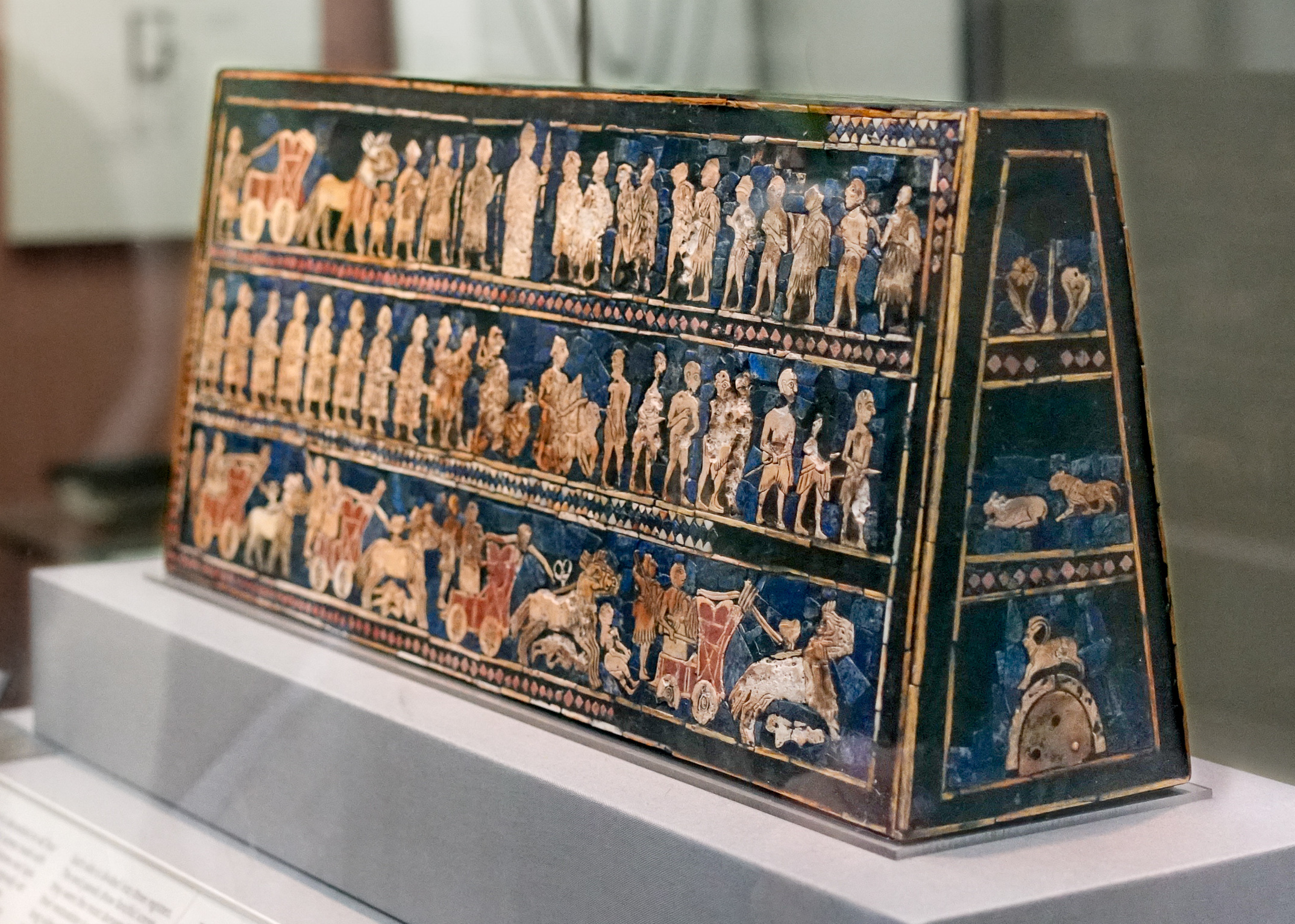
The Standard of Ur is a fascinating rectangular box-like object which, through intricate mosaic scenes, presents the violence and grandeur of Sumerian kingship. It is made up of two long flat panels of wood (and two short sides) and is covered with bitumen (a naturally occurring petroleum substance, essentially tar) in which small pieces of carved shell, red limestone, and lapis lazuli were set. It is thought to be a military standard, something common in battle for thousands of years: a readily visible object held high on a pole in the midst of the combat and paraded in victory to symbolize the army (or individual divisions of the army) of a war lord or general. Although we don’t know if this object ever saw the melee of battle, it certainly witnessed a grisly scene when it was deposited in one of the royal graves at the site of Ur in the mid-3rd millennium B.C.E.
In the 1920s the British archaeologist Sir Leonard Woolley worked extensively at Ur and in 1926 he uncovered a huge cemetery of nearly 2,000 burials spread over an area of 70 x 55 m (230 x 180 ft). Most graves were modest, however a group of sixteen were identified by Woolley as royal tombs because of their wealthier grave goods and treatment at interment.
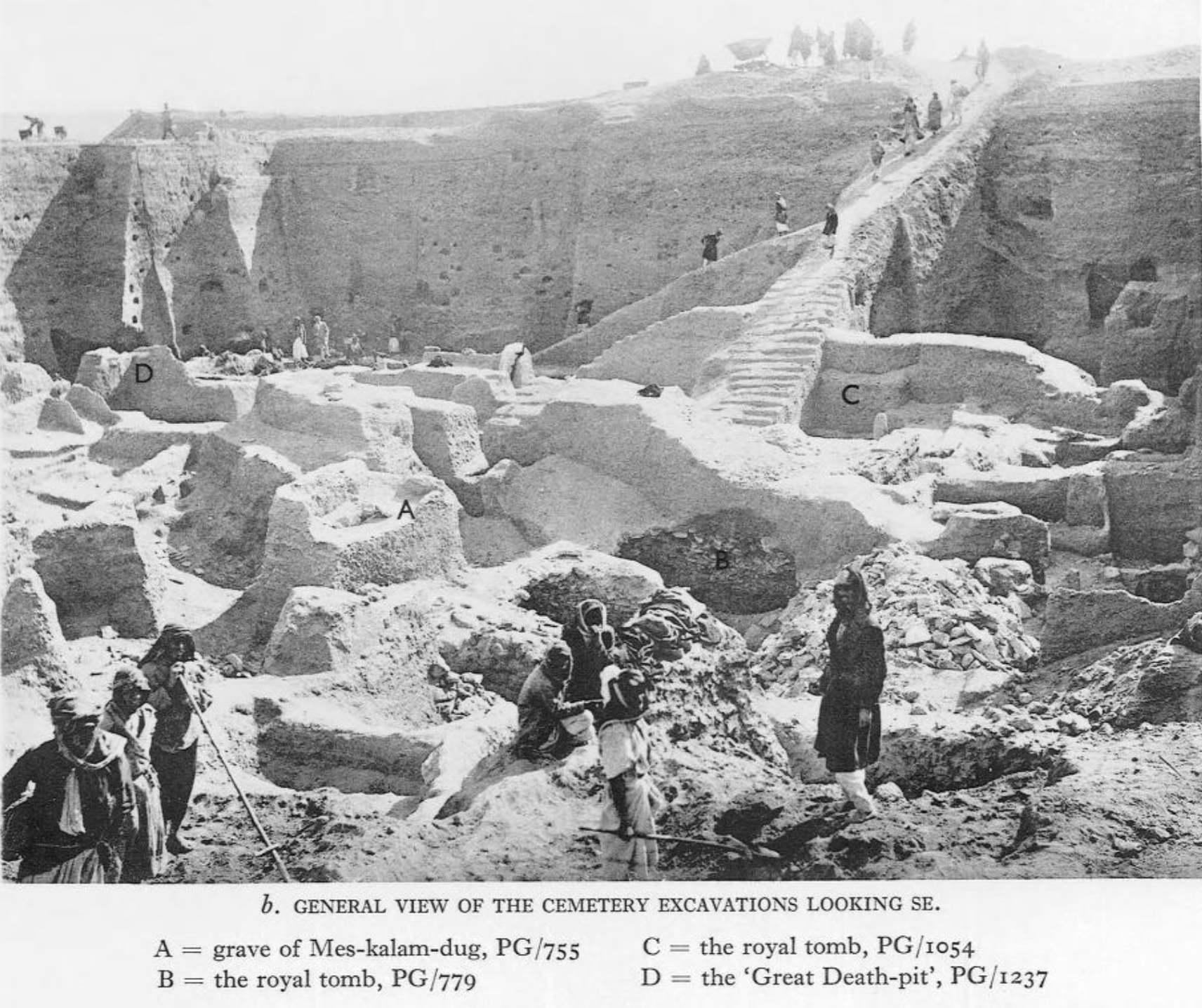
Each of these tombs contained a chamber of limestone rubble with a vaulted roof of mud bricks. The main burial of the tomb was placed in this chamber and surrounded by treasure (offerings of copper, gold, silver and jewelry of lapis lazuli, carnelian, agate, and shell). The main burial was also accompanied by several other bodies in the tomb, a mass grave outside the chamber, often called the Death Pit. We assume that all these individuals were sacrificed at the time of the main burial in a horrific scene of deference.
One of the royal graves (PG779) had four chambers but no death pit. It had been plundered in antiquity but one room was largely untouched and had the remains of at least four individuals. In the corner of this room the remains of the Standard of Ur were found. One of its long sides was found lying face down in the soil with the other one face up, which lead Woolley to conclude that it was a hollow structure; additional inlay were found on either side of the short ends and appeared to fill a triangular shape and which lead to the Standard being reconstructed with its sloping sides. The remains of the Standard were found above the right shoulder of a man whom Woolley thought had carried it attached to a pole. The identification of this object as a military standard is by no means secure; the hollow shape could just as easily have been the sound box of a stringed instrument, such as the Queen’s Lyre found in an adjacent tomb.
War and peace
The two sides of the Standard appear to be the two poles of Sumerian kingship, war and peace. The war side was found face up and is divided into three registers (bands), read from the bottom up, left to right. The story begins at the bottom with war carts, each with a spearman and driver, drawn by donkeys trampling fallen enemies, distinguished by their nudity and wounds, which drip with blood. The middle band shows a group of soldiers wearing fur cloaks and carrying spears walking to the right while bound, naked enemies are executed and paraded to the top band where more are killed.
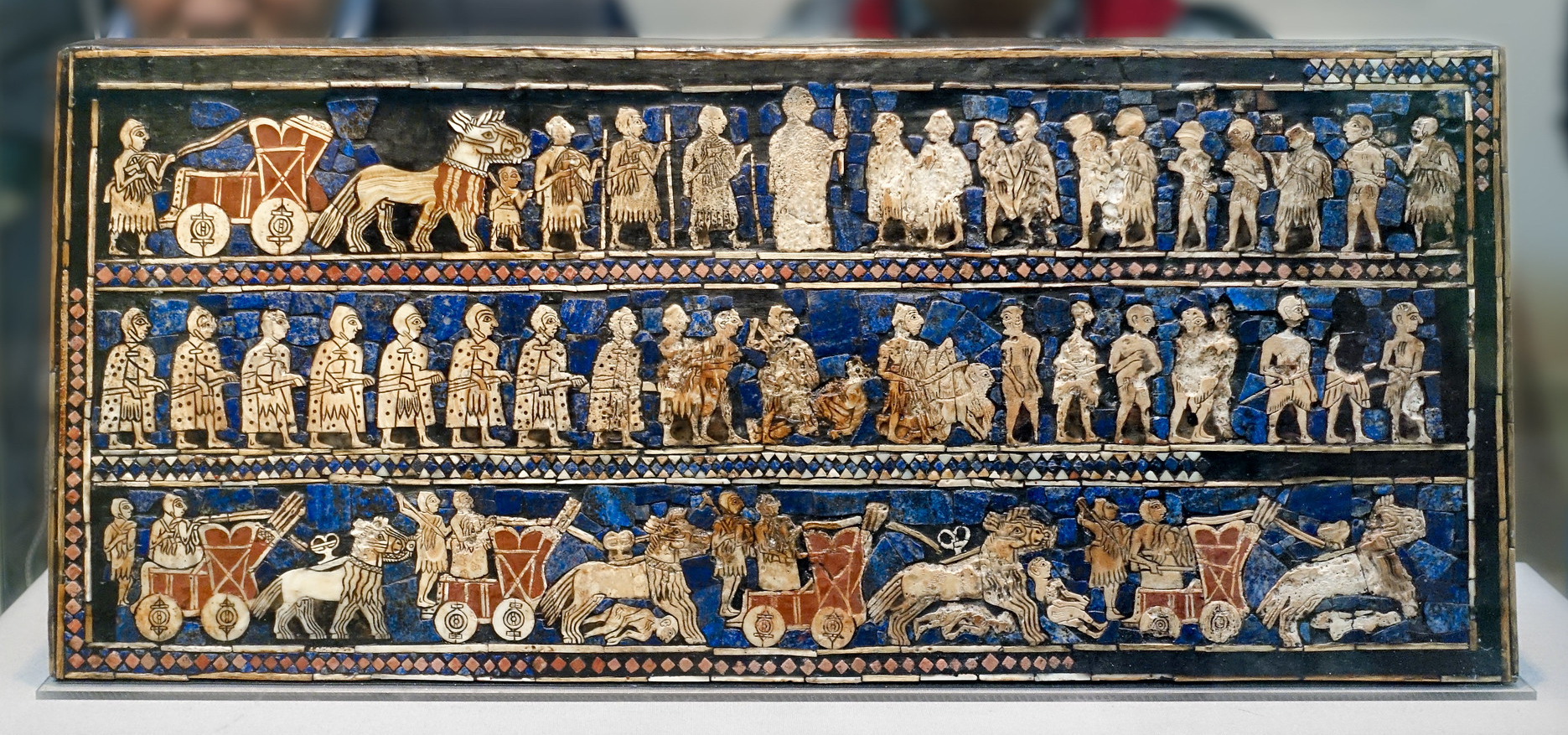
In the center of the top register, we find the king, holding a long spear, physically larger than everyone else, so much so, his head breaks the frame of the scene. Behind him are attendants carrying spears and battle axes and his royal war cart ready for him to jump in. There is a sense of a triumphal moment on the battlefield, when the enemy is vanquished and the victorious king is relishing his win. There is no reason to believe that this is a particular battle or king as there is nothing which identifies it as such; we think it is more of a generic image of a critically important aspect of Ancient Near Eastern kingship.
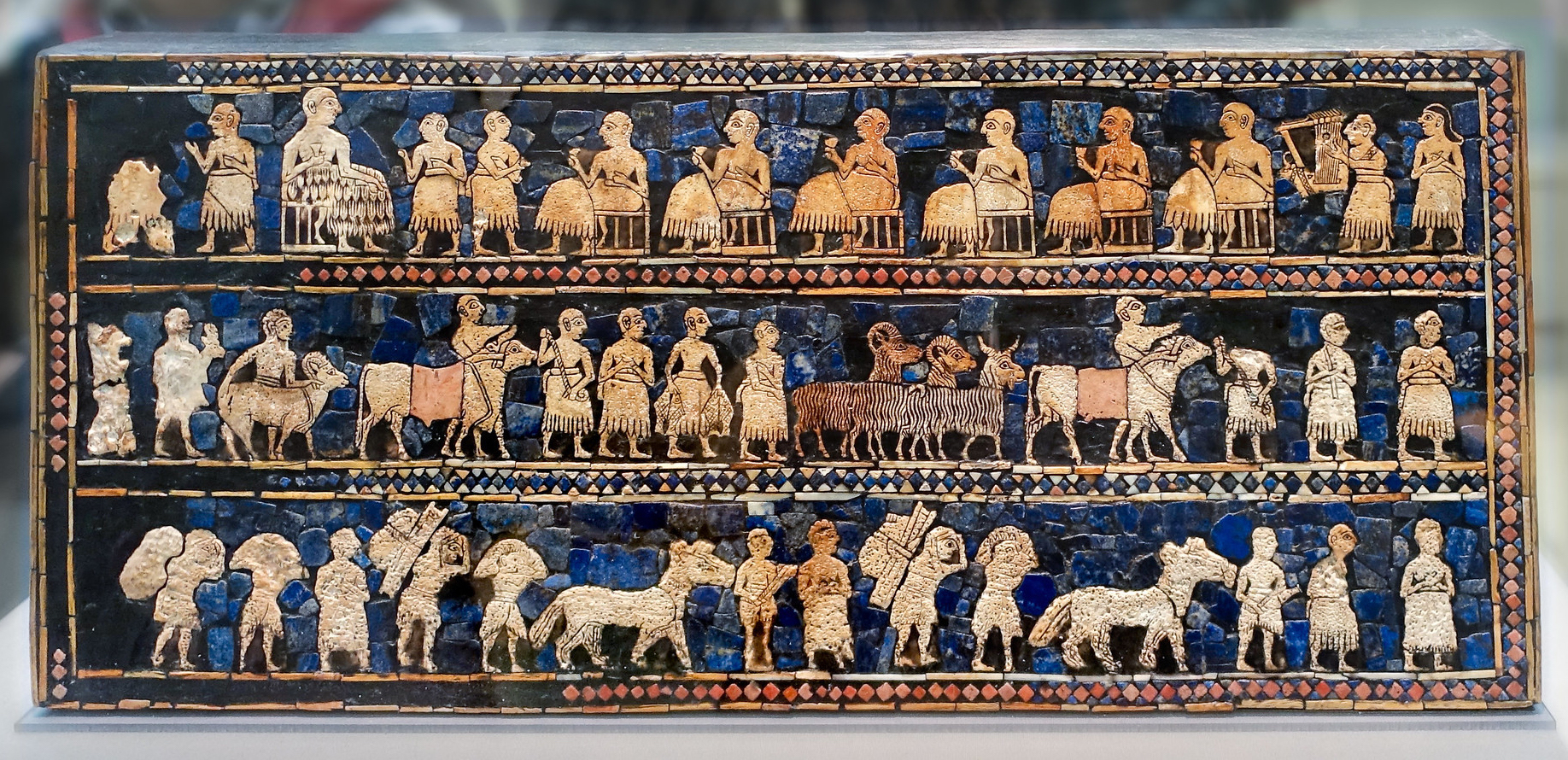
The opposite peace panel also illustrates a cumulative moment, that of the celebration of the king, this time for great agricultural abundance which is afforded by peace. Again, beginning at the bottom left, we see men carrying produce on their shoulders and in bags and leading donkeys. In the central band, men lead bulls, sheep and goats, and carry fish. In the top register a grand feast is taking place, complete with comfortable seating and musical accompaniment.
On the left, the largest figure, the king, is seated wearing a richly flounce fur skirt, again so large, even seated, he breaks the frame. Was it an epic tale of battle that the singer on the far right is performing for entertainment as he plays a bull’s head lyre, again, like the Queen’s Lyre? We will never know but certainly such powerful images of Sumerian kingship tell us that whomever ended his life with the Standard of Ur on his shoulder was willing to give his life in a ritual of kingly burial.
Akkad, an introduction
Competition between Akkad in the north and Ur in the south created two centralized regional powers at the end of the third millennium. This centralization was military in nature and the art of this period generally became more martial. The Akkadian Empire was begun by Sargon, a man from a lowly family who rose to power and founded the royal city of Akkad (Akkad has not yet been located, though one theory puts it under modern Baghdad). Founded by the famed Sargon the Great, Akkad was a powerful military empire.
Head of an Akkadian ruler
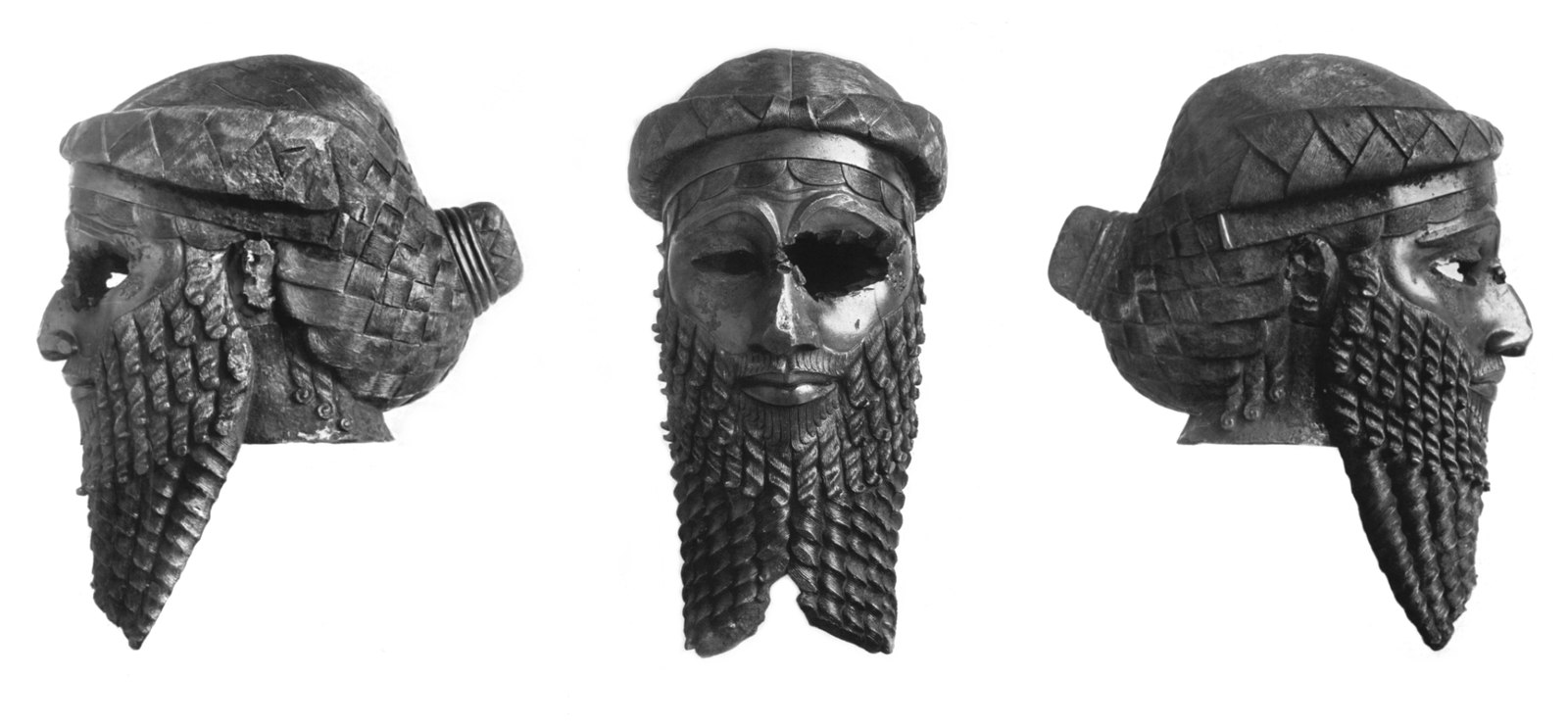
This sculpture of an unidentified Akkadian ruler (some say it is Sargon, but no one knows) is one of the most beautiful and terrifying images in all of Ancient Near Eastern art. The life-sized bronze head shows in sharp geometric clarity, locks of hair, curled lips, and a wrinkled brow. Perhaps more awesome than the powerful and somber face of this ruler is the violent attack that mutilated it in antiquity.
Victory Stele of Naram-Sin
Naram-Sin leads his victorious army up a mountain, as vanquished Lullubi people fall before him. This monument depicts the Akkadian victory over the Lullubi Mountain people. In the 12th century B.C.E., a thousand years after it was originally made, the Elamite king, Shutruk-Nahhunte, attacked Babylon and, according to his later inscription, the stele was taken to Susa in what is now Iran. A stele is a vertical stone monument or marker often inscribed with text or relief carving.
Neo-Sumerian, Ur III period
The kingdom of Akkad ends with internal strife and invasion by the Gutians from the Zagros mountains to the northeast. The Gutians were ousted in turn and the city of Ur, south of Uruk, became dominant. King Ur-Nammu established the third dynasty of Ur, also referred to as the Ur III period. It is during this period that the great Ziggurat of Ur is constructed.
Ziggurat of Ur
Ziggurats
A ziggurat is a built raised platform with four sloping sides—like a chopped-off pyramid. Ziggurats are made of mud-bricks—the building material of choice in the Near East, as stone is rare. Ziggurats were not only a visual focal point of the city, they were a symbolic one, as well—they were at the heart of the theocratic political system (a theocracy is a type of government where a god is recognized as the ruler, and the state officials operate on the god’s behalf). So, seeing the ziggurat towering above the city, one made a visual connection to the god or goddess honored there, but also recognized that deity’s political authority.
The Great Ziggurat of Ur has been reconstructed twice, in antiquity and in the 1980s—what’s left of the original?

The Great Ziggurat
The ziggurat is the most distinctive architectural invention of the Ancient Near East. Like an Ancient Egyptian pyramid, an ancient Near Eastern ziggurat has four sides and rises up to the realm of the gods. However, unlike Egyptian pyramids, the exterior of ziggurats were not smooth but tiered to accommodate the work which took place at the structure, as well as the administrative oversight and religious rituals essential to Ancient Near Eastern cities. Ziggurats are found scattered around what is today Iraq and Iran, and stand as an imposing testament to the power and skill of the ancient culture that produced them.
One of the largest and best-preserved ziggurats of Mesopotamia is the Great Ziggurat at Ur. Small excavations occurred at the site around the turn of the twentieth century, and in the 1920s Sir Leonard Woolley, in a joint project with the University of Pennsylvania Museum in Philadelphia and the British Museum in London, revealed the monument in its entirety.
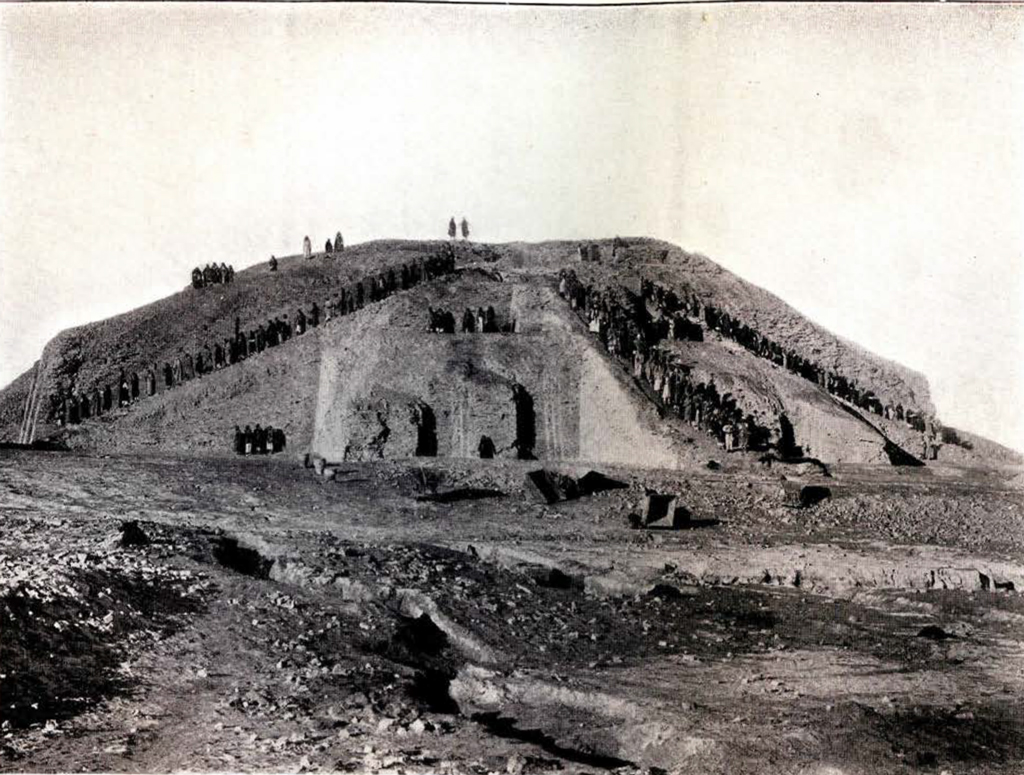
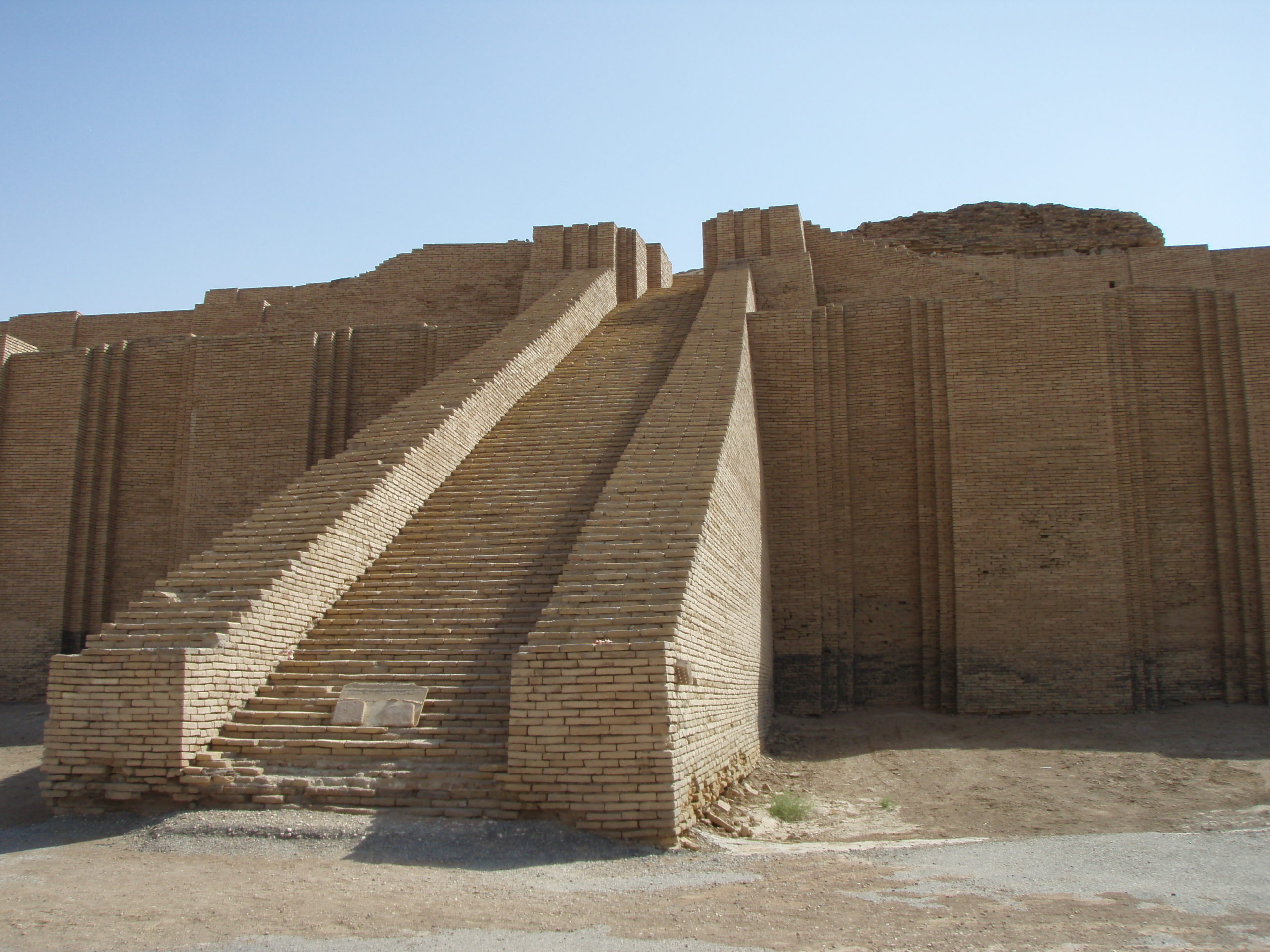
What Woolley found was a massive rectangular pyramidal structure, oriented to true north, 210 x 150 feet (64 x 46 meters), constructed with three levels of terraces, standing originally between 70 x 100 feet (21 x 30 meters) high. Three monumental staircases led up to a gate at the first terrace level. Next, a single staircase rose to a second terrace which supported a platform on which a temple and the final and highest terrace stood. The core of the ziggurat is made of mud brick covered with baked bricks laid with bitumen, a naturally occurring tar. Each of the baked bricks measured about 11.5 x 11.5 x 2.75 inches (29 x 29 x 7 cm) and weighed as much as 33 pounds. The lower portion of the ziggurat, which supported the first terrace, would have used some 720,000 baked bricks. The resources needed to build the ziggurat at Ur are staggering.
Moon goddess Nanna
The ziggurat at Ur and the temple on its top were built around 2100 B.C.E. by the king Ur-Nammu of the Third Dynasty of Ur for the moon goddess Nanna, the divine patron of the city state. The structure would have been the highest point in the city by far and, like the spire of a medieval cathedral, would have been visible for miles around, a focal point for travelers and the pious alike. As the ziggurat supported the temple of the patron god of the city of Ur, it is likely that it was the place where the citizens of Ur would bring agricultural surplus and where they would go to receive their regular food allotments. In antiquity, to visit the ziggurat at Ur was to seek both spiritual and physical nourishment.
Clearly the most important part of the ziggurat at Ur was the Nanna temple at its top, but this, unfortunately, has not survived. Some blue glazed bricks have been found which archaeologists suspect might have been part of the temple decoration. The lower parts of the ziggurat, which do survive, include amazing details of engineering and design. For instance, because the unbaked mud brick core of the temple would, according to the season, be alternatively more or less damp, the architects included holes through the baked exterior layer of the temple allowing water to evaporate from its core. Additionally, drains were built into the ziggurat’s terraces to carry away the winter rains.
Hussein’s assumption
The ziggurat at Ur has been restored twice. The first restoration was in antiquity. The last Neo-Babylonian king, Nabodinus, apparently replaced the two upper terraces of the structure in the 6th century B.C.E. Some 2,400 years later in the 1980s, Saddam Hussein restored the façade of the massive lower foundation of the ziggurat, including the three monumental staircases leading up to the gate at the first terrace. Since this most recent restoration, however, the ziggurat at Ur has experienced some damage. During the recent war led by American and coalition forces, Saddam Hussein parked his MiG fighter jets next to the ziggurat, believing that the bombers would spare them for fear of destroying the ancient site. Hussein’s assumptions proved only partially true as the ziggurat sustained some damage from American and coalition bombardment.
Assyria, an introduction
Led by aggressive warrior kings, Assyria dominated the fertile crescent for half a millennia, amassing vast wealth.
A military culture
The Assyrian empire dominated Mesopotamia and all of the Near East for the first half of the first millennium B.C.E., led by a series of highly ambitious and aggressive warrior kings. Assyrian society was entirely military, with men obliged to fight in the army at any time. State offices were also under the purview of the military.
Indeed, the culture of the Assyrians was brutal, the army seldom marching on the battlefield but rather terrorizing opponents into submission who, once conquered, were tortured, raped, beheaded, and flayed with their corpses publicly displayed. The Assyrians torched enemies’ houses, salted their fields, and cut down their orchards.
Luxurious palaces
As a result of these fierce and successful military campaigns, the Assyrians acquired massive resources from all over the Near East which made the Assyrian kings very rich. The palaces were on an entirely new scale of size and glamour; one contemporary text describes the inauguration of the palace of Kalhu, built by Ashurnasirpal II, to which almost 70,000 people were invited to banquet.
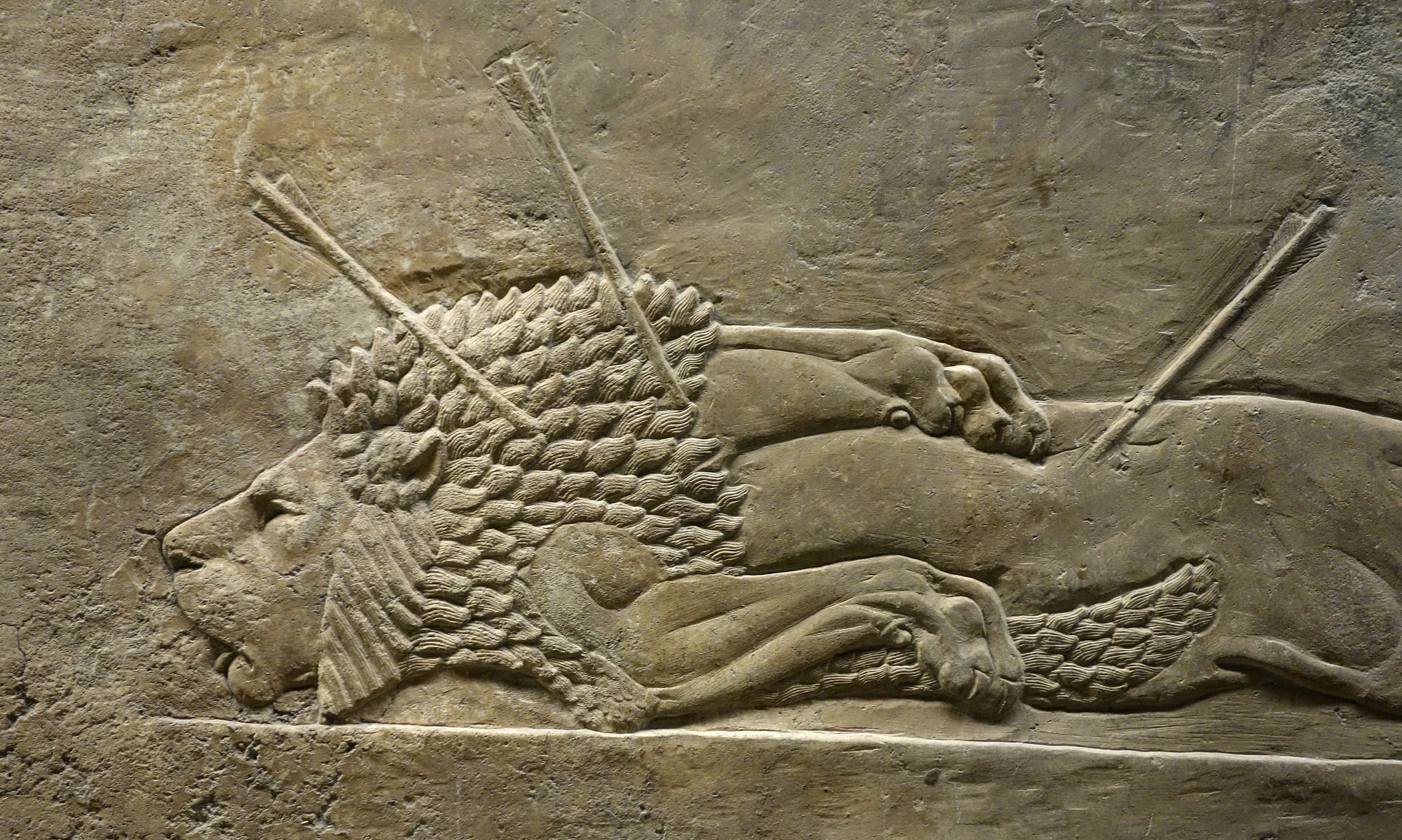
Some of this wealth was spent on the construction of several gigantic and luxurious palaces spread throughout the region. The interior public reception rooms of Assyrian palaces were lined with large scale carved limestone reliefs which offer beautiful and terrifying images of the power and wealth of the Assyrian kings and some of the most beautiful and captivating images in all of ancient Near Eastern art.
Feats of bravery
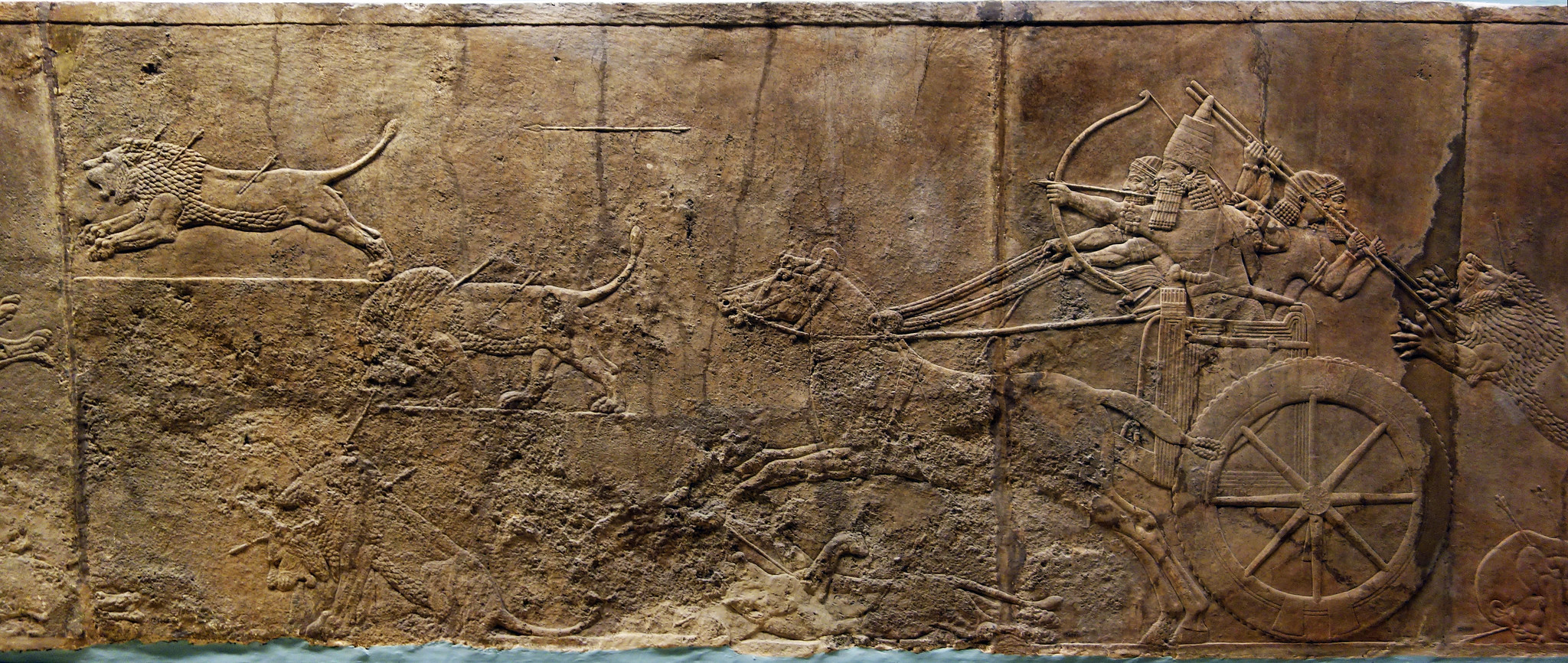
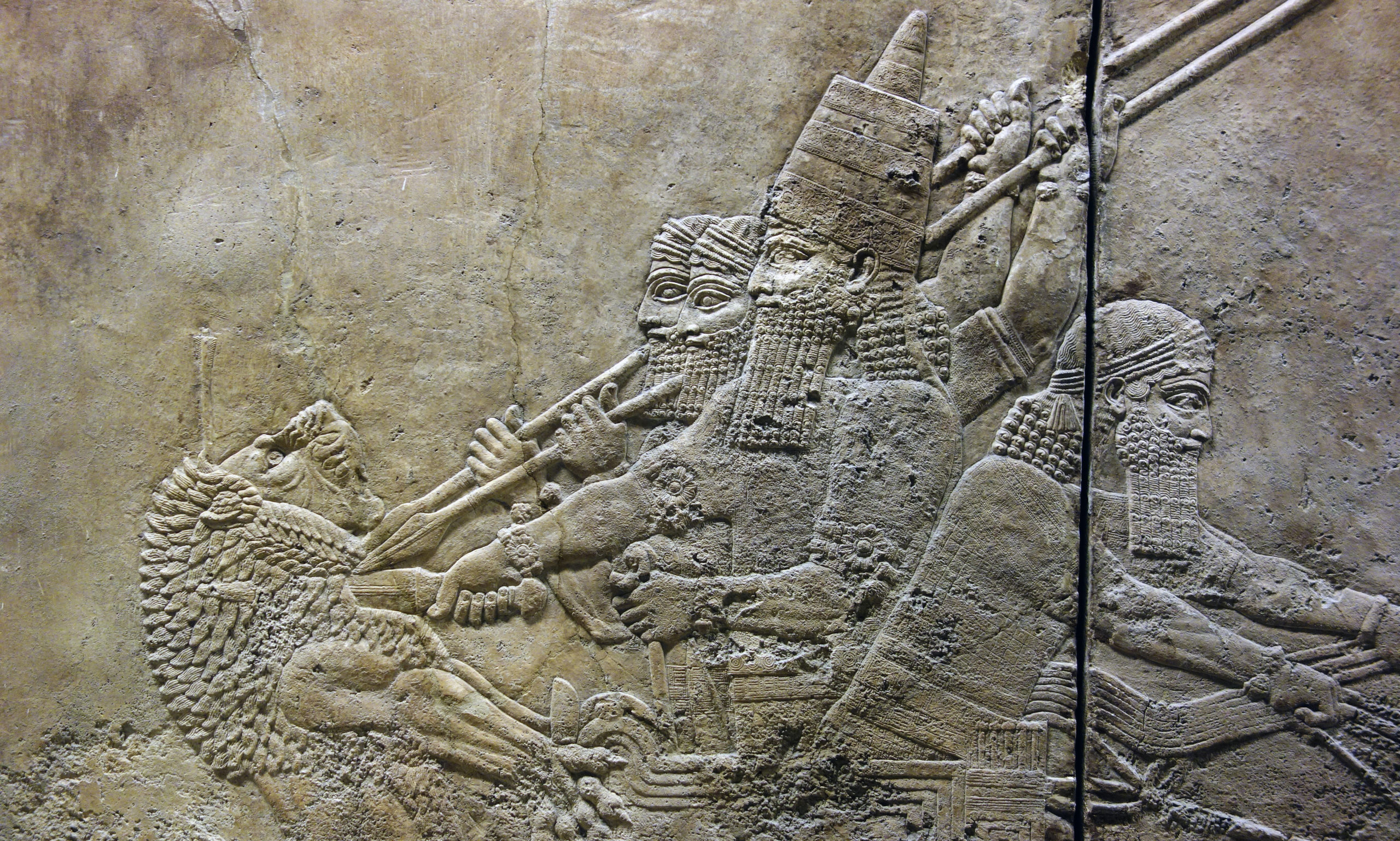
Like all Assyrian kings, Ashurbanipal decorated the public walls of his palace with images of himself performing great feats of bravery, strength, and skill. Among these he included a lion hunt in which we see him coolly taking aim at a lion in front of his charging chariot, while his assistants fend off another lion attacking at the rear.
The destruction of Susa
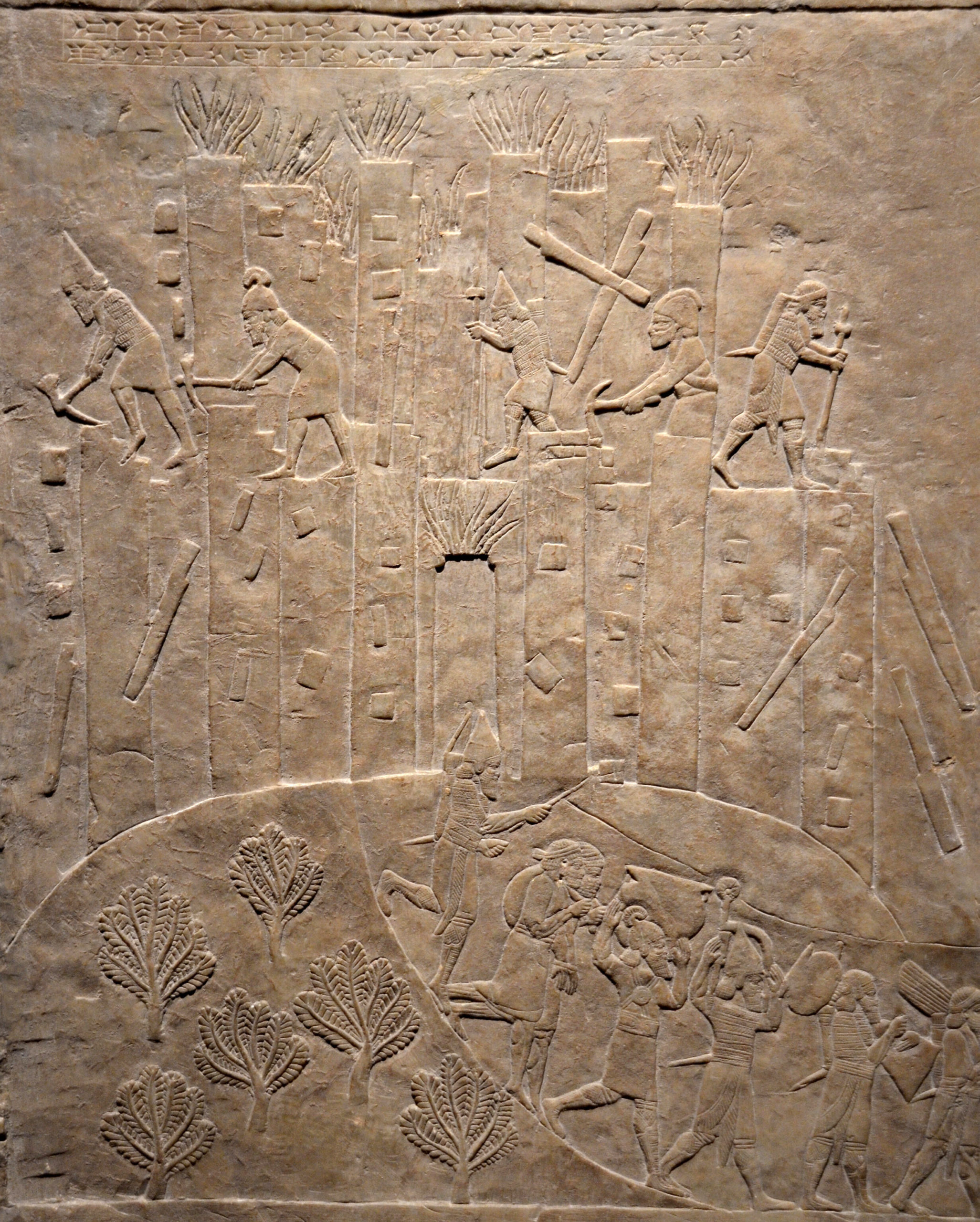
One of the accomplishments Ashurbanipal was most proud of was the total destruction of the city of Susa. In one relief, we see Ashurbanipal’s troops destroying the walls of Susa with picks and hammers while fire rages within the walls of the city.
Military victories & exploits
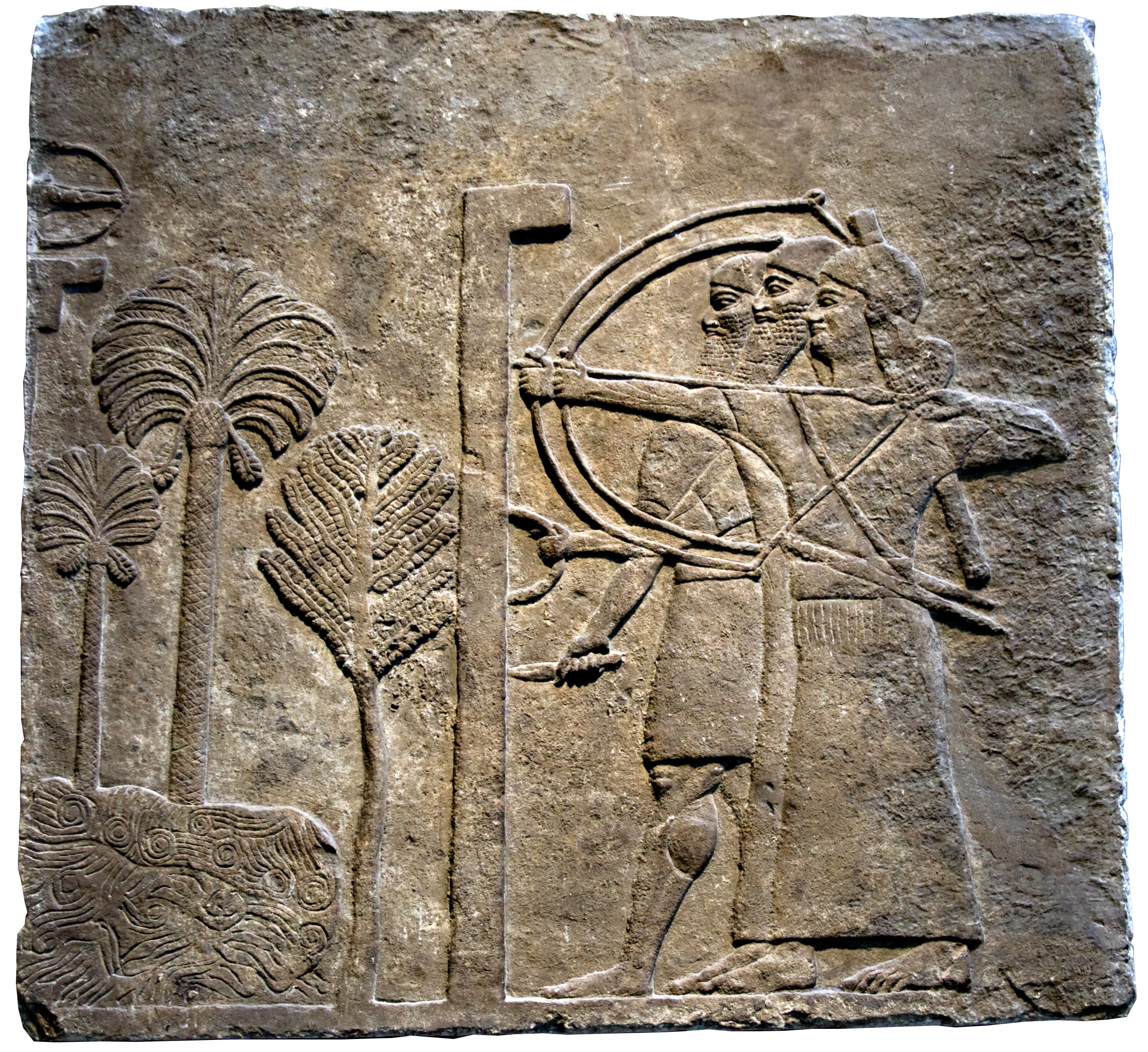
In the Central Palace at Nimrud, the Neo-Assyrian king Tiglath-pileser III illustrates his military victories and exploits, including the siege of a city in great detail. In one scene we see a soldier holding a large screen to protect two archers who are taking aim. The topography includes three different trees and a roaring river, most likely setting the scene in and around the Tigris or Euphrates rivers.
Ashurbanipal Hunting Lions
Only the king was permitted to kill lions—and doing so signified his power and ability to keep nature at bay.
Practicing Visual Analysis
The artists who created Ashurbanipal Hunting Lions used long-standing Ancient Mesopotamian visual arts techniques, particularly the register to convey a narrative about power and authority. However, unlike the Sumerian Standard of Ur with its composite view of the king and use of hierarchy of scale, Assyrian artists used a profile view and showed the king in proportion with other figures and forms. Carved in low relief, contour lines create the shapes of the figurative forms of people, animals, and objects like chariots. The pictorial space is shallow yet shows depth with overlapping figures. Assyrian artists used many patterns to indicate hair and luxurious details on clothing while lines within the figures define the muscular structure on both people and animals. Interestingly, although the display of emotion is mostly absent in the art of the ancient world, Assyrian artists frequently showed animals in agony.
The Ishtar Gate and Neo-Babylonian art and architecture
“I, Nebuchadnezzar . . . magnificently adorned them with luxurious splendor for all mankind to behold in awe.” Nebuchadnezzar II, Inscription plaque of the Ishtar Gate
The chronology of Mesopotamia is complicated. Scholars refer to places (Sumer, for example) and peoples (the Babylonians), but also empires (Babylonia), and unfortunately for students of the Ancient Near East, these organizing principles do not always agree. The result is that we might, for example, speak of the very Ancient Babylonians starting in the 1800s B.C.E. and then also the Neo-Babylonians more than a thousand years later. What came in between you ask? Well, quite a lot, but mostly the Kassites and the Assyrians.
The Assyrian Empire which had dominated the Near East came to an end at around 600 B.C.E. due to a number of factors including military pressure by the Medes (a pastoral mountain people, again from the Zagros mountain range), the Babylonians, and possibly also civil war.
A Neo-Babylonian dynasty
The Babylonians rose to power in the late 7th century and were heirs to the urban traditions which had long existed in southern Mesopotamia. They eventually ruled an empire as dominant in the Near East as that held by the Assyrians before them.
This period is called Neo-Babylonian (or new Babylonia) because Babylon had also risen to power earlier and became an independent city-state, most famously during the reign of King Hammurabi.
In the art of the Neo-Babylonian Empire, we see an effort to invoke the styles and iconography of the 3rd-millennium rulers of Babylonia. In fact, one Neo-Babylonian king, Nabonidus, found a statue of Sargon of Akkad, set it in a temple and provided it with regular offerings.
Architecture
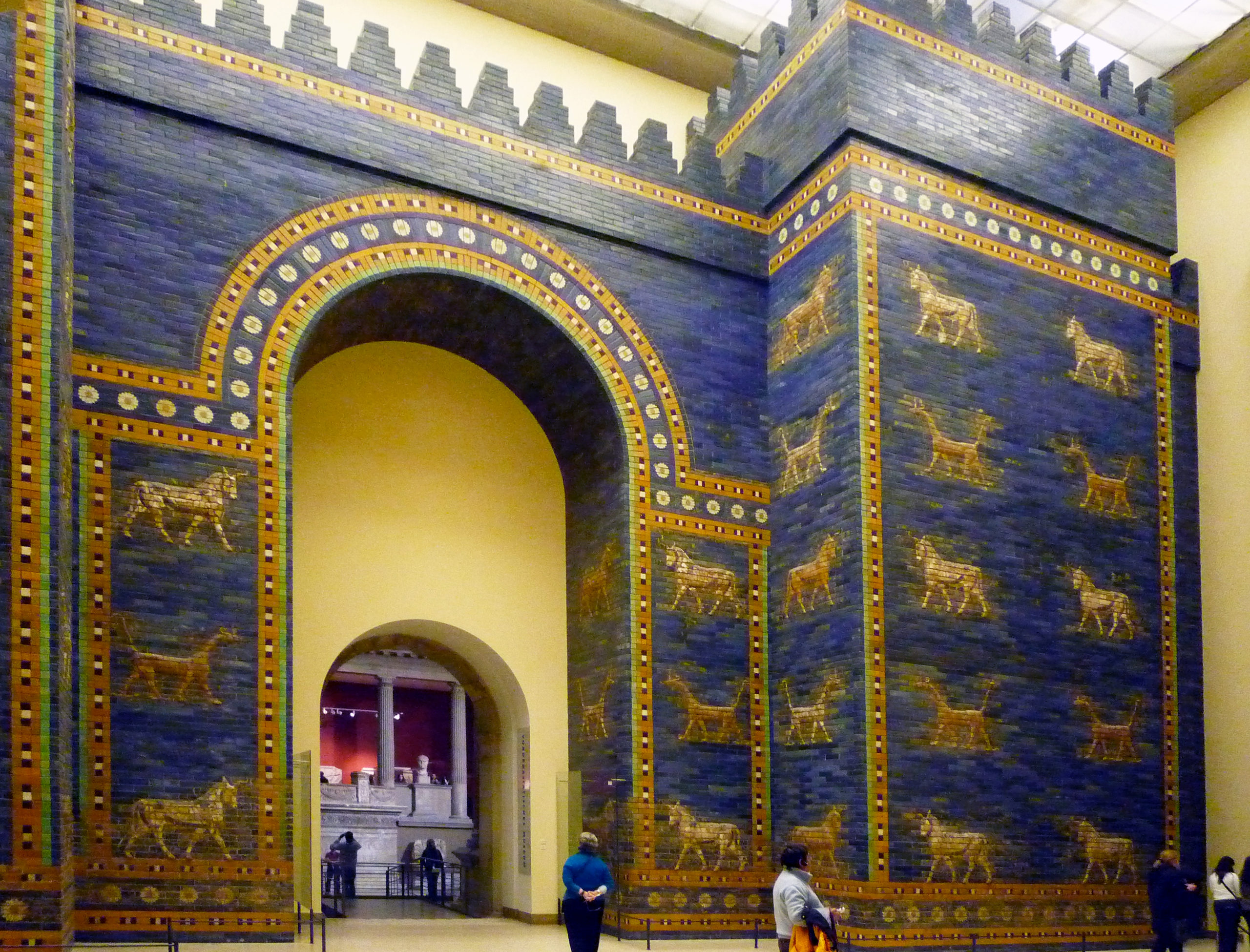
The Neo-Babylonians are most famous for their architecture, notably at their capital city, Babylon. Nebuchadnezzar II largely rebuilt this ancient city including its walls and seven gates. It is also during this era that Nebuchadnezzar II purportedly built the “Hanging Gardens of Babylon” for his wife because she missed the gardens of her homeland in Media (modern day Iran). Though mentioned by ancient Greek and Roman writers, the “Hanging Gardens” may, in fact, be legendary.
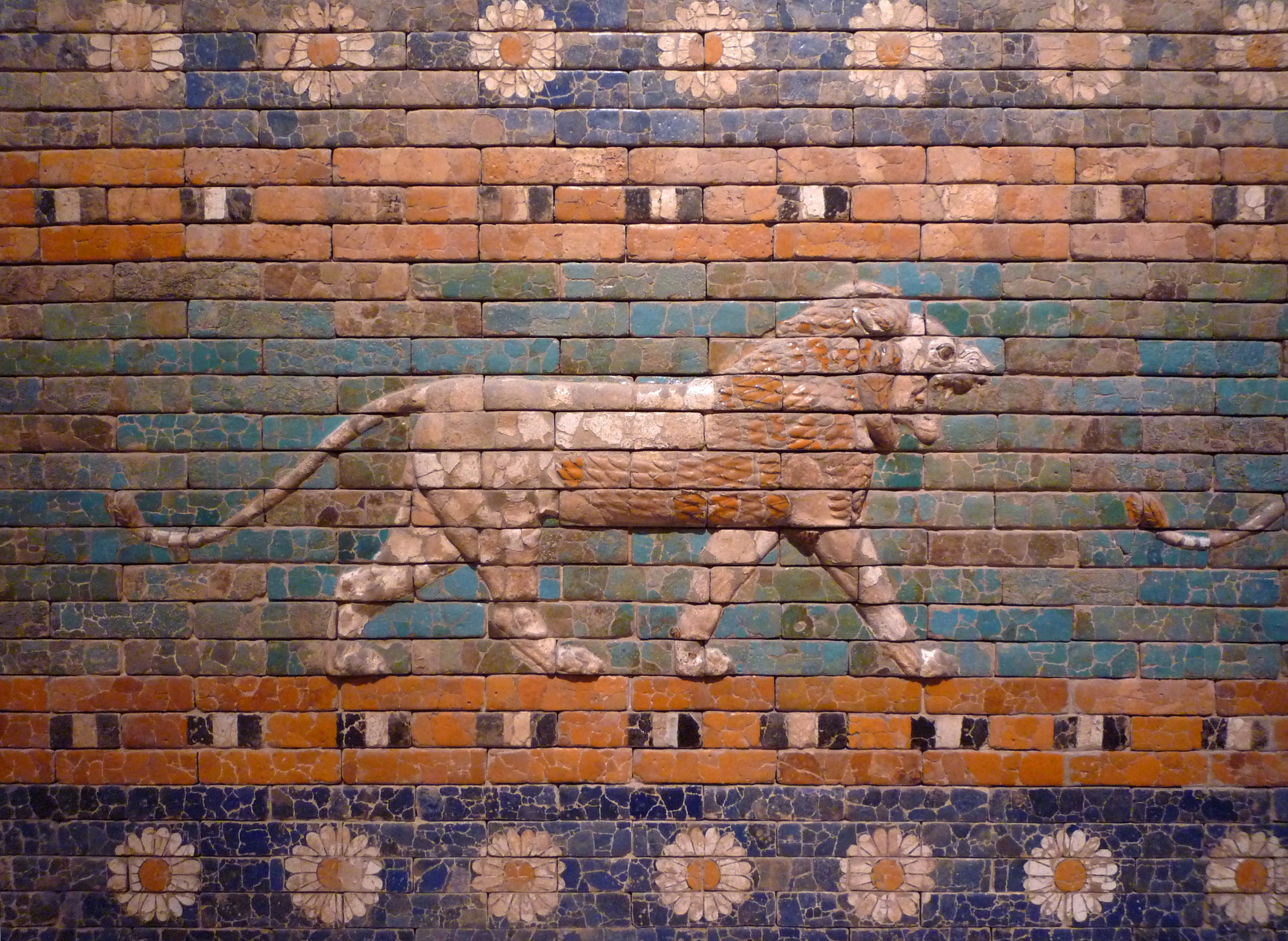
The Ishtar Gate (today in the Pergamon Museum in Berlin) was the most elaborate of the inner city gates constructed in Babylon in antiquity. The whole gate was covered in glazed bricks which the inscription tells us are made of lapis lazuli which would have rendered the façade with a jewel-like shine. Alternating rows of lion and cattle march in a relief procession across the gleaming blue surface of the gate.
Ancient Persia, an introduction
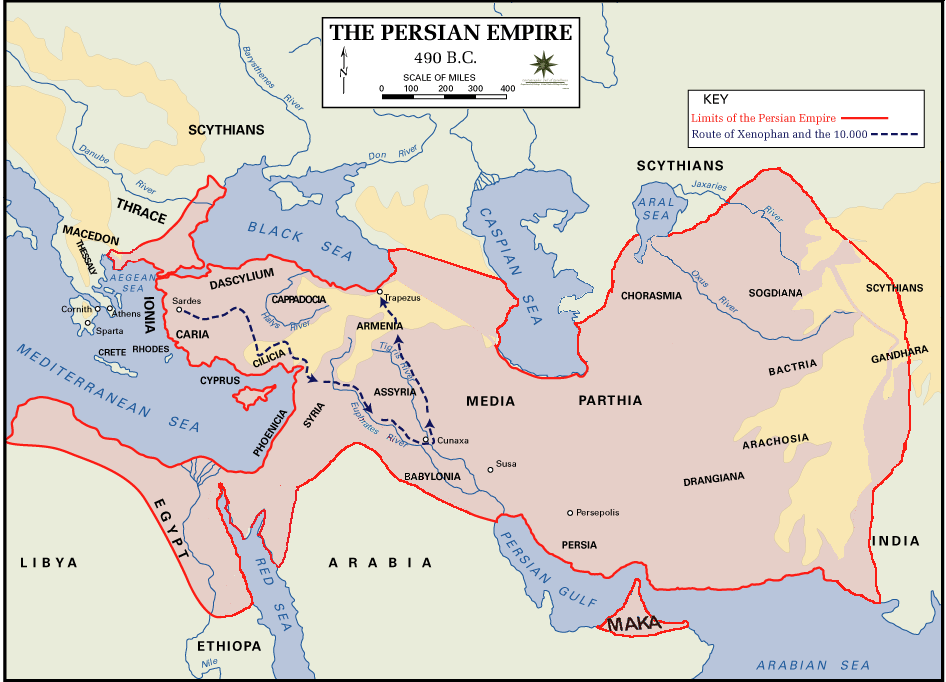
The heart of Ancient Persia is in what is now southwest Iran, in the region called the Fars. In the second half of the 6th century B.C.E., the Persians (also called the Achaemenids) created an enormous empire reaching from the Indus Valley to Northern Greece and from Central Asia to Egypt. Under Cyrus the Great, the Achaemenids conquered Neo-Babylonia and the region of Mesopotamia.
Overview of the Achaemenid Empire
The Achaemenid Empire (First Persian Empire) was an imperial state of Western Asia founded by Cyrus the Great and flourishing from c. 550–330 B.C.E. The empire’s territory was vast, stretching from the Balkan peninsula in the west to the Indus River valley in the east. The Achaemenid Empire is notable for its strong, centralized bureaucracy that had, at its head, a king and relied upon regional satraps (regional governors).
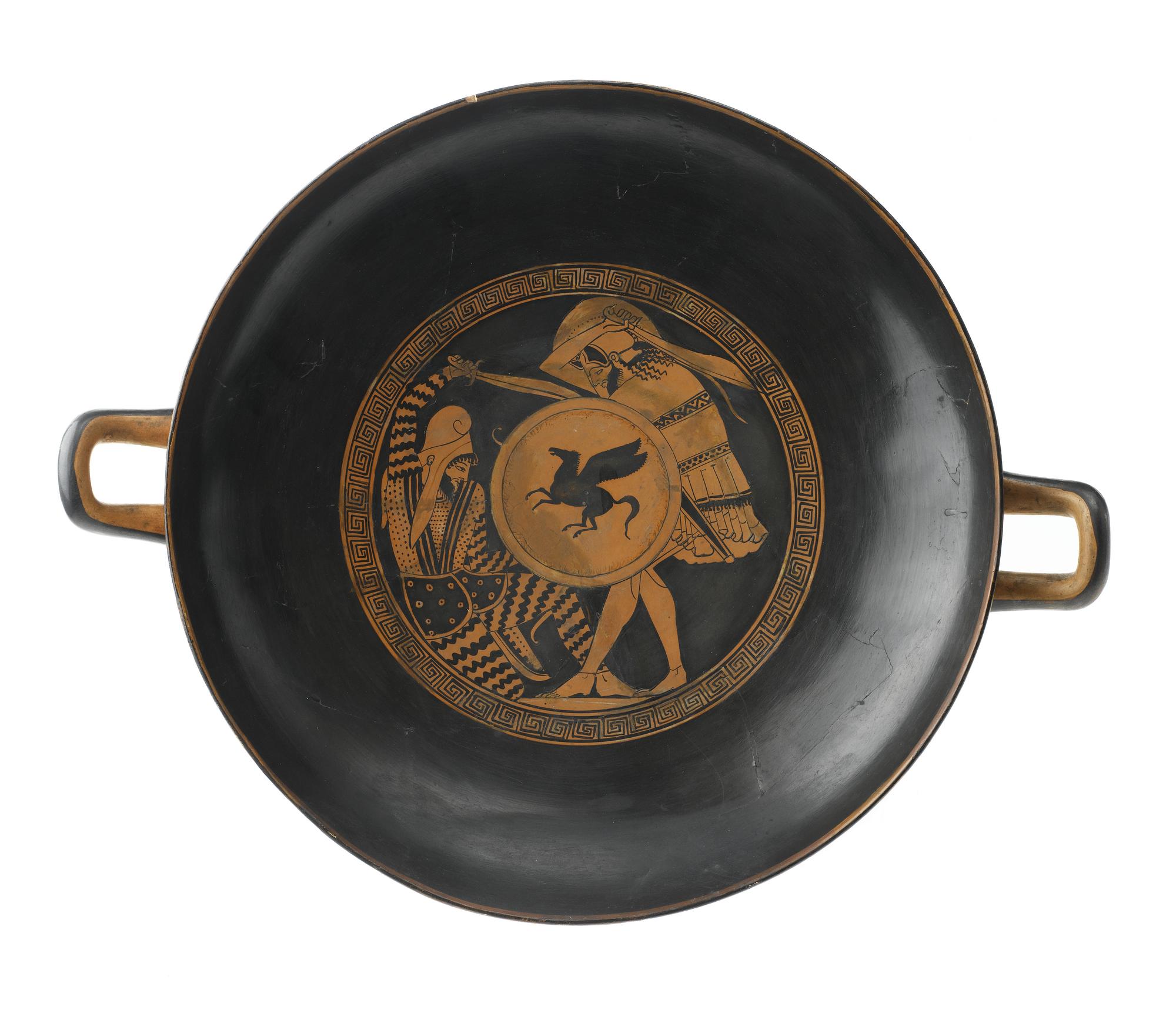
A number of formerly independent states were made subject to the Persian Empire. These states covered a vast territory from central Asia and Afghanistan in the east to Asia Minor, Egypt, Libya, and Macedonia in the west. The Persians famously attempted to expand their empire further to include mainland Greece but they were ultimately defeated in this attempt. The Persian kings are noted for their penchant for monumental art and architecture. In creating monumental centers, including Persepolis, the Persian kings employed art and architecture to craft messages that helped to reinforce their claims to power and depict, iconographically, Persian rule.
A tolerant empire
Although the surviving literary sources on the Persian empire were written by ancient Greeks who were the sworn enemies of the Persians and highly contemptuous of them, the Persians were, in fact quite tolerant and ruled a multi-ethnic empire. Persia was the first empire known to have acknowledged the different faiths, languages, and political organizations of its subjects.
This tolerance for the cultures under Persian control carried over into administration. In the lands which they conquered, the Persians continued to use indigenous languages and administrative structures. For example, the Persians accepted hieroglyphic script written on papyrus in Egypt and traditional Babylonian record keeping in cuneiform in Mesopotamia. The Persians must have been very proud of this new approach to empire, as can be seen in the representation of the many different peoples in the reliefs from Persepolis, a city founded by Darius the Great in the 6th century B.C.E.
By the early fifth century B.C.E. the Achaemenid (Persian) Empire ruled an estimated 44% of the human population of planet Earth. Through regional administrators the Persian kings controlled a vast territory which they constantly sought to expand. Famous for monumental architecture, Persian kings established numerous monumental centers, among those is Persepolis (today, in Iran). The great audience hall of the Persian kings Darius and Xerxes presents a visual microcosm of the Achaemenid empire—making clear, through sculptural decoration, that the Persian king ruled over all of the subjugated ambassadors and vassals (who are shown bringing tribute in an endless eternal procession).
Overview of Persepolis
Persepolis, the ceremonial capital of the Achaemenid Persian empire, lies some 60 km northeast of Shiraz, Iran. The earliest archaeological remains of the city date to c. 515 B.C.E. Persepolis, a Greek toponym meaning “city of the Persians”, was known to the Persians as Pārsa and was an important city of the ancient world, renowned for its monumental art and architecture. The site was excavated by German archaeologists Ernst Herzfeld, Friedrich Krefter, and Erich Schmidt between 1931 and 1939. Its remains are striking even today, leading UNESCO to register the site as a World Heritage Site in 1979.
Persepolis was intentionally founded in the Marvdašt Plain during the later part of the sixth century B.C.E. It was marked as a special site by Darius the Great in 518 B.C.E. when he indicated the location of a “Royal Hill” that would serve as a ceremonial center and citadel for the city. This was an action on Darius’ part that was similar to the earlier king Cyrus the Great who had founded the city of Pasargadae. Darius the Great directed a massive building program at Persepolis that would continue under his successors Xerxes and Artaxerxes I. Persepolis would remain an important site until it was sacked, looted, and burned under Alexander the Great of Macedon in 330 B.C.E.
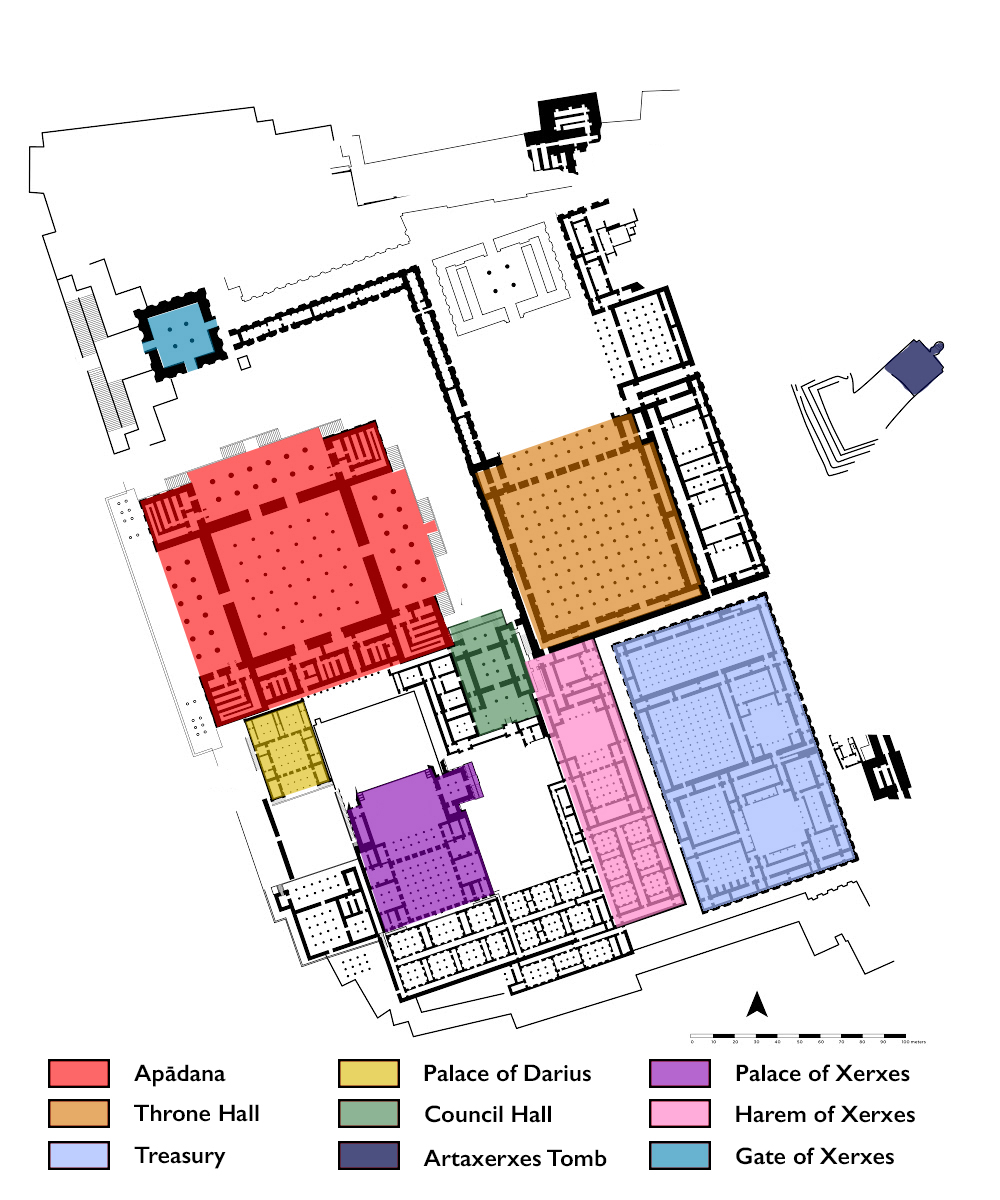
Darius’ program at Persepolis including the building of a massive terraced platform covering 125,000 square meters of the promontory. This platform supported four groups of structures: residential quarters, a treasury, ceremonial palaces, and fortifications. Scholars continue to debate the purpose and nature of the site. Primary sources indicate that Darius saw himself building an important stronghold. Some scholars suggest that the site has a sacred connection to the god Mithra (Mehr), as well as links to the Nowruz, the Persian New Year’s festival. More general readings see Persepolis as an important administrative and economic center of the Persian empire.
Persepolis: The Audience Hall of Darius and Xerxes
The Apādana
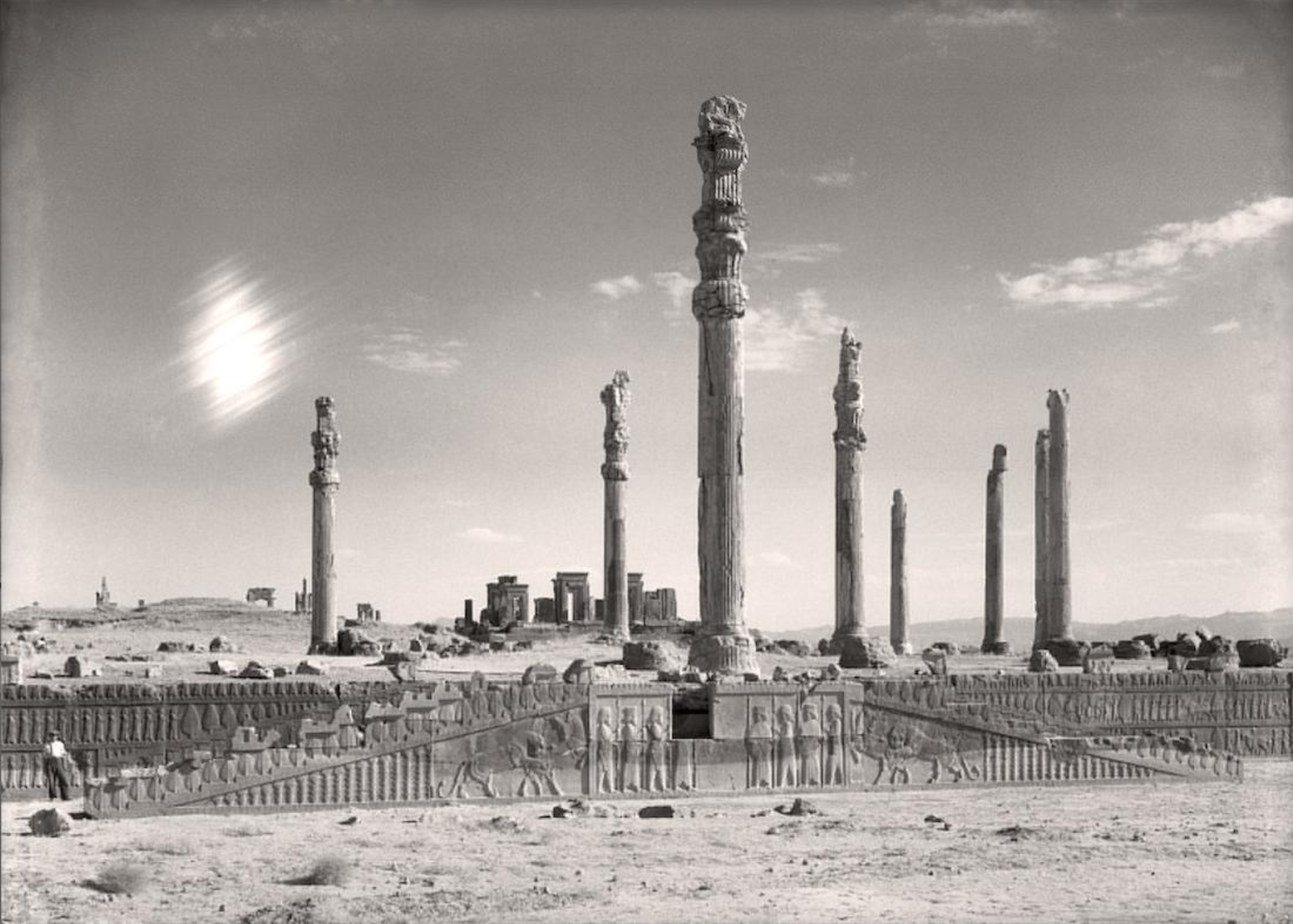
Persepolis included a massive columned hall used for receptions by the Kings, called the Apādana. This hall contained 72 columns and two monumental stairways.
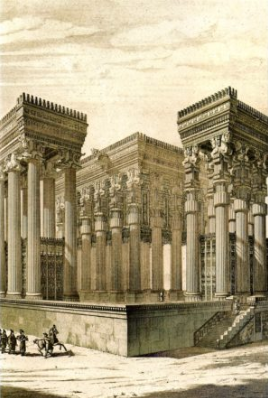
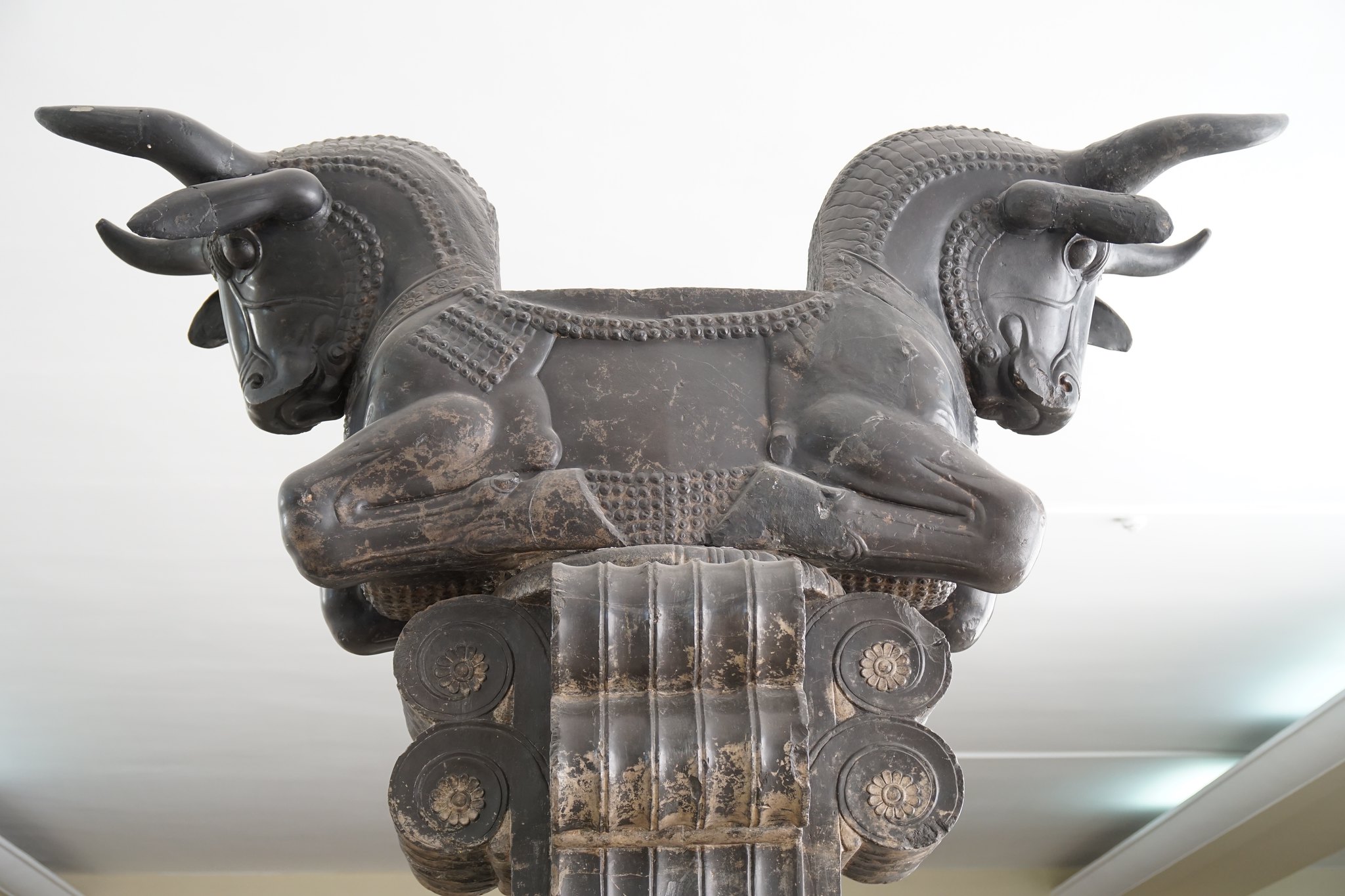
The Apādana palace is a large ceremonial building, likely an audience hall with an associated portico. The audience hall itself is hypostyle in its plan, meaning that the roof of the structure is supported by columns. Apādana is the Persian term equivalent to the Greek hypostyle (Ancient Greek: ὑπόστυλος hypóstȳlos). The footprint of the Apādana is c. 1,000 square meters; originally 72 columns, each standing to a height of 24 meters, supported the roof (only 14 columns remain standing today). The column capitals assumed the form of either twin-headed bulls (above), eagles or lions, all animals represented royal authority and kingship.
The king of the Achaemenid Persian empire is presumed to have received guests and tribute in this soaring, imposing space. To that end a sculptural program decorates monumental stairways on the north and east. The theme of that program is one that pays tribute to the Persian king himself as it depicts representatives of 23 subject nations bearing gifts to the king.
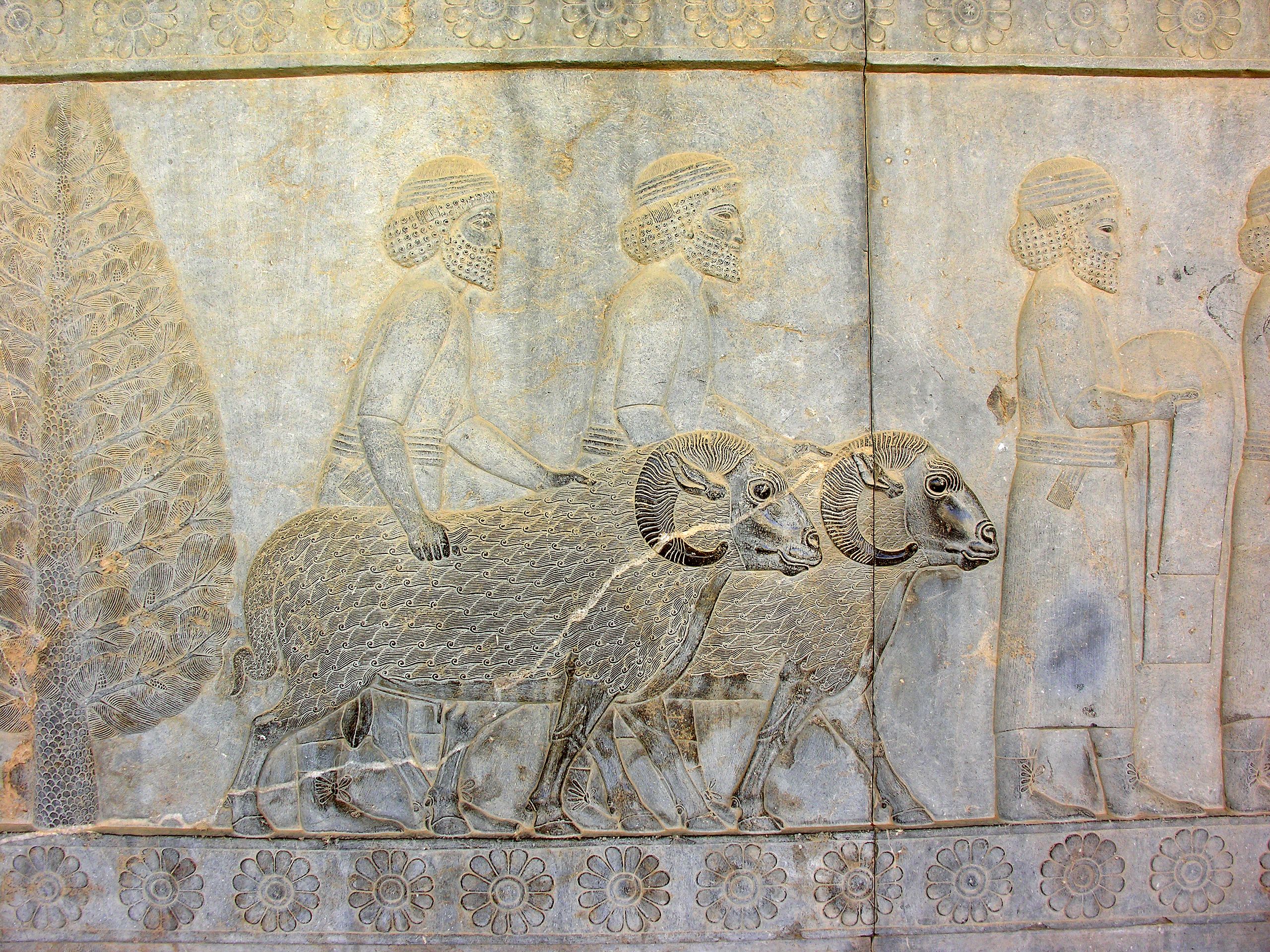
The walls of the spaces and stairs leading up to the reception hall were carved with hundreds of figures, several of which illustrated subject peoples of various ethnicities, bringing tribute to the Persian king.
The Apādana stairs and sculptural program
The monumental stairways that approach the Apādana from the north and the east were adorned with registers of relief sculpture that depicted representatives of the twenty-three subject nations of the Persian empire bringing valuable gifts as tribute to the king. The sculptures form a processional scene, leading some scholars to conclude that the reliefs capture the scene of actual, annual tribute processions—perhaps on the occasion of the Persian New Year–that took place at Persepolis. The relief program of the northern stairway was perhaps completed c. 500–490 B.C.E. The two sets of stairway reliefs mirror and complement each other. Each program has a central scene of the enthroned king flanked by his attendants and guards.
Noblemen wearing elite outfits and military apparel are also present. The representatives of the twenty-three nations, each led by an attendant, bring tribute while dressed in costumes suggestive of their land of origin. Margaret Root interprets the central scenes of the enthroned king as the focal point of the overall composition, perhaps even reflecting events that took place within the Apādana itself.
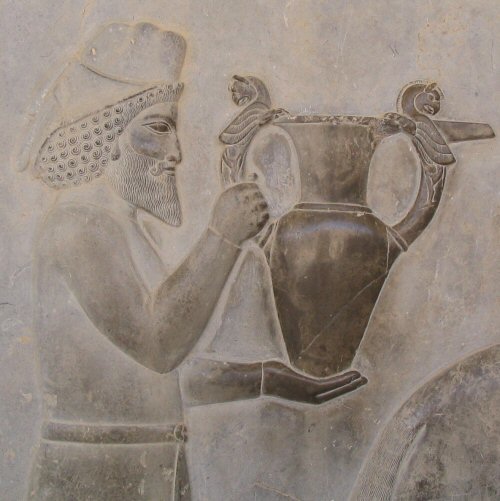
The relief program of the Apādana serves to reinforce and underscore the power of the Persian king and the breadth of his dominion. The motif of subjugated peoples contributing their wealth to the empire’s central authority serves to visually cement this political dominance. These processional scenes may have exerted influence beyond the Persian sphere, as some scholars have discussed the possibility that Persian relief sculpture from Persepolis may have influenced Athenian sculptors of the fifth century B.C.E. who were tasked with creating the Ionic frieze of the Parthenon in Athens. In any case, the Apādana, both as a building and as an ideological tableau, make clear and strong statements about the authority of the Persian king and present a visually unified idea of the immense Achaemenid empire.
Conquered by Alexander the Great
The Persian Empire was, famously, conquered by Alexander the Great. Alexander no doubt was impressed by the Persian system of absorbing and retaining local language and traditions as he imitated this system himself in the vast lands he won in battle. Indeed, Alexander made a point of burying the last Persian emperor, Darius III, in a lavish and respectful way in the royal tombs near Persepolis. This enabled Alexander to claim title to the Persian throne and legitimize his control over the greatest empire of the Ancient Near East.
Conclusion
Ancient Mesopotamian history spans a vast timeline across several different civilizations of the Ancient Near East. From the Sumerians and their city-centers like Ur to the Persian Empire anchored in Persepolis, the various civilizations created artworks that were expressive of cultural ideas related to religion, politics, and power.
Citation and Licensing
The following sections were written by Chelsea Wright and are licensed CC BY-NC-SA 4.0:
- Chapter Overview and Introduction
- Focus artwork and term list compiled by Chelsea Wright
- Practicing Visual Analysis
- Conclusion
The following articles from Smarthistory licensed CC BY-NC-SA 4.0 were remixed and adapted for the chapter:
- Dr. Senta German, “Sumer, an introduction,” in Smarthistory, June 8, 2018.
- Dr. Senta German, “Standard of Ur and other objects from the Royal Graves,” in Smarthistory, July 26, 2023.
- Dr. Senta German, “Akkad, an introduction,” in Smarthistory, June 8, 2018.
- Dr. Beth Harris and Dr. Steven Zucker, “Victory Stele of Naram-Sin,” in Smarthistory, November 24, 2015.
- Dr. Senta German, “Ziggurat of Ur,” in Smarthistory, August 8, 2015.
- Dr. Senta German, “White Temple and ziggurat, Uruk,” in Smarthistory, August 8, 2015.
- Dr. Senta German, “Assyria, an introduction,” in Smarthistory, May 14, 2019.
- Dr. Steven Zucker and Dr. Beth Harris, “Ashurbanipal Hunting Lions,” in Smarthistory, December 11, 2015.
- Dr. Senta German, “The Ishtar Gate and Neo-Babylonian art and architecture,” in Smarthistory, August 8, 2015.
- Dr. Senta German, “Ancient Persia, an introduction,” in Smarthistory, June 8, 2018.
- Dr. Jeffrey A. Becker, “Persepolis: The Audience Hall of Darius and Xerxes,” in Smarthistory, January 24, 2016.