
Chapter Overview and Introduction
Visual analysis as a methodology for studying the history of art. Being able to accurately describe a work of art can be difficult. We know what we see, but how do we put that into words? Visual analysis is your training to describe what you see. In the technique of visual analysis, discussion of historical context and iconography (symbolism) is set aside. Instead, the focus is on all the physical or formal qualities of an artwork. Often, visual analysis is called formal analysis. This is because the approach analyzes the formal properties within an artwork: line, shape, scale, color, pattern, texture, etc.
Prehistoric refers to the period before written historical documentation. It is in the prehistoric era that some of the earliest artistic expressions were created by human beings. Early humans expressed themselves through two-dimensional drawing and painting, three-dimensional sculpture, and three-dimensional architecture. The chronology of the prehistoric era spans a large time frame. Prehistoric art ranges from Paleolithic sculptures like Nude Woman dating from c. 28,000-25,000 B.C.E. to Neolithic architectural monuments such as Stonehenge dating to 2500-1600 B.C.E.
Focus Artworks
- Nude woman (Venus of Willendorf) from Willendorf, Austria, c. 28,000-25,000 B.C.E., limestone
- Quartzite slabs depicting animals, Apollo 11 Cave, Namibia, c. 25,500–25,300 B.C.E.
- Warty pig (Sus celebensis), c. 43,900 B.C.E., painted with ocher (clay pigment), Maros-Pangkep caves, Leang Bulu’ Sipong 4, South Sulawesi, Indonesia
- Hall of the Bulls in the cave at Lascaux, France, c. 16,000-14,000 B.C.E., largest bull 11’6″ long
- Stonehenge, Salisbury Plain, Wiltshire, England, 2500-1600 B.C.E.
Term List
- Visual Analysis (also called Formal Analysis)
- Formal properties
- Subject matter (iconography)
- Historical context
- Scale
- Composition
- Foreground
- Background
- Pictorial space
- Overlapping
- Form
- Figurative form
- Curvilinear
- Rectilinear
- Line
- Contour line
- Color
- Light
- Tone
- Texture
- Veracity
- Pattern
- Prehistoric
- Paleolithic
- Stationary art
- Portable (moveable, mobile) art
- Twisted perspective
- Neolithic
How to do visual (formal) analysis
The vocabulary presented in this section will be used throughout the entire textbook. Artists and art historians use a shared set of terminology to analyze an artwork. The following video demonstrates the technique of visual analysis as applied to a Renaissance painting Madonna of the Meadow by Giovanni Bellini. The same formal elements discussed in the video can be applied to prehistoric artworks, including the Venus of Willendorf and Hall of Bulls.
Paleolithic art, an introduction
The oldest art: ornamentation
Humans (Homo sapiens) make art. We do this for many reasons and with whatever technologies are available to us. Recent research suggests that Neanderthals also made art.
Extremely old, non-representational ornamentation has been found across Africa. The oldest firmly-dated example is a collection of 82,000 year old Nassarius snail shells found in Morocco that are pierced and covered with red ochre. Wear patterns suggest that they may have been strung beads. Nassarius shell beads found in Israel may be more than 100,000 years old and in the Blombos cave in South Africa, pierced shells and small pieces of ochre (red Hematite) etched with simple geometric patterns have been found in a 75,000-year-old layer of sediment.
The oldest representational art
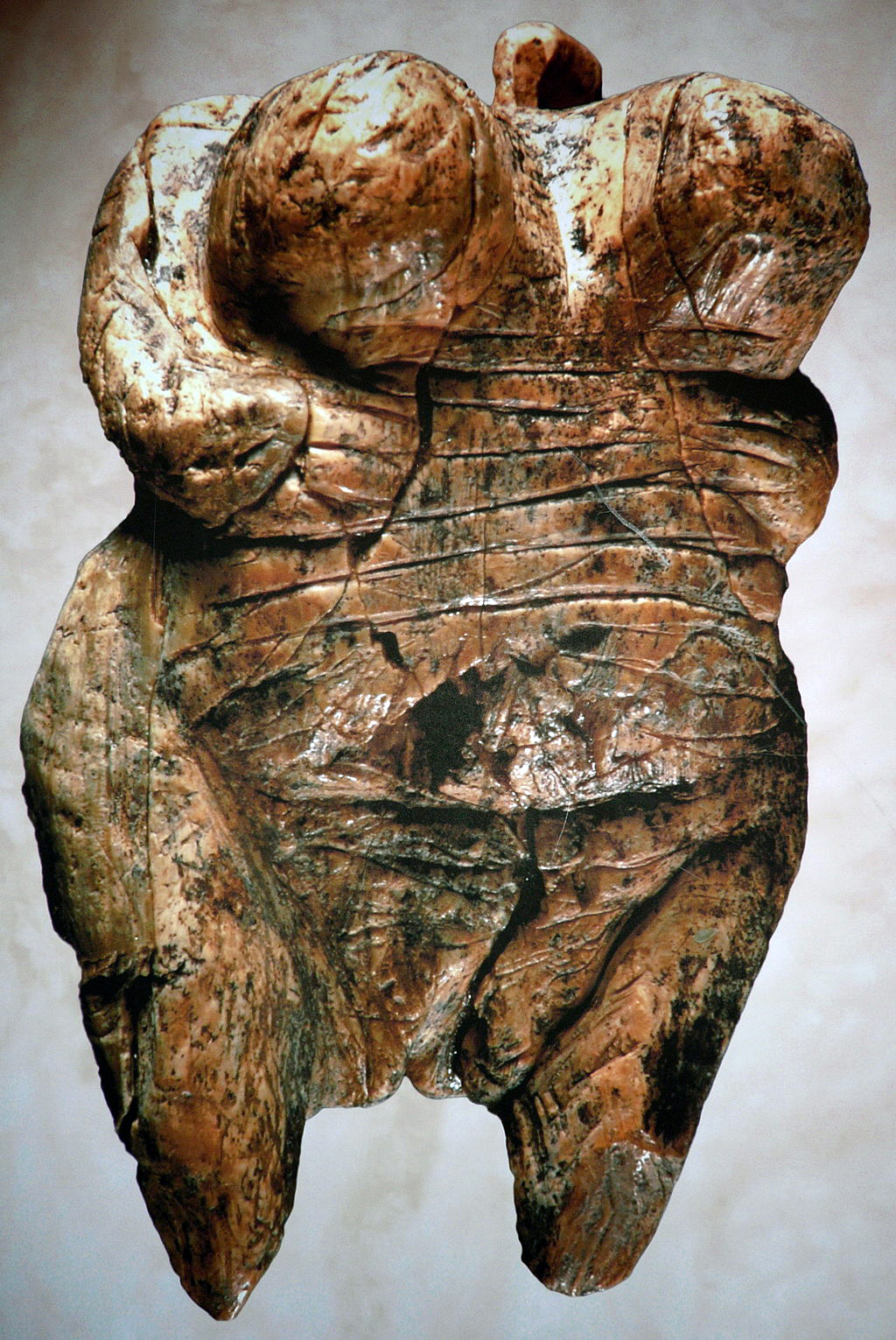
Some of the oldest known representational imagery comes from the Aurignacian culture of the Upper Paleolithic period (Paleolithic means old stone age). Archaeological discoveries across a broad swath of Europe (especially Southern France, Northern Spain, and Swabia, in Germany) include over two hundred caves with spectacular Aurignacian paintings, drawings, and sculpture that are among the earliest undisputed examples of representational image-making. Among the oldest of these is a 2.4-inch tall female figure carved out of mammoth ivory that was found in six fragments in the Hohle Fels cave near Schelklingen in southern Germany. It dates to 35,000 B.C.E.
The caves
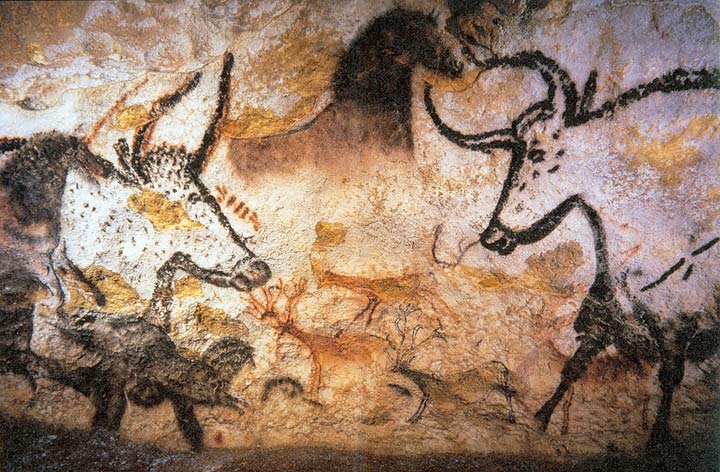
The caves at Chauvet-Pont-d’Arc, Lascaux, Pech Merle, and Altamira contain the best known examples of pre-historic painting and drawing. Here are remarkably evocative renderings of animals and some humans that employ a complex mix of naturalism and abstraction. Archaeologists that study Paleolithic era humans, believe that the paintings discovered in 1994, in the cave at Chauvet-Pont-d’Arc in the Ardéche valley in France, are more than 30,000 years old. The images found at Lascaux and Altamira are more recent, dating to approximately 15,000 B.C.E. The paintings at Pech Merle date to both 25,000 and 15,000 B.C.E. The world’s oldest known cave painting was found in Sulawesi, Indonesia in 2017 and was made at least 45,500 years ago.
What can we really know about the creators of these paintings and what the images originally meant? These are questions that are difficult enough when we study art made only 500 years ago. It is much more perilous to assert meaning for the art of people who shared our anatomy but had not yet developed the cultures or linguistic structures that shaped who we have become. Do the tools of art history even apply? Here is evidence of a visual language that collapses the more than 1,000 generations that separate us, but we must be cautious. This is especially so if we want to understand the people that made this art as a way to understand ourselves. The desire to speculate based on what we see and the physical evidence of the caves is wildly seductive.
Chauvet-Pont-d’Arc
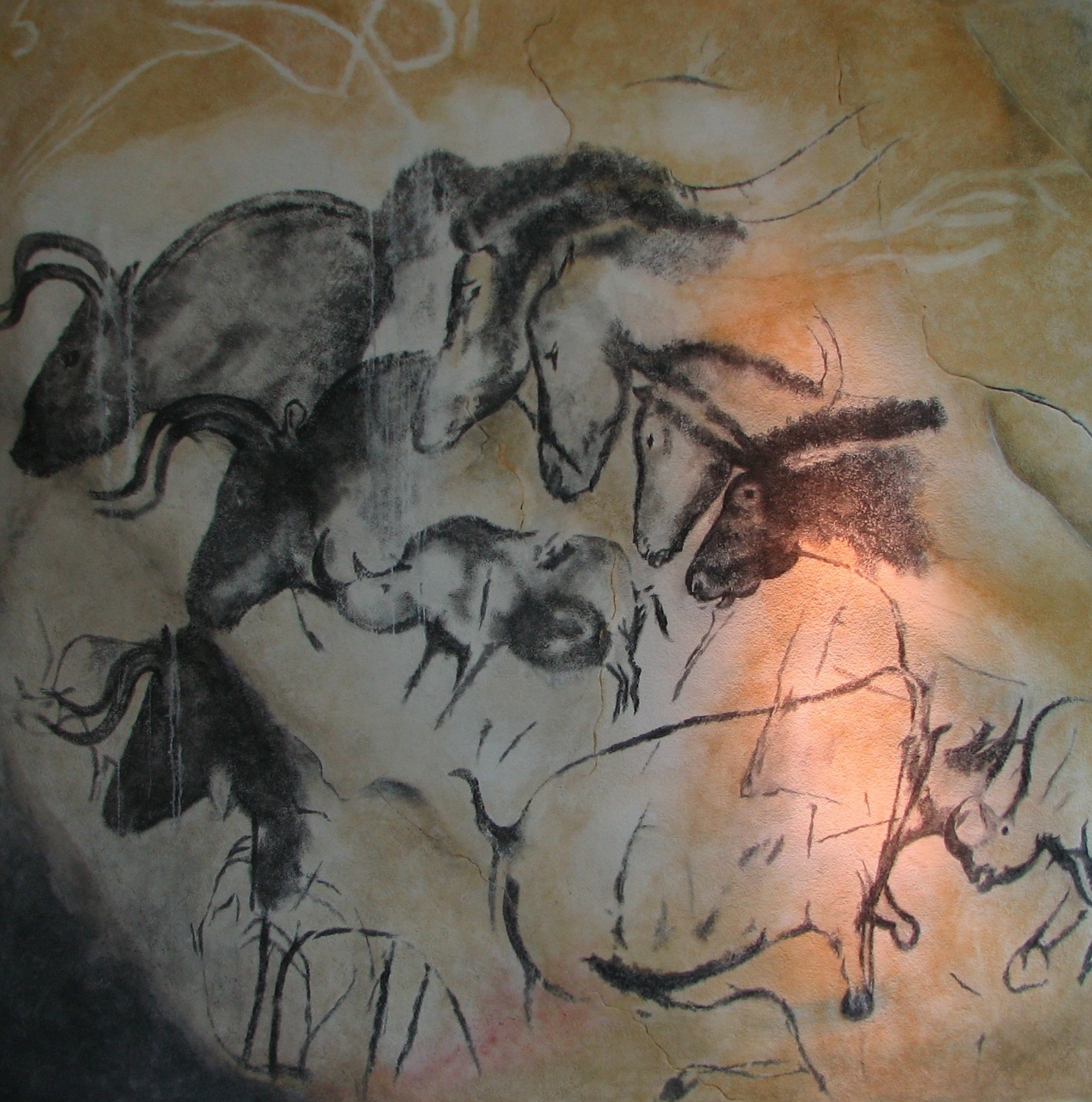
The cave at Chauvet-Pont-d’Arc is over 1,000 feet in length with two large chambers. Carbon samples date the charcoal used to depict the two head-to-head Rhinoceroses (see the image above, bottom right) to between 30,340 and 32,410 years before 1995 when the samples were taken. The cave’s drawings depict other large animals including horses, mammoths, musk ox, ibex, reindeer, aurochs, megaceros deer, panther, and owl (scholars note that these animals were not then a normal part of people’s diet). Photographs show that the drawing at the top of this essay is very carefully rendered but may be misleading. We see a group of horses, rhinos, and bison and we see them as a group, overlapping and skewed in scale. But the photograph distorts the way these animal figures would have been originally seen. The bright electric lights used by the photographer create a broad flat scope of vision; how different to see each animal emerge from the dark under the flickering light cast by a flame.
In a 2009 presentation at University of California San Diego, Dr. Randell White, Professor of Anthropology at New York University, suggested that the overlapping horses pictured above might represent the same horse over time, running, eating, sleeping, etc. Perhaps these are far more sophisticated representations than we have imagined. There is another drawing at Chauvet-Pont-d’Arc that cautions us against ready assumptions. It has been interpreted as depicting the thighs and genitals of a woman but there is also a drawing of a bison and a lion, and the images are nearly intertwined. In addition to the drawings, the cave is littered with the skulls and bones of cave bear and the track of a wolf. There is also a footprint thought to have been made by an eight-year-old boy.
Clovis culture
Although the Paleo-Indians who migrated to America from Asia (across the Bering Strait — a land bridge that once joined present-day Alaska and eastern Siberia) during the Pleistocene Epoch (Ice Age) did not leave behind a written (or even a large material) record, they can be identified by specific toolkits. Clovis points, for example, reveal technologies of hunting and processing meat, as well as crafting a sharp point from available resources. Workers used a hard rock to chip flakes from a softer one, shaping it into a sturdy point that could be used by hand or fastened to a wooden spear.
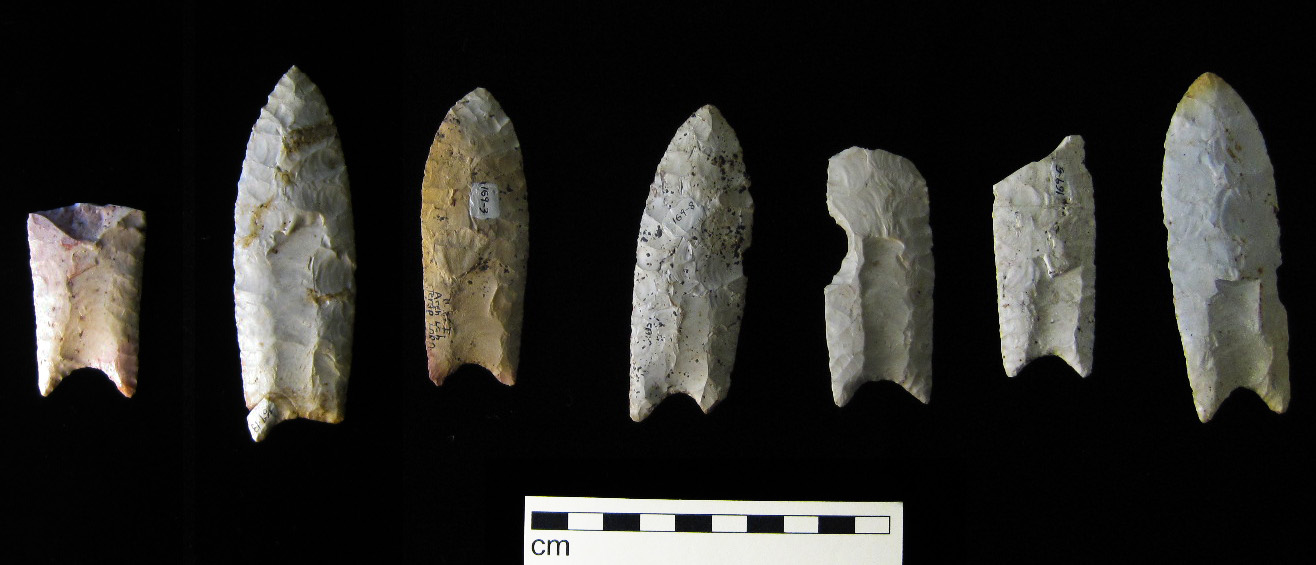
These tools reveal that Clovis people were hunter-gatherers, relying upon big game. As ice thawed, toolkits diversified. Later Archaic people left behind wooden fishing spears reflecting an expansion of hunting and diet, possible boat technology, and a variety of specialized stone tools. But the most significant development in the Americas was the start of agriculture which fundamentally altered lifestyles of people throughout the hemisphere.
Venus of Willendorf
Can a 25,000-year-old object be a work of art?
The artifact known as the Venus of Willendorf dates to between 24,000–22,000 B.C.E., making it one of the oldest and most famous surviving works of art. But what does it mean to be a work of art?
The Oxford English Dictionary, perhaps the authority on the English language, defines the word “art” as “the application of skill to the arts of imitation and design, painting, engraving, sculpture, architecture; the cultivation of these in its principles, practice, and results; the skillful production of the beautiful in visible forms.”
Some of the words and phrases that stand out within this definition include “application of skill,” “imitation,” and “beautiful.” By this definition, the concept of “art” involves the use of skill to create an object that contains some appreciation of aesthetics. The object is not only made, it is made with an attempt of creating something that contains elements of beauty.
In contrast, the same Oxford English Dictionary defines the word “artifact” as, “anything made by human art and workmanship; an artificial product. In Archaeol[ogy] applied to the rude products of aboriginal workmanship as distinguished from natural remains.”
Again, some keywords and phrases are important: “anything made by human art,” and “rude products.” Clearly, an artifact is any object created by humankind regardless of the “skill” of its creator or the absence of “beauty.”
Artifact, then, is anything created by humankind, and art is a particular kind of artifact, a group of objects under the broad umbrella of artifact, in which beauty has been achieved through the application of skills. Think of the average plastic spoon: a uniform white color, mass produced, and unremarkable in just about every way. While it serves a function—say, for example, to stir your hot chocolate—the person who designed it likely did so without any real dedication or commitment to making this utilitarian object beautiful. You have likely never lovingly gazed at a plastic spoon and remarked, “Wow! Now that’s a beautiful spoon!” This is in contrast to a silver spoon you might purchase at Tiffany & Co. While their spoon could just as well stir cream into your morning coffee, it was skillfully designed by a person who attempted to make it aesthetically pleasing; note the elegant bend of the handle, the gentle luster of the metal, the graceful slope of the bowl.
These terms are important to bear in mind when analyzing prehistoric art. While it is unlikely people from the Upper Paleolithic period cared to conceptualize what it meant to make art or to be an artist, it cannot be denied that the objects they created were made with skill, were often made as a way of imitating the world around them, and were made with a particular care to create something beautiful. They likely represent, for the Paleolithic peoples who created them, objects made with great competence and with a particular interest in aesthetics.
Caves and pockets

Two main types of Upper Paleolithic art have survived. The first we can classify as permanently located works found on the walls within caves. This is also referred to as stationary art. Mostly unknown prior to the final decades of the nineteenth century, many such sites have now been discovered throughout much of southern Europe and have provided historians and archaeologists new insights into humankind millennia prior to the creation of writing. The subjects of these works vary: we may observe a variety of geometric motifs, many types of flora and fauna, and the occasional human figure. They also fluctuate in size; ranging from several inches to large-scale compositions that span many feet in length.
The second category of Paleolithic art may be called portable since these works are generally of a small-scale—a logical size given the nomadic nature of Paleolithic peoples. Despite their often diminutive size, the creation of these portable objects signifies a remarkable allocation of time and effort. As such, these figurines were significant enough to take along during the nomadic wanderings of their Paleolithic creators.
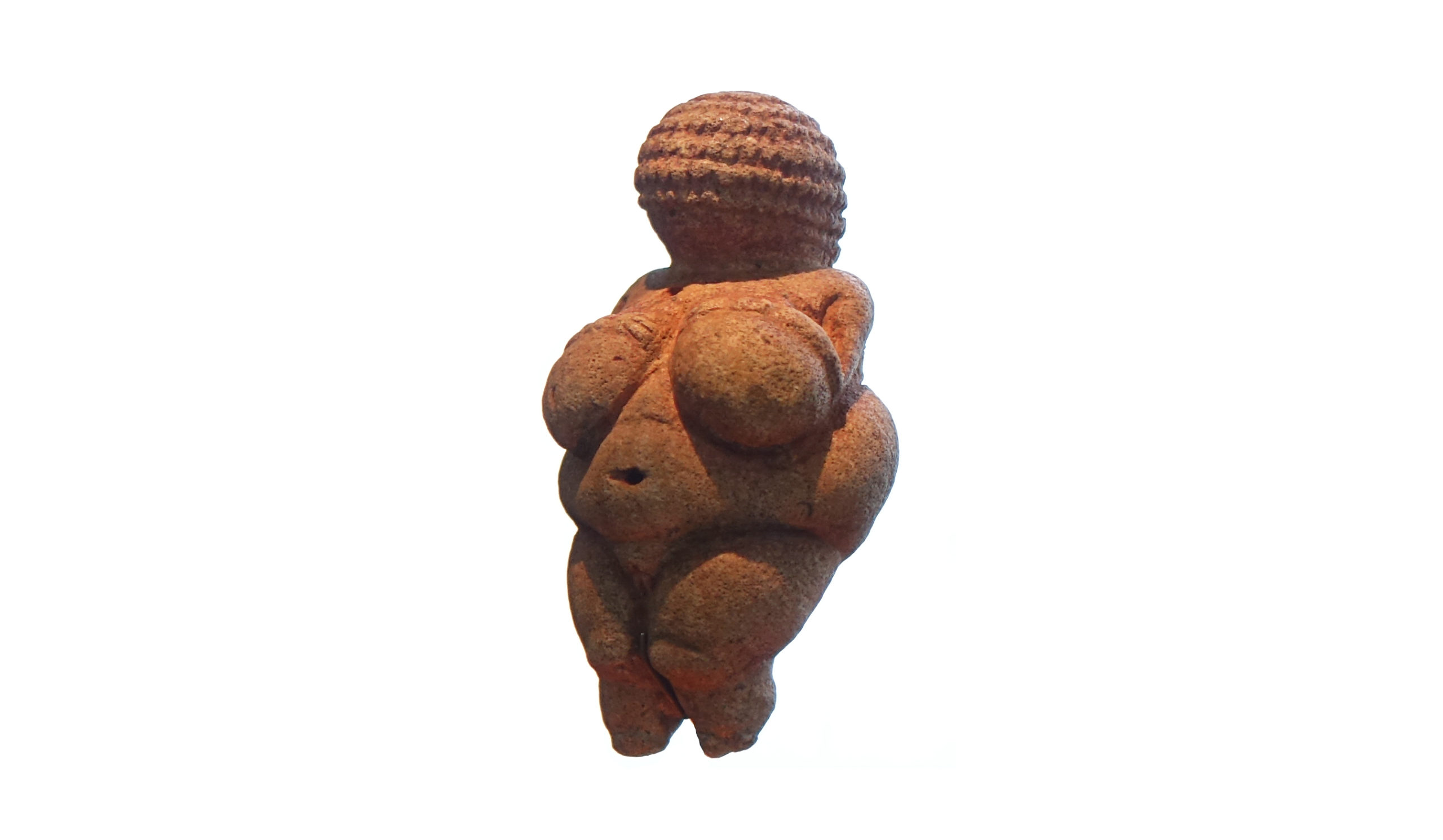
The Venus of Willendorf is a perfect example of this. Josef Szombathy, an Austro-Hungarian archaeologist, discovered this work in 1908 outside the small Austrian village of Willendorf. Although generally projected in art history classrooms to be several feet tall, this limestone figurine is petite in size. She measures just under 11.1 cm high, and could fit comfortably in the palm of your hand. This small scale allowed whoever carved (or, perhaps owned) this figurine to carry it during their nearly daily nomadic travels in search of food.
Naming and dating
Clearly, the Paleolithic sculptor who made this small figurine would never have named it the Venus of Willendorf. Venus was the name of the Roman goddess of love and ideal beauty. When discovered outside the Austrian village of Willendorf, scholars mistakenly assumed that this figure was likewise a goddess of love and beauty. There is absolutely no evidence though that the Venus of Willendorf shared a function similar to its classically inspired namesake. However incorrect the name may be, it has endured and tells us more about those who found her than those who made her.
Dating too can be a problem, especially since Prehistoric art, by definition, has no written record. In fact, the definition of the word prehistoric is that written language did not yet exist, so the creator of the Venus of Willendorf could not have incised “Bob made this in the year 24,000 B.C.E.” on the back. In addition, stone artifacts present a special problem since we are interested in the date that the stone was carved, not the date of the material itself. Despite these hurdles, art historians and archaeologists attempt to establish dates for prehistoric finds through two processes. The first is called relative dating and the second involves an examination of the stratification of an object’s discovery.
Relative dating is an easily understood process that involves stylistically comparing an object whose date is uncertain to other objects whose dates have been firmly established. By correctly fitting the unknown object into this stylistic chronology, scholars can find a very general chronological date for an object. A simple example can illustrate this method. The first Chevrolet Corvette was sold during the 1953 model year, and this particular car has gone through numerous iterations up to its most recent version. If presented with pictures of the Corvette’s development from every five years to establish the stylistic development from its earliest model to the most recent (for example, images from the 1953, 1958, 1963, and all the way to the current model), you would have a general idea of the changes the car underwent over time. If then given a picture of a Corvette from an unknown year, you could, on the basis of stylistic analysis, generally place it within the visual chronology of this car with some accuracy. The Corvette is a convenient example, but the same exercise could be applied to iPods, Coca-Cola bottles, suits, or any other object that changes over time.

The second way scholars date the Venus of Willendorf is through an analysis of where it was found. Generally, the deeper an object is recovered from the earth, the longer that object has been buried. Imagine a penny jar that has had coins added to it for hundreds of years. It is a good bet that the coins at the bottom of that jar are the oldest, whereas those at the top are the newest. The same applies to Paleolithic objects. Because of the depth at which these objects are found, we can infer that they are very old indeed.
What did it mean?
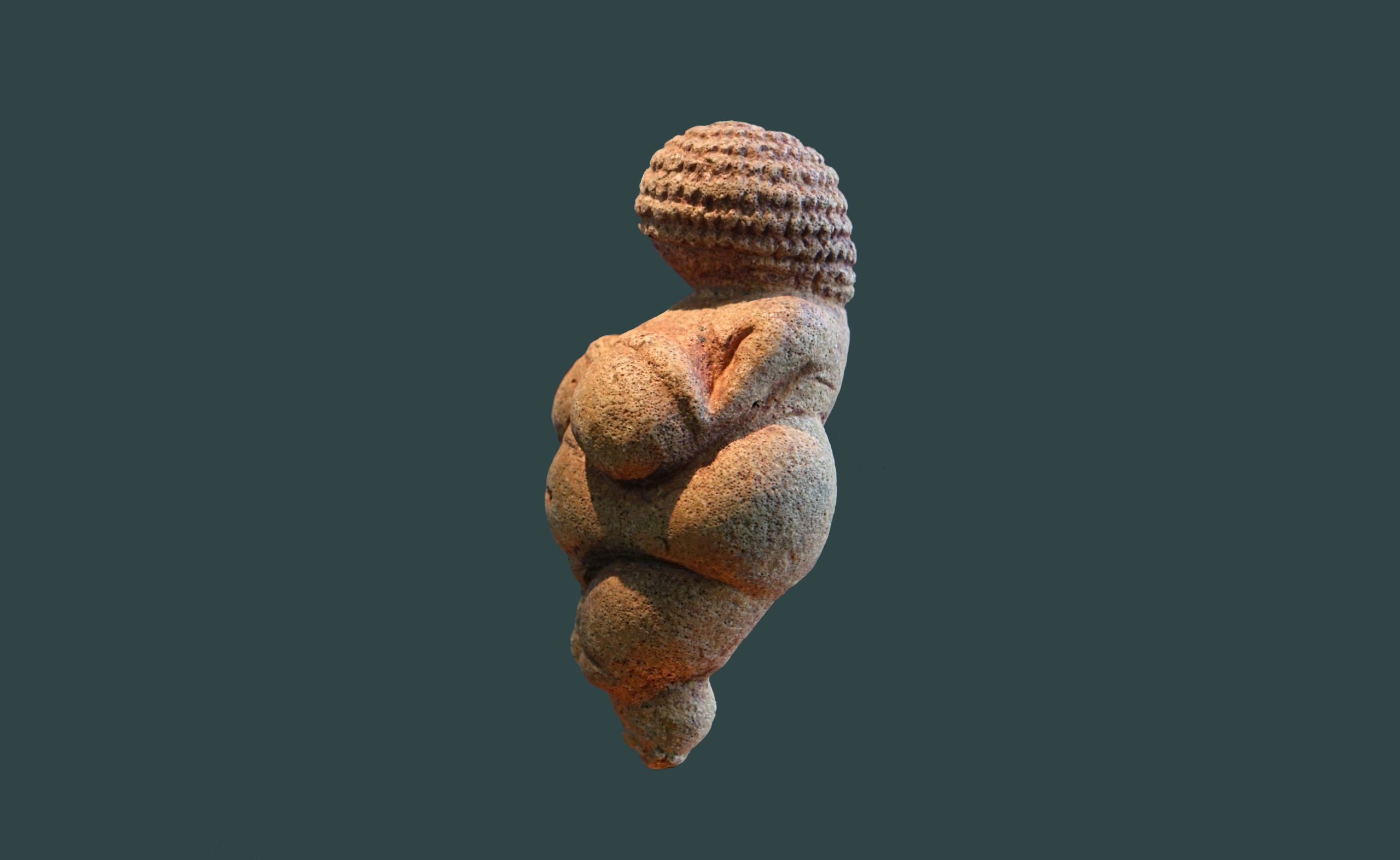
In the absence of writing, art historians rely on the objects themselves to learn about ancient peoples. The form of the Venus of Willendorf—that is, what it looks like—may very well inform what it originally meant. The most conspicuous elements of her anatomy are those that deal with the process of reproduction and child rearing. The artist took particular care to emphasize her breasts, which some scholars suggest indicates that she is able to nurse a child. The artist also brought deliberate attention to her pubic region. Traces of a pigment—red ochre—can still be seen on parts of the figurine.

In contrast, the sculptor placed scant attention on the non-reproductive parts of her body. This is particularly noticeable in the figure’s limbs, where there is little emphasis placed on musculature or anatomical accuracy. We may infer from the small size of her feet that she was not meant to be free-standing and was either meant to be carried or placed lying down. The artist carved the figure’s upper arms along her upper torso, and her lower arms are only barely visible, resting upon the top of her breasts. As enigmatic as the lack of attention to her limbs is, the absence of attention to the face is even more striking. No eyes, nose, ears, or mouth remain visible. Instead, our attention is drawn to seven horizontal bands that wrap in concentric circles from the crown of her head. Some scholars have suggested her head is obscured by a knit cap pulled downward, others suggest that these forms may represent braided or beaded hair and that her face, perhaps once painted, is angled downward.
If the face was purposefully obscured, the Paleolithic sculptor may have created, not a portrait of a particular person, but rather a representation of the reproductive and child rearing aspects of a woman. In combination with the emphasis on the breasts and pubic area, it seems likely that the Venus of Willendorf had a function that related to fertility.
Without a doubt, we can learn much more from the Venus of Willendorf than its diminutive size might at first suggest. We learn about relative dating and stratification. We learn that these nomadic people living almost 25,000 years ago cared about making objects beautiful. And we can learn that these Paleolithic people had an awareness of the importance of women.
The Venus of Willendorf is only one example of dozens of Paleolithic figures that may have been associated with fertility. Nevertheless, it retains a place of prominence within the history of human art.
Practicing Visual Analysis
Looking at the Venus of Willendorf, the scale of the work is essential. At 4” tall, this small piece helps us understand its function as a portable work. The artist incised or carved curvilinear lines to create an organic, figurative form. Curvilinear lines deeply carved into the rough texture of limestone articulate the rounded shape of breasts and stomach while more angular rectilinear lines indicate the genital region. A face is noticeably absent from the sculpture, which adds to the likely indication that the piece serves to represent the abstract concept of fertility rather than a specific portrait, while the artist added detail on the top of the head with the small circular shapes to show the pattern for hair. By visually analyzing a work and its formal properties, we can begin to understand the conscious decisions artists make when creating. Look for “Practicing Visual Analysis” sections as you read through the textbook.
Portable and Stationary Art Across the Ancient Globe
The Venus of Willendorf exemplifies prehistoric portable art. With their small scale, portable (or mobile) artworks were designed to move with the members of its nomadic community. In contrast, stationary art is not meant to be moved or relocated. From Europe and Africa to Asia and Australia, prehistoric two-dimensional stationary artworks made from a variety of materials have been discovered.
Africa: Apollo 11 Cave Stones
A significant discovery
Approximately 25,000 years ago, in a rock shelter in the Huns Mountains of Namibia on the southwest coast of Africa (today part of the Ai-Ais Richtersveld Transfrontier Park), an animal was drawn in charcoal on a hand-sized slab of stone. The stone was left behind, over time becoming buried on the floor of the cave by layers of sediment and debris until 1969 when a team led by German archaeologist W.E. Wendt excavated the rock shelter and found the first fragment (the left slab of the Quartzite slabs depicting animals). Wendt named the cave “Apollo 11” upon hearing on his shortwave radio of NASA’s successful space mission to the moon. It was more than three years later however, after a subsequent excavation, when Wendt discovered the matching fragment (the right slab of the Quartzite slabs depicting animals), that archaeologists and art historians began to understand the significance of the find.
Indirect dating techniques
In total seven stone fragments of brown-grey quartzite, some of them depicting traces of animal figures drawn in charcoal, ocher, and white, were found buried in a concentrated area of the cave floor less than two meters square. While it is not possible to learn the actual date of the fragments, it is possible to estimate when the rocks were buried by radiocarbon dating the archaeological layer in which they were found. Archaeologists estimate that the cave stones were buried between 25,500 and 25,300 years ago during the Middle Stone Age period in southern Africa making them, at the time of their discovery, the oldest dated art known on the African continent and among the earliest evidence of human artistic expression worldwide.
While more recent discoveries of much older human artistic endeavors have corrected our understanding (consider the 2008 discovery of a 100,000-year-old paint workshop in the Blombos Cave on the southern coast of Africa), the stones remain the oldest examples of figurative art from the African continent. Their discovery contributes to our conception of early humanity’s creative attempts, before the invention of formal writing, to express their thoughts about the world around them.
The origins of art?
Genetic and fossil evidence tells us that Homo sapiens developed on the continent of Africa more than 100,000 years ago and spread throughout the world. But what we do not know—what we have only been able to assume—is that art, too, began in Africa. Is Africa, where humanity originated, home to the world’s oldest art? If so, can we say that art began in Africa?
100,000 years of human occupation

The Apollo 11 rock shelter overlooks a dry gorge, sitting twenty meters above what was once a river that ran along the valley floor. The cave entrance is wide, about twenty-eight meters across, and the cave itself is deep: eleven meters from front to back. While today a person can stand upright only in the front section of the cave, during the Middle Stone Age, as well as in the periods before and after, the rock shelter was an active site of ongoing human settlement.
Inside the cave, above and below the layer where the Apollo 11 cave stones were found, archaeologists unearthed a sequence of cultural layers representing over 100,000 years of human occupation. In these layers stone artifacts, typical of the Middle Stone Age period—such as blades, pointed flakes, and scrapers—were found in raw materials not native to the region, signaling stone tool technology transported over long distances. Among the remnants of hearths, ostrich eggshell fragments bearing traces of red color were also found—either remnants of ornamental painting or evidence that the eggshells were used as containers for pigment.
On the cave walls, belonging to the Later Stone Age period, rock paintings were discovered depicting white and red zigzags, two handprints, three geometric images, and traces of color. And on the banks of the riverbed just upstream from the cave, engravings of a variety of animals, some with zigzag lines leading upwards, were found and dated to less than 2000 years ago.
The Apollo 11 cave stones
But the most well-known of the rock shelter’s finds, and the most enigmatic, remain the Apollo 11 cave stones. On the cleavage face of what was once a complete slab, an unidentified animal form was drawn resembling a feline in appearance but with human hind legs that were probably added later. Barely visible on the head of the animal are two slightly-curved horns likely belonging to an Oryx, a large grazing antelope; on the animal’s underbelly, possibly the sexual organ of a bovid.
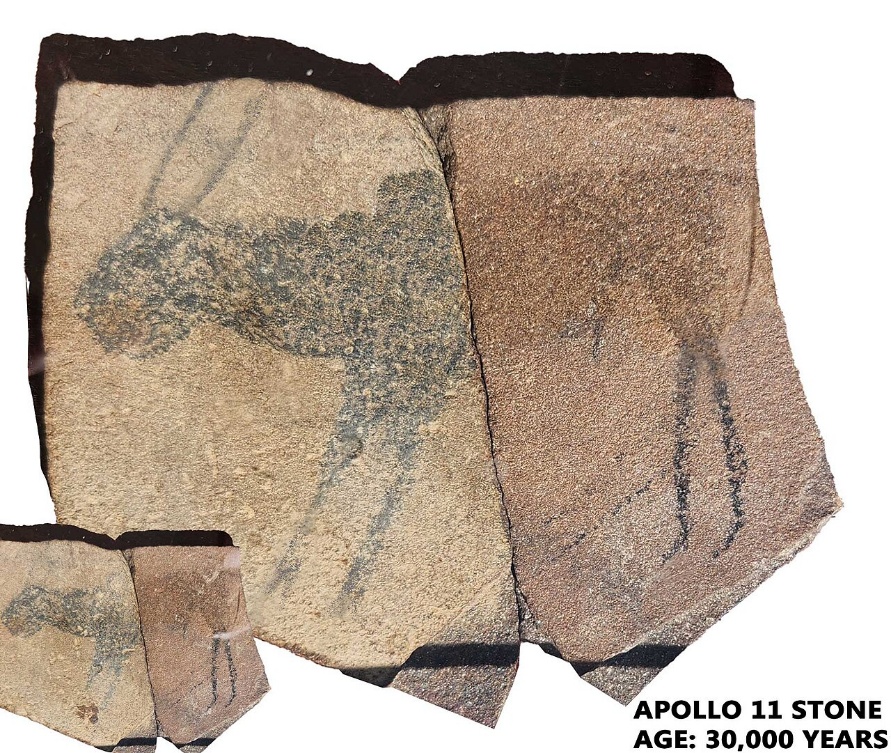
Perhaps we have some kind of supernatural creature—a therianthrope, part human and part animal? If so, this may suggest a complex system of shamanistic belief. Taken together with the later rock paintings and the engravings, Apollo 11 becomes more than just a cave offering shelter from the elements. It becomes a site of ritual significance used by many over thousands of years.
The global origins of art
In the Middle Stone Age period in southern Africa, prehistoric man was a hunter-gatherer, moving from place to place in search of food and shelter. But this modern human also drew an animal form with charcoal—a form as much imagined as it was observed. This is what makes the Apollo 11 cave stones find so interesting: the stones offer evidence that Homo sapiens in the Middle Stone Age—us, some 25,000 years ago—were not only anatomically modern, but behaviorally modern as well. That is to say, these early humans possessed the new and unique capacity for modern symbolic thought, “the human capacity,” long before what was previously understood.
The cave stones are what archaeologists term art mobilier—small-scale prehistoric art that is moveable. But mobile art, and rock art generally, is not unique to Africa. Rock art is a global phenomenon that can be found across the world—in Europe, Asia, Australia, and North and South America. While we cannot know for certain what these early humans intended by the things that they made, by focusing on art as the product of humanity’s creativity and imagination we can begin to explore where, and hypothesize why, art began.
Asia: Warty pig cave painting in Sulawesi, Indonesia
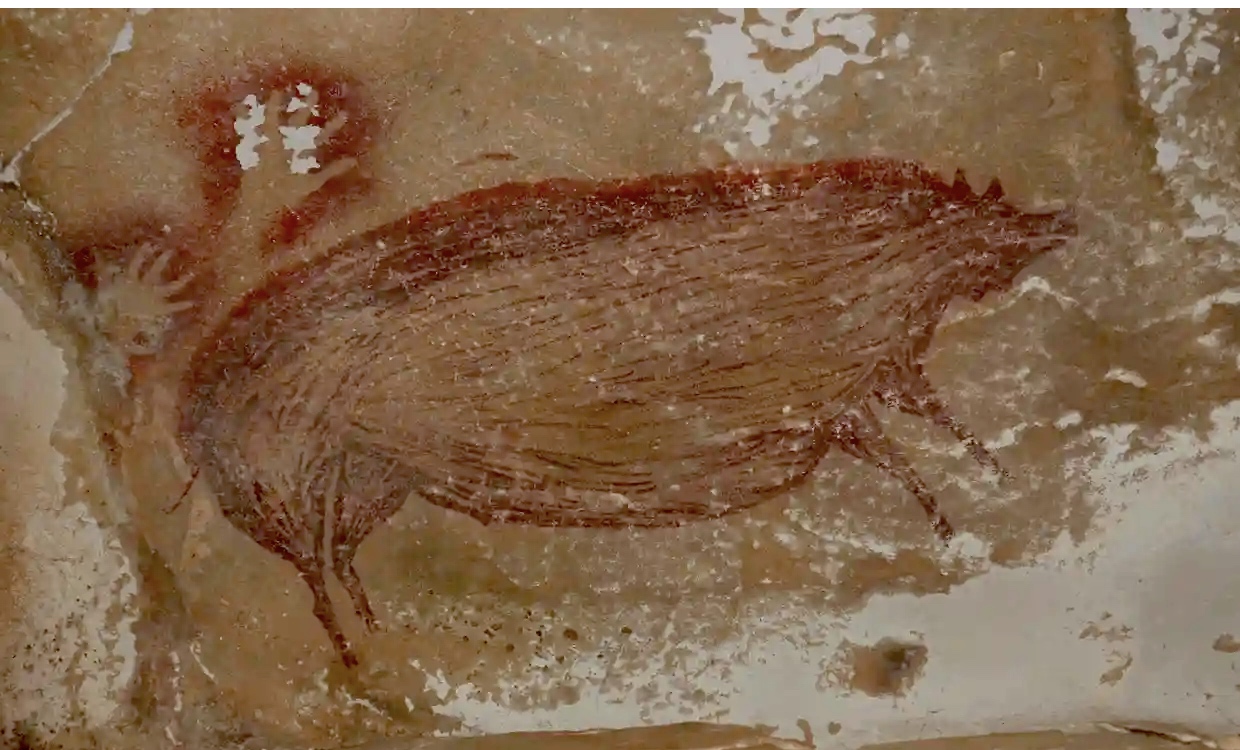
A team of Griffith University archaeologists has shared in the discovery of what may be the world’s oldest known cave painting, dating back to at least 45,500 years ago.
Uncovered in South Sulawesi (in the Maros-Pangkep caves on Indonesia) during field research conducted with Indonesia’s leading archaeological research centre, Pusat Penelitian Arkeologi Nasional (ARKENAS), the cave painting consists of a figurative depiction of a Sulawesi warty pig, a wild boar that is endemic to this Indonesian island.
“The Sulawesi warty pig painting we found in the limestone cave of Leang Tedongnge is now the earliest known representational work of art in the world, as far as are aware,” said Professor Adam Brumm from Griffith’s Australian Research Centre for Human Evolution, co-leader of the Griffith-ARKENAS team.
Europe: Hall of Bulls, Lascaux
We are as likely to communicate using easily interpretable pictures as we are text. Portable handheld devices enable us to tell others via social media what we are doing and thinking. Approximately 15,000 years ago, we also communicated in pictures—but with no written language.
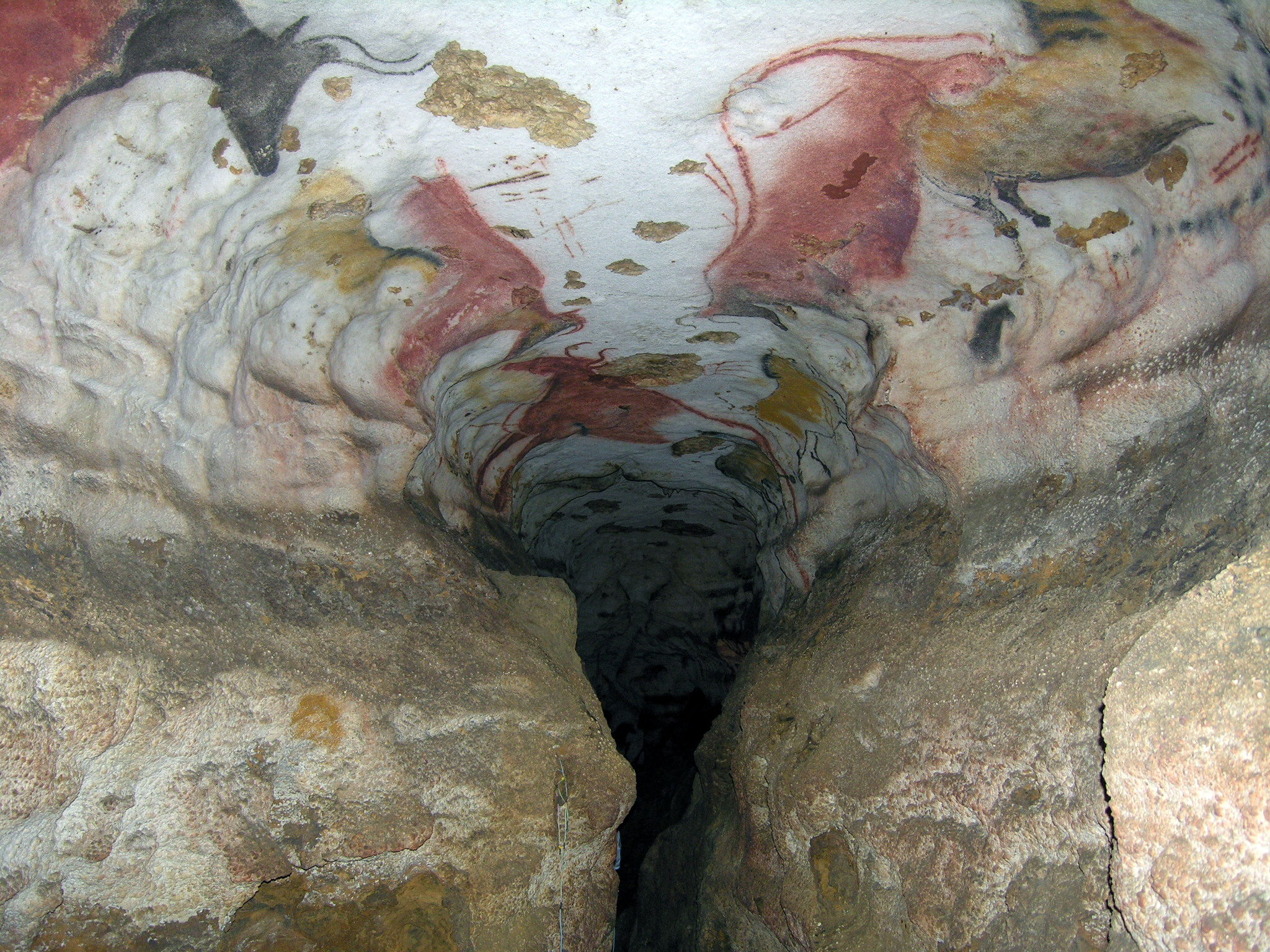
The cave of Lascaux, France is one of almost 350 similar sites that are known to exist—most are isolated to a region of southern France and northern Spain. Both Neanderthals (named after the site in which their bones were first discovered—the Neander Valley in Germany) and Modern Humans (early Homo Sapiens Sapiens) coexisted in this region 30,000 years ago. Life was short and very difficult; resources were scarce and the climate was very cold.
Location, location, location!
Approximately 15,000 years later in the valley of Vèzére, in southwestern France, modern humans lived and witnessed the migratory patterns of a vast range of wildlife. They discovered a cave in a tall hill overlooking the valley. Inside, an unknown number of these people drew and painted images that, once discovered in 1940, have excited the imaginations of both researchers and the general public.
After struggling through small openings and narrow passages to access the larger rooms beyond, prehistoric people discovered that the cave wall surfaces functioned as the perfect, blank “canvas” upon which to draw and paint. White calcite, roofed by nonporous rock, provides a uniquely dry place to feature art. To paint, these early artists used charcoal and ocher (a kind of pigmented, earthen material, that is soft and can be mixed with liquids, and comes in a range of colors like brown, red, yellow, and white). We find images of horses, deer, bison, elk, a few lions, a rhinoceros, and a bear—almost as an encyclopedia of the area’s large prehistoric wildlife. Among these images are abstract marks—dots and lines in a variety of configurations. In one image, a humanoid figure plays a mysterious role.
How did they do it?
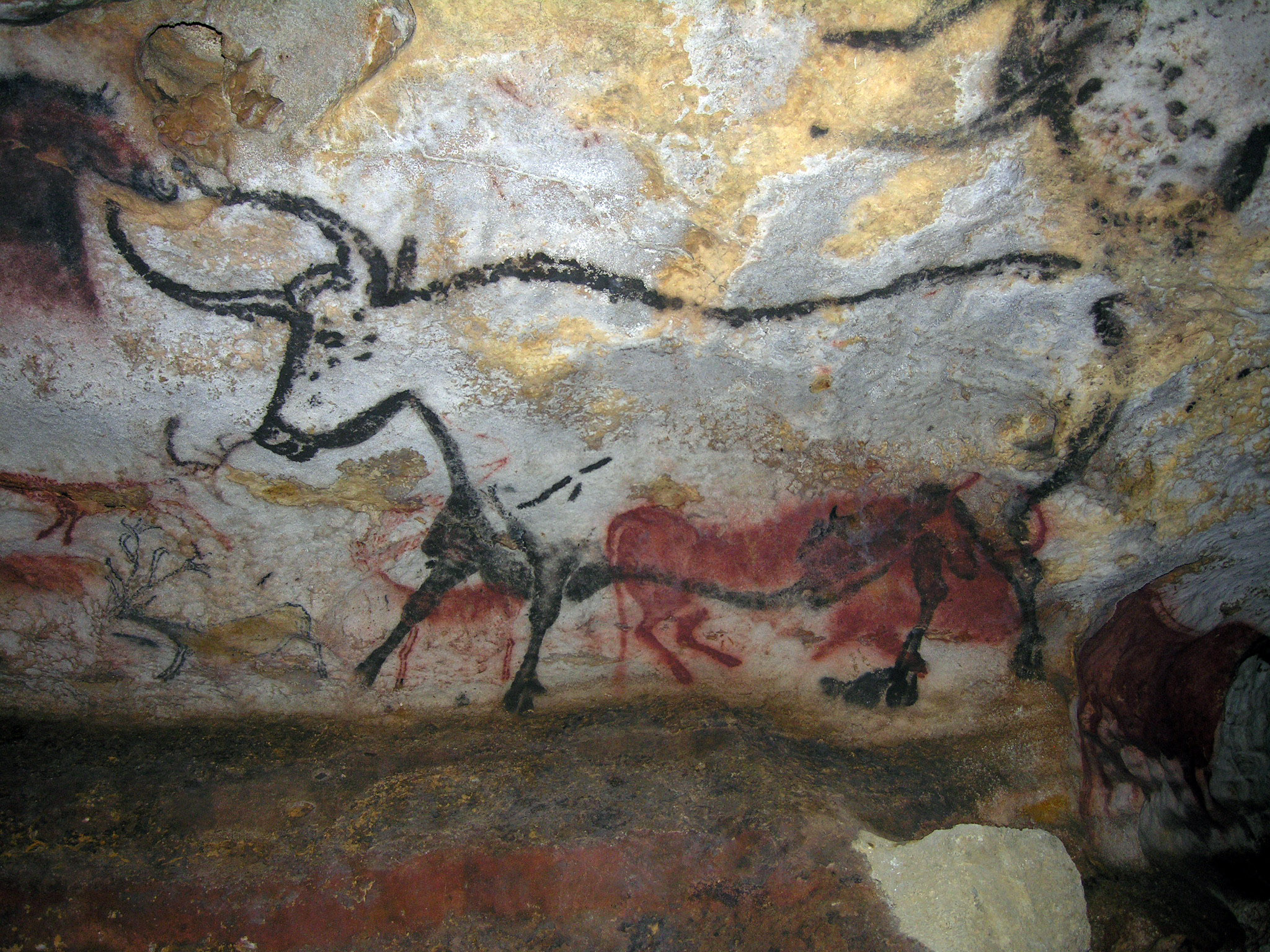
The animals are rendered in what has come to be called “twisted perspective,” in which their bodies are depicted in profile while we see the horns from a more frontal viewpoint. The images are sometimes entirely linear—line drawn to define the animal’s contour. In many other cases, the animals are described in solid and blended colors blown by mouth onto the wall. In other portions of the Lascaux cave, artists carved lines into the soft calcite surface. Some of these are infilled with color—others are not.
The cave spaces range widely in size and ease of access. The famous Hall of Bulls is large enough to hold some fifty people. Other “rooms” and “halls” are extraordinarily narrow and tall.
Archaeologists have found hundreds of stone tools. They have also identified holes in some walls that may have supported tree-limb scaffolding that would have elevated an artist high enough to reach the upper surfaces. Fossilized pollen has been found; these grains were inadvertently brought into the cave by early visitors and are helping scientists understand the world outside.
Hall of Bulls
Given the large scale of many of the animal images, we can presume that the artists worked deliberately—carefully plotting out a particular form before completing outlines and adding color. Some researchers believe that “master” artists enlisted the help of assistants who mixed pigments and held animal fat lamps to illuminate the space. Alternatively, in the case of the “rooms” containing mostly engraved and overlapping forms, it seems that the pure process of drawing and repetitive re-drawing held serious (perhaps ritual) significance for the makers.
Why did they do it?
Many scholars have speculated about why prehistoric people painted and engraved the walls at Lascaux and other caves like it. Perhaps the most famous theory was put forth by a priest named Henri Breuil. Breuil spent considerable time in many of the caves, meticulously recording the images in drawings when the paintings were too challenging to photograph. Relying primarily on a field of study known as ethnography, Breuil believed that the images played a role in “hunting magic.” The theory suggests that the prehistoric people who used the cave may have believed that a way to overpower their prey involved creating images of it during rituals designed to ensure a successful hunt. This seems plausible when we remember that survival was entirely dependent on successful foraging and hunting, though it is also important to remember how little we actually know about these people.

A bison, drawn in strong, black lines, bristles with energy, as the fur on the back of its neck stands up and the head is radically turned to face us. A form drawn under the bison’s abdomen is interpreted as internal organs, spilling out from a wound. A more crudely drawn form positioned below and to the left of the bison may represent a humanoid figure with the head of a bird. Nearby, a thin line is topped with another bird and there is also an arrow with barbs. Further below and to the far left the partial outline of a rhinoceros can be identified.
Interpreters of this image tend to agree that some sort of interaction has taken place among these animals and the bird-headed human figure—in which the bison has sustained injury either from a weapon or from the horn of the rhinoceros. Why the person in the image has the rudimentary head of a bird, and why a bird form sits atop a stick very close to him is a mystery. Some suggest that the person is a shaman—a kind of priest or healer with powers involving the ability to communicate with spirits of other worlds. Regardless, this riveting image appears to depict action and reaction, although many aspects of it are difficult to piece together.
Preservation for future study
The Caves of Lascaux are the most famous of all of the known caves in the region. In fact, their popularity has permanently endangered them. From 1940 to 1963, the numbers of visitors and their impact on the delicately balanced environment of the cave—which supported the preservation of the cave images for so long—necessitated the cave’s closure to the public. A replica called Lascaux II was created about 200 yards away from the site. The original Lascaux cave is now a designated UNESCO World Heritage Site. Lascaux will require constant vigilance and upkeep to preserve it for future generations.
Many mysteries continue to surround Lascaux, but there is one certainty. The very human need to communicate in the form of pictures—for whatever purpose—has persisted since our earliest beginnings.
The Neolithic revolution

A settled life
When people think of the Neolithic era, they often think of Stonehenge, the iconic image of this early time. Dating to approximately 3000 B.C.E. and set on Salisbury Plain in England, it is a structure larger and more complex than anything built before it in Europe. Stonehenge is an example of the cultural advances brought about by the Neolithic revolution—the most important development in human history. The way we live today, settled in homes, close to other people in towns and cities, protected by laws, eating food grown on farms, and with leisure time to learn, explore and invent is all a result of the Neolithic revolution, which occurred approximately 11,500–5,000 years ago. The revolution which led to our way of life was the development of the technology needed to plant and harvest crops and to domesticate animals.
Before the Neolithic revolution, it’s likely you would have lived with your extended family as a nomad, never staying anywhere for more than a few months, always living in temporary shelters, always searching for food and never owning anything you couldn’t easily pack in a pocket or a sack. The change to the Neolithic way of life was huge and led to many of the pleasures (lots of food, friends and a comfortable home) that we still enjoy today.
Neolithic art

The massive changes in the way people lived also changed the types of art they made. Neolithic sculpture became bigger, in part, because people didn’t have to carry it around anymore; pottery became more widespread and was used to store food harvested from farms. Alcohol was first produced during this period and architecture, as well as its interior and exterior decoration, first appears. In short, people settled down and began to live in one place, year after year.
It seems very unlikely that Stonehenge could have been made by earlier, Paleolithic, nomads. It would have been a waste to invest so much time and energy building a monument in a place to which they might never return or might only return infrequently. After all, the effort to build it was extraordinary. Stonehenge is approximately 320 feet in circumference and the stones which compose the outer ring weigh as much as 50 tons; the small stones, weighing as much as 6 tons, were quarried from as far away as 450 miles. The use or meaning of Stonehenge is not clear, but the design, planning and execution could have only been carried out by a culture in which authority was unquestioned. Here is a culture that was able to rally hundreds of people to perform very hard work for extended periods of time. This is another characteristic of the Neolithic era. The Neolithic period is also important because it is when we first find good evidence for religious practice, a perpetual inspiration for the fine arts.
Neolithic peoples didn’t have written language, so we may never know what their creators intended. The earliest example of writing develops in Sumer in Mesopotamia in the late 4th millennium B.C.E. However, there are scholars that believe that earlier proto-writing developed during the Neolithic period.
Conclusion
Contrary to popular culture stereotypes, evidence of sophisticated artistic expression remains from the prehistoric world. The portable and stationary artworks of the paleolithic period demonstrate conscious, intentional design choices made by ancient people. The archaeological record helps historians to understand the various materials and functions of ancient art. With the development of agriculture during the Neolithic revolution, civilizations began to emerge.
Citation and Licensing
The following sections were written by Chelsea Wright and are licensed CC BY-NC-SA 4.0:
- Chapter Overview and Introduction
- Focus artwork and term list compiled by Chelsea Wright
- Introduction text to “How to do visual (formal) analysis”
- Practicing Visual Analysis
- Portable and Stationary Art Across the Globe
- Conclusion
The following articles from Smarthistory licensed CC BY-NC-SA 4.0 were remixed and adapted for the chapter:
- Dr. Beth Harris and Dr. Steven Zucker, “How to do visual (formal) analysis,” in Smarthistory, September 18, 2017.
- Dr. Beth Harris and Dr. Steven Zucker, “Paleolithic art, an introduction,” in Smarthistory, June 8, 2018.
- Dr. Bryan Zygmont, “Venus of Willendorf,” in Smarthistory, November 21, 2015.
- Dr. Nathalie Hager, “Apollo 11 Cave Stones,” in Smarthistory, November 21, 2015.
- Griffith University, “Warty pig cave painting in Sulawesi, Indonesia,” in Smarthistory, January 13, 2021.
- Mary Beth Looney, “Hall of Bulls, Lascaux,” in Smarthistory, November 19, 2015.
- Dr. Senta German, “The Neolithic revolution,” in Smarthistory, June 8, 2018.



.jpg)


