
The Environment
Measuring High-Quality in Early Care and Education Classrooms
One of the characteristics of a high-quality early childhood program is the practice of continuously monitoring children’s development, along with the environmental setting and teacher interactions. By evaluating the overall performance in these key areas, teachers, administrators and families can reflect, make necessary changes and improvements to support all students and families. There are numerous tools on the market that evaluate program quality. For the purpose of this text we will focus on just a few tools that are highly recognized and most often used in California to monitor quality practices in preschool programs.
The Environment Rating Scales (ERS)
The Environment Rating Scale is a standardized assessment tool that can help caregivers, teachers, and administrators improve the quality of their program. The ERS measure process quality.
Process quality consists of the various interactions that go on in a classroom between staff and children, staff, parents, and other adults, among the children themselves, and the interactions children have with the many materials and activities in the environment, as well as those features, such as space, schedule and materials that support these interactions. Process quality is assessed primarily through observation and has been found to be more predictive of child outcomes than structural indicators such as staff to child ratio, group size, cost of care, and even type of care, for example child care center or family child care home.
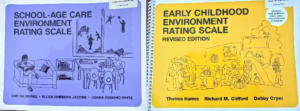
There are 4 Environment Rating Scales:
- The Infant and Toddler Environmental Rating Scale (ITERS) for programs serving young learners aged 6 weeks to 30 months
- The Early Childhood Environmental Rating Scale (ECERS) for preschool programs serving children aged 3-5 years
- The School-Age Child Environmental Rating Scale (SACERS) for afterschool programs serving children aged 5-12 years
- The Family Child Care Environmental Rating Scale (FCCERS) for family childcare programs serving children aged 6 weeks to 12 years.
Why Use Environment Rating Scales
The scales are used in a variety of ways including for self-assessment by center staff, preparation for accreditation, and voluntary improvement efforts by licensing or other agencies. For example, in the United States:
- Several states, including California, Massachusetts, Montana, Mississippi, Kansas, Oregon, Kentucky, New Mexico, Georgia, Florida, Wisconsin, and Nebraska have also initiated quality evaluation and improvement programs using our scales. Each state is tailoring its use of the scales to its individual needs and resources.
- The state of Arkansas has trained personnel, who do assessments and provide training and technical assistance so that childcare centers and homes can increase their quality of care. Another innovative feature of the Arkansas program is that parents who select childcare facilities with an average of 4.5 or higher on our scales are eligible for two times the state childcare tax exemption. Thus, both parents and providers are being rewarded for quality improvements that benefit the children.
- The state of Colorado uses the scales in a variety of program improvement and evaluation projects. For example, Denver has a quality improvement program that uses on site consultation and training based on scale scores. Many of the centers participating in this program serve poor and minority children and their families. The state of Colorado is currently considering a tiered reimbursement system using the scales.
- North Carolina also currently uses scale scores as part of their 5-star rated license system. Centers and family childcare homes are awarded either one or two stars based on compliance with licensing standards. Programs may voluntarily apply for an additional three stars based on a set of quality measures including the licensing compliance record, teacher and director education, and the levels of process quality as measured by the appropriate environmental scale. Only the lowest level of licensing is mandatory. However, an additional fee is paid to the provider of subsidized care for each additional star earned voluntarily.
- The Oklahoma 3-star tiered license incorporates an evaluation with the scales in the second tier as a basis for quality improvement, and provides technical assistance based on scores for meeting accreditation standards. Tiered reimbursement is a part of this system.
- Tennessee is now initiating a rated license system, based on North Carolina’s experience. In their system, however, program evaluation is not voluntary, but is required yearly to create a “Report Card” that must be posted with the license so childcare consumers have access to reliable information on the quality of childcare they are using for their children. Tiered reimbursement will also be tied to scores on the scale.
- All the US military services have been using the scales routinely in their center and family childcare homes for program improvement and monitoring. The military child development system was recognized by Executive Order in 1998 for its high quality.
- Our environmental rating scales are widely used by programs as they prepare for accreditation. This is due to the fact that our scales use a format with detailed levels of quality that provides a blueprint for gradual change. The content of our scales is completely supportive of the various credentialing and accreditation programs.
The ERS Tool
As suggested by ERS, in order to provide high-quality care and education experiences to all children and their families, a childcare program must provide for the three basic needs all children have:
- Protection of their health and safety
- Building positive relationships
- Opportunities for stimulation and learning from experience
Let’s take a closer look at how to use the Early Childhood Environmental Rating Scale (ECERS-3) for preschool programs serving children aged 3-5 years. The Scale consists of 35 items organized into 6 subscales:65
- Space and Furnishings
- Personal Care Routines
- Language and Literacy
- Learning Activities
- Interaction
- Program Structure
Within each subscale there are indicators that are arranged in a hierarchical order with basic needs at low levels and the more educational and interactional aspects at higher levels. The requirements for each indicator must be met before the next indicator is measured. If a requirement is not met, scoring then comes to a stop.
Key Takeaways
Scoring:
1 = inadequate
3 = minimal
5 = good
7 = excellent
Empirical Research
Empirical studies using the Early Childhood Environment Rating Scale – Revised (ECERS-R) tool have generally found positive associations between the quality of early childhood programs and child development.
The ECERS-R (1998) is the revised edition of the original ECERS (1980). It is currently being used in several major studies, including the Early Head Start Study (Mathematica Corporation), and Welfare, Children and Families: A Three City Study (Columbia University, University of Chicago, and Harvard University). The original ECERS was used in the Head Start FACES study, in which over 400 classrooms are included nationwide. The preliminary results in all these studies show that the ECERS and the ECERS-R are performing very well.
Additionally, it should be noted that the ECERS and ITERS were used as the comprehensive quality measures in the National Child Care Staffing Study (Whitebook, Howes, & Phillips, 1989) and the Cost, Quality, and Child Outcomes Study (1995), the major studies of their time. The FDCRS was used in The Study of Children in Family Child Care and Relative Care (Galinsky, Howes, Kontos, & Shinn, 1994).
In all of these studies, a relationship was found between higher scores on the ECERS and more positive child development outcomes in areas that are considered important for later school success. The effects of higher quality early childhood experiences have now been shown to last at least through the second grade of elementary school (Peisner-Feinberg, Burchinal, Clifford, Culkin, Howes, Kagan, Yazejian, Byler, Rustici, & Zelazo, 1999). Research is continuing to evaluate longer-lasting effects.66
ERS Strengths
The instrument has good test-retest reliability, high inter-rater reliability (Clifford et al., 2010), and many studies have demonstrated its predictive validity (Burchinal et al., 2008; Montes et al., 2005; Peisner-Feinberg et al., 2001). Furthermore, the results show that ECERS-R is a significant predictor of child development in two domains: physical health and well-being, and social competence.
ERS Limitation
While the ECERS-R is a useful tool to measure the quality of early childhood programs across various settings, there are some limitations. Because the Environmental Rating Scales were developed in the United States, the relevance to non-American cultural settings has been questioned (Dickinson,2006; Mathers, Singler,& Karemaker, 2012).
Some have criticized that the ITERS-R scale places too much emphasis on the structural aspects of childcare (Sanders & Howes, 2013;Vermeer et al., 2008, while others are concerned that the Rating Scales fail to measure the interactions between the teacher and children and families, which is considered to be key quality factors in childcare (Bisceglia, Perlman, Schaack,& Jenkins, 2009; Helmerhorst et al., 2014).
Although the Environment Rating Scales are highly regarded, there has also been some considerable criticism. For example, a closer look at the items in the ECERS-R reveals that some items may be less relevant than others in our study’s setting—poor, rural villages in Indonesia. Item 27 outlines the provision of TV, video or computers for classroom activities. Item 3 describes the provision of soft furnishings such as carpeted space and cushions for children’s relaxation and comfort. While all of these provisions would be great to have, they are often unfeasible in rural, resource-constrained environments.
In over 3 weeks of field observation, we rarely saw soft furnishings—sitting on the floor for children and adults alike is the norm in rural Indonesia – even when soft furnishings are available. We did encounter one center with a computer lab during piloting of the ECERS-R but this was a state-of- the-art center where not one but three international donors had channeled funding (Brinkman, S. et.al., 2016).
Exercises
ECERS FAQ Find
- When was the first ECERS tool published?
- Who typically uses the ECERS tool?
- Who administers the assessment tool?
- How can teachers prepare for an assessment?
- When was the last time the ECERS tool was updated?
- How many measures are there in the ECERS?
Media Attributions
- image26