
5 The Hellenistic Age
Introduction
The ancient Greek word for Greece is Hellas. The period after the Classical Age is referred to as the Hellenistic Age because it saw Greek civilization spread across the entire Middle East, thanks to the tactical genius and driving ambition of one man, Alexander the Great. Hellenistic history at its simplest is easy to summarize: a Macedonian king named Alexander first conquered Greece and then all of the lands of the Persian Empire during twelve years of almost non-stop campaigning. Shortly afterward, he died without naming an heir. His top generals fell to bickering and ultimately carved up Alexander’s empire between themselves, founding several new dynasties in the process. Those dynasties would war and trade with each other for about three hundred years before being conquered by the Romans. Thanks to the legacy of Alexander’s conquests, Greek culture went from relative insignificance to become a major influence on the entire region.
Macedon and Philip II
The story starts in Macedon, a kingdom to the north of Greece. The Macedonians were warriors and traders and lived in villages instead of city-states. While they considered themselves as Greeks because of their language and culture, those to the south saw them as being a bit like country bumpkins and borderline barbarians. Prior to Philip II, Macedonia was little more than a confederation of rural tribes. It was those who lived in lower—or eastern—Macedonia, with its plains, wide rivers and large villages, that saw themselves as proper Greeks. Those who lived in upper—or western—Macedonia, inhabited a wild, hilly region. According to the southern Greeks, these Macedonians were as wild as the land they lived on, and this was the stereotype that they imposed on all Macedonians. Technically, Macedon was a kingdom ruled by a single monarch, but that monarch had to constantly deal with both his conniving relatives and his disloyal nobles, all of whom frequently conspired to get more power for themselves. This was especially true for the militarily powerful upper Macedonians. Macedon was also bordered by nomadic peoples to the north—particularly the Thracians from what is today Bulgaria—whose repeated invasions the Macedonians repelled. By the fifth century BCE, some of the larger villages of Macedon grew big enough to be considered cities, and elite Macedonians made efforts to civilize their country in the style of the southern Greeks. They competed in the Olympics and patronized the arts and literature but still were not fully accepted by the Greeks.
Interestingly enough, Macedon had actually been under the authority of the Persian Empire since the time of Darius I who had used diplomacy to convince its king—Amyntas I—to submit to the empire. For the most part, Macedonia enjoyed a large degree of autonomy, and though it was never made a satrapy, it was expected to provide troops to the empire. This happened during the invasion of Greece by Xerxes when Alexander I provided troops who would fight against the Greesk at the critical Battle of Plataea. Following the war Macedon was freed of its obligations to the empire. However, this did nothing to improve the situation in Macedon itself, which remained split between the royal family and the nobility. In 399 BCE, Macedon slid into an ongoing civil war, with the nobles openly rejecting the authority of the king, causing the kingdom to slide into a state of anarchy. The war lasted for forty years.
In 359 BCE, the Macedonian king, Philip II, re-unified the country. Philip was the classic Macedonian leader: shrewd, clever, skilled in battle, and quick to reward loyalty or punish sedition. He led military campaigns across Macedonia and the surrounding areas to the north, defeating and usually killing his noble rivals as well as hostile tribes. When men joined with him, he rewarded them with looted wealth, and his army grew.
Philip was a tactical innovator as well. He found a way to secure the loyalty of his nobles by organizing them into elite cavalry units who swore loyalty to him, and he proudly led his troops personally into battle. He also reorganized the infantry into a new kind of phalanx that used longer spears than did traditional hoplites. These new spearmen would hold the enemy in place and then the cavalry would charge them, a tactic that proved effective against both “barbarian” tribes and traditional Greek phalanxes. Philip was the first Macedonian king to insist on the drilling and training of his infantry, and the combination of his updated phalanx and the cavalry proved unstoppable. Philip attacked neighboring Greek settlements and seized gold mines in the north of Greece, which funded his soldiers’ pay and equipment. He hired mercenaries to supplement his Macedonian troops, ending up with the largest army Macedon had ever seen.
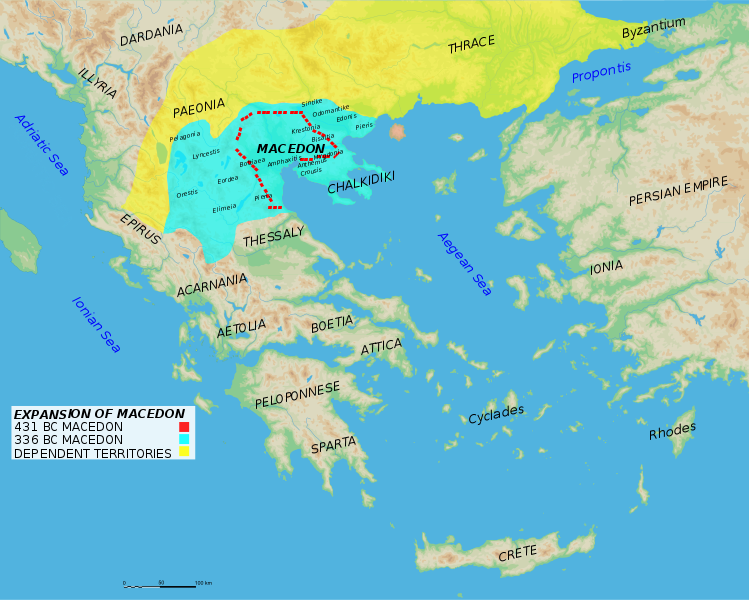
Figure 5.1 The expansion of Macedon under Philip II, from the small region marked in the red border to the larger blue region, along with the dependent regions surrounding it. Credit: Macedonian expansion by MaryroseB54.
The Greek city-states were understandably worried about these developments. Under the leadership of Athens, they organized into a defensive league to resist Macedonian aggression. For about ten years, the Macedonians bribed potential Greek allies, threatened those that opposed them, and launched attacks in northern Greece while the larger city-states to the south prepared for war. In 338 BCE, following a full-scale Macedonian invasion, the Macedonian army crushed the coalition armies at the Battle of Chaeronea. The key point of the battle was when Philip’s eighteen-year-old son Alexander led the noble cavalry unit in a charge that smashed apart the Greek forces.
In the aftermath of the invasion, Philip set up a new league of city-states under his control and stationed troops throughout Greece. As of 338 BCE, Greece was no longer the collection of independent city-states it had been for over a thousand years, it was now united under an invader from the north. The Greeks deeply resented this occupation. They only grudgingly accepted the Macedonians as fellow Greeks and had celebrated the independence of the Greek city-states as one of the defining characteristics of Greek civilization for centuries. Philip thus had his job cut out for him in managing his new conquest.
The more immediate problem facing Philip in the aftermath of the Greek conquest was that his men demanded more loot—the only way he could pay them was to find new places to invade and sack. Thus, Philip ruled Greece, but he could not afford to sit idle with troops aching for more victories. Cleverly, having just defeated the Greek city-states, Philip began behaving like a Greek statesman and assuming a kind of symbolic leadership role for Greek culture itself, not just Greek politics. He began agitating for a Greek invasion of Persia under his leadership to avenge the Persian invasion of the prior century. All things considered, this was a far-fetched scheme. Persia was by far the superpower of its day, and since the end of the Persian War numerous Greeks had served Persian emperors as mercenaries and merchants. Nevertheless, the idea of an invasion created an excuse for Macedonian and Greek imperialism and aggression under the pretext of revenge.
Unfortunately for Philip, he was murdered by one of his bodyguards in 336 BCE, just two years after conquering Greece. Family politics might have been to blame here, as his estranged wife Olympias—mother of Alexander—may have ordered his murder, as well as the murder of his other wife and children because she worried her own son might be set aside. Another, much more dramatic, theory is that the bodyguard—Pausanias—had a personal vendetta against the king. Pausanias was once Philip’s favorite lover. When Philip turned his affections to another younger man—also named Pausanias—the old lover felt spurned and publicly insulted the new one, calling him effeminate. To prove his masculinity, the younger Pausanias fought recklessly in battle and died. This could have been the end of it, unfortunately the younger man was a friend of the Macedonian general Attalus who, furious over his friend’s death, got the older Pausanias drunk at a banquet and had him gang-raped. When Pausanias complained to Philip, the king refused to punish his general, who just so happened to be related to his new wife. In the end, feeling dishonored and betrayed, Pausanias publicly murdered Philip. Regardless of who was ultimately responsible for the assassination, Alexander took advantage of the situation and ascended to the throne at the age of twenty following his father’s demise.
Alexander the Great
Alexander is a complicated figure. He quite rightly deserves the moniker “the Great” due to being a military genius and a courageous warrior who personally led his armies in battle. He was a charismatic and inspirational leader who won the loyalty not only of his Macedonian countrymen, but the Greeks and, most remarkably, the people of the Persian Empire whom he conquered. However, he could also be reckless, cruel and was by some accounts mentally instable. On several occasions, he continued to fight despite being wounded. In the ancient world, the death of a leader, meant the end of the battle. Putting himself at such risk, not only could have ended his life, but the livelihoods of all those who followed him into battle.
Alexander was driven by incredible ambition. Tutored by none other than Aristotle in his youth, he modeled himself on the legendary Greek hero Achilles, hoping to not only match but to surpass Achilles’ prowess in battle. He actually carried a copy of the Iliad with him on campaign as a guidebook for his own actions. Alexander became a legend in his own life, worshiped as a god by many of his subjects, and even the Greeks came to venerate him as one of the greatest leaders of all time.
There is no doubt that Alexander was intelligent, but it was an intelligence that was used just as much for destruction as it was for creation. His conquests began almost immediately after seizing the throne. He first ruthlessly killed off his rivals and enemies in Macedon and Greece, executing nobles he suspected of treason and family members he deemed as a threat to his authority. He then led an army back through Macedonia, crushing the Thracian tribes of the north who threatened to defect. While his attention was concentrated in the north, some of the Greek city-states rose up, hoping to end Macedonian control almost as soon as it begun. However, Alexander quickly returned to reconquer the rebellious Greek cities. In the case of the city of Thebes, for instance, Alexander let the Thebans know that, by rebelling, they had signed their own death warrants, and he refused to accept their surrender. As a warning to the rest of Greece, after he sacked the city, slaughtering thousands of its inhabitants and enslaving the rest, he put it to the torch. This is one instance where we can see some interesting behavior from Alexander. As the city burned, he had his men protect one house—that of one of his favorite poets, Pindar. This captures the enigma that was Alexander, destruction and chaos on one hand, and an appreciation of art and beauty on the other.
By 334 BCE, two years after he became king, Alexander was thoroughly in control of Greece. This meant he could now turn his attention on fulfilling his father’s mission to attack Persia. Taking the northern land route, he crossed the Hellespont—Dardanelles—into Asia Minor leading a relatively small army of about 37,000 men consisting of both hoplites and cavalry into Persian territory. Note how much smaller this army was than the Persian one that had invaded Greece a century earlier. While this makes sense given the demographic differences between Greece and Persia, it would also later be used to promote Greek/Macedonian superiority. Look what you did with 200,000 soldiers, look what we did with a fraction of that. Alexander’s army immediately engaged Persian forces at the Granicus River in northwestern Anatolia. His success there led to additional victories as he secured Anatolia and its rich Greek port cities in 333 BCE and Syria by 332 BCE. In almost every major battle, Alexander personally led the cavalry, a quality that inspired loyalty and confidence in his men.
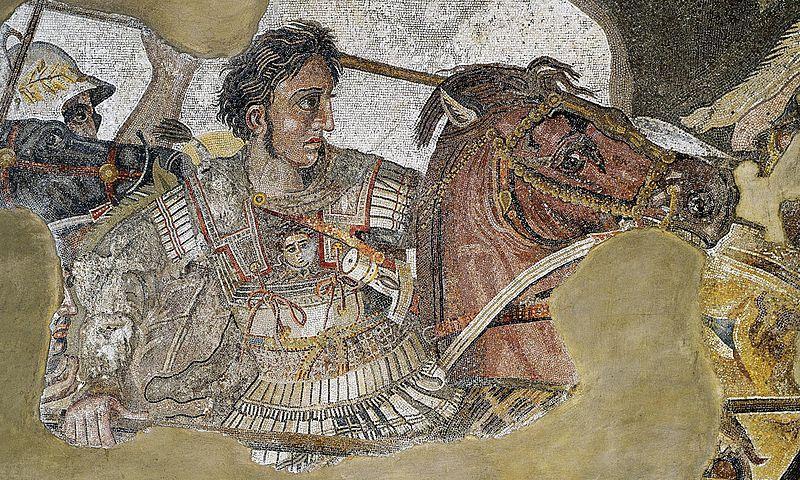
Figure 5.2 A Roman mosaic depicting Alexander the Great in battle, possibly based on a Greek original. Credit: Alexander mosaic by Unattributed.
His success against the Persians can be explained in part by the fact that the Persian technique of calling up their armies was too slow. Even though Alexander had arrived in Anatolia with only 37,000 men, against a potential Persian army of close to 300,000, far fewer troops were actually available to the Persians at any one time during the first years of Alexander’s campaign. Instead, the first two years of the invasion consisted of Macedonian and Greek forces engaging with smaller Persian armies, some of which even included Greek mercenaries. Alexander’s forces succeeded in conquering Persian territory piecemeal, taking key fortresses and cities, seizing supplies, and fighting off Persian counterattacks. Even with its overall military superiority, the Persian Empire could not focus its full might against the Greeks until much of the western empire had already been lost. In addition, Alexander was happy to offer alliances and concessions to Persian subjects who surrendered, sometimes even honoring those who had fought against him and lost with lands and positions. In sum, conquest by Alexander was not experienced as a disaster for most Persian subjects, merely a shift in rulership.
Though there is reason to believe that this episode was invented by Greek propagandists afterwards, in 332 BCE, the Persian king, Darius III, tried to make peace with Alexander and offered him his daughter in marriage, along with the entire western half of the Persian Empire. Alexander refused and instead marched into Egypt where the local aristocracy greeted him as a liberator and crowned him pharaoh in Memphis, a process which included naming him the son of Ra and the incarnation of Horus. At this point we see a shift in Alexander, as he began to believe he was divine, rather than simply a mortal Macedonian king. An example of this was in how he treated Callisthenes, his official historian and Aristotle’s nephew. Upon his accension to this new throne, Alexander began to demand proskynesis—Persian-style prostration before a ruler. Callisthenes opposed this demand and criticized other Egyptian and Persian customs that were being embraced by Alexander. This caused friction with the king and so when Callisthenes was accused of involvement in a conspiracy against Alexander’s life, the king ordered his arrest. Despite there being little to no evidence that he was a party to the conspiracy, Callisthenes was found guilty and was ultimately put to death. Callisthenes had spoken truth to power—Alexander you are not a god—but Alexander was not willing to hear it. As all of this occurred, Darius III succeeded in raising the entire strength of the Persian army, knowing that a final showdown was inevitable.
Alexander did not stay in Egypt for long and after founding the city of Alexandria, intending it to be a major Greek port and cultural center, he returned to his campaigning. From Egypt, the Greek armies headed east, where they faced the Persians in the Battle of Gaugamela. This crucial battle—fought in modern-day Iraq—saw Alexander’s smaller, but more disciplined, force decisively defeat Darius III’s massive army. Following Gaugamela Alexander conquered and occupied major Persian cities like Babylon and Susa. The campaign against Persia culminated in 330 BCE when they seized Parsa—called Persepolis by the Greeks, simply meaning “city of the Persians”—the ceremonial capital city. There, the Greek armies looted the entire palace complex before burning it to the ground. Historians have concluded that Alexander ordered the burning to force the remaining Persians who were resistant to his conquest to acknowledge its finality. The wealth of Persepolis and the surrounding Persian cities not only paid for the entire Greek army for years to come but also inspired a renaissance of building in Greece and Macedon. Darius III fled to the east but was murdered by a Persian noble named Bessus, who hoped that he would be rewarded by Alexander with wealth and power. This did not work as Alexander had him put to death for regicide—the killing of a king—and deicide—the killing of a god.
Alexander After the Conquest of Persia
Alexander paused his campaign to pay off his men and allow some of his troops to return to Greece. He then arranged for thousands of his Greek and Macedonian officers to marry Persian noblewomen in an effort to formally and permanently fuse together the Greek and Persian civilizations. His goal was not to devastate the empire, but to become the next “Great King” to whom all other leaders had to defer. He maintained the Persian bureaucracy—such as the organization of the satrapies—and enlisted thousands of Persian soldiers to join his campaign as his armies moved even farther east. He also made a show of treating Darius’s family with respect and honor, demonstrating that he wanted to win the Persians over rather than humiliate them. Finally, before heading east, Alexander declared that the ancient city of Babylon would be his new capital. Alexander ruled over the largest empire in the world, but he wasn’t content. It was time to conquer the lands his new Persian subjects had told him about that were beyond the borders of the empire.
As Alexander headed east with his armies, he continued to experience victory, defeating the tribesmen of present-day Afghanistan and then fighting a huge battle against the forces of the Indian king Porus in the northern Indus River Valley in 327 BCE. Alexander was so impressed by Porus—who had fielded 200 war elephants against him—that after the battle he appointed him as satrap over what had been his own kingdom. He then pressed on into India for several months, following the Indus south, but finally his loyal but exhausted troops refused to go on. Alexander had heard of Indian kingdoms even farther east toward the Ganges River Valley—places completely unknown to the Greeks before this point—and, being Alexander, he wanted to conquer them too. His men, however, were both weary and rich beyond their wildest dreams. Few of them could see the point of further conquests and wanted instead to return home and enjoy their hard-won loot. Some of his followers were now over 65 years old, having fought for both Philip II and then Alexander, and they concluded that it was time to go home.
Alexander consulted an oracle that confirmed that disaster would strike if he crossed the next river, so after sulking in his tent for a week, he finally relented. To avoid the appearance of a retreat, however, he insisted that his armies fight their way down the Indus River Valley and then across the southern part of the former Persian Empire on their way back to Mesopotamia. Unfortunately, Alexander made a major tactical error when he reached the Indian Ocean, splitting his forces into a fleet and a land force that would travel west separately. The fleet survived unscathed, but the army had to cross the brutally difficult Gedrosian Desert—also known as the Makran—in the southern part of present-day Pakistan and Iran, which cost Alexander’s forces more lives than had the entire Indian campaign.
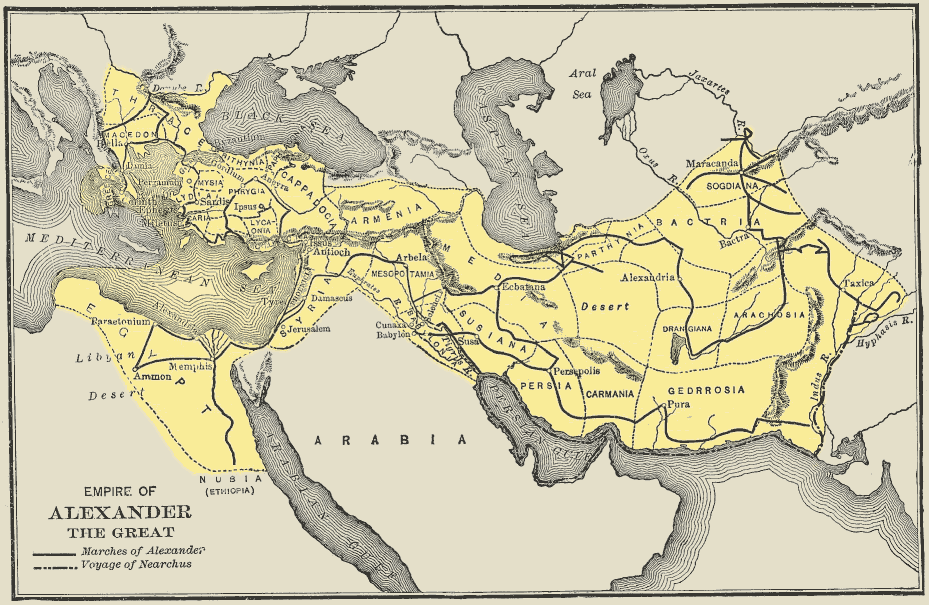
Figure 5.3 Alexander’s conquests—the dark black lines trace his route from Macedon in the far northwest through Egypt, across the Persian heartland, then to Afghanistan and India, and finally along the shores of the Indian Ocean and Persian Gulf back to Babylon. Credit: Alexander’s conquests by George Willis Botsford.
The return journey was arduous, and it took years to get back to the heartland of Persia. In 323 BCE, his armies finally arrived in Babylon. Alexander was exhausted and plagued by injuries from the many battles he had fought, but Macedonian and Greek tradition required him to drink to excess with his generals. Some combination of his injuries, alcohol, and exhaustion finally caught up with him. Supposedly, while he lay on his deathbed, his generals asked who would follow him as Great King and he replied, “the strongest,” then died. The results were predictable: decades of fighting as each general tried to take over the huge empire Alexander had forged.
The true legacy of Hellenistic civilization was not Alexander’s wars, as remarkable as they were, but their aftermath. During his campaigns, Alexander founded numerous new cities that were to be colonies for his victorious Greek soldiers, all of which were named Alexandria except for ones that he named after his horse, Bucephalus, and his dog, Peritas. For almost 100 years, Greeks and Macedonians streamed into these colonies, which resulted in a tremendous growth of Greek culture across the ancient world. They also came to settle in conquered Persian cities. Everywhere, Greeks became a new elite class, establishing Greek laws and Greek buildings and amenities. At the same time, the Greeks were always a small minority in the lands of the east, a fact that Alexander had certainly recognized. To deal with the situation, not only did he encourage inter-marriage, but he simply took over the Persian system of governance, with its royal road, its regional governors, and its huge and elaborate bureaucracy.
The Hellenistic Monarchies
As we have seen the Macedonians could be united by powerful leaders, but in their absence, the nobility tended to be selfish and jealous of power. Since he named no heir, Alexander almost guaranteed that his empire would collapse as his generals turned on each other. Indeed, within a year of his death the empire plunged into civil war, and it took until 280 BCE for the fighting to cease and three major kingdoms to be established, founded by the generals Antigonus, Ptolemy, and Seleucus.
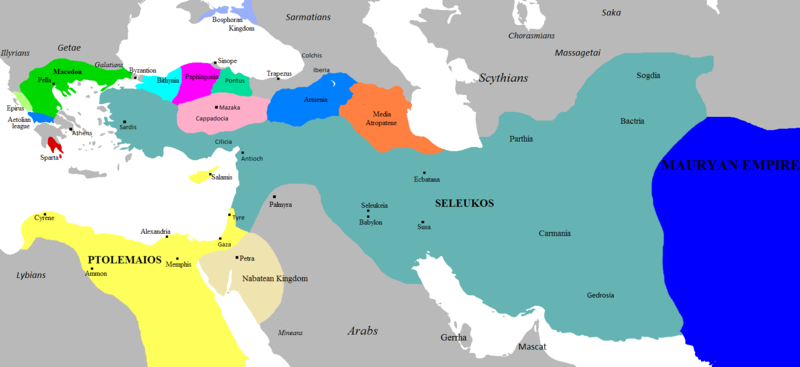
Figure 5.4 The major Hellenistic kingdoms (here Anglicized as “Seleukos” rather than “Seleucid” and “Ptolemaios” instead of “Ptolemaic.”) The Mauryan Empire was a new Indian state that swiftly achieved independence from Greek influence following Alexander’s death. Credit: Hellenistic kingdoms by Javierfv1212.
Antigonus established a dynasty that would rule over Macedon and Greece. However, despite controlling the Macedonian heartland and Greece itself, the Antigonids possessed the least territory among the Hellenistic monarchies. Additionally, the region had been depopulated in the time of Alexander as many thousands of soldiers and their families had emigrated to the new military colonies established by the late emperor. Over time, the Antigonids had to fight to hold on to power in Greece and they ultimately saw many of the Greek city-states achieve independence from their rule. Their hold over Macedon itself remained strong until they were conquered by Rome in 148 BCE. One thing that had bolstered their ability to retain Macedon was trade with the successor state that had achieved control over Egypt.
It was the general Ptolemy who had accomplished this. Of the three states the Ptolemies were the most powerful. Not only could they take advantage of the strong economy, but they also had the benefit of ruling over a coherent, unified state that had ancient traditions of kingship. Once they cemented their control, the Ptolemies were able to simply act as pharaohs, despite remaining ethnically and linguistically Macedonian Greek. In their state, the top levels of rule and administration were Greek, but the bulk of the royal bureaucracy was Egyptian. There were long-term patterns of settlement and integration, but right up to the end the dynasty itself was fiercely proud of its Greek heritage, with Greek soldier colonies providing the backbone of the Ptolemaic military. Ptolemy had been a close friend and trusted general of Alexander, and he took Alexander’s body to Egypt and buried it in a magnificent tomb in Alexandria, thereby asserting a direct connection between his regime and Alexander himself. Under Ptolemaic rule, Alexandria also became a gathering place for scholars and intellectuals of all kinds.
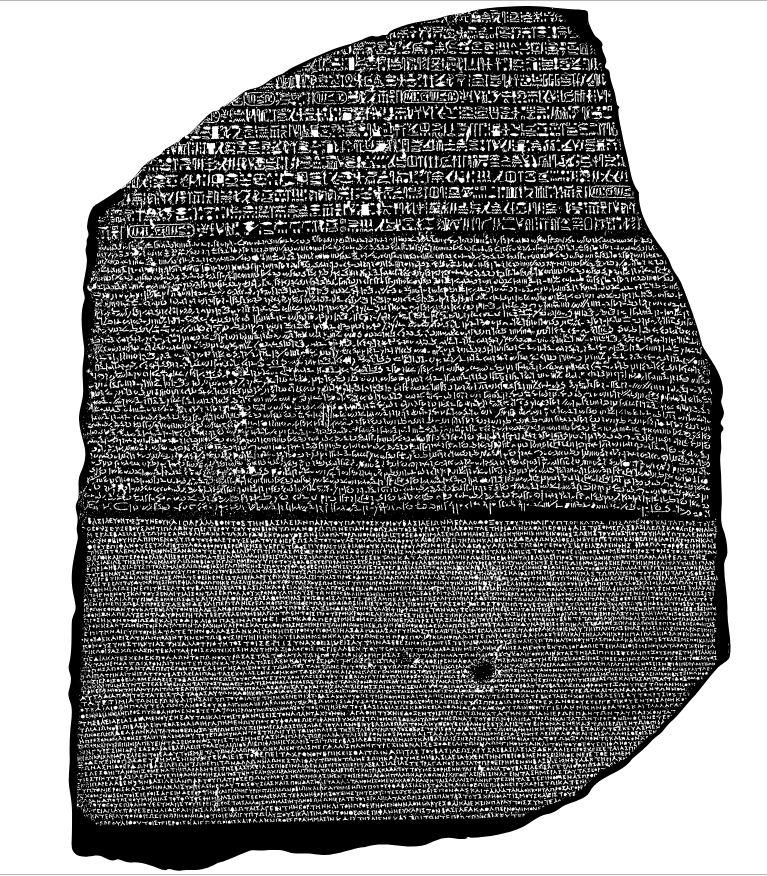
Figure 5.5 One of the most important artifacts of the Ptolemaic era was the Rosetta Stone, the object that enabled the translation of Egyptian hieroglyphics. Written during Ptolemaic rule, the stone consists of a single royal proclamation in two hieroglyphic alphabets as well as ancient Greek. Credit: Rosetta Stone by Creative Commons License.
Under the Ptolemies, starting with Ptolemy himself, the existing Egyptian bureaucracy was expanded and its middle and upper ranks staffed entirely by Greeks and Macedonians, who developed obsessively detailed records on every sheaf of wheat owed to the royal treasury. So much papyrus was used in keeping records that old copies had to be dumped unceremoniously in holes in the desert to make room for new one. Quite a lot of information about the Ptolemaic economy survived in these dumps and was discovered by archaeologists a few thousand years later, giving us greater insight into the period. Likewise, the abundance of the Nile was carefully managed to produce the greatest yields in history, so large that even after numerous taxes were taken, Egyptian wheat was still the cheapest available everywhere from Spain to Mesopotamia. The same held true with papyrus, a royal monopoly used everywhere in the Hellenistic world. Under the Ptolemies, Egypt was in many ways at its most prosperous in history. This prosperity helped the Ptolemies be the longest lasting of the Hellenistic dynasties.
Finally, the Seleucids ruled over Mesopotamia and Persia. Despite the vast wealth of the Seleucid kingdom, it was the most difficult one to govern effectively. There was a relative scarcity of Greeks vis-à-vis the native populations, and it was also the most diverse. It proved impossible in the long term for the Seleucid kings to hold on to the entire expanse of territories originally conquered by Alexander. After a military defeat, Seleucus himself gave his Indian territory back to an Indian king—Chandragupta —in 301 BCE in return for 500 war elephants. Chandragupta would go on to found one of India’s most impressive ancient states, the Mauryan Empire. Back in Persia, in 247 BCE a leader of the nomadic Parni tribe based in the region of Parthia destroyed Seleucid control in the Iranian Plateau. In the process he founded a new Persian empire—remembered as the Parthian Empire based on the name of the region. Nevertheless, the Seleucid kingdom held on until its remnants were defeated in 63 BCE by Pompey the Great of Rome, one-time ally and subsequent enemy of Julius Caesar.
The political legacy of the Seleucid kingdom was of nearly constant rebellion and infighting. While the dynasty tried to model itself both on Greek traditions of rule and on the earlier Persian dynasty of the Achaemenids it never established legitimacy in the eyes of many of its subjects. Instead, the Seleucid rulers were military leaders first and foremost, often obliged to crisscross their large empire suppressing rebellions, fighting off invasions of Central Asian nomads, and squabbling with their neighbors in Egypt.
That noted, where Seleucid rule left a lasting mark on the region it was in consolidating long-distance trade, especially in relation to the famous Silk Road, which began during the Hellenistic period. As noted above, Alexander left behind garrisons and colonies as his armies moved east, and as part of this practice a group of Greek and Macedonian soldiers intermarried with the local people of what is today Tajikistan in Central Asia. By 200 BCE, the descendants of this Greek-Bactrian people, the Yuehzi, were trading for Chinese silks in small quantities. Agents of the new Han Dynasty of China—founded in 206 BCE—learned of this trade and were eventually successful in trading silk for warhorses from the Yuehzi. In the process this laid the groundwork for an official, Chinese-sponsored trade route across Central Asia to the Middle East that vastly expanded the volume of trade goods traveling between China, the Middle East and, eventually, Europe.
The Seleucids then ruled over the Persian territories that lay directly on the main trade routes of the Silk Road, and they did everything in their power to support it. The dynasty supervised the construction of roads and canals useful to merchants and derived much of their revenue from silk textiles. Even though raw silk—from silkworms—was only available from China, subjects of the Seleucids in Mesopotamia did master the production of textiles from the raw material, creating an enormously valuable commodity to markets farther west. Persian silk weavings were of such high quality that they were actually traded back to China for profit. Thus, even though Seleucid political control was somewhat haphazard overall, it did at least play a role in encouraging the east/west trade that would only grow in the following centuries.
All of the Hellenistic monarchs of the successor kingdoms discussed above tried to rule in the style of Alexander, rewarding their inner circles with riches, founding new cities, and expanding trade routes to foreign lands. However, they also warred with one another. The Ptolemies and the Seleucids emerged as particularly bitter rivals, frequently fighting over the territories that separated their empires, such as in Canaan, where they fought eight full-scale wars. The kingdoms fielded large armies, many of which consisted of the descendants of Greek settlers who agreed to serve in the armies in return for permanent landholdings in the special military towns.
While Greek became the language of state and of the elites, the trade language of Aramaic was still used across most of the lands, and a host of local tongues existed as the vernacular. The kings often did not speak a word of the local languages. Indeed, Cleopatra VII, the last ruler of Egypt before its conquest by Rome, was the first Ptolemaic monarch to speak Egyptian. However, overall, the Hellenistic Age was a period that saw a fusion of identities across the lands conquered by Alexander, and even beyond. Even though Greek identity, ideas and language were presented as superior, they still melded with local concepts and identities from the Italian Peninsula to Persia to India to create a zone of cultural, intellectual and economic exchange.
One of the remarkable aspects of the Hellenistic age was the extent to which the people of Greece and the Middle East started exploring beyond the confines of the ancient world as they had known it. The Ptolemies supported trading posts along the Red Sea and as far south as present-day Eritrea and Ethiopia, trading for ivory and gold from the African interior. Explorers tried to circumnavigate Africa itself but did not quite succeed. In addition to accounts by explorers, the Greeks of the Hellenistic lands enjoyed histories and accounts of foreign kingdoms written by the natives of those lands. Major histories of Mesopotamia, Persia, and Egypt were written during the Hellenistic period and translated into Greek. Ambassadors from the Hellenistic kingdoms in places as far afield as India sometimes wrote accounts of the customs they encountered. In short, it was a period when Greek knowledge of the world greatly expanded.
The core of the Hellenistic kingdoms were the new cities founded by Alexander or, later, by the Hellenistic monarchs. The largest was Alexandria in Egypt, but there were equivalently grandiose cities in the other kingdoms. Both the new cities founded by Alexander and his successors and the old Greek settlements along the eastern coasts of the Mediterranean grew and prospered. The new cities were built on grid-pattern streets with various Greek amenities like public forums, theaters, and temples. Likewise, citizenship, which had been the basic unit of political currency in the ancient city-states, became instead a mark of elite membership that could be won in multiple cities at the same time.
Of note is the fact that the Seleucid cities represented the first major experiment in what we now call the welfare state. Because of the obligations the first monarchs felt toward their specifically Greek subjects, things like education and garbage collection were funded by the state. Eventually, public services extended to include relief for the poor, which consisted of free food distributed within the cities to the poorest classes of permanent residents. This practice had nothing to do with charity, it was simply a means for keeping the peace in the growing cities.
There were major ongoing problems for the Hellenistic ruling class, however, the most important of which was the continued stratification between Greeks and their non-Greek subjects. Greeks in the Hellenistic kingdoms felt that they were the heirs to Alexander’s conquests and that they were thus justified in occupying most—if not all—of the positions of political power. Especially in places like Egypt and Mesopotamia that had enormous non-Greek populations, resentment could easily turn into outright rebellion. This was partially manifested in the form of literature predicting the downfall of the Greek rulers. Mesopotamian priests, Zoroastrians in Persia, and Egyptian religious leaders all wrote works of prophecy claiming that the Greeks were in league with evil forces and would eventually be deposed. The Jews also struggled with their Greek overlords, though over time they began to take part in the overall fusion, eventually even translating the Torah into Greek. The Septuagint, as it was known, became the primary scripture for Greek-speaking Jews as the use of Hebrew faded.
Gender in the Hellenistic Age
Unrelated to the struggle between Greeks and non-Greeks, the Hellenistic period saw a significant shift in gender relations. Simply put, the Greek obsession with maintaining a strict sexual hierarchy that included the social separation of men and women that had reached its zenith in Classical Athens loosened enormously in the Hellenistic age. Women were praised for fulfilling social and familial duties, for carrying out religious ceremonies, and—in the case of noteworthy queens like Alexander’s mother Olympias and the Ptolemaic ruler Cleopatra VII— even for their political savvy.
Strikingly, Hellenistic women exercised considerable economic power and enjoyed much greater legal recognition than had women in earlier periods of Greek history. While they were sometimes obliged to do so with the backing of a male guardian, women controlled property, could borrow and lend money, and could manage the inheritances of their children. Some few women even served in political office, such as Phile who served as magistrate of Priene—a city-state in Ionia—around 50 BCE.
The general pattern appears to be that women in Greece itself faced greater legal restrictions than those living in Greek colonies elsewhere in the Hellenistic world. This is unsurprising since the older Greek city-states had centuries of both law and tradition in place enforcing sexual divisions. The Macedonian society represented by Alexander and his companions had always been less restrictive, with women exercising much more autonomy than in the Greek city-states to the south, and that cultural value was clearly imprinted along with Macedonian rule itself across the Hellenistic world. Back in Greece, meanwhile, Sparta stood apart as the one city-state that exceeded even Macedonian gender standards: Spartan women were fully autonomous economically, owning two-fifths of the land overall, and asserting considerable political influence.
However, as usual when discussing gender in the pre-modern period, it is necessary to provide some caveats. With very few exceptions—once again, Cleopatra VII is the outstanding example—men continued to control politics. While the laws of the Hellenistic kingdoms protected and recognized women in various ways, men were always given the greater legal role and identity. Analysis of birth rates suggests that infanticide was common, with girl babies often left to die both out of a general preference for boys and because the dowry the girl would have to be provided for at marriage was a burdensome expense for the family. Most male intellectuals continued to insist on the desirability of female submission—this group includes Aristotle—and with few exceptions, the bulk of the literature and philosophy from the period was written by men.
Philosophy and Science
Hellenistic philosophy largely shifted away from the concerns of Greek philosophers of the Classical Age. Instead of focusing on politics—as had Socrates, Plato, and Aristotle—they instead explored personal ethics, in particular in how to live a happy life filled with pleasure and tranquility. In other words, the focus was on individualism, rather than community. All of the major schools of Hellenistic philosophy shared this same pursuit, although they expressed it in different ways. We will focus on three of them here—the Epicureanism, Stoicism, and Cynicism.
The Epicureans, named after their founder Epicurus, believed that humans ought to turn their backs on the pointless drama of politics and social competition and retire to a kind of inner contemplation. Epicurus taught that even if gods existed, they clearly had no interest in human affairs and thus did not need to be feared. Death was final and total, representing release and peace, not an afterlife of torment or work, so there was no need to worry about it. In short, the Epicureans believed in a virtuous renunciation of earthly cares and an indulgence in pleasure. Pleasure was not about overindulgence, however—which led to suffering such as indigestion and hangovers—but a refined enjoyment of food, drink, music, and sex. Although, one interesting aspect of this philosophy was the idea that sexual pleasure was fine, but emotional love was to be avoided since it was too likely to result in suffering. To this day, the word “epicurean” as it is used in English means someone who enjoys the finer things in life, especially in terms of good cooking.
The Cynics believed that social conventions were unfortunate byproducts of history that distracted people from the true source of virtue and happiness: nature. This means that the only route to happiness was an aggressive rejection of society. Indeed, it should be noted that the word “cynic” is derived from the Greek kynikos, meaning dog-like. Cynics advocated a combination of asceticism and naturalism, indulging in one’s physical needs without regard to social convention. Practically speaking, this involved deliberately flouting social mores, sometimes in confrontational or even disgusting ways: Diogenes, the founder of Cynicism, notoriously masturbated and defecated in public. Most Cynics were slightly more restrained, but most took great pleasure in mocking people in positions of political authority. One story had it that Alexander sought out Diogenes and found him lying in the street in the city-state of Corinth. Asking Diogenes what he, the king, might do for him, the philosopher replied, “stop standing in my sunbeam.” Though this story is more than likely not true, it illustrates that even the mightiest were of no consequence to the Cynics. Additionally, they also belittled the members of other philosophical schools for their overly rigid systems of thought.
Originally an offshoot of the Cynics, Stoicism became a philosophy of fate and rationality. Unlike the others, Stoics believed that humans had an obligation to engage in politics, which formed part of a great divine plan linked to both fate and nature. As participants in the natural order, humans ought to learn to accept the trials and tribulations of life rationally, without succumbing to emotion—hence the contemporary meaning of the word “stoic”: someone who is indifferent in the face of pain or discomfort. They celebrated the idea that the rational mind was always more powerful than emotional reactions. The Stoics accepted the necessity of being part of a society and of fulfilling social obligations, but they warned against excessive pride and greed. Instead, a Stoic was to do his duty in his social roles without the distraction of luxury or indulgence. They also believed that one must accept one’s place in the larger scheme instead of resisting it. An image used by the Stoics was that of a dog hooked up to a loaded cart—a common sight in ancient Greece—at the top of a hill. If the dog balked at its load and tried to slowly move down the hill, there was a chance the full cart could overwhelm him, leading to injury or death. However, if the dog just runs down the hill, without worrying about the cart behind him, the cart will simply follow. A modern take on this would be the phrase, “go with the flow.”
What these three schools of philosophy had in common, despite their obvious differences, is that they all represented different approaches to accepting the—political—status quo. The Epicureans avoided politics, the Stoics supported existing political structures, and the Cynics mocked everything without offering positive suggestions for change. This was a far cry from the earnest inquiry of a Socrates, a Plato, or an Aristotle in trying to establish a virtuous form of politics. While Greek culture enjoyed a period of unprecedented influence during the Hellenistic period, its experiments in rational—let alone democratic—political analysis were not a major component of that influence.
While political theory did not enjoy a period of growth during the period, there were significant accomplishments in science and mathematics. The most important Hellenistic mathematicians were Euclid and Archimedes. Euclid was the inventor of the mathematical discipline of geometry. He was the first to use obvious starting points called axioms —for instance, the idea that two parallel lines will never intersect—to be able to deduce more complex principles called theorems. Euclid is one of those relatively few ancient thinkers who really “got it right” in the sense that none of his major claims were later proved to be inaccurate. His work on geometry, the Elements, was still used as the standard textbook in many courses on mathematics well into the twentieth century CE, thousands of years after it was composed. Archimedes was also a geometrician, best remembered for his applications of geometry to engineering. He discovered the principle of using the displacement of water to calculate the specific gravity—mass divided by volume— of objects, and he devised a number of complex war machines used against Roman forces when his home city of Syracuse, in Sicily, was under attack—including, according to some accounts, a giant mirror used to focus the sun’s rays on Roman ships and set them on fire.
Hellenistic thinkers also made important discoveries in astronomy. It was Aristarchus of Samos who posited that the sun was the center of the known universe, not the earth, and Hipparchus created the first star charts that included precise positions for stars over the course of the year. Additionally, to help keep track of their positions he created the first system of longitudes and latitudes. Other Hellenistic astronomers made increasingly precise calculations of the Earth’s size, with Eratosthenes producing a remarkably accurate estimate of its circumference—off by only about 200 miles.
Perhaps the most memorable achievement in scholarship during the period was the institutional form it took at the Library of Alexandria and its associated Museon, often considered to be the first research university in the western world. Funded directly by the Ptolemaic government, the Library collected and translated every scrap of available scholarship from the Hellenistic world and played host to scholars who based their own work on its archives. In fact, the Museon functioned similarly to a modern university: scholars resided there, conducted research in a variety of specialized subjects, and presented their findings via lecture and publication. Unfortunately, a fire in 47 BCE destroyed most of the library, and another in 7 CE completely destroyed it. However, the knowledge stored there was not all irretrievably lost. In I45 BCE, during the reign of Ptolemy VII, all foreign scholars in Alexandria were expelled when one of them got involved in a succession dispute. This created a diaspora of scholars who took their knowledge and possibly some texts to other cities, such as Athens and Rhodes. Additionally, as Alexandria became a provincial outpost of the Roman Empire, it suffered from a lack of consistent imperial funding and support. The position of head librarian lost its academic prestige, and fewer resources were devoted to maintaining and recopying the perishable papyrus scrolls, which naturally would have decayed over time if not constantly preserved.
This task fell to Greek-speaking scholars from around the Hellenistic world who were allowed to make copies of its contents, and over the decades and centuries these copies had been distributed across the region. Certainly, much was lost, but it is not as catastrophic as popular media makes it out to be.
While there were certainly important intellectual breakthroughs that occurred during the Hellenistic period, there were not corresponding achievements in technology or engineering. This is not surprising as the pace of technological change in the ancient world was always glacially slow by modern standards. What mattered at the time was the creation and spread of ideas and knowledge. That it had no immediate and practical consequences in the form of applied technology was not relevant.
Conclusion
While Alexander the Great is a well-known figure from ancient history, the Hellenistic period as a whole is not. The reason for that relative neglect—in popular culture and in many history classes, at least those at the pre-college level—is that the Hellenistic age is overshadowed by what was happening simultaneously to the west: the rise of Rome. In precisely the same period in which Alexander and his successors first conquered then ruled the territories of the former Persian Empire, Rome was in the process of evolving from a town in central Italy to the center of what would eventually be one of the greatest and longest-lasting empires in world history. It is to this subject that we will devote the next few chapters.

.svg)


