
2 The Archaic Age of Greece
It can be difficult to decide where to begin the history of a people or region. Certainly, both the Minoans and Myceneans had occupied the geographical space we call Greece. However, they both had writing systems and languages that would be unrecognizable to modern Greeks. Though it is undeniable that both civilizations help to develop the foundations of Greek identity, they were not truly Greek, so we are going to mainly by-pass them. After briefly touching on them, we are going to begin our focus on the post-Mycenean period. A time when after the Bronze Age collapse, an Indo-European speaking people moved into the Greek peninsulas and claimed them for themselves. These were a people that can be credited with creating forms of political organization and approaches to learning that were and remain hugely influential. Among other things, the Greeks carried out the first experiments in democratic government, invented a form of philosophy and learning concerned with empirical observation and rationality, created forms of drama like comedy and tragedy, and devised the method of researching and writing history itself. It is thus useful and productive to begin our discussion of European history with them.
The Greek Dark Age
During the Bronze Age, as described in the last chapter, the Minoans and Mycenaeans were two of the civilizations that were part of the international trade and diplomacy network of the Mediterranean and Middle East. The Minoans were a major seafaring civilization based on the island of Crete. They created huge palace complexes, magnificent artwork, and great wealth. They eventually vanished as a distinct culture, most likely after they were conquered and absorbed by the Mycenaeans, their neighbors to the north.
The Mycenaeans developed as a civilization after the Minoans were already established in Crete. The Mycenaeans lived on the Greek mainland and the islands of the Aegean Sea and were known primarily as sea-going merchants and raiders. They were extremely warlike, attacking each other, their neighbors, and even the people they traded with whenever the opportunity presented itself. The Mycenaeans were the protagonists of the famous epic poems written by (the possibly mythical) Homer, The Iliad and The Odyssey.
The Mycenaeans vanished as a civilization at the end of the Bronze Age. The cause was probably a combination of foreign invasions and local rebellions and wars. One strong possibility is that there was a sustained civil war among the Mycenaean palace-settlements that resulted in a major economic. A bad enough war within Greece could have easily disrupted agriculture, which was already near a subsistence level, leading to famine. Mixed with on-going war and external trade disruptions, the Mycenaeans just couldn’t recover. Whatever the ultimate cause, by 1100 BCE the Mycenaeans were in critical decline. This marks the beginning of what historians refer to as the Dark Age in Greek history (1100-750 BCE), named such because so little documentation from that period has survived to the modern day. It is during this period that the predecessors of modern ethnic Greeks entered the region, in the process causing even further problems for the last of the Mycenean states.
Of all the regions and cultures affected by the collapse of the Bronze Age, Greece was among those hit hardest. First and foremost, foreign trade declined dramatically. Whereas the Mycenaeans had been seafaring traders, the current residents of Greece were now largely limited to local production and trade and trade with neighboring areas all but vanished. In turn, this reversion to local subsistence economies cut the Greeks off from important sources of nutrition and materials for daily life, as well as foreign ideas and cultural influences. The Myceneans had been a great traveling and trading culture; the new Greeks were largely isolated from their neighbors. The results were devastating: some scholarly estimates postulate that the population of Greece declined by as much as 90 percent in the centuries following the Bronze Age collapse.
The Archaic Age and Greek Values
The Greek Dark Age started to end around 750 BCE. The subsequent period of Greek history, from around 750 BCE – 500BCE, is referred to as the “Archaic” (meaning “old”) Age, or the Period of the Greek city-states. The Archaic Age saw the re-emergence of sustained contact with foreign cultures, starting with the development of Greek colonies on the Aegean islands and on the western coast of Anatolia—known to the Greeks as Ionia. These Greeks helped to reestablish long-distance trade, most importantly with the Phoenicians, the great merchants of the Iron Age. Eventually, foreign-made goods and cultural contacts started to flow back into Greece once again.
Of the various influences the Ionian Greeks received from the Phoenicians, none was more important than their alphabet. Working from the Phoenician version, the Ionian Greeks developed their own syllabic alphabet (an earlier Greek writing system, Linear B, vanished during the Greek Dark Age). This system of writing proved flexible, nuanced, and relatively easy to learn. Soon, the Greeks started recording not just tax records and mercantile transactions, but their own literature, poetry, and drama. The earliest surviving Greek literature dates from around 800 – 750 BCE thanks to the use of this new alphabet (which, in turn, served as the basis of the Roman alphabet and from there to the alphabets used in all Latinate European languages, including English).
Homer’s epic poems —The Iliad and The Odyssey—were written down in this period after being recited in oral form by traveling singers for centuries. They purported to recount the deeds of great heroes from the Mycenaean age, in the process providing a rich tapestry of information about ancient Greek values, beliefs, and practices. Both poems celebrated arete—a Greek virtue which can be translated as “excellence” and “success,” but must be understood as a moral characteristic as much as a physical or mental one. Arete meant, among other things, fulfilling one’s potential, which was almost always the highest goal espoused in Greek philosophy. Throughout the epics, men and women struggle to overcome both one another and their own limitations, while grappling with the limitations imposed by nature, chance, and the will of the gods.
Remembering that this was a patriarchal culture— with men holding all official positions of political power—the values on display in the Homeric poems spoke to how the Greeks of the Archaic Age determined what was good and desirable in human behavior in general. The main focus of the aristocratic men of the era—these were the literate ones and so it makes sense it was their values that were being recorded—was on the two ways that a man could dominate other men: through strength of arms and through skill at words. The two major areas a man had to master were thus war and rhetoric: the ability to defeat enemies in battle and the ability to persuade potential allies in the political arena.
These writings can also tell us about how men understood women in this period. The Greek myths and epic tales—of which the writings of Homer are no exception—are rife with hostility and suspicion of assertive, intelligent women, while celebrating those who dutifully served their husbands or fathers. In fact, women played a significant role in the Homeric tales, sometimes as murderous and sinister, like the queen Clytemnestra, but at other times as exemplars of virtue, like the hero Odysseus’s faithful wife Penelope. Indeed, Penelope is described as waiting faithfully for twenty years for Odysseus to return from the invasion of Troy despite a legion of suitors trying to win her hand—and Odysseus’s lands. We also see in The Odyssey that the ideal woman was sexually monogamous with her husbands. However, as is the norm in most patriarchal societies, men’s sexual liaisons—with female slaves as well as other men of their own social rank—were perfectly acceptable behaviors.
That being noted, it is clear that women in the Archaic Age did enjoy both social influence and some access to economic power, as in the ability to inherit property. Likewise, women were not generally secluded from men in normal social discourse, with various Greek tales including moments of casual interaction between men and women. Practically speaking, women were invaluable to the Greek economy, providing almost all of the domestic labor and contributing to farming and commerce as well. Their status, however, would grow more fraught over time. As the Archaic Age evolved into the Classical Age restrictions on women’s lives and freedoms would increase, especially in key city-states like Athens, culminating in some of the most misogynistic gender standards in the ancient world.
In almost all cases the characters in Homer’s epics embodied the Greek ethical outlook. As such, they serve as one of the most important sources in understanding Greek culture itself.
Another example of this is that they show us that what was important to the Greeks was the public performance of excellence, not private virtue or good intentions. It mattered how a man performed publicly, in battle, in athletic competitions, or in the public forums of debate that emerged in the growing city-states of Archaic Greece. The fear of shame was a built-in part of the pursuit of excellence. Greek competitions—in everything from athletics to poetry—had no second-place winners, and the losers were openly mocked in the aftermath of the contests. This idea of competition and public debate was to have an enormous influence on the development of Greek culture, one that would subsequently spread around the entire Mediterranean region.
These Greek values translated directly into Greece’s political order and the Archaic Age was an era of major Greek political innovation. Of these, the most important was the creation of the polis (plural: poleis): a political unit centered on a city and including the surrounding lands. In English we often refer to this type of political unit as a city-state, which is how we will refer to the concept from this point. This political development—the English word “political” actually derives from “polis”—was so important we sometimes call this the Period of the Greek city-state. The polis was the center of Greek political life, and innovations in political theory developed in this period have had an enormous historical legacy. Starting in this period and continuing through the Classical Age, the notion of legal citizenship and equality, the practice of voting on laws, and a particular concept of political pride—now referred to as patriotism— all first took shape. Indeed, the city-state became the core of a person’s identity. Ask a Greek where they were from and the immediate answer would be, “I am Athenian” or “I am Spartan.”
During the Archaic Age, the Greek city-states shared many similar institutions. Greek citizens could only be members of a single city-state, and citizens had some kind of role in political decision-making. Citizens would gather in the agora, an open area that was used as a market and a public square and discuss matters of importance to the city-state as a whole. The richest and most powerful citizens became known as “aristocrats”—the “best people.” Eventually, aristocracy became hereditary. Other free citizens could vote, usually either to elect officials or approve laws, the latter of which were usually created by a council of elders—the archons—all of whom were aristocrats. At this early stage in their development commoners had little real political power. However, important for the future development of democracy was the precedent that was set of meeting to discuss politics.
Even in city-states in which citizens did not directly vote on laws there was a strong sense of community. Out of this developed the concept of civic virtue—the idea that the highest moral calling was to place the good of the community above one’s own selfish desires. This concept was almost unparalleled elsewhere in the ancient world. While other ancient peoples certainly identified with their places of origin, in most cases they linked themselves to lineages of kings rather than the abstract idea of a community. Also, Greek citizens were equal before the law within their own city-state, which was a radical break from other civilizations that had different sets of laws based on class identity. That being said, there were considerable ironies in Greek notions of equality which we will examine in Chapter 4. Civic virtue, very closely related to the modern concept of patriotism, was a powerful and influential idea because it would continue through the Greek Classical Age, be transmitted by the conquests of Alexander the Great, and eventually become one of—if not the single most important—ethical standards of both the Roman Republic and Empire. It would ultimately go on to influence intellectuals and politicians in the modern world.
Greek Culture and Trade
The Greek city-states were each distinct, fiercely proud of their own identity and independence, and they frequently fought small-scale wars against one another. Even as they did so, they recognized each other as fellow Greeks and therefore as cultural equals. All Greeks spoke mutually intelligible dialects of the Greek language and shared the political tradition of citizenship. They also all worshiped the same pantheon of gods. Finally, the Greeks took part in a range of shared cultural practices, from listening to traveling storytellers who recited the Iliad and Odyssey from memory to holding drawn-out drinking parties called symposia.
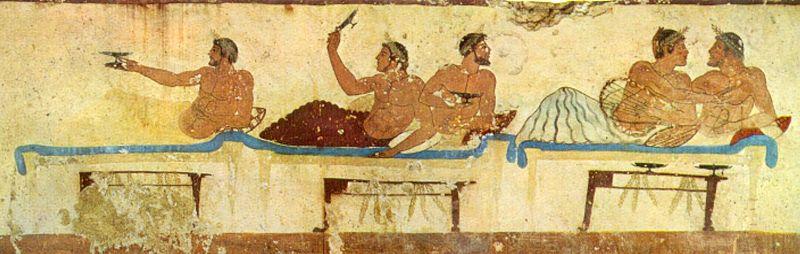
Figure 2.1 Depiction of a symposium dating from c. 475 BCE. Credit: Symposium by PD-1923.
The city-states also invented institutions that united the cities culturally, despite their political independence. One of the most important was the Panhellenic games. “Panhellenic” literally means “all Greece,” and the games were meant to unite all of the Greek city-states, including those founded by colonists and located far from Greece itself. The games were a combination of religious festival and competition in which aristocrats from each city competed in various sports, including javelin, discus, footraces, and a brutal form of unarmed combat called pankration.
The most significant of these games was the Olympics. Named after Olympia—a site in the western part of the Peloponnesus peninsula—they were held every four years for over 1,000 years, starting in 776 BCE and ending in 393 CE. Thanks to the Olympics, the date 776 BCE is often used as the definitive break between the Dark and Archaic ages of Greek civilization. The Olympics were extraordinary not just in their longevity, but because Greeks from the entire world of Greek settlements came to them, traveling from as far away as Sicily and the Black Sea region. Wars were temporarily suspended and all Greek city-states agreed to let athletes travel with safe passage to participate in the games, in part because the Olympics were dedicated to Zeus, the chief Greek god. As noted above, there were no second prizes. Greek culture was hugely competitive. The defeated were humiliated and the winners completely triumphant. In the games they sought—in the words of the Greek poet Tyrtaeus—“either the wreath of victory or death.” Mind you, Tyrtaeus was a Spartan, and as such wrote poetry to inspire courage and duty while extolling soldiers to die bravely for the state in order to gain honor. There is no evidence that defeated athletes actually committed suicide.
Meanwhile, with the end of the Dark Age, population levels in Greece recovered. This led to emigration as the population outgrew the ability of the poor, rocky soil of Greece to provide for them. Eventually, Greek colonies stretched across the Mediterranean as far as Spain in the west and the coasts of the Black Sea in the north. Greeks founded colonies on the North African coast and on the islands of the Mediterranean, most importantly on Sicily. Greeks set up trading posts—known as emporia—in the areas they settled, even in Egypt. The colonies continued the mainland practice of growing olives and grapes for oil and wine, but they also took advantage of much more fertile areas away from Greece to cultivate other crops.
Greek colonists sometimes intermarried with local peoples on arrival, an unsurprising practice given that many expeditions of colonists were comprised almost entirely of young men. In other cases, however, colonists found relatively isolated areas appropriate for shipping and set up shop, maintaining close connections with their home city-state as an economic outpost. The one factor that was common to all Greek colonies was that they were rarely far from the sea. They were so closely tied to the idea of a shared Greek civilization and the need for seafaring trade routes was so strong that colonists were not generally interested in trying to push inland.
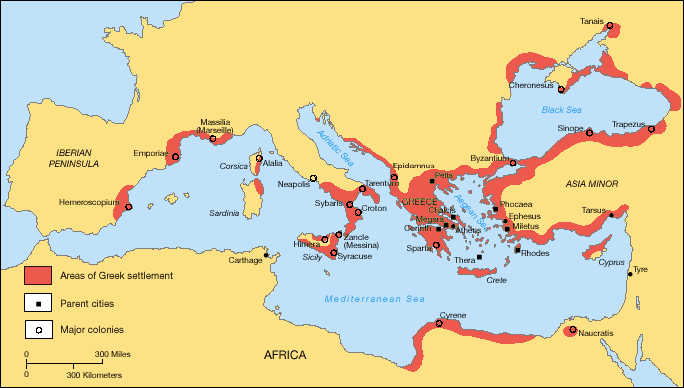
Figure 2.2 Greek colonization during the Archaic period – note how Greek colonies were always near the sea. Credit: Greek colonies by Regaliorum.
As trade recovered following the end of the Dark Age, the Greeks re-established their commercial shipping network across the Mediterranean, with their colonies soon playing a vital role. Utilizing the pentekonter—a 50-oared vessel that had the stability to sail the Mediterranean but a high enough draft to be used on rivers—Greek merchants eagerly traded with everyone from the Celts of Western Europe to the Egyptians, Lydians, and Babylonians. When Julius Caesar conquered Gaul about 700 years later, he found the Celts there writing in the Greek alphabet, long since learned from the Greek colonies along the coast. Likewise, archaeologists have discovered beautiful examples of Greek metalwork as far from Greece as northern France.
Greek colonies far from Greece were as important as the older city-states in Greece itself, since they created a common Greek civilization across the entire Mediterranean world. Greek civilization was not an empire united by a single ruler or government; it was united by culture.
Military Organization and Politics
A key military development unique to Greece was the phalanx: a unit of spearmen—armed with a spear 7 to 9 feet in length—standing in a dense formation, with each using his shield to protect the man to his left. Each soldier in a phalanx was called a hoplite. Each hoplite had to be a free Greek citizen of his city-state and had to be able to pay for his own weapons and armor. He also had to be able to train and drill regularly with his fellow hoplites, since maneuvering in the densely packed phalanx required a great deal of practice and coordination.
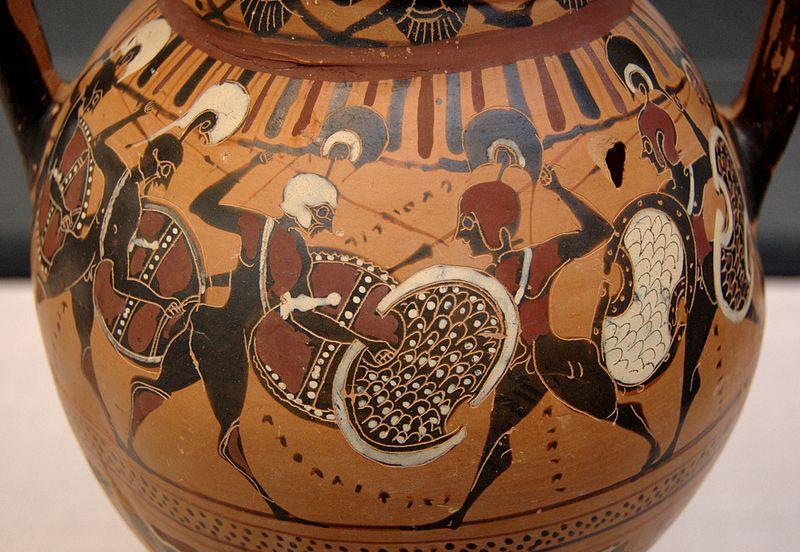
Figure 2.3 Depiction of a battle between phalanxes of hoplites from rival city-states, dating from c. 560 BCE. The clay vessel is an amphora; a container used for wine or olive oil. Credit: Phalanxes by Bibi Saint-Pol.
The most noteworthy military innovation represented by the hoplites was that their form of organization provided one solution to the age-old problem of how to pay for highly trained and motivated soldiers. Rather than a state paying for a standing army, the hoplites paid for themselves and were motivated by civic virtue. When rival city-states fought, the phalanxes of each side would square off and stab away at each other until one side broke, threw down their shields, and ran away—by far the deadliest part of the confrontation. The victors would then allow the losers time to gather their dead for a proper burial and peace terms would be negotiated.
The hoplites were significant politically because they were not aristocrats. Because they defended the city-states and proved extremely effective on the battlefield, they would eventually be able to demand better political representation, something that would have a major impact on Greek politics. This happened in the seventh century BCE, when hoplites in many city-states began clamoring for better political representation, since they were excluded by the traditional aristocrats from meaningful political power. In many cases, the result was the rise of tyrannies. This concept was not understood by the Greeks in the same way as we do today. While it was a government led by a man—the tyrant—who had no legal right to power, those who had appointed them were the citizens of a city-state. They did so with the express purpose to stave off civil conflict. While the tyrants were generally aristocrats, they answered to the needs of the hoplites. To the Greeks, the term tyrant did not originally mean an unjust or cruel ruler since many tyrants succeeded in solving major political crises on behalf of the hoplites while still managing to placate the aristocrats.
Since the tyrants lacked official political status, they had to play to the interests of the people to stay in power. One way they did this was to seize lands of aristocrats outright and distribute them to free citizens. Many of them also built public works and provided jobs, while others went out of their way to promote trade. The period between 650-500 BCE is sometimes called the “Age of Tyrants” in Greek history because many city-states instituted tyrants to stave off civil war between aristocrats and less wealthy citizens during this period. Sometimes the rule of tyrants led to a return to aristocratic rule in the form of an oligarchy, where power is shared amongst an exclusive group. Other times they led to democracies, where certain classes—primarily male citizens—could vote. By 500 BCE, regardless of type, the foundations had been laid for how each city-state would be governed as the Greeks entered into the Classical Period.
Sparta and Athens
Two of the most memorable city-states of the Archaic Age were Sparta and Athens. The two city-states were in many ways a study in contrasts: an obsessively militaristic and inward-looking society of “equals” who controlled the largest slave society in Greece, and a cosmopolitan naval power at the forefront of political innovation.
Sparta
Starting in about 700 BCE, the Spartans began conquering a large swath of territory in their home region of Greece, the southern Greek peninsula called the Peloponnesus. Under the authority of the tyrant Lycurgus, Sparta had developed into an aristocratic monarchy with two kings. Under the two kings were a smaller council that issued laws and a large council made up of all Spartan males over 30 who approved or rejected the laws proposed by the council. Over time, citizenship was limited to men who had undergone the arduous military training for which the Spartans are best remembered and which led to their dominance in the region form about 600-450 BCE.
Spartan culture was among the most extreme forms of militarism the world has ever seen. At the age of seven, Spartan boys were removed from their families to live in communal barracks and began the agoge, a rigorous state-sponsored training system. They were regularly beaten, both as a form of discipline and to make them unafraid of pain. Children with deformities of any kind were left in the elements to die, as were children maimed by the training regimen. Spartan boys were trained constantly in combat, maneuvering, and physical endurance. Spartan girls were allowed to stay with their parents but were trained in martial skills as children as well, along with the knowledge they would need to run a household. When a man reached the age of twenty, assuming he was judged worthy, he would be elevated to the rank of “Equal”—a full Spartan citizen—and receive a land grant that ensured that he could concentrate on military discipline for the rest of his life without having to worry about making a living.
Even activities like courtship and acquiring nourishment were designed to test Spartans. When it was time for a young Spartan to marry—around the age of 20—the young man would brawl his way into the family home of his bride-to-be, fighting her relatives until he could “kidnap” her. Married couples were not allowed to live together before the age of 30. Until that age, the man was expected to sneak out of his bunker to see his wife, then sneak back in again before morning. The idea was to maintain the comradery amongst the troops and to make sure that living with a woman would not “soften” the warrior and ruin all the training he had been through. In addition, Spartans in training were often forced to steal food—from their own slave-run farms. If they were caught, they would be punished, but the infraction was being caught, not the theft. The purpose of the theft was to practice stealth.
The reason for all this militaristic mania was simple: Sparta was a slave-holding society. Early Spartan conquests had resulted in a very large area under their control, populated by people who were not Spartan. Rather than extend any kind of political representation to these subjects, the Spartans instead maintained absolute control over them, up to the right of killing them at will with no legal consequence. At the height of Spartan power approximately 90 percent of the population under their control were helots, serfs descended from the people conquered by Sparta in the eighth century BCE.
Every year, the Spartans would declare war on the helots and part of the training of young Spartans was serving on the Krypteia, the Spartan secret police that infiltrated Helot villages to watch for signs of rebellion. Adolescent Spartans in training would even be dispatched to simply murder any helots they encountered. All of this was to ensure that the helots would be too terrified and broken-spirited to resist Spartan domination. There were never more than 8,000 Spartan soldiers, along with another 20,000 or so of free noncitizens known as perioikio—inhabitants of towns near Sparta who were not considered helots, but instead free but subservient subjects—overseeing a much larger population of helots. Simply put, Spartan society was a military hierarchy that arose out of the fear of a massive slave uprising.
Likewise, despite the famous—and accurate—accounts of key battles in which the Spartans were victorious, they were loath to be drawn into wars, especially ones that took them more than a few days’ march from Sparta. They were so preoccupied with maintaining control over the helots that they were hesitant to engage in military campaigns of any kind, and hence rarely engaged in battles against other city-states. This would change with the outbreak of war against Athens in the fourth century BCE.
The only area in which Spartan society was actually less repressive than the rest of the Greek city-states was in gender roles. According to Greeks from outside of Sparta, free Spartan women were much less restricted than women elsewhere in Greece. They were trained in war, they could speak publicly, and they could own land. They scandalized other Greeks by participating in athletics and appear to have benefited from a greater degree of personal freedom than women anywhere else in Greece. Of course, this was a social necessity since the men of Sparta lived in barracks until they were 30, leaving the women to run household estates.
Ultimately everything was done for the good and unity of Sparta, a concept known as eunomia. Spartans were trained to put the good of their comrades and Spartan society as a whole above their own self-interest. This would be seen in its most spectacular form at the Battle of Thermopylae against the Persians. A Spartan life was about discipline and upholding eunomia, they were to focus on one form of art, the art of war. That being said, the Spartans faced two major weaknesses—they were prone to slave revolts, and they were not a sea power.
Athens
In many ways, Athens was the opposite of Sparta. Though like Sparta, Athens controlled a large, enslaved population, Athens is also remembered as the birthplace of democracy. Whereas the Spartans were militaristic and austere—to the extent that we have made “spartan” a verb in English today which means “severe and unadorned—the Athenians celebrated art, music, and drama. In the end, Sparta and Athens were—especially in the fifth and fourth centuries BCE—rivals for the position of the most powerful city-state in Greece.
The city of Athens itself contained a population of about 75,000 people at its height. Though with the addition of the regional population outside of the city walls the number of people who claimed to be Athenian was closer to 200,000. Its location on the southeastern coastline of the Attica Peninsula primed Athens to look outwards into the larger Mediterranean world, where it would become a major force in trade. The wealth brought in by this trade ultimately led to conflicts over its distribution among the citizens. Starting early in the Archaic Age, Athens witnessed a series of struggles and compromises between the wealthy aristocrats—who controlled most of the land as well as most of the political power—and everyone else, particularly the free citizens and farmers of Athens. One key development in Athenian politics arose from the fact that merchants and prosperous farmers could afford the arms and armor to be hoplites but were shut out of political decision-making. The aristocrats—who consisted of about 60 families and met in a body known as the Council of Areopagus—were more than happy to maintain the status quo.
The crisis of representation reached a boiling point in about 600 BCE when there was a real possibility of civil war between the common citizens and the aristocrats. The major problem was that the aristocrats owned most of the land that other farmers worked on. Many of those farmers were increasingly indebted to the aristocrats, and by Athenian law anyone who could not pay off his or her debts could be legally enslaved. An increasing number of formerly-free Athenian citizens thus found themselves enslaved to pay off their debts to an aristocrat. Even the members of the Council of Areopagus could see that there was an issue, and so they worked on legislation to address it. Draco, the man who was charged with implementing the “reforms,” diagnosed Athens’s crisis in fundamentally different terms than the broader Athenian population, Instead of not having enough say in their own governance, Draco believed that the citizens of Athens had too many liberties. In keeping with this, Draco created a very harsh law code where even minor crimes were punishable by death. Ultimately his laws did not last, but some of his thinking would remain influential. For example, he established that motive is important and that there were degrees of homicide. Additionally, he established sanctuary—or safe—zones, where people accused of crimes could go to be safe from mob “justice” until the time of their trial. As you might imagine, Draco’s reforms did not in fact solve the underlying problems and Athens moved even closer to civil war.
To prevent it, the Athenians appointed Solon (638 – 558 BCE), an aristocratic but fair-minded politician, to serve as a tyrant that would be about to institute reform. His most important step in restoring order was to cancel debts and to eliminate debt-slavery itself. He even used public money to buy enslaved Athenian—both at home and abroad—so they could be freed. One thing he didn’t do, was to return lands that had already been seized as debt. After all, his own family had further enriched themselves by that process. Solon enacted other legal reforms that reduced the overall power of the aristocracy, and in a savvy move, he had the laws written down on wooden panels and posted around the city so that anyone who could read could examine them. Those who could not read, could always find someone nearby who could. This was revolutionary, because up to that point the only people who actually knew the laws were the aristocratic judges, which made it all too easy for them to abuse their power.
However, Solon was not some kind of rabble-rouser or proto-communist. While he mitigated the worst of the social divides between rich and poor in Athens, he still reserved the highest offices for members of the richest families. He did this by instituting a timocratic-style government—one in which political participation was determined by a hierarchy based on property. The key here though is that participation was not limited to the ultra-wealthy, other classes of Athenians were now also able to take part in the governing of Athens, albeit at levels that were determined by their wealth. Even those at the bottom of the economic hierarchy saw gains under Solon as
the poorer citizens were completely exempt from taxes, which made it easier for them to stay out of debt and to contribute to Athenian society and the military. Perhaps the most innovative and important of Solon’s innovations was the concept of an impersonal state, one in which the politicians come and go but which continues on as an institution obeying written laws. This is in direct contrast to the state as just a ruling cabal of elite men, which Athens had been prior to Solon’s intervention.
This pattern of rule in Athens continued for about a century. Solon’s successors were a collection of new tyrants, some of whom seized more land from aristocrats and distributed it to farmers, most of whom sponsored new building projects, but none of whom definitively broke the power of the old families. Social divides and tension continued to be the essential reality of Athenian society.
In 508 BCE, however, the Athenian assembly appointed a new tyrant named Cleisthenes, who finally took the radical step of allowing all male citizens to have a vote in public matters and to be eligible to serve in public office. This included citizens who were too poor to afford weapons and serve as hoplites. He had lawmakers chosen by lot (i.e. randomly) and created new “tribes” mixing men of different backgrounds together to force them to start to think of themselves as fellow Athenians, not just jealous protectors of their own families’ interests. Thus, under Cleisthenes, Athens became the first “real” democracy in history.
That being noted, by modern standards Athens was still highly unequal and unrepresentative. Women were completely excluded from political life, as were free non-citizens (including many prosperous Greeks who had not been born in Athens) and, of course, those who had been enslaved. Additionally, the voting age was set at 20. Overall, about 40 percent of the population were native-born Athenians, of which half were men. Of these, half were under 20, so only about 10 percent of the actual population had political rights. This is still a very large percentage by the standards of the ancient world, but in no way did the Athenians believe in equality in a modern sense.
Conclusion
Greece managed to develop its unique political institutions and culture as part of a larger Mediterranean world, trading with, raiding, and settling alongside many of the other civilizations of the Iron Age. For centuries, Greece itself was too geographically remote and too poor in terms of natural resources to tempt foreign invaders to try to seize control. Starting in the sixth century BCE, however, some Greek colonies fell under the sway of the greatest empire the world had seen to date and the following series of events culminated in a full-scale war between the Greeks and that empire: Persia. This conflict will be a defining moment in the development of Greece as it transitions into the Classical Age.