
1 Before the Greeks
Introduction
It is with the Greeks that we will begin the study of European history. However, nothing ever appears out of a vacuum. In order to understand how the Greeks came to be, we must first examine what came before them in the wider region of the Eastern Mediterranean.
We can start this review by asking the simple question: what is “civilization”? In English, the word encompasses a wide variety of meanings, often implying a culture possessing some combination of learning, refinement, and political identity. As described in the introductory chapter, it is also a loaded term, replete with an implied division between civilization and its opposite, barbarism, with civilized people often eager to describe people who are of a different culture as being uncivilized. Fortunately, more practical and value-neutral definitions of the term also exist. Civilization as a historical phenomenon speaks to certain foundational technologies, most significantly agriculture, combined with a high degree of social specialization, technological progress—albeit of a very slow kind in the case of the pre-modern world—and cultural sophistication as expressed in art, learning, and spirituality. As we also saw, it is derived from the Latin word civitas—meaning city—and so also is connected to a society that is built on urban foundations.
The study of civilization has been the traditional focus of history since the late nineteenth century. As academic fields became specialized over the course of the 1800s CE, history identified itself as the study of the past based on written artifacts. A sister field, archeology, developed as the study of the past based on non-written artifacts—such as the remains of bodies in grave sites, buildings, and tools. Thus, for practical reasons, the subject of history as a field of study begins with the invention of writing, something that began concurrently within the earliest civilizations. History and archeology remain closely intertwined as academic disciplines, especially since so few written records remain from the remote past. Most historians of the ancient world also perform archeological research, and all archeologists are also at least conversant with the relevant histories of their areas of study.
Before we move on, a note on dates. Historians use the terms “Before Common Era” or “BCE” and “Common Era” or “CE” rather than “BC” and “AD.” BC and AD are terms originating from Christianity, meaning “Before Christ” and “Anno Domini,” the latter meaning “in year of the lord” in Latin. Because historians work in a secular context and because most of the cultures under consideration in high-level histories like this textbook were not Christian, BCE and CE are the preferred terms. That being noted, the dates are identical: 1000 BCE is the same as 1000 BC, and 1950 CE is the same as 1950 AD.
The World Before the Greeks
To understand the Greeks and the world they appeared and developed in, we might as well start at the very beginning. Modern humans belong to the hominid family, a group that includes both early human ancestors as well as the great apes. The earliest known hominids, such as Australopithecus, appeared in Africa roughly four million years ago. Over time, evolutionary developments—most notably larger brains, upright walking, and tool-making—gave rise to successive species, including Homo erectus and eventually Homo sapiens. By roughly 300,000 years ago, humans biologically identical to those living today had emerged.
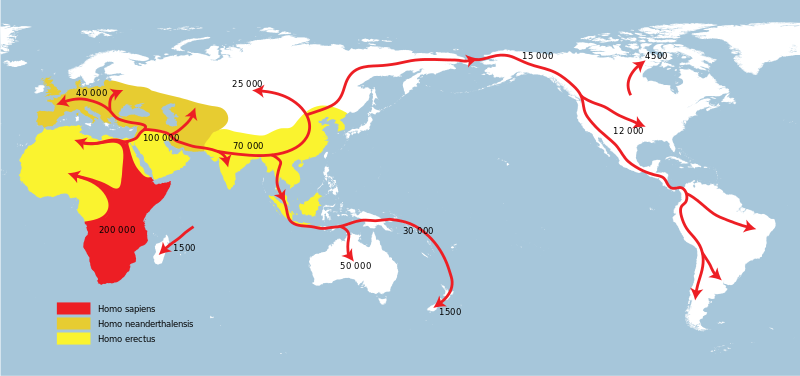
Figure 1.1 Of the advanced hominids, only homo sapiens spread around the entire globe. Credit: Homo sapiens map by NordNordWest.
Armed with advanced cognitive abilities—like spoken language and tool making—early Homo sapiens spread across the globe, adapting to diverse climates and environments. Long before cities or states existed, humans migrated across continents, crossed oceans, created art, practiced ritual burial, and developed belief systems that sought to explain life, death, and the forces of nature. For tens of thousands of years, most people lived as hunter-gatherers in small, relatively egalitarian groups, relying on hunting animals and gathering wild plants for survival.
A decisive turning point occurred around 10,000 to 8000 BCE with the independent development of agriculture in several regions of the world. The deliberate cultivation of plants and the domestication of animals made it possible to produce large food surpluses.
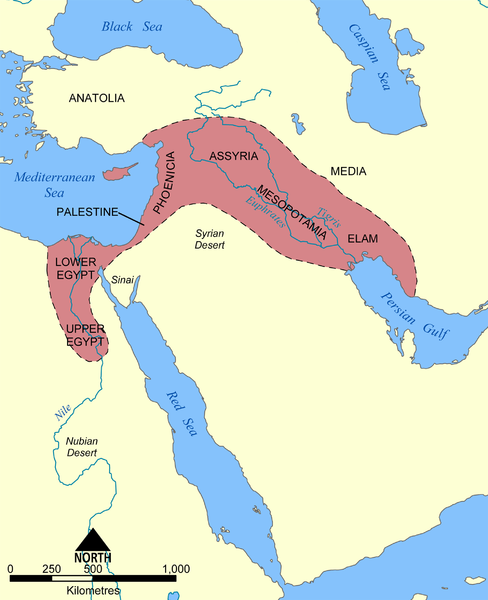
Figure 1.2 The earliest sites of agriculture emerged in the Fertile Crescent, the region encompassing Egypt along the Nile River, the Near East, and Mesopotamia. Credit: Fertile crescent map by NormanEinstein.
It makes sense that the earliest civilizations emerged in regions especially well-suited to agriculture. One of these areas was the Fertile Crescent region of the Middle East. There, the management of water resources, increased food production, and trade led to the development of the first cities, primarily within Mesopotamia—an area analogous with modern Iraq. With these cities came the development of complex religions, written records, and legal systems. Though Mesopotamia was a prime region for these developments, it also had major drawbacks. For one, the annual flooding of the Tigris and Euphrates Rivers—from whence the region takes its name, meso-between, potamoi-rivers—was not regular. Some years too much snow run-off from the mountains of Syria would lead to catastrophic flooding. Other years not enough could lead to drought and famine. Additionally, the region also had few natural barriers, allowing the easy movement of armies that led to frequent invasion.
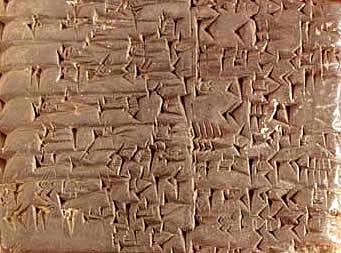
Figure 1.3 An example of cuneiform script, carved into a stone tablet, dating from c. 2400 BCE. Credit: Cuneiform by Salvor.
In contrast to Mesopotamia’s harsh and unpredictable environment, the Nile River Valley—where ancient Egyptian civilization developed—experienced regular and dependable annual floods that created agricultural abundance. This environmental predictability, as well as being protected by natural barriers—the Nile Delta in the north, the cataracts in the south and inhospitable desert, the deshret or “red land” to the east and west—shaped Egypt’s worldview, politics, and culture. Knowing their gods favored them and not experiencing any sort of external invasion in their formative years, fostered stability, optimism, and continuity over thousands of years. The Nile’s fertile floodplain—known to the Egyptians as Kemet, the “Black Land”—produced immense food surpluses. This enabled population growth, strong royal authority, and the ability to construct monumental architecture on a scale unmatched elsewhere in the ancient world.
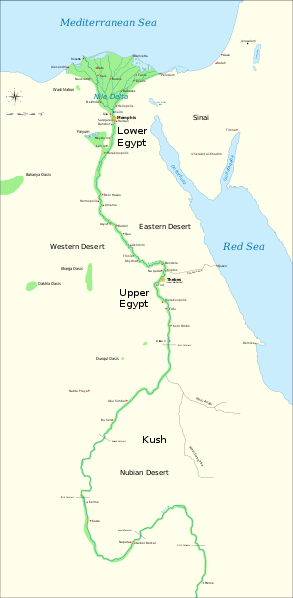
Figure 1.4 Ancient Egypt’s Old Kingdom came into being with the unification of Lower Egypt, where the Nile empties into the Mediterranean, and Upper Egypt, where the Nile exits from Nubia (present-day Sudan). Credit: Egypt map by Jeff Dahl.
Egyptian history is traditionally divided into three major periods of native rule—the Old Kingdom, Middle Kingdom, and New Kingdom—separated by Intermediate Periods of political fragmentation and disorder. This framework, devised by the priest Manetho around 300 BCE, remains the standard way historians organize Egyptian chronology. Across these periods, the central institution of Egyptian life was kingship. The king (later called the pharaoh) was believed to be divine, serving as the link between the gods and humanity and guaranteeing ma’at, the fundamental principle of truth, justice, balance, and harmony, established at creation and constantly threatened by chaos (isfet)
The Old Kingdom marked the first great expression of Egyptian civilization. Following the unification of Upper and Lower Egypt, the state developed an effective bureaucracy staffed by scribes who recorded taxes, rituals, and administration using hieroglyphics. The immense agricultural surplus of the Nile funded the construction of the pyramids, monumental tombs intended to ensure the king’s successful journey to the afterlife and, by extension, the stability of the world. Egypt’s geographic isolation further contributed to political continuity during this period.
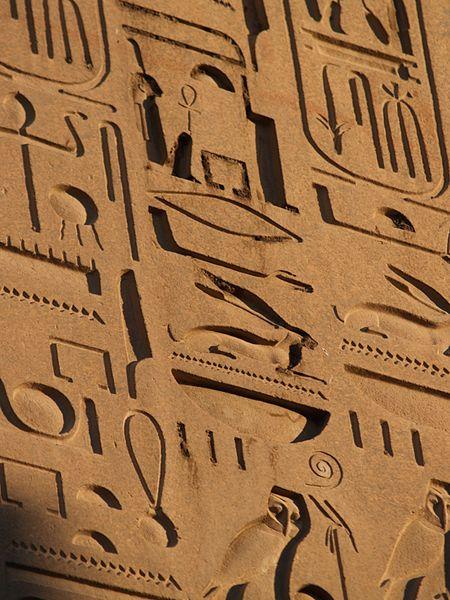
Figure 1.5 An example of hieroglyphics—the above depicts the sacred style used in temple and tomb carvings, as opposed to the “cursive” form used for everyday record keeping. Credit: Hieroglyphics by Sherif217.
The collapse of the Old Kingdom around 2200 BCE ushered in the First Intermediate Period, a time of political chaos and religious anxiety. In response to instability, Egyptian religious thought evolved, placing greater emphasis on moral judgment and the possibility of an afterlife for ordinary people. Power also decentralized, as regional elites gained hereditary authority. The Middle Kingdom restored unity under rulers who emphasized both their divine role and their responsibility to protect their people. This era saw renewed prosperity, expanded trade, military campaigns into Nubia, and increased cultural exchange with neighboring regions.
The Second Intermediate Period began when foreign rulers known as the Hyksos seized control of parts of Egypt. Though they adopted Egyptian customs, they introduced transformative military technologies, including bronze weapons, horses, and chariots. These innovations laid the groundwork for the New Kingdom, Egypt’s most powerful and expansionist phase. Under the New Kingdom pharaohs, Egypt became a true empire, conquering territory in Nubia, Canaan, and Syria.
The New Kingdom was also marked by ambitious monumental architecture, bureaucratic sophistication, and prominent rulers, including Hatshepsut, Akhenaten, Tutankhamun, and Ramses II. Akhenaten’s attempted religious revolution—an effort to impose exclusive worship of the sun god Aten—ultimately destabilized traditional beliefs and weakened the sacred authority of the pharaoh. Although the old religion was restored after his death, the episode signaled the beginning of the decline of royal power.
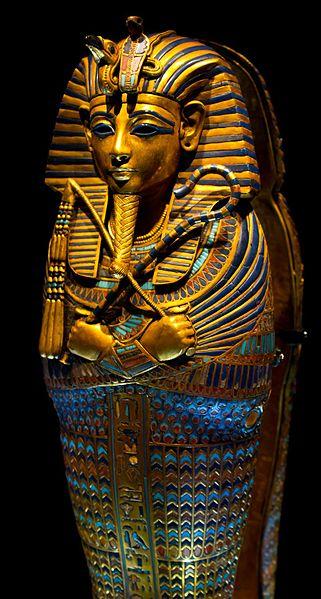
Figure 1.6 The sarcophagus of King Tutankhamun. Credit: Tutankhamun’s coffin by D. Denisenkov.
Weakened by invasions and internal strife Egypt’s New Kingdom collapsed around 1150 BCE as part of the wider Bronze Age collapse. While Egyptian civilization endured culturally and economically, it would never again enjoy long-term independence under native dynasties. Nevertheless, Egypt’s enduring traditions—its religious concepts, bureaucratic systems, monumental architecture, and scribal culture—left a lasting legacy. Long after its political power waned, Egypt remained one of the richest and most coveted regions of the ancient world and a foundational contributor to the development of later Mediterranean civilizations as we will see, first with the Greeks and later with the Romans.
The New Kingdom was part of the Bronze Age (c. 3000–1100 BCE), a period that marked a crucial phase in the expansion and consolidation of civilization across the eastern Mediterranean and Near East. During this period, increasingly complex states and early empires emerged, sustained by agricultural surplus, technological innovation, and established networks of long-distance trade and diplomacy. Bronze—an alloy of copper and tin—was the defining technology of the era. Its durability revolutionized warfare and agriculture, giving decisive advantages to states wealthy enough to acquire and distribute bronze weapons and tools. As a result, power tended to concentrate in large, resource-rich empires.
Four major regions dominated the Bronze Age world in the Mediterranean: Egypt, Mesopotamia, Anatolia, and the Aegean. These regions were close enough to sustain continuous interaction with Akkadian functioning as a shared diplomatic language. Among the most important Bronze Age powers were the Hittites of Anatolia, whose empire flourished from around 1700 BCE. Militarily formidable and economically prosperous, the Hittites clashed with New Kingdom Egypt. Distinctively, they absorbed the customs, religions, and technologies of conquered peoples and, in the process, transmitting ideas and myths that later shaped Greek civilization.
In the Aegean world, the Bronze Age saw the rise of the first Greek civilizations: the Minoans of Crete and the Mycenaeans of mainland Greece. The Minoans were seafaring traders whose wealth derived from maritime commerce rather than territorial conquest. Their palace complexes served as political, religious, and economic centers, and their art and writing testify to a sophisticated and relatively peaceful society. The Mycenaeans, by contrast, were intensely warlike, operating as both merchants and raiders across the Eastern Mediterranean. Their culture glorified elite warfare, a legacy preserved in later Greek epics such as The Iliad and The Odyssey. Though politically fragmented, the Mycenaeans shared a common warrior culture and relied heavily on seaborne trade due to Greece’s poor agricultural resources.
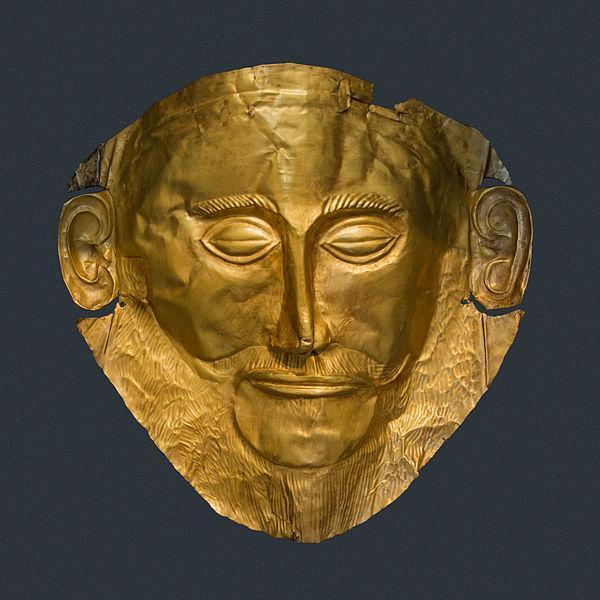
Figure 1.7 The “Mask of Agamemnon,” a Mycenaean funerary mask discovered by a German archaeologist in the late nineteenth century. Credit: Mask of Agamemnon by Jebulon.
Between roughly 1200 and 1100 BCE, this interconnected Bronze Age world collapsed. Major empires—including the Hittite Empire and Mycenaean Greece—fell into ruin, while Egypt and Mesopotamia were severely weakened. The causes of this collapse remain debated, but evidence points to a convergence of factors: prolonged drought and climate change, widespread famine, foreign invasions—including the so-called “Sea Peoples”—internal rebellions, and the breakdown of trade networks essential to bronze production. The result was the near-total destruction of the diplomatic and economic systems that had sustained Bronze Age civilization for centuries.
Out of this disruption, beginning around 1100 BCE, emerged the Iron Age. Unlike bronze, iron did not depend on long-distance trade, as iron ore was widely available. Although difficult to work with, iron gradually replaced bronze as the metal of choice for tools and weapons. Eventually new societies and states arose, often surpassing their Bronze Age predecessors in scale and power. In Canaan, the Phoenicians rebuilt long-distance trade through maritime networks and founded colonies across the Mediterranean. Their most enduring contribution was the development of a phonetic alphabet, which dramatically simplified literacy and became the foundation of Greek, Roman, and modern European writing systems. Around the same time, the Lydians introduced coined money, revolutionizing commerce and state finance.
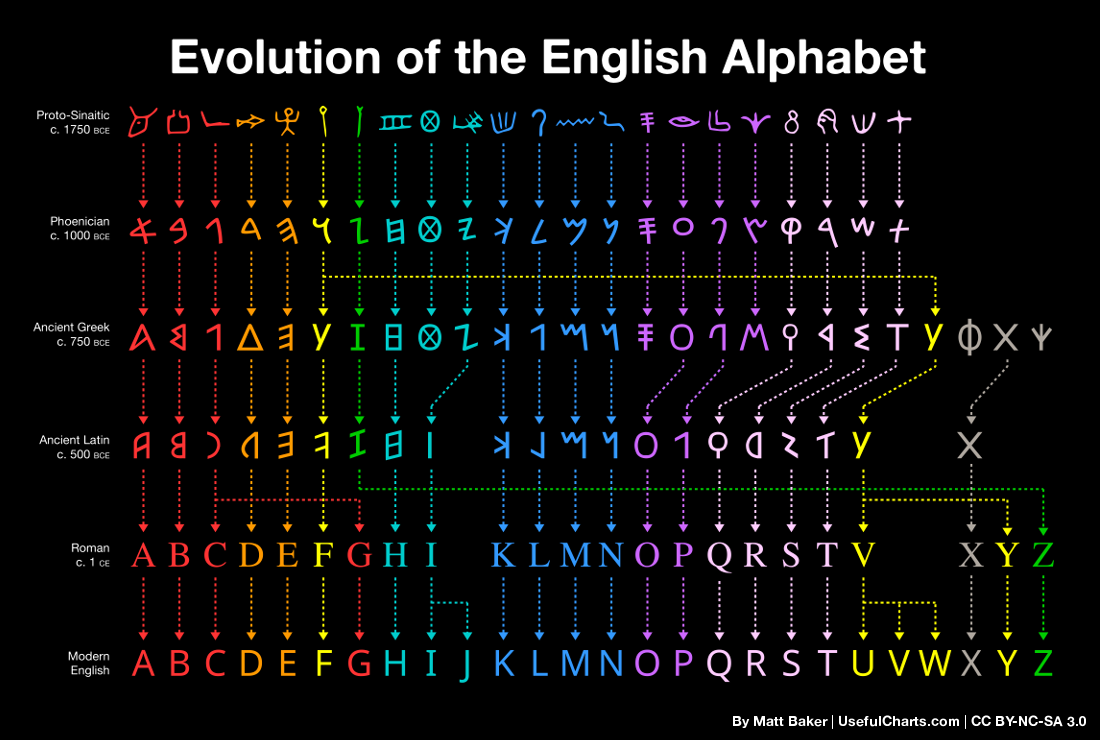
Figure 1.8 The legacy of the ancient Phoenicians: their 22-character alphabet evolved over time into the Greek, Roman, and modern English alphabets. Credit: Phoenician Alphabet Chart by Matt Baker.
The most formidable Iron Age power was Assyria, the sole major Bronze Age state to survive the collapse intact. During the Neo-Assyrian period, Assyria became the largest and most militarized empire the world had yet seen. It maintained a professional standing army, pioneered iron weaponry on a large scale, developed cavalry warfare, and enforced control through terror, mass deportations, and systematic tribute. At its height in the seventh century BCE, the Assyrian Empire ruled from Persia to Egypt, uniting the Nile and Mesopotamian river valleys under a single authority for the first time.
Despite their brutality, the Assyrians were also patrons of learning. They preserved Mesopotamian scholarship and literature, most famously through the great library of King Ashurbanipal. Their empire ultimately collapsed in 609 BCE, overthrown by a coalition of Babylonians (from Mesopotamia) and Medes (from Iran). The resulting Neo-Babylonian Empire emphasized trade, infrastructure, and scientific learning, becoming a center of astronomy and mathematics before falling to the Achaemenid Persian Empire—who had overthrown the Medes—less than a century later.
During the Iron Age, the Hebrews played a uniquely influential role. Politically small and often conquered by their neighbors, their lasting significance lay in religion rather than empire. Drawing on older Near Eastern traditions, Hebrew religious thought evolved from henotheism into true monotheism between roughly 750 and 550 BCE. This movement emphasized exclusive worship of Yahweh, ethical conduct, and the idea that all individuals were morally accountable to a single, just God. The destruction of the Kingdom of Israel by the Assyrians and Judah by the Babylonians profoundly reshaped Hebrew belief, leading to the development of Judaism as a “portable” religion that could survive without a homeland.
During the Babylonian Captivity, Jewish leaders compiled sacred texts, codified laws and rituals, and articulated a vision of Yahweh as omnipotent and omnipresent. Judaism thus introduced ideas that would have immense historical consequences: monotheism, ethical universalism, and the spiritual equality of all people. These beliefs, initially held by a small and vulnerable community, would later shape Christianity, Islam, and much of world history.
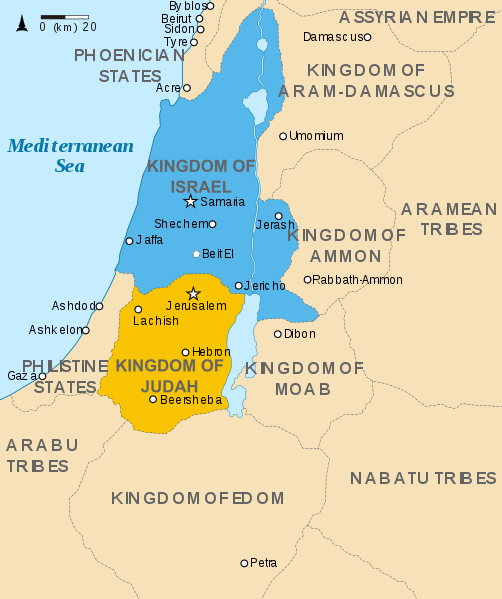
Figure 1.9 Israel and Judah in the ninth century BCE, approximately a century before Israel was invaded and destroyed by the Assyrian Empire. Credit: Israel and Judah by FinnWikiNo.
Taken together, the Bronze and Iron Ages represent a period of unprecedented dynamism in human history. States grew larger, warfare more organized, economies more interconnected, and ideas more portable. The interactions among civilizations—from Greece to Mesopotamia—laid the foundations for later empires and belief systems, ensuring that the legacies of this era would endure long after its kingdoms fell. So, as we can see, by the time Greek civilization began to develop, humans had already accumulated thousands of years of experience with farming, urban life, political authority, warfare, and intellectual inquiry.



.jpg)

