
8 The Late Empire and Christianity
Rome underwent half a century of crisis in the middle of the third century CE. Beset by incursions along its borders and hobbled by constant infighting, the empire was at real risk of collapse for decades. However, it did not collapse and in fact enjoyed a resurgence of a sort that held the Roman state together until the end of the fifth century. In fact, the period between the end of the Five Good Emperors and the collapse of Rome was much more complex than one of simple decline and weakness, and even when the city of Rome could not defend itself, Roman civilization left an enormous, permanent impression on European history. Perhaps most importantly, what began as an obscure reform movement in Roman-ruled Judea eventually became one of the great world religions—Christianity—thanks to its success in spreading throughout the Roman Empire before the Empire collapsed in the west.
Crisis and Recovery
Major crises affected the Empire from 235 to 284 CE. It all started when the emperor Severus Alexander was murdered in 235 CE. Including this death, all of the emperors to follow for the next 49 years were murdered or died in battle, save one. This might not seem too bad, until we discover that there were 22 emperors in those 49 years, and only that one died of natural causes. Many emperors stayed on the throne for only a few months before they were killed. Not surprisingly, in this environment, most emperors were only concerned with either seizing the throne or staying alive once they had it, meaning they tended to neglect tasks important to the stability of the Empire.
Rome’s internal political problems were somewhat of its own making—the Praetorian Guard auctioned off the throne, would-be emperors eagerly assassinated their rivals, and Roman elites largely retreated to their enormous estates to profit off of their serfs. Other factors, however, were external. In 220 BCE, a new group—the Sasanians, though in some history books you will see them as the Sassanids—seized control of Persia. The Sasanians were much more aggressive and well-organized than the earlier Parthian dynasty had been, and Rome was obliged to fight almost constant wars to contain the Persian threat. Persia was not, of course, simply a powerful and well-organized threat to the Roman Empire, it was an ancient and sophisticated civilization of its own. By the Sasanian period it was already nearly eight centuries old. Drawing on an ancient term for the Persian people, the Sasanians identified their empire as Eranshahr, the land of the Iranians, and from this point on it is appropriate to refer to Persia as Iran. However, for clarity’s sake we will continue to use the term “Persia” until we get to the modern period in Volume 2. Under Sasanian rule, Persia reached the height of its power during the ancient period.
While the Sasanian kings were obliged to govern both settled peoples and nomads, as had all earlier Persian dynasties, they were more successful in creating a stable system of rule. Additionally, for the first time in its history, Zoroastrianism became the official state religion, and its holy books were codified, in contrast to the earlier oral traditions of the religion. The state made major efforts to increase both agricultural productivity and the amount of land under cultivation, especially in Mesopotamia. The long-distance trade routes that had grown to such importance under Parthian rule continued to expand in scope and volume of trade, as did crafts and manufacturing in Sasanian territory. Indeed, Sasanian silk textiles were of such high quality that they were even exported to China itself. The Sasanian rulers drew a direct connection between stability, centralization, and prosperity at precisely the same time that the chaos in Rome undermined the Roman commercial economy.
Sasanian centralization built on the earlier Achaemenid tradition. All rulers were members of the Sasanian family line, and governors of the important provinces were also related to the extended family. Authority was understood to emanate from the Zoroastrian god Ahura Mazda himself, and while a degree of regional autonomy was necessitated by the sheer size and diversity of the empire, regional rulers knew themselves to be inferior to the Sasanian Shahanshah (King of Kings). A powerful institutional relationship between the rulers and the magi—Zoroastrian priesthood—emerged in which Sasanian rule was justified by the direct, unequivocal support of the religious power structure. In turn the religious power structure received the approval and support of the royal state, which included the only campaigns of religious persecution against non-Zoroastrians in Persian history.
The Sasanian state faced nearly constant challenges from the time it seized power in 220 CE until the death of its final ruler in 651 CE during the Arab invasion. Rome and Persia did not war constantly, but when they did, Persia was obligated to devote enormous resources to containing Roman ambitions. Invaders from the Central Asian steppes and the mountains of Afghanistan proved an ongoing security threat to the empire as well, as did the Arab clans to the southwest well before they unified under the Islamic prophet Muhammad. Nevertheless, and in spite of some significant Roman victories, the Sasanian state remained stable and the economy prosperous for centuries. Subsequent dynasties would look back to the Sasanians as the model to emulate, just as the Sasanians had emulated the Achaemenids.
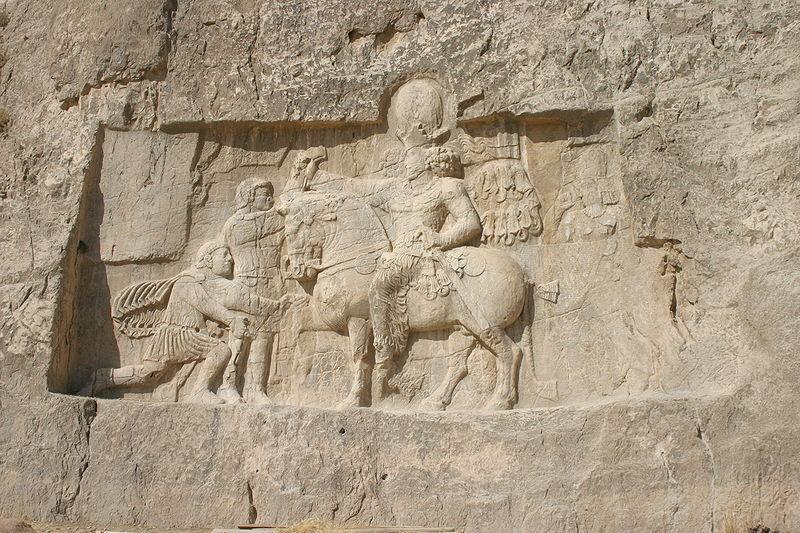
Figure 8.1 The defeat of the emperor Valerian, kneeling on the left, before the Persian king Shapur I, on horseback. Credit Defeat of Valerian by Ali Ganjei.
The core territories of Rome in the west were also being threatened as Germanic groups along Rome’s northern borders were growing larger and better organized. Centuries of contact with Rome itself had improved agricultural techniques among the Germans, leading to population growth. Eventually, these larger, wealthier groups joined together into forces that posed serious threats to the Roman borders.
As the quality of Roman leadership declined and the threats grew worse, the results were predictable: Rome lost battles and territory. The emperor Valerian was captured by the Persian king Shapur I when he led a Roman army against Persia and, according to some accounts, was used as the Persian king’s personal footstool for climbing up onto his horse. Another emperor rebuilt walls around Rome itself in 270 CE because of the threat of Germanic invaders from the north who had pushed all the way into northern Italy.
One problem was that the entire Roman imperial system hinged on the direct, personal decision-making of the emperor himself. The emperor was supposed to oversee all major building campaigns, state finances, and the worship of the Roman gods, not just military strategy. However, since these emperors, who were all generals, traveled constantly with their armies it meant that their courts had to travel with them while they were waging campaigns. Due to this, the emperor’s reach was limited by the speed a messenger could travel on horseback. As a result, the machinery of the Roman government ground to a halt whenever the latest emperor was weeks or even months away from Rome. Needless to say, the problem was exacerbated when the Empire was torn between rival claimants to the throne—for a few years toward the end of the crisis period the empire proper was split into three competing “empires”’ under rival imperial pretenders.
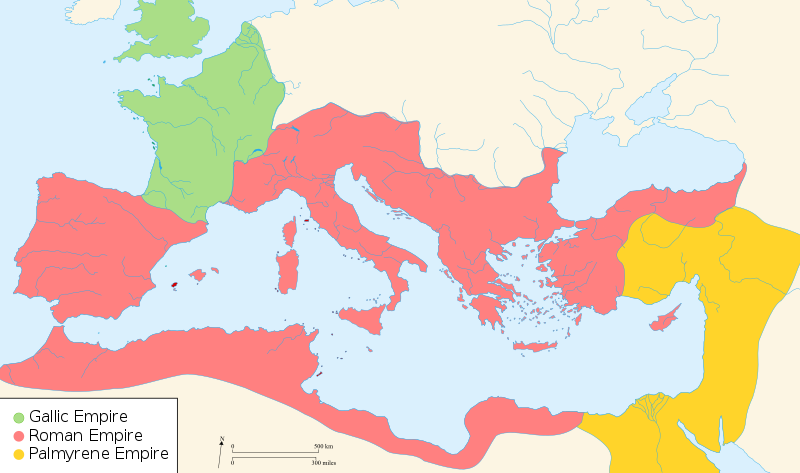
Figure 8.2 The three rival “Roman Empires” as of 271 CE. Credit: Divided Empire Map by Creative Commons, historicair.
Diocletian
The period of crisis that had made the eastern empire so vulnerable to Persian invasion ended with the ascension of the emperor Diocletian in 284 CE. Unlike those that had come before him, Diocletian managed to survive for twenty years after taking the throne. This longevity allowed him to make some fundamental changes to the organization of the empire. Recognizing that its sheer size was a detriment to its effective governance, Diocletian decided to share power with a co-emperor: Setting himself up in the eastern half of the empire he named Maximian—a trusted general—as ruler of the west. Then, about ten years after he took the throne, Diocletian decided to further divide responsibility and each man took on a junior emperor. This created the Tetrarchy, the rule of four—two “augusti” and two “caesars”—who worked together to administer the entire territory.
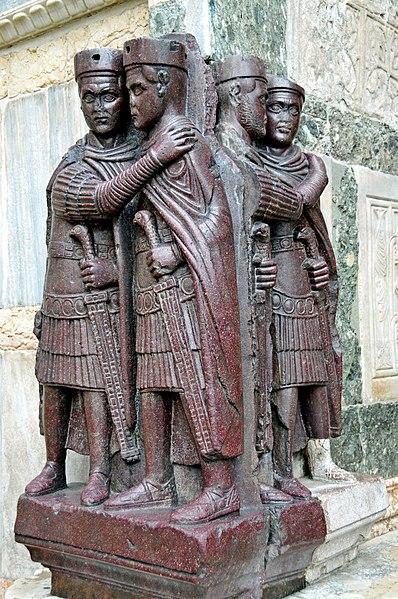
Figure 8.3 A Roman depiction of the tetrarchy dating from the period of Diocletian’s reign. Credit: The Tetrarchy by Dennis Jarvis.
Diocletian’s hope was that the tetrarchy would end the cycle of assassinations. The junior emperors were the senior emperors’ respective heirs, destined to assume full power when their seniors stepped down. When that happened, each new senior emperor would then select new juniors. It was hoped that this system, similar to the merit-based selection process used during the rule of the Five Good Emperors, would end the constant bloodshed and uncertainty that had haunted Roman politics for half a century.
Diocletian also divided the Empire into smaller provinces so that governors had an easier time with administration. These provinces were grouped into larger units called dioceses overseen by an official called a “vicar.” When Christianity moved from being an illegal cult to the official religion of the empire—as we will see below—this division would be adopted by the Catholic Church, am administrative practice that persists all the way to the present.
To deal with the threat of both Persia and the Germanic tribes, Diocletian reorganized the Roman army and recruited more soldiers—including Germanic ones—making it larger than it ever had been. Borrowing from the Persian practice, he emphasized the use of heavy cavalry to respond quickly to threats and built new roads to be able to move armies along the borders more efficiently. Finally, even though the army itself was now larger, he made individual legions smaller. The logic behind this, was that each legion’s commander would no longer have enough power to challenge the current emperor.
State finances were in shambles when Diocletian came to power. To try to deal with the problem, the emperor reformed the tax system and instituted an official census for taxation purposes. He also tried to freeze wages and prices by decree, something that did not work since it created a black market for both goods and labor. As had happened many times before and since, it was the peasants that bore the brunt of Diocletian’s reforms. In fact, most independent farmers were turned into serfs, a step just above slavery. State tax collectors were so feared that many peasants willingly gave their land to wealthy landowners who promised to protect them from the tax agents.
Finally, Diocletian tried to reinstate religious orthodoxy. He believed that too many people had turned away from worship of the Roman gods, which had in turn brought about the long period of crisis preceding his takeover. Thus, he went after sects that he thought threatened stability, including Christianity. He banned Christian worship and executed several thousand Christians who refused to renounce their beliefs in an attempt to wipe out the cult once and for all. Needless to say, this was a spectacular failure.
Diocletian retired in 305 CE due to failing health, as did his co-emperor in the west—though reluctantly. Remember, the idea behind the Tetrarchy was that the junior emperors would then become the senior emperors and recruit new juniors. Unfortunately, his system worked exactly once, as the junior emperors under Diocletian and Maximian did indeed take power. However, instead of a smooth transition the Empire was yet again plunged into civil war. A general—at the time stationed in Britain—named Constantine, son of the Tetrarch Constantius, launched a military campaign to reunite Rome under his sole rule. By 324 CE he had succeeded, claiming total control and appointing no co-emperor.
Constantine
As mentioned, Constantine did away with the system of co-emperors—although it would re-emerge after his death—but otherwise he left things as they had been under Diocletian’s reforms. The eastern and western halves of the Empire were still administered separately, and he kept up the size and organization of the army. He also took a decisive step toward stabilizing the economy by issuing new currency based on a fixed gold standard. The new coin, the solidus, became the standard international currency in the Mediterranean world for the next 800 years. Long after the disappearance of Rome in the west, Frankish kingdoms would strike solidi bearing Byzantine imperial portraits and even Arab caliphs would mint gold dinars based on the solidus weight standard.
Constantine’s greatest historical impact, however, was in the realm of religion. As we have seen, prior to Constantine, during times of trial the Romans placed blame on anyone that was perceived as different to them. One of the major scapegoats for Roman emperors in this period were the Christians. During the Severan Period, many emperors had attempted to eliminate the practice of Christianity by eliminating Christians. However, before they could really organize a program of persecution, they would be overthrown and the next emperor would have to start all over. This actually helped Christianity to survive, for by the time Diocletian became emperor the practice of Christianity had gone underground. Certainly, Diocletian did a lot of harm, but it could have been worse if the Christian population had not been prepared in the previous period. Christianity got a real powerful friend in the form of Constantine around the year 312. The story, recorded by Eusebius of Caesarea—who was not there—says that at the Battle of Milvian Bridge in Rome the forces of Constantine rode into battle carrying Christian symbols after the emperor had a dream showing him that this was the way to victory.
We don’t know Constantine’s motives for his support and later conversion to Christianity—he was baptized on his death bed—though we can be sure that there was no political pressure. We can make some educated guesses though. For one, his mother was a Christian, and by the laws of the day, this knowledge should have led to her death. So perhaps there was this personal incentive. There was also a very practical one. A lot of the wealth of the empire in this period was in the east, and this is where Constantine will eventually construct his new capital. There were also a lot of Christians in this region. Perhaps Constantine believed it would be easier to work with this population rather than eliminate them. Regardless of the reasoning, his victory led him to issue the Edict of Milan in 313. This edict did not make Christianity the official religion of Rome, but it did make it illegal to persecute someone on the basis of their religion. This, of course, tremendously helped the Roman Christian population.
As mentioned, in 324 CE, Constantine founded a new capital city for the empire at the site of the ancient Greek town of Byzantium, at the intersection of Europe and Anatolia He named it Nova Roma, but after his death, it was renamed it “Constantine’s City,” or Constantinople, in his honor. It was at the juncture of the eastern and western halves of the Empire, with all trade routes between Asia and Europe passing through its area of influence. It became the heart of wealth and power in the Empire. The city grew to become one of the great cities of late antiquity and the Middle Ages, fed by grain from Egypt and bringing in enormous wealth through trade. Subsequent emperors also built up massive fortifications, walls so strong that it took 1,000 years for an enemy to be able to breach them (namely the Ottoman Turks, who finally conquered the city in 1453 CE).
Religion: Roman Faiths and the birth of Christianity
Rome had always been a hotbed of religious diversity. While the official Roman gods were venerated across the Empire, Roman elites had no objections to the worship of other deities, and indeed many Romans (elites and commoners alike) eagerly embraced foreign faiths. Originating in the Hellenistic kingdoms, many Romans were attracted to mystery religions—from the Greek mystirios, that which cannot be known—cults that promised spiritual salvation to their members. These mystery religions shared a belief that the universe was full of magical charms that could lead to spiritual salvation or eternal life itself. In many ways, they were more like cults of magic than traditional religious faiths. A worshiper could join multiple mystery religions—for a price—intoning chants and prayers and participating in rituals in hopes of securing good fortune and wealth in life and the possibility of spiritual immortality after death.
Even Rome’s perennial adversary Persia supplied sources of spiritual inspiration to Rome. Mithras, the Zoroastrian god of war, the sun, and rebirth became immensely popular among Romans. Mithrans believed that Mithras had been a soldier, slain by his enemies, who then rose to enjoy eternal life. Roman soldiers campaigning in Persia brought Mithraism back to Rome since Mithras’s identity as a former soldier made his worship all the more appealing to members of the Roman military. The worship of Mithras was so popular that, some historians have noted, it is easy to imagine the Roman Empire becoming Mithran instead of Christian if Constantine had not converted to the latter faith. In fact, there were so many similarities the rituals of both faiths that a contemporary Roman could be excused for confusing Christianity as a branch of Mithraism.
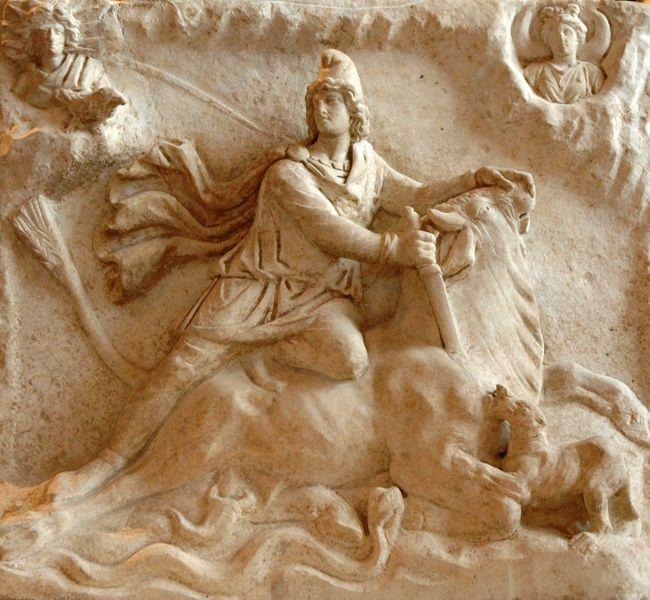
Figure 8.4 A relief from an altar of Mithras dating from the second or third century CE. In all of the discovered Mithran temples, Mithras is depicted slaying a bull, which somehow (the details of the myth are long lost) helped to create the world. Credit: Mithras by Jastrow.
In some cases, non-Roman gods even came to supplant Roman ones. One of the Severan emperors embraced the worship of the Syrian sun god Sol Invictus—meaning “the unconquered sun”—and had a temple built in Rome to honor the god alongside the traditional Roman deities. The notion of being as powerful and unstoppable as the sun appealed to future emperors, so subsequent emperors tended to venerate Sol Invictus along with the Roman Jupiter until the rise of Christianity. In other cases, the worship of non-Roman gods was so popular that it could not be suppressed in the few cases in which Roman leaders saw a need to. The Egyptian goddess Isis, who was at the heart of the largest mystery cult in the Mediterranean region, was so popular among both women and men that repeated attempts to purge her cult from Rome for being socially disruptive utterly failed.
The Jews and Jesus
The Roman territory of Palestine has long been a thorn in Rome’s side thanks to the opposition of the Jewish population to their control. One key point of contention was that the Jews refused to recognize the divinity of the emperors. The Romans insisted that their subjects participate in symbolic rituals acknowledging the primacy of the emperors, but since the Jews were strict monotheists, they would not do so. One way Rome punished the region was by levying heavy taxation on the region.
In 66 CE there was a huge uprising against Rome. Helped by the collapse of the Julio-Claudian dynasty and the civil war that was the Year of the Four Emperors in 69, it took four years for imperial forces to crush the uprising, resulting in the greatest disaster in ancient Jewish history: the permanent destruction of the Temple of Jerusalem in 70 CE. In the aftermath, the Romans enslaved or deported much of the Jewish population, which contributed to the phenomenon of the Jewish diaspora. Another uprising decades later (between 132 – 136 CE) resulted in the almost complete dispersal of the Jews, to the point that a Jewish homeland did not exist until the foundation of the modern state of Israel in 1948 CE.
In the first century CE, Jewish society, especially its leadership, was divided between rival groups. Some powerful priests, the Sadducees, claimed that all Jews should follow the 10 Commandments, but only the priests of the Temple needed to follow the 613 laws and injunctions laid down by Moses. They were opposed by the Pharisees, who insisted that all Jews had to abide by all of the laws of Moses, and they also preached that a messiah – a savior – would soon come to bring about a day of judgment before Yahweh and bring about the fulfillment of the Biblical Covenant. In the deserts outside of the major cities, a group called the Essenes emphasized a life of asceticism and mysticism, while across Palestine anti-Roman revolutionaries known as the Zealots advocated for armed revolt against the Roman occupier.
The Jewish uprising that occurred against the Romans in 66 CE happened a generation after the death of another Jewish revolutionary of sorts: Jesus of Nazareth. The major source of information on the life of Jesus are the four Gospels, accounts of his life and teachings composed after his death by three of his apostles (his closest followers and students), Matthew, Mark, and John, and another early Christian leader, Luke. The Gospels were transmitted orally for decades before being recorded in their definitive versions. Most scholars now date the written gospels to approximately 90 CE (about sixty years after the death of Jesus) with the Gospel of John believed to have been written last, around 100 CE. While the specific language of the Gospels is, of course, different, and some of the events described are also described differently, the Gospels agree on most of the major aspects of the life of Jesus. As a historian, it is always important to approach religious texts with a degree of healthy skepticism. We must set aside belief and faith and instead approach the source with the understanding that those who write about their own religion—and individuals important to it—are often going to present it in the best light possible.
With this in mind, according to the Gospels, Jesus was the son of the miraculous union of the Holy Spirit, one of the aspects of the Jewish God Yahweh, and a virgin named Mary. Jesus showed an aptitude for theological and spiritual understanding at a young age, debating Jewish doctrine with learned Jewish priests when he was still a boy. At the age of thirty, having earned his living as a carpenter up to that point, Jesus began to preach a message of salvation that revolved around the concept that mankind as a whole could be saved if it sought forgiveness from God for its sins. He traveled and delivered his teachings in the Roman province of Palestine and the nearby puppet kingdoms dominated by the Romans for three years but was then arrested by the Roman authorities for inciting rebellion. In the end, Jesus was executed at the age of 33 in the customary Roman fashion for those found guilty of rebellion: crucifixion.
According to the Gospels, Jesus returned to life, and an angel rolled the boulder back from the entrance to the tomb in which his body had been laid to rest. He renewed his call for devotion to God and the offer of salvation for those who sought forgiveness, then passed into the divine presence. Jesus’s followers, led by the twelve apostles, began to teach his lessons to others, and the new religion of Christianity was born. His followers began to refer to Jesus as “the Christ,” meaning “the anointed one” in Greek, a reference to the idea that Jesus was anointed to provide salvation for humanity.
Early Christianity
At the beginning of the Christian faith, there was no single set of texts or beliefs that united Christians. The four major Gospels do not agree on everything, because they were written by different people from memory (decades after the apostles themselves were alive). Indeed, a close reading of the Gospels reveal them to be focused more on Jewish reform, than on Jesus himself. It was the message, rather than the man that was important. How then did Christianity as we know it today get its start? It comes down to a man named Paul, a Pharisee from the city of Tarsus, who underwent a profound conversion experience and became the foremost Christian evangelist. It was he who popularized the notion that the death of Jesus on the cross was part of a divine plan that canceled out human sin. Still, for hundreds of years, Christians debated and argued about what Christ’s message had “really” been because many of Jesus’s teachings were, and are, open to interpretation. Some of the issues that early Christians were divided on included:
-
What God did Jesus represent? One cult believed that the God of Christ was not the Jewish God, who had been vengeful and warlike. According to this sect, Christ’s God was a more powerful and loving deity come to save the world from Yahweh.
-
Was Jesus the messiah? In Jewish doctrine, the messiah was to be a figure who liberated the Jews from oppression and made good on the Covenant between the Jews and God, delivering the Promised Land for all eternity. Many Jews had hoped that Jesus would fill this roll, but since Judea remained in Roman hands after his death, they did not believe that Jesus had been the messiah. Early Christians came to insist, following Paul, that Jesus had indeed been the messiah, but that the “liberation” he offered was spiritual in nature, rather than having to do with prosaic politics. In other words, the potential to save one’s soul from damnation superseded the old Covenant.
-
Was Jesus human, or was he instead somehow God Himself? He lived like a normal man, but according to the Gospels he had also performed miracles, and he claimed to be the son of God. Likewise, while Jesus lived an exemplary life, he also displayed traits like anger and doubt (the latter most famously on the cross when he asked God why He had “forsaken” Jesus), traits that did not seem those of a “perfect” being. This debate would go on for centuries, with equally pious groups of Christians coming to completely different conclusions about Christ’s divine and human natures.
-
Finally, early Christians were torn as to whether everyone could be a Christian, or instead, if membership was limited to the Jews. If Jesus was indeed the specifically Jewish messiah, after all, it did not make sense for a Roman or a Persian or a Celt to be able to convert. In the end, thanks largely to the influence of St. Paul again, most Christians came to believe that the salvation offered by Christ was potentially universal, and that not just Jews could become Christians as a result.
Under the influence of the mystery religions noted above, many early Christians were Gnostics, meaning “those who know” in Greek. The Gnostics believed that Jesus had been a secret-teller, almost a magician, who provided clues in his life and teachings about how to achieve union with God. This had more to do with magic than with a recognizable set of religious rituals or customs—for example, many Gnostics believed that it was possible to deduce a series of incantations from Christ’s teachings that included hundreds of secret “names of God.” If a Gnostic was to properly chant all of the names of God, he would not only achieve salvation but might enjoy power on earth, as well. The Gnostics had no interest in converting people to their version of Christianity; it was a secret they wanted to keep for themselves.
Still, despite the bewildering diversity of beliefs among early Christians, there were common themes, most importantly the emphasis Jesus had placed on the spiritual needs of the common people, even social outcasts. The most radical aspect of Christianity was its universalism. From Judaism, it inherited the idea that all human beings are spiritually equal. Once the debate about whether non-Jews could become Christians was resolved, it was also potentially open to anyone who heard Christianity’s teachings and doctrine. Early Christians recognized no social distinctions, which was fundamentally at odds with the entire Roman system, reliant as it was on formal legal separations between social classes and a stark system of social hierarchy. Likewise, one unequivocal requirement placed on Christians was to love their neighbors, meaning in practice showing kindness and compassion to others regardless of their social rank. Few concepts could have been more alien to Roman sensibilities.
Christianity thus at least potentially threatened the hierarchical nature of Roman society. Likewise, it inherited from Judaism a strict monotheism that refused to accept the worship of the Roman emperors. What made it even more threatening than Judaism, however, was that Christianity actively sought out new converts. Roman authorities were thus already very much inclined to be suspicious of the Christians as potential rabble-rousers. In 68 CE, Nero blamed the Christians for the huge fire that consumed much of the city of Rome, and hundreds of Christians were rounded up and slaughtered in the arena. The persecution of Christians became a potent symbol for Christianity as a whole. Over a thousand years later, when Christianity was firmly entrenched as the religion of Europe, the trope of martyrdom was still used to explain righteous suffering.
Early Christian Organization
Before Constantine, Christianity expanded through missionary work, which succeeded in founding congregations across the Empire but did not seriously disrupt polytheism or the Empire’s religious diversity. Imperial sponsorship changed that because it linked secular power to Christian identity. Following Constantine, being a Christian became a way to get ahead in the Roman power structure, and over time it became a liability to remain a polytheist. Thus, whereas early Christianity had been a religion of the common people, Roman elites flocked to convert after Constantine did so in order to stay in the emperor’s good graces.
Prior to this political support, early Christians had already developed a distinct hierarchy dividing priests from worshipers. Bishops were the head of each city’s congregation, and they supervised a staff of priests and deacons who interacted with everyday worshipers and led services. The bishops of main cities, usually the imperial capitals of their respective provinces, came to be called an archbishop. Each bishop oversaw activity in the diocese, again following the imperial structure, in instructing people in Christian doctrine and in building charity networks. One important effect was that the Church actively supported charities for the poor and hungry, a practice which won over new converts. This was one of the notable moments in history when a religion linked together a message of compassion for the needy and real, practical efforts to help the needy. In another strong contrast with Roman practice, Christianity saw disenfranchised groups like women and the poor (not to mention poor women) play major roles in the Church’s organization, especially before “official” Christianity came into being under Constantine.
Almost immediately after Constantine embraced Christianity, bishops saw their secular power increase dramatically. For example, the emperor allowed bishops to serve as official judges, giving Christians the ability to request a bishop instead of a non-Christian judge in trial. Bishops also moved in administrative circles, representing not just the Church but their cities in actions and requests before governors and assemblies. In short, bishops suddenly assumed power on par with that of the traditional Roman nobility, directly linking power within the Christian church hierarchy to power within the Roman political system.
The most important bishop was the archbishop of Rome, who for the first few centuries of Christianity was just one among several major church leaders. Originally, the archbishops of cities like Alexandria and Damascus were of comparable importance to the Roman archbishop, but over time Roman archbishops tried to assert authority over the entire Church hierarchy in the west. Their authority, however, was not recognized in much of the eastern part of the Empire, and it should be emphasized that it took more than six centuries after Constantine for the Roman archbishop’s authority to receive acceptance even in the west. Eventually, however, that authority was at least nominally in place, and the Roman archbishop came to be known as the “pope,” meaning simply “father,” of the Church.
The pope’s role as leader of the Church emerged for a few reasons. First and foremost, the symbolic power of the city of Rome itself gave added weight to the Roman archbishop’s authority. Second, there was a doctrinal tie to the Apostle Peter, who was supposed to have been given the symbolic keys to heaven directly from Christ, which were in turn passed on to his successor in Rome—the archbishop of Rome—before he himself was crucified. Roman archbishops could thus argue that the Christian church itself was centered in Rome, and that they inherited the spiritual keys to heaven upon taking office—this concept was known as the Petrine Doctrine. By the mid-fifth century CE, the popes were claiming to have total authority over all other bishops, and at least some of those bishops—in Western Europe, at any rate—did look to Rome for guidance. In later centuries, the mere fact that the early popes had claimed that authority, and certain bishops had acknowledged it, was cited as “proof” that the Roman papacy had always been the supreme doctrinal power in the Church as a whole.
Christianity’s Relationship with Non-Christian Religions
Once it enjoyed the support of the Roman elite, the Christian church began incorporating non-Christian holidays into its own liturgical calendar. December 25 had been the major festival of the sun god Sol Invictus, and early Christians embraced the overlap between that celebration and Christmas, noting that Christ was like the sun as a source of spiritual life. Other Christian holidays like Easter coincided with various fertility festivals that took place in early spring, around the time of the spring equinox. The tradition of saint’s days, holidays celebrated in veneration of specific saints, often overlapped with various non-Christian celebrations. Most church leaders saw no theological problem with this practice, arguing that the ultimate goal was the salvation of souls through conversion, so it made perfect sense to use existing holy days and rituals in order to ease the transition for new converts.
That being noted, the incorporation of non-Christian celebrations into the liturgical calendar did not imply that Christians were willing to accept polytheism. Unlike most ancient faiths, Christians could not tolerate the worship of other gods, which they regarded as nothing more than nonexistent delusions that endangered souls. They used the term “pagan,” coming from the Latin paganus, which means “country bumpkin” or “redneck,” to describe all worshipers of all other gods, even gods that had been worshiped for thousands of years at that point. Christians thus used scorn and contempt to vilify worshipers of other gods—”pagan” indicated that the non-Christian was both ignorant and foolish, even if he or she was a member of the Roman elite.
It took about a century for the believers in the old Roman gods, especially the conservative aristocracy of Rome, to give up the fight. Right from the beginning of “official” Christianity, Constantine financed construction of huge churches, including the Basilica of St. Peter in what is today the Vatican (at the time it was an obscure graveyard in Rome). The traditional Roman public buildings, including forums, theaters, bathhouses and so on, were often neglected in favor of churches, and many temples to Roman gods and other public buildings were repurposed as churches. As money shifted toward building Christian churches and away from temples, Christians sometimes lead attacks to desecrate the sites of pagan worship. Riots occasionally broke out as Christian mobs attacked worshipers of other gods, all with the tacit support of the emperors. In 380 CE the Empire was officially declared to be Christian by the emperor Theodosius I and all people of importance had to be, at least nominally, Christians. There was no sustained resistance to Christianity simply because “polytheism” or “paganism” was never a unified system, and it was impossible for people who worshiped a whole range of gods to come together “against” Christianity, especially when it was the official religion of the Empire itself.
A much more difficult battle, one that it some ways was never really won, had to do with “pagan” practices. Everyone in the ancient world, Christians among them, believed in the existence of what is now thought of as “magic” and “spirits.” Christian leaders came to believe that, in general, magic was dangerous, generated by the meddling of the devil, and that the spirits found in nature were almost certainly demons in disguise. There was very little they could do, however, to overturn the entire worldview of their followers, considering that even Christian leaders themselves very much believed that spirits and magic were present in the world, demonic or not. Thus, pagan practices like blessing someone after they sneezed—to keep out an invading spirit or demon—throwing salt over one’s shoulder to ward off the devil and employing all manner of charms to increase luck have survived to the present.
Orthodoxy and Heresy
As noted above, there were serious debates around who or what Jesus was. For centuries, there could be no “orthodoxy,” meaning “correct belief,” because there was no authority within the Church—very much including the popes—who could enforce a certain set of beliefs over rival interpretations. The beginning of orthodoxy was in the second and third centuries, when a group of theologians argued that there were three personas or states of the divine being, referred to as the Holy Trinity. In this view, God could exist simultaneously as three beings: God the Father, the being that spoke in the Old Testament, God the Son, Jesus himself, and God the Holy Spirit, the presence of God throughout the universe. This concept did not quell all controversy though, because it created a distinct stance that people could disagree with and rival groups of Christians came to refer to their enemies as “heretics,” from the word “heresy,” meaning simply “choice.”
In the late third century, an Egyptian Christian priest named Arius created a firestorm of controversy when he made a simple logical argument: God the father had created Jesus, so it did not make any sense for Jesus to be the same thing as God. Furthermore, it was impossible to be both human and perfect; since Jesus was human, he was imperfect and could not therefore be God, who was perfect. This belief came to be known as “Arianism” (note that the word has nothing whatsoever to do with the misguided belief in some kind of ancient Germanic race—the “Aryans”—so important to Nazi ideology almost two thousand years later). Arianism quickly took hold among many people, most importantly among the Germanic tribes of the north, where Arian Christian missionaries made major inroads. Thus, Arianism quickly became the largest and most persistent heresy in the early Christian church.
In 325 CE, only a little over a decade after he began his support for Christianity, Constantine assembled a council of church leaders, the Council of Nicaea, to lay Arianism to rest. One of the results was the Nicene Creed, to this day one of the central elements of Catholic Mass. In a single passage short enough to commit to memory, the Creed declared belief in Christ’s identity as part of God (“consubstantial to the Father” in its present English translation), Christ’s status as the son of God and the Virgin Mary, Christ’s resurrection, and the promise of Christ’s return at the end of the world. There was now the first official doctrine in the early history of Christianity: a specific set of beliefs backed by institutional authority.
While it certainly clarified the beliefs of the most powerful branch of the institutional church, as the Council of Nicaea defined the official orthodoxy, it guaranteed that there would always be those who rejected that orthodoxy in the name of a different theological interpretation. Likewise, the practical issues of lingual and cultural differences undermined the universalism (“Catholicism”) of the Christian Church. Those differences and the diversity of belief would only grow over time.
One of the biggest differences was language , since the western Empire still spoke Latin and the eastern Empire Greek. In 410 the monk Jerome produced a version of the Christian Bible in Latin, the Vulgate, which was to be the main edition in Europe until the sixteenth century. Surprising from a contemporary perspective, however, is that it was not until 1442 (during the Renaissance) that the definitive and in a sense “final” version of the Bible was established by the Western Church when it defined exactly which books of the Old Testament were to be included and which were not.
Meanwhile, in the east, Greek was not only the language of daily life for many, it was the official language of state in the Empire and the language of the Church. The books of the New Testament, starting with the Gospels, were written in Greek in the first place, and the Greek intellectual legacy was still very strong. There was an equally strong Jewish intellectual legacy that provided accurate translations from Hebrew and Aramaic to Greek, providing Greek-speaking Christians with access to a reliable version of the Old Testament.
Monasticism and Christian Culture
Near the end of the third century, a new Christian movement emerged that was to have major ramifications for the history of the Christian world: monasticism. Originally, monasticism was tied to asceticism, meaning self-denial, following the example of an Egyptian holy man named Antony. In about 280, Antony sold his goods and retreated to the desert to contemplate the divine, eschewing all worldly goods in imitation of the poverty of Christ. He would have remained in obscurity except for a book about him written by the bishop Athanasius, The Life of Antony, that celebrated Antony’s rejection of the material world and embrace of divine contemplation. According to Athanasius, normal life was full of temptation, greed, and sin, and that the holiest life was thus one that rejected it completely in favor of prayer and meditation away from human company. Thousands of people followed Antony’s example, retreating to the wilderness. These early monks practiced hermetic monasticism: they were hermits who lived alone in deserts, forests, or mountains away from the temptations of a normal social existence—although they had to live close enough to civilization for the donations of food that kept them alive.
One particularly extreme sect of early monks were the Stylites, from the Greek word stylos, meaning “column.” The founder of the group, St. Simeon the Stylite, climbed up a pillar in Syria and spent the next 30 years living on top of it. He was so famous for his holiness and endurance in the face of the obvious physical toll of living on top of a pillar that he attracted followers from all over the Roman world who came to listen to him preach. Soon, many others sought out columns in imitation of Simeon.
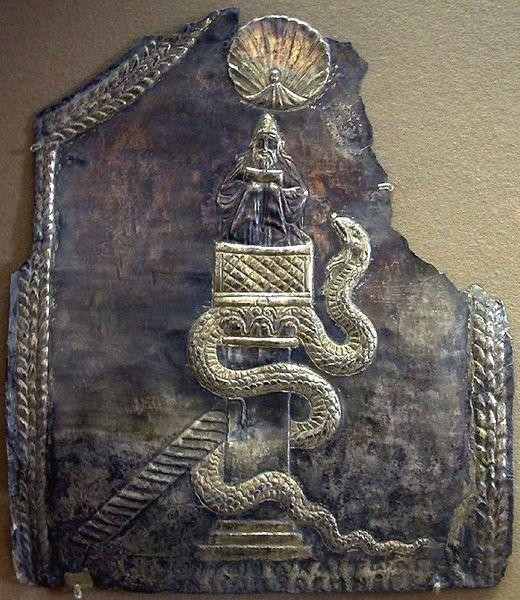
Figure 8.5 A depiction of St. Simeon from the sixth century CE. The snake symbolizes the temptation to abandon his holy life, presumably by getting down off of the pillar. Credit: St. Simeon by AxelBoldt.
Ultimately, pillar-sitting did not become the predominant model of Christian life. Instead, groups of ascetics came together in communities called monasteries, in what is known as cenobitic monasticism. Originally, these early monks spent almost all of their time in prayer, but over time most monastic communities came to embrace useful work as well as prayer and meditation. An early important development in monasticism was the work of Benedict, an Italian bishop, who wrote a book known as the Rule in about 529 that laid out how monks should live. The Rule dictated a strict schedule for daily life that revolved around prayer, study, and useful work for the monastery itself—tending crops and animals, performing labor around the monastery, and so on. Over time many monasteries became economic powerhouses, owning large tracts of land and selling their products at a healthy profit.
More important than their economic productivity—at least from the perspective of the history of ideas—is that monasteries became major centers of learning following the collapse of the western Roman Empire. One of the tasks undertaken by monks was the painstaking hand-copying of books, almost all of which had to do with Christian theology—e.g. the Bible itself, commentaries from important Christian leaders, etc.—but some of which were classical Greek or Roman writings that would have otherwise been lost. Often, these books were beautifully illustrated by the monks. These illuminated manuscripts give us some of the finest examples of medieval art. The monks’ and nuns’ constant scribing also advanced the art of writing and the earliest literatures of many vernacular European languages were products of this manuscript culture.
Outside of monasteries, churches were built in practically every city and town—and many small villages—in the Roman sphere of influence. One interesting and, from a contemporary perspective, somewhat peculiar phenomenon in early Christianity was the focus on holy objects known as relics. Relics were everything from the bones of saints to fragments of the “True Cross” on which Christ was crucified. Each church usually had a relic in its altar—contained in a special box called a reliquary. All relics were not created equal: the larger the object, or the closer it had been to Christ or the apostles, the more holy power it was believed to contain. Thus, a thriving trade in relics—plagued by counterfeits – it was not easy to determine if a given finger bone was really the finger bone of St. Mark!—developed in Europe as rival church leaders tried to secure the most powerful relic for their church. This was not just about the symbolic importance of the relics, as pilgrims would travel from all over the Roman world to visit the site of noteworthy relics, bringing with them considerable wealth. Whole regional economies centered on pilgrimage sites as a result. It is important to note that when it came to relics, perception was more important than reality. The relic did not have to be legitimate as long as the people believed it was real, it was.
Christian Learning
Christian learning was a complex issue, because, strictly speaking, spiritual salvation was thought to be available to anyone simply by accepting the basic tenets of Christian doctrine. In other words, the whole intellectual world of Greek and Roman philosophy, literature, science, and so on did not necessarily relate to the Church’s primary task of saving souls. Many church leaders were learned men and women, however, and insisted that there was indeed a place for learning within Christianity. The issue was never settled—one powerful Church leader, Tertullian, once wrote “what does Athens have to do with Rome?”, meaning, why should anyone study the Greek intellectual legacy when it was produced by pre-Christian polytheists?
Once Christianity was institutionalized, Church leaders generally came around to the importance of classical learning because it proved useful for administration. A vast Greco-Roman literature existed describing governance, science, engineering, etc., all of which was necessary in the newly Christian Empire. A kind of uneasy balance was struck between studying classical learning, especially things like rhetoric, while warning against the spiritual danger of being seduced by its non-Christian messages.
The most important thinker who addressed the intersection of Christian and classical learning was St. Augustine of Hippo—a Roman city in North Africa—whose life spanned the late fourth and early fifth centuries. Augustine lived through the worst period of Roman decline, completing his work while his own city was besieged by a Germanic group called the Vandals. To Roman Christians, the decline of Rome posed a huge challenge—if all-powerful God had embraced them, why was their empire falling apart? Augustine’s answer was that life on earth is not ultimately significant. In his work The City of God, Augustine distinguished between the perfect world of heaven, attainable through Christian faith, versus the flawed and imperfect world of the living. This concept explained the decline of the Empire as being irrelevant to the greater mission of salvation. Thus, according to Augustine, all of learning was just a facet of material life; useful in its way but totally insignificant compared to the necessity of laying one’s soul bare to God and waiting for the second coming of Christ.
The irony of these struggles over Christian doctrine versus ancient learning was that the issue was decided by the collapse of Rome as a centralizing political entity. When Germanic invaders entered Rome in the mid-fifth century, so began the decline of organized learning—there simply was no funding from Roman elites for what had been a robust private school system. In the absence of instruction, literature and philosophy and engineering all but vanished, preserved only in monasteries and in the eastern Empire. Once the western Empire disintegrated, the Church was the only institution that still supported scholarship (including basic literacy), but over time the levels of literacy and education in Europe unquestionably declined. This decline inspired the contempt of later Renaissance thinkers who wrote off the period between the fall of Rome and the beginning of the Renaissance in the mid-1300s CE as the “Dark Ages.”
The Fall of Rome
The fall of Rome, conventionally dated to 476 CE, is one of the most iconic events in the history of Europe. For centuries, people have tried to draw lessons from Rome’s decline and fall about their own societies, a practice inspired by the question of how so mighty and, at one time, stable a civilization could so utterly disintegrate. The answers have varied considerably: Rome grew corrupt and weak over time, Rome was infiltrated by “barbarian” cultures, Rome was simply overcome by overwhelming odds, or perhaps Rome was simply transformed into a different, more diverse set of societies rather than destroyed. However the events of the period are interpreted, the simple fact remains: the political unity of the Roman Empire was shattered by the end of the fifth century CE.
While the debate as to the causes of Rome’s demise will probably never be definitively answered, an important caveat should be noted: Rome did not “really” fall for another thousand years, even though the city of Rome itself, along with the western half of the Empire, did indeed lose its sovereignty in the face of invasion by Germanic peoples. The Roman capital had already been moved to Constantinople in the early fourth century, and the eastern half of the empire remained intact, albeit under constant military pressure, until 1453. Arguably, one of the major causes for the collapse of the western empire was the fact that the Empire as a whole had focused its resources in the east for a century by the time waves of Germanic peoples appeared on the horizon starting in the fourth century CE.
At the time, most Christians blamed polytheism and heresy for Rome’s fall: it was God’s wrath exacted on a sinful society. In turn, the remaining polytheists blamed Christians for undermining the worship of the gods who had presided over the Empire while Rome was great. From the contemporary perspective, Rome’s fall seems to have less to do with divine intervention than routine defeats and growing threats.
Roman Relations with the peoples of Western Europe
Romans had always held those on the periphery of Roman territory in contempt, and they believed that the lands held by these people (such as in Scotland and Germany) were largely unsuitable for civilization, being too cold and wet for the kind of Mediterranean agriculture Romans were accustomed to. Romans believed that the Germanic peoples, and others like them, were inferior to subject peoples like the Celts, who could at least be made useful subjects (and, later, citizens) of the Empire. For the entire history of the Empire, the Romans never seem to have figured out exactly which groups they were interacting with; they would simply lump them together as “Goths” or even “Scythians,” a blanket term referring to steppe peoples. Occasionally, hundreds of years after they “should have known better,” Roman writers would actually refer to Germans as Celts.
It is easy to overstate this negative attitude. However, there were many members of Germanic tribes who did rise to prominence in Rome. One, a man named Stilicho, was one of the greatest Roman generals in the late Empire, and he was half Vandal by birth. Likewise, it is clear from archaeology that many Germanic warriors made a career of fighting in the Roman armies and then returning to their native areas, and that many Germanic people looked up to Rome as a model of civilization to be emulated, not some kind of permanent enemy. Some Romans clearly admired things about certain Germanic groups, as well—the great Roman historian Tacitus, in his Germania, even praised them for their vigor and honor, although he did so in order to contrast the Germanic peoples with what he regarded as his own corrupt and immoral Roman society.
That said, it is clear that the overall pattern of contact between Rome and Germania was a combination of peaceful coexistence punctuated by many occasions of extreme violence. Various tribes would raid Roman lands, usually resulting in brutal Roman reprisals. As the centuries went on, Rome came increasingly to rely on both Germanic troops and on playing allied tribes off against hostile ones. In fact, by the late fourth century CE, many (sometimes even most) soldiers in Roman armies in the western half of the Empire were recruited from Germanic groups.
The only place worthy of Roman recognition as another “true” civilization was Persia. When Rome was forced to cede territory to Persia in 363 CE after a series of military defeats, Roman writers were aghast because the loss of territory represented “abandoning” it to the other civilization and state. When Germanic tribes seized territory, however, it rarely warranted any mention among Roman writers, since it was assumed that the territory could and would be reclaimed whenever it was convenient for Rome.
Meanwhile, there had been hundreds of years of on-again, off-again wars along the Roman borders before the “fall” of Rome actually occurred. Especially since the third century, major conflicts were an ongoing reality along the borders marked by the Rhine and Danube rivers. Those conflicts had prompted emperors to build a system of limes (frontier defenses) meant to defend Roman territory, and from that point on, the majority of Roman legions were usually deployed along the semi-fortified northern borders of the empire. There is no question that the performance of the Roman military was far poorer in the late imperial period than it had been, for instance, under the republic. Additionally, there is evidence that many of these soldiers on the frontier spent their careers as not-so-glorified border guards and administrators and never experienced battle itself.
Many of the Germanic people who settled along those borders were known as federatii, tribal groups who entered into treaties with Rome that required them to pay taxes in kind (i.e. in crops, animals, and other forms of wealth rather than currency) and send troops to aid Roman conquests, and who received peace and recognition (and usually annual gifts) in return. The problem for Rome was that most Germanic peoples regarded treaties as being something that only lasted as long as the emperor who had authorized the treaty lived. On his death, there would often be an incursion since the old peace terms no longer held. The first task new emperors had to attend to was often suppressing the latest invasion from the north. One example was the Goths, settled at the time somewhere around present-day Romania, whom Constantine severely punished after they turned on his forces during his war of conquest leading up to 312 CE.
As of the late fourth century CE, this situation seemed like business as usual to most political and military elites in the Roman Empire. To them, the borders were teeming with “barbarians”, but they had always been teeming with barbarians. Rome traded with them, enlisted them as soldiers, and fought them off or punished them as Roman leaders thought it necessary. No one in Rome seemed to think that this state of affairs would ever change. What contemporary historians have determined, however, is that things had changed: there were more Germanic people than ever before in the empire, they were better-organized, and they were capable of defeating large Roman forces. What followed was a kind of domino effect that ultimately broke the western Empire into pieces and ended Roman power over it.
One other factor in the demise of the western half of the Empire should be emphasized: once Rome began to lose large territories in the west, tax revenues shrunk to a fraction of what they had been. While the east remained intact, with taxes going to pay for a robust military which successfully defended Roman sovereignty, Roman armies in the west were under-funded, under-manned, and vulnerable. There was thus a vicious cycle of lost land, lost revenue, and poor military performance that saw Roman power simply disintegrate over the course of less than a century. Even the handful of effective emperors and generals in the west during that period could not staunch the tide of defeat.
Transitions to Germanic Authority
The beginning of the end for the western empire was the Huns. The Huns were warriors of the Central Asian steppes: expert horsemen, skillful warriors, and unattached to any particular land. They had much in common with other groups of steppe peoples like the Scythians who had raided civilized lands going back to the very emergence of civilization in Mesopotamia. They were believed to be so cruel and unstoppable that the Germanic groups farther west claimed that they were the product of unions between demons and witches rather than normal humans.
In 376 the Huns drove a large group of Goths from their lands in southern Russia. Those Goths were allowed to settle in the Balkans by the Romans, but were soon extorted by Roman officials, causing the Goths to rise up against Rome in retribution. In 378 the Goths killed the emperor, Valens, and destroyed a Roman army in an open battle. The new emperor made a deal with the Goths, allowing them to serve in the Roman army under their own commanders in return for payment. This proved disastrous for Rome in the long run as the Goths, under their king Alaric, started looting Roman territory in the Balkans, finally marching into Italy itself and sacking Rome in 410 CE. This caused the western Roman government to officially move to much more defensible city of Ravenna in the north.
The Gothic attack on Rome was the first time in roughly seven hundred years that the walls of Rome had been breached by non-Romans. The entire Roman world was shocked and horrified that mere barbarians could have overwhelmed Roman armies and struck at the heart of the ancient Empire itself. Rome’s impregnability was itself one of the founding stories Romans told themselves. Indeed, Romans had long vowed that the Celtic sack of 387 BCE would be the last, and yet the Goths had shattered that myth, and this was just the first disaster of many for the Empire.
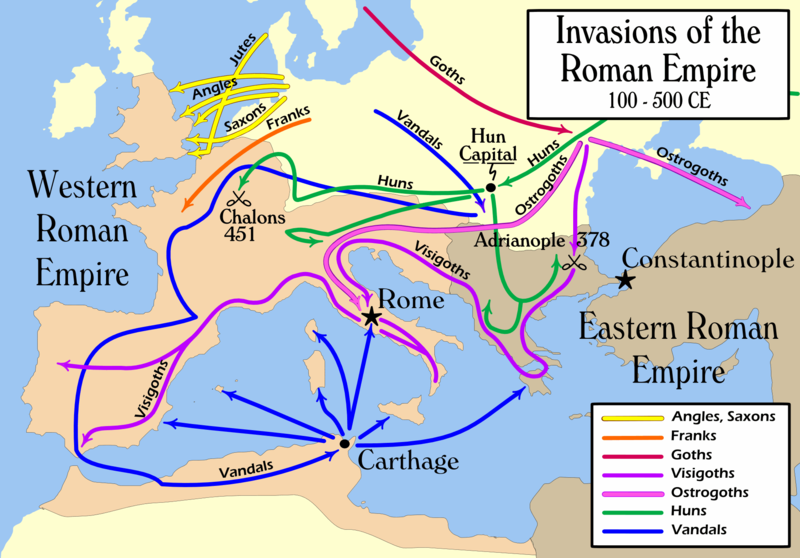
Figure 8.6 The major invasions of the Roman Empire leading up to its demise. Note, among other things, their astonishing scope: the Goths may have originated in Scandinavia but some of their descendants ended up ruling over Spain, while the Vandals came from somewhere in present-day Germany and conquered Roman North Africa. Credit: Invasions Map by MapMaster.
Leading up to that event, the Roman legions were already losing their former coherence and unity. In 406 CE a very cold winter froze the Rhine river, and Germanic armies invaded (literally walking across the frozen river in some cases), bypassing the traditional Roman defenses. One group, the Vandals, sacked its way to the Roman provinces of Hispania and seized a large swath of territory there. The entire army of Britain left in 407 CE, when yet another ambitious general tried to seize the imperial throne, and Roman power there swiftly collapsed.
Elsewhere, Roman armies from the western empire hastily marched back to the Italian Peninsula to fight the Goths, abandoning their traditional defensive posts. For the next fifty years, various groups of Germanic invaders moved across Europe, both looting and soon, settling down to occupy territory that had only recently been part of the Roman Empire. Most of these groups soon established kingdoms of their own. The Vandals pushed through Spain and ended up conquering most of Roman North Africa. After the Goths sacked Rome itself in 410, the emperor Honorius gave them southern Gaul to get them to leave. Unsatisfied with their newly claimed land, they ended up seizing most of Spain (from the Vandals who had arrived before them) as well. At that point, the Romans came to label this group the Visigoths—“western Goths”—to distinguish them from other Gothic tribes still at large in the Empire.
Back in the Italian Peninsula, the Huns, under the leadership of the legendary warlord Attila, arrived in the late 440s, pushing as far as the gates of Rome in 451. There, Pope Leo I personally appealed to Attila not to sack the city and paid him a hefty bribe. Attila died in 453 and the Huns were soon defeated by a combined army of their former Germanic subjects and a Roman army. By then, however, the damage was done. Only two years after the Huns were defeated, the Vandals sailed from Africa in 455 and sacked Rome again. This sacking, despite occurring with relatively little carnage, nevertheless led to the use of the word “vandal” to mean a malicious destroyer of property.
The Italian Peninsula as a whole held out until 476, when an Ostrogothic (“eastern Goth”) warlord named Odoacer deposed the last emperor and declared himself king of Italy. The Roman emperor in Constantinople (having little choice) approved of Odoacer’s authority in Italy in return for a nominal pledge of loyalty. In 493, Odoacer was deposed and killed by a different Ostrogothic king, Theodoric, but the link with Constantinople remained intact. The Roman emperor worked out a deal with Theodoric to stabilize the Italian Peninsula, and Theodoric went on to rule for decades (r. 493 – 526). Thus, by 500 CE the Italian Peninsula and the city of Rome itself were no longer part of the empire still called “Roman” by the people of the eastern empire. By the end of the fifth century, the western empire was gone, replaced by a series of kingdoms ruled by Germanic peoples but populated by former citizens of the Roman Empire.
Theodoric presided over a few decades of prosperity, restoring peace to the Italian peninsula and joining together with other Gothic territories to the west. He maintained excellent relations with the Pope even though he was an Arian Christian, and he set up a system in which a government existed for his Goths that was distinct from the Roman government (with him at the head of both, of course). Some historians have speculated that Theodoric and the Goths might have been able to forge a new, stable empire in the west and thereby obviate the coming of the “Dark Ages,” but that possibility was cut short when the Byzantine Empire invaded to try to reconquer its lost territory (that invasion is considered in the next chapter).
Meanwhile in Gaul, a fierce tribe called the Franks, from whom France derives its name, came to power, driving out rivals like the Visigoths. Unlike the other Germanic tribes, the Franks did not abandon their homeland when they set out for new territory. From the lower Rhine Valley, they gradually expanded into northern Gaul late in the fifth century. Under the leadership of the warrior chieftain Clovis (r. 481/482 – 511), the various Frankish tribes were united, which gave them the military strength to depose the last Roman governor in Gaul, drive the Visigoths into Spain, absorb the territory of yet another group known as the Burgundians, and eventually conquer most of Gaul. Thus, what began as an invasion and occupation of Roman territory evolved in time to become the earliest version of the kingdom of France with portions of modern Germany thrown in for good measure.
In almost every case, the new Germanic kings pledged formal allegiance to the Roman emperor in Constantinople in return for acknowledgment of the legitimacy of their rule. They often did their best to build on the precedent of Roman civilization as well; for example, Clovis made a point of having Frankish laws recorded in Latin, and over time the Frankish language vanished, replaced by the early form of French, a Latinate language. In fact, for well over a century, most Germanic “kings” were, officially, treaty-holding, recognized Roman officials from the legal and diplomatic perspective of Constantinople. That said, the emperors of Constantinople had plenty of legal pretext to regard those kings as usurpers as well, since the treaties of acknowledgment were often full of loopholes. Thus, when the emperor Justinian invaded the Italian Peninsula in the sixth century, he was doing so to reassert not just the memory of the united empire, but to restore it to the legal state in which it already technically existed.
Conclusion: World-Historical Comparisons
It is useful to step back from the exclusive focus on Rome to consider one of the peculiar aspects of its “fall”: the fact that the Roman legacy lived on in Byzantium even as it was very nearly extinguished in the west. The contrast with other major world-historical civilizations is striking. As noted in the discussions of Persia, dynasties came and went over time, but Persian culture remained intact. As we will soon see with the discussion of Islam in a following chapter, Persia retained its own distinctive culture despite being conquered during the Arab conquests of the seventh century CE as well. On the other side of Eurasia, the Han Dynasty of China’s reign (206 BCE – 220 CE) coincided almost exactly with the greatest period of Roman power. The Han Dynasty eventually fell, but unlike the western empire of Rome, the Han political and cultural legacy was so powerful that every subsequent imperial dynasty of China (until the collapse of the imperial system in the early twentieth century CE) followed its precedent in political culture and practices. In other words, regimes might fall in places like Persia and China, but political legacies lived on.
The Roman political legacy in the west was much weaker. While the Roman Church would retain some of Rome’s learning and scholarship, and Christianity itself thrived in Europe thanks in large part to its establishment in Rome before the “fall,” no new kingdom or empire would ever emerge in Europe that would truly follow in Rome’s footsteps (despite the pretentions of the “Holy Roman Empire” centered in Germany that began in 800 CE).
Instead, in contrast to the more direct inheritance of political regimes in places like Persia and China, the Roman inheritance in world history is primarily cultural, linguistic, and legal in nature. The Latinate languages of Europe, spoken by over a billion people today, are a Roman legacy, as are the influences of Roman law in many legal systems. In the modern period, the very idea of “checks and balances” in democratic governance was drawn directly from the organization of the Roman Republic.
By 500 CE in Europe west of Greece and the Balkans, the question of Rome’s legacy was largely irrelevant to people who were now part of newly emerging kingdoms ruled by Germanic leaders. Likewise, while interpretations of the collapse of the Roman Empire will continue to differ as long as there are people interested in Roman history, there is no question about the basic fact: half of what had once been an enormous, coherent, and amazingly stable state was splintered into political fragments by the end of the fifth century.



.jpg)


