10
We have seen how to compare a single mean against a given value and how to utilize difference scores to look for meaningful, consistent change with a correlated sample (within-subjects research design.) Now, we will learn how to compare two separate means from groups that do not overlap to see if there is a difference between them (between subjects research design). The process of testing hypotheses about two means is exactly the same as it is for testing hypotheses about a single mean, and the logical structure of the formulas is the same as well. However, we will be adding a few extra steps this time to account for the fact that our data are coming from different sources.
Independent Samples T-tests
In this chapter, we will deal with the difference of the means, that is, the average values of separate groups that are represented by separate descriptive statistics. This analysis involves two groups and one time point. As with all of our other tests as well, both of these analyses are concerned with a single dependent variable.
It is very important to keep the differences between the a correlated sample and independent sample t-test separate. Understanding the distinctions between them is important because they assess very different questions and require different approaches to the data. For an independent samples t-tests, if there’s no logical or meaningful way to link individuals across groups, then we say the groups are independent and use the independent samples t test, the subject of this chapter.
Research Questions about Independent Means
Many research ideas in the behavioral sciences and other areas of research are concerned with whether or not two means are the same or different. Logically, we therefore say that these research questions are concerned with group mean differences. That is, on average, do we expect a person from Group A to be higher or lower on some variable than a person from Group B. In any research design looking at group mean differences, there are some key criteria we must consider: the groups must be mutually exclusive (i.e., you can only be part of one group at any given time), and the groups have to be measured on the same variable (i.e., if you want to access difference in healthcare between wealthy and impoverished communities) you would measure access for both groups and compare them.
Let’s look at one of the most common and logical examples: testing a new medication. When a new medication is developed, the researchers who created it need to demonstrate that it effectively treats the symptoms they are trying to alleviate. The simplest design that will answer this question involves two groups: one group that receives the new medication (the “treatment” group) and one group that receives a placebo (the “control” group). Participants are randomly assigned to one of the two groups (remember that random assignment is the hallmark of a true experiment), and the researchers test the symptoms in each person in each group after they received either the medication or the placebo. They then calculate the average symptoms in each group and compare them to see if the treatment group did better (i.e., had fewer or less severe symptoms) than the control group.
In this example, we had two groups: treatment and control, which is a classic between subjects research design. Membership in these two groups was mutually exclusive—each individual participant received either the experimental medication or the placebo. No one in the experiment received both, so there was no overlap between the two groups. Additionally, each group could be measured on the same variable: symptoms related to the disease or ailment being treated. Because each group was measured on the same variable, the average scores in each group could be meaningfully compared. If the treatment was ineffective, we would expect that the average symptoms of someone receiving the treatment would be the same as the average symptoms of someone receiving the placebo (i.e., there is no difference between the groups the null hypothesis). However, if the treatment was effective, we would expect fewer symptoms from the treatment group, leading to a lower group average (the alternative hypothesis).
Now let’s look at an example using groups that already exist. A common, and perhaps salient, question is how students feel about their job prospects after graduation depending on student’s ethnic background. Suppose that we have narrowed our participants to comparing Black and White graduates. In the course of trying to decide between the two, we come across a survey that has data from each ethnic group on how the students feel about their future job prospects. As with our last example, we have two groups: White and Black, and each participant is in only one of the two groups. Because students of each ethnicity completed the same survey, they are measuring the same thing, so we can use a t test to compare the average perceptions of students to see if they are the same.
As we can see, the grouping variable we use for an independent samples t test can be a set of groups we create (as in the experimental medication example) or groups that already exist naturally (as in the ethnicity and perceptions about job prospects example). There are countless other examples of research questions relating to two group means, making the independent samples t test one of the most widely used analyses around.
Hypotheses and Decision Criteria
The process of testing hypotheses using an independent samples t test is the same as it was in the last three chapters, and it starts with stating our hypotheses and laying out the criteria we will use to test them.
Our null hypothesis for an independent samples t test is the same as all others: there is no difference. The means of the two groups are the same under the null hypothesis, no matter how those groups were formed. Mathematically, this takes on two equivalent forms:
H0 : μ1= μ2
or
H0 : μ1 – μ2 = 0
Both of these formulations of the null hypothesis tell us exactly the same thing: that the numerical value of the means is the same in both groups. This is more clear in the first formulation, but the second formulation also makes sense (any number minus itself is always zero) and helps us out a little when we get to the math of the test statistic. Either one is acceptable and you only need to report one. The English interpretation of both of them is also the same:
H0: There is no difference between the means of the two groups
Our alternative hypotheses are also unchanged: we simply replace the equal sign (=) with one of the three inequalities (>, <, ≠):
HA : μ1> μ2
HA : μ1< μ2
HA : μ1≠ μ2
or
HA : μ1> μ2 > 0
HA : μ1< μ2 < 0
HA : μ1≠ μ2 ≠ 0
Whichever formulation you chose for the null hypothesis should be the one you use for the alternative hypothesis (be consistent), and the interpretation of them is always the same:
HA: There is a difference between the means of the two groups
Notice that we are now dealing with two means instead of just one, so it will be very important to keep track of which mean goes with which population and, by extension, which dataset and sample data. We use subscripts to differentiate between the populations, so make sure to keep track of which is which. If it is helpful, you can also use more descriptive subscripts. To use the experimental medication example:
H0 : There is no difference between the mean of the treatment and control groups
H0 : μtreatment= μcontrol
HA : There is a difference between the mean of the treatment and control groups
HA : μtreatment ≠ μcontrol
Once we have our hypotheses laid out, we can set our criteria to test them using the same three pieces of information as before: significance level ( ), directionality (left, right, or two-tailed), and degrees of freedom, which for an independent samples t test are:
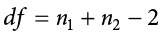
This looks different than before, but it is just adding the individual degrees of freedom from each group (n − 1) together. Notice that the sample sizes, n, also get subscripts so we can tell them apart.
For an independent samples t test, it is often the case that our two groups will have slightly different sample sizes, either due to chance or some characteristic of the groups themselves. Generally, this is not an issue, so long as one group is not massively larger than the other group. What is of greater concern is keeping track of which is which using the subscripts.
Independent Samples t Statistic
The test statistic for our independent samples t test we use the formula below:
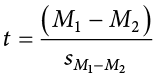
Our standard error in the denomination is still standard deviation (s) with a subscript denoting what it is the standard error of. Because we are dealing with the difference between two separate means, rather than a single mean or single mean of difference scores, we put both means in the subscript. Calculating our standard error, as we will see next, is where the biggest differences between this t test and other t tests appears. However, once we do calculate it and use it in our test statistic, everything else goes back to the same process as the previously discussed t-tests. Our decision criteria are still comparing our obtained test statistic to our critical value, and our interpretation based on whether or not we reject the null hypothesis is unchanged as well.
Standard Error and Pooled Variance
Because we are working with two samples drawn from two populations, we have to first combine their estimates of standard deviation—or, more accurately, their estimates of variance—into a single value that we can then use to calculate our standard error.
The combined estimate of variance using the information from each sample is called the pooled variance and is denoted  ; the subscript p serves as a reminder indicating that it is the pooled variance. The term “pooled variance” is a literal name because we are simply pooling or combining the information on variance—the sum of squares and degrees of freedom—from both of our samples into a single number. The result is a weighted average of the observed sample variances, the weight for each being determined by the sample size, and will always fall between the two observed variances. The computational formula for the standard error is:
This formula above can look daunting at first, but it is in fact just a weighted average. They look slightly different but mathematically they are exactly the same as the both require the standard deviation in the numerator.
Using this formula, it’s very simple to see that we are just adding together the same pieces of information we have been calculating since Chapter 3. Thus, when we use this formula, the pooled variance is not nearly as intimidating as it might have originally seemed.
Looking at that, we can now see that, once again, we are simply adding together two pieces of information—no new logic or interpretation required. Once the standard error is calculated, it goes in the denominator of our test statistic, as shown above and as was the case in all previous chapters. Thus, the only additional step to calculating an independent samples t statistic is computing the pooled variance. Let’s see an example in action.
Example Movies and Mood
We are interested in whether the type of movie someone sees at the theater affects their mood when they leave. We decide to ask people about their mood as they leave one of two movies: a comedy (Group 1, n = 35) or a horror film (Group 2, n = 29). Our data are coded so that higher scores indicate a more positive mood. We have good reason to believe that people leaving the comedy will be in a better mood, so we use a one-tailed test at a = .05 to test our hypothesis.
Step 1: State the Hypotheses
As always, we start with hypotheses:
H0 : There is no difference in average mood between two movie types
H0 : μ1= μ2 or H0 : μ1 – μ2 = 0
HA : The comedy film will produce a better average mood than the horror film
HA : μ1-μ2 > 0
HA : μ1> μ2
Notice that in the first formulation of the alternative hypothesis we say that the first mean minus the second mean will be greater than zero. This is based on how we code the data (higher is better), so we suspect that the mean of the first group will be higher. Thus, we will have a larger number minus a smaller number, which will be greater than zero. Be sure to pay attention to which group is which and how your data are coded (higher is almost always used as better outcomes) to make sure your hypothesis makes sense!
Step 2: Find the Critical Values
Just like before, we will need critical values, which come from our t table. In this example, we have a one-tailed test at a = .05 and expect a positive answer (because we expect the difference between the means to be greater than zero). Our degrees of freedom for our independent samples t test is just the degrees of freedom from each group added together: 35 + 29 − 2 = 62. From our t table, we find that our critical value is t* = 1.671. Note that because 62 does not appear on the table, we use the next lowest value, which in this case is 60.
Step 3: Compute the Test Statistic
The data from our two groups are presented in the tables below. Table 10.1 shows the values for the Comedy group, and Table 10.2 shows the values for the Horror group. Values for both have already been placed in the sum of squares tables since we will need to use them for our further calculations. As always, the column on the left is our raw data.
Table 10.1. Raw scores and sum of squares for Group 1 (comedy).
|
X |
X − M |
(X − M)2 |
|---|---|---|
|
39.10 |
15.10 |
228.01 |
|
38.00 |
14.00 |
196.00 |
|
14.90 |
−9.10 |
82.81 |
|
20.70 |
−3.30 |
10.89 |
|
19.50 |
−4.50 |
20.25 |
|
32.20 |
8.20 |
67.24 |
|
11.00 |
−13.00 |
169.00 |
|
20.70 |
−3.30 |
10.89 |
|
26.40 |
2.40 |
5.76 |
|
35.70 |
11.70 |
136.89 |
|
26.40 |
2.40 |
5.76 |
|
28.80 |
4.80 |
23.04 |
|
33.40 |
9.40 |
88.36 |
|
13.70 |
−10.30 |
106.09 |
|
46.10 |
22.10 |
488.41 |
|
13.70 |
−10.30 |
106.09 |
|
23.00 |
−1.00 |
1.00 |
|
20.70 |
−3.30 |
10.89 |
|
19.50 |
−4.50 |
20.25 |
|
11.40 |
−12.60 |
158.76 |
|
24.10 |
0.10 |
0.01 |
|
17.20 |
−6.80 |
46.24 |
|
38.00 |
14.00 |
196.00 |
|
10.30 |
−13.70 |
187.69 |
|
35.70 |
11.70 |
136.89 |
|
41.50 |
17.50 |
306.25 |
|
18.40 |
−5.60 |
31.36 |
|
36.80 |
12.80 |
163.84 |
|
54.10 |
30.10 |
906.01 |
|
11.40 |
−12.60 |
158.76 |
|
8.70 |
−15.30 |
234.09 |
|
23.00 |
−1.00 |
1.00 |
|
14.30 |
−9.70 |
94.09 |
|
5.30 |
−18.70 |
349.69 |
|
6.30 |
−17.70 |
313.29 |
|
Σ = 840 |
Σ = 0 |
Σ = 5061.60 |
Table 10.2. Raw scores and sum of squares for Group 2 (horror).
|
X |
X − M |
(X − M)2 |
|---|---|---|
|
24.00 |
7.50 |
56.25 |
|
17.00 |
0.50 |
0.25 |
|
35.80 |
19.30 |
372.49 |
|
18.00 |
1.50 |
2.25 |
|
−1.70 |
−18.20 |
331.24 |
|
11.10 |
−5.40 |
29.16 |
|
10.10 |
−6.40 |
40.96 |
|
16.10 |
−0.40 |
0.16 |
|
−0.70 |
−17.20 |
295.84 |
|
14.10 |
−2.40 |
5.76 |
|
25.90 |
9.40 |
88.36 |
|
23.00 |
6.50 |
42.25 |
|
20.00 |
3.50 |
12.25 |
|
14.10 |
−2.40 |
5.76 |
|
−1.70 |
−18.20 |
331.24 |
|
19.00 |
2.50 |
6.25 |
|
20.00 |
3.50 |
12.25 |
|
30.90 |
14.40 |
207.36 |
|
30.90 |
14.40 |
207.36 |
|
22.00 |
5.50 |
30.25 |
|
6.20 |
−10.30 |
106.09 |
|
27.90 |
11.40 |
129.96 |
|
14.10 |
−2.40 |
5.76 |
|
33.80 |
17.30 |
299.29 |
|
26.90 |
10.40 |
108.16 |
|
5.20 |
−11.30 |
127.69 |
|
13.10 |
−3.40 |
11.56 |
|
19.00 |
2.50 |
6.25 |
|
−15.50 |
−32.00 |
1024.00 |
|
Σ = 478.6 |
Σ = 0.00 |
Σ = 3896.45 |
Using the sum of the first column for each table, we can calculate the mean for each group:
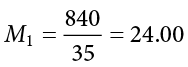
and
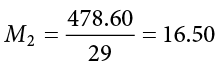
These values were used to calculate the middle rows of each table, which sum to zero as they should (the middle column for Group 2 sums to a very small value instead of zero due to rounding error—the exact mean is 16.50344827586207, but that’s far more than we need for our purposes). Squaring each of the deviation scores in the middle columns gives us the values in the third columns, which sum to our next important value: the sum of squares for each group: SS1 = 5061.60 and SS2 = 3896.45. These values have all been calculated and take on the same interpretation as they have since Chapter 3—no new computations yet. Before we move on to the pooled variance that will allow us to calculate standard error, let’s compute our standard deviation for each group; they are still important descriptors of our data:
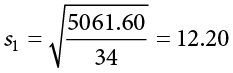
and
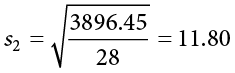
Now we can use those values to calculate our standard error, the last step before we can find our test statistic:
 =
= 
Finally, we can use our standard error and the means we calculated earlier to compute our test statistic. Because the null hypothesis value of  1 − 2 is 0.00, we will leave that portion out of the equation for simplicity:
Step 4: Make the Decision
Our test statistic has a value of t = 2.48, and in Step 2 we found that the critical value is t* = 1.671. Because 2.48 > 1.671, we reject the null hypothesis:
Reject H0. Based on our sample data from people who watched different kinds of movies, we can say that the average mood after a comedy movie (M1 = 24.00, SD1 = 12.20) is better than the average mood after a horror movie ( M2 = 16.50, SD2 = 11.80), t(62) = 2.48, p < .05.
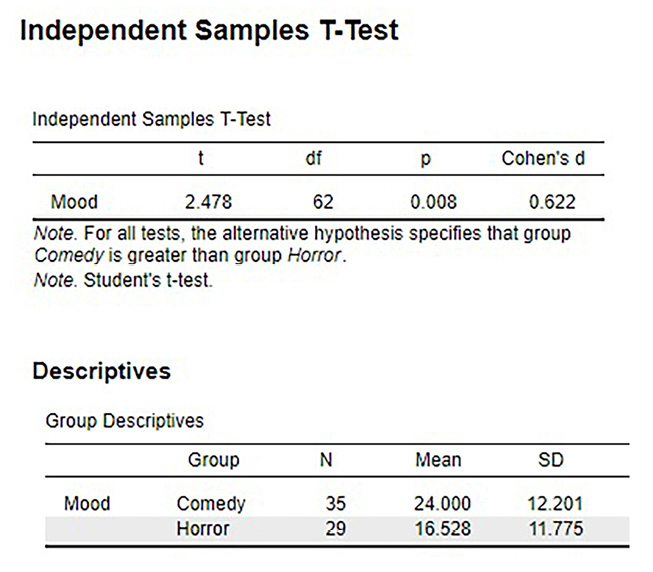
Figure 10.1 shows the output from JASP for this example.
Figure 10.1. Output from JASP for the independent-samples t test described in the Movies and Mood example. The output provides the t value (2.478), degrees of freedom (62), the exact p value (.008, which is less than .05), and Cohen’s d for effect size (0.622). Note that the means and standard deviations for both samples are also provided. Based on our sample data from people who watched different kinds of movies, we can say that the average mood after a comedy movie (M = 24.0, SD = 12.2) is better than the average mood after a horror movie (M = 16.5; SD = 11.8), t(62) = 2.48, p = .008, d = 0.62. (“JASP independent-samples t test” by Rupa G. Gordon/Judy Schmitt is licensed under CC BY-NC-SA 4.0.)
Reading indEpendent samples t tests in spss: Which row to use for significance?
When you run an independent samples t test in SPSS, the output gives you two rows: one labeled Equal variances assumed and one labeled Equal variances not assumed. Which one should you use? SPSS automatically runs a test called Levene’s Test for Equality of Variances to check whether the two groups have about the same spread (variance). If the Sig. value for Levene’s Test is greater than .05, you can assume the group variances are about equal, so you use the row labeled Equal variances assumed. If the Sig. value is .05 or less, you cannot assume equal variances, so you use the row labeled Equal variances not assumed. In other words, always look at Levene’s Test first to decide which row to report.
Exercises
- What is meant by “the difference of the means” when talking about an independent samples t test? How does it differ from the “mean of the differences” in a related samples t test?
- Describe three research questions that could be tested using an independent samples t test.
- Calculate standard error from the following raw data:
Group 1
Group 2
16
4
11
10
9
15
7
13
5
12
4
9
12
8
- Calculate the standard error from the following descriptive statistics.
- s1 = 24, s2 = 21, n1 = 36, n2 = 49
- s1 = 15.40, s2 = 14.80, n1 = 20, n2 = 23
- s1 = 12, s2 = 10, n1 = 25, n2 = 25
- Determine whether to reject or fail to reject the null hypothesis in the following situations:
- t(40) = 2.49, a = .01, one-tailed test to the right
- M1 = 64, M2 = 54, n1 = 14, n2 = 12, Sm1-m2 = 9.75, a = .05, two-tailed test
- A professor is interested in whether the type of software program used in a statistics lab affects how well students learn the material. The professor teaches the same lecture material to two classes but has one class use a point-and-click software program in lab and has the other class use a basic programming language. The professor collects final exam scores for students in each class. Conduct a hypothesis test to answer the research question.
Point-and-Click
Programming
83
86
83
79
63
100
77
74
86
70
84
67
78
83
61
85
65
74
75
86
100
87
60
61
90
76
66
100
54
- A researcher wants to know if there is a difference in how busy someone is based on whether that person identifies as an early bird or a night owl. The researcher gathers data from people in each group, coding the data so that higher scores represent higher levels of being busy, and tests for a difference between the two at the .05 level of significance. Conduct a hypothesis test to answer the research question.
Early Bird
Night Owl
23
26
28
10
27
20
33
19
26
26
30
18
22
12
25
25
26
- Lots of people claim that having a pet helps lower their stress level. Use the following summary data to test the claim that there is a lower average stress level among pet owners (Group 1) than among non-owners (Group 2) at the .05 level of significance.
- M1 = 16.25, M2 = 20.95, s1 = 4.00, s2 = 5.10, n1 = 29, n2 = 25
- Administrators at a university want to know if students in different majors are more or less extroverted than others. They provide you with descriptive statistics they have for English majors (coded as 1) and History majors (coded as 2) and ask you to create a confidence interval of the difference between them. Does this confidence interval suggest that the students from the majors differ?
- M1 = 3.78, M2 = 2.23, s1 = 2.60, s2 = 1.15, n1 = 45, n2 = 40
- Researchers want to know if people’s awareness of environmental issues varies as a function of where they live. Use the following summary data from two states, Alaska and Hawaii, to test for a difference.
- MH = 47.50, MA = 45.70, sH = 14.65, sA = 13.20, nH = 139, nA = 150
Answers to Odd-Numbered Exercises
1)
The difference of the means is one mean calculated from a set of scores compared to another mean calculated from a different set of scores; the independent samples t test looks for whether the two separate values are different from one another. This is different than the “mean of the differences” because the latter is a single mean computed on a single set of difference scores that come from one data collection of matched pairs. So, the difference of the means deals with two numbers but the mean of the differences is only one number.
3) 2.103
5)
a) Reject
b) Fail to reject
7)
Step 1: H0: μ1 − μ2 = 0 “There is no difference in the average busyness of early birds versus night owls,” HA: μ1 − μ2 ≠ 0 “There is a difference in the average busyness of early birds versus night owls.”
Step 2: Two-tailed test, df = 15, t* = 2.131
Step 3: M1= 26.67, M2 = 19.50, = 27.73, Sm1-m2 = 2.37, t = 3.03
Step 4: t > t*, Reject H0. Based on our data of early birds and night owls, we can conclude that early birds are busier (M1 = 26.67) than night owls (M2 = 19.50), t(15) = 3.03, p < .05, d = 1.47.
9) M1 -M2 = 1.55, t* = 1.990, = 0.45, CI = (0.66, 2.44). This confidence interval does not contain zero, so it does suggest that there is a difference between the extroversion of English majors and History majors.
“Boyfriend” by Randall Munroe/xkcd.com is licensed under CC BY-NC 2.5.)