
5 Trade Empires
European society underwent a major change during the early modern period with regards to its outlook on wealth and property. Along with that change came the growth of a new kind of state and society, one not only defined by the growth of bureaucracy seen in absolutism, but in the power of the moneyed classes whose wealth was not predicated on owning land. The rise of that class to prominence in certain societies, especially those of the Netherlands and England, accompanied the birth of the most distinctly modern form of economics: capitalism.
In the Middle Ages, wealth, land, and power were intimately connected. Nobles were defined by their ownership of land and by their participation in armed conflict. That changed by the early modern period, especially as it became increasingly common for monarchs to sell noble titles to generate money for the state. By the seventeenth century the European nobility was split between “nobles of the sword” who inherited their titles from their warlike ancestors and “nobles of the robe” who had either been appointed by kings or purchased titles. Both categories of nobility were far more likely to be owners of land exploiting their peasants than warriors. Among almost all of them, there was considerable contempt for merchants, who were often seen as parasites who undermined good Christian morality and the proper order of society. Even nobles of the robe who had only joined the nobility within the last generation tended to cultivate a practiced loathing for mere merchants, their social inferiors.
In addition, the economic theory of the medieval period, known as mercantilism, posited that there was a finite, limited amount of wealth in the world, and that the only thing that could be done to become wealthier was to get and hold on to more of it. In both the medieval and Renaissance-era mindset, the only forms of wealth were land and bullion (precious metals), and since there is only so much land and so much gold and silver out there, if one society grew richer, by definition every other society grew poorer.
According to this mindset, kingdoms could only increase their wealth by seizing more territory, especially territory that would somehow increase the flow of precious metals into royal coffers. Trade was only important insofar as trade surpluses with other states could be maintained, thereby ensuring that more bullion was flowing into the economy than was flowing out. Colonies abroad provided raw materials and, hopefully, bullion itself.
Mercantilism worked well enough, but commerce fit awkwardly into its paradigm. Trade was not thought to generate new wealth, since it did not directly dig up more silver or gold, nor did it seize wealth from other countries. Trade did not “make” anything according to the mercantilist outlook. Of all classes of society, bankers in particular were despised by traditional elites since instead of producing anything themselves, they (seemingly) profited off of the wealth of others.
These attitudes started undergoing significant changes in the sixteenth and seventeenth centuries, mostly as a result of the incredible success of overseas corporations, groups that generated enormous wealth outside of the auspices of mercantilist theory. Many of the beneficiaries of the new wealth of the sixteenth and seventeenth centuries were not noblemen, but were instead wealthy merchant townsfolk, especially in places like the Dutch Republic and, later, England. However, the men who amassed these huge fortunes did not fit neatly into the existing power structure of landholding nobles, the Church, and the common people. This friction inspired an increasingly spirited battle over the idea that not just land but wealth itself was something that the state should protect and encourage to grow.
Early Capitalism
The growth of commercial wealth was closely tied to the growth of overseas empires. Whereas the initial wave of European colonization (mostly in the Americas) had been driven by a search for gold and a desire to convert native populations to Christianity, by the seventeenth century European powers came to pursue colonies and trade routes more in the name of producing commodities and the wealth they generated. Because of the enormous wealth to be generated not from gold and silver themselves, but from commodities like sugar, tobacco, and coffee (as well as luxury commodities like spices that had always been important), the states of Europe were willing to war constantly among themselves as well as to perpetrate one of the greatest crimes in history: the Transatlantic Slave Trade.
In short, we see in the seventeenth and eighteenth centuries the first phase of a system that would later be called capitalism: an economic system in which the exchange of commodities for profit generated wealth that would be reinvested in the name of still greater profits. Capitalism is dependent on governments that enforce legal systems that protect property and, historically, by wars that tried to carve out bigger chunks of the global market from rivals. To reiterate, capitalism was (and remains) a combination of two major economic and political phenomena: enterprises run explicitly for profit and a legal framework to protect and encourage the generation of profit. The pursuit of profit was nothing new, historically, but the political power enjoyed by merchants, the political focus on overseas expansion for profit, and the laws enacted to encourage these processes were.
Overseas Expansion
The development of early capitalism was intimately connected with overseas expansion. Europe was an important node of a truly global economy by the seventeenth century, and it was that economy that fueled the development of capitalistic, commercial societies in places like the Netherlands and England. While the original impulse behind overseas expansion during this period was primarily commercial, focused on the search for commodities and profit, it was also a major political focus of all the European powers by the eighteenth century. In other words, European elites actively sought not just to trade with, but to conquer and control, overseas territories both for profit and for their own political “glory” and aggrandizement. The result was a dramatic expansion of European influence or direct control. By 1800, roughly 35% of the globe was directly or indirectly controlled by European powers.
European success in conquering and colonization was driven by military technology and organization. The early modern military revolution (i.e. the evolution of gunpowder warfare during and after the Renaissance period) resulted in highly trained soldiers with the most advanced military technology in the world by the late seventeenth centuries. As European powers expanded, they built fortresses in the modern style and defended them with cannons, muskets, and warships that often outmatched the military forces and technology they encountered.
European states also benefited from the relative political fragmentation of parts of the non-European world. There were powerful kingdoms and empires in Africa, the Middle East, and Asia that defied European attempts at hegemony, but much of the world was controlled by smaller states. A prime example is India, which was divided up into dozens of (relatively) small kingdoms. The Mughal Empire that ruled much of the subcontinent early in the period of British expansion was in rapid decline by the early eighteenth century, well before the British controlled much territory, and there was thus no need for the British to confront a true empire as they expanded their holdings on the subcontinent. When the British and French began taking control of Indian territory, it was against the resistance of small Indian kingdoms, not some kind of overall Indian state.
An important note regarding European colonial power: this period saw the consolidation of European holdings in the New World and the beginning of empires in places like India, but it did not include major land holdings in Africa, the Middle East, or East Asia. In places with powerful states like China, the Ottoman Empire, and Japan, even the relative superiority of European arms was not sufficient to seize territory. Likewise, not only were large African states such as Ethiopia, able to successfully fight off Europeans as well, but African diseases made it impossible for large numbers of Europeans to colonize or occupy much African territory. As the Transatlantic Slave Trade grew, Europeans sometimes launched slave raids, but most slaves were instead captured by African slavers who enjoyed enormous profits from the exchange.
Concurrent to all of this, European states and the corporations they supported worked diligently to establish monopolies on trade with various parts of the world. However, “monopolies” in this case only meant monopolies in trade going to and from Europe. There were enormous, established, and lucrative networks of trade between Africa, India, South Asia, Southeast Asia, China, Japan, and the Pacific, all of which were dominated by non-European merchants, such as in the Indian Ocean which had served as an oceanic crossroads of trade between Africa and Asia for thousands of years. Europeans broke into those markets primarily by securing control of goods that made their way back to Europe rather than seizing control of intra-Asian or African trade routes, although they did try to dominate those routes when they could, and Europeans were able to seize at least some territories directly in the process.
The Netherlands
The Dutch were at the forefront of these changes. During their rebellion against Spain in the late sixteenth century, the Dutch began to look to revenue generated from trade as an economic lifeline. They served both as the middlemen in European commerce, shipping and selling things like timber from Russia, textiles from England, and wine from Germany, and they also increasingly served as Europe’s bankers. The Dutch invented both formalized currency exchange and the stock market, both of which led to huge fortunes for Dutch merchants. A simple way to characterize the growth of Dutch commercial power was that the Netherlands replaced northern Italy as the heart of European trade after the Renaissance.
In 1602, Dutch merchants with the support of the state created the world’s first corporation: the Dutch East India Company (VOC in its Dutch acronym). It was created to serve as the Republic’s official trading company, which possessed a legal monopoly to trade with India and Southeast Asia. The VOC proved phenomenally successful in pushing out other European merchants in the Indies through a combination of brute force and the careful deployment of legal strategies. A common approach was to offer “protection” from the supposedly more rapacious European powers like Portugal in return for trade monopolies from spice-producing regions. In many cases, the VOC simply used the promise of protection as a smokescreen for seizing complete control of a given area (especially in Indonesia, which eventually became a Dutch colony), while in other areas local rulers remained in political control but lost power over their own spice production and trade. For the better part of the seventeenth century, the Dutch controlled an enormous amount of the hugely profitable trade in luxury goods and spices from the East Indies.
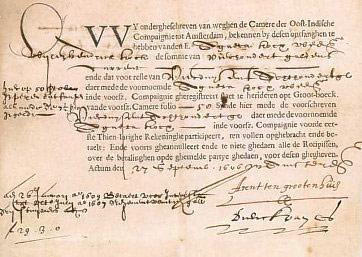
Figure 5.1 An early stock certificate from the VOC. Credit: VOC Stock in Public Domain
The profits for Dutch merchants and investors were concomitantly high. As an example, above and beyond direct profits by individual members of the company, all stockholders in the VOC received dividends of 30% on their investments within the first ten years, in addition to a dramatic boost in value of the stocks themselves. The other states of Europe were both aghast at Dutch success and grudgingly admiring of it. In 1601, there were 100 more Dutch ships in the port of London at any given time than there were English ships, and by 1620 about half of all European merchant vessels were Dutch.
In 1652, the Dutch seized control of the Cape of Good Hope at the southern tip of Africa, allowing them to control shipping going around Africa en route to Europe from Asia, and they exerted additional military force in the Indies to force native merchants to trade only with them (among Europeans). Note here that the Dutch takeover of the Cape of Good Hope was the historical origin of the modern nation of South Africa—as these were the first permanent European settlers. The Dutch were also the only European power allowed to keep a small trading colony in Japan, which was otherwise completely cut off to westerners after 1641 (thanks to a failed Portuguese-sponsored Christian uprising against the Japanese shogun).
The iconic moment in the history of the Dutch golden age of early capitalism was the tulip craze of the 1620s – 1630s. Tulips grow well in the Netherlands and had long been cultivated for European elites. A tulip fad among Dutch elites in the 1620s drove up the price of tulip bulbs dramatically. Soon, enterprising merchants started buying and selling bulbs with no intention of planting them or even selling them to someone who would—they simply traded the bulbs as a valuable commodity unto themselves.
In 1625, one bulb was sold for 5,000 guilders, about half the cost of a mansion in Amsterdam. It went up from there—the real height of the craze was the winter of 1636 – 1637, when individual bulbs sometimes changed hands ten times in a day for increasing profits. This was the early modern Dutch equivalent of “flipping” houses. The element to emphasize is not just the seemingly irrational nature of the boom, but of the mindset: it had nothing to do with the actual tulips any longer, instead the Dutch moneyed classes were embracing speculative market economies, in which the value of a given commodity has almost nothing to do with what it does, but instead from what people are willing to spend on it. In capitalist economies this phenomenon often leads to “bubbles” of rising values that then eventually collapse. In this case, the tulip craze did indeed come crashing down in the winter of 1637 – 1638 (it had little effect on the Dutch economy as a whole, although many individual tulip speculators did lose out), but in the meantime it presaged the emergence of commodity speculation for centuries to come.
The development of this early form of capitalism unquestionably originated in the Netherlands, but it spread from there. One by one, the other major states of Europe started to adopt Dutch methods of managing finances: sophisticated accounting, carefully organized tax policy, and an emphasis on hands-on knowledge of finances up to the highest levels of royal government. For example, Louis XIV insisted that his son study political economy and Colbert, Louis’ head of finance, wrote detailed instructions on how a king should oversee state finances. This was a significant change, since until the mid-seventeenth century at the earliest, to be a king was to refuse to dirty one’s hands with commerce. It was because of the incredible success of the Dutch that kings and nobles throughout Europe began to change their outlooks and values. Ultimately, at least among some kings and nobles in Western Europe, humanistic education and the traditional martial values of the nobility were combined with practical knowledge, or at least appreciation, of mercantile techniques.
As the other states of Europe began to focus their own efforts on trade, and when the Netherlands was dragged into the wars initiated by Louis XIV toward the end of the seventeenth century, it spelled the beginning of the end for their dominance (although not their prosperity—the Netherlands has remained a resolutely prosperous country ever since). During that period, however, the Dutch had created a global trade network, proved that commercial dominance would play a crucial factor in political power in the future, and overseen a cultural blossoming of art and architecture.
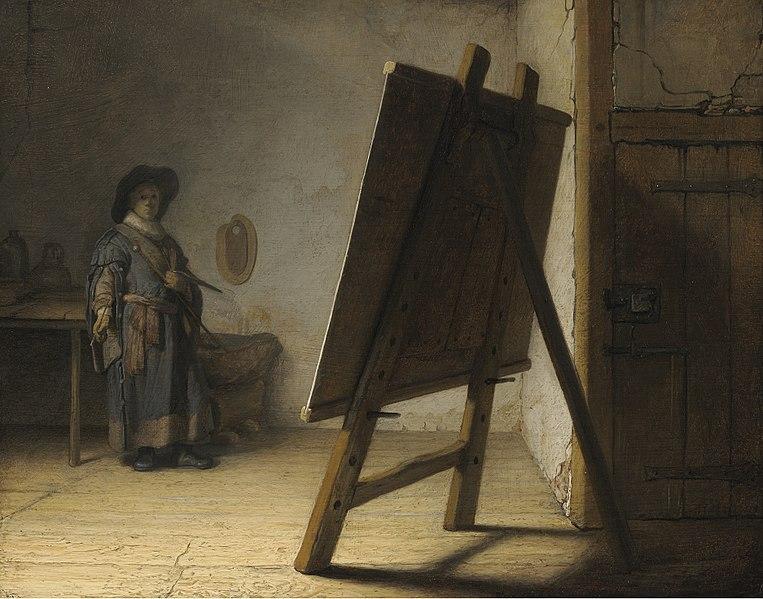
Figure 5.2 One of the many self-portraits of the Dutch master Rembrandt, the most prominent painter associated with the golden age of Dutch culture in the seventeenth century. Credit: Rembrandt Painting in Public Domain
Britain and the Transatlantic Slave Trade
Of the other European states, the British were the most successful at imitating the Dutch. In 1667 the British king Charles II officially designated the royal treasury as the coordinating body of British state finances and made sure that officials trained in the Dutch style of political economy ran it. The British parliament grew increasingly savvy with financial issues as well, with numerous debates emerging about the best and most profitable use of state funds.
In 1651, both to try to seize trade from the Dutch and to fend off Britain’s traditional enemies, France and Spain, parliament passed the English Navigation Acts, which reserved commerce with English colonies to English ships. This, in turn, led to extensive piracy and conflict between the powers of Europe in their colonial territories as they tried to seize profitable lands and enforce their respective monopolies. Ultimately, the British fought three wars with the Dutch, defeating them each time and, among other things, seizing the Dutch port of New Amsterdam in North America (which the English promptly renamed New York). Britain also fought Spain in both the seventeenth and eighteenth centuries, ultimately acquiring Jamaica and Florida as colonies.
In terms of trade, the major prize, at least initially, was the Caribbean, due to its suitability for growing sugar. Sugar quickly became the colonial product, hugely valuable in Europe and possible to cultivate in the subtropical climate (in contrast to exotic products like spices, which were only available from Asian sources). In Europe, sugar consumption doubled every 25 years during this period, and it was ultimately the profits of sugar that helped bankroll the British growth in power in the seventeenth and eighteenth centuries. The only efficient way to grow sugar was through proto-industrialized plantations with rendering facilities built to extract the raw sugar from sugar cane. That, in turn, required an enormous amount of back-breaking, dangerous labor. Most enslaved Indigenous American quickly died off or escaped and hence the Transatlantic Slave Trade between Africa and the New World began in earnest by the early sixteenth century.
The Transatlantic Slave Trade
The Transatlantic Slave Trade was the single largest sustained trade in enslaved human beings in human history, with approximately 13 million people enslaved in Africa (almost exclusively in West Africa south of the Sahara) and transported across the Atlantic to the Americas. The trade began in the early 1500s and continued through the 1700s, coming to an end in the first half of the 1800s thanks to legal bans on slave trading enforced by the British navy. As of the 1820s, three Africans had crossed the Atlantic to the Americas for every one European, fundamentally shaping the demographic makeup of the American continents and leaving lasting social and cultural legacies to the present.
The foundation of the Transatlantic Slave Trade was economic in nature. After the European conquests of American territories began with the Spanish invasions of the late fifteenth and early sixteenth centuries, hugely profitable natural resources became available to European states and private merchants. The Americas were replete with precious metals, crops, and arable lands that could be used to produce commodities like tobacco, coffee, indigo, and (especially) sugar. There was, however, an enormous labor shortage that impeded the ability of Europeans to extract and/or cultivate those resources. Thanks to the demographic impact of the Great Dying and the violence of European conquest, the Indigenous American population declined precipitously in the first century of European colonization. Small numbers of indentured European laborers crossed the Atlantic, but never in numbers sufficient to fully access American resources. Thus, slavery, an institution as old as civilization itself, became the perverse answer to the labor needs of European empires.
Of course, Europeans needed a source of slaves that could meet this labor demand. Coincidentally, the same oceanic voyages that set the stage for Columbus to cross the Atlantic and stumble across the Bahamas in 1492 also made the Transatlantic Slave Trade itself possible. By the mid-1400s, Europeans had discovered the system of currents and wind patterns that were to define sail-based navigation in the Atlantic. Europeans could sail down the coast of West Africa, then head west across the Atlantic Ocean. After arriving in the Americas, vessels could sail north to reach the Gulf Stream current that heads west to east across the northern part of the Atlantic, bringing the ships back to Europe. Ongoing trans-continental trade was thus possible.
Meanwhile, slavery was already integral to West African societies. For centuries, West African kingdoms and empires regularly warred against one another in part to capture slaves. Enslaved captives were an important part of the regional economy, and there was no philosophical or religious objection to slavery as an institution present in any West African societies that we know of. The difference between this form of slavery and the Transatlantic trade that followed, however, was in both scale and type: the Transatlantic Slave Trade created an endless demand for newly-enslaved peoples, and the forms of both enslavement and slave labor forced upon Africans sold to Europeans (as opposed to Africans sold to other Africans) were far more brutal. The Transatlantic trade increased in volume from century to century, reaching its peak in the 1700s, and as a result the entire economic and demographic setting of West Africa was fundamentally altered.
To emphasize the point: on the supply side, Africans were enslaved and sold to Europeans by African slave raiders and regular governments. Europeans would have enslaved Africans directly if they could have, but they could not: West African states were militarily powerful and the few abortive attempts of Europeans to establish control over African territories resolutely failed (with the limited exception of the small Portuguese trading settlement of Angola). African states did not normally enslave their own people, instead capturing enemies in times of war or authorizing slave raiders who targeted rival states, but to Europeans it made no difference where a given enslaved person was from; thus, in the eyes of Europeans all enslaved Africans were of the same “race” (a concept that emerged from the slave trade itself) rather than recognizing the diversity of the states and societies of West Africa.
The destination for the majority of enslaved Africans—roughly 90%—was either the Caribbean or Brazil, tropical regions that were ideal for the cultivation of the most lucrative commodities exploited by European merchants. The Transatlantic Slave Trade was relatively small-scale in the sixteenth century, but already the basic pattern that would see its future growth was established: commodity crops like tobacco and sugar were grown on large plantations, with the cultivators consisting of enslaved West Africans. Approximately 40% of enslaved Africans were transported to Brazil, and most of the others were sent to the Caribbean, both because of the enormous profits involved (the only present-day comparison to sugar during this era is the narcotics trade) and because the labor process of extracting sugar was so brutal that most enslaved people died within five years of arrival. Thus, thousands more were captured and sold every year to keep up with the growing demand for replacements.
The voyage across the Atlantic between West Africa and the Americas is remembered as the “Middle Passage” because it was the central leg of the three-part triangular trade that linked Europe, Africa and the Americas. It was horrendous, with enslaved Africans packed in the cargo holds of ships with no room to move in the stifling heat. Between disease, exhaustion, and abuse, at least 10% of enslaved people died on the Middle Passage before ever reaching the Americas. There are also documented cases of shipowners simply murdering their “cargos” of human beings by forcing them overboard in order to collect insurance payments.
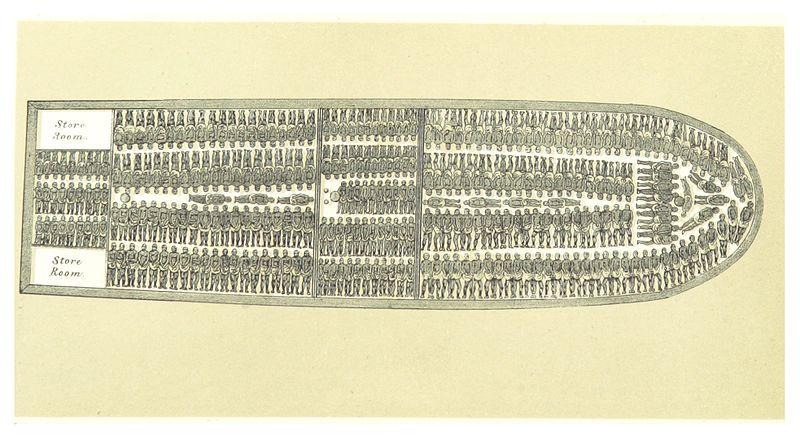
Figure 5.3 Illustration of a slave ship’s human cargo under conditions that often saw more than 10% of the enslaved individuals on board perish. Credit: Triangle Trade by SimonP
This system is also often called the triangle trade. Enslaved Africans were transported to the Americas, where they produced commodities. Those commodities were normally shipped back to Europe to be manufactured into finished goods or consumed (as with sugar). Manufactured goods, not least huge quantities of weapons, were then shipped to Africa to pay for more slaves. While African states grew extremely wealthy from the slave trade they were also unable to resist being part of it—even as some African kings and emperors complained about unauthorized slave raids in their territories, the financial incentive (and the threat of neighboring states) was so high that they remained part of it.
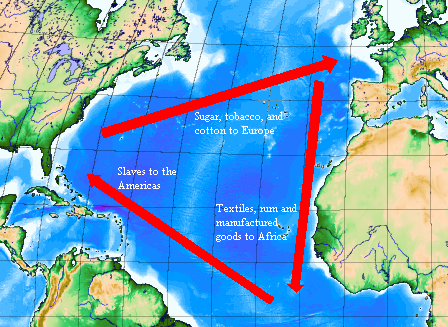
Figure 5.4 The “triangle trade” led to tremendous profits in Europe, horrendous human suffering, and the eventual depopulation of much of West Africa over the centuries. Credit: Slave Ship in Public Domain
The result was a long-term demographic drain on the entire region of Africa south of the Sahara from the border with the desert in the north to the Kongo region in the south, reaching inland roughly 200 miles from the coast. Young men were particularly targeted by slave raiders, followed by young women, meaning millions of people who would have raised families in their homelands were taken from them by force. Portuguese slave merchants (and agents of the Portuguese government) carried out a census in their small trading depot in Angola in 1777 – 1778 that determined that there were 43 adult men for every 100 adult women, a stark demonstration of the effects of the trade. It is impossible to determine how badly regional productivity and population levels were affected overall, but it was certainly devastating, above and beyond the immense human suffering involved.
One final point about the nature of the Transatlantic Slave Trade should be emphasized: at its very heart lay the profit motive. Europeans did not start the slave trade with pre-existing ideas of race and racism that saw them set out to enslave Africans. They started with a powerful desire to economically exploit their new American territories, and enslaved Africans (for the reasons explained above) were the most convenient source of labor. Likewise, the African political elites and slave traders who sold other Africans to Europeans were motivated by a comparable desire for profit. Needless to say, they did not harbor racist ideas about their fellow West Africans; enslaved people simply happened to be an incredibly lucrative source of revenue. The whole perverse legacy of the concept of race was a pernicious byproduct of this equally destructive trade in human beings, not its starting point.
Around the Globe
Even as the British were actively participating in the slave trade in the Atlantic region, they began the process of seizing control of territory in India as well. There, they set up self-contained merchant colonies (called factories) run by the English East India Company (EIC), which had a legal monopoly of trade just as its Dutch counterpart did in the Netherlands. The original impetus behind the EIC was profitable trade, not political power per se.
While Britain eventually came to control India outright, as of the mid-eighteenth century, British power in India was limited to its factories, which served as clearinghouses for trade with Indian merchants. In 1756, however, an Indian prince sent an army to Kolkata (Calcutta) to drive out the British, whom he hated and resented, resulting in the massacre of hundreds of English noncombatants and thousands of their Indian colleagues and allies. The next year, a small British force of 800 men with 2,000 Indian mercenary troops (called sepoys) defeated the prince at the Battle of Plassey, then began the process of taking over the entire province of Bengal.
The takeover of Bengal started the slow creep of British power: tax revenue supplemented mercantile revenue, which allowed the British to hire tens of thousands of sepoys, who they armed with modern European weapons. That, in turn, both allowed the British to drive out the French from Indian territories and to dominate Indian princes, thereby seizing yet more Indian territory. In this patchwork fashion, the EIC expanded its power in India over the next century, directly controlling some territories, indirectly controlling others through Indian puppet princes, and economically dominating others. The result was that the EIC, a private corporation backed by the British state, controlled almost all of the Indian subcontinent by the middle of the nineteenth century.
On the other side of the world, while far less economically important than the Caribbean, North America was still a focus of European colonization. Britain was one of the two major powers—France the other—that colonized areas of the eastern seaboard of North America. While initial attempts at colonization either failed or struggled to survive (e.g. almost all of the original settlers at Jamestown in Virginia were dead by the time more arrived in 1610), the survivors discovered that they could at least grow one cash crop that would both enrich themselves and tempt other Europeans to immigrate: tobacco. Likewise, a relatively small part of the slave trade soon included the importation of the enslaved to work first the tobacco fields, and then later further south, cotton fields. Simultaneously, a French explorer named Samuel de Champlain founded the colony of Quebec on the St. Lawrence river. That soon became the center of New France, and its cash “crop” consisted of furs gained through barter with Indigenous American groups or taken by French trappers.
Until the latter half of the seventeenth century, these were small-scale colonies compared to the vast states of Central and South America. Slowly but surely, however, colonists did arrive in North America, and not always for economic reasons. Britain came to boast the largest population of colonists among Europeans in North America in the seventeenth century because English religious dissenters, Puritans, began to settle in Massachusetts by the thousands in the 1620s (this was during the period under James I and Charles I before the English Civil War). That said, the North American colonies all remained small and economically unimportant compared to the colonies of Latin America and the Caribbean until well into the eighteenth century.
Meanwhile, the overseas empire of Portugal steadily shrank as its colonies and factories were seized or handed over to the Dutch and British in the seventeenth century. While Portugal had enjoyed a (relatively brief) period of ascendancy that began with the remarkable voyage of Vasco Da Gama in the fifteenth century, it was not able to compete with the better-funded and equipped forces of the Netherlands and Britain, and thus most Portuguese colonies and trading posts were lost over time to its rivals. The major exception was Brazil, which was hugely profitable, and which imported staggering quantities of the enslaved (Brazil was also the last European state to outlaw slavery, in 1888).
Finally, while Russia’s emergence as an independent state is considered in a later chapter, it should be noted here that Russian explorers moved eastward across Siberia from the period of the fifteenth through the eighteenth centuries in search of furs. Furs were so critical to the Russian economy at the time that they were often used in lieu of currency outside of the major cities. In turn, Russian fur trappers and traders arrived at the Pacific in the late seventeenth century. From there, they sailed across to Alaska and then down the west coast of North America, establishing small churches and forts but not colonizing territory (i.e. for the most part, they did not stay and establish families). By the early eighteenth century, the various branches of European exploration and expansion converged in the Pacific Northwest of what later became the United States: in the eighteenth century, Russian fur trappers, French fur trappers, Spanish missionaries, and English explorers all arrived in what eventually became the American states of Washington and Oregon.
The Spanish Empire
The incredible success of the British in establishing what ultimately became the largest (noncontiguous) empire in world history in the nineteenth century has sometimes overshadowed what was the largest empire in the centuries before: the Spanish Empire. The phrase “the sun never sets on the British Empire” is well remembered, but in fact the phrase was first applied to the Spanish Empire, since its territories stretched quite literally from one side of the globe to the other.
The Spanish Empire included almost all of South America, all of Central America, and the American West as far north as what eventually became the American state of Oregon. In addition, Spain held territory in the Pacific island chain of the Philippines (named after the Spanish King Philip II) as well. South American silver passed through both Spain and the Philippines en route to China, where it paid for luxury goods that were shipped back to Spain. The Spanish crown, especially under a branch of the Bourbon royal family that became the royal dynasty of Spain in 1700, exercised direct control over colonial trade and taxation (rather than relying on a corporation as did the Dutch and English).
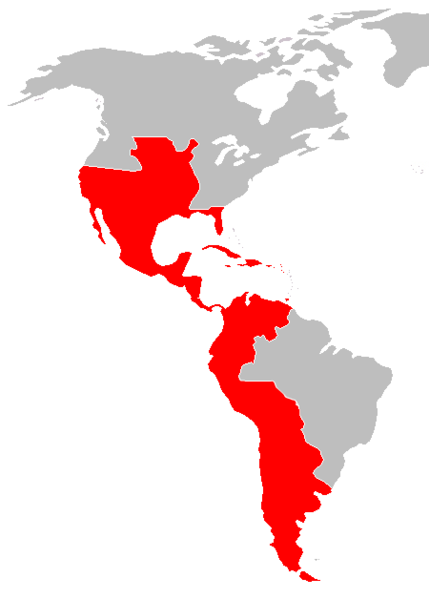
Figure 5.5 Spanish territories in the Americas in the eighteenth century, at the height of their territorial expanse. Credit: Spanish Americas by Luis Wiki
The Philippines represented the crucial link between Spain, the Americas, and the vast wealth of East and Southeast Asia. In a striking parallel to the Spanish conquest of the Aztec and Inca empires of the Americas, the takeover of the Philippines was as much a matter of alliances and settlement as actual invasion. Between 1564 – 1571 a few hundred Spanish soldiers allied with groups from the northern Filipino islands of the Visayas, especially the Kingdom of Tondo, and created the Spanish settlement of Manila. The Mexican city of Acapulco served as the American side of the trade connected with Manila, which in turn oversaw the crucial silver exports to China. For several generations most of the Spanish soldiers, sailors, and merchants stationed in Manila were in fact Black, mestizo, or Indigenous Americans who set out from Acapulco to take part in the trade (and hopefully get rich in the process). Over time, Spain did establish actual political control over much of the territory of the Philippines, but that was a long process that relied as much on shrewd alliances with Filipino kingdoms and peoples as it did Spanish military victories.
Strangely, despite the wealth of the Spanish Empire, the Spanish crown struggled to remain solvent. Spain engaged in nearly constant warfare against other European powers over the course of the latter sixteenth and first half of the seventeenth centuries, draining its coffers and achieving no noteworthy military achievements. The sheer quantity of American silver led to significant inflation, undermining its value, as did the rise and fall in the value of silver in the Chinese currency market. Likewise, in the seventeenth century as the Dutch and English began carving out their respective trade empires, it was often at the expense of Spain and Portugal, leaving the core territories of the Spanish Empire intact but Spain itself trailing behind the Netherlands and Britain in terms of power and influence in Europe.
Despite the (ironic) weakness of the Spanish crown, and the failure of attempted reforms in the eighteenth century to more closely supervise the imperial economy, much of the empire enjoyed considerable prosperity and a higher quality of life than did many other global regions. In the late eighteenth century, a Prussian (northern German) nobleman named Alexander von Humboldt traveled across Mexico and carried out a series of studies and observations trying to compare and contrast life in the American territories and life back in his native Prussia. He concluded that even poor Mexican farmers enjoyed a higher quality of life, measured in the amount and quality of food they ate, the difficulty of their work, and the income they had available, than did peasants in northern Europe. It is thus important to consider the fact that political weakness—in this case the relative weakness and lack of direct control of the Spanish state—did not always translate into a poor quality of life for regular people.
Conclusion
The greatest changes in world history during the early modern period have to do with the ongoing contact between the different regions of the globe that began with Columbus’s (quite literally) misguided voyage in 1492. By the seventeenth century, the peoples of Africa, the Americas, Europe, and Asia were all linked by commerce, trade, politics, slavery, and warfare. As those contacts grew stronger going into the modern period so too did the dominance of Europe.



_p038_A_SLAVE_SHIP.jpg)
